Memo: Fast, Faster, Fastest Fashion

Fast: H&M. Faster: Zara. Fastest: Shein. It’s a progression that has changed consumerism, accelerated textile production, and hurt the economy while doing so. Zara disrupted H&M and then Shein unseated them both. Now, H&M has gone on the offensive in an effort to regain the advantage it once had.

The hope is to regain the millions of consumers who’ve gone the way of Zara and Shein. It all comes down to the x and y axes of two competing ideas: economics and environmental impact.

There are consequences to fast-fashion and athleisure; plastics weren’t intended to be worn and discarded with impunity.

The chatter around the future of fashion is one of pure contradiction: a young generation of shoppers say they want to preserve the environment. Juxtapose this ideal atop of what they actually buy and you’ll find that there are cracks in their collective “save the planet” philosophy. Gen Z is often referred to as the most sustainably conscious, environmentally-minded consumer segment. They’re also fuelling the rise of Shein, the biggest fast fashion company in history. Zara and H&M were small retailers in comparison. A 2021 Harvard Business School case study explained how Inditex, the parent company of Zara, innovated around supply chain efficiency to produce faster products that were more in-line with trends.

Zara was the Group’s oldest and largest brand, representing around 69% of sales, or €18 billion in 2018. At the core of Zara’s success was an innovative business model based on a very responsive supply chain and quick merchandise turnaround. Zara designed, produced and delivered new items to stores in less than three weeks, allowing it to constantly update its collections and adapt to changing customer tastes.

Just two years after this case was written, Zara is now looking upwards at an infant brand: Shein is Zara on steroids. And Gen Z loves it. Shein has become a favorite on TikTok, where users share hauls from the brand of $15 dresses, $10 shorts and $5 tops. The clothes are cheap and trendy, designed for one-time wears posted on social media and discarded. The concept is not new but with the trend toward sustainability, it was supposed to be going out of style. Instead, the idea is more powerful.
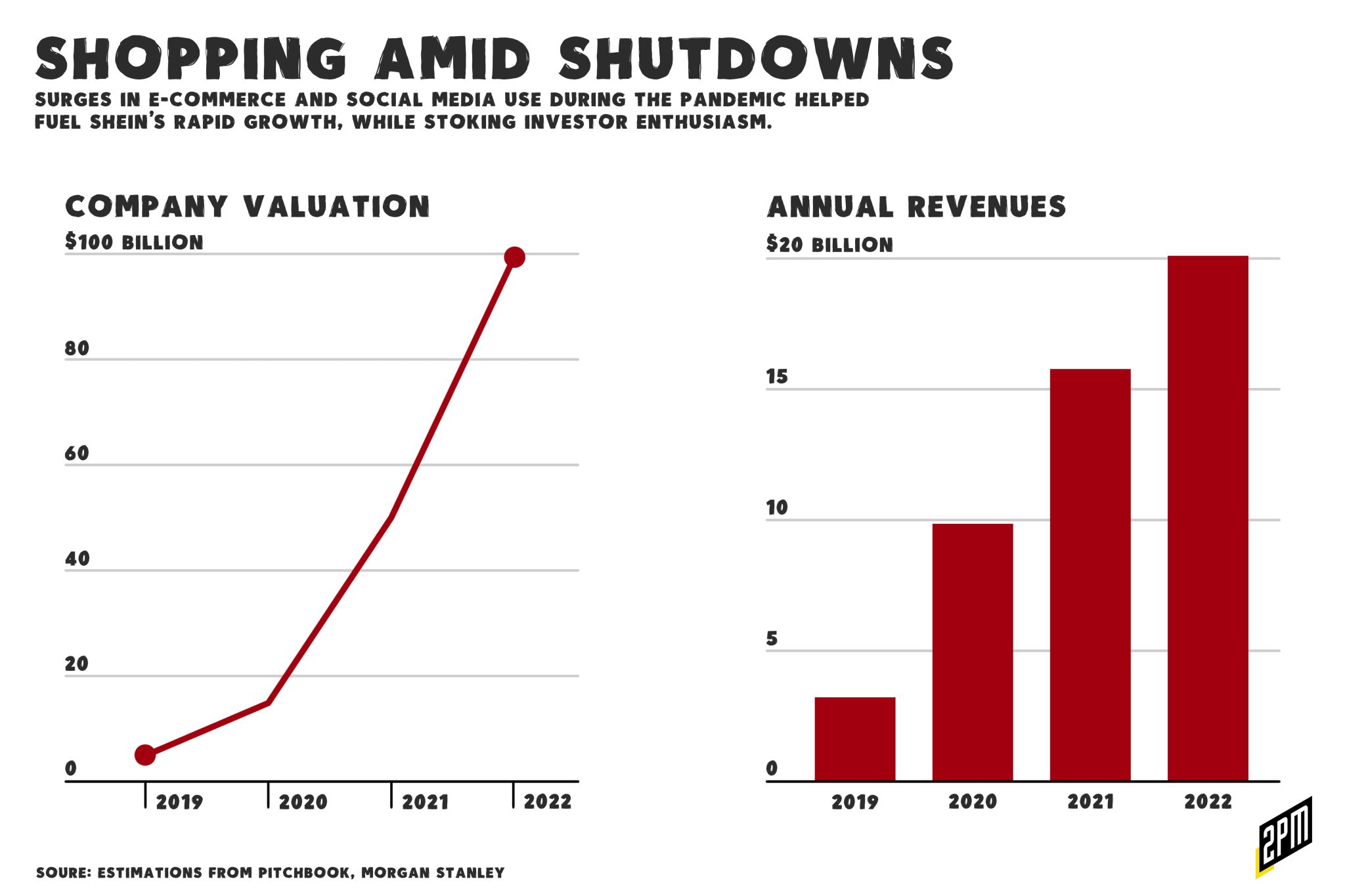
Shein’s scale is difficult to grasp. The operation is more secretive than most but what is evident is that we are more aware than ever of the consequences. There are very tangible negatives to fast-fashion and athleisure; plastics weren’t intended to be worn and discarded with impunity. Fortune wrote a deep-dive on Shein on May 31, laying bear the narrative:

Global investors, for whom it is increasingly fashionable to champion high standards on environmental, social, and governance (ESG) matters, are similarly smitten. They have pumped Shein’s valuation up to $100 billion, making it the world’s third most valuable startup behind ByteDance, the Chinese parent of TikTok, and Elon Musk’s SpaceX. Shein is now worth more than H&M and Inditex, Zara’s parent company, combined, according to Bloomberg.

But while Shein’s innovative business model might lower prices for consumers, watchdogs grumble that Shein has built its clothing empire on the back of cheap labor, knockoff goods, and A.I.-driven design software that encourages consumers to ditch old outfits at rates that are bad for the planet. Those complaints, along with a recent e-commerce slowdown, make the company’s continued dominance far from certain.

Fortune’s position that, in so many words: “Shein’s impact on the environment will eventually lead to its undoing” is faulty at best. Why? There is a cognitive dissonance in fast fashion’s target market. Can one save the planet while buying $13 dresses for Instagram? So far, fast fashion companies have only lost dominance when they’ve been replaced by faster companies that can regurgitate trends at lower prices. Whether Shein’s nefarious practices are lost on customers or willfully ignored doesn’t ultimately matter. Customers who are drawn to clothing because of their affordable price are typically not the same ones who will stop to ask why a piece of clothing costs so little. What does matter is the bottom-line evidence that faced with cheap options, young consumers will shop for fast fashion.

At play behind the rise of Shein is a combination of factors. Social media has accelerated the trend cycles of fashion. Sustainable fashion is prohibitively expensive and the shifting tides of consumerism have, for many, determined that fashion is not an investment, at least not in terms of trends. Consumers are often held responsible for “voting with their dollars” when it comes to encouraging corporations to be more sustainable but this has never been completely true. Customers will buy what is easily and affordably available, particularly when they’re young.

Shein itself is a black box. Little is made public about how it sources and manufactures its clothing but the numbers and price tags speak for themselves. The company has started speaking up about – of all things – its sustainability efforts. Vogue calls this greenwashing:

Each week, a shocking 15 million garments arrive at Kantamanto Market from countries in the Global North, decimating the local textiles industry there.

It hired a global head of ESG and recently announced a $50 million fund that will go toward offsetting its environmental impact and handling its waste problem. That is a $50 million drop in the bucket that will barely undo a stitch of what Shein has unleashed on the market of TikTok, Snapchat, Instagram, and Kardashian loyalists. This week, it received praise for partnering with the OR Foundation, which it will give $15 million over three years in order to combat clothing waste in Accra, Ghana, where many discarded clothing ends up.

It’s nothing more than a diversion from the reality of the impact on landfills. Shein calling out waste and donating funds to bring attention to the cause may be perceived as disingenuous. Luckily for them, H&M is doing something similar, committing $250 million alongside Lululemon on behalf of the new organization that succeeded Aii:

“What we’re trying to demonstrate is that this is the center of gravity for all of climate work and everyone from Textile Exchange to Fashion for Good to many others — that are working in lowering carbon and coming up with solutions and getting them to pilot — are all beneficiaries of this,” he said. “This is a collective ‘we.’ This is not giving it to Aii, and it’s not going to go into other climate work. This is creating a central pooled fund whereby we all can begin to look at a more consolidated approach as opposed to fragmentation of project work that’s not talking to each other and duplicating efforts.”

What will solve fashion’s Shein problem is not donations, public relations, or acknowledgements of wrong-doing. The more fruitful solution will be social media trending away from fast fashion and towards sustainability. But there’s no relying on Gen Z customers to fix this problem. It is time to accept that no well meaning customer can stop the retail machine desired by millions, as new trends come along and TikTok broadcasts them for all to emulate.

By The 2PM Team

No. 274: Merch has become fashion

facebook-ad copy 4
Cofounders of Everybody.World

The word merch is synonymous with throwaway. Or at least it used to be. In 2PM’s leading story, Quartzy discusses the changing demographics that have influenced the types of products that luxury brands sell. Gone are the days when famed fashion houses like Gucci focus solely on traditional luxury fashion. Today, their products reflect an affinity for sweat pants, tennis shoes, and modern t-shirt patterns.

This has trickled on down to the merchandise industry. Younger millennials and Gen Z’ers wear merch as a fashion statement and luxury has adopted this burgeoning trend. For merch providers, this means that the American Apparel / LA Apparel aesthetic has given way to something new patterns, styles, and definitions of inclusivity.

2PM recently took a deep dive into the types of merchandising campaigns that are moving the concept of merch away from throwaway and towards luxury. In this archived brief, we explored everything from platforms used to preferred t-shirt patterns and blanks.

Member Brief No. 11: Mega Merch 101

Social media and the normalization of digitally vertical native brands have enabled artists and influencers to create online retail brands as a primary source of revenue. In this report, we will break down best practices – including some insights from our editor’s work with a certain Youtube creator.

Bain Capital released a 2017 report on global luxury that emphasized this shift driven by millennial consumers. Here is an important excerpt:


The Millennial State of Mind: Success in the next decade requires brands to refocus on their customers to better anticipate and cater to their needs. The younger generation will be key as millennials and Gen Z will represent 45 percent of the global personal luxury goods market by 2025. Still, when analysing behaviours, it is more correct to talk about a “millennial state of mind,” which is increasingly permeating across all generations and is thus more a psychographic phenomenon rather than a purely demographic one.

Read the rest here.


To summarize Bain Capital, the Gen Z interpretation of luxury fashion has permeated throughout the entire industry. This has affected consumer industry across footwear, accessories, and apparel. There are merch providers that are well-positioned here.

Business of Fashion’s wrote a recent feature on the two founders of Everybody.World. The write up did a masterful job of explaining how one merch provider built a direct-to-consumer brand that fueled their high growth wholesale business. By working with a curated selection that represents the zeitgeist. This includes: style contributors, graphic designers, a well-designed basics line, and the one staple that has become the go-to for festival merchandisers.

Quality, too, has become increasingly important as concert merch has evolved from souvenir to fashion statement, underscored by merch-like pieces released by luxury brands including Gucci, Balenciaga and Vetements. “The demand is absolutely higher than when I started doing this six years ago,” said Allen, who sourced roughly 70,000 pieces of merch for 2018’s Coachella Valley Music and Arts Festival. “And the expectations for the product itself are definitely higher.”

That’s why, this year, Allen looked beyond the typical “blank” T-shirt companies — think Gildan, Bella Canvas and Hanes — to boost Coachella’s offering.

Read more here (unlocked)

Cofounders Iris Alonzo and Carolina Crespo have done an extraordinary job of positioning the Everybody.World brand by building a strong direct-to-consumer business. Something that LA Apparel head Dov Charney is having problems with, this second time around. Due to the successes that they’ve had with wholesaling their famed ‘trash tee’ for $2.90/unit, wholesale traction has allowed the two founders to grow a substantial, higher-margin, direct-to-consumer business. Their main vehicle has been zeitgeist-driven basis and unexpected collaborations with contributors (even Virgil Abloh is listed on the site).

In Q2, merchandise drops have grown to become a major part of the creator narrative. Beyonce’s Coachella performance and her subsequent eCommerce drop was studied in Member Brief No. 11. And above, you’ll see high profile merchandise drops to include: Kanye West, Kid Cudi, and Nas.

As creators continue to emphasize merchandising as an extension of their art (and business), it’s imperative for providers to observe the shifts in the meaning of luxury and how Gen Z consumers have begun to shape the merchandise-turn-fashion industry. For the time being, tees are no longer a dress-down device. And it’s not just about what’s on the shirt, these days. Patterns and fit matter more than ever.

Blanks are no longer viewed as commodity products to a growing segment of American buyers. In fact, the industry is supplying a key component of Gen Z’s fashion identity. There are several providers that are well positioned to grow with the youngest of American consumers.

Read more of the issue here.

By Web Smith | About 2PM

Editor’s note: the next 2PM database (releasing 6/21) will include the most notable of merchandising providers to include Pittsburgh, Pennsylvania’s “Blank” run by Michelle Sharp. This will be a growing database. Join the executive membership for access. 

No. 272: A “Tier A” Path Forward

tierapathforward.jpg

The worst thing to happen to the American mall is the boom of online-first modern luxury companies. And it’s also the best thing to happen to the American mall.

There are 1,100+ malls in America and approximately 320 are graded Tier A. We have an oversupply of malls but that does not mean that traditional, anchored shopping centers no longer have a place in consumerism. We’d argue that Tier A malls have yet to see their best years. We expect their footfall traffic KPIs to grow, while B and C tiered malls continue their trends toward repurposed real estate and other methods to maintain footfall traffic KPIs (mall opportunity, sales opportunity, and store performance).

Suzanne Mulvee, director of research at CoStar, cites that “lower-quality malls in markets with smaller populations and lower incomes will continue to close” —a trend that persists today. And here’s a data based position:

Green Street Advisors, a research firm, forecast a 6.0 percent drop in market revenue per available foot (RevPaF) for class-B and -C malls from 2018 to 2022, versus a 0.5 percent increase for class-A malls during the same period. 

Private market values of class-B and -C malls have also dropped the most since January 2017, according to Green Street, plunging 27.0 percent and 25.0 percent, respectively, year-over-year. Meanwhile, the values of class-A malls declined by 14.0 percent year-over-year.

National Real Estate Investor

So what does this mean for digitally vertical native brands (DNVB), old and new? In short, online-first brands should be positioning their product offering for inclusion in Tier A malls. First, let’s look at the established. A retail presence for DNVBs varies, as such:

  • Harry’s has a prominent position in J. Crew shops (Tier A)
  • Shinola has marquee positioning as stand alone stores (Tier A)
  • Mizzen + Main has prominent position at Nordstrom (Tier A)
  • Bevel has showroom real estate at Macys (Tier A / B)
  • Warby Parker has great stand alone stores (Tier A)
  • Greats has marquee positioning at Nordstrom (Tier A)
  • Ministry of Supply has great stand alone stores in Tier A areas
  • Homage has great stand alone stores (Tier A)
  • Bonobos has stand alone stores and Nordstrom positioning (Tier A)
  • MeUndies has positioning at Nordstrom (Tier A)
  • Goop is opening sponsored pop ups (Tier A)

There are very few presences in Tier B malls and virtually no DNVB presence in Tier C malls. These brands have done a wonderful job positioning themselves as modern luxury companies. They’ve been incubated online for five to ten years and they’ve become prominent enough to live as lifestyle brands in traditional retail spaces. It’s a forgone conclusion that omni-channel operations should be a focus for DNVBs; retail real estate analysis is a skill that is becoming more and more important. And DNVB’s are well-positioned to benefit from the Tier A adoption of the online brands. Recall this quote from Issue No. 265:


2PM’s Meghan Terwilliger had this to say:

Luxury, however you define it, is a brand’s embodiment of characteristics that make it desirable. Historically, those characteristics have been more ‘What’ features like quality, exclusivity, and cost. You can still define luxury as characteristics that make a brand desirable, but those characteristics have shifted. Quality is table stakes.

The characteristics that make brands more desirable are ‘how’ features like excellent customer experience (how do I experience the brand), meaningful brand mission (how do they give back/make a difference), and community engagement. Is it artist-created and excessively expensive? Maybe not. But if it is a product, or even an entire experience that is highly desirable, it can be considered a luxurious brand. DNVBs just so happen to possess a great infrastructure to support the characteristics that define modern luxury.


There are DNVBs that are launching daily. It is important that these brands understand that online retail mechanics has its limits. For these brands to expand into $30 million or more in annual revenue, omni-channel strategy can provide longterm growth. Additionally, this can reinvigorate top funnel sales through online channels.

Here are the top five suggestions for DNVBs launching today:

  • Master the first product. Bonobos began with pants, Mizzen + Main with a single white dress shirt, and Bevel with one blade.
  • Develop a strong sense of product ambassadorship. Mizzen + Main targets millennials, but the most capable buyers are between the age of 34-45. Developing a sense of loyalty with them can pay dividends. For their peers that don’t shop online, they’ll become a top funnel driver of them to your brick and mortar locations.
  • Avoid discount promotion, even at the beginning. Price stability over time is crucial. The moment that a brand is seen as a discounter, the Tier A mall demographic loses interest (with few exceptions).
  • Emphasize advertising to Tier A mall consumers. When DNVB’s grow online, they need to focus on the customers that possess the greatest LTV (lifetime value) potential. This correlates with Tier A mall shoppers.
  • Establish relationships with non-competitive retailers. It can be a powerful signal of longterm viability when existing brands co-sign your early product. This is most often seen by way of product collaborations, cross-promotion, or merchandising your products in their flagship stores.

Retailers that appeal to…the upper class are thriving. One look at Houston’s Galleria, Columbus’ Easton Town Center, or Miami’s Bal Harbour Shops will confirm as such. This is the future that many in retail are planning for. So no, retail is not dead. But retail is leaving the middle class behind because, frankly, so are we.

2PM Member Brief No. 5

In the first sentence, I wrote that online retail is the best and worst thing to happen to malls. In many ways, this is true. The shuttering of weaker retailers and shopping centers is long overdue. Experts attribute this trend to the emergence of online retail brands (and the excessive private equity debt that these retailers accrued to compete with them).

We have more retail real estate than any developed country on earth. Malls are not dying, the bad ones are. While eCommerce efficiency is appealing to digital marketers, the brick and mortar channel is golden for brand operatives who are establishing their brands as modern luxury products. Marketing is arithmetic, whereas brand-building is more of a subjective art. If you were to ask the chief executives at each of the aforementioned brands, they would point to their brick and mortar successes as great milestones. There will be fewer malls in the coming the years, but an early bet on the ones that remain will position young DNVBs for omni-channel success.

Read the rest of the issue.

By Web Smith and Meghan Terwilliger | About 2PM