Memo: How Sanzo Won Marvel

A generation of young consumers deserve the credit for its role in how brands think about partnerships and messaging.

For today’s retailers, authentic engagement and depth can matter as much as reach when it comes to partnerships. This has become common practice in the world of modern brands and niche media outlets. But something bigger is taking shape. If there ever was a “trickle up” effect, this essay will serve as an example. One of the largest and most powerful media conglomerates in the world chose sincerity over cash, reach, and distribution.

Long gone are the days of no-brainer deals with Pepsi, Coca-Cola, and Nike. Today’s public figures are setting aside their reliance on major brands in favor of partnerships that are more true to themselves. Authenticity is at the center of this shift, and it’s opening wide doors for nascent brands to compete against their elder statesmen. In a recent essay on OLIPOP’s partnership with Olympian Gabrielle Thomas, 2PM highlighted this changing sentiment around brand partnership:

In speaking with the agency for this report, they emphasized how important Thomas’s ideals were to her product sponsorship selections. The partnership between OLIPOP and Thomas was a natural fit as it is reported that she was already an organic fan of the brand. [1]

Now, that’s trickling up to film studios, sports leagues, streaming networks, and music festivals, which all seem to be following the same wave of authenticity. Over the previous year, digitally native retailers have done a remarkable job of positioning themselves for these opportunities.

In the past year, Rowing Blazers partnered with dormant English retailer Warm & Wonderful to produce the Princess Diana jumpers as Netflix’s The Crown wowed viewers with an inspired depiction of the late humanitarian. Kim Kardashian’s influence and business acumen helped land Skims as the official underwear partner to the U.S. Olympic Commission’s athletes. Madhappy partnered with Lebron James’s remake of Space Jam, producing hoodies and crew neck sweaters that are now sold on the secondary market for $450 or more. And hot sauce CPG brand Truff’s partnership with one Taco Bell location in Southern California has permeated social media conversations well beyond the border.

While each of these are notable, none accomplished what Sanzo has so early in the company’s lifespan. A recent report by BEVNET began: “Though it may not be a household name, when it comes to marketing partnerships Sanzo is punching above its weight.” The praise was deserved. Founded in 2019 by Sandro Roco, a Queens-born Filipino American, the brand is one of the latest entrants into the white-hot “fizzy water” market. The cap table includes the likes of Away’s Jen Rubio, Adobe’s Scott Belsky, and as of recently Simu Liu, the star of Marvel’s Shang-Chi and The Legend of The Ten Rings. More on that last investor in a moment.

The Sanzo brand is emerging during a dynamic period for Asian Americans and Pacific Islanders. Its two years in existence have been wrought with senseless and indiscriminate violence towards Americans of Asian descent. The angry rhetoric and exclusion birthed such hashtags as #StopAsianHate, a tag that you will find spread by a handful of the most powerful investors and businesspeople including Jeremy Liew, Partner at Lightspeed Venture Partners.

The former executive at Bombfell and J.P. Morgan trader, Sandro Roco took a grassroots and hard-nosed approach to building Sanzo. In the beginning, you would find him hauling cases down the street, hoping to sample his way to omnichannel adoption by today’s most important retailers. It worked. While Asian Americans were being indiscriminately targeted in some of America’s biggest cities, Roco was positive and hopeful in his persistence to break through in an intensifying market. That often meant him doing the work at the street level with a dolly and cases of product. Take a moment to empathize with Roco’s cognitive load as scores of citizen-captured videos flooded social media by the day. He really wanted Sanzo to breakthrough the noise. And he found a way to do just that.

At the same time that indiscriminate violence was on the rise, the ‘easternizing’ of American culture accelerated. More commercial opportunities, once afforded almost exclusively to guys named Brad, were now afforded to actors, actresses, musicians, artists, and entrepreneurs of AAPI descent. This Roco quote from a recent Forbes article announcing Sanzo’s latest funding does a solid job of summarizing Sanzo’s appeal and the wave that may help it compete against larger, well-funded, and better equipped CPG conglomerates.

Back in mid-2018, we started to see what I describe as ‘easternizing’ of American culture with Crazy Rich Asians becoming the number-one film in the box office and K-pop getting a fever pitch. [2]

One of the national efforts to combat implicit and explicit bias towards AAPI citizens was the launch of Gold House. Founded in 2019, it was built to help Asian founders “overcome societal stereotypes” while elevating their work beyond what was customarily deemed their target market. Sandro credits Gold House for helping the Sanzo brand forge a relationship with Walt Disney Corporation, one that would later manifest into the Marvel Studios project. In a May 2021 NBC News report on the organization:

The nonprofit Gold House is best known for elevating films like Parasite and Crazy Rich Asians into epic blockbusters. But true representation of Asians isn’t just necessary in Hollywood; the organization is determined to see it in every industry, in every C-suite. [3]

The next big opportunity for Gold House was March 2021’s Raya and The Last Dragon, an animated feature by Disney Studios featuring Kelly Marie Tran, Sandra Oh, Gemma Chan, Daniel Dae Kim, and Awkwafina. The film grossed $122.7 million in the box office while simultaneously released on Disney+. Roco’s Sanzo brand was used as cross-promotion for the Disney picture and according to Roco, it was a profitable venture. He noted Disney’s positive role in partnering with an “unknown” for the project. Roco told 2PM:

It’s impossible to do anything in eight weeks with Disney. But they recognized that we are not Coca-Cola or General Mills. Together, we made it work.

He applauded his team’s hard work and diligence to make the latest partnership come alive. After the completion of the Raya partnership, Roco “shot his shot” and pitched a Shang-Chi collaboration. The green light came almost immediately. In the Sanzo founder’s conversation with BEVNET’s Martin Caballero, he added:

We’ve seen firsthand that both the Marvel and the Disney executive team have taken a more intentional approach to partner with brands that more authentically represent the messages of the films they are putting out there. They noted to us that the strength of our brand and the community that we bring in gives a certain level of authenticity.

In August, that green light became green money. Shang-Chi is one of Marvel Studios’ most highly-anticipated films as of late. Analysts predict that it has the potential to outperform Black Widow, despite the latter film’s star power of actress Scarlett Johansson in the starring role. Shang-Chi features rising stars Simu Liu, Awkwafina, Tony Leung Chiu-wai, and Fala Chen. The well-reviewed film pairs a relevant theme with a new slate of heroes and action formats that are new to the Marvel Cinematic Universe. The commentary around the film is not entirely new.

While smart merchandising partnerships like Sanzo’s deal are a highlight for the film, some argue that Marvel is not properly promoting the film due to the age-old idea that it may not resonate with a larger audience – a euphemism for white audiences. Though Disney was proven wrong by the global reception ($1.3 billion grossed) to Black Panther, this burden remains for AAPI actors to retread the same territory. In my many conversations with Sandro Roco, he cites the hidden market opportunity for products like Sanzo. He notes that Asians and their taste preferences represent over 60% of the world’s population. What Disney and Marvel Studios view as niche isn’t at all. In this way, Sanzo and Shang-Chi are running in parallel.

When the founder and his film-customized cans showed up for the red carpet debut of the film, he was welcomed with open arms by Shang-Chi‘s slate of stars. Gold House was right: there seemed to be an authentic appreciation for Sanzo’s story of resilience and comeuppance (the brand is now in Central Market, Whole Foods, Erewhon, and other retailers). There waiting for Sandro on the red carpet was Simu Liu, who became an investor in the brand after the deal was negotiated in April of 2021. The stuntman and movie star recently dominated social media conversations with Marvel’s release of one of the film’s fight scenes, an homage to Jackie Chan’s inventive use of his surroundings as weaponry.

Over just two years, Sandro Roco and his team have worked tirelessly to gain approval from an industry that is cold to outsiders. Now that the founder has momentum, a few key partnerships, and a superhero on his team, his fight to the top may be a little easier.

Sanzo has reported a sixfold increase in daily DTC sales and conversations that will surely lead to greater omnichannel opportunities. But before Sanzo won over merchandisers and national distribution, the brand won over Disney and Marvel. Other digitally-native retailers should take note of this momentous year in extraordinary partnerships.

By Web Smith | Editor: Hilary Milnes | Art by Alex Remy  

Disclosure: Sanzo and Rowing Blazers are 2PM investments. Sadly, Madhappy isn’t. 

Member Exclusive: Studying The Fast Cinematic Universe

We’ve never seen anything quite like the Fast Cinematic Universe in all of entertainment history.

This member brief is designed exclusively for Executive Members, to make membership easy, you can click below and gain access to hundreds of reports, our DTC Power List, and other tools to help you make high level decisions.

Join Here

Memo: The Netflix Playbook 2.0

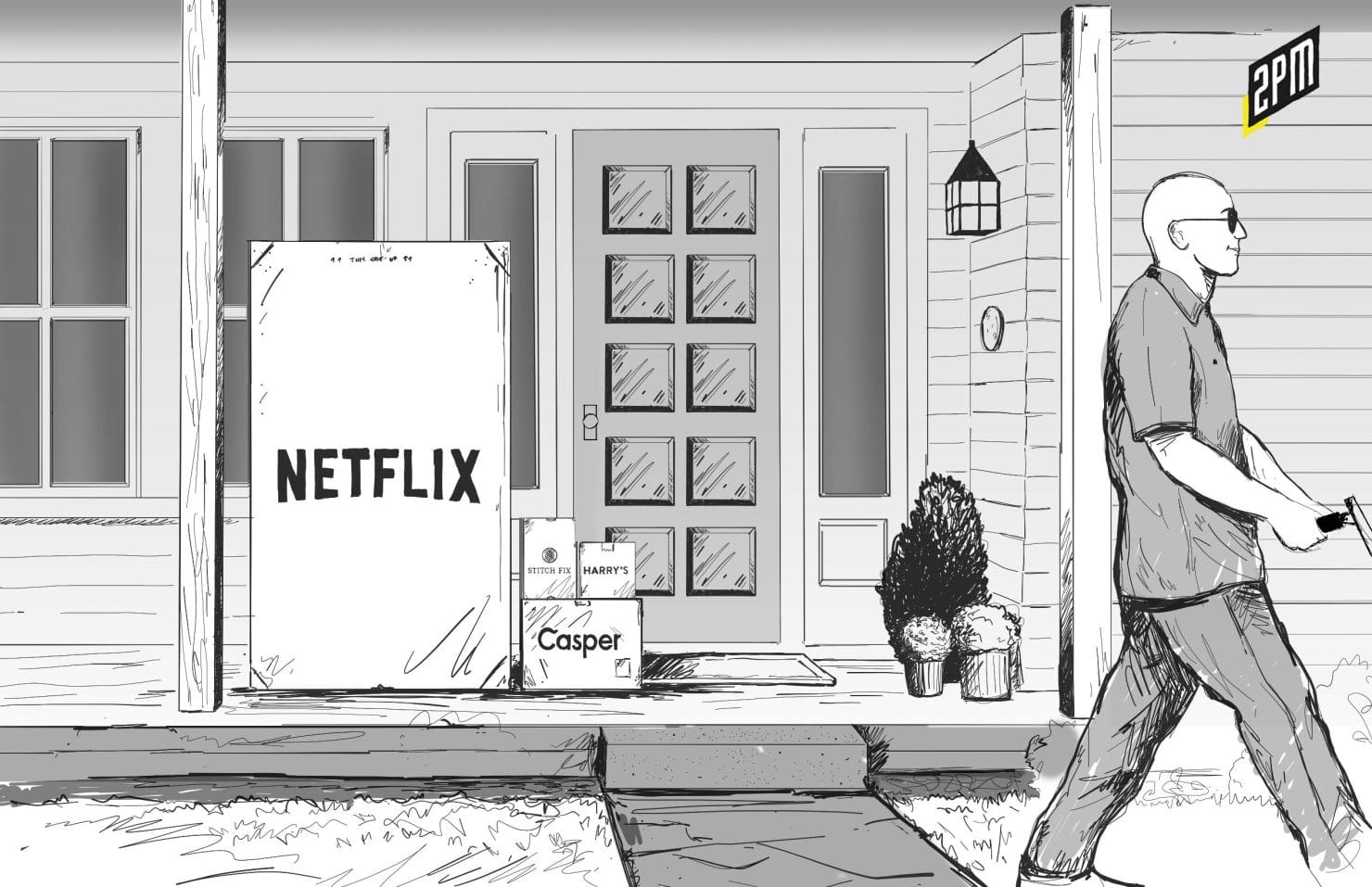
One hire can make all of the difference. For Netflix, Josh Simon’s role as VP of Consumer Products is key to the platform’s offense, defense, and long-term viability as studios become self-sustained content fortresses.

The excitement around Netflix’s eCommerce push is palpable. If this project succeeds, the implications are far greater. CEO Ted Sarandos and Netflix are resting on dormant potential. With direct-to-consumer retail success, the streaming service and film studio could compete with Disney on another front.

Disney Plus infringed on Netflix’s ground and made an immediate impact on its offering by doing so. Netflix’s Marvel, Star Wars, and Pixar catalogues are now sparse. In April 2021, the other major intellectual property factories began threatening to move their projects from Netflix. Engadget recently encapsulated the mounting competition:

The battle to gain a foothold in the streaming era has spurred Hollywood studios to go on the defensive. After licencing films and shows to Netflix and Amazon, the likes of Disney and WarnerMedia have yanked their biggest properties from the competition to boost their own platforms. Not to be left behind, Comcast-owned NBCUniversal is reportedly mulling a similar strategy in a bid to prop up its fledgling streamer, Peacock, reports Bloomberg. [1]

As Hollywood goes on the defense, Netflix has responded with a strategy that signals the beginning of a longer-term approach to competition with Disney, Amazon, WarnerMedia, and Comcast’s NBCUniversal. It begins with DTC retail.

Phase One: Original Brand Retail

Netflix’s Shopify build shouldn’t be much of a surprise. The decision to pursue a millennial-friendly style of commerce over a traditional custom build or a more robust partnership with Salesforce, BigCommerce, or Magento is telling. This is what very large companies do when they’re not entirely sure about direction: equal parts skepticism and efficiency. But the decision may play in its favor.

Even if the Shopify development required $1-3 million (it was likely much less expensive), it’s a relatively tiny investment into a nascent operation that will grow methodically over the coming weeks. Designed by BVA and developed by SDG (a partner to Skims and Prive Revaux), Netflix.shop is the streaming giant’s entrance into DTC. It’s a launch that the company hopes will communicate its brand is fresher than its age (Netflix is now 24 years old).

And aesthetically, functionally, and psychographically, the Shopify approach is consistent with Netflix’s goals. Not just from its front-end appearance and merchandising but from the technologies used: Shopify, Klaviyo, and Signifyd. In terms of product development, collaborative partners, and product photography styling, the retail platform succeeded in setting out to attract a younger, vibrant, and savvy consumer. So young that geriatric millennials may not fully grasp Netflix’s product and partnership strategies. Japan’s Beam brand, anime, and its Yasuke animated property are all indicators this approach may have greater implications. So in theory, this small investment may become Netflix’s most important.

Web Smith on Twitter: “Our daughters now have a whopping $126 worth of merchandise commemorating Season 3 of Stranger Things and outside of minimal licensing fees, Netflix earned none of that. Linear Commerce would transform Netflix’s prospects. / Twitter”

Our daughters now have a whopping $126 worth of merchandise commemorating Season 3 of Stranger Things and outside of minimal licensing fees, Netflix earned none of that. Linear Commerce would transform Netflix’s prospects.

Netflix has long known its potential in leveraging its intellectual property for merchandise sales. In July 2019, a countless number of retailers licensed Netflix’s “Stranger Things” property. For a short period, it was a retail bonanza for Target, Amazon, H&M, Kellogg’s, Burger King, Coca-Cola, Hot Topic, Walmart, and even Baskin-Robbins who converted 75 of their stores to appear like the series’ “Scoops Ahoy” ice cream shop.

The Duffers said none of the marketing deals meant to hype their show would add to their bank accounts. “We’re not getting a revenue cut from any of this,” they said. “The hope is that it just gets the show more exposure.” [2]

But throughout this era of Netflix, the only potential transactions were in-show product placement and the potential of heightened subscription interest.

Phase Two: Live Events and Activations

In March 2020, I calculated the math on Netflix’s eCommerce potential as the streaming studio’s hire of Josh Simon tipped off the current direction.

Web Smith on Twitter: “In July, I did some basic estimates on Netflix’s online retail / licensing potential. “Just 7% of Netflix’s viewers purchasing through the app – at a $50 AOV – would equate to over $140M in sales from 41 million households.”@Netflix is moving towards linear commerce. pic.twitter.com/P2DpTe0dlq / Twitter”

In July, I did some basic estimates on Netflix’s online retail / licensing potential. “Just 7% of Netflix’s viewers purchasing through the app – at a $50 AOV – would equate to over $140M in sales from 41 million households.”@Netflix is moving towards linear commerce. pic.twitter.com/P2DpTe0dlq

Simon’s hire is as directional as it is functional. Earlier in the new VP of Consumer Product’s career, he spent time working at Nike. But it was his six years working for Walt Disney Studios and Blumhouse’s live experience business that will shape Netflix’s brand and audience strategy for consumer products. He’s tasked with “identifying and building plans across different lines of business in consumer products” according to a 2020 article by Variety [3].

And this is why the Shopify experiment has long-term implications. If Netflix can prove that it can successfully capture more of its commercial upside by insourcing more of its retail, more live events will follow. Later in 2020, “Stranger Things” rode the success of the Baskin-Robbins partnership by launching an interactive drive-thru experience in Los Angeles. Spanning 400,000 square feet at Skylight Row in Downtown Los Angeles, the hour-long performance featured scenes from 1985 Hawkins. The guests were encouraged to dress in their finest 1980s wears as they were transported back 35 years to a high school reunion, the fictional “Starcourt Mall”, and then to a three-part show featuring the three seasons’ key moments. The live event was co-produced by Netflix and Fever, a venture-backed event platform. This is inline with Adweek’s contention that the streaming giant will continue finding innovative ways to capitalize on its intellectual property:

Netflix’s eCommerce push caps off years of dabbling in the consumer products business that Netflix has been pursuing through retail and brand partnerships as it has looked to find ways to capitalize on the runaway success of some of its original series. [4]

Netflix’s Shopify strategy is the precursor to a focused effort to bolster the viability of its class of properties that may eventually take on life as temporary live events. But this isn’t where Netflix’s aspirations need to end.

Phase Three: The Netflix Universe

With Josh Simon’s charge to capitalize on the runaway success of some of its original series, Netflix’s strategy is unlikely to complete with temporary live events and short-term activations. Netflix has amusement park potential and its decision to pursue commerce as an initial step is a credible attempt to capture the data required to build a strategy around a physical location for young adults. That includes members of Generation Z, Netflix’s core demographic, as it attempts to compete with video game studios, amusement parks, and film production houses with their own streaming services. Consider Netflix’s biggest competition:

Netflix said in 2019 that its biggest competition is actually Fortnite, which is what more likely pulls players away from the streaming service. [5]

Netflix’s digital world may converge on the physical for good. In doing so, Netflix will finally go on the offensive after nearly a decade of Hollywood’s traditional studios breaking down one of its two prized advantage: its content curated from other studios. The result may be a Netflix that goes all-in on becoming more like Disney or Universal in the process:

As Netflix tries to compete with Disney on a global scale, it is trying to create franchises that can have the same impact on culture as “Star Wars” or “Toy Story.” [6]

It is unlikely that Netflix will ever find it suitable to acquire 25,000 acres of land like Disney before it, or even 415 acres like Universal Studios. But in nearly every metropolitan region in America, there is a dying mall – one that bustled in the era depicted by the “Stranger Things” fictional Starcourt Mall. There will be inexpensive property at CEO Ted Sarandos’ disposal and it wouldn’t be the first time that Netflix converted a dead mall into something useful.

If the streaming giant proves that IP-fueled merch can sell, so might brick and mortar retail, pop-up experiences, and amusements. Don’t be surprised if Netflix’s digital experiments precede its venture into physical retail, events, and a permanent home for its beloved original properties. It’s created franchises that are valuable. Walt Disney knew what he was doing when constructing a Bay Lake, Florida home for his franchises. In this day and age, what begins as DTC often ends up in physical formats. It’s what takes a valuable property and makes it a beloved one. A lasting cultural impact may follow.

By Web Smith | Art: Alex Remy | Editor: Hilary Milnes