
Memo: A DTC Brand Takes Over

This week, NOBULL began its time as the title sponsorship of the CrossFit Games. The event was associated with Reebok for ten year. There are a number of narratives here – the founding team at NOBULL were once Reebok employees. It’s a story with endless examples of rivalry but the main one is one oft seen in retail. The generational brand gave way to the challenger. They’ve earned their time in the spotlight. Now, we will see what NOBULL does with the opportunity.

Direct-to-consumer startups are designed to be disruptive by nature. Their purpose is to see the opportunities that larger corporations have gotten too big to identify themselves, improving on process and product in doing so. At CrossFit, the changeover in sponsor is giving a DTC challenger the chance to go toe-to-toe where an incumbent left shoes to fill. CrossFit CEO Eric Roza sought out NOBULL to take over as CrossFit’s main sponsor, letting Reebok’s time lapse. The brand pulled out following the former CEO’s remarks.
Roza had a choice to make. As he recently told Footwear News, he could have given the company more time to recover before seeing who else he might have to choose from on the market. But he was a NOBULL fan, in large part due to the brand’s DTC spirit. He said in the interview:

I love their nimbleness and that I had a friendship with the founders, not just a business relationship. When I met them, I had an interest in investing in them, so they knew I was a bit of a fanboy. I loved that they were a direct-to-consumer play, they were e-commerce forward. The fact that they were digitally-native, really good at direct marketing and native to CrossFit with styling I really liked, made it the right decision for us.

NOBULL’s nimbleness, digitally-native and eCommerce forward traits made it the most attractive partner to CrossFit, proving that DTC challengers have real potential in shaking up the markets they’re in. That’s especially true when it comes to partnerships with brands who are looking to borrow some of that DTC spirit.

Reebok is making its own moves. The brand last week launched a Bonus Program that offers prize money to athletes who take first or second place in a CrossFit event wearing a Reebok shoe – directly incentivizing athletes to disregard the new sponsor’s shoes with a financial bonus. According to Reebok, nearly 200 athletes have taken them up on the challenge. NOBULL, in response, reminded Reebok who had the title sponsor spot. CMO Todd Meleney told Morning Chalk Up, “Since the beginning we’ve been in favor of anything that supports the athletes and the CrossFit community. As the title sponsor of the CrossFit Games, that’s the case now more than ever.”

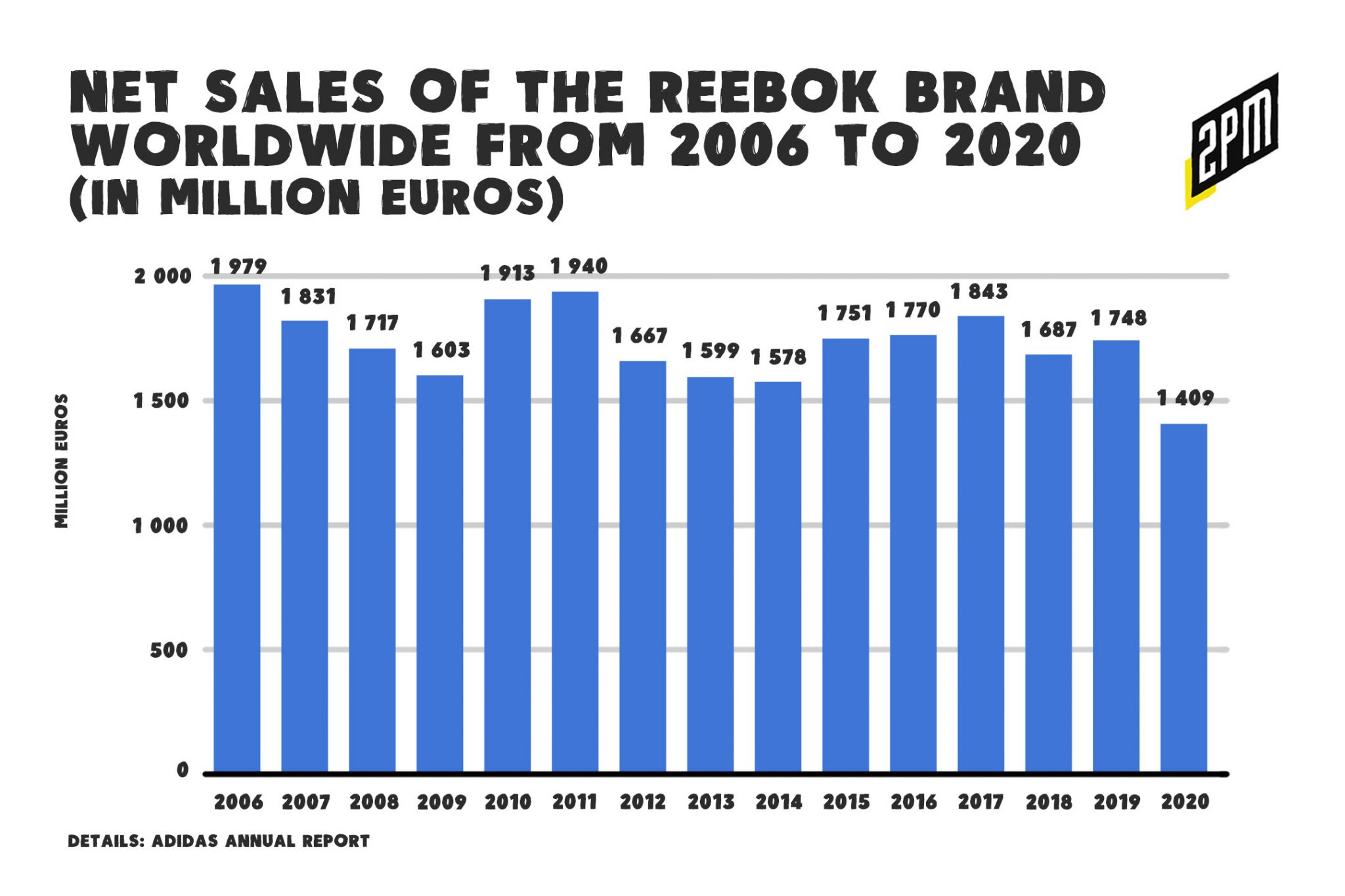
In all, this is as much a story about Reebok’s failure (the company is looking for a buyer) as it is NOBULLs rise as an enterprise-level brand. Click on the above graph to read Retail Dive’s narration of Reebok’s rise and fall. Reebok’s sales fell to a 15 year low, meanwhile Nike and Puma (who suffered similar pandemic struggles) only fell to three and five year lows respectively. Meanwhile, at No. 109, 2PM estimates NOBULL’s revenue to be well into the nine figures just seven years into their life cycle.

By Web Smith | Editor: Hilary Milnes | Art: Christina Williams and Alex Remy

Memo: Olympic Fashion

With a market value north of $8 billion and an annual revenue mark that should surpass 2020’s mark of $6.16 billion, few are comparable to Ralph Lauren. And that may be why its reception at this year’s Tokyo Olympics has been as chilly as its cooling blazers. The New York Times’ chief fashion critic Vanessa Friedman recently reported on multiple advancements:

The navy jackets of the flag bearers Sue Bird and Eddy Alvarez incorporate what the brand has dubbed RLCoolant technology. [1]

The brand also graduated from synthetic fibers to manufacture technical denim, a much-welcomed advancement in an industry that companies like Ministry of Supply and Mizzen + Main pioneered in 2011.

Oh, and the “jeans” (of course, they had to have jeans: Ralph-the-designer even wears his own faded denim to black tie events) are made from a special new material the brand says is “free from synthetic plastics.” [1]

As a veteran of both the preppy wear and technical wear industries, I applaud these improvements. They deserve the spotlight, as does the company’s emphasis on domestic manufacturing. These are welcomed advancements and no one can test the market quite like RL. But the masses don’t see these developments as worthy of its great, international stage. Though Ralph Lauren has done a notable job outfitting the American athletes since 2008, a world of change has happened since. The brand is not suffering from a technical or a supply chain deficiency; it’s suffering from a cultural one. In The New Prep, I explained that Ralph Lauren, Tommy Hilfiger, and Brooks Brothers are at risk of being relegated to cultural irrelevance:

For retailers like Ralph Lauren and Tommy Hilfiger, African-American streetwear culture co-opted their styles. That new base of organic interest drove the two brands to extraordinary heights in the 1990s. Ralph Lauren Corporation (and its $5.5 billion market capitalization) remains a beneficiary of that accidental cultural impact.

Few could have predicted what has happened since 2008. Brands like Aimé Leon Dore, Noah, KITH, Telfar, Todd Snyder (owned by American Eagle), and Rowing Blazers have each contributed to a rewriting of what it means to be preppy. In ways – each their own – the brands acknowledged what Ralph Lauren didn’t during its most pivotal growth stage. There is a new American sportswear, according to GQ’s Rachel Tashjian. It’s authentic and inclusive.

The culture that accidently sparked a revolution for Ralph Lauren in the 1980s and 1990s has all but consumed preppy culture today. In the Hamptons, Rebekah Mercer lives in the same community as Sean Combs. At elite preparatory schools, teenage students arrive at their campus entrances in Jeep Wranglers listening to hip hop and wearing Jordan 1s with their school-issued plaids and khaki. The scenes harken imagery more from New Jack City than Cruel Intentions. Their pop culture idols have brown and black skin. And if they don’t, they were influenced by artists who do. On weekends, high school and college wardrobes of the preppy are influenced by StockX or Golden Goose. The very definition of American Prep has so far diverged from Lisa Birnbaum’s 1980 cult classic The Preppy Handbook that it might as well be a different genre of fashion altogether. Except it isn’t. It is truly prep.

A 1990 article in Utah’s 171-year-old daily paper Deseret News began:

If the 1980s were a movie – and the metaphor is almost unavoidable given actor/president Ronald Reagan’s domination of the decade – the credit lines would have to include costumes by Ralph Lauren. [2]

Fast forward to the Tokyo Olympics and Ralph Lauren’s expression of American preppiness is one of 1980s tradition, not 2020s reality. And when you present a notion of culture that doesn’t accurately reflect America, you see countless responses like the one below:

Mike Sington on Twitter: “Why is Ralph Lauren always selected to design the Team USA Olympic Opening Ceremony uniforms? Our American athletes are a diverse group, they’re not a bunch of preppy white people headed to Newport or the Hamptons. pic.twitter.com/JaTCH6tEu9 / Twitter”

Why is Ralph Lauren always selected to design the Team USA Olympic Opening Ceremony uniforms? Our American athletes are a diverse group, they’re not a bunch of preppy white people headed to Newport or the Hamptons. pic.twitter.com/JaTCH6tEu9

The problem with an overdone caricature of high society is that it bolsters the insinuation that places like Newport, The Hamptons, elite schools, and prestige industries (once notable for 80s yuppie culture) are devoid of others. It’s simply not true. There are Ivy educated bankers of color on Wall Street. There are culturally and ethnically-diverse students in the best schools. Very few dress like they’re mooring their schooner after a weekend on Block Island. Suggesting that Ralph Lauren’s version of American prep is today’s reality is to say that those who currently inhabit the culture do not belong. So where does that leave us?

While Ralph Lauren’s fortunes are much better than Brooks Brothers, there is undoubtedly a new guard.

It was presumably tweets like these that warranted a response from one of the most accomplished fashion writers in the industry. In that tweet, I noted:

This is probably the last year that Ralph Lauren outfits the Olympic team. The next design cycle will likely be a consortium of brands that define today. Noah, KITH, Aime Leon Dore, Todd Snyder, Rowing Blazers, Fear of God, Telfar, et al.

This wasn’t wishful thinking by any means. To be clear, it is unlikely that Friedman was referring specifically to my suggestion, but I take issue with the reasoning that she used to justify Ralph Lauren’s continued involvement. Friedman’s contention is simple: RL’s moat is economies of scale.

Vanessa Friedman on Twitter: “All those people calling for a new official Olympic outfitter for Team USA instead of more Ralph Lauren – I get it, but remember: they have to be able to afford making free clothes for 615 competitors plus coaches etc. There are limited designers with that budget. / Twitter”

All those people calling for a new official Olympic outfitter for Team USA instead of more Ralph Lauren – I get it, but remember: they have to be able to afford making free clothes for 615 competitors plus coaches etc. There are limited designers with that budget.

Scale isn’t as much of a moat as one would think. There are a number of individual brands birthed in the digitally-native era who could accomplish this on their own. These aren’t merely independent design houses, they are financed businesses in most cases. Skims, the company founded by Jens Grede and Kim Kardashian has raised $154 million over its two-year lifespan. The company made news by earning the role as the “official underwear provider of the US Olympic team.” Rowing Blazers outfitted a much smaller contingent in El Salvador’s Olympic team, a nod to the recently re-capitalized company’s American ambitions. And Telfar Clemens, the Queens-born, Liberian-American designer successfully outfitted Liberia’s Olympic team – a nod that he, too, would rise to the occasion if the US Olympic Commission chose to consider a redefinition of today’s American culture. The popular designer was recently thrust into the mainstream after Beyoncé was seen with one of his bags. As Beyoncé does, so does America.

The economics of the opportunity are nothing to minimize, to Friedman’s point. And while few brands have the balance sheet to supply 80 garments to 615 Olympic athletes, there are ways in which a task like this can be met. Step outside of fashion for a moment and you may find your solution.

This week, NOBULL has an annual event in its name, the rights to which were for 10 years synonymous with Reebok. The MLS Cup Champion Columbus Crew moved to a new stadium after a change in ownership and a reinvigorated interest in its role in the city’s culture. When the $314 million Lower.com Field was announced to the surprise of many, NOBULL was but three years old. According to Columbus Business First, the deal is valued at $3-4 million annually. The Olympics opening ceremony presents a similar opportunity.

It is not likely that you will ever see a fashion label name a stadium or a sporting event, but Halston (1976), Levi’s (1980 and 1984), and Ralph Lauren (2008 – forward) established a close enough proximate. If given an opportunity to elevate one’s brand on an international stage, it’s likely that a modern retailer would take the chance and raise the requisite amount to afford the project. This includes the 10% USOC royalty, official rights, and the cost of goods required to ship an entire season’s volume of units to an Olympic host country. In return, that brand receives earned media, opened doors, top of funnel interest, and perhaps the great story of Summer 2024.

There will be a brand that rises to fill the big shoes of Ralph Lauren. When their interpretation of classic Americana is televised and streamed across the globe, it won’t feel like a caricature of American preppiness. It will look like America. If Ralph Lauren chooses to hand the baton to the next generation of American brands, there isn’t a label that wouldn’t design, manufacture, and ship that honor. In fact, there are at least a few brands actively awaiting the opportunity. They’re prepared.

By Web Smith | Editor: Hilary Milnes 

Memo: The Rise of the Holding Companies

One side has the advantage of distribution, the other side has the advantage of brand equity. I believe that the holding company trend will favor brand equity in the long run.

As the rumor persists that Thrasio is nearing a public offering, its competitors are growing in force, with Branded Group, Elevate Brands, Unybrands, Technology Commerce Management, Boosted Commerce, Heyday, and Win Brands Group among them. While technology may play a role in quantifying each investment’s viability and potential upside, none rely solely on an algorithm to determine a brand’s fate. That is, until recently.

OpenStore has raised $30 million to grow its business rolling up Shopify sellers, Axios reported this week. The emergence of a cottage industry of merchant holding companies on Shopify, also a thriving business for Amazon sellers, is telling: Shopify has built an eCommerce universe with gravitational pull. Here is how OpenStore works:

  • retailers hand over login credentials
  • OpenStore verifies sales and other inventory data
  • bots determine the acquisition offer by the next business day

OpenStore is now valued at $250 million and has already launched its automated acquisition tool targeting thousands of brands. While Shopify merchants sell on their own sites with no centralized selling platform, OpenStore can benefit from the richer nature of these sellers, who have direct relationships with their customers, unlike Amazon sellers. OpenStore is targeting sellers that are struggling to stand out in a vast sea of eCommerce players – a smart tactic as customer acquisition, marketing and brand awareness are among the most expensive parts of building a merchant business, and Shopify lacks the promotional algorithm and search functions of Amazon (though that’s beginning to change with Shop).

Amazon is the queen of discoverability.

According to Bloomberg, Shopify is leaning into the roll-up functionality, having built its own exchange for storefronts. The offer process will soon become part of the Shopify platform: any merchant can log in and, using OpenStore’s bots, receive a bid for selling their entire business. Shopify’s roll-up business has room for scale but is still far off from Amazon’s, and that’s for good reason. While Amazon sellers tend to have more scale than the traditional small business merchant, Shopify sellers tend to score higher on a measure of brand equity and net promoter score. For Amazon sellers, few own the relationship to the customer. It requires a bit of sophisticated advertising and sales funnel development to target Amazon customers, driving them over to the brand’s native cart. Shopify brand acquirers see one less step. For companies like Win Brands Group, a backend system of operational excellence is used to improve operations, grow margins, and trim duplicity. Time will tell whether or not OpenStore has a similar strategy in the works.

Amazon’s advantage remains product discoverability. The roll-up companies devoted to that format usually acquire FBA brands with less short-term risk but higher long-term risk. This is the key question:

Are nascent Amazon brands capable of the same successes if sold through Shopify, BigCommerce, or another commerce provider?

OpenStore competitors like Perch, Thrasio and Elevate Brands are focused on nascent businesses. This makes sense for them. It takes much less work for Amazon retailers to exceed $5 million or higher in run rate. For Shopify merchants to accomplish the same, it requires a better sales funnel, a stronger operational team, and a brand that consumers are drawn to. To lower risk of failure, Win Brands Group acquires brands earning eight figures or greater in annual revenue. When assessed through traditional methods, this seems to be the best method. But OpenStore can revolutionize the Shopify side of the brand acquisition spree if it can identify strong businesses as well as Win Brands Group can, but much earlier in their growth trajectory. Can OpenStore detect these types of brands algorithmically? And when they acquire them, can they streamline operations in a way that is conducive to proper retail brand development?

Right now, the business of Amazon brand acquisition is the prefered channel. Consider this recent commentary about the state of digitally-native brands. In one of those contributor posts for Forbes by Chris Shipferling, the Managing Partner at Global Wired Advisors, provided a bull case for Amazon brand acquisitions:

I believe that campaigns prioritizing keyword rankings, earning reviews and driving conversions will all but replace traditional branding strategy within the next three to five years. And as many of these practices are already ubiquitous in the marketplace, the definition of what comprises a premium brand will evolve to reflect best practices for e-commerce.

There has never been a more incorrect assessment of retail brand psychology. While these quantifiable metrics will continue to serve a role in how a consumer assesses their purchasing options, brand has likely never been more important as algorithms shift, third-party data diminishes, and platforms cultivate their own private labels. Brand is important. And this is where OpenStore can succeed in a model that more resembles an Amazon acquisition (quantitative) than a Shopify buy (qualitative).

Retailers want one-to-one contact with their customers. They want their brands to have a message, a purpose and a point of view. More of these exist on Shopify.com than (natively) on Amazon.com. now, and this may lead a defection away from Amazon-hosted brands. See below for a relevant example. As the industry shifts toward the roll up of Shopify brands, fewer non-VC backed brands will need to wait to maturity before interest from investment vehicles like Win Brands Group. OpenStore is in good position to scale the Shopify strategy if its proprietary technologies can select brands as well as the digitally-native brand veterans at Win Brands Group and their Shopify-focused contemporaries.

By Web Smith

Note: this memo is an expansion of the short analysis from Friday’s member brief. That version had a few grammatical errors. This version has been improved and is worth your time. To all who emailed in, I apologize for the errors.