
Memo: Fast, Faster, Fastest Fashion

Fast: H&M. Faster: Zara. Fastest: Shein. It’s a progression that has changed consumerism, accelerated textile production, and hurt the economy while doing so. Zara disrupted H&M and then Shein unseated them both. Now, H&M has gone on the offensive in an effort to regain the advantage it once had.

The hope is to regain the millions of consumers who’ve gone the way of Zara and Shein. It all comes down to the x and y axes of two competing ideas: economics and environmental impact.

There are consequences to fast-fashion and athleisure; plastics weren’t intended to be worn and discarded with impunity.

The chatter around the future of fashion is one of pure contradiction: a young generation of shoppers say they want to preserve the environment. Juxtapose this ideal atop of what they actually buy and you’ll find that there are cracks in their collective “save the planet” philosophy. Gen Z is often referred to as the most sustainably conscious, environmentally-minded consumer segment. They’re also fuelling the rise of Shein, the biggest fast fashion company in history. Zara and H&M were small retailers in comparison. A 2021 Harvard Business School case study explained how Inditex, the parent company of Zara, innovated around supply chain efficiency to produce faster products that were more in-line with trends.

Zara was the Group’s oldest and largest brand, representing around 69% of sales, or €18 billion in 2018. At the core of Zara’s success was an innovative business model based on a very responsive supply chain and quick merchandise turnaround. Zara designed, produced and delivered new items to stores in less than three weeks, allowing it to constantly update its collections and adapt to changing customer tastes.

Just two years after this case was written, Zara is now looking upwards at an infant brand: Shein is Zara on steroids. And Gen Z loves it. Shein has become a favorite on TikTok, where users share hauls from the brand of $15 dresses, $10 shorts and $5 tops. The clothes are cheap and trendy, designed for one-time wears posted on social media and discarded. The concept is not new but with the trend toward sustainability, it was supposed to be going out of style. Instead, the idea is more powerful.
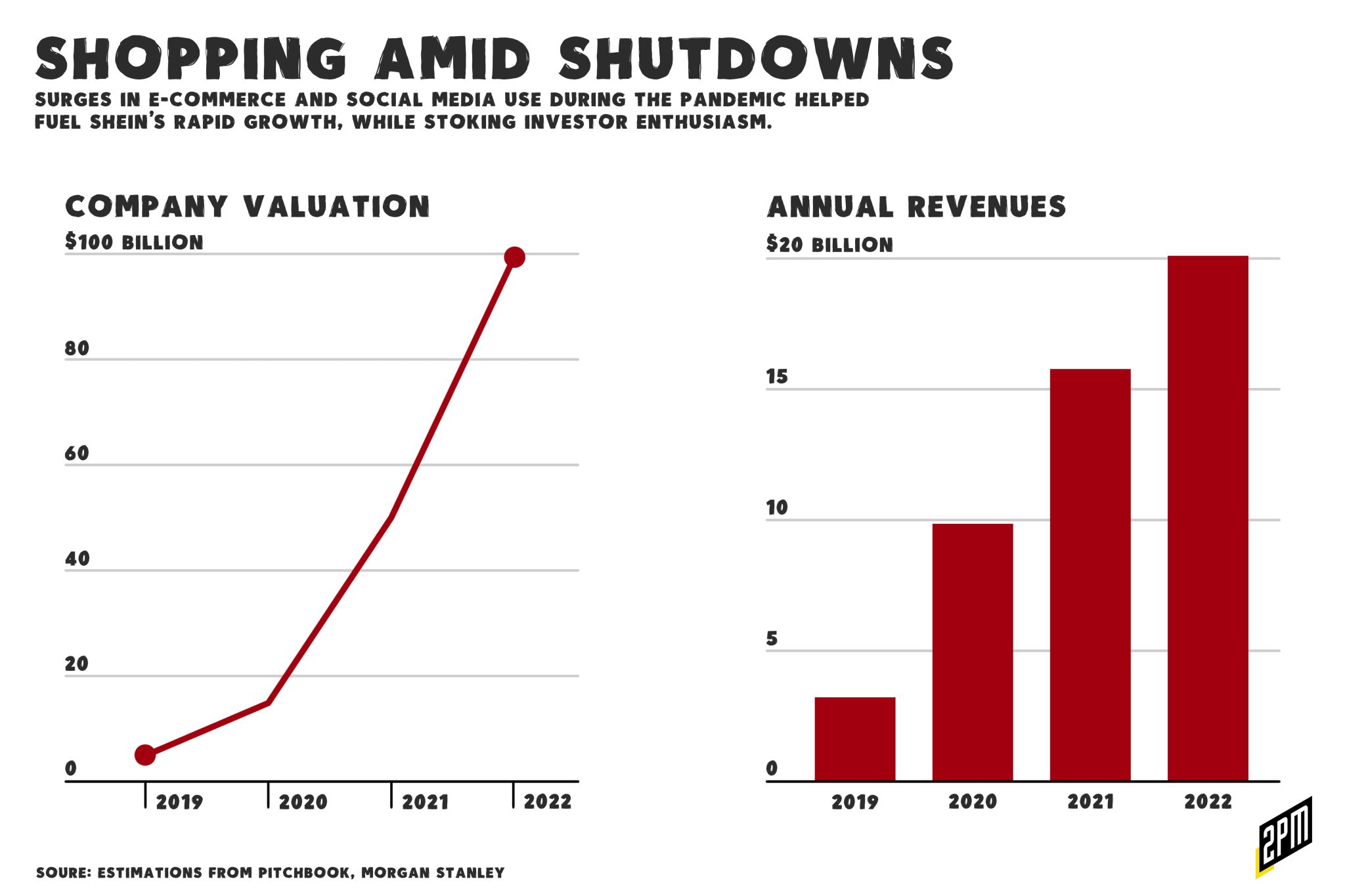
Shein’s scale is difficult to grasp. The operation is more secretive than most but what is evident is that we are more aware than ever of the consequences. There are very tangible negatives to fast-fashion and athleisure; plastics weren’t intended to be worn and discarded with impunity. Fortune wrote a deep-dive on Shein on May 31, laying bear the narrative:

Global investors, for whom it is increasingly fashionable to champion high standards on environmental, social, and governance (ESG) matters, are similarly smitten. They have pumped Shein’s valuation up to $100 billion, making it the world’s third most valuable startup behind ByteDance, the Chinese parent of TikTok, and Elon Musk’s SpaceX. Shein is now worth more than H&M and Inditex, Zara’s parent company, combined, according to Bloomberg.

But while Shein’s innovative business model might lower prices for consumers, watchdogs grumble that Shein has built its clothing empire on the back of cheap labor, knockoff goods, and A.I.-driven design software that encourages consumers to ditch old outfits at rates that are bad for the planet. Those complaints, along with a recent e-commerce slowdown, make the company’s continued dominance far from certain.

Fortune’s position that, in so many words: “Shein’s impact on the environment will eventually lead to its undoing” is faulty at best. Why? There is a cognitive dissonance in fast fashion’s target market. Can one save the planet while buying $13 dresses for Instagram? So far, fast fashion companies have only lost dominance when they’ve been replaced by faster companies that can regurgitate trends at lower prices. Whether Shein’s nefarious practices are lost on customers or willfully ignored doesn’t ultimately matter. Customers who are drawn to clothing because of their affordable price are typically not the same ones who will stop to ask why a piece of clothing costs so little. What does matter is the bottom-line evidence that faced with cheap options, young consumers will shop for fast fashion.

At play behind the rise of Shein is a combination of factors. Social media has accelerated the trend cycles of fashion. Sustainable fashion is prohibitively expensive and the shifting tides of consumerism have, for many, determined that fashion is not an investment, at least not in terms of trends. Consumers are often held responsible for “voting with their dollars” when it comes to encouraging corporations to be more sustainable but this has never been completely true. Customers will buy what is easily and affordably available, particularly when they’re young.

Shein itself is a black box. Little is made public about how it sources and manufactures its clothing but the numbers and price tags speak for themselves. The company has started speaking up about – of all things – its sustainability efforts. Vogue calls this greenwashing:

Each week, a shocking 15 million garments arrive at Kantamanto Market from countries in the Global North, decimating the local textiles industry there.

It hired a global head of ESG and recently announced a $50 million fund that will go toward offsetting its environmental impact and handling its waste problem. That is a $50 million drop in the bucket that will barely undo a stitch of what Shein has unleashed on the market of TikTok, Snapchat, Instagram, and Kardashian loyalists. This week, it received praise for partnering with the OR Foundation, which it will give $15 million over three years in order to combat clothing waste in Accra, Ghana, where many discarded clothing ends up.

It’s nothing more than a diversion from the reality of the impact on landfills. Shein calling out waste and donating funds to bring attention to the cause may be perceived as disingenuous. Luckily for them, H&M is doing something similar, committing $250 million alongside Lululemon on behalf of the new organization that succeeded Aii:

“What we’re trying to demonstrate is that this is the center of gravity for all of climate work and everyone from Textile Exchange to Fashion for Good to many others — that are working in lowering carbon and coming up with solutions and getting them to pilot — are all beneficiaries of this,” he said. “This is a collective ‘we.’ This is not giving it to Aii, and it’s not going to go into other climate work. This is creating a central pooled fund whereby we all can begin to look at a more consolidated approach as opposed to fragmentation of project work that’s not talking to each other and duplicating efforts.”

What will solve fashion’s Shein problem is not donations, public relations, or acknowledgements of wrong-doing. The more fruitful solution will be social media trending away from fast fashion and towards sustainability. But there’s no relying on Gen Z customers to fix this problem. It is time to accept that no well meaning customer can stop the retail machine desired by millions, as new trends come along and TikTok broadcasts them for all to emulate.

By The 2PM Team

Memo: Apple’s Property Tax

For Apple, hardware is the afterthought. Content, digital land, and privacy is at the forefront.

Two announcements in the past 24 hours confirms as much. This week, Apple won its first Oscar for best picture. And according to Nikkei, Apple is lowering the output of iPhones and Airpods as inflationary pressures and supply chain issues persist. From where will the margin come?

The answer can be found in Apple’s recent investments. Between 2017 and 2021, Apple’s ad revenue climbed from $300 million to $4 billion, mirroring Facebook’s steep climb from $750 million to $4.2 billion between 2009 and 2012. Apple is nowhere near the size of Meta’s advertising business (the company reached $115 billion in 2021) but there’s reason to believe that Apple could grow a considerable business in a timeframe comparable to what was seen at Facebook (now-Meta). In Linear Commerce and Content Fortresses, I explained:

Apple’s intentions appear straightforward at first glance. The company wanted to improve the privacy of its end users. This virtuous effort came with a few additional outcomes.

By upgrading its privacy practices, Apple will impair large ad networks that have grown with the help of those end users. This could potentially cripple Facebook’s current model with its new privacy demands. Apple has also opened the door to an unintentional adjustment to its privacy mandate. In doing so, the Mark Zuckerberg-led advertising company (and social network) will adopt a new way to accomplish its most critical objectives: revenue growth and user utility.

Apple understands that the web isn’t private and at its core, whether through Apple’s ATT (App Tracking Transparency) or newer privacy initiatives, they are prioritizing the end user and her privacy. In June of 2021, iCloud+ was announced as a premium subscription service that featured a service called Private Relay. It is designed to encrypt all connections (even the ones not using HTTPS) to hide your IP address and prevent anyone from knowing your location or your identity (including Apple). From iMore:

The connection uses QUIC, which is meant to be like TCP but with lower latency and HTTP/3, and because Apple encrypts the connection, even your ISP can’t see where it is on the web you want to go. All they see is the connection to Apple’s ingress proxy server. So, Apple knows your IP, but not the website you want to go to because that’s encrypted.

At that point, Apple will strip away your real IP address and replace it with a temporary IP address from a pool of available addresses.

Now, consider the pace in which Apple captures ground in industry. Over the previous four years, Apple’s advertising grew as quickly as Facebook’s between 2009 and 2012. There’s an even greater example. In September 2019, it was announced in the New York Times that “Apple steps into the movie business.” In March of 2022, Apple TV+ became the first streaming service to win best picture. Apple has built a fortress; it’s using content and commerce as its bricks and privacy as its mortar.

Private Relay has the potential to have a major impact on the advertising industry. As The Information explains, the feature was released in September to Apple iCloud+ customers who could elect to turn the feature on for Safari browsing and a small percentage of “insecure app traffic over port 80.” For now, users can still use Chrome or any other non-native browser. Additionally, platforms that have you logged in: Gmail, Youtube, Facebook, TikTok can track your movements through the first-party data that the platforms collect.

But one thing is certain, when third-party technology companies circumvent Apple’s new policies on privacy, it is likely to precede another drastic measure taken by the hardware manufacturer. When turned on, Private Relay creates a virtual private network, meaning the internet provider can’t track what websites a user is visiting, and the websites can’t see any identifying information about the visitors. With Apple’s recent pivot to privacy, there’s reason to believe that this feature will be rolled out more aggressively to more users, which would be yet another blow to other platforms like Meta and Google who are currently relying on IP addresses to workaround the existing privacy crackdowns that Apple implemented last year. From The Information:

If the Private Relay service expanded beyond Safari to stop the transmission of user IP addresses across mobile apps, ad industry executives say it would hobble the efforts many ad networks and ad tech companies have made to adapt to Apple’s earlier changes, known as App Tracking Transparency. Many of the workarounds that firms including Meta, Snap and Google developed in the wake of Apple’s changes rely in part on having access to groups of user IP addresses to measure whether ads the users saw led to sales.

These workarounds include using an IP address to determine if a visitor to the site then took further action, like making a purchase. There’s evidence that these workarounds were effective. A recent report from 9to5Mac noted Facebook’s success in identifying (short-term) workarounds, noted for a sudden surge in advertising performance:

In a company statement, a Meta spokesperson said it has “continued to adapt our systems to help businesses succeed while honoring privacy and shared extensive steps they can take to maximize performance and measurement on our platforms.”

While Apple said it would pull apps who violated its new privacy policies, there’s been no action against this type of workaround. It might have been biding its time, knowing that harsher restrictions to user visibility were coming, which would take a further hit on these tech companies’ advertising businesses. Regardless of Apple’s stated motivations, these moves are benefitting its own ad business while hampering others. At the same time, Meta and Google are not going to lay down without a fight – each company is equipped to build more counters to Apple’s moves. But the owner of the hardware ultimately controls the hosted content. This poses a problem no matter how big and mighty the advertising duopoly might seem.

And that’s not where Apple’s actions end. Email addresses are a critical currency for brand marketers who want to establish closer relationships with their customers. Discount codes and branded newsletters are pushed hard to visitors who go to a company website. Apple’s new Hide My Email feature, rolled out in December to iCloud+ customers, randomly generates an email for customers to share with a site to unlock access that hides their real email. Another marketing cornerstone and key touchpoint for advertisers is severed. That complicates future targeting efforts and obfuscates a clear view on who’s coming to the website and browsing and buying what.

And this means that while Apple continues to build a new identity around the importance of privacy, advertising efficacy on other platforms may continue to diminish. It’s also likely that we will see something similar from that other hardware / software company. Google may adopt similar strategies; the iOS vs. Android arms race tends to work like that. The loser in all of this seems to be Facebook and the many brands reliant on their advertising service:

It is unlikely that Apple reverses course on its ATT changes and its diminishing of the IDFA but an entire industry is in need of a middle ground. For many founders and executives, their livelihoods are on the line and it isn’t Facebook that will be remembered as the culprit. Apple must either resolve its decision in favor of the advertisers reliant on sales-driven marketing.

Facebook anticipates a $10 billion impact on its own advertising sales, a sum that represents tens of billions in goods and services traded. It’s unlikely that the hole left by the degraded performance of Facebook advertising will be filled by another digital platform.


Apple will need to continue growing its content marketplace; Tim Cook’s digital fiefdom will require greater (user-generated) content engagement. As such, it’s not leap in logic that Apple will build a platform for user-generated content (UGC). Don’t be surprised if Apple acquires one in the process. Twitter, anyone? Without greater advertising opportunity within the Apple ecosystem, digitally-native businesses will suffer from the collateral damage. Apple has become the solution for handheld consumer privacy; business owners deserve a capable alternative to the services that Apple is crushing with its new practices.

When Apple shuttered the iAd Network in June of 2016, few could have predicted how successful a second iteration of it could become just six year later. If Apple expands its iCloud+ offering to all users, it’s pursuit of digital advertising dominance will be official. The writing is on the fortress wall, built atop the land that Apple owns. That land is due to come with new property tax for all who enter.

Memo: Planet of the Apes

We are living in a brave new world, a planet of the apes.

This week, decentralized autonomous organizations (DAOs) took another step into the mainstream with the airdrop of Bored Ape Yacht Club-licensed ApeCoins to BAYC’s existing community of crypto-wealthy ape owners. Andreessen Horowitz was heavily involved in this DAO, accruing nearly 14% of the available coins along with Animoca. The DAO drop follows Bored Ape parent Yuga Labs’ recently-announced $450 million round led by Andreessen Horowitz, according to the Financial Times:

The four founders of Yuga — until recently known only by their online pseudonyms such as Gargamel and Emperor Tomato Ketchup — were allocated 8 per cent. A group of “launch partners”, including Andreessen and Hong Kong-based NFT and crypto investor Animoca Brands, were together given a 14 per cent allocation, in exchange for helping prepare for the issuance.

This isn’t A16Z’s first rodeo. In December 2021, it was announced that Andreessen Horowitz made an investment into PleasrDAO, a blockchain-aligned group of crypto investors who partnered to acquire high-priced NFTs to fractionalize. One was the $4 million purchase of the Doge image, sold as 17 billion pieces that once amassed an implied market cap of $100 million. Just three years ago, the idea of this was unfathomable. The deal was highly visible to the crypto power users.

But unlike the intent behind many DAOs, ApeCoin ownership does not give you a governance interest in Yuga Labs, A16Z’s recent investment. Casey Newton explained:

ApeCoin DAO is not Yuga Labs, its PR firm took pains to explain to me in a press release Thursday. (This information was highlighted for me in a section of the release that was outlined in a box and headlined “Important facts.”) Rather: Yuga Labs gifted ApeCoin DAO a one-of-one NFT featuring a blue version of the Bored Ape Yacht Club logo. This NFT conveys along with it all rights and privileges of the logo’s intellectual property to the ApeCoin DAO. The ApeCoin DAO will decide how the IP is used.

This may not always be so easy to do from a regulations perspective. This week, I sat with an official at the Securities and Exchange Commission; she and I riffed on the next generation of securitization. I began researching the Howey Test in the context of the increasing popularity of DAOs. According to the Howey Test, a transaction is only an investment contract if:

  • An investment that requires money
  • There is an expected profit associated with the investment
  • The investment is a common enterprise
  • Profit comes by way of the third-party or promoter’s efforts

Oh yes, the SEC will certainly regulate investments like these. It was easy to see that most web3 consumers are unaware of what they are purchasing. In a recent academic paper published in the Boston University Law Review, it explains the potential for market failure due to information asymmetry or “the lack of understanding about what investors are buying.” It goes on to suggest that:

The relatively high perceived value of the interests in non-cash-flow monetizations suggests that some investors, possibly influenced by the recent history of rapidly rising prices, are looking to resale value.

Casey Newton’s recent essay mirrors this concern with respect to information asymmetry:

My guess is that it falls into the category of “legal for now,” a time-tested way for Silicon Valley startups to make money. But perhaps the Securities and Exchange Commission will have other ideas.

Regardless of the web iteration we’re operating in, consumer startups live and die by how well they live up to the promises they’ve made. It’s typical for investors to help founders fulfill those promises. In some cases, they can end up getting in between the vision of the founders and the reality for consumers.

The original direct-to-consumer retail boom was fueled by the same funds interested in Web3 today. In the worst case scenarios, failed startup autopsies reported stories of pressures to maximize investor interest, potentially clouding product decisions and roadmaps. They became cautionary tales. Web3 businesses are now pooling money from investors who view it as the next big opportunity. In The New Class System, 2PM laid out this opportunity in relation to how much time is now spent in online spaces:

Density precedes agglomeration, which influences consumer behaviors. Agglomeration economies are the benefits that come when firms and people locate near one another together in cities and industrial clusters. In short, agglomeration, once a physical phenomena, has digitized.

Consider the year-over-year growth in use for services like Slack, Microsoft Teams, Zoom, Instacart, Amazon, or Jokr. Consider the distance learning boom, the shift to home school, and the rising American ideal of remote work. And if you’re the type that is intensely into the internet, notice what seems like a sudden Web3 boom: NFTs, DAOs, and the normalization of cryptocurrencies as stores of value. We do more on the internet than ever before.

As early Web3 startups grow, how they handle the demands of their investors with the wants of their end users will play a role in shaping the future of Web3. I’d argue that the launch of ApeCoin is an example.

Understanding the Power of DAO

Bored Ape Yacht Club (BAYC) and its owner Yuga Labs is now the most powerful player – and among the most recognizable – in the Web3 space. Their decisions set the groundwork for others. The token associated with BAYC can be used to buy virtual goods and land in the Yuga Labs’ metaverse, according to the company. But the ApeCoin DAO is being held at arms’ length by Yuga Labs.

So far, ApeCoin DAO has decided to use the IP to reward all of Yuga Labs’ earliest backers. On Thursday, just a few days before today’s announcement, the DAO gifted a healthy chunk of the 1 billion total ApeCoin tokens to Yuga Labs, Yuga Labs’ founders, and the VCs who backed the project. Bored Apes owners got tokens as well. The coins hit a high of $40 per coin on trading markets before settling down to $12.20 today. At that price, VCs’ tokens are worth around $1.7 billion — far more than they have invested in the project to date. And that’s in addition to their equity stake.

DAOs are core to Web3’s promised land in that they are meant to decentralize control: they put the power in the hands of a community, which can mean everyday customers, fans and loyalists have the opportunity to buy into an organization they care about. With their tokens, they receive voting rights and other privileges that separate Web3 companies from Web2, in which only goods and services can be bought. In Web3, tokens are traded for control – or at least, a piece of it. With the majority of ApeCoin’s allotted tokens going to Yuga Lab’s major investors, can it still be considered decentralized?

ApeCoin risks diminishing the trust of its community by leaning into pleasing its investors and conventionally wealthy NFT owners. But there’s the potential of a favorable outcome for ApeCoin holders. By giving investors a return on investment long before the typical investment horizon, Yuga could be freed up to prioritize the consumer and the promises it made to its community. People will be watching. Whatever Yuga Labs does next will shape Web3’s next steps and, more than likely, the Security Exchange Commission’s.

Decentralized organizations were a key tenant of the Web3 promise. It may require one of our nation’s centralized organizations to determine which was the dominant species: the intelligent apes or regulators. The outcome may mean fewer airdrops for preferred guests, friends, family, and venture capitalists.