Member Brief: The Case For Revenue Per Employee

Meta, Google, Amazon, Salesforce, Twitter, Microsoft – but not Apple. What gives? Each of these companies are vital to the retail ecosystem but one measures key results in a way that is most commonly seen in an altogether different industry.

“You’ll hear revenue per employee again, in tech, no one was looking at these metrics at least in the private world, the VC world for at least five years,” Keith Rabois recently said to Elon Musk’s Twitter management.

Whereas growth and market share were once key performance indicators, profitability and efficiency will be the measures of this next five to 10 years. An OKR (objectives and key results) is a strategic framework and a KPI is a measurement within said framework. Brand and SaaS marketing discusses KPIs with endless zeal, but OKRs are rarely communicated with the same energy. I believe that this will change.

For Continued Member Access

Objectives and Key Results (OKRs) are closely tied to human resources but by connecting business development with HR OKRs, organizations can create a stronger, more consistent brand image while also fostering a positive and engaging work environment for employees. Of all of the HR metrics, one seems to be emerging as key to American economic recovery. There’s headcount, time to hire, acceptance rate, employee satisfaction, turnover rate, retention rate, training expenses, and revenue per employee (RPE). The latter is the measure of the hour.

RPE is the metric that has come to define big tech’s layoff narrative. RPE, often ignored during bull market growth periods has become the talking point used to justify right-sizing organizations. Fortune Magazine explained:

In addition to curtailing talent acquisition efforts and building up its people practice, Apple is reducing business travel and delaying employee bonuses. CEO Tim Cook will also take a pay cut of about 40% this year, which he reportedly requested. Altogether, the moves make for a true “doing more with less” strategy.

Apple is efficient in a key sense that many others in big tech will adopt. Here’s an example that reads like a big law firm’s measure of success. Founded in 2006 and headquartered in Amsterdam with around 2,000 employees, Adyen is the best direct ‘comp’ to Stripe. The Information recently explained why Stripe’s private valuation to Adyen’s public valuation:

Stripe spent so heavily on staff and new business initiatives in recent years that its 2022 expenses per employee were twice those of Adyen, even though Adyen’s revenue per employee was higher, according to an analysis by The Information. The expense gap is expected to stay the same this year, although Stripe is expected to do better on revenue per employee.

Even Google Trends reflect the growing reference to the phrase “revenue per employee.” Long a practice in other industries: they say that if you are a law firm partner, you need to consider yourself a business and not an employee. According to The Four Week MBA, Amazon’s primary OKR – RPE – grew by $40,000 between 2021 and 2022. But clearly the objectives were not met; Amazon recently laid off another 9,000. Though, I suspect RPE grew again in 2023 as layoffs continued. Meta’s RPE is set to rise to $1.85 million based on the Wall Street Journal’s revenue and headcount projections.
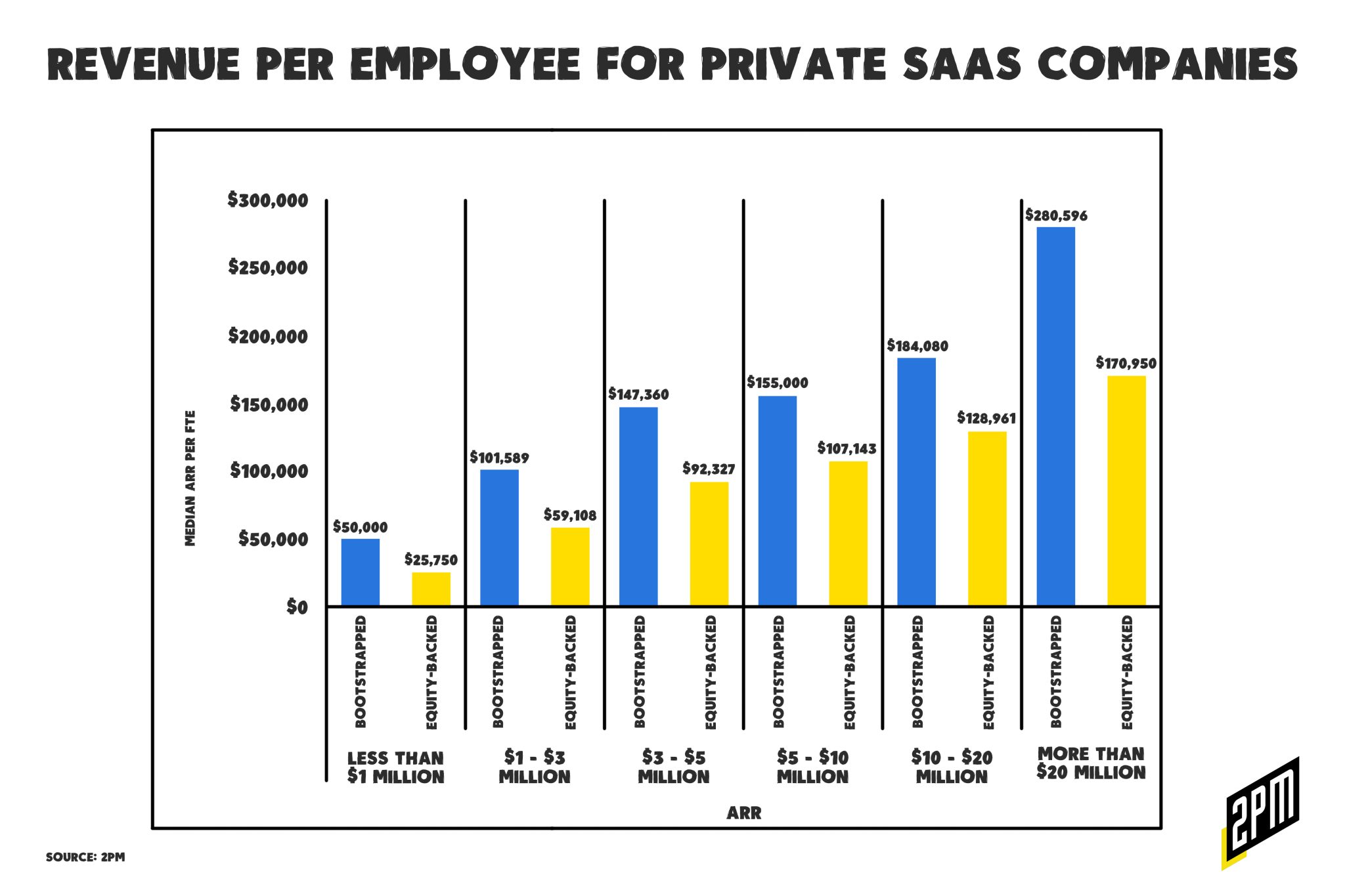
And this is how companies will be judged. A firm well-known to many in big tech, Wilson Sonsini measures success by RPE. According to data by The American Lawyer, the firm’s RPE and headcount have grown precipitously since 2019. Law.com began its March 2023 analysis with:

Wilson Sonsini’s profits per equity partner fell 9.5% as the firm bulked up its lawyer head count to 1,045 lawyers including 266 partners.

In today’s rapidly evolving business landscape, companies are increasingly seeking new ways to evaluate their performance and long-term prospects. Traditional metrics such as revenue, net income, and market capitalization have been widely used for years, but they may not tell the whole story, especially for big tech companies. The comparison between big tech companies and law firms is based on the premise that both types of businesses will be judged by this OKR in the coming years.

The Case For A New Measurement

RPE is a simple yet powerful metric that divides a company’s total revenue by the number of its employees. This ratio indicates how much revenue each employee contributes to the business, offering valuable insights into the company’s efficiency, productivity, and ability to scale. There are several reasons why RPE is becoming an increasingly important metric for big tech companies:

Focus on Efficiency and Productivity

RPE helps measure how effectively a company is utilizing its people, a critical component of any organization. But also, how those people perceive their role in the growth and health of the company. Senior Research Analyst for Yahoo Tom Forte cited the type of role that saw early attrition at Amazon, i.e. ones that didn’t directly impact revenue growth:

So if you look in particular at the March quarter and the June quarter last year, they had about 100,000 attrition between those two quarters, and it was mostly not rehiring someone to replace someone who left at the fulfillment center level.

A higher RPE ratio implies that the company is generating more income with fewer employees, indicating a more efficient and productive business model. As Amazon begins to show, they’re willing to explore whether or not they can accomplish “more” with fewer cost centers.

Attraction and Retention of Talent

Talent is a critical resource in the tech industry and companies need to ensure they can attract and retain top talent to maintain their competitive edge. A higher RPE ratio suggests that the company is utilizing its workforce effectively, which can lead to increased employee satisfaction and loyalty. This, in turn, can help attract new talent and reduce turnover, contributing to the overall health and growth of the company.

Scaling and Growth

As tech companies grow, they often face challenges in scaling their operations efficiently. RPE can help identify whether a company is maintaining or improving its productivity as it expands. A consistent or increasing RPE ratio during periods of growth suggests that the company is successfully scaling its operations, which is essential for long-term success. Barron’s recently published relevant numbers:

Apple generated around $2.4 million in revenue per employee in its latest fiscal year and has averaged around $2.1 million on the same metric over the past five years, according to FactSet. That far outstrips Facebook-owner Meta (META), which generated $1.35 million in revenue per employee in 2022—below its five-year average of $1.5 million.

This gives us a uniform means of comparing companies regardless of their status as a public or private company.

Use in eCommerce and Retail

RPE can serve as a valuable benchmark for comparing companies across the tech industry. The Information framed this public vs. private tech company conversation as such:

An unfavorable comparison to Adyen is a surprising turn for Stripe, a startup brand that became a near-holy name in Silicon Valley. Its early rapid growth and exposure to the fast-expanding e-commerce market helped the payments firm raise more than $2 billion from some of venture capitalists’ biggest names over a dozen years. After it raised money in early 2021 at a $95 billion valuation, it was one of the most highly valued startups in the world.

In comparison, Adyen raised just $200 million as a private company, although it raised  hundreds of millions when it went public in its 2018 initial public offering. Its current market capitalization is about $44 billion.

By evaluating this metric, investors, analysts, and other stakeholders can gain a clearer understanding of how well a company is performing relative to its peers, which can help inform strategic decisions and investment opportunities.

Shopify was ahead of the curve in discussing the potency of this measure in retail. RPE is the key metric for assessing the health and prospects of big tech companies, but can be used to assess brands as well.

If you’re looking for real-life examples of how brands calculate RPE, let’s take data from 2PM to calculate the average revenue per employee popular retailers make. Knix: has 127 employees generating an average revenue of $70.5 million per year. That comes out to $555,118 revenue per employee. Boll and Branch: has 116 employees generating an average revenue of $80.8 million per year. That equates to $696,551 revenue per employee. Everlane: has 309 employees generating an average revenue of $361.2 million per year. That equates to $1.68 million revenue per employee.

By focusing on efficiency, productivity, talent attraction and retention, in addition to scaling, RPE provides valuable insights into a company’s performance that traditional measures may not capture. It also emphasizes the importance of efficient profit-seeking. As the tech industry continues to evolve and face new challenges, RPE will play a crucial role in helping companies navigate the competitive landscape and achieve long-term viability.

By Web Smith | Edited by Hilary Milnes with art by Alex Remy and Christina Williams

Member Brief: How Meta Wins After All

For once in our months-long coverage of the changing advertising landscape, there is momentum on the side of Meta’s resurgence in the advertising space. With political pressure to reduce TikTok’s influence over American consumers, the door is open for Meta to recover the attention market that it lost. This, as the Facebook and Instagram parent appears to be investing heavily in improving its post-ATT advertising marketplace.

This member brief is designed exclusively for Executive Members, to make membership easy, you can click below and gain access to hundreds of reports, our DTC Power List, and other tools to help you make high level decisions.

Join Here

Memo: The Greatest App Ever Scrolled

It’s one of the most impressive media properties in the world and one of the best (and most obscure) examples of linear commerce that I’ve stumbled upon (move over, Michelin). But you won’t find many success stories written about it.

Today, its track record, growth, and technology are on par with many of the strongest technology companies in the United States. It has one ownership group, no venture capital, and – with the exception of one 2013 New York Times article – it has gone virtually unnoticed by business or mainstream media. And still it is home to one of the largest online communities in the world. With just 165 employees (many of whom could work for any major tech company), it is responsible for over 545 million users and 5.5 billion app opens. Over 497 million videos have played through the app, it has 2,600 translations to cover as many formats and languages as it can. It sounds world changing to me. There are only few precedents for this type of reach.

Take a step back into time for a moment to understand the significance of the YouVersion Bible App.

The Gutenberg press is in part to thank for the boom in European literacy, the Italian Renaissance, the scientific revolution, the Age of Enlightenment, and Protestant Reformation (Martin Luther was once the world’s most published author). Gutenberg’s invention allowed for the mass production of books for the first time in human history. In 1455 Mainz, Johannes Gutenberg printed 180 copies of the Bible and from there, made history. In the larger scope, Biblical scholars now consider YouVersion to be a key player in the next third in how the book is consumed:

  • scroll to codex
  • codex to the 15th century printing press
  • printing press to digital media

Innovation comes in all shapes, sizes, industries, and denominations. This report on an unheralded little mobile application headquartered in Edmund, Oklahoma may shock you, guide you, or even encourage you. It’s not objective; the app has played a major role in my previous year of deep thought and reflection. From that 2013 report on the then-eight year old company, here is a standout quote by former Kleiner Perkins investor, Chi-Hua Chien:  

This is a remarkable tech startup by any measure.

Now the managing partner of Goodwater capital, Chien went on to compare YouVersion to then-hot companies Pinterest and Path, a now-defunct social media network that garnered wide praise, 50 million users (in 2013), and a $500 million valuation. At a tenth of the size of the app at the center of this report, it begs the question: what can we learn from its trajectory? Regardless of belief, this business deserves the Harvard Business case study treatment. This will have to suffice in the meantime.

The YouVersion Bible app, which was first launched in 2007, has had a significant impact on the growth of Life.Church and Christianity as a whole. Bobby Gruenewald, the CEO and founder of YouVersion and Life Church’s Pastor and Innovation Leader, has all of the pedigree of your traditional Silicon Valley entrepreneur:

As one of the leading voices in the Church on innovation and the use of technology, Gruenewald has been featured in The New York Times, TechCrunch, CNN, and more. Prior to joining the Life.Church team in 2001, he started and sold two technology companies as well as served in advisory capacities for various startups and venture capital funds.

Life.Church was founded in 1996 by Craig Groeschel, a leader that impresses with every book, sermon, podcast, and leadership session I have observed by him. Under Groeschel’s leadership Gruenewald left traditional business to work for Life.Church, and seven years later with Tory Storch, he co-founded YouVersion. The side project became one of the foremost media companies and spiritual development tools on earth. Here is Groeschel in an earlier interview on the genesis of the YouVersion app:

As our team thought about how Gutenberg’s invention revolutionized the accessibility and distribution of Scripture hundreds of years ago, we wondered how technology might be able to do something similar for our generation. So, we launched a website specifically designed to create community around the Bible. The only problem was — it didn’t work.

As a last-ditch effort, we offered a mobile version of the site and engagement took off. Shortly after, we heard Apple would be launching something called “apps.” With the momentum of the mobile site, we asked ourselves, “What if the Bible could be one of the first apps in the App Store?” We had a 19-year-old guy on staff create the first version of the YouVersion Bible App, and within three days we saw it downloaded on 83,000 devices.

The app has made the Bible accessible to millions of people worldwide through its free and user-friendly platform. It offers various versions of the Bible, reading plans, and devotionals, which have encouraged individuals to engage more with the scriptures on a daily basis. Additionally, the app’s social features, such as the ability to share verses with friends, have facilitated personal connections and helped to spread the message of the gospel.

As a result of these features and the overall growth of iPhone and Android usage over the last fifteen years, Life.Church and many other Christian organizations have been able to reach and impact more people than ever before. Like the Gutenberg Press, the app has been instrumental in promoting biblical literacy, fostering spiritual growth, and strengthening the faith of its users. It has also helped break down geographical barriers and connected people from diverse backgrounds, allowing them to engage with one another and share their faith journeys. It’s no coincidence that Groeschel and Life.Church now steward over 35 physical locations with 85,000 members, according to Outreach Magazine, the authority on tracking fast-growing churches.

Both the Gutenberg Bible and the YouVersion app have played a major role in increasing access to the Bible and making it easier for people to study and engage with the Christian faith. They have also had a profound impact in this way.

Let’s look at this from a purely business perspective.

Technology is in Life.Church’s DNA. Because of Groeschel’s ability to think and hire smart people, the church is likely the largest in the world. The YouVersion Bible App was formative in the trajectory of the church’s growth and its ability to raise funds for debt-free expansion. The app’s social features have helped democratize access to the Bible and other tools that were never centrally-located prior to YouVersion. These features have contributed to a more engaged and connected Life.Church community, ultimately leading to its growth. What’s even more impressive is the financial technology built within the mobile app.

Smooth, in-app eCommerce functionality with subscription capability.

With Apple Pay, Paypal, and other one-click tools, the app supports its own growth without the continued investment from Life.Church (it is reported that the app’s initial investment exceeded $20 million). Imagine: just a few years after the growth of Facebook from college campus to college campus, Groeschel felt compelled to pitch a world-changing mobile app to his first campus in Edmund, Oklahoma. Still, there are plans for more.

In a 2021 article in the New York Times on Facebook’s intentions for integrating more religious content into its platform, Gruenewald explained:

Facebook’s outreach was the first time a major technology company wanted to collaborate on a development project. Obviously there are different ways they ultimately, I am sure, will serve their shareholders. From our vantage point, Facebook is a platform that allows us to build community, and connect with our community and accomplish our mission. So it serves I think everybody well.

His point of contact at the company (now Meta) was Nora Jones, who served as Meta’s direct of global faith partnerships. On January 19, she left Meta to join YouVersion as the Chief Content Officer. Hiring Jones and other pedigreed executives from Fortune 500 companies is all a part of the plan, according to Gruenewald. The article goes on:

Currently, 165 people work on the app, said Gruenewald, and there are plans to double the team in the next few years.

It’s a remarkable story of an alternative to the growth customs of any organization, one whose success story from a two-car garage in 1996 is already enlightening and encouraging enough.

Over the last 317 consecutive days (at the time of publishing) and counting, this app has quite literally changed how I view the world. I am a product of its numerous “growth hacks.” The app sat dormant on my phone for nearly a decade. Here is a summary of the eight most effective ones:

  • universal access: 2600 versions including 50 English versions
  • UCG: daily devotionals and reading plans
  • feel good: badges for streaks and participation
  • daily reminders: maintain your habit of study, meditation, and prayer
  • audiophile: you can now listen while you work
  • streaks: just like Snapchat but the Bible
  • reason to login: a verse of the day, each day, everyday
  • leadership through love: a team devotional function that helps others around you

The last hack is the one that turned a dormant app into a daily fix for me. A venture-backed entrepreneur in the eCommerce logistics industry reached out to me in December 2021 and said, “Join my men’s devotional group.” I did. And then, weeks later, I kept digging and digging until I decided to drop what was once important to me. I went all=in on really studying and understanding. I began to read what I should have been reading all along.

The Gutenberg press began with a bible and unlocked a tidal wave of secular literary milestones that changed humanity. What lessons from this will be applied to modern business? I suspect that as more people learn of this story, there will be more than a few.

The business of church is incredibly difficult to navigate. Few organizations have the tech-adjacent entrepreneurial spirit that Groeschel cultivated in Oklahoma. It began with what I suspect to be a key question: “What is our Gutenberg press?” That’s a big question that requires a moonshot of an answer. His was to self-fund one of the first 200 free apps in thee Apple app store in 2007. The result is the most far-reaching and powerful media company in the modern church. Over 545 million people later and I think he’s found his answer. I am eternally grateful for it.

By Web Smith | Edited by Hilary Milnes with art by Alex Remy and Christina Williams