No. 340: A Mobility Collision Course

Steve Jobs believed that one of the few things that separated humans from high primates was our ability to build tools. In some cases, these tools mitigated the crippling inferiority of human mobility. Compared to some animals, humans possess lesser top end speed, endurance, and efficiency of movement. It’s our ability to engineer solutions that ultimately improves our collective mobility. Jobs assessed these shortcomings in a 1995 interview:

I read a study that measured the efficiency of locomotion for various species on the planet. The condor used the least energy to move a kilometer. And, humans came in with a rather unimpressive showing, about a third of the way down the list. It was not too proud a showing for the crown of creation.

Over the course of Jobs’ career, he predicted the future quite a few times. He foresaw what the inter connectivity of internet would do for humanity. He predicted the efficacy of the computer’s mouse, and the dawn of cloud computing, and the professional preference of the laptop computer. Jobs even understood that the diffusion of this technology would be so profound that ten year olds would own computers that are orders more powerful than the ones used by 1960’s-era NASA engineers. But it was perhaps his two distinct thoughts on figurative and literal mobility that may go on to define the next ten years of disruption.

Jobs indirectly recognized the inverse relationship between online retail and shopping centers:

People are going to stop going to a lot of stores. And they’re going to buy stuff over the web.

The second thought expounded on his obsession with human physical efficiency:

Somebody at Scientific American had the insight to test the efficiency of locomotion for a man on a bicycle. And, a man on a bicycle, a human on a bicycle, blew the condor away, completely off the top of the charts.

This line of thinking is the origin of Jobs’ commentary on the personal computer serving as a proverbial bicycle for the mind. According to Jobs, “What a computer is to me, is it’s the most remarkable tool we’ve ever come up with. It’s the equivalent of a bicycle for our minds. Walking is relatively slow and inefficient.” This remarkable thought may end up meaning something more than what Jobs meant at the time.

The advancement of mobile payment technology and the evolution of physical mobility are on a collision course. The diffusion of one technology may lead to the diminishing of the other. There is no greater example of the potential disruption than China’s stark contrast to the nature of American retail. Cashless consumer economies will have a profound effect on mobility. Paul Haswell of Pinsent Masons notes:

Many Chinese cities are now the closest we have to cashless consumer economies.

According to eMarketer’s Shelleen Shum: 79.3% of smartphone users in China will operate within a completely cashless economy. By comparison, the United States will see just 23% of smartphone users doing so by 2021. And Germany will have just 15%. Why is this significant? The move towards a cashless economy corresponds with a shift in mobility preferences. “The use of digital technologies—from smartphones and wearables to artificial intelligence and driverless cars—is rapidly transforming how city dwellers shop, travel, and live.Without a firm foundation in electronic payments, cities will not be able to fully capture their digital future, according to our analysis,” said Lou Celi, Head of  the Roubini ThoughtLab.

No Title

Mobile payments are influencing a collision course. No. 1 market for mCommerce (payments) is China. Here is a quick comparison. Mobility:1a/ US cars per 1000: 8381b/ China’s cars per 1000: 179Retail locations:2a/ US sq. ft. / person: 23.5 2b/ China sq. ft. / person: 2.8

And here is the key question. If the United States is moving towards a cashless society driven by mobile wallets and smartphone-driven payments systems, will the shape of our economy begin to change with it? The data affirms. The shuttering of American retailers outpaced all of 2018 by April of 2019 according to data from Coresight Research. As of now, the correlation does not rely upon mobile payment tech. Rather, it’s driven by the growing adoption of online retail. However, online retail adoption in China is driven by mobile payment technologies. American adoption of such technologies will accelerate overall growth. The percentage of retail in the form of eCommerce will hockey stick when it does.

Smart Cities and Urban Mobility

9db5098f3d10fea0f7d35b394714b6ae9518277c_2_1380x840
From Polymathic: The market opened to red, post Black Friday 2019.

There may not be a greater example of the potential clash between online retail and mobility than the city that is quietly known for its specialty retailers. In retail circles, Columbus is known as HQ City; the Central Ohio region is host to Abercrombie & Fitch (and Hollister), L Brands (Victoria’s Secret, Bath & Body Works, etc.), Express, Ascena Retail Group (Limited, Justice), DSW, Value City Furniture, and ties to American Eagle Outfitters. There isn’t a mall in the United States that isn’t influenced by this region’s businesses.

For Columbus, it’s a double-edged sword. The city’s working population is heavily influenced by this small group of very large employers. And these large employers have a symbiotic relationship with America’s inflated 23.5 square feet of retail real estate / person. In comparison, China has just 2.8 square feet of retail / person. Despite this lacking physical infrastructure, China passed the United States as the number one retail market in 2019. [1]

In 2015, Columbus, Ohio applied for a national grant for the Smart City Challenge, a national competition between a collective of technologically progressive cities.

Smart Columbus will help shift travel patterns. Even more, we want to shift people’s thought patterns and behavior. This means inspiring policy makers and influencing people’s preferences. We will partner with others to create programs, introduce new solutions and promote adoption. Once our city understands what’s possible, everybody should be able to get on board. This will be a gradual process over the coming decade. As a region with urban sprawl, we are committing to a new, improved ecosystem of solutions to move people and goods. [2]

A smart city is tasked with testing technological solutions and progressive policies to innovate mobility practices. As the winner of the first-ever Smart City Challenge, the city agreed to embrace the “reinvention of transportation to accelerate human progress.” The city would then serve as a standard bearer to other cities as they continue to evolve. In 2017, the city outwitted dozens of other top cities to include: Pittsburgh, San Francisco, Portland, Kansas City, Austin, and Denver. The result was an award of a combined $50 million grant from the US Department of Transportation and the Paul Allen Foundation.  This award would then be amplified by hundreds of millions in public-private partnership, generated by the cities own businesses and political partnerships.

Through the Smart City Challenge, the Department committed up to $40 million to one winning city. In response, cities leveraged an additional $500 million in private and public funding to help make their Smart City visions real. [3]

Screen Shot 2019-12-02 at 1.44.24 PM
United States: eCommerce as a share of retail

The data suggests that the advancement of eCommerce adoption would influence mass transit and ride sharing as primary means of urban travel. This same data would suggest that eCommerce would also spur economic development in harder to reach areas of the region. But it would have to get much worse before conditions improve. Some 92% of the citizens in China’s largest cities use Alipay or Wechat as their mobile wallets and sole means of transacting. In rural China, that number is 47%. In both cases, the primary means of retail is through eCommerce channels. In contrast, America will see just 12.4% of retail by eCommerce in 2020. For rural citizens and underbanked Americans, that number is significantly lower. The majority of eCommerce transactions are located in or near major metropolitan areas. This is relevant and will be explained shortly.

Black Friday 2019

In September of 2017, the proverbial floodgates opened. Amazon’s patent for one-click purchasing expired. With this, any and every online retailer could build or integrate payments solutions to promote better consumer experiences on desktop and mobile platforms. The improved experiences were especially noticeable on mobile operating systems, where dropped carts were commonly 60+%.

The end of Amazon’s hold on one-click ordering gives opportunities to large and small retailers to reap benefits they haven’t had before. Perhaps the most widespread benefit will come in the world of mobile commerce where there are high rates of cart and purchasing abandonment. […] The patent expiration will allow for widespread adoption of one-click purchasing, which will challenge the market to adapt quickly. There is an opportunity for major reconfiguration of social networks to challenge major e-commerce giants such as Amazon.  [4]

This coincided with the integration of tools like Apple Pay, Android Pay, and Shopify Pay, three solutions that would fuel mobile commerce in ways that were only previously seen in Chinese markets. Apple Pay recently crossed Paypal in volume of transactions. Amazon’s YoY growth was closely tied to the stickiness of similar technologies. An unnamed Shopify analyst suggested that with Shopify Pay, conversion rates were nearly identical to Amazon’s – an extraordinary improvement in performance between 2016 and 2019.

Screen Shot 2019-12-02 at 1.42.59 PM
United States: Projected revenue from mobile commerce ($B)

Over this most recent retail holiday, there was a contrast to observe. In 2PM’s most recent Executive Member Report, I explain the context behind the title “The Blackest Friday.” According to data pulled from Alibaba, Amazon, and Shopify – Black Friday was a success for the burgeoning eCommerce ecosystem and a disappointment to traditional retailers like Kohl’s, JCP, and Nordstrom. The holiday shed light on the growing divide between mobile adoption and the dependence on traditional retailers.

No Title

It wasn’t deals that drove the BF, it was ease of purchase. Via Adobe Analytics: 1/ 39% of eCom: mobile2/ 61% of traffic: mobileAnd Shopify added 400k stores in 2019. The avg. BF $ / merchant dropped just 1.8%. Payments ease mitigated the lack of trust or perceived value.

Adobe, which now owns Magento, revealed data that communicates a permanent shift toward mobile traffic (61% mobile). Shopify’s data (69% mobile) reflected the same. Physical retail continued to slip.

The drop in Black Friday physical shopping mirrors a year-long share pullback in departments stores including Macy’s, Kohl’s and Foot Locker, all of which are down more than 25% this year. Meanwhile, Amazon, the dominant U.S. e-commerce retailer, has gained about 20% this year. [5]

For Shopify, the result was especially positive. On the heels of Apple Pay adoption and the growth of Shopify Pay,  the company added 400,000 new stores in 2019 while dropping just 1.8% in average store revenue on Black Friday. This tells a story. Despite the relative infancy of nearly 40% of the stores on the platform, new merchants were able to generate nearly enough in sales volume to match the per capita avg sales figure of the previous year’s merchants. This would indicate that the shift away from desktop and towards mobile payments mitigated issues of trust or early-stage brand equity concerns by lifting conversion rates. As mobile payment adoption increases, the divide between DTC-minded brands and traditional retailers will continue to grow. So where does this get us?

Conclusion: On Primates and Politics

If you’ve ever frequented Amazon Prime Now, you understand the value of two hours saved. In a matter of 90 seconds, you can click through on recently purchased grocery items to replenish your pantries. Then, in a matter of 60-90 minutes, those selections manifest. There are four packages at your door. When Steve Jobs suggested that software engineering would impact our mobility, it’s unlikely that he imagined the effect that mobile commerce would have on developed cities. Mobility isn’t just the efficiency, speed, or distance traveled. It’s what we can do with our time. Mobility is freedom.

When Columbus, Ohio was awarded $50 million to build the blueprint for a smart city, it’s unlikely that the city’s leaders understood the ties between commerce technology and physical mobility. If so, the heaviest investments would have been earmarked for commerce infrastructure:

  • improving shipping lanes by designating key routes for delivery vehicles and couriers
  • retrofitting struggling malls and shopping centers as fulfillment hubs
  • investing in the numerous local businesses by equipping them with the same types of technologies that enable the DTC mobile revolution
  • repurposing successful malls as meeting grounds, deemphasizing the emphasis on shopping
  • and laying the groundwork for a city with 60-80% fewer cars and 70-90% fewer shopping centers

America is over-retailed. And unfortunately, innovation in online retail will exacerbate this. For Columbus (and many other forward-thinking cities), this is a conflict of interest. As regions shift toward mobile commerce-forward models, old ways of retailing will subside. And given early data  – the numerous retailers that are headquartered in and around the city would be placed at existential risk.

It’s for this reason that Columbus serves a microcosm of traditional retail as a whole. The industry will have to choose between its past and its future, both of which are tied to shifts in mobility innovation.  Like Jobs said in 1995: “People are going to stop going to a lot of stores. And they’re going to buy stuff over the web.” This is beginning to reflect in public and private markets. What happens when we stop driving to stores? What happens when shopping centers no longer have sufficient demand? What happens when advancements in last-mile delivery becomes carbon negative? This is happening now.

The largest retail economy in the world is no longer the United States. But this will potentially change, as the United States closes the gap in mobile computing and payments adoption. China has 10% of the retail square footage and 79% fewer cars. This should give us pause. These numbers provide a bit of foresight into how this country must adapt to modern retail. Computers did become the bicycles for our minds. And now, advancements in mobile computing and payments are influencing physical mobility. The smartest cities will correct for these advancements before the markets correct it for them.

Research and Report by Web Smith | About 2PM 

No. 338: UpWest and Hygge

Hygge-2PM

A publicly-traded retailer launched a DTC brand. This is a deep dive into their reasoning, the build, and their internal expectations. 

Middle-class retail is at an impasse. Since the beginning of 2019, there have been 19 bankruptcies to include Forever 21, Gymboree, Charlotte Russe, Payless ShoeSource, Diesel, and Destination Maternity. And there are another eight retailers at risk to include: J.C. Penney, Neiman Marcus, J. Crew, and Hudson’s Bay. In Gilded Age 2.0, I explain that our current retail era signals a casualty of the middle class consumer; a class that once emerged in response to the industrial and financial booms of the late 19th century and the governmental reforms of the mid-20th century.

With a flailing gig economy, stagnant wages, and rising personal debts, 2019 presents a break from the mid-century momentum that defined the 20th century. We are beginning to hear faint echoes of an earlier time of boom or bust and feast or famine. Rather than appealing to pure luxury consumers or fast fashion-loving millennials, the “long middle: erroneously remains the bullseye of the target. Retailers have been slow to optimize for a new market of coveted consumers.

In a recent report by Business of Fashion proclaimed that America still doesn’t have an answer to LVMH. They explain:

Spoilt for choice, consumers are less interested in mid-priced products available at scale: they want dangerously affordable fast fashion or pure luxury. (And preferably at a discount.) It’s harder for consumers to see the value in something that is not cheap but not that expensive, either. Especially if it’s not utterly unique. That’s a problem for Tapestry in particular, which deals exclusively in accessible luxury. [1]

Against the backdrop of abundant choice and a bifurcating market, Ohio retailer Express launched a new brand. Express is currently trading at a $265 million market cap with north of $2b in sales. The cost of that revenue is extraordinarily high compared to healthier retailers. Trailing twelve months, Ralph Lauren Corporation earned north of $6.5 billion with a $2.45 billion cost of revenue.

In contrast, Express earned (TTM) north of $2.1 billion with a $1.5 billion cost of revenue. A 25% gross profit margin heading into a crucial holiday season, the Columbus-based retailer hopes to use the DTC initiative to improve their long-term outlook. The effort has been met with a mix of pessimism and optimism. 

Pierre Kim of Away

For years, retailers have been criticized for not evolving quickly enough to meet the demands of their customers, so what do they have to lose with this new strategy? Their core labels may be faltering, but they still have brand equity. Why not use it to experiment and launch new businesses?  [2]

Paul Munford of Lean Luxe

There’s baggage associated with being under a legacy retailer’s umbrella—it decreases the value of the brand to the savvy consumer,” he said. “However, execution will always ultimately be the key here. Spinoffs need to feel like their own entity, as opposed to a sub-brand of the legacy retailer. [2]

There are merits to both arguments. And a little bit of digging provided more clarity for this report. Under the umbrella of Les Wexner’s Limited Brands, Express launched as women’s clothier “Limited Express” in 1980 Chicago. Led by CEO Michael Weiss, the brand expanded to eight stores in 1981 and by 1986, Express began a test for menswear in 16 of its 250 stores. The men’s line spun out as Structure in 1989.

I remember the brand very clearly. As a twelve year old in 1995, the halls of my middle school were split between the haves and the have nots. For the ones with, shirts by Polo and Structure were the daily wears and all I could remember is the sensation of having neither.

4
Remember this?

The advancements that Express made during that 20 year run are astounding to think about. In 2001, Express became a dual gender brand – a pivot that Madewell is currently attempting to execute. Structure “sold” to Express, or at least that’s how I remembered it. Because immediately, I became a fan of Express. In actuality, the brand was owned by the same holding company. It funneled its mens business to a brand that provided more opportunity. L Brands then, quietly, sold the mark to Sears in 2003. The Structure brand was never heard from again.

Express is no longer owned by L Brands, one of the most prolific builders of retail brands in history. It was sold to Golden Gate Capital Partners, a private equity firm with $15b in assets under management. And then, in May of 2010, the retailer went public.

Demographic vs. Psychographic | Part Two 

In 2016, Express made its first play for the direct-to-consumer era by acquiring a minority stake in HOMAGE, the Columbus Ohio retailer led by founder Ryan Vesler. It’s a genuine brand, one where the founder-product fit is as valuable as its product-market fit. The minority investment with vintage t-shirt company meant that Express bought a new audience of a key demographic: the college-aged millennial.

Homage President Jason Block said in an email that Express will consult with the company on an ongoing basis and the investment will allow Homage to expand both its digital and brick-and-mortar presence. [3]

Aside from investing in a growing company,  Express gained the rights to include a limited selection of HOMAGE products in store. The investment was intended to bolster foot traffic while, potentially, benefitting from the long-term flip – if and when the HOMAGE brand grew with the help of Express. It’s unclear whether or not this initiative was successful for either of the brands. The company is currently trading below the price it maintained during the period that Express began its partnership with HOMAGE. The publicly-traded retailer’s missteps over the past two years were due, in part, to a number of macroeconomic shifts.  The launch of UpWest represents a strategy shift of its own.

In Psychographics in Focus, I explain the difference between a demographic and psychographic. Consumer psychology involves the interest in lifestyle, behavior, and habit. It’s an encompassing measure that considers our idiosyncrasies, our temperament, and even our subtle personality traits. These are the variables that influence our behavior as consumers. Psychographic segmentation is the analysis of a consumer cohort’s lifestyle with the intent to create a detailed profile. [4]

Taking a community-building approach, UpWest plans to connect with new customers through experiential events, including a regional tour across the US that features the UpWest Cabin, a mobile pop-up exhibit featuring relaxation-focused experiences like yoga and meditation classes. Slated stops include Columbus, Chicago, Nashville, Denver and Austin.  [2]

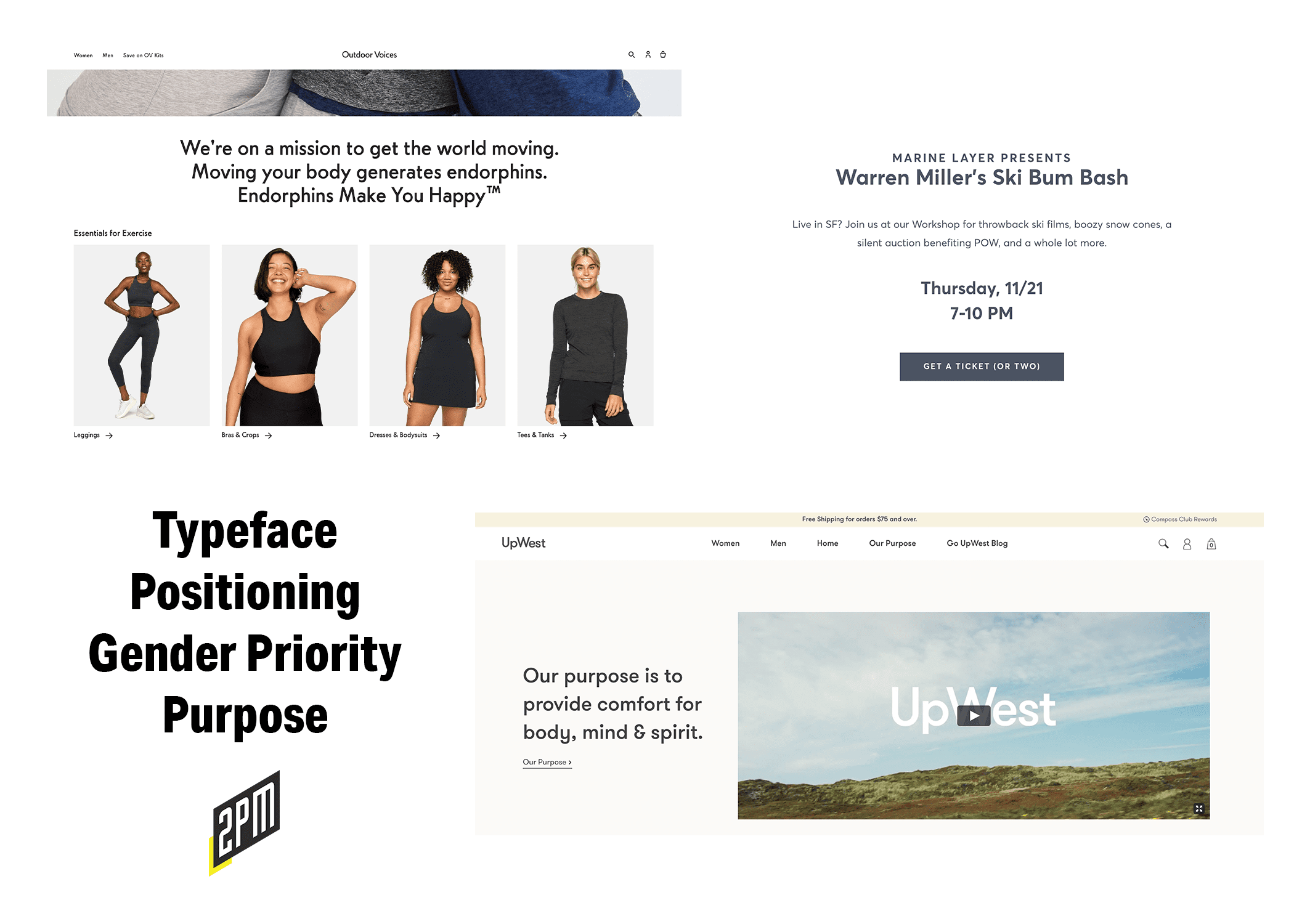
From the typeface, to the story-telling, to the merchandising – the UpWest brand is designed to attract fans of the digitally-native industry. Rather than a specific demographic, Express pursued an interest (DTC) and is building a brand atop of that engaged audience.

DTC As A Psychographic

Web Smith on Twitter

DTC, 2012: a tech stack strategy. DTC, 2016: a logistics strategy. DTC, 2020: a brand strategy.

In a span of three days, I received multiple emails and texts from contacts close to the launch of UpWest. Kaleigh Moore, Forbes writer and 2PM collaborator had a story in queue by then. In the Lean Luxe Slack, it was a topic of conversation. Rather than building in-house with Express’ existing engineering group, UpWest contracted Shopify agency BVAccel to handle the design and development work. This was a nod to several of the most successful digitally native brands in the space to include Untuckit, Cubcoats, Chubbies, and Rebecca Minkoff. 

Comparison-Upwest

The site’s architecture communicates a desire to be mentioned in the DTC conversation, this includes UpWest’s partnership with Klaviyo and its new-age loyalty program. It would appear that UpWest chose to focus on the DTC psychographic for the sake of earned media and brand positioning. As far as the nuts and bolts are concerned, the site’s build communicates that the desired target demographic is millennial-aged women. On day zero, the brand has an explicit purpose: to provide comfort for body, mind, & spirit. The clothes, are priced similar in design and price to Marine Layer – its next closest competitor.

Identifying Waves: Importing Hygge to America

In the past year, this concept of Scandinavian coziness has made inroads with an international audience. [5]

Imagine a whiteboard in one of Express’ suburban Columbus boardrooms; the word “hygge” would have been at the center of it in big and bold lettering. You can picture the brand’s chief comfort officer (and Express’ SVP of Strategic Initiatives) standing in the corner of the room, jamming as Cody’s It’s Christmas plays on the room’s four Sonos speakers. The brand wants you to feel a feeling. Analysts agree. Emily Singer, founder of the DTC newsletter “Chips and Dip” had this to say:

There’s something very boring about it. Maybe that’s intentional. This line feels a little too on the nose: ‘Welcome to curated comfort. For those who are seeking peace and calm in a stressful world.’ Brands tap into emotional states, but it’s rarely laid out so explicitly.

It’s this perceived boredom that is viewed as an understated luxury in American culture. To the Danes, hygge is free of economic status. The culture’s entire focus is on practicality, movement, wellness, and mindfulness. It’s this underlying culture that Express hopes to import with the help of some obvious visual cues from well-known DTC retailers.

The UpWest typeface is nearly identical to the typeface of Outdoor Voices and Marine Layer’s. Ironically, both retailers have references to Scandinavian hygge throughout their brand messaging. But for UpWest, there’s no understatement. Every message is turned to maximum volume. Like the primary header of Express.com: UpWest’s primary menu is a throwback to “Limited Express”, a retailer for women-first and men-second. There are elements of luxury abound. Upwest’s blog features new-age terms like: nourish, mindfulness, tranquility, and sanctuary. The traveling pop-up is a “cabin.” These are all symbols of wealthier millennials with time and resources to spare. As is the concept of philanthropy and sustainability (though UpWest sells products that are made with synthetics).

It starts with our cozy apparel, home and wellness products. We want to surround you with calm and give you balance. But it’s not just the tangible things. It’s also about slowing down. Diving deeper. And giving back.

Not to be outdone, UpWest wants consumers to help them donate $1 million to the Mental Health Association. The Express-borne retailer plays the entire DTC hand of cards. This report began with a simple statement: middle-class retail is at an impasse. To the average consumer, this DTC play is akin to Structure being launched as Express Men. Like a sheep, the seventeen year old me bought from Express as soon as my adolescent wallet would allow. The mechanics are similar here. Express is attracting an existing audience (the DTC psychographic) and using it to invigorate a brand that is plateauing.

Conclusion

The UpWest bet is that the retailer can earn the business of the upwardly mobile DTC audience by engineering a product-market fit. One with heavy branding, ideal-alignment, and market messaging. This is one of the first upmarket attempts that we’ve seen from a specialty retailer. It’s one that deserves praise. Their management team engineered a brand with contemporary pricing and luxury messaging – void of pricing promotions (for now). They’ve acknowledged that the data shows a middle-class at an impasse. They have the supply chain, the logistics, the distribution, and a snapshot of a brand. But do the executives at Express truly understand what makes the top DTC brands work? That remains the question that could move the market.

Time will tell if Express can duplicate the brand architecting of their L Brands era – a time defined by face-less brands, clever signage, billboards, and foot traffic. My guess is that Express will find an audience that is more sophisticated and critical than the young adults of the 80’s, 90’s, and 2000’s. Messaging, distribution, and customer acquisition methods will evolve with this realization. And if that’s the case, their hygge may be tested for quite some time.

Research and Report by Web Smith | About 2PM 

Memo: The Gilded Age 2.0

thegildedage.jpg

Mark Twain once wrote, “History doesn’t repeat itself but it often rhymes.” According to historians, the groundwork for the New Gilded Age began in 1990. Nearly 30 years later, the age of the “robber baron” industrialist and the cutthroat financier has returned. Since that time, there are few industries that have seen the magnitude of disruption that housing and retail have endured. Nearly 26,000 stores have closed in the past three years; 2019 will double 2018’s closures. There are echoes of this bifurcation throughout the physical and digital spaces of commerce. Contrary to popular opinion, retail isn’t dying. Instead: changes in earnings, increased debt loads, and decreased consumption rates are beginning to polarize some consumers. The middle is being squeezed and retail failed to anticipate this socio-economic shift.

“The retail reckoning has only just begun.” Those are the words of reporter Jack Hough who released a blockbuster, paywalled report for Barron’s. But reckoning and death are not necessarily synonyms in this context. Retail is not dying, it is bifurcating. In The Ballad of Victor Gruen, the boom and bust of retail real estate is explained through the lens of socio-politics and tax policy:

Source: Barron’s

According to CNBC reporter Lauren Thomas, apparel mall retail profits are at recession levels. As of June 2019, Macerich, Simon Properties, Kimco, Washington Prime Group, and Taubman properties are trading at five-year lows. There aren’t enough viable challenger brands (DTC) to fill the 67,000+ store closures projected by 2026. So, it’s difficult to determine whether or not an American retail empire built on post-war consumerism, suburbanization, and accelerated depreciation will return to its former glory. But when we wonder how the “retail apocalypse” happened, look to 1954.[1]

Per capita, America is over-retailed; it always has been. But for nearly 60 years of suburban retail expansion, it seemed as though the industry would never contract. According to Randal Konik, an analyst with Jefferies: “There are about 1,350 enclosed malls in the United States but only 200 to 400 are needed.” But while retail stores shutter, sales are expected to grow 3.5% to $3.7 trillion. According to reports by UBS, it may take ten years to reach the equilibrium (1,350 to 200). The investment bank forecasts 75,000 additional stores closing in that time.

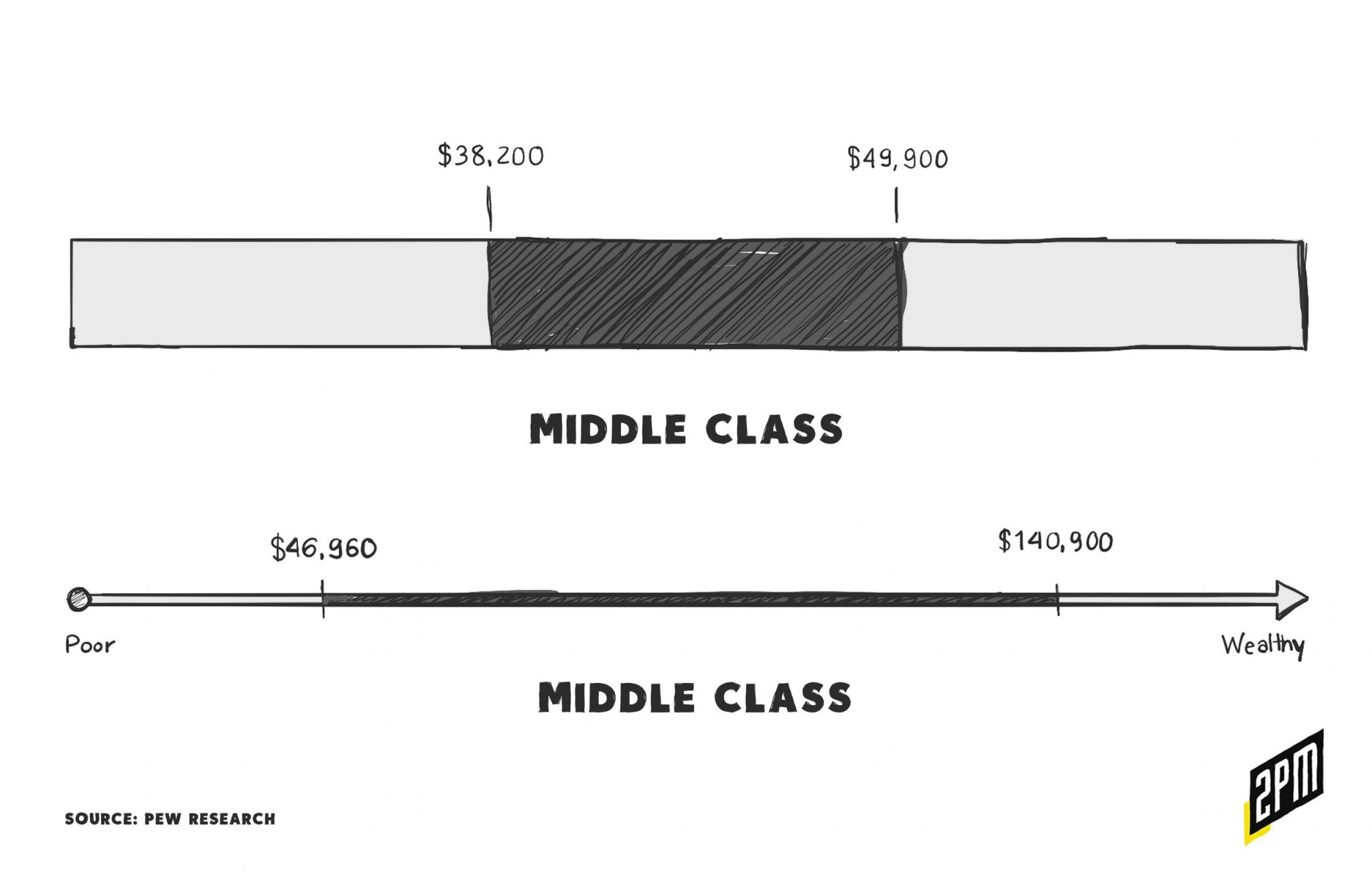
To better understand who the store closures are targeting, we must first consider the definition of the middle class – a shrinking cohort of the American consumer. There’s a great chance that if you’re reading this, you are statistically in the upper middle and wealth classes and gaining. That group earns greater than $140,901 in annual household income.

At top, the typical consumption of the average middle class family. And at bottom, the wide range of salaries that make up the American Middle Class. These figures are influenced by region, number of dependents, and a host of other factors.

But for many hard working, middle Americans, something is lost in translation. With inflation, under-employment, rises in college tuition, mounting consumer debt, and healthcare costs – typical consumption has fallen. And families who earn a comfortable wage are living closer to the lower end of the middle-class range or below. In short, levels of wealth are polarizing and retail’s bifurcation is following suit.

Understanding the Gilded Age

The times of mining bonanza kings, railroad barons, merchant princes, bankers, generational trusts, and utility tycoons were rife with brute capitalism and a stark economically inequality that America hadn’t seen before. The country began to lead the world in the production and refinement of valuable goods and services. For the select few who benefited, new, economic monarchies were forged. For everyone else, life seemed more like scene from Sinclair’s “The Jungle.”

If you’ve ever had the good fortune of visiting Newport, Rhode Island – you’d recognize something peculiar: The Gilded Age presents itself in certain areas of the city like the era was never replaced by the middle-class boom. Between 1870 and 1900, three of the largest and most extravagant homes in America were constructed along the shores of the beautiful New England city. Of these palatial homes is what many consider the crown jewel: The Breakers. On 14 acres, the 65,000 square foot mansion serves as an archetypal memory of the age of industrialism. Cornelius Vanderbilt II bought the land for $450,000 in 1885 and finished construction on the 70+ room “summer cottage” in 1895.

As a student, I walked the halls of The Breakers with several of my classmates. We’d never seen anything like it before. Frankly, I was in shock. Growing up squarely in the middle class, I could barely imagine living in 4,000 square feet. But in the structure that harkened to the Italian renaissance, we marveled at a family’s home that spanned an entire acre of land. I didn’t know that this level of wealth existed and I surely had yet to see any of modern derivatives of that boom’s past. Castles were for history books and midieval films, or so I thought.

The rich get richer and the poor get – children.

F. Scott Fitzgerald

There are a number of Gilded Age-era homes across the United States; many have been repurposed into public buildings and monuments to the era. San Francisco has the mansions of their Big Four. Just a ways away, you’ll find the Hearst Castle. Connecticut is home to the Lauder Greenway estate. Massachusetts has The Mount. And of course, the streets of New York are peppered with homes like the Arden, Indian Neck, Olana, and Woodlea – the now-home of the Sleepy Hollow Country Club. In all, there are nearly 80 homes of this caliber in America. Not one was built after Jay Gatsby’s 1920s. That is, until recently.

There’s a paragraph in the recently published The Triumph of Money in America by Jack Beatty:

But, brazen as it was, inequality then conformed to the pattern of the unequal past. Not so inequality in what publications from the Atlantic Monthly to Seattle Weekly have denominated the “New Gilded Age,” when for every additional dollar earned by the bottom 90 percent of the income distribution, the top .01 percent earn $18,000. From 1950 to 1970, they erned $162. […] Paul Krugman notes, “Not since the Gilded Age has America witnessed a similar widening of the income gap.

The Gilded Age was a salicious spectacle of glory and tragedy. It seems that we are on the precipice of another flashpoint, where years of quiet build-up led to an “aha!” moment. Housing, mounting middle-class consumer debt, and retail trends all seem to point in that direction. Consider last mile delivery services like DoorDash or GrubHub, a luxury experienced by the upper-middle and wealth classes. But a job that takes advantage of the underemployed – many of whom are likely white collar professionals fighting to remain somewhere in the depleting middle.

There is a polarization of American wealth and it’s progressing at a dizzying pace. Look no further than San Francisco, where the newly homeless camp against the walls of four and five star hotels. The dichotomy is striking. Or consider New York City, where there may be slightly less of a wealth disparity (to the blind eye). Yet, the city’s private helicopter traffic is growing noisier while the subway system is failing many who are fighting to remain in the middle class. There are as many last mile workers on the streets of New York as there are pedestrians at times. A noticeable number of New York’s miles of retail storefonts lie vacant.

In 2018, USA Today reporter Rick Hampson wrote: “That time (roughly 1870-1900) shares much with our time: economic inequality and technological innovation; conspicuous consumption and philanthropy; monopolistic power and populist rebellion, […] and change —  constant, exhilarating, frightening.” Understanding the mirrored socio-economic patterns of then and now should profoundly impact the retail operations of today.

Gilded AGE 2.0 And Modern Retail

Sears, the once-famed retailer earned its beginning in the Gilded Age. Richards Sears, a railroad worker, founded R.W. Sears in Minnesota. Operating as a reseller of jewelry and watches, early success moved the business to Chicago where he met and hired Alvah Roebuck. The retail founder and the watchmaker built an innovative business: they’d own products and brands and sell direct to consumer. A predecessor of eCommerce, today. On the heels of direct-sales and catalogue success, the retailer went public in 1906 [2].

Sears went public with preferred shares selling at $97.50 each, or more than $2,500 now. Goldman Sachs managed the offering. That year, Sears also opened a mail-order distribution center on Chicago’s West Side that, with three million square feet of floor space, was among the largest buildings of its kind in the world.

The boom of Sears’ brick and mortar growth relied the boom of rural and suburban penetration throughout America. Nearly sixty years of fortune followed. Richard Sears adjusted for the times. A business built for the wealthy became a symbol of the burgeoning middle-class. He saw the opportunity, I suppose.

Online retail sales as percentage of total retail | Source: eMarketer 2018

Fast forward to 2019 and retail’s lines of my demarcation are clear as ever. Online retail has been adopted by nearly a quarter of Chinese citizens and across the country’s economic strata. In the United States, the makeup of online retail customers skews towards the affluent. Amazon Prime’s membership boasts over 110 million users, or a third of all of American households. Of all internet consumers, 66.3% of those who earn over $150,000 use Amazon Prime. Just 31.6% of those who earn $35,000 annually have purchased the membership.

The suburbs are overstored and undershopped, and experts say only the top 20% of malls are thriving.[WWD]

Online retail and “Tier A” malls attract an affluent consumer. Off-price physical retailers and “Tier C” malls skew towards the economically-distressed. Between 2018 and 2019, the following specialty retailers have shuttered en masse: Nine West, Claire’s, Brookstone, Samuel’s, Mattress Firm, Sears, David’s Bridal, Charlotte Russe, Payless, Gymboree, Topshop, J. Crew, J.C. Penney, Pier 1 Imports, and DressBarn.

More closures are to come. Of them: GAP and L Brands will accelerate closures, further diminishing middle class retail. Not only are we witnessing a polarization of American wealth at a dizzying pace, it is now reflecting in retail real estate. The institutions for the affluent have remained steady, in some cases contributing to a growing retail sector. The institutions for the economically-distressed are also doing quite well. Historically, off-price and luxury retail were at the periphery. If these trends continue, these two cohorts may become the collective majority.

There are implications for digital-natives. Consider the rising customer acquisition costs of today’s direct to consumer business. Facebook, Instagram, and Google’s advertising inventory have remained static while the volume of DTC founders who launch companies continues to rise. Rather than a go-to-market that appeals to a growing number of modern luxury consumers and HENRY’s (high earners, not rich yet), many DTC brands optimize message, branding, and ad spend to reach a contracting number of middle-class consumers. Or worse, off-price consumers who’ve yet to fully adopt online retail as a method of consumption. It’s unclear whether or not this dynamic is contributing to a rising CAC but the shifting dynamics of an audience should concern marketers.

Meanwhile, off-price digital natives like Brandless and Jet.com have struggled as they focus on forms of bargain-driven promotion. While over 100 million Americans use Amazon Prime, we’re still at 11-13% of retail being attributed to online transactions. The United States is still in the early stage of eCommerce adoption; as such, off-price consumers continue to lag behind in the adoption curve. It’s reasonable to assume that this contributed to what may have been an overestimation of total addressable market (TAM) for retailers in the off-price category. Brandless has since adjusted their strategy to appeal to more affluent shoppers. “The average order value today needs to move from $48 to probably $70 or $80,” the words of Brandless’new CEO who has committed to charging more for products, leaving behind the company’s bargain basement strategy.

This era has begun to reveal sharp contrasts in how Americans approach the consumption of goods and services. Net consumption continues to grow despite a catastrophic number of store closures. Some in retail and media are quietly recognizing that the most competitive approach to growth is the pursuit of the modern luxury consumer – a cohort that seems to be invulnerable to these shifts. Products have become more exclusive, with higher quality production, and superior service. As online retail penetration continues to grow from 11% to levels resembling China’s, off-price retailers will begin to see more success – a notion that should bode well for Walmart, Costco, and others.

While history doesn’t repeat itself, it does rhyme. The economically-disadvantaged deliver food, novelties, alcohol, and commodities to urban sprawls and gated suburbs – within the hour. Across the country, the net worths of the top 1% have become noticeable as conspicuous consumption of products and services have risen; the rise of platforms like StockX, Hodinkee, and Uncrate demonstrate this. For the top .01%, there are more 40,000+ square foot homes than there were in the Roaring 20’s. Retail is responding to economic realities of today. Wealth is galvanizing; retail strategies should adjust to meet the shifts head on.

The term retail apocalypse has always been an uncomfortable generalization to make. This research suggests that it’s also an innacurate one. Rather, Gilded Age 2.0 is a casualty of the middle class; a consumer that emerged in response to the industrial and financial booms of the late 19th century. The early 21st century resembles a time when the middle barely existed. It was an unfortunate time of boom or bust, feast or famine. For commerce and its adjacent industries – 2.0 is a correction that can no longer be ignored.

Research and Report by Web Smith | About 2PM