No. 340: A Mobility Collision Course

Steve Jobs believed that one of the few things that separated humans from high primates was our ability to build tools. In some cases, these tools mitigated the crippling inferiority of human mobility. Compared to some animals, humans possess lesser top end speed, endurance, and efficiency of movement. It’s our ability to engineer solutions that ultimately improves our collective mobility. Jobs assessed these shortcomings in a 1995 interview:

I read a study that measured the efficiency of locomotion for various species on the planet. The condor used the least energy to move a kilometer. And, humans came in with a rather unimpressive showing, about a third of the way down the list. It was not too proud a showing for the crown of creation.

Over the course of Jobs’ career, he predicted the future quite a few times. He foresaw what the inter connectivity of internet would do for humanity. He predicted the efficacy of the computer’s mouse, and the dawn of cloud computing, and the professional preference of the laptop computer. Jobs even understood that the diffusion of this technology would be so profound that ten year olds would own computers that are orders more powerful than the ones used by 1960’s-era NASA engineers. But it was perhaps his two distinct thoughts on figurative and literal mobility that may go on to define the next ten years of disruption.

Jobs indirectly recognized the inverse relationship between online retail and shopping centers:

People are going to stop going to a lot of stores. And they’re going to buy stuff over the web.

The second thought expounded on his obsession with human physical efficiency:

Somebody at Scientific American had the insight to test the efficiency of locomotion for a man on a bicycle. And, a man on a bicycle, a human on a bicycle, blew the condor away, completely off the top of the charts.

This line of thinking is the origin of Jobs’ commentary on the personal computer serving as a proverbial bicycle for the mind. According to Jobs, “What a computer is to me, is it’s the most remarkable tool we’ve ever come up with. It’s the equivalent of a bicycle for our minds. Walking is relatively slow and inefficient.” This remarkable thought may end up meaning something more than what Jobs meant at the time.

The advancement of mobile payment technology and the evolution of physical mobility are on a collision course. The diffusion of one technology may lead to the diminishing of the other. There is no greater example of the potential disruption than China’s stark contrast to the nature of American retail. Cashless consumer economies will have a profound effect on mobility. Paul Haswell of Pinsent Masons notes:

Many Chinese cities are now the closest we have to cashless consumer economies.

According to eMarketer’s Shelleen Shum: 79.3% of smartphone users in China will operate within a completely cashless economy. By comparison, the United States will see just 23% of smartphone users doing so by 2021. And Germany will have just 15%. Why is this significant? The move towards a cashless economy corresponds with a shift in mobility preferences. “The use of digital technologies—from smartphones and wearables to artificial intelligence and driverless cars—is rapidly transforming how city dwellers shop, travel, and live.Without a firm foundation in electronic payments, cities will not be able to fully capture their digital future, according to our analysis,” said Lou Celi, Head of  the Roubini ThoughtLab.

Без названия

Mobile payments are influencing a collision course. No. 1 market for mCommerce (payments) is China. Here is a quick comparison. Mobility:1a/ US cars per 1000: 8381b/ China’s cars per 1000: 179Retail locations:2a/ US sq. ft. / person: 23.5 2b/ China sq. ft. / person: 2.8

And here is the key question. If the United States is moving towards a cashless society driven by mobile wallets and smartphone-driven payments systems, will the shape of our economy begin to change with it? The data affirms. The shuttering of American retailers outpaced all of 2018 by April of 2019 according to data from Coresight Research. As of now, the correlation does not rely upon mobile payment tech. Rather, it’s driven by the growing adoption of online retail. However, online retail adoption in China is driven by mobile payment technologies. American adoption of such technologies will accelerate overall growth. The percentage of retail in the form of eCommerce will hockey stick when it does.

Smart Cities and Urban Mobility

9db5098f3d10fea0f7d35b394714b6ae9518277c_2_1380x840
From Polymathic: The market opened to red, post Black Friday 2019.

There may not be a greater example of the potential clash between online retail and mobility than the city that is quietly known for its specialty retailers. In retail circles, Columbus is known as HQ City; the Central Ohio region is host to Abercrombie & Fitch (and Hollister), L Brands (Victoria’s Secret, Bath & Body Works, etc.), Express, Ascena Retail Group (Limited, Justice), DSW, Value City Furniture, and ties to American Eagle Outfitters. There isn’t a mall in the United States that isn’t influenced by this region’s businesses.

For Columbus, it’s a double-edged sword. The city’s working population is heavily influenced by this small group of very large employers. And these large employers have a symbiotic relationship with America’s inflated 23.5 square feet of retail real estate / person. In comparison, China has just 2.8 square feet of retail / person. Despite this lacking physical infrastructure, China passed the United States as the number one retail market in 2019. [1]

In 2015, Columbus, Ohio applied for a national grant for the Smart City Challenge, a national competition between a collective of technologically progressive cities.

Smart Columbus will help shift travel patterns. Even more, we want to shift people’s thought patterns and behavior. This means inspiring policy makers and influencing people’s preferences. We will partner with others to create programs, introduce new solutions and promote adoption. Once our city understands what’s possible, everybody should be able to get on board. This will be a gradual process over the coming decade. As a region with urban sprawl, we are committing to a new, improved ecosystem of solutions to move people and goods. [2]

A smart city is tasked with testing technological solutions and progressive policies to innovate mobility practices. As the winner of the first-ever Smart City Challenge, the city agreed to embrace the “reinvention of transportation to accelerate human progress.” The city would then serve as a standard bearer to other cities as they continue to evolve. In 2017, the city outwitted dozens of other top cities to include: Pittsburgh, San Francisco, Portland, Kansas City, Austin, and Denver. The result was an award of a combined $50 million grant from the US Department of Transportation and the Paul Allen Foundation.  This award would then be amplified by hundreds of millions in public-private partnership, generated by the cities own businesses and political partnerships.

Through the Smart City Challenge, the Department committed up to $40 million to one winning city. In response, cities leveraged an additional $500 million in private and public funding to help make their Smart City visions real. [3]

Screen Shot 2019-12-02 at 1.44.24 PM
United States: eCommerce as a share of retail

The data suggests that the advancement of eCommerce adoption would influence mass transit and ride sharing as primary means of urban travel. This same data would suggest that eCommerce would also spur economic development in harder to reach areas of the region. But it would have to get much worse before conditions improve. Some 92% of the citizens in China’s largest cities use Alipay or Wechat as their mobile wallets and sole means of transacting. In rural China, that number is 47%. In both cases, the primary means of retail is through eCommerce channels. In contrast, America will see just 12.4% of retail by eCommerce in 2020. For rural citizens and underbanked Americans, that number is significantly lower. The majority of eCommerce transactions are located in or near major metropolitan areas. This is relevant and will be explained shortly.

Black Friday 2019

In September of 2017, the proverbial floodgates opened. Amazon’s patent for one-click purchasing expired. With this, any and every online retailer could build or integrate payments solutions to promote better consumer experiences on desktop and mobile platforms. The improved experiences were especially noticeable on mobile operating systems, where dropped carts were commonly 60+%.

The end of Amazon’s hold on one-click ordering gives opportunities to large and small retailers to reap benefits they haven’t had before. Perhaps the most widespread benefit will come in the world of mobile commerce where there are high rates of cart and purchasing abandonment. […] The patent expiration will allow for widespread adoption of one-click purchasing, which will challenge the market to adapt quickly. There is an opportunity for major reconfiguration of social networks to challenge major e-commerce giants such as Amazon.  [4]

This coincided with the integration of tools like Apple Pay, Android Pay, and Shopify Pay, three solutions that would fuel mobile commerce in ways that were only previously seen in Chinese markets. Apple Pay recently crossed Paypal in volume of transactions. Amazon’s YoY growth was closely tied to the stickiness of similar technologies. An unnamed Shopify analyst suggested that with Shopify Pay, conversion rates were nearly identical to Amazon’s – an extraordinary improvement in performance between 2016 and 2019.

Screen Shot 2019-12-02 at 1.42.59 PM
United States: Projected revenue from mobile commerce ($B)

Over this most recent retail holiday, there was a contrast to observe. In 2PM’s most recent Executive Member Report, I explain the context behind the title “The Blackest Friday.” According to data pulled from Alibaba, Amazon, and Shopify – Black Friday was a success for the burgeoning eCommerce ecosystem and a disappointment to traditional retailers like Kohl’s, JCP, and Nordstrom. The holiday shed light on the growing divide between mobile adoption and the dependence on traditional retailers.

Без названия

It wasn’t deals that drove the BF, it was ease of purchase. Via Adobe Analytics: 1/ 39% of eCom: mobile2/ 61% of traffic: mobileAnd Shopify added 400k stores in 2019. The avg. BF $ / merchant dropped just 1.8%. Payments ease mitigated the lack of trust or perceived value.

Adobe, which now owns Magento, revealed data that communicates a permanent shift toward mobile traffic (61% mobile). Shopify’s data (69% mobile) reflected the same. Physical retail continued to slip.

The drop in Black Friday physical shopping mirrors a year-long share pullback in departments stores including Macy’s, Kohl’s and Foot Locker, all of which are down more than 25% this year. Meanwhile, Amazon, the dominant U.S. e-commerce retailer, has gained about 20% this year. [5]

For Shopify, the result was especially positive. On the heels of Apple Pay adoption and the growth of Shopify Pay,  the company added 400,000 new stores in 2019 while dropping just 1.8% in average store revenue on Black Friday. This tells a story. Despite the relative infancy of nearly 40% of the stores on the platform, new merchants were able to generate nearly enough in sales volume to match the per capita avg sales figure of the previous year’s merchants. This would indicate that the shift away from desktop and towards mobile payments mitigated issues of trust or early-stage brand equity concerns by lifting conversion rates. As mobile payment adoption increases, the divide between DTC-minded brands and traditional retailers will continue to grow. So where does this get us?

Conclusion: On Primates and Politics

If you’ve ever frequented Amazon Prime Now, you understand the value of two hours saved. In a matter of 90 seconds, you can click through on recently purchased grocery items to replenish your pantries. Then, in a matter of 60-90 minutes, those selections manifest. There are four packages at your door. When Steve Jobs suggested that software engineering would impact our mobility, it’s unlikely that he imagined the effect that mobile commerce would have on developed cities. Mobility isn’t just the efficiency, speed, or distance traveled. It’s what we can do with our time. Mobility is freedom.

When Columbus, Ohio was awarded $50 million to build the blueprint for a smart city, it’s unlikely that the city’s leaders understood the ties between commerce technology and physical mobility. If so, the heaviest investments would have been earmarked for commerce infrastructure:

  • improving shipping lanes by designating key routes for delivery vehicles and couriers
  • retrofitting struggling malls and shopping centers as fulfillment hubs
  • investing in the numerous local businesses by equipping them with the same types of technologies that enable the DTC mobile revolution
  • repurposing successful malls as meeting grounds, deemphasizing the emphasis on shopping
  • and laying the groundwork for a city with 60-80% fewer cars and 70-90% fewer shopping centers

America is over-retailed. And unfortunately, innovation in online retail will exacerbate this. For Columbus (and many other forward-thinking cities), this is a conflict of interest. As regions shift toward mobile commerce-forward models, old ways of retailing will subside. And given early data  – the numerous retailers that are headquartered in and around the city would be placed at existential risk.

It’s for this reason that Columbus serves a microcosm of traditional retail as a whole. The industry will have to choose between its past and its future, both of which are tied to shifts in mobility innovation.  Like Jobs said in 1995: “People are going to stop going to a lot of stores. And they’re going to buy stuff over the web.” This is beginning to reflect in public and private markets. What happens when we stop driving to stores? What happens when shopping centers no longer have sufficient demand? What happens when advancements in last-mile delivery becomes carbon negative? This is happening now.

The largest retail economy in the world is no longer the United States. But this will potentially change, as the United States closes the gap in mobile computing and payments adoption. China has 10% of the retail square footage and 79% fewer cars. This should give us pause. These numbers provide a bit of foresight into how this country must adapt to modern retail. Computers did become the bicycles for our minds. And now, advancements in mobile computing and payments are influencing physical mobility. The smartest cities will correct for these advancements before the markets correct it for them.

Research and Report by Web Smith | About 2PM 

No. 338: UpWest and Hygge

Hygge-2PM

A publicly-traded retailer launched a DTC brand. This is a deep dive into their reasoning, the build, and their internal expectations. 

Middle-class retail is at an impasse. Since the beginning of 2019, there have been 19 bankruptcies to include Forever 21, Gymboree, Charlotte Russe, Payless ShoeSource, Diesel, and Destination Maternity. And there are another eight retailers at risk to include: J.C. Penney, Neiman Marcus, J. Crew, and Hudson’s Bay. In Gilded Age 2.0, I explain that our current retail era signals a casualty of the middle class consumer; a class that once emerged in response to the industrial and financial booms of the late 19th century and the governmental reforms of the mid-20th century.

With a flailing gig economy, stagnant wages, and rising personal debts, 2019 presents a break from the mid-century momentum that defined the 20th century. We are beginning to hear faint echoes of an earlier time of boom or bust and feast or famine. Rather than appealing to pure luxury consumers or fast fashion-loving millennials, the “long middle: erroneously remains the bullseye of the target. Retailers have been slow to optimize for a new market of coveted consumers.

In a recent report by Business of Fashion proclaimed that America still doesn’t have an answer to LVMH. They explain:

Spoilt for choice, consumers are less interested in mid-priced products available at scale: they want dangerously affordable fast fashion or pure luxury. (And preferably at a discount.) It’s harder for consumers to see the value in something that is not cheap but not that expensive, either. Especially if it’s not utterly unique. That’s a problem for Tapestry in particular, which deals exclusively in accessible luxury. [1]

Against the backdrop of abundant choice and a bifurcating market, Ohio retailer Express launched a new brand. Express is currently trading at a $265 million market cap with north of $2b in sales. The cost of that revenue is extraordinarily high compared to healthier retailers. Trailing twelve months, Ralph Lauren Corporation earned north of $6.5 billion with a $2.45 billion cost of revenue.

In contrast, Express earned (TTM) north of $2.1 billion with a $1.5 billion cost of revenue. A 25% gross profit margin heading into a crucial holiday season, the Columbus-based retailer hopes to use the DTC initiative to improve their long-term outlook. The effort has been met with a mix of pessimism and optimism. 

Pierre Kim of Away

For years, retailers have been criticized for not evolving quickly enough to meet the demands of their customers, so what do they have to lose with this new strategy? Their core labels may be faltering, but they still have brand equity. Why not use it to experiment and launch new businesses?  [2]

Paul Munford of Lean Luxe

There’s baggage associated with being under a legacy retailer’s umbrella—it decreases the value of the brand to the savvy consumer,” he said. “However, execution will always ultimately be the key here. Spinoffs need to feel like their own entity, as opposed to a sub-brand of the legacy retailer. [2]

There are merits to both arguments. And a little bit of digging provided more clarity for this report. Under the umbrella of Les Wexner’s Limited Brands, Express launched as women’s clothier “Limited Express” in 1980 Chicago. Led by CEO Michael Weiss, the brand expanded to eight stores in 1981 and by 1986, Express began a test for menswear in 16 of its 250 stores. The men’s line spun out as Structure in 1989.

I remember the brand very clearly. As a twelve year old in 1995, the halls of my middle school were split between the haves and the have nots. For the ones with, shirts by Polo and Structure were the daily wears and all I could remember is the sensation of having neither.

4
Remember this?

The advancements that Express made during that 20 year run are astounding to think about. In 2001, Express became a dual gender brand – a pivot that Madewell is currently attempting to execute. Structure “sold” to Express, or at least that’s how I remembered it. Because immediately, I became a fan of Express. In actuality, the brand was owned by the same holding company. It funneled its mens business to a brand that provided more opportunity. L Brands then, quietly, sold the mark to Sears in 2003. The Structure brand was never heard from again.

Express is no longer owned by L Brands, one of the most prolific builders of retail brands in history. It was sold to Golden Gate Capital Partners, a private equity firm with $15b in assets under management. And then, in May of 2010, the retailer went public.

Demographic vs. Psychographic | Part Two 

In 2016, Express made its first play for the direct-to-consumer era by acquiring a minority stake in HOMAGE, the Columbus Ohio retailer led by founder Ryan Vesler. It’s a genuine brand, one where the founder-product fit is as valuable as its product-market fit. The minority investment with vintage t-shirt company meant that Express bought a new audience of a key demographic: the college-aged millennial.

Homage President Jason Block said in an email that Express will consult with the company on an ongoing basis and the investment will allow Homage to expand both its digital and brick-and-mortar presence. [3]

Aside from investing in a growing company,  Express gained the rights to include a limited selection of HOMAGE products in store. The investment was intended to bolster foot traffic while, potentially, benefitting from the long-term flip – if and when the HOMAGE brand grew with the help of Express. It’s unclear whether or not this initiative was successful for either of the brands. The company is currently trading below the price it maintained during the period that Express began its partnership with HOMAGE. The publicly-traded retailer’s missteps over the past two years were due, in part, to a number of macroeconomic shifts.  The launch of UpWest represents a strategy shift of its own.

In Psychographics in Focus, I explain the difference between a demographic and psychographic. Consumer psychology involves the interest in lifestyle, behavior, and habit. It’s an encompassing measure that considers our idiosyncrasies, our temperament, and even our subtle personality traits. These are the variables that influence our behavior as consumers. Psychographic segmentation is the analysis of a consumer cohort’s lifestyle with the intent to create a detailed profile. [4]

Taking a community-building approach, UpWest plans to connect with new customers through experiential events, including a regional tour across the US that features the UpWest Cabin, a mobile pop-up exhibit featuring relaxation-focused experiences like yoga and meditation classes. Slated stops include Columbus, Chicago, Nashville, Denver and Austin.  [2]

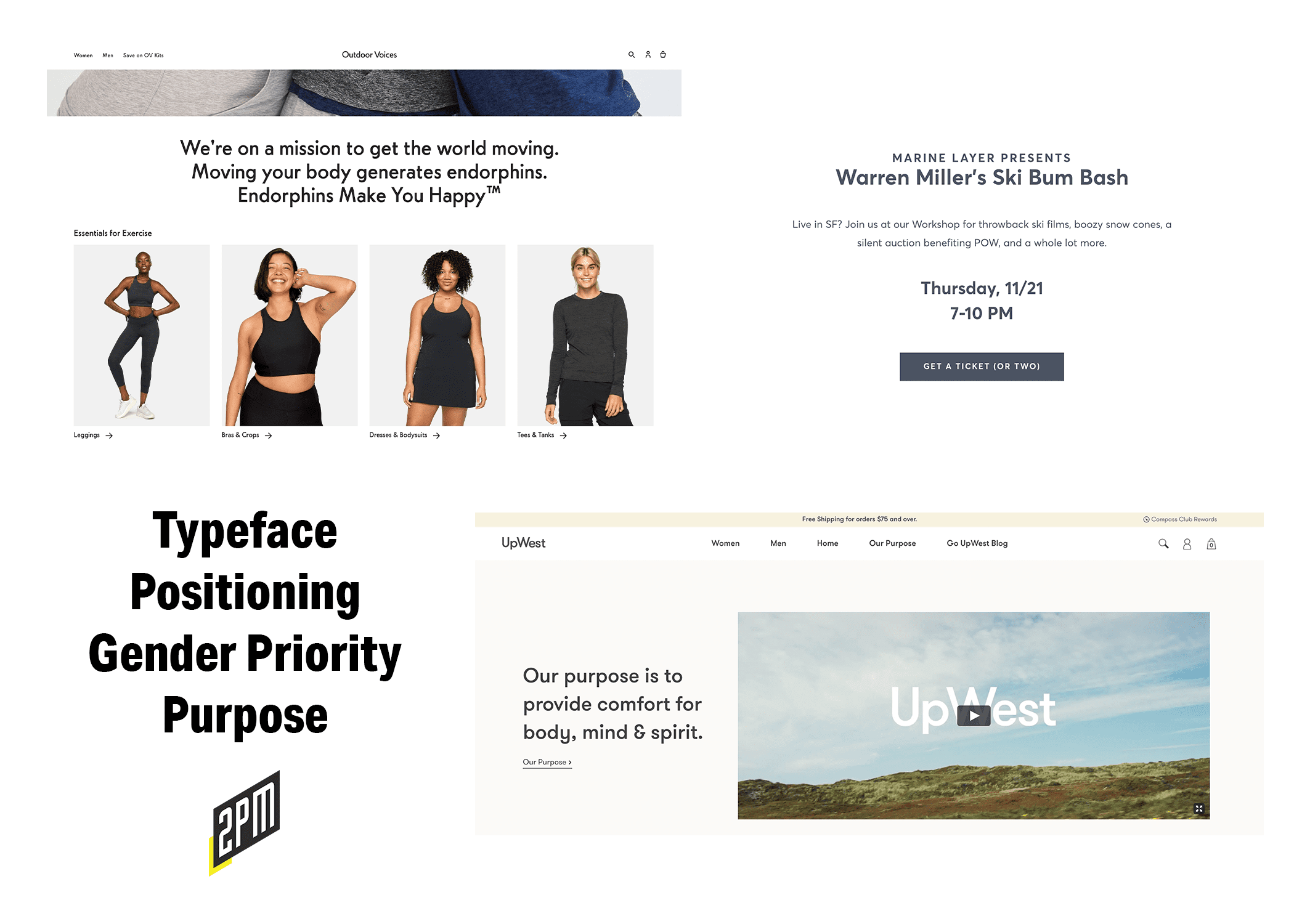
From the typeface, to the story-telling, to the merchandising – the UpWest brand is designed to attract fans of the digitally-native industry. Rather than a specific demographic, Express pursued an interest (DTC) and is building a brand atop of that engaged audience.

DTC As A Psychographic

Веб Смит в Twitter

DTC, 2012: a tech stack strategy. DTC, 2016: a logistics strategy. DTC, 2020: a brand strategy.

In a span of three days, I received multiple emails and texts from contacts close to the launch of UpWest. Kaleigh Moore, Forbes writer and 2PM collaborator had a story in queue by then. In the Lean Luxe Slack, it was a topic of conversation. Rather than building in-house with Express’ existing engineering group, UpWest contracted Shopify agency BVAccel to handle the design and development work. This was a nod to several of the most successful digitally native brands in the space to include Untuckit, Cubcoats, Chubbies, and Rebecca Minkoff. 

Comparison-Upwest

The site’s architecture communicates a desire to be mentioned in the DTC conversation, this includes UpWest’s partnership with Klaviyo and its new-age loyalty program. It would appear that UpWest chose to focus on the DTC psychographic for the sake of earned media and brand positioning. As far as the nuts and bolts are concerned, the site’s build communicates that the desired target demographic is millennial-aged women. On day zero, the brand has an explicit purpose: to provide comfort for body, mind, & spirit. The clothes, are priced similar in design and price to Marine Layer – its next closest competitor.

Identifying Waves: Importing Hygge to America

In the past year, this concept of Scandinavian coziness has made inroads with an international audience. [5]

Imagine a whiteboard in one of Express’ suburban Columbus boardrooms; the word “hygge” would have been at the center of it in big and bold lettering. You can picture the brand’s chief comfort officer (and Express’ SVP of Strategic Initiatives) standing in the corner of the room, jamming as Cody’s It’s Christmas plays on the room’s four Sonos speakers. The brand wants you to feel a feeling. Analysts agree. Emily Singer, founder of the DTC newsletter “Chips and Dip” had this to say:

There’s something very boring about it. Maybe that’s intentional. This line feels a little too on the nose: ‘Welcome to curated comfort. For those who are seeking peace and calm in a stressful world.’ Brands tap into emotional states, but it’s rarely laid out so explicitly.

It’s this perceived boredom that is viewed as an understated luxury in American culture. To the Danes, hygge is free of economic status. The culture’s entire focus is on practicality, movement, wellness, and mindfulness. It’s this underlying culture that Express hopes to import with the help of some obvious visual cues from well-known DTC retailers.

The UpWest typeface is nearly identical to the typeface of Outdoor Voices and Marine Layer’s. Ironically, both retailers have references to Scandinavian hygge throughout their brand messaging. But for UpWest, there’s no understatement. Every message is turned to maximum volume. Like the primary header of Express.com: UpWest’s primary menu is a throwback to “Limited Express”, a retailer for women-first and men-second. There are elements of luxury abound. Upwest’s blog features new-age terms like: nourish, mindfulness, tranquility, and sanctuary. The traveling pop-up is a “cabin.” These are all symbols of wealthier millennials with time and resources to spare. As is the concept of philanthropy and sustainability (though UpWest sells products that are made with synthetics).

It starts with our cozy apparel, home and wellness products. We want to surround you with calm and give you balance. But it’s not just the tangible things. It’s also about slowing down. Diving deeper. And giving back.

Not to be outdone, UpWest wants consumers to help them donate $1 million to the Mental Health Association. The Express-borne retailer plays the entire DTC hand of cards. This report began with a simple statement: middle-class retail is at an impasse. To the average consumer, this DTC play is akin to Structure being launched as Express Men. Like a sheep, the seventeen year old me bought from Express as soon as my adolescent wallet would allow. The mechanics are similar here. Express is attracting an existing audience (the DTC psychographic) and using it to invigorate a brand that is plateauing.

Заключение

The UpWest bet is that the retailer can earn the business of the upwardly mobile DTC audience by engineering a product-market fit. One with heavy branding, ideal-alignment, and market messaging. This is one of the first upmarket attempts that we’ve seen from a specialty retailer. It’s one that deserves praise. Their management team engineered a brand with contemporary pricing and luxury messaging – void of pricing promotions (for now). They’ve acknowledged that the data shows a middle-class at an impasse. They have the supply chain, the logistics, the distribution, and a snapshot of a brand. But do the executives at Express truly understand what makes the top DTC brands work? That remains the question that could move the market.

Time will tell if Express can duplicate the brand architecting of their L Brands era – a time defined by face-less brands, clever signage, billboards, and foot traffic. My guess is that Express will find an audience that is more sophisticated and critical than the young adults of the 80’s, 90’s, and 2000’s. Messaging, distribution, and customer acquisition methods will evolve with this realization. And if that’s the case, their hygge may be tested for quite some time.

Research and Report by Web Smith | About 2PM 

Меморандум: Позолоченный век 2.0

thegildedage.jpg

Марк Твен однажды написал: "История не повторяется, но часто рифмуется". По мнению историков, закладка фундамента для нового позолоченного века началась в 1990 году. Спустя почти 30 лет вернулась эпоха "баронов-разбойников" и жестоких финансистов. С тех пор мало какая отрасль пережила такие разрушения, как жилищное строительство и розничная торговля. За последние три года закрылось почти 26 000 магазинов; в 2019 году число закрытий удвоится по сравнению с 2018 годом. Отголоски этого раздвоения наблюдаются во всем физическом и цифровом пространстве торговли. Вопреки распространенному мнению, розничная торговля не умирает. Напротив: изменения в доходах, увеличение долговой нагрузки и снижение уровня потребления начинают поляризовать некоторых потребителей. Середина сжимается, и розничная торговля не смогла предвидеть этот социально-экономический сдвиг.

"Расплата за розничную торговлю только началась". Это слова репортера Джека Хоу, который выпустил платный отчет для Barron's. Но "расплата" и "смерть" в данном контексте не обязательно являются синонимами. Розничная торговля не умирает, она раздваивается. В книге "Баллада о Викторе Груэне" бум и крах торговой недвижимости объясняется через призму социально-политической и налоговой политики:

Источник: Barron's

По данным корреспондента CNBC Лорен Томас, прибыль торговых центров одежды находится на уровне рецессии. По данным на июнь 2019 года, показатели Macerich, Simon Properties, Kimco, Washington Prime Group и Taubman находятся на пятилетних минимумах. Не хватает жизнеспособных брендов-претендентов (DTC), чтобы заполнить 67 000+ магазинов, закрытие которых прогнозируется к 2026 году. Таким образом, трудно сказать, вернется ли американская империя розничной торговли, построенная на послевоенном консьюмеризме, субурбанизации и ускоренном износе, к своей былой славе. Но когда мы задаемся вопросом, как произошел "розничный апокалипсис", мы обращаемся к 1954 году[1].

В расчете на душу населения Америка перегружена розничной торговлей, и так было всегда. Но на протяжении почти 60 лет развития розничной торговли в пригородах казалось, что эта отрасль никогда не сократится. По словам Рэндала Коника, аналитика компании Jefferies: "В Соединенных Штатах насчитывается около 1350 закрытых торговых центров, но нужны только 200-400". Но пока магазины закрываются, ожидается рост продаж на 3,5 % до 3,7 триллиона долларов. Согласно отчетам UBS, для достижения равновесия (1 350 к 200) может потребоваться десять лет. Инвестиционный банк прогнозирует, что за это время закроется еще 75 000 магазинов.

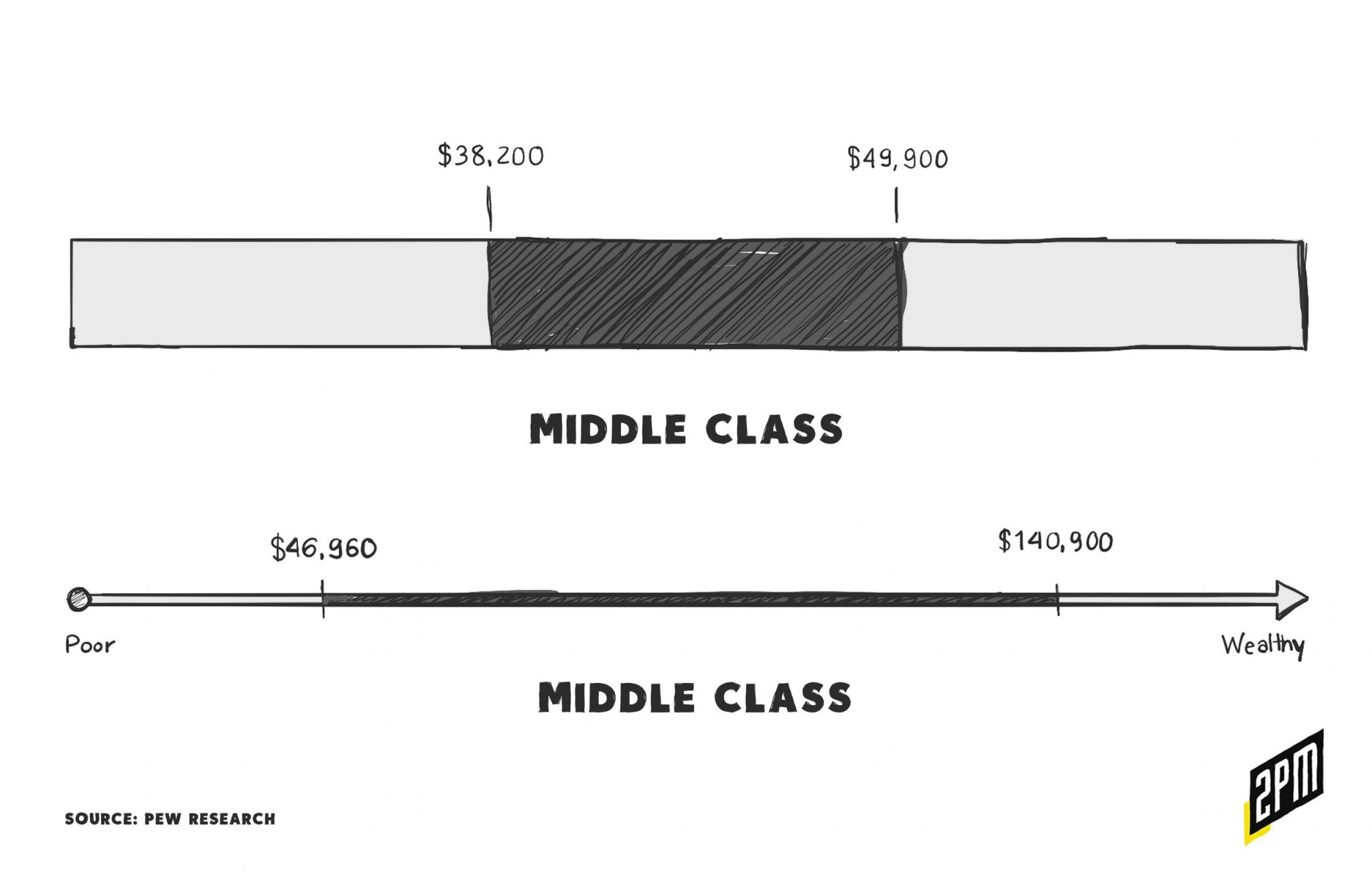
Чтобы лучше понять, на кого направлено закрытие магазинов, мы должны сначала рассмотреть определение среднего класса - сокращающейся когорты американских потребителей. Велика вероятность того, что если вы читаете эти строки, то по статистике вы относитесь к верхнему среднему классу и классу богатых. Эта группа зарабатывает более 140 901 доллара в год на семью.

Вверху - типичное потребление среднестатистической семьи среднего класса. Внизу - широкий диапазон зарплат, составляющих американский средний класс. На эти цифры влияют регион, количество иждивенцев и множество других факторов.

Но для многих трудолюбивых американцев среднего достатка что-то теряется в переводе. В условиях инфляции, недостаточной занятости, роста платы за обучение в колледже, увеличения потребительского долга и расходов на здравоохранение - типичное потребление снизилось. А семьи, которые получают комфортную зарплату, живут ближе к нижней границе среднего класса или ниже. Короче говоря, уровни благосостояния поляризуются, и раздвоение розничной торговли следует их примеру.

Понимание позолоченного века

Времена королей горнодобывающей промышленности, железнодорожных баронов, торговых князей, банкиров, родовых трестов и коммунальных магнатов изобиловали грубым капитализмом и разительным экономическим неравенством, которого Америка еще не видела. Страна стала лидировать в мире по производству и переработке ценных товаров и услуг. Для немногих избранных создавались новые экономические монархии. Для всех остальных жизнь больше напоминала сцену из романа Синклера "Джунгли".

Если вам посчастливилось побывать в Ньюпорте, штат Род-Айленд, вы наверняка заметили нечто необычное: Позолоченный век предстает в некоторых районах города так, словно на смену эпохе так и не пришел бум среднего класса. В период с 1870 по 1900 год на берегах прекрасного новоанглийского города были построены три самых больших и экстравагантных дома в Америке. Среди этих дворцовых домов есть то, что многие считают жемчужиной: The Breakers. Расположенный на 14 акрах земли особняк площадью 65 000 квадратных футов служит архетипическим воспоминанием об эпохе индустриализма. Корнелиус Вандербильт II купил землю за 450 000 долларов в 1885 году и закончил строительство 70-комнатного "летнего домика" в 1895 году.

Будучи студентом, я вместе с несколькими своими однокурсниками ходил по коридорам The Breakers. Мы никогда раньше не видели ничего подобного. Честно говоря, я была в шоке. Выросшая в среднем классе, я с трудом могла представить себе жизнь в 4000 квадратных футов. Но в строении, напоминающем об итальянском ренессансе, мы восхищались домом семьи, который занимал целый акр земли. Я не знал о существовании такого уровня богатства и, конечно же, не видел ни одного из современных производных этого бума прошлого. Замки - это для учебников истории и средневековых фильмов, так я думал.

Богатые становятся богаче, а бедные - детьми.

F. Скотт Фицджеральд

В Соединенных Штатах сохранилось множество домов эпохи Позолоченного века; многие из них были переоборудованы в общественные здания и памятники эпохе. В Сан-Франциско находятся особняки "большой четверки". В нескольких шагах от него находится замок Херстов. В Коннектикуте находится поместье Лаудер Гринвей. В Массачусетсе есть гора The Mount. И, конечно, улицы Нью-Йорка усеяны такими домами, как Арден, Индиан-Нек, Олана и Вудлеа, где сейчас располагается загородный клуб "Сонная лощина". Всего в Америке насчитывается около 80 домов такого уровня. Ни один из них не был построен после Джея Гэтсби в 1920-х годах. То есть до недавнего времени.

В недавно опубликованной книге Джека Битти "Триумф денег в Америке" есть один абзац:

Но, как ни дерзко это было, неравенство тогда соответствовало модели неравного прошлого. Не так обстоит дело с неравенством в том, что издания от Atlantic Monthly до Seattle Weekly назвали "новым позолоченным веком", когда на каждый дополнительный доллар, заработанный нижними 90 процентами распределения доходов, верхние 0,01 процента зарабатывают 18 000 долларов. С 1950 по 1970 год они получали 162 доллара. [...] Пол Кругман отмечает: "Со времен "позолоченного века" Америка не была свидетелем подобного увеличения разрыва в доходах.

Позолоченный век был ярким зрелищем славы и трагедии. Похоже, что мы находимся на пороге новой вспышки, когда годы спокойного развития привели к моменту "ага!". Жилье, растущий потребительский долг среднего класса и тенденции в розничной торговле - все это, похоже, указывает в этом направлении. Рассмотрим службы доставки "на последнюю милю", такие как DoorDash или GrubHub, - роскошь, которую могут позволить себе представители верхнего среднего и богатого классов. Но это работа, которая использует преимущества неполной занятости - многие из которых, вероятно, являются профессионалами "белого воротничка", борющимися за то, чтобы остаться где-то в истощающейся середине.

В Америке происходит поляризация богатства, и она идет головокружительными темпами. Посмотрите на Сан-Франциско, где новые бездомные разбивают лагеря у стен четырех- и пятизвездочных отелей. Дихотомия поражает. Или возьмем Нью-Йорк, где неравенство в уровне благосостояния, возможно, чуть меньше (на первый взгляд). Тем не менее, частные вертолеты в городе становятся все более шумными, а система метро не справляется со многими, кто борется за то, чтобы остаться в среднем классе. На улицах Нью-Йорка столько же работников "последней мили", сколько порой и пешеходов. Заметное количество километров торговых площадей в Нью-Йорке пустует.

В 2018 году журналист USA Today Рик Хэмпсон писал: "То время (примерно 1870-1900 годы) имеет много общего с нашим временем: экономическое неравенство и технологические инновации; показное потребление и филантропия; монопольная власть и популистский бунт, [...] и перемены - постоянные, волнующие, пугающие". Понимание зеркального отражения социально-экономических моделей того и нынешнего времени должно оказать глубокое влияние на розничную торговлю сегодняшнего дня.

Позолоченная эпоха 2.0 и современный ритейл

Компания Sears, некогда знаменитый розничный магазин, начала свою деятельность в Позолоченном веке. Ричардс Сирс, железнодорожник, основал компанию R.W. Sears в Миннесоте. Занимаясь перепродажей ювелирных изделий и часов, Ричард Сирс рано добился успеха и перевел свой бизнес в Чикаго, где познакомился и нанял Алву Робука. Основатель розничной торговли и часовщик построили инновационный бизнес: они владели собственными товарами и брендами и продавали их напрямую потребителю. Предшественник современной электронной коммерции. На волне успеха прямых продаж и каталогов в 1906 году компания вышла на биржу[2].

Sears вышла на биржу с привилегированными акциями по цене 97,50 доллара за штуку, или более 2500 долларов. Управление размещением акций осуществлял Goldman Sachs. В том же году Sears открыла в чикагском Вест-Сайде центр выдачи заказов по почте, который, занимая площадь в три миллиона квадратных футов, был одним из крупнейших зданий такого рода в мире.

Бум кирпичных и минометных магазинов Sears повлек за собой бум проникновения в сельские и пригородные районы Америки. За этим последовали почти шестьдесят лет удачи. Ричард Сирс подстроился под время. Бизнес, созданный для богатых, стал символом растущего среднего класса. Полагаю, он увидел возможность.

Розничные онлайн-продажи в процентах от общего объема розничных продаж | Источник: eMarketer 2018

Перенесемся в 2019 год, и линии разграничения розничной торговли станут четкими, как никогда. Онлайн-ритейлом пользуется почти четверть жителей Китая, причем во всех экономических слоях страны. В Соединенных Штатах среди покупателей интернет-магазинов преобладают обеспеченные люди. Участниками программы Amazon Prime являются более 110 миллионов пользователей, или треть всех американских домохозяйств. Из всех интернет-потребителей 66,3 % тех, кто зарабатывает более 150 000 долларов, пользуются услугами Amazon Prime. Только 31,6 % тех, кто зарабатывает 35 000 долларов в год, приобрели членство в программе.

В пригородах переизбыток и недостаток магазинов, а эксперты говорят, что процветают только 20 % лучших торговых центров.[WWD]

Онлайн-ритейл и торговые центры уровня "А" привлекают состоятельных потребителей. Недорогая физическая розница и торговые центры уровня "С" ориентированы на экономически неблагополучные слои населения. В 2018-2019 годах массово закрылись следующие специализированные розничные магазины: Nine West, Claire's, Brookstone, Samuel's, Mattress Firm, Sears, David's Bridal, Charlotte Russe, Payless, Gymboree, Topshop, J. Crew, J.C. Penney, Pier 1 Imports и DressBarn.

Грядут новые закрытия. Среди них: GAP и L Brands ускорят процесс закрытия, что приведет к дальнейшему сокращению розничной торговли для среднего класса. Мы не только наблюдаем поляризацию американского благосостояния, происходящую головокружительными темпами, но и отражающуюся в торговой недвижимости. Учреждения для состоятельных людей остаются неизменными, в некоторых случаях способствуя росту сектора розничной торговли. Неплохо идут дела и у учреждений для экономически неблагополучных слоев населения. Исторически сложилось так, что розничная торговля в сегментах off-price и luxury находилась на периферии. Если эти тенденции сохранятся, то эти две когорты могут стать коллективным большинством.

Это чревато последствиями для цифровых аборигенов. Подумайте о растущих расходах на привлечение клиентов в современном бизнесе, ориентированном на прямого потребителя. Рекламный инвентарь Facebook, Instagram и Google остается неизменным, в то время как количество основателей DTC, запускающих компании, продолжает расти. Вместо того чтобы выходить на рынок, ориентированный на растущее число современных потребителей роскоши и HENRY's (высокодоходных, но еще не богатых), многие бренды DTC оптимизируют сообщения, брендинг и рекламные расходы, чтобы охватить все большее число потребителей среднего класса. Или, что еще хуже, потребителей, которые еще не полностью освоили онлайн-ритейл как способ потребления. Неясно, способствует ли эта динамика росту CAC, но изменение динамики аудитории должно беспокоить маркетологов.

В то же время цифровые аборигены неценового сегмента, такие как Brandless и Jet.com, испытывают трудности, поскольку они сосредоточились на формах продвижения, основанных на выгодных предложениях. Хотя более 100 миллионов американцев пользуются услугами Amazon Prime, на долю онлайн-транзакций по-прежнему приходится 11-13 % розничной торговли. Соединенные Штаты все еще находятся на ранней стадии развития электронной коммерции, поэтому потребители товаров по сниженным ценам продолжают отставать в развитии. Можно предположить, что это привело к завышенной оценке общего объема рынка (TAM) для ритейлеров в категории off-price. С тех пор Brandless скорректировала свою стратегию, чтобы привлечь более состоятельных покупателей. "Средняя стоимость заказа сегодня должна вырасти с 48 долларов до 70 или 80 долларов", - говорит новый генеральный директор Brandless, который взял курс на повышение цен на товары, оставив в прошлом стратегию "дешевых подвалов".

Эта эпоха начала выявлять резкие контрасты в отношении американцев к потреблению товаров и услуг. Чистое потребление продолжает расти, несмотря на катастрофическое число закрытий магазинов. Некоторые представители розничной торговли и СМИ потихоньку осознают, что наиболее конкурентоспособным подходом к росту является погоня за современным потребителем роскоши - когортой, которая, кажется, неуязвима для этих изменений. Товары стали более эксклюзивными, с более высоким качеством производства и превосходным сервисом. По мере того как проникновение онлайн-ритейла продолжает расти с 11 % до уровня, напоминающего китайский, ритейлеры неценовых товаров начнут добиваться большего успеха - эта идея должна стать хорошим предзнаменованием для Walmart, Costco и других компаний.

История не повторяется, но рифмуется. Экономически неблагополучные люди доставляют еду, новинки, алкоголь и товары в городские кварталы и закрытые пригороды - в течение часа. По всей стране чистые состояния верхнего 1 % стали заметны по мере роста потребления товаров и услуг; об этом свидетельствует рост таких платформ, как StockX, Hodinkee и Uncrate. Для верхнего .01% существует больше домов площадью 40 000+ квадратных футов, чем в Ревущие 20-е годы. Розничная торговля реагирует на экономические реалии сегодняшнего дня. Богатство растет, и стратегии розничной торговли должны адаптироваться к изменениям.

Термин " розничный апокалипсис " всегда был неудобным обобщением. Данное исследование показывает, что оно также является неточным. Скорее, "позолоченный век 2.0" - это жертва среднего класса, потребителя, возникшего в ответ на промышленный и финансовый бум конца XIX века. Начало XXI века напоминает время, когда среднего класса почти не существовало. Это было злополучное время бумов и спадов, пиршеств и голода. Для коммерции и смежных с ней отраслей 2.0 - это коррекция, которую больше нельзя игнорировать.

Исследование и отчет Веба Смита | Около 2PM