No. 288: An open letter to publishers

well

To digital publishing executives. Yesterday’s Wall Street Journal published an eye-opening look at one of the best-positioned digital publishers in the industry.  Founded in 2008, Vox Media has raised $307.6 million in venture capital and made several key acquisitions. None of these acquisitions are more important than Recode, the tech news site founded by Kara Swisher. At a valuation in excess of $1 billion and nearly 700 employees (via Linkedin), Vox Media is by most accounts, the model venture-backed publisher.

Ryan Pauley, the brand’s talented SVP of biz ops and strategy also serves as the head of Concert, Vox Media’s attempt to platformize their sophisticated advertising operations. And recently, the company launched “The Goods”, the media conglomerate’s editor-driven attempt at driving affiliate commerce.

The Goods by Vox’s editorial team will publish a range of news, features, ongoing series, videos and Explainers each weekday. There will be an email newsletter delivering The Goods by Vox content to your inbox twice per week.

Vox’s Deputy Managing Editor Eleanor Barkhorn will oversee The Goods by Vox, as well as a team of talented reporters and editors, including Editor Julia Rubin and Deputy Editors Meredith Haggerty and Alanna Okun.

Vox Media PR

This doesn’t sound like the profile of a company that will struggle to reach $185 million in 2018 revenue but it is so. Digital advertising’s collapse is diminishing or has diminished several top publishers: Vice, Mashable, The Outline, and Buzzfeed. And there is no end in sight, as long as the duopoly of Facebook and Google persists.


2PM Data

statistic_id288615_growth-of-digital-advertising-revenue-in-the-us-2017-2018-by-format-1.png

statistic_id455840_digital-market-outlook_-digital-advertising-revenue-in-the-us-2016-2022-by-format


One consistency that you’ll find across many of these media platforms, amidst sagging performance, is the outsized cost of managing advertising executives.

In August, Vox Media announced internally a reorganization of its advertising sales workforce, creating one team to handle major categories and accounts and another to focus on cultivating new business. In April, the company promoted Chief Marketing Officer Lindsay Nelson to become its chief commercial officer in charge of leading revenue growth efforts.

Amol Sharma | Wall Street Journal

One study places the average salary for lower level advertising sales employees at $120,000+ per year, cutting into companies’ gross margins while deepening the dependency on these personnel investments. Meanwhile, commerce operations are often reduced to inconsequential merch operations.

Screen Shot 2018-09-24 at 1.29.02 PM
Vox Media: SB Nation’s Shopify store

But not everyone in the industry sees it this way. Buzzfeed has one of the most robust commerce operations in the industry. In a recent report by The Information, Jonah Peretti’s strategy was laid bare:

Late last year, Mr. Peretti unveiled his “Nine Boxes” strategy in an employee memo outlining the areas the company was focusing on to increase revenue. They included ecommerce, programmatic ads and BuzzFeed News making TV shows for streaming services and TV networks. The goal of the memo was to provide clarity to employees about where they stood in the company’s strategy, one thing some employees had said was missing, Mr. Peretti said.

Publishers must begin deemphasizing digital advertising to invest in direct-to-consumer (DTC) commerce teams. These commerce teams should be equipped to handle all affiliate operations, in line with the brand’s strategy for commerce and advertising. Affiliate commerce operations is not a suitable role for journalists; they should focus on their crucial, core competency: creating and building community around their content. They are the priority!


Issue No. 280: Media companies are brands too

The digital landscape is changing beneath our feet. For publishers to continue building organic readership, they must become brands. Operating as a source of content is no longer enough. To do that, efforts can no longer be siloed, the traditional factions of legacy-styled newsrooms must fall.


There are publishers who are doing this successfully. In No. 252, 2PM took a deep dive into content and commerce. We recognized the media brands that drive meaningful operational margins with DTC commerce. Of these media brands, Uncrate may have the most notable blueprint for a publishing revenue ecosystem. The company generates revenue with (1) well-performing display ads, (2) a coveted native advertising offering, and an (3) online store featuring direct access to a curation of the brands most desired by the publisher’s target demo.

When this flavor of revenue operations works alongside a team focused on delivering relevant content, these three revenue components actually feed an aggregate growth in viewership, advertising interest, and social referrals. Investments into commerce operations indicate that digital publishers have prioritized the growth of self-sustaining ecosystems void of reliance on Google and Facebook. While publishers need the duopoly of Silicon Valley advertising giants, their pie is growing at your expense.

Read more of the issue here.

By Web Smith | About 2PM

No. 273: Modern Luxe Doesn’t Bend

Watermark_ByTailorBrands
Pictured: Outdoor Voices, from our Open Letter to DNVB CEOs

In November of 2016, Lean Luxe’s Paul Munford penned somewhat of a scripture to upstart modern luxury brands: promotion-heavy retailers will not last. There are few takeaways from “The Downward Spiral” that are worth mentioning as recent economic reports suggest that the retail apocalypse is coming to an end, a great sign for aspirational DNVBs that are looking to expand into physical retail.

Screen Shot 2018-06-12 at 10.05.48 AM.png

We are in a time of unprecedented retail brand launches, collaborations, acquisitions, and re-imaginations – much of which is online-first. This begs the question, what will separate the winners from the commodities? There are early and permanent decisions that determine a brand’s trajectory. For every Mizzen + Main or Ministry of Supply, there is a State and Liberty. For every Outdoor Voices, there is a Bandier. And for every Away, there is a Raden. Each decision matters. And no decision matters more than pricing and a brand’s promotional tendencies.

Here are the top ten takeaways from some of Munford’s best work:

  • No maneuver in retail appears to be as easy to roll out, yet no strategy is as detrimental to a retailer’s long term prospects as the heavy discount. It is a palliative pill: wonderful for the consumer in the short run, but ultimately bad for both business and shoppers over time. It commoditizes the brand, forcing companies to differentiate on price. 
  • The second problem, also related to scale, is systemic to the industry itself: The need to constantly add more and more products at regular intervals, flooding the marketplace with goods that are newer, but rarely better.
  • The lure of the discount, then, becomes too hard to resist. It provides a short term boost to the bottom line and the illusion of growth, but at the expense of brand reputation and sustainable profit — two vital arteries for a business’s overall health.
  • Modern luxury companies have figured out the formula, and it’s remarkably simple: create less merchandise than will sell (and predict, if possible, the sell-through rate, with pre-orders), keep demand high. Embrace the waiting list, as Everlane, Glossier, Caraa, and Alala, among others, often do. 
  • Never discount; preserve the standing of the brand. These tactics certainly do not work, however, or at least for very long, if product standards are below par.
  • Hermes, for instance, is notorious for never slashing prices. Its products carry a prestige because of that, and there is always a demand, no matter how frivolous the item. And they certainly are not above testing the limits of consumer devotion: It has even gone so far as to repackage its cutting floor leather scraps to sell them as high-priced gift boxes.
  • That opposition to discounting would come from founders within the emerging modern luxury industry is no coincidence. For one, it displays the trademark sense of calm confidence in the product that this group is quickly becoming known for. 
  • As for Mr. Preysman, the full price mantra feeds into his mission to constantly refine the product, to make it better, and push it ever closer to perfection according to the standards of the brand.
  • Surprisingly, rejecting the discount is also quite consumer-centric. The eternally-wise Ben Franklin said it best, of course, when he offered this observation: “The bitterness of poor quality remains long after the sweetness of low price is forgotten.”
  • It takes superb maturity and a great deal of resilience to fight the urge for the temporary discount boost at the expense of preserving a long term reputation. 

Maturity, patience, grit, and perhaps temporary poverty are keys to developing the types of brands that grow to compete with age old legends and fierce (but hopefully friendly) rivals. In 2013, Brooks Brothers commented on Mizzen + Main’s influence on the shirting industry for the New York Times:

While Brooks Brothers experimented with “performance” shirts akin to Mizzen & Main’s, [Brooks Brothers’ spokesman] Mr. Blee said that customers preferred the general wearability of conventional all-cotton. The stretch fibers felt synthetic to them. Although a range of Brooks Brothers oxford shirts have moisture-wicking properties, he said, “We are known as a natural-fiber house: 100 percent cotton, 100 percent cashmere.

Just five years later, Brooks Brothers is launching a competitor to compete in a menswear world that is being re-defined by technical fabrics and other innovations.

Mizzen+Main on Twitter

we’re old enough to remember when Brooks Brothers laughed at performance menswear: https://t.co/5hBzcUHAEx https://t.co/xCN29dVk81

I remember the joy of that article hitting the newsstands on December 18, 2013. Not because of the notoriety that it would provide but because it had been over a year and half and we really needed the sales. We stood firm on our price while we built allegiances and Kevin worked feverishly to improve the product. And the company lasted. What Lavelle and team has done today is nothing short of spectacular. And it has allowed the brand to stand, eye to eye, in the same clubs and on the same courses as the company that invented the polo shirt (sorry, Ralph).

To achieve growth and longevity, branding cannot be viewed as a soft skill. Price cannot be viewed as an arbitrary number to manipulate. The five forces must always be considered. And patience must be paramount because great brands start slowly. In the age of modern luxury DNVB’s this is as important as the products themselves.

Read more: An Open Letter to DNVB CEOs (Issue No. 254)

Read the rest of Issue No. 273 here.

By Web Smith and Meghan Terwilliger | About 2PM

No. 268: The Billions Effect

facebook-ad copy 2

Affleisure: affluent leisure. Showtime’s hit series Billions peers into the life of Bobby Axelrod, a 9/11 survivor who rose through the ranks to become a billionaire hedge fund investor only to establish a rivalry with U.S. Attorney Chuck Rhoades. Axelrod is loosely based on hedge fund manager Steve Cohen and is described as a man from humble beginnings. This is the appeal of the most polarizing character on television. And he is just one part of premium cable television’s most talked about show.

If you’ve built a great product, you’ll need an audience. And if you’ve built a captive audience, you’ll need a great product. The study of content x commerce shouldn’t be reduced to digital publishing.  We see examples of media properties’ influence on commerce all around us. As such, analysts cannot ignore the influence that Billions and, particularly, Damien Lewis’ portrayal of ‘Bobby Axelrod’ has had on apparel consumers.

Historically, a media property’s proof of influence is the measure that drives advertising revenue. Thanks to a shift to streaming media, media conglomerates like Showtime, Inc. will measure this data in new ways. Namely: how will this media property advance our subscription business? 

The show, which averages between 4.5-to-5 million weekly viewers across platforms, has a very loyal legion of fans that via word-of-mouth, have helped grow the show’s viewership season-over-season. Throughout season two, the series grew on Sunday nights by more than 35% from premiere-to-finale. And, the season three premiere was the show’s highest-rated ever with the March 25 debut up 23% from last year.

Fans Love Billions, Forbes

Taking note of the viral spread of pop culture trends based on influence, Showtime recognized the opportunity to drive an additional revenue stream beyond the standard media subscriptions and event sponsorship (boxing, etc.).


Here is a recap from Issue No. 252: Content x Commerce Super Powers:

Billion’s Axe Capital is one of the most intriguing fictional companies on television. It should be no surprise that I’ve stumbled upon a handful of sophisticated finance-types wearing these branded hedge fund vests on a spring day in Manhattan. They are in on the joke.

But more than just intellectual property hawking, Showtime is innovating here. Their commerce software is capable of overlaying store content on screen during broadcasts.

Connekt’s patent for T-Commerce enables seamless and secure viewer engagement and checkout by combining consumer profiles with pre-existing registration services.

Showtime is preparing for an Apple TV-driven entertainment world where purchasing products is as simple as authorizing your iTunes account to spend $44.95 for the hoodie that Bobby Axelrod was wearing.

See the Showtime store here.


As media and branding continues to converge, controlling the ecosystem is key for many industry players. One of 2PM’s capstone beliefs is that success in merchandising is a foremost indicator that a publisher’s existing community can grow by word of mouth. And without the pull of fickle social networks or a weakening advertising business.

Web Smith on Twitter

Bobby Axlerod is influencing white collar soccer dads. Everyone is dressed in head-to-toe, all-black, biz-athleisure.

This is where cultural impact comes into play. Unlike viewership and eCommerce sales, culture can be difficult to quantify. But it’s apparent that the show is influencing its target demo: 24-39 year old males.

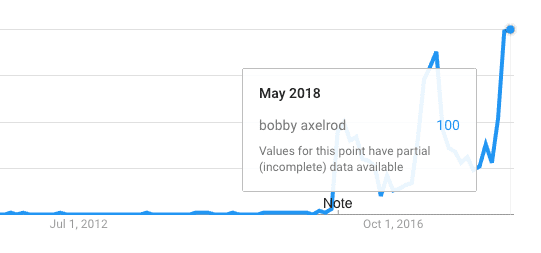
Type “Bobby Axelrod” into Google and the first recommendation that pops up is “Bobby Axelrod hoodie.” So, to satisfy your curiosity: Mr. Axelrod, the cool-as-an-ice-cube-in-Alaska protagonist of Showtime’s series “Billions,” wears Loro Piana zip-ups. They’re cashmere and just in case you’re really interested in dressing like the man who makes the billions on “Billions,” each one costs $2,295. 

How to Dress Like a Billionaire, Wall Street Journal

There is a palpable shift in both the style of clothing and the color palette used by the upper-middle class fans of the show in Silicon Valley, Los Angeles, New York, and even the metropolitan midwestern cities. Brands are beginning to partner with Showtime to capitalize on this.

Last week, Brooklyn’s Greats Brand released an ultra-limited edition Axelrod shoe; 100 pairs of the premium Italian-suede shoes sold out in under 17 minutes. Viewers are so drawn to morally-ambiguous Bobby Axelrod that they’re buying shoes in his name.

Screen-Shot-2018-05-07-at-3.41.18-PM.png
May 2018 saw peak search traffic for the ‘Billions’ character

CEO of GREATS Brand (2PM No. 73), Ryan Babenzien had this to say in defense of the collaboration:

Bobby Axelrod is a man from humble beginnings. A desire to escape his means and prove his ambition drove years of hustling and grinding. Add no small amount of cunning, and eventually Axe made himself into one of the most powerful men on Wall Street: a bona fide billionaire. We admire Axe for his ambition as much as we do for his style. Favoring a well-worn pair of jeans and Metallica t-shirt over the obvious power-suit, Axe carries himself with the confidence and understated elegance that we appreciate here at GREATS. With Axe as our inspiration, we partnered with Showtime to create our richest Royale yet.

Billions has achieved a television milestone like only a handful of shows before it. It’s influenced men’s fashion by redefining business casual (specifically high dollar affleisure) for white collar workers. Babenzien’s aforementioned statement perfectly summarized the character’s appeal. The shoe collaboration further established the influence of the show’s culture and the virtuous cycle of water cooler chatter, media buzz, and search traffic around each week’s episode. Coincidentally, the most recent Sunday night was the show’s strongest in its three year history.

Read more of the issue here.

By Web Smith and Meghan Terwilliger | About 2PM