
Memo: The Netflix Playbook 2.0

One hire can make all of the difference. For Netflix, Josh Simon’s role as VP of Consumer Products is key to the platform’s offense, defense, and long-term viability as studios become self-sustained content fortresses.

The excitement around Netflix’s eCommerce push is palpable. If this project succeeds, the implications are far greater. CEO Ted Sarandos and Netflix are resting on dormant potential. With direct-to-consumer retail success, the streaming service and film studio could compete with Disney on another front.

Disney Plus infringed on Netflix’s ground and made an immediate impact on its offering by doing so. Netflix’s Marvel, Star Wars, and Pixar catalogues are now sparse. In April 2021, the other major intellectual property factories began threatening to move their projects from Netflix. Engadget recently encapsulated the mounting competition:

The battle to gain a foothold in the streaming era has spurred Hollywood studios to go on the defensive. After licencing films and shows to Netflix and Amazon, the likes of Disney and WarnerMedia have yanked their biggest properties from the competition to boost their own platforms. Not to be left behind, Comcast-owned NBCUniversal is reportedly mulling a similar strategy in a bid to prop up its fledgling streamer, Peacock, reports Bloomberg. [1]

As Hollywood goes on the defense, Netflix has responded with a strategy that signals the beginning of a longer-term approach to competition with Disney, Amazon, WarnerMedia, and Comcast’s NBCUniversal. It begins with DTC retail.

Phase One: Original Brand Retail

Netflix’s Shopify build shouldn’t be much of a surprise. The decision to pursue a millennial-friendly style of commerce over a traditional custom build or a more robust partnership with Salesforce, BigCommerce, or Magento is telling. This is what very large companies do when they’re not entirely sure about direction: equal parts skepticism and efficiency. But the decision may play in its favor.
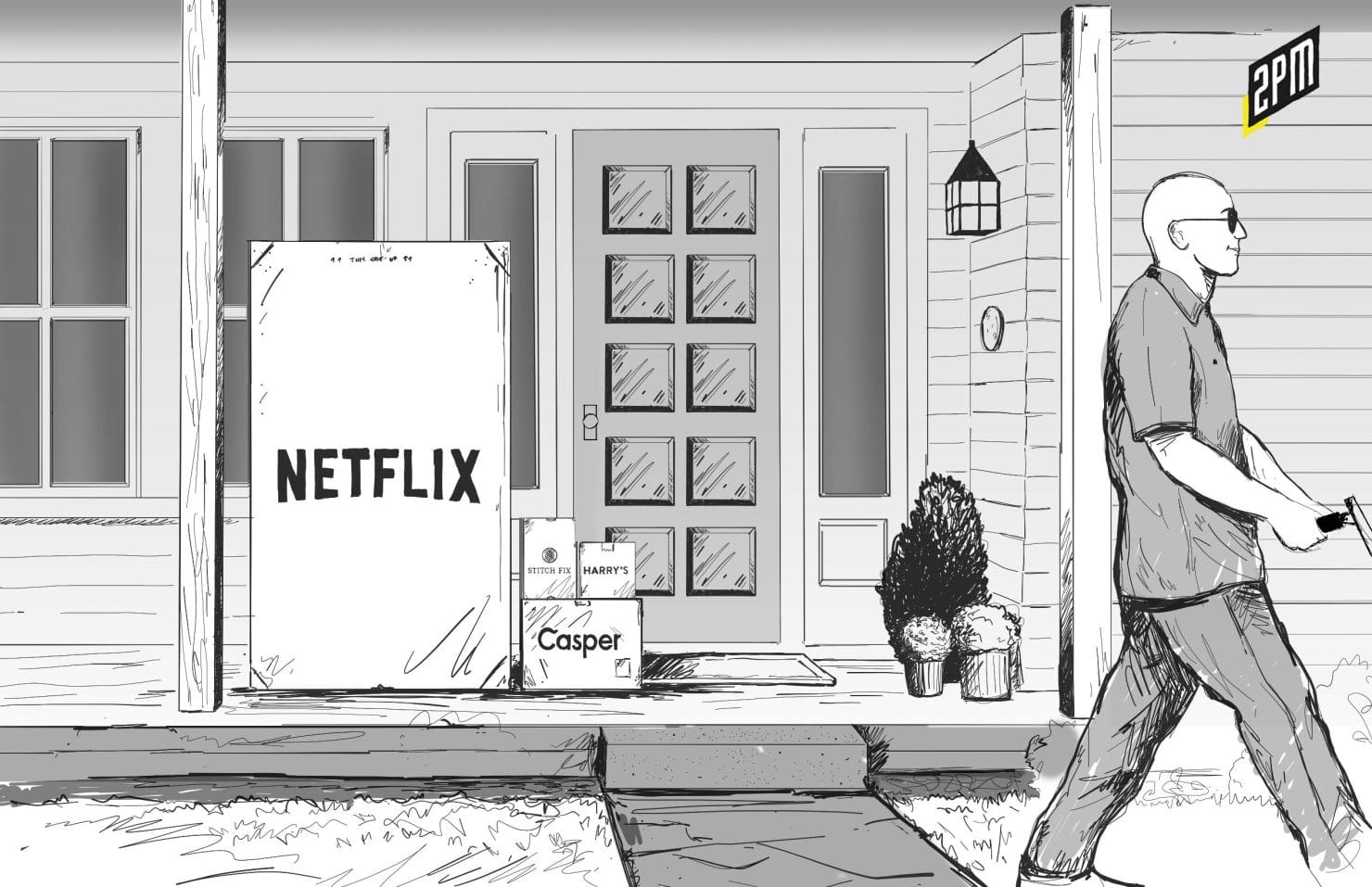
Even if the Shopify development required $1-3 million (it was likely much less expensive), it’s a relatively tiny investment into a nascent operation that will grow methodically over the coming weeks. Designed by BVA and developed by SDG (a partner to Skims and Prive Revaux), Netflix.shop is the streaming giant’s entrance into DTC. It’s a launch that the company hopes will communicate its brand is fresher than its age (Netflix is now 24 years old).

And aesthetically, functionally, and psychographically, the Shopify approach is consistent with Netflix’s goals. Not just from its front-end appearance and merchandising but from the technologies used: Shopify, Klaviyo, and Signifyd. In terms of product development, collaborative partners, and product photography styling, the retail platform succeeded in setting out to attract a younger, vibrant, and savvy consumer. So young that geriatric millennials may not fully grasp Netflix’s product and partnership strategies. Japan’s Beam brand, anime, and its Yasuke animated property are all indicators this approach may have greater implications. So in theory, this small investment may become Netflix’s most important.

Web Smith on Twitter: “Our daughters now have a whopping $126 worth of merchandise commemorating Season 3 of Stranger Things and outside of minimal licensing fees, Netflix earned none of that. Linear Commerce would transform Netflix’s prospects. / Twitter”

Our daughters now have a whopping $126 worth of merchandise commemorating Season 3 of Stranger Things and outside of minimal licensing fees, Netflix earned none of that. Linear Commerce would transform Netflix’s prospects.

Netflix has long known its potential in leveraging its intellectual property for merchandise sales. In July 2019, a countless number of retailers licensed Netflix’s “Stranger Things” property. For a short period, it was a retail bonanza for Target, Amazon, H&M, Kellogg’s, Burger King, Coca-Cola, Hot Topic, Walmart, and even Baskin-Robbins who converted 75 of their stores to appear like the series’ “Scoops Ahoy” ice cream shop.

The Duffers said none of the marketing deals meant to hype their show would add to their bank accounts. “We’re not getting a revenue cut from any of this,” they said. “The hope is that it just gets the show more exposure.” [2]

But throughout this era of Netflix, the only potential transactions were in-show product placement and the potential of heightened subscription interest.

Phase Two: Live Events and Activations

In March 2020, I calculated the math on Netflix’s eCommerce potential as the streaming studio’s hire of Josh Simon tipped off the current direction.

Web Smith on Twitter: “In July, I did some basic estimates on Netflix’s online retail / licensing potential. “Just 7% of Netflix’s viewers purchasing through the app – at a $50 AOV – would equate to over $140M in sales from 41 million households.”@Netflix is moving towards linear commerce. pic.twitter.com/P2DpTe0dlq / Twitter”

In July, I did some basic estimates on Netflix’s online retail / licensing potential. “Just 7% of Netflix’s viewers purchasing through the app – at a $50 AOV – would equate to over $140M in sales from 41 million households.”@Netflix is moving towards linear commerce. pic.twitter.com/P2DpTe0dlq

Simon’s hire is as directional as it is functional. Earlier in the new VP of Consumer Product’s career, he spent time working at Nike. But it was his six years working for Walt Disney Studios and Blumhouse’s live experience business that will shape Netflix’s brand and audience strategy for consumer products. He’s tasked with “identifying and building plans across different lines of business in consumer products” according to a 2020 article by Variety [3].

And this is why the Shopify experiment has long-term implications. If Netflix can prove that it can successfully capture more of its commercial upside by insourcing more of its retail, more live events will follow. Later in 2020, “Stranger Things” rode the success of the Baskin-Robbins partnership by launching an interactive drive-thru experience in Los Angeles. Spanning 400,000 square feet at Skylight Row in Downtown Los Angeles, the hour-long performance featured scenes from 1985 Hawkins. The guests were encouraged to dress in their finest 1980s wears as they were transported back 35 years to a high school reunion, the fictional “Starcourt Mall”, and then to a three-part show featuring the three seasons’ key moments. The live event was co-produced by Netflix and Fever, a venture-backed event platform. This is inline with Adweek’s contention that the streaming giant will continue finding innovative ways to capitalize on its intellectual property:

Netflix’s eCommerce push caps off years of dabbling in the consumer products business that Netflix has been pursuing through retail and brand partnerships as it has looked to find ways to capitalize on the runaway success of some of its original series. [4]

Netflix’s Shopify strategy is the precursor to a focused effort to bolster the viability of its class of properties that may eventually take on life as temporary live events. But this isn’t where Netflix’s aspirations need to end.

Phase Three: The Netflix Universe

With Josh Simon’s charge to capitalize on the runaway success of some of its original series, Netflix’s strategy is unlikely to complete with temporary live events and short-term activations. Netflix has amusement park potential and its decision to pursue commerce as an initial step is a credible attempt to capture the data required to build a strategy around a physical location for young adults. That includes members of Generation Z, Netflix’s core demographic, as it attempts to compete with video game studios, amusement parks, and film production houses with their own streaming services. Consider Netflix’s biggest competition:

Netflix said in 2019 that its biggest competition is actually Fortnite, which is what more likely pulls players away from the streaming service. [5]

Netflix’s digital world may converge on the physical for good. In doing so, Netflix will finally go on the offensive after nearly a decade of Hollywood’s traditional studios breaking down one of its two prized advantage: its content curated from other studios. The result may be a Netflix that goes all-in on becoming more like Disney or Universal in the process:

As Netflix tries to compete with Disney on a global scale, it is trying to create franchises that can have the same impact on culture as “Star Wars” or “Toy Story.” [6]

It is unlikely that Netflix will ever find it suitable to acquire 25,000 acres of land like Disney before it, or even 415 acres like Universal Studios. But in nearly every metropolitan region in America, there is a dying mall – one that bustled in the era depicted by the “Stranger Things” fictional Starcourt Mall. There will be inexpensive property at CEO Ted Sarandos’ disposal and it wouldn’t be the first time that Netflix converted a dead mall into something useful.

If the streaming giant proves that IP-fueled merch can sell, so might brick and mortar retail, pop-up experiences, and amusements. Don’t be surprised if Netflix’s digital experiments precede its venture into physical retail, events, and a permanent home for its beloved original properties. It’s created franchises that are valuable. Walt Disney knew what he was doing when constructing a Bay Lake, Florida home for his franchises. In this day and age, what begins as DTC often ends up in physical formats. It’s what takes a valuable property and makes it a beloved one. A lasting cultural impact may follow.

By Web Smith | Art: Alex Remy | Editor: Hilary Milnes

Member Practical: Art, Science, and Economics Meet

A kitten, an NBA champion, a canvas of graffiti-covered art, and 4,101 parcels of virtual land walk into a bar. Instantly, the value of that bar grows by 137 ethereum. If you have no idea what I am talking about, you are not alone. This primer will help explain the origin, the present, and the future of non-fungible tokens – a complex field that will make a sizable impact beyonded of its intended audience. The term “NFTs” is entering the mainstream. Yes, even for those who may scoff at the idea of blockchain technologies, tokenized goods, or paying for an asset class that was previously free or easily transferable.

This member brief is designed exclusively for Executive Members, to make membership easy, you can click below and gain access to hundreds of reports, our DTC Power List, and other tools to help you make high level decisions.

Join Here

Memo: The Great War

Robert Vann, publisher and editor of the Pittsburgh Courier, wrote in awe about the newly minted international sports icon Jesse Owens in 1936. Owens had just won four gold medals at that year’s Olympics, held in Berlin.

I looked on with a heart which beat proudly as the lad who was crowned king of the 100 meters event, get an ovation the like of which I have never heard before. I saw him greeted by the Grand Chancellor of this country as a brilliant sun peeped out through the clouds. I saw a vast crowd of some 85,000 or 90,000 people stand up and cheer him to the echo.

A sprinter from the Jim Crow South and student at a then-segregated Ohio State University, Owens experienced racially-integrated life for the first time while sailing to Europe and living abroad for the Olympics. In a span of a week during the Olympic games, he challenged and diminished many of the ethnic and racial myths perpetuated by Adolf Hitler, the “Grand Chancellor” referenced by Vann, by dominating the Berlin Olympics and undermining Hitler’s claims of national and racial supremacy.

Berlin, on the verge of World War II, was bristling with Nazism, red-and-black swastikas flying everywhere. Brown-shirted Storm Troopers goose-stepped while Adolf Hitler postured, harangued, threatened. A montage of evil was played over the chillingly familiar Nazi anthem: “Deutschland Uber Alles.” This was the background for the 1936 Olympics. When Owens finished competing, the African-American son of a sharecropper and the grandson of slaves had single-handedly crushed Hitler’s myth. [1]

Owens returned to America after the Olympics, where President Franklin D. Roosevelt would not acknowledge his feat and, in failing to do so, spawned an historic missed opportunity to shift a global narrative. What could have been had Owens’ treatment at home matched his achievements abroad? Had America amplified and marketed his four Olympic gold medals as symbols of psychological defeat over Germany’s prevailing ideology, perhaps a tyrannical belief system could have been thwarted before words turned to actions. In reality, Kristallnacht would take place two years following the 1936 Olympics. Owens would go on to say:

Some people say Hitler snubbed me. But I tell you, Hitler did not snub me. I am not knocking the President. Remember, I am not a politician, but remember that the President did not send me a message of congratulations because, people said, he was too busy.

Because he was an African-American man, major corporations would not employ him as a pitch man. His amateur status was revoked by the NCAA, and he was reduced to running against horses for compensation. During Owens’ career, the country was pioneering large-scale advertising and public relations campaigns, but we failed to use his historical wins to our advantage.

We must ask ourselves why.

The Great Invention of the 20th Century

Owens’ story becomes a lesson in foreshadowing and an important parable. Advertising is one of the most powerful forces in shaping opinion and influencing policy, but it’s much harder to advertise when a company, brand, or sovereign nation isn’t itself in support of the cause in question.

Just five years after Owens silenced Hitler with his speed, American advertising agencies and their brand partners mastered cause marketing when they needed it most: World War II. America was at war abroad and grappling with a vulnerable economy at home. The economic engine of war involved a never before seen form of consumer marketing. Advertising was used to promote consumerism as a patriotic duty and brands were intertwined with government initiatives to both supply our military industrial complex and support the domestic economy. WWII-era brands and media agencies were aligned in a forceful showing that ideas could be used no differently than physical weaponry.

Throughout history, brands have grown stronger during periods of societal unrest, but only when the dissonance between their ideas and their actions were at a minimum. Civil rights wasn’t an American corporate or policy priority when Owens stood above a saluting Nazi, laying waste to the host country’s agenda. Contrast this to the collective efforts that won a war after escalation required our participation.

Film depictions of WWII feature the Lucky Strike brand of cigarettes as prominently as if the packages of rolled tobacco were leading characters of the story’s arc. Lucky Strike was omnipresent internationally throughout the war. But before the packs of branded cigarettes were included as C-rations for American soldiers, Edward Bernays, known as “the father of public relations”, helped the American subsidiary of the British tobacco company with its first mindshare coup. History’s first PR campaign was designed to convince American women to take up smoking. With the wind of suffrage at their backs and the 19th Amendment to the Constitution fueling a new wave of enfranchisement, women became a marketer’s new focal point. Lucky Strike cigarettes were their “torches of freedom.” Corporate America co-opted a social movement to further an economy. It would be the first time of many.

No Title

Modern marketing / PR was a byproduct of American war efforts in the Wilson administration (1917). Without Edward Bernays and his uncle (Freud), our consumer economy would not be the same.What he didn’t account for was our distributed media system. From 1928’s “Propaganda”: pic.twitter.com/9C7MIkYTAx

Alongside savvy marketing tactics, new brand innovations gained traction thanks to their contributions to wartime economies. Walt Disney manufactured morale for GIs shipped to different theaters of war. Jeeps were built for the American military. Mars invented M&Ms during the Spanish Civil War. Bausch & Lomb created Ray-Ban aviator anti-glare frames at the request of an Army Air Corps lieutenant general. Kotex began as a WWI-era gauze before being adapted by Army nurses to relieve menstrual bleeding. Super Glue was formulated in 1942 to serve as a manufacturing additive for military weapons. Silly Putty was designed after a war-production experiment to find an alternative for rubber went wrong. And Fanta was invented after a trade embargo prevented Coca-Cola syrup from being imported into Nazi Germany during World War II.

Overwhelmingly, at the dawn of the American advertising age, brands were a part of the war effort, liberation, and many cultural shifts of the times. There were exceptions, of course, just as there are exceptions today.

A Century Later, Lessons Forgotten

When outspoken Coinbase CEO Brian Armstrong suggested in a September 2020 blog post that his company was better served by apathy, it was consistent with the culture within its walls.

Everyone is asking the question about how companies should engage in broader societal issues during these difficult times, while keeping their teams united and focused on the mission. Coinbase has had its own challenges here, including employee walkouts. I decided to share publicly how I’m addressing this in case it helps others navigate a path through these challenging times.

In short, I want Coinbase to be laser focused on achieving its mission, because I believe that this is the way that we can have the biggest impact on the world. [2]

An argument can be made that Armstrong’s assessment of the mood of his own workforce was accurate. Given Coinbase’s internal dynamics, running an advertisement akin to Beats By Dre’s “You Love Me” would not have worked for the same reason Cadillac could not have run an advertisement on behalf of Jesse Owens’ historic days abroad in 1936: The brand’s promotion of freedom would have clashed with Owens’ reality.

Commonplace in 1944, rare in 2021.

But the Coinbase culture eventually spoke for itself when a number of minority employees called out cultural schisms within company walls. In many ways, Armstrong was right: His company had no authority to take a public position on civil rights or equality.

Recent decisions at companies like Shopify, Twitter, Facebook, Snapchat, and Google to deplatform Donald Trump and his campaign can be interpreted as good-faith efforts to address current societal unrest, which has seen online words evolve into real-life actions. But like Coinbase, many of these companies are also laser-focused on their missions. The ideas of freedom, cooperation, and equality that are so critical to democracy are barely communicated or shared by today’s top advertisers.

I began to wonder why cause-based advertising wasn’t more prevalent given the issue’s thread throughout our society: economically, politically, socially, and otherwise.

During WWII-era advertising, nearly every major corporation was directly involved with the issue of its time. During that same era of advertising, Jim Crow bigotry and violence prevailed at home while racial and ethnic atrocities persisted abroad. Today, the corporations that are best positioned to promote the ideas that a threatened democracy requires to heal seem to be extraordinarily quiet right now, when it matters most. Beats by Dre’s ad in November 2020, Dove’s June 2020 ad placement, and the Nike’s September 2018 spot starring Colin Kaepernick are exceptions to the rule.

Overall, few corporations are prepared to champion the American ideals the way their predecessors did during past threats to American democracy. And perhaps it’s because, like Jesse Owens’ wins and the PR blitz that never was, there is a dissonance between the messages that today’s advertisers want to share and the reality of the dynamics within our own walls: our neighborhoods, our workplaces, and our places of gather.

A timely lesson bound to reemerge

Eighty years ago, a war threatened democracy. And in the first month of 2021, democracy is again under siege. At the root of today’s unrest is the myth that an election was stolen – the same contest that saw historic levels of African-American voter turnout in swing states. The corollary is not a mistake. In the 1940s, corporations were proponents of the war’s resolution. They manufactured goods and used their associations with the war efforts to espouse American ideals. Where is today’s equivalent? One possible explanation is that media has never been more fractured and brands’ abilities to promote ideals has diminished over the decades. The explanation more difficult to hear is that perhaps we are more like the racially-segregated country that Owens came home to than we are willing to admit. Look no further than our own workspaces, virtual or otherwise.

Back then, we needed Cadillac to build engines for fighter planes. Today, we need brands to internally reflect the ideals of America that they so desperately want to espouse in marketing: from workplace equity to representation in leadership. This past week, many Americans have found that we are not what we thought we were. Today’s primary mission is to heal a deep-seated division. The resolution is found within the walls of our homes, our places of gather, the workforces that we build alongside, and our nation. Maybe and only then can the marketing and advertising of today reflect who we as Americans believe ourselves to be. As of now, there aren’t many examples at which to point.

The refrain seems to grow louder by the day from people who look like me. You love my culture but do you love me? Corporate America never answered that question for Owens and the many other pioneers of his day. In doing so, we missed an opportunity to beat down evil in its idea stage. Perhaps today’s corporations will see the need to be more dynamic in how they respond. First, with action, and then, through the amplification of messaging that has been proven to impact the hearts and minds of the people.

By Web Smith | Editor: Hilary Milnes | Art: Alex Remy | About 2PM