
Joann King Herring sat across the living room, lively and engaging as ever. I was standing in her world. As a 16-year-old junior at Houston’s Jesuit Preparatory School, I was a lower middle-class outsider thrust into a world that I couldn’t fully grasp at the time. The geopolitical concerns of the 1980s were long past (or so we all believed at the time). But the 70-year-old socialite and philanthropist still carried herself as though she influenced foreign policy, and in the home of a mutual friend in Houston’s famed River Oaks area, Herring still held court. In a small corner of a major city, she was a titan that influenced outcomes a world over.
It was 1999 and, perhaps, the first time that I heard the phrase “arm the rebels.” Herring was a friend to a Texas Congressman named Charlie Wilson and four years after that meeting, their story, Charlie Wilson’s War, would be on the New York Times‘ best seller list [1] before getting turned into a major Hollywood motion picture in 2007. It was a tale about short-term success and long-term failure. It was about doing too little and doing too much. The film covered two American figures who lobbied the US government to fund a resistance against the then-USSR’s occupying forces in Afghanistan.
Now 90 years old, Joann and her friend Charlie armed the rebels over a 10-year event known as Operation Cyclone [2]. As the conflict came to a close, an official of one of the war’s affected countries would later tell the sitting US President, “You are creating a Frankenstein.” There is always an
But Herring and Wilson’s efforts worked over the short term. They armed the rebels and those rebels won. Whether or not the fruits of their labor had a net-positive or net-negative effect on global war and peace will be left to national security experts. The relevancy of this anecdote being used is simple: the act of “arming the rebels” maintained three components over that ten-year span from 1979 to 1989: (1) tools, (2) money, and (3) psychological support.
The rebels defeated a heavily-armed Russian military machine with American tools, American money, and the promise that they had the full support of the American government. This communicated to the opposing military that the money, the tools, and the rebellion would continue. The unbeatable army was beaten by endless supply, force, and psychological warfare.
Shopify and The Arming of The Rebels
Harley Finkelstein on Twitter: “Arming the rebels @Shopify-style, a 3 step guide:1. Create a network of fulfillment centers across America 🕸️2. Allow small businesses to leverage these centers 📦3. Add in robots 🤖Result: Affordable products shipped on a two day cycle to 99% of America. 💪 pic.twitter.com/a6KIptqsbm / Twitter”
Arming the rebels @Shopify-style, a 3 step guide:1. Create a network of fulfillment centers across America 🕸️2. Allow small businesses to leverage these centers 📦3. Add in robots 🤖Result: Affordable products shipped on a two day cycle to 99% of America. 💪 pic.twitter.com/a6KIptqsbm
Shopify has done a tremendous job executing on their corporate rallying cry: We arm the rebels. Having passed Ebay to become the second-largest eCommerce ecosystem in North America, Shopify has maintained that Amazon is next – an unbeatable army in its own right. Once known solely for its role in small cap eCommerce, Shopify now services financial processing, loans, fulfillment, hardware, and an ecosystem of developers at the beck and call of merchants who can afford their services.
Shopify exists to basically arm the rebels. We want a lot of people to go out and compete against Amazon.
Tobi Lütke, founder and CEO
But what happens when you execute on two components – the tools and the money – without the psychological support? The phrase “arming the rebels”, coined by Ruby on Rails creator David Hansson in reference to Shopify’s role in a densifying eCommerce landscape [3], has a hopeful ring to it. It implies that Shopify is punching upwards (it is). But Shopify will also need to punch downwards to maintain its position.
Shopify has investors excited because it is increasingly seen as the most likely challenger to Amazon’s ecommerce dominance. While many retailers, both traditional and online, have tried to tackle Amazon’s “everything store” head-on, Shopify has succeeded by arming individual merchants with the same technology and capabilities, but with more control. [4]
Shopify’s merchants have nearly every resource at their disposal except for one. The company is slow to champion the very brands that use their platform. Out of fear of coming off as partial, Shopify has thus far hesitated to provide the one advantage that could lock brands into their ecosystem for the long term. Yes, one of three components necessary to arm the rebels: psychological support.
The Big Game Ad That Wasn’t

I waited, fruitlessly, for Shopify’s Super Bowl advertisement. I wanted the brand to discuss – in front of the biggest audience – its evolution over time: the agencies that its ecosystem has fostered, its move into financial technologies, the DTC Era that Shopify’s invention pioneered, and the robots that will eventually fill its 3PLs.
Shopify has armed the rebels by supplying some of them with the funds necessary to operate or expand. Now, it needs to influence the demand curve for the businesses on its platforms. Shopify needs to become an evangelist for its brands.
The phrase “arming the rebels” has a hopeful ring to it. It implies that Shopify is punching upwards (it is) but will also need to punch downwards to maintain its position.
When Squarespace’s Super Bowl ad premiered, it was enough of a threat to Shopify’s market position that the company’s corporate Twitter addressed their smaller competitor in a sequence of tweets that felt somewhat out of character. Shopify is currently trading at a $54 billion market cap; Squarespace remains orders of magnitude smaller, and private.
Shopify on Twitter: “Hey, @SquareSpace we believe in supporting independent businesses too! In fact, there are over 40 businesses in #WinonaMN that are on @Shopify. So we’re going to promote as many of them as possible during the #BigGame. #WelcometoWinona #SupportingIndependents pic.twitter.com/CPq8Ld6Pgl / Twitter”
Hey, @SquareSpace we believe in supporting independent businesses too! In fact, there are over 40 businesses in #WinonaMN that are on @Shopify. So we’re going to promote as many of them as possible during the #BigGame. #WelcometoWinona #SupportingIndependents pic.twitter.com/CPq8Ld6Pgl
Given the market position that Shopify has earned, it’s become clear that Lütke’s position on psychological support must change and it should have begun with Super Bowl LIV. Shopify’s promotional power could reduce insurgent competition while closing the gap with the incumbent company that it is challenging: Amazon. Shopify must evolve into its own marketplace. As customer acquisition costs rise for small-to-middle market retailers, Amazon has become a reasonable partner for retailers looking to increase top-of-funnel awareness. From 2PM‘s A Familiar Strategy:
Amazon is harvesting consumer data to become an efficient vertical reseller. The Amazon products will continue to have the preferred place on product pages. In this way, opposing marketers’ frustrations are founded. It may be true that external brands will continue to be penalized for competing against Amazon’s private labels. The Seattle eCommerce giant seems to be preparing for a day when their data harvesting practices – a process that has spawned countless private labels – will be called into question.
Lütke’s likely opposition to this idea is clear: By selecting brands or products to feature in a marketplace format, Shopify becomes a kingmaker of sorts. A kingmaker is a person or organization with great influence on the value of a candidate. This person or organization uses policy, finance, and competitive forces to influence succession. I contend that offering loans or advancements to merchants is another form of kingmaking. Now that Shopify has begun to market financial products, there is less of an argument to be made.
Shopify’s moat has been discussed at length: Community and the partnership ecosystem are two buzz phrases that come to mind. But the Ottawa-based SaaS company has drawn the line at promoting the businesses that support the ecosystem; the company rarely pushes traffic and media attention to the companies growing within the ecosystem.
One of the three key resources for Operation Cyclone was psychological support. In the context of Shopify’s use of the phrase, the third resource is missing. If Shopify is comfortable defending its position against Squarespace by promoting independent retailers on Twitter, their management team should also feel comfortable supporting its own marketplace.
In December 2019, Shopify.com saw nearly 47 million visitors with over 40% of the traffic coming from the United States. While official numbers have yet to be reported, the Super Bowl was viewed by over 150 million people. Situated in this audience were potential consumers who may want to start their own company, developers who may want to build for Shopify, and consumers who may want to buy from Shopify.
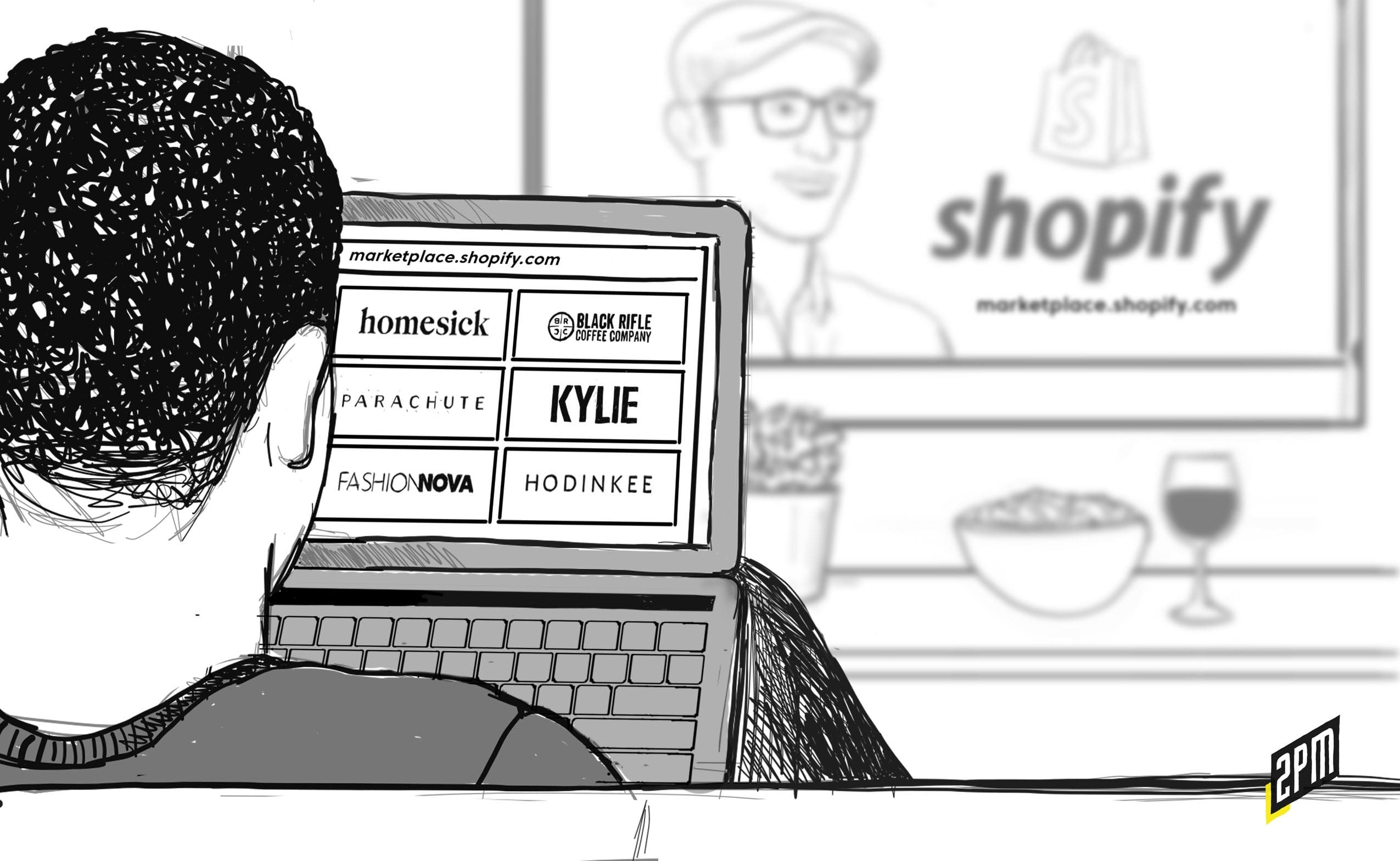
Amazon, Google, Microsoft, Walmart, Hulu, Quibi, Verizon, and Squarespace shelled out fees to advertise during the big game. However – direct-to-consumer brands were noticeably absent, priced out by the exorbitant costs of doing business. Imagine a $5.7 million, 30-second advertisement that sent tens of millions of Americans to marketplace.shopify.com. When those potential customers, developers, and consumers arrive: they’d see a curation of Shopify’s greatest brands – new and old, established and fresh. Shopify wouldn’t have only gained new customers or partnership prospects. Shopify would have influenced the awareness, growth, and viability for a number of brands that are dependent on three key resources.
In a June 2013 report by the Foreign Press [5], Edward Luttwak lists the five rules for arming the rebels: (1) Figure out who your friends are (2) Be prepared to do all of the work (3) Don’t give away anything that you wouldn’t want back (4) Do not invite an equal and opposite reaction by a larger power and (5) Lay groundwork for the endgame. For Shopify, that endgame involves an emphasis on demand-side economics. For the companies that rely on Shopify’s increasing suite of tools, they must thrive to remain B2B users.
By the end of that evening in Houston in 1999, I conjured up the courage to ask Herring a question or two. I was wearing my nice blue blazer, that night, so I had more confidence than usual. We learned about Operation Cyclone from an alum of the school in one of our courses but it wasn’t yet a widely known story. So on that night, I felt privileged to speak with her before her answers would be honed by Madison Avenue public relations spinmasters. I asked Ms. Herring the type of simple question that a 16-year-old student would: “What did you learn from it all?” She replied with something to the effect of, “We should have given them more and faster. It all dragged on too long. We could have done 10 years’ work in three or four.”
When you arm the rebels, do whatever you can to make sure that they win. They’re fighting for their supplier as much as they’re fighting for their own well-being. After all, their war is now your war.
Read the No. 345 edition here.
Report by Web Smith, Edited by Hilary Milnes | About 2PM

