
Memo: Frenemies, Part 2


In a new feature detailing the trajectory of Shopify, Bloomberg unpacked CEO Tobi Lütke’s distinct management style, the company’s history, and its pointed differences from Amazon. While Amazon’s obsession with its customer and “everything store” tag define it, Shopify is merchant-obsessed and now striving to be the “everywhere store”, underscored by its early-pandemic move to completely virtual work. After years spent building the backbones of small businesses’ online stores, Shopify went public in 2015 and has catapulted to greater heights since the pandemic’s onset as traditional retailers moved online.

Its trajectory is one that Amazon missed out on. A 2015 headline in Recode stated: “Amazon Will Shut Down Amazon Webstore, Its Competitor to Shopify and Bigcommerce.” The report by Jason Del Rey added:

The eCommerce software business focused on small and midsize businesses has become more competitive in recent years as young companies such as Shopify and Bigcommerce have raised gobs of venture capital to expand their tool sets and attract more customers.

Six years later, we’ve learned via Bloomberg that Amazon sold its merchant platform (Webstore) to Shopify for $1 million. In exchange for the more than 80,000 merchants who switched their business to Shopify, Amazon Pay was enabled on the Shopify platform. From Bloomberg:

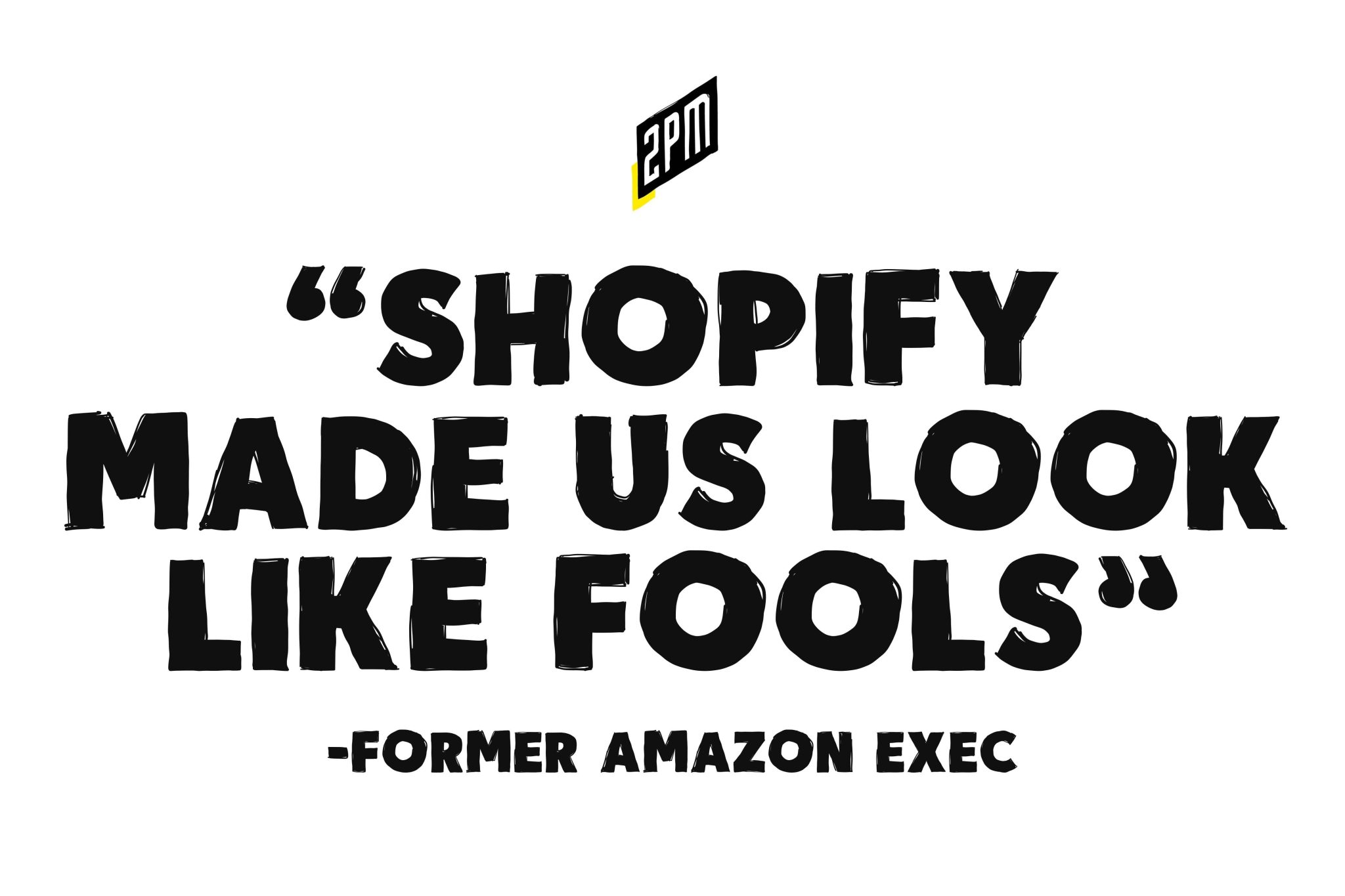
Bezos and his colleagues believed that supporting small retailers and their online shops was never going to be a large, profitable business. They were wrong – small online retailers generated about $153 billion in sales in 2020, according to AMI Partners. “Shopify made us look like fools,” says [a] former Amazon executive.

Shopify’s success is not due to Amazon’s Webstore misstep, but it afforded the company an advantage in capitalizing on a piece of eCommerce that Amazon underestimated. Amazon didn’t take direct-to-consumer sales seriously enough to work that into its long-term business plan, and it went so far as to set up a competitor for success in that area of retail. It was focused elsewhere, including on its private-label brands. Amazon communicated to many that entrepreneurs aren’t its bread and butter, rather the end customer is.

By focusing on product retail, Amazon left the field open for Shopify to excel in the art of brand development, something that Amazon has notoriously minimized as it built its own retail empire with the Amazon brand at the forefront. With Shopify putting its merchant brands first, its scope expanded beyond small merchants by earning the trust of leading retailers as well. The validation from Amazon, granted when it turned over its Webstore merchants, also helped.
Now, Shopify is stretching its legs to emerge from behind the scenes, tapping creators and big names to appeal to young customers and brands on the rise. Last fall, it hired former Yeezy GM Jon Wexler to lead its creator and influencer program, a move that has already led to deals like BIGFACE Coffee, created by NBA star Jimmy Butler. In No. 759, we wrote on the Wexler era and Shopify’s foray into persona-led brands:

BIGFACE Coffee is the experiment’s first major output of Shopify’s creator program. It’s a project that combines demand, earned media, and a pulse with the technical prowess and support of Shopify Inc.  It uses what Shopify has been known for (physical products) and pairs it with built-in demand (creators) and tests newer forms of commerce and technology (Web3 products / new front end design concepts / etc). Yes, BIGFACE packages a selection of its products with NFTs.

With earned media and more flair, Shopify intends to work on its own brand next. The road ahead will not be easy, however. Shopify is still behind in the critical are of fulfillment management and third-party logistics. While it began investing in fulfillment in 2019, the “last mile” is largely left to merchants whereas Amazon has shouldered one of the heaviest burdens for its sellers.

In this way, Amazon has taken steps to regain its edge on Shopify. Over the summer, it inked a partnership with BigCommerce to provide fulfillment for its merchants, a move that gives a direct Shopify competitor an edge on the leading SaaS provider by extending the power of Amazon’s biggest advantage, full-stack fulfillment. The possibility of it creating a Shopify-killer isn’t ruled out. “Amazon is a worthy rival,” Lütke told Bloomberg. But if the numerous developments covered above are any indication, Shopify’s rival may become a fulfillment partner. In Amazon’s Moat, we explain:

Through years of investments, Amazon has created its own cargo shipping fleet and is leasing planes, along with the opening of an Air Hub in Cincinnati, to avoid out-of-stock problems that have begun plaguing other retailers at this stage in the holiday shopping season. Amazon has stretched its business in myriad ways, but its advantages are no longer just product and digital-driven. On October 5, a container ship ported in Houston, Texas with a ship filled entirely by Amazon.

Shopify’s product pipeline does not include a fleet of shipping vehicles or investments into a midwest air hub, or transnational shipping strategy that consolidates shipments for its vendors. Amazon has passed FedEx in shipping volume and is poised to capture UPS and USPS’s market share as well. Additionally, Amazon will spend $52 billion on warehousing and shipping. Amazon is now in command of nearly 175 million square feet of warehousing with the ability to process, pack, and deliver over 50% of the goods that it sells. [1]

Amazon is approaching a truly vertically integrated logistics network on par with the largest delivery companies in the world. [2]

While Shopify has the advantage now, Amazon’s network of fulfillment systems is quickly becoming essential. Shopify’s great rival, may eventually become its most necessary partner.

Edited by Hilary Milnes with art by Alex Remy and Christina Williams 

Frenemies, Part I: Shopify vs. Meta

Member Anecdote: Frenemies

When you think about DTC, Web3 is its natural successor.

This member brief is designed exclusively for Executive Members, to make membership easy, you can click below and gain access to hundreds of reports, our DTC Power List, and other tools to help you make high level decisions.

Join Here

Memo: The Rise of the Holding Companies

One side has the advantage of distribution, the other side has the advantage of brand equity. I believe that the holding company trend will favor brand equity in the long run.

As the rumor persists that Thrasio is nearing a public offering, its competitors are growing in force, with Branded Group, Elevate Brands, Unybrands, Technology Commerce Management, Boosted Commerce, Heyday, and Win Brands Group among them. While technology may play a role in quantifying each investment’s viability and potential upside, none rely solely on an algorithm to determine a brand’s fate. That is, until recently.

OpenStore has raised $30 million to grow its business rolling up Shopify sellers, Axios reported this week. The emergence of a cottage industry of merchant holding companies on Shopify, also a thriving business for Amazon sellers, is telling: Shopify has built an eCommerce universe with gravitational pull. Here is how OpenStore works:

  • retailers hand over login credentials
  • OpenStore verifies sales and other inventory data
  • bots determine the acquisition offer by the next business day

OpenStore is now valued at $250 million and has already launched its automated acquisition tool targeting thousands of brands. While Shopify merchants sell on their own sites with no centralized selling platform, OpenStore can benefit from the richer nature of these sellers, who have direct relationships with their customers, unlike Amazon sellers. OpenStore is targeting sellers that are struggling to stand out in a vast sea of eCommerce players – a smart tactic as customer acquisition, marketing and brand awareness are among the most expensive parts of building a merchant business, and Shopify lacks the promotional algorithm and search functions of Amazon (though that’s beginning to change with Shop).

Amazon is the queen of discoverability.

According to Bloomberg, Shopify is leaning into the roll-up functionality, having built its own exchange for storefronts. The offer process will soon become part of the Shopify platform: any merchant can log in and, using OpenStore’s bots, receive a bid for selling their entire business. Shopify’s roll-up business has room for scale but is still far off from Amazon’s, and that’s for good reason. While Amazon sellers tend to have more scale than the traditional small business merchant, Shopify sellers tend to score higher on a measure of brand equity and net promoter score. For Amazon sellers, few own the relationship to the customer. It requires a bit of sophisticated advertising and sales funnel development to target Amazon customers, driving them over to the brand’s native cart. Shopify brand acquirers see one less step. For companies like Win Brands Group, a backend system of operational excellence is used to improve operations, grow margins, and trim duplicity. Time will tell whether or not OpenStore has a similar strategy in the works.

Amazon’s advantage remains product discoverability. The roll-up companies devoted to that format usually acquire FBA brands with less short-term risk but higher long-term risk. This is the key question:

Are nascent Amazon brands capable of the same successes if sold through Shopify, BigCommerce, or another commerce provider?

OpenStore competitors like Perch, Thrasio and Elevate Brands are focused on nascent businesses. This makes sense for them. It takes much less work for Amazon retailers to exceed $5 million or higher in run rate. For Shopify merchants to accomplish the same, it requires a better sales funnel, a stronger operational team, and a brand that consumers are drawn to. To lower risk of failure, Win Brands Group acquires brands earning eight figures or greater in annual revenue. When assessed through traditional methods, this seems to be the best method. But OpenStore can revolutionize the Shopify side of the brand acquisition spree if it can identify strong businesses as well as Win Brands Group can, but much earlier in their growth trajectory. Can OpenStore detect these types of brands algorithmically? And when they acquire them, can they streamline operations in a way that is conducive to proper retail brand development?

Right now, the business of Amazon brand acquisition is the prefered channel. Consider this recent commentary about the state of digitally-native brands. In one of those contributor posts for Forbes by Chris Shipferling, the Managing Partner at Global Wired Advisors, provided a bull case for Amazon brand acquisitions:

I believe that campaigns prioritizing keyword rankings, earning reviews and driving conversions will all but replace traditional branding strategy within the next three to five years. And as many of these practices are already ubiquitous in the marketplace, the definition of what comprises a premium brand will evolve to reflect best practices for e-commerce.

There has never been a more incorrect assessment of retail brand psychology. While these quantifiable metrics will continue to serve a role in how a consumer assesses their purchasing options, brand has likely never been more important as algorithms shift, third-party data diminishes, and platforms cultivate their own private labels. Brand is important. And this is where OpenStore can succeed in a model that more resembles an Amazon acquisition (quantitative) than a Shopify buy (qualitative).

Retailers want one-to-one contact with their customers. They want their brands to have a message, a purpose and a point of view. More of these exist on Shopify.com than (natively) on Amazon.com. now, and this may lead a defection away from Amazon-hosted brands. See below for a relevant example. As the industry shifts toward the roll up of Shopify brands, fewer non-VC backed brands will need to wait to maturity before interest from investment vehicles like Win Brands Group. OpenStore is in good position to scale the Shopify strategy if its proprietary technologies can select brands as well as the digitally-native brand veterans at Win Brands Group and their Shopify-focused contemporaries.

By Web Smith

Note: this memo is an expansion of the short analysis from Friday’s member brief. That version had a few grammatical errors. This version has been improved and is worth your time. To all who emailed in, I apologize for the errors.