
No. 273: Modern Luxe Doesn’t Bend

Watermark_ByTailorBrands
Pictured: Outdoor Voices, from our Open Letter to DNVB CEOs

In November of 2016, Lean Luxe’s Paul Munford penned somewhat of a scripture to upstart modern luxury brands: promotion-heavy retailers will not last. There are few takeaways from “The Downward Spiral” that are worth mentioning as recent economic reports suggest that the retail apocalypse is coming to an end, a great sign for aspirational DNVBs that are looking to expand into physical retail.

Screen Shot 2018-06-12 at 10.05.48 AM.png

We are in a time of unprecedented retail brand launches, collaborations, acquisitions, and re-imaginations – much of which is online-first. This begs the question, what will separate the winners from the commodities? There are early and permanent decisions that determine a brand’s trajectory. For every Mizzen + Main or Ministry of Supply, there is a State and Liberty. For every Outdoor Voices, there is a Bandier. And for every Away, there is a Raden. Each decision matters. And no decision matters more than pricing and a brand’s promotional tendencies.

Here are the top ten takeaways from some of Munford’s best work:

  • No maneuver in retail appears to be as easy to roll out, yet no strategy is as detrimental to a retailer’s long term prospects as the heavy discount. It is a palliative pill: wonderful for the consumer in the short run, but ultimately bad for both business and shoppers over time. It commoditizes the brand, forcing companies to differentiate on price. 
  • The second problem, also related to scale, is systemic to the industry itself: The need to constantly add more and more products at regular intervals, flooding the marketplace with goods that are newer, but rarely better.
  • The lure of the discount, then, becomes too hard to resist. It provides a short term boost to the bottom line and the illusion of growth, but at the expense of brand reputation and sustainable profit — two vital arteries for a business’s overall health.
  • Modern luxury companies have figured out the formula, and it’s remarkably simple: create less merchandise than will sell (and predict, if possible, the sell-through rate, with pre-orders), keep demand high. Embrace the waiting list, as Everlane, Glossier, Caraa, and Alala, among others, often do. 
  • Never discount; preserve the standing of the brand. These tactics certainly do not work, however, or at least for very long, if product standards are below par.
  • Hermes, for instance, is notorious for never slashing prices. Its products carry a prestige because of that, and there is always a demand, no matter how frivolous the item. And they certainly are not above testing the limits of consumer devotion: It has even gone so far as to repackage its cutting floor leather scraps to sell them as high-priced gift boxes.
  • That opposition to discounting would come from founders within the emerging modern luxury industry is no coincidence. For one, it displays the trademark sense of calm confidence in the product that this group is quickly becoming known for. 
  • As for Mr. Preysman, the full price mantra feeds into his mission to constantly refine the product, to make it better, and push it ever closer to perfection according to the standards of the brand.
  • Surprisingly, rejecting the discount is also quite consumer-centric. The eternally-wise Ben Franklin said it best, of course, when he offered this observation: “The bitterness of poor quality remains long after the sweetness of low price is forgotten.”
  • It takes superb maturity and a great deal of resilience to fight the urge for the temporary discount boost at the expense of preserving a long term reputation. 

Maturity, patience, grit, and perhaps temporary poverty are keys to developing the types of brands that grow to compete with age old legends and fierce (but hopefully friendly) rivals. In 2013, Brooks Brothers commented on Mizzen + Main’s influence on the shirting industry for the New York Times:

While Brooks Brothers experimented with “performance” shirts akin to Mizzen & Main’s, [Brooks Brothers’ spokesman] Mr. Blee said that customers preferred the general wearability of conventional all-cotton. The stretch fibers felt synthetic to them. Although a range of Brooks Brothers oxford shirts have moisture-wicking properties, he said, “We are known as a natural-fiber house: 100 percent cotton, 100 percent cashmere.

Just five years later, Brooks Brothers is launching a competitor to compete in a menswear world that is being re-defined by technical fabrics and other innovations.

Mizzen+Main on Twitter

we’re old enough to remember when Brooks Brothers laughed at performance menswear: https://t.co/5hBzcUHAEx https://t.co/xCN29dVk81

I remember the joy of that article hitting the newsstands on December 18, 2013. Not because of the notoriety that it would provide but because it had been over a year and half and we really needed the sales. We stood firm on our price while we built allegiances and Kevin worked feverishly to improve the product. And the company lasted. What Lavelle and team has done today is nothing short of spectacular. And it has allowed the brand to stand, eye to eye, in the same clubs and on the same courses as the company that invented the polo shirt (sorry, Ralph).

To achieve growth and longevity, branding cannot be viewed as a soft skill. Price cannot be viewed as an arbitrary number to manipulate. The five forces must always be considered. And patience must be paramount because great brands start slowly. In the age of modern luxury DNVB’s this is as important as the products themselves.

Read more: An Open Letter to DNVB CEOs (Issue No. 254)

Read the rest of Issue No. 273 here.

By Web Smith and Meghan Terwilliger | About 2PM
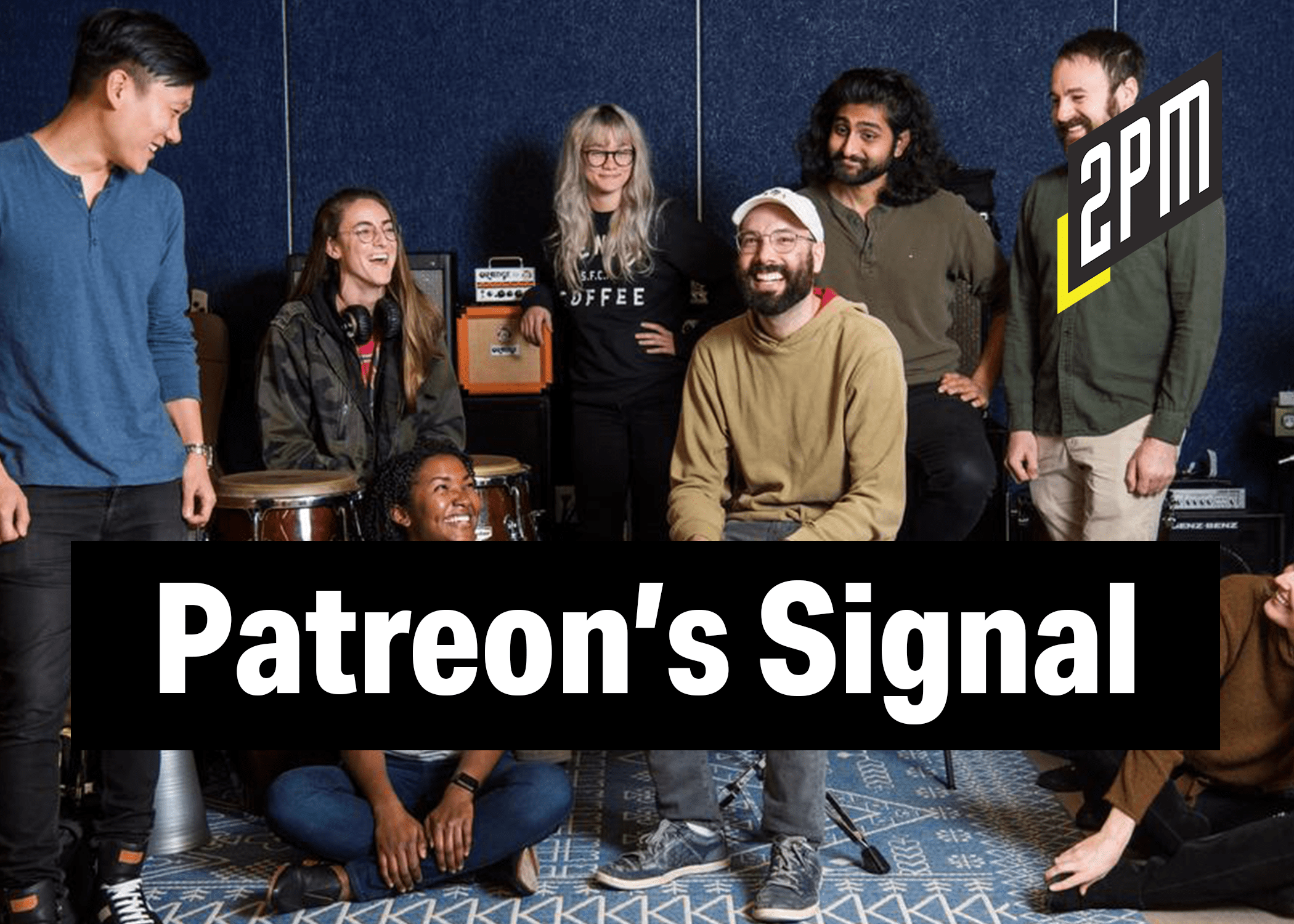
Member Brief No. 16: Patreon’s Signal

If you’re an independent creator, it’s likely that Patreon is a platform that you call home. Nearly 100,000 creators do. The platform has achieved notable traction in a relatively short period of time. It’s reported that by 2018, they’d process nearly $1 billion. Cofounders Jack Conte and Sam Yam’s creation launched in May of 2013 after Conte grew frustrated by Youtube’s lack of alternative monetization. As the story would go, Conte beta-tested the site with his own personal Youtube audience and began raking in $7,000+ per video. Youtube’s monetization would earn him a little more than $50 for the same work. Fast forward five years and Patreon is synonymous with patronage, as much as Kickstarter is synonymous with crowdfunding.

This member brief is designed exclusively for Executive Members, to make membership easy, you can click below and gain access to hundreds of reports, our DTC Power List, and other tools to help you make high level decisions.

Join Here

No. 255: The Drum Major Instinct

Watermark_ByTailorBrands

Let’s save the outrage for a moment and look at Chrysler’s Ram ad for what it is, a valiant effort and a missed opportunity. Their ad utilized a speech on what MLK called the fall of the Roman empire. Chrysler and their ad agency deserve applause for being gutsy enough to use this as their source material.

Because nations are caught up on the ‘drum major instinct.’ I must be first, I must be supreme, our nation must rule the world. And I am going to continue to say it to America. Because I love this country too much to see the drift that it’s taken.

Martin Luther King, in the same speech.

In an NFL season that was heavy on the politics, Super Bowl advertisements generally held American politics at arm’s length. It’s clear that there has been social activism fatigue. But this Ram Trucks’ ad attempted to be all things to all people and frankly, only courage can convert a valiant effort into a meaningful outcome.

There are levels to consider here and it begins with the framing of the advertisement:

  • Ram wants to sell trucks. This is the only reason that you pay $5M for an ad on the world’s biggest stage.
  • Chrysler outsourced this concept and direction to High Dive, a boutique agency in Chicago. Their attempt was likely well-meaning.
  • February is Black History Month.
  • Martin Luther King is a safe American hero.
  • Both the Philadelphia Eagles and the New England Patriots fielded activist players in the 2017-2018 season.
  • Chrysler is leaning on the President’s approval rating to make a statement that they felt most reasonable Americans agreed with.

This particular creative agency would likely identify as liberal. And it’s also likely that they felt that this advertisement was an opportunity to do more than move products. Ram’s agency has an interesting mantra on their homepage:

Screen Shot 2018-02-05 at 5.30.44 PM

This likely motivated their approach here. The juxtaposition of the famous MLK Drum Major Instinct speech, exactly fifty years prior to the biggest game of the year, was too much to pass up. This, even though the speech’s context makes little sense when you consider what they chose for the advertisement’s imagery.

The above agency requested permission from the King Family Estate to use his likeness in the ad. And upon receiving that permission, we can infer that there was a battle between the creative agency and the in-house marketing team at Chrysler.

Martin Luther King was obviously a great man but for context, by 1968 he had grown weary of the Vietnam War. He’d also taken up the mantle for America’s poor (of all ethnicities). He’d publicly called for an end to American corporate greed. His popularity was at an all-time low by then. With the “Drum Major” speech, he established a few basic tenets of the American far left platform that endured for decades. This ad was an attempt to juxtapose his words with our times.

ram-sb-team-mlk-PAGE-2018

I’d venture to guess that the creative agency wanted imagery of a player kneeling. Because, of course they did. The Ram team at Chrysler likely objected and compromised by allowing High Dive to include the 1.7 seconds of a team of African-American high school football players kneeling for their pre-game prayer. It’s imagery that’s vague enough to be a political non-issue in an ad about trucks that targets 25-35 year old men in towns like Cookeville, Tennessee.

The real appeal of using this MLK speech was his re-defining of the word “great” – an argument against the current administration’s “Make America Great Again” motto. With an approval rate in the 30’s, this was a safe calculation. The Chrysler team latched on to this politically-centrist approach because it is inoffensive to the right and (assumably) endearing to the left.

In so many words, the ad in a sentence was:

America is great already and it’s because we are a nation of servants who believe in helping our fellow man. Ram is the vehicle for those who serve.

I completely understand this collective thought process. If you don’t, consider that no sport delved deeper into the world of social activism than the NFL’s small band of players – one of whom was starting for the Philadelphia Eagles.  The other of whom was banned from playing the game. Neither of whom were involved in the advertisement and for obvious brand demographic reasons. The stage was set to execute one of the most meaningful ads of the past year.

But the ad fell flat. And this is where a diversity of opinion and background is handy in creative environments.

Throughout 2017, there was quite a bit of cognitive dissonance. Many NFL fans, commentators, politicians, and our President damned those men who took part in peaceful protest. This while uplifting and honoring the man who originated it. In this way, Ram inadvertently highlighted that cognitive dissonance and set off quite a nerve on social media and beyond.

ESPN’s Darren Rovell in a message to 2PM:

A company really cant use that speech to sell something. It just feels dirty. I at least had that reaction and everyone on Twitter seemed to have as well. Just like the Prince projection, when we bring back the dead, we have to be so careful. I think Dodge got caught up on the 50 years idea. But didn’t fully think through how the crass commercialism make it hard to use the speech as a device to better sell.

I am not upset by the advertisement, itself. The King family’s estate approved it and the creative agency likely did the best that they could with some mighty restraints.

I am upset that the opportunity was wasted and even the smallest tweak to the visuals could have eased the uproar.

There was no stock footage of Ram trucks serving others in times of need. There was no archival footage of peaceful protestors jumping out of the bed of a truck to meet their friends at the front line. There wasn’t even that reconciliatory visual of a service member (who serves) and the athlete / political activist (who serves) both coming to terms with each other’s efforts.

MLK’s sermons were so powerful because they made us think about our own human flaws.

But perhaps next time, agencies and in-house corporate teams can possess the courage to take a step out of their comfort zones, leaning in to authentic messaging. Even if it’s not tidy or politically correct. This, too, is a form of service. 

This is the opinion of  the editor. The 2PM Parse pod is devoted to breaking down advertisements like these – the good and the bad. 

Read more of the issue here.


Listen to the entire MLK speech here. At the time of publishing, this ad was viewed 14x more than Ram’s lauded viking ad.