Memo: The Daily Harvest Ordeal

You’re damned if you do; you’re damned if you don’t. Keep this old adage in mind as you read on.

In the four weeks leading up to the recall, Daily Harvest was riding the high of positive press; it was the flavor of media attention that direct to consumer brands clamor for. The Forbes treatment highlighted the equity partnership between Daily Harvest and Blake Griffin, Carmelo Anthony and other notable athletes through the Patricof Co investment vehicle and advisory platform. Each of those involved were a part of the Series D financing which was announced in Q4 2021 and closed in Q1 2022. The Fortune treatment focused on the spectacular achievements of CEO Rachel Drori, the former marketing executive turned consumer goods founder. You know the narrative by now:

Daily Harvest saw exponential growth through the pandemic, when people all over the world turned to their freezers with newfound appreciation. When the crisis started in the U.S., Drori began doubling up on inventory and appealed to her network of farming suppliers to keep fruits and vegetables flowing to Daily Harvest kitchens. (3)

She is now worth $350 million after just seven years of building a retail operation whose revenues lived up to the marketing and branding hype. The DTC Power List estimates annual revenues at $158 million and that is likely on the conservative end. When a brand is on that type of press track, they will do anything to preserve it. Here is a short timeline of events:

  • April 28: Daily Harvest announced the launch of Crumbles (positive)
  • May 28: Daily Harvest announced partnership with Blake Griffin (positive)
  • June 15: Daily Harvest founder is featured in Forbes (positive)
  • June 21: Daily Harvest is featured in Eater, NBC News, and others (critical)

It’s the worst-case scenario for a CPG brand in the fastest growing sectors in direct to consumer retail. Earned media (in Forbes and Fortune, for that matter) are rare. Few brand CEOs would be willing to put that to a premature end to face more complicated matters. But one could argue that it may have been the only option. There is also a counter-argument, however.

As early as April, Daily Harvest customers were reporting severe stomach discomfort, liver pain, and gastrointestinal problems that landed some in emergency rooms. The issue was traced back to the product announced in April. Almost immediately, the conversation shifted from recipes to criticism on Daily Harvest’s subreddit.

Two weeks ago I tried the crumbles for the first time. That night, I had debilitating stomach pain, like nothing I had ever felt before. It was so bad I had to go to the ER as a last ditch effort to alleviate and manage the pain. After a CT scan, IV, meds, and a week on a bland diet I thought perhaps it was some sort of bug.

Several days later I tried a flatbread from them and had a fever the next day. I thought it was related to the previous bout of illness.

Fast forward to yesterday, I decided to try the crumbles again. Lo and behold I am awake with the exact same horrible stomach pain. Luckily I have prescription meds from the last time this happened and do not need to go back to the ER.

Before issuing an official recall on Sunday, the team seemed to have a faulty approach to customer service outreach, with NBC reporting that it had reached out to at least one customer to advise they throw out the lentils and offering a discount code days before there would be a statement released. What became clear is that the problem was more widespread than Daily Harvest’s team likely communicated through its social media presences. In the days before issuing a recall, Daily Harvest was in an unenviable position. There was the positive press that they hoped to amplify to help them reignite the growth that they’d gained over the pandemic. There was also the negative sentiment that they knew to address.

The response evolved from:

A small number of customers have reported gastrointestinal discomfort after consuming our French Lentil + Leek Crumbles, the email said. As included in our cooking instructions, lentils must be thoroughly cooked to an internal temperature of 165°F.

…to a response that included:

We launched an investigation to identify the root cause of the health issues being reported. We’re working closely with the FDA and with multiple independent labs to investigate this. We are working with a group of experts to help us get to the bottom of this—that includes microbiologists, toxin and pathogen experts as well as allergists.

Daily Harvest worked to balance corporate growth and stability with consumer accountability. I’d argue that their scenario is more complicated than the general public understands. Once the Food and Drug Administration (FDA) is involved, it is never an amicable scenario for the product manufacturer. Today, I interviewed an anonymous source with first-hand experience on dealing with the Administration:

When [the FDA] is involved, your brand instantly loses its voice. Nothing you say or do is right and everything bit of messaging goes through them. They prefer that your brand suffers and they will assure that it does. This is how they deflect blame with product defects.

There’s an ideal playbook for responding to a potential recall without losing consumer trust. You’d think that it looked like this: act quickly, be overly-cautious and be transparent. In 2015, Jeni’s Ice Cream – another 9-figure revenue CPG brand – had a listeria scare that could have been deadly. The way the company responded felt right but it had severe penalties.

In 2015, Jeni Britton of Jeni’s fame experienced a public backlash of her own. With the help of CEO John Lowe, the first of 16 appearances of Polymathic Audio, Jeni’s executives navigated a national listeria crisis by acting quickly, being overly-cautious, and being transparent. In many ways, while noble and morally-praised, it backfired. Nearly seven years to the day that a similar article ran on Eater about Daily Harvest, they published this on Jeni’s $2.5 million loss (the company was bootstrapped at the time).

Ohio-based ice cream company Jeni’s Splendid Ice Creams has traced the source of its listeria outbreak. Last month, Jeni’s —  which operates multiple scoops shops in addition to a national wholesale business — initiated a voluntary recall of all of its products after a random sample from a pint of ice cream showed that Listeria bacteria was present. A week later, the company announced that it destroyed over half of a million pounds of ice cream, which is estimated to have cost the company $2.5 million

Lowe, Britton and team destroyed their inventory and publicly sacrificed themselves at the altar of public opinion and made matters worse for the company. The news proceeded to package their company with Blue Bell Ice Creams, a separate company that allowed deaths caused by their own listeria outbreak. Blue Bell employed an opposing strategy: deny, stall, and keep quiet. While Jeni and her team did what was morally right, preventing sickness by recalling their own products, they dumped gasoline on an otherwise regional story and likely angered the FDA in the process (by going around them to publish a blog). Just three years later, an NBC News report recounted the ordeal:

Lowe and Britton Bauer decided the only way forward was to fully tackle the problem — and to do it with complete transparency. “We decided to pull all of our ice cream — not just that lot, not just that flavor, but everything, and shut down our scoop shops,” says Lowe. “We couldn’t — fathom the idea that somebody could walk into our scoop shop the next day and be injured.” The Jeni’s team also released a blog post about the recall on their website.

The sentiment of the NBC Report was simple: “Jeni’s commitment to complete transparency and damage control was costly.” In that report, you won’t find a single mention of the FDA who was reportedly angered by the approach of the Jeni’s team. I came to find a common thread by researching brand responses with FDA oversight. The government agency often prevents you from communicating effectively to consumers. In return, the brand is often dealing with an angry customer base, a media sentiment that reflects customer concern, and few allies willing to stand by the brand (until it is beyond its troubles).

There are lessons to be learned from any story involving CPG brands, harmed consumers, and the government agency enacted to be the buffer between consumer and the consumed. The first lesson is that there is no completely right way forward. Daily Harvest was lambasted by social media for being unnecessarily coy in their responses. Jeni’s was nearly bankrupted for being too transparent. You’re damned if you do; you’re damned if you don’t.

Rachel Drori and Daily Harvest will find a way through this. If Jeni’s story was any indication, it’s possible to rebuild trust with customers. Few remember 2015 at their countless scoop shops around the country. One takeaway from Jeni Britton’s work to rebuild her namesake brand is to over deliver until trust is rebuilt. The brand in question may build new brand advocates in the process.

By The 2PM Team: Art, Editing, Data, and Research

Memo: Fast, Faster, Fastest Fashion

Fast: H&M. Faster: Zara. Fastest: Shein. It’s a progression that has changed consumerism, accelerated textile production, and hurt the economy while doing so. Zara disrupted H&M and then Shein unseated them both. Now, H&M has gone on the offensive in an effort to regain the advantage it once had.

The hope is to regain the millions of consumers who’ve gone the way of Zara and Shein. It all comes down to the x and y axes of two competing ideas: economics and environmental impact.

There are consequences to fast-fashion and athleisure; plastics weren’t intended to be worn and discarded with impunity.

The chatter around the future of fashion is one of pure contradiction: a young generation of shoppers say they want to preserve the environment. Juxtapose this ideal atop of what they actually buy and you’ll find that there are cracks in their collective “save the planet” philosophy. Gen Z is often referred to as the most sustainably conscious, environmentally-minded consumer segment. They’re also fuelling the rise of Shein, the biggest fast fashion company in history. Zara and H&M were small retailers in comparison. A 2021 Harvard Business School case study explained how Inditex, the parent company of Zara, innovated around supply chain efficiency to produce faster products that were more in-line with trends.

Zara was the Group’s oldest and largest brand, representing around 69% of sales, or €18 billion in 2018. At the core of Zara’s success was an innovative business model based on a very responsive supply chain and quick merchandise turnaround. Zara designed, produced and delivered new items to stores in less than three weeks, allowing it to constantly update its collections and adapt to changing customer tastes.

Just two years after this case was written, Zara is now looking upwards at an infant brand: Shein is Zara on steroids. And Gen Z loves it. Shein has become a favorite on TikTok, where users share hauls from the brand of $15 dresses, $10 shorts and $5 tops. The clothes are cheap and trendy, designed for one-time wears posted on social media and discarded. The concept is not new but with the trend toward sustainability, it was supposed to be going out of style. Instead, the idea is more powerful.

Shein’s scale is difficult to grasp. The operation is more secretive than most but what is evident is that we are more aware than ever of the consequences. There are very tangible negatives to fast-fashion and athleisure; plastics weren’t intended to be worn and discarded with impunity. Fortune wrote a deep-dive on Shein on May 31, laying bear the narrative:

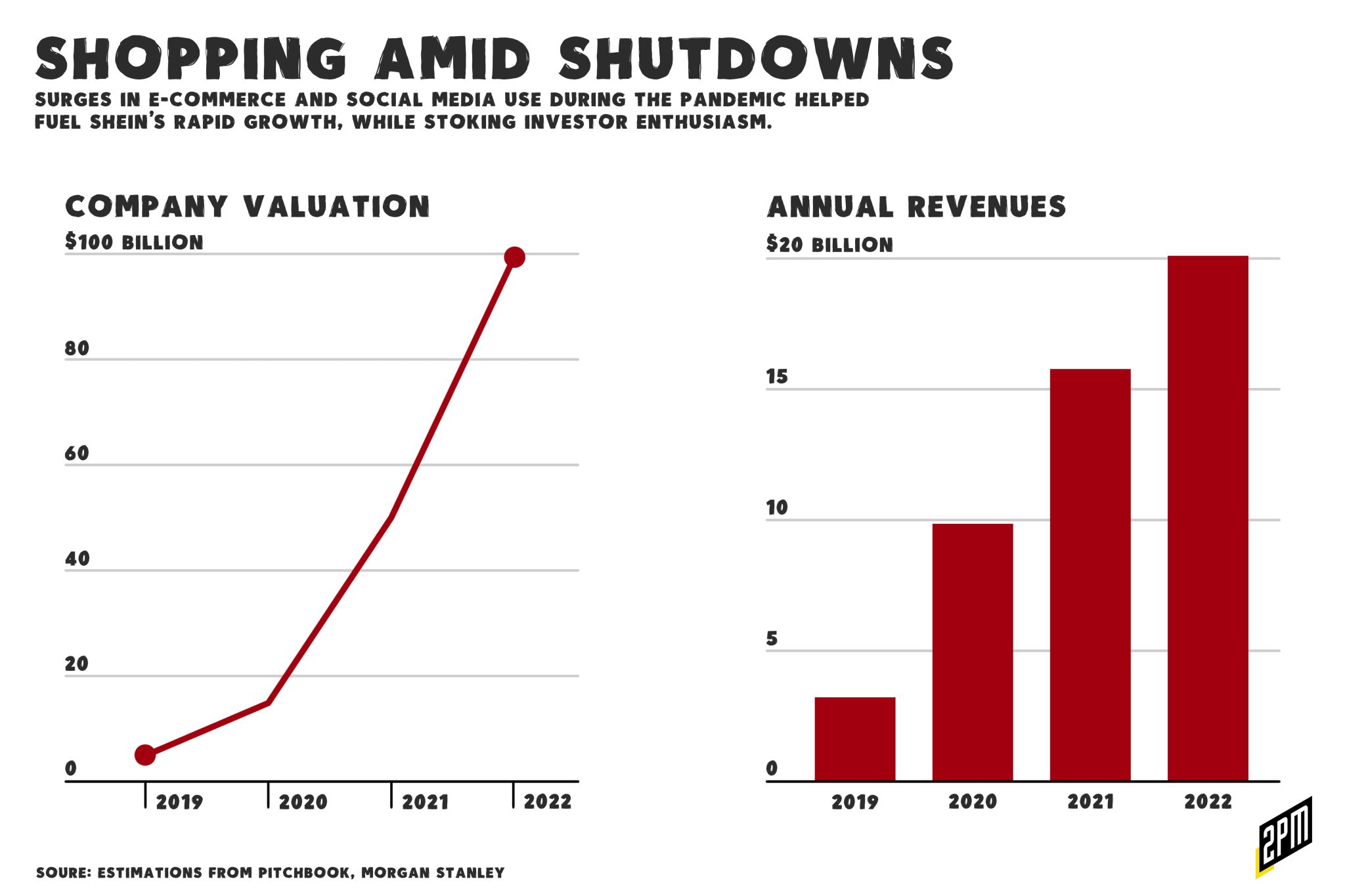
Global investors, for whom it is increasingly fashionable to champion high standards on environmental, social, and governance (ESG) matters, are similarly smitten. They have pumped Shein’s valuation up to $100 billion, making it the world’s third most valuable startup behind ByteDance, the Chinese parent of TikTok, and Elon Musk’s SpaceX. Shein is now worth more than H&M and Inditex, Zara’s parent company, combined, according to Bloomberg.

But while Shein’s innovative business model might lower prices for consumers, watchdogs grumble that Shein has built its clothing empire on the back of cheap labor, knockoff goods, and A.I.-driven design software that encourages consumers to ditch old outfits at rates that are bad for the planet. Those complaints, along with a recent e-commerce slowdown, make the company’s continued dominance far from certain.

Fortune’s position that, in so many words: “Shein’s impact on the environment will eventually lead to its undoing” is faulty at best. Why? There is a cognitive dissonance in fast fashion’s target market. Can one save the planet while buying $13 dresses for Instagram? So far, fast fashion companies have only lost dominance when they’ve been replaced by faster companies that can regurgitate trends at lower prices. Whether Shein’s nefarious practices are lost on customers or willfully ignored doesn’t ultimately matter. Customers who are drawn to clothing because of their affordable price are typically not the same ones who will stop to ask why a piece of clothing costs so little. What does matter is the bottom-line evidence that faced with cheap options, young consumers will shop for fast fashion.

At play behind the rise of Shein is a combination of factors. Social media has accelerated the trend cycles of fashion. Sustainable fashion is prohibitively expensive and the shifting tides of consumerism have, for many, determined that fashion is not an investment, at least not in terms of trends. Consumers are often held responsible for “voting with their dollars” when it comes to encouraging corporations to be more sustainable but this has never been completely true. Customers will buy what is easily and affordably available, particularly when they’re young.

Shein itself is a black box. Little is made public about how it sources and manufactures its clothing but the numbers and price tags speak for themselves. The company has started speaking up about – of all things – its sustainability efforts. Vogue calls this greenwashing:

Each week, a shocking 15 million garments arrive at Kantamanto Market from countries in the Global North, decimating the local textiles industry there.

It hired a global head of ESG and recently announced a $50 million fund that will go toward offsetting its environmental impact and handling its waste problem. That is a $50 million drop in the bucket that will barely undo a stitch of what Shein has unleashed on the market of TikTok, Snapchat, Instagram, and Kardashian loyalists. This week, it received praise for partnering with the OR Foundation, which it will give $15 million over three years in order to combat clothing waste in Accra, Ghana, where many discarded clothing ends up.

It’s nothing more than a diversion from the reality of the impact on landfills. Shein calling out waste and donating funds to bring attention to the cause may be perceived as disingenuous. Luckily for them, H&M is doing something similar, committing $250 million alongside Lululemon on behalf of the new organization that succeeded Aii:

“What we’re trying to demonstrate is that this is the center of gravity for all of climate work and everyone from Textile Exchange to Fashion for Good to many others — that are working in lowering carbon and coming up with solutions and getting them to pilot — are all beneficiaries of this,” he said. “This is a collective ‘we.’ This is not giving it to Aii, and it’s not going to go into other climate work. This is creating a central pooled fund whereby we all can begin to look at a more consolidated approach as opposed to fragmentation of project work that’s not talking to each other and duplicating efforts.”

What will solve fashion’s Shein problem is not donations, public relations, or acknowledgements of wrong-doing. The more fruitful solution will be social media trending away from fast fashion and towards sustainability. But there’s no relying on Gen Z customers to fix this problem. It is time to accept that no well meaning customer can stop the retail machine desired by millions, as new trends come along and TikTok broadcasts them for all to emulate.

By The 2PM Team

Memo: Apple’s Property Tax

For Apple, hardware is the afterthought. Content, digital land, and privacy is at the forefront.

Two announcements in the past 24 hours confirms as much. This week, Apple won its first Oscar for best picture. And according to Nikkei, Apple is lowering the output of iPhones and Airpods as inflationary pressures and supply chain issues persist. From where will the margin come?

The answer can be found in Apple’s recent investments. Between 2017 and 2021, Apple’s ad revenue climbed from $300 million to $4 billion, mirroring Facebook’s steep climb from $750 million to $4.2 billion between 2009 and 2012. Apple is nowhere near the size of Meta’s advertising business (the company reached $115 billion in 2021) but there’s reason to believe that Apple could grow a considerable business in a timeframe comparable to what was seen at Facebook (now-Meta). In Linear Commerce and Content Fortresses, I explained:

Apple’s intentions appear straightforward at first glance. The company wanted to improve the privacy of its end users. This virtuous effort came with a few additional outcomes.

By upgrading its privacy practices, Apple will impair large ad networks that have grown with the help of those end users. This could potentially cripple Facebook’s current model with its new privacy demands. Apple has also opened the door to an unintentional adjustment to its privacy mandate. In doing so, the Mark Zuckerberg-led advertising company (and social network) will adopt a new way to accomplish its most critical objectives: revenue growth and user utility.

Apple understands that the web isn’t private and at its core, whether through Apple’s ATT (App Tracking Transparency) or newer privacy initiatives, they are prioritizing the end user and her privacy. In June of 2021, iCloud+ was announced as a premium subscription service that featured a service called Private Relay. It is designed to encrypt all connections (even the ones not using HTTPS) to hide your IP address and prevent anyone from knowing your location or your identity (including Apple). From iMore:

The connection uses QUIC, which is meant to be like TCP but with lower latency and HTTP/3, and because Apple encrypts the connection, even your ISP can’t see where it is on the web you want to go. All they see is the connection to Apple’s ingress proxy server. So, Apple knows your IP, but not the website you want to go to because that’s encrypted.

At that point, Apple will strip away your real IP address and replace it with a temporary IP address from a pool of available addresses.

Now, consider the pace in which Apple captures ground in industry. Over the previous four years, Apple’s advertising grew as quickly as Facebook’s between 2009 and 2012. There’s an even greater example. In September 2019, it was announced in the New York Times that “Apple steps into the movie business.” In March of 2022, Apple TV+ became the first streaming service to win best picture. Apple has built a fortress; it’s using content and commerce as its bricks and privacy as its mortar.

Private Relay has the potential to have a major impact on the advertising industry. As The Information explains, the feature was released in September to Apple iCloud+ customers who could elect to turn the feature on for Safari browsing and a small percentage of “insecure app traffic over port 80.” For now, users can still use Chrome or any other non-native browser. Additionally, platforms that have you logged in: Gmail, Youtube, Facebook, TikTok can track your movements through the first-party data that the platforms collect.

But one thing is certain, when third-party technology companies circumvent Apple’s new policies on privacy, it is likely to precede another drastic measure taken by the hardware manufacturer. When turned on, Private Relay creates a virtual private network, meaning the internet provider can’t track what websites a user is visiting, and the websites can’t see any identifying information about the visitors. With Apple’s recent pivot to privacy, there’s reason to believe that this feature will be rolled out more aggressively to more users, which would be yet another blow to other platforms like Meta and Google who are currently relying on IP addresses to workaround the existing privacy crackdowns that Apple implemented last year. From The Information:

If the Private Relay service expanded beyond Safari to stop the transmission of user IP addresses across mobile apps, ad industry executives say it would hobble the efforts many ad networks and ad tech companies have made to adapt to Apple’s earlier changes, known as App Tracking Transparency. Many of the workarounds that firms including Meta, Snap and Google developed in the wake of Apple’s changes rely in part on having access to groups of user IP addresses to measure whether ads the users saw led to sales.

These workarounds include using an IP address to determine if a visitor to the site then took further action, like making a purchase. There’s evidence that these workarounds were effective. A recent report from 9to5Mac noted Facebook’s success in identifying (short-term) workarounds, noted for a sudden surge in advertising performance:

In a company statement, a Meta spokesperson said it has “continued to adapt our systems to help businesses succeed while honoring privacy and shared extensive steps they can take to maximize performance and measurement on our platforms.”

While Apple said it would pull apps who violated its new privacy policies, there’s been no action against this type of workaround. It might have been biding its time, knowing that harsher restrictions to user visibility were coming, which would take a further hit on these tech companies’ advertising businesses. Regardless of Apple’s stated motivations, these moves are benefitting its own ad business while hampering others. At the same time, Meta and Google are not going to lay down without a fight – each company is equipped to build more counters to Apple’s moves. But the owner of the hardware ultimately controls the hosted content. This poses a problem no matter how big and mighty the advertising duopoly might seem.

And that’s not where Apple’s actions end. Email addresses are a critical currency for brand marketers who want to establish closer relationships with their customers. Discount codes and branded newsletters are pushed hard to visitors who go to a company website. Apple’s new Hide My Email feature, rolled out in December to iCloud+ customers, randomly generates an email for customers to share with a site to unlock access that hides their real email. Another marketing cornerstone and key touchpoint for advertisers is severed. That complicates future targeting efforts and obfuscates a clear view on who’s coming to the website and browsing and buying what.

And this means that while Apple continues to build a new identity around the importance of privacy, advertising efficacy on other platforms may continue to diminish. It’s also likely that we will see something similar from that other hardware / software company. Google may adopt similar strategies; the iOS vs. Android arms race tends to work like that. The loser in all of this seems to be Facebook and the many brands reliant on their advertising service:

It is unlikely that Apple reverses course on its ATT changes and its diminishing of the IDFA but an entire industry is in need of a middle ground. For many founders and executives, their livelihoods are on the line and it isn’t Facebook that will be remembered as the culprit. Apple must either resolve its decision in favor of the advertisers reliant on sales-driven marketing.

Facebook anticipates a $10 billion impact on its own advertising sales, a sum that represents tens of billions in goods and services traded. It’s unlikely that the hole left by the degraded performance of Facebook advertising will be filled by another digital platform.


Apple will need to continue growing its content marketplace; Tim Cook’s digital fiefdom will require greater (user-generated) content engagement. As such, it’s not leap in logic that Apple will build a platform for user-generated content (UGC). Don’t be surprised if Apple acquires one in the process. Twitter, anyone? Without greater advertising opportunity within the Apple ecosystem, digitally-native businesses will suffer from the collateral damage. Apple has become the solution for handheld consumer privacy; business owners deserve a capable alternative to the services that Apple is crushing with its new practices.

When Apple shuttered the iAd Network in June of 2016, few could have predicted how successful a second iteration of it could become just six year later. If Apple expands its iCloud+ offering to all users, it’s pursuit of digital advertising dominance will be official. The writing is on the fortress wall, built atop the land that Apple owns. That land is due to come with new property tax for all who enter.