Memo: Webvan (Again)

There is an operative sentence in the detailed report on the instant delivery industry’s current woes: “The Gopuff founders knew little of this history.” Here is a quick recap of 1998 through 2001:

Many remember the rise and fall of first-mover Webvan. At its peak it maintained a $178.5 million run rate with close to $530 million in expenses. It offered customers the ability to have orders delivered within a 30 minute window and operated in 26 markets. In 1999, a company called Kozmo maintained a run rate of $3.5 million with a net loss of $26.3 million after raising $250 million (to include $60 million from Amazon). In both cases, it was growth that hindered Webvan and Kozmo. Webvan even contracted the construction of $1 billion-plus in warehouses prior to going out of business.

In March of 2022, 3% of Gopuff’s global workforce was let go. Another 1,500 followed in July and, according to Bloomberg, Gopuff shuttered roughly 12% of its warehouse network. After the most recent layoff 0f 250 employees, reported just four days ago, the tone changed and a critical view of Gopuff’s business model resulted.

Bloomberg’s inference is that Gopuff could go the way of Webvan and Kozmo, a complete toppling of the house of cards built by instant grocery delivery startups over the past three years.

The pandemic made it seem like not only was quick-delivery grocery possible, but that it was necessary. We entitled it The Parasite Economy. A few things have happened since that 2020 report: the pandemic concluded and inflation rose. More consumers were willing to travel to stores to offset the rising costs of food and fewer Parasite Economy workers were willing to hurriedly work for an unforgiving category of professional pursuit that may no longer cover the costs of life that it once had.

Gopuff was eyeing a $40 billion valuation as recently as January. By March, investors were selling off stakes at valuations down to $15 billion. While nothing is written in stone, it is shaping up to become just one in a long list of similar startups who have seized on the opportunity to fill the supposed need for under 30-minute convenience delivery propped up by VC funding. Competitors, some of which have come and gone, include Getir, Jokr, Gorillas, Just Eat, Fridge No More, Buyk and Food Rocket.

This one seemed best positioned to have the chance to pull ahead. Gopuff went as far as to develop a private label brand to promote profit margin. Back in March, that was still a risky bet. What was apparent then, which 2PM reported, is that one-hour-and-under delivery is a back-breaking competitive space that’s nearly impossible to make profitable. Even Amazon relies on other business mechanics to accomplish this with Whole Foods. The infrastructure needed could sink a business. This is one advantage of traditional grocery: the technology is now the commodity and the infrastructure is the competitive advantage. Most consumers will still find that they can go pick out their groceries themselves. And grocery stores have been investing in their own technology that makes them more competitive in the next-gen retail race. We wrote in March:

Whether it is for margin protection or product availability (after publishing Consumer Trends 2022, it was noted that Gopuff sources some products through Instacart to maintain stock), big grocery’s eCommerce pioneers will be the traditional companies who’ve built the technology atop their existing storefronts. This mirrors the world’s of GPG and digitally native brands.

Now, the new report from Bloomberg puts the precarious nature of this class of startups into even clearer focus. Gopuff put a spin on the GrubHub and Instacart models to make itself more efficient by opening warehouses, stocking them, hiring people to man them as well as contractors to make those speedy deliveries. The problem is that few of these models, by all accounts, can scale profitably. Valuations have fallen across the board. Many startups have gone out of business. Instacart, which saw a pandemic-era explosion, is pivoting its model to be the technology service provider for grocery chains that want to compete on that level. The deliveries aren’t its ticket to growth. Bloomberg’s report lays out the current Gopuff situation as plainly as possible.

By their own admission, the Gopuff founders never imagined this scenario. After the company burned roughly $700 million in expansion mode in 2021, in recent months it’s laid off almost 2,000 employees, withdrawn from parts of Europe, shelved grandiose plans for new categories, raised fees on customers, and halted a planned initial public offering as its valuation has plummeted. Almost 25 years after Kozmo.com’s infamous flameout, Ilishayev and Gola are scrambling to figure out if it’s still possible to crack this particular Silicon Valley obsession. Or if the billions poured into it are destined to simply gopoof.

Gopuff appears to be heading down the path laid by its delivery service ancestors. These startups label themselves as disruptors of sleepy, wonky industries that leave something to be desired for the customer. This class of real-world technology perpetuates growth thanks to venture capital, promising category domination that would reward investors and launch a new era of business backed by technology. When that promise fails to materialize, the investment dollars grow thinner and the cost is transferred to customers. Uber rides are far more expensive than they used to be. Airbnb has received a growing swell of backlash to its mounting fees as customers have begun to question the value in the service over staying at a hotel – the establishment competitor that Airbnb set out to disrupt.

There is a limit to how much people will pay for convenience, and coupled with inflation raising prices on grocery, more will begin to consider what their time is worth versus their dollar. And it’s not just inflation and economy working against Gopuff – legislation is out for it as well. We wrote in March that Gopuff was most likely to be best positioned to stand up to legislation in New York that would crack down on “dark stores” and worker safety. It circumnavigated it by making their warehouses shoppable. From a Vice report earlier this year:

And Gopuff, in an attempt to prove its storefronts are not warehouses and avoid regulatory scrutiny, have claimed its New York locations will also sell directly to walk-in customers, although the New York Post found even such “retail” locations are unmanned and have no prices listed on items.

But now, these facilities are at risk. Gopuff, which was launched to meet the needs of college students with late-night cravings but no cars (making for a relatively niche addressable market), doesn’t have the scale of a 7-Eleven or the existing infrastructure of a grocery store. When you consider all of what the company is up against, it’s difficult to imagine that the company will maintain without some good fortune and inflation shifting towards “transitory.”

The smoke is clearing, and Bloomberg details a business running on fumes, dealing with perishables gone bad and restocking shelves by relying on Instacart’s supply chain. Consider that in New York City, Gopuff’s biggest market: orders are down 27%. PYMNT’s consumer inflation sentiment report explains the issue with fewer than 20 words:

Four in five affluent consumers are cutting back their spending, and retail purchases are taking the greatest hit.

Not all pandemic-era behaviors were ever going to become long-term consumer trends. The elusive 30-minute delivery may become one of the first to go. Gopuff will need to slim its offering, establish regional and/or national long-term grocery partnerships, and do whatever else to find the margin required to survive. Gopuff does not have to follow all of Webvan or Kozmo’s footsteps.

Read the larger picture in letter no. 886.

By Web Smith | Edited by Hilary Milnes with art by Alex Remy and Christina Williams
Memo: Why The Slow Adoption?

This is a question raised within the boardrooms of tech companies and retail brands. The answer may be simple enough: the American consumer is preoccupied with real world problems. The metaverse is here but we’re not ready. In 2020, our report “Enter the Metaverse” asked a key question:

Can a company build a Metaverse or does it simply manifest?

When Facebook rebranded to Meta, with intentions to go all-in on the metaverse, it was known then it would be a years-long transition. Perhaps the Meta leadership didn’t envision 9% inflation, falling consumer confidence, layoffs at some of the largest corporations in America, and high interest rates bringing the housing market to a halt. In the same report from nearly three years ago, we mentioned timing as an essential ingredient.

Some of the most valuable commercial real estate for retail is in the Metaverse. Where brands, content, creativity, and consumerism meet, civilization forms. There is a juxtaposition of this virtual community forming as physical gathering spaces are temporarily prohibited or even permanently shuttered. If history has a lesson to share: in the world of network effects, timing is an essential ingredient.

This is where those two ideas intersect:

  • Can the metaverse be manufactured? Or is it the result of digital agglomeration?
  • Will the metaverse accelerate as this recessionary period expires?

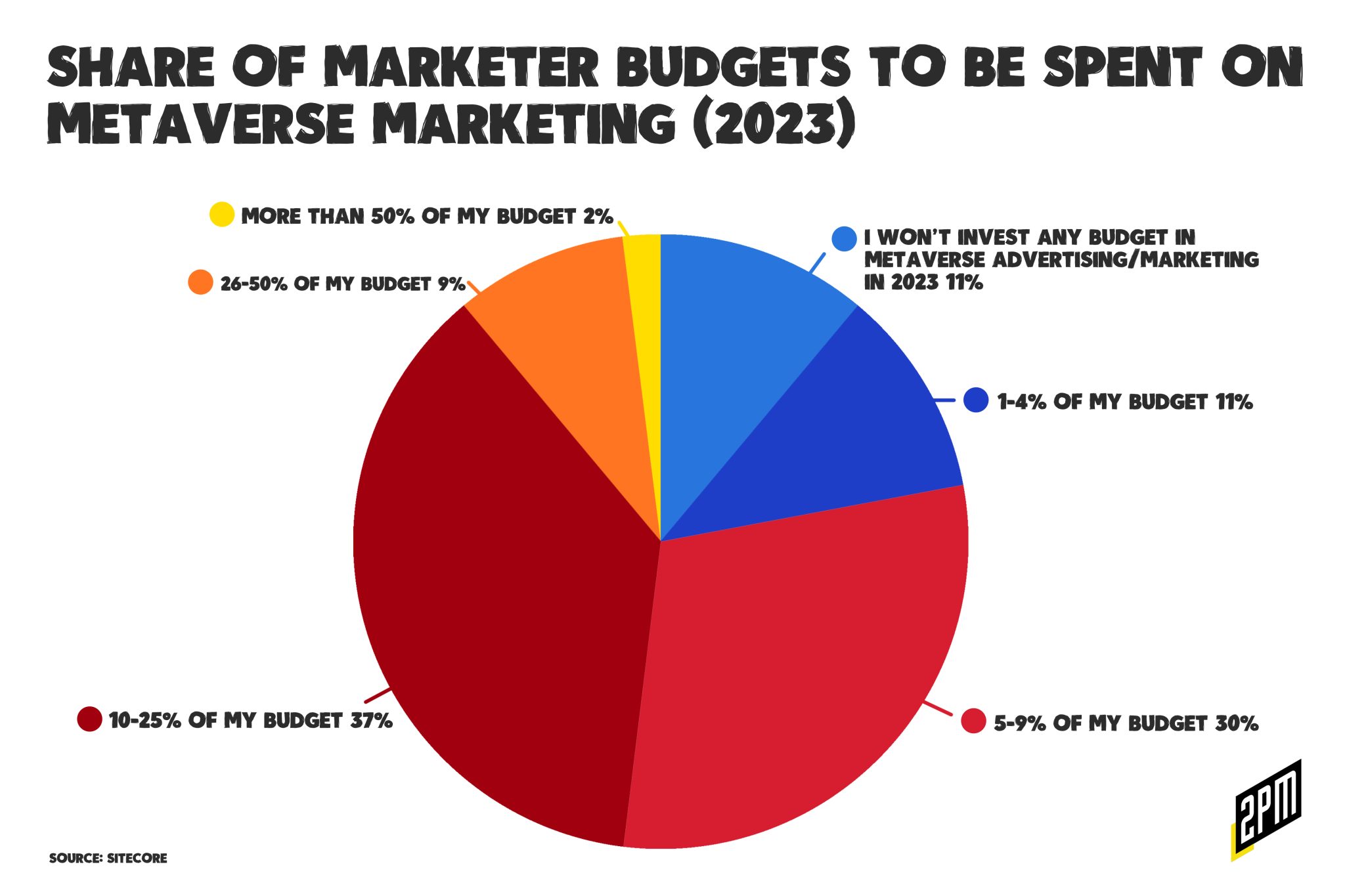
The metaverse holds promise for how we work, play and interact. But even as brands have begun building worlds in metaverse platforms like Decentraland, they’re building for an audience that hasn’t yet come. High rates of remote work are not translating to higher participation in virtual community. Not only is it still a novel concept for most, but in challenging economic environments, the futuristic and fantastical can become sidelined. Instability is often an ideal backdrop for innovation; this seems to be the exception, but that doesn’t mean Meta hasn’t made progress. Heavy investments are still planned for 2023, though it is being outpaced by investments into retail media networks (ding, ding, ding):

In two reviews this week, the Meta Quest was tested for its current experience and its potential. The headset costs $1,500, making it a luxury purchase only for those who are already invested or willing to invest in gaming. In a New York Times review, the headset and experience are praised for their ability to change the world of gaming, but not much else.

There’s a valuable lesson amid all the hype surrounding virtual (augmented, mixed, whatever-you-want-to-call-dorky-looking) goggles: We shouldn’t spend our dollars on a company’s hopes and promises for what a technology could become. We should buy these headsets for what they currently do. And based on what I saw, for the foreseeable future, the Meta Quest Pro will primarily be a gaming device. (I predict the same outcome for the Apple headset expected for an unveiling next year.)

But Mark Zuckerberg’s vision for Meta Quest is wider-ranging. He sees it as a place people will want to spend time socializing with others in a variety of environments. But you can’t socialize when there’s no one around, and for now, there aren’t enough people to make the metaverse what it could be.

What role do brands play? Many companies are operating out of a dual desire to “stay ahead of the curve” and avoiding FOMO (fear of missing out). Similar to Meta, they’re working toward a future that isn’t yet a reality. The promise is there but the momentum is not. AdWeek’s position on this matter makes a note of it:

Major brands including Walmart, Nike, Disney, Levazza, Argos and Mini have flocked to develop their own experiences across platforms such as Meta’s Horizons, Decentraland, Sandbox and games such as Fortnite, Roblox and Star Atlas. Even Second Life, which was born in 2003 during Web 1.0, is getting a second life in Web3. But are audiences buying in? Not so much. At least not yet.

It’s clear that there’s corporate investment in the metaverse but it goes back to the two questions that began this report: can the metaverse be manufactured? And is our economic uncertainty hindering the moonshot that is required to achieve digital agglomeration? The issue is not that the spaces aren’t welcoming themselves — people are distracted and the utility of the metaverse hasn’t yet proven itself. The period that led to the fast rise of Web3, where NFT hype and value exploded as a community of eager opportunists, seems like years ago. But even though that time was sullied by pandemic concerns, most Americans felt reassured that opportunity, money, and other resources would always be available (in the real world). Today is proving that it is not the case.

As such, more pressure is on Meta. It’s building for a future that isn’t currently supported by reality. It’s finding that virtual reality has its roots in the excesses of the real world, when there are worries, people aren’t flocking to a make belief world quite yet (this is the premise of Ready Player One). Meta’s share price is reflective of the broader tech industry and a downward shift in gears from the trust in the digitally-native world. Online retail, digital advertising, and Web3 technologies are all suffering from the same sociological bent. And it will struggle until the economy regains its footing. Right now, Meta’s avatars don’t have legs – literally and figuratively. Mark Zuckerberg’s avatar has gone through multiple iterations after being mocked online. And according to the WSJ review, even internal employees have stopped using Meta Quest.

What the New York Times gets right is that, at least for right now, gaming is the best and most active use case for the metaverse. It has active users who are willing to spend on the leisure of digital competition. It may be quite some time until work, social, and educational catch up to the leisure of gaming.

By Web Smith | Edited by Hilary Milnes with art by Alex Remy and Christina Williams

Memo: The eCommerce Advantage Shifts

The article’s title reads, “Why e-commerce disruptors are trading like brick and mortar dinosaurs.” Our position is that for many in retail’s old guard, life finds a way.

The dinosaur comparison is thanks to a new report from The Information, which has tracked stock prices for Farfetch, 1stDibs, The RealReal, Stitch Fix, Rent the Runway, and ThredUp, and has painted a picture of a bursting bubble, declaring “e-commerce is on sale.” Each company that The Information mentioned are digital natives that debuted on the market in the past two years and have since seen their valuations tumble and their stock prices fall. After a pandemic boom for some, many have seen growth taper off. Now, some of them are looking for the exit by seeking acquisition partners. For others, consolidation has already begun. South Korea’s Naver acquired Poshmark, which just went public in 2021. Here is a summary from The Information:

Several members of the group, including ThredUp, Poshmark, Wish and Rent the Runway, went public last year as overall market valuations were peaking. Underlying their public debuts was investor confidence that the pandemic had triggered a permanent shift in shopper behavior toward buying more online. But the timing was off. As lockdowns have eased, growth in online shopping has slowed sharply—to just 6.8% year over year in the first two quarters of this year, from the 30%-plus growth rates seen starting in the second quarter of 2020, according to the U.S. Census Bureau. Even in 2019, before Covid-19, growth rates hovered between 12% and 18%.

The advantage once maintained by retail’s newer generation of online marketplaces has subsided, at least temporarily. Many of those retailers enjoyed high-profile IPOs in the past two years (or private market, secondary rounds). Now, they are struggling to keep pace in an economy that has begun to favor brick-and-mortar retailers like Target and Walmart. In some ways, the dinosaurs are out-innovating the innovators – they are disrupting the disruptors.

It’s not just Target and Walmart. Department store-era retailers, once known for foot traffic and mall real estate, have invested heavily in e-commerce operations. This includes Macy’s, Saks, and Kohl’s. But even with improved omnichannel operations by fashion-based, traditional retailers, the inventory glut has influenced the depth of discounts and the frequency of pricing promotions seen at many of these store. These inventory overruns aren’t universal, however, for retailers that also sell appliances and consumer packaged goods, inventory is more stable than what is seen in fashion retail. It is the full marketplace that is in the better position to survive the up hill climb that seems to be ahead. In Inventory Changes, I explained:

To dig out from under the excess inventory, promotions and long-term storage of excess inventory will likely be necessary for affected retailers. This is a tough pill to swallow for big box companies. Target and Walmart can offset less in-demand sales items with consistently high performing categories like grocery and household necessities.

Emerging online marketplaces were supposed to change the way people shopped forever. I believe that they taught consumers how to interact with retailers online just as the dinosaurs became successful online retailers themselves. In a way, the new generation is at the disadvantage. Single-channel retail is nearing its extinction point for many.

It’s a turn for the worse for the modern retailers who had hoped that by doing things differently than their department store predecessors, they would write new rules to retail and tap into a newfound customer energy at the same time. But technology is expensive, especially when you factor in higher-than-average customer acquisition costs, logistics shortfalls, razor thin product margins. Profitability for these companies has been difficult to maintain. Now, they are finding themselves in a position that may appear like the dinosaurs they tried to disrupt.

Going into a volatile holiday shopping season, the “dinosaurs” are better positioned to earn more market share than the digitally-natives. Shoppers have inflation and budgetary restrictions front of mind. Traditional retailers are dealing with an inventory glut that is going to lead to deep discounts and frequent promotions. These are magnets to consumers who prefer the best deal over ease of purchase during times of distress. It’s a sign of the times for the retail industry that’s gone back to basics: availability, promotions and accessibility.

But when the inventory glut is resolved, the retailers that have invested the most in their eCommerce capabilities are positioned to succeed because omnichannel availability provides the best customer experience. Additionally, these retailers are drawing in digitally native brands who need to unlock wholesale revenue. Layer in promotions on top of that. In an early October report, we looked at how Walmart was readying its inventory levels for the upcoming holiday season, in part by cracking down on brands who couldn’t meet fulfillment requirements:

The brands have become more replaceable while the retailers have become more selective. Walmart, with its vast store network and supply chain capabilities, could become the dominant marketplace this holiday season and beyond. Brands are recognizing that they need the mass retailer to survive.

This year has reinforced Target, Walmart and Amazon’s positions as industry leaders, as already proven by DTC brands hearty embrace. Now, the modern retailers are finding themselves on the backside in the industry that they set out to disrupt. These eCommerce marketplace retailers will recover and / or live on in some form, especially as the economy recovers and consumers are less incentivized to shop promotions at retailers with inventory gluts. But Target and Walmart have become as critical to the online retail engine as Amazon appears to be. Very few predicted that in 2009 when this “DTC” era began, this present time can feel like an ice age to those who were reliant on simpler times and greener pastures.

By Web Smith | Edited by Hilary Milnes with art by Alex Remy and Christina Williams