Member Brief: The Case For Revenue Per Employee

Meta, Google, Amazon, Salesforce, Twitter, Microsoft – but not Apple. What gives? Each of these companies are vital to the retail ecosystem but one measures key results in a way that is most commonly seen in an altogether different industry.

“You’ll hear revenue per employee again, in tech, no one was looking at these metrics at least in the private world, the VC world for at least five years,” Keith Rabois recently said to Elon Musk’s Twitter management.

Whereas growth and market share were once key performance indicators, profitability and efficiency will be the measures of this next five to 10 years. An OKR (objectives and key results) is a strategic framework and a KPI is a measurement within said framework. Brand and SaaS marketing discusses KPIs with endless zeal, but OKRs are rarely communicated with the same energy. I believe that this will change.

For Continued Member Access

Objectives and Key Results (OKRs) are closely tied to human resources but by connecting business development with HR OKRs, organizations can create a stronger, more consistent brand image while also fostering a positive and engaging work environment for employees. Of all of the HR metrics, one seems to be emerging as key to American economic recovery. There’s headcount, time to hire, acceptance rate, employee satisfaction, turnover rate, retention rate, training expenses, and revenue per employee (RPE). The latter is the measure of the hour.

RPE is the metric that has come to define big tech’s layoff narrative. RPE, often ignored during bull market growth periods has become the talking point used to justify right-sizing organizations. Fortune Magazine explained:

In addition to curtailing talent acquisition efforts and building up its people practice, Apple is reducing business travel and delaying employee bonuses. CEO Tim Cook will also take a pay cut of about 40% this year, which he reportedly requested. Altogether, the moves make for a true “doing more with less” strategy.

Apple is efficient in a key sense that many others in big tech will adopt. Here’s an example that reads like a big law firm’s measure of success. Founded in 2006 and headquartered in Amsterdam with around 2,000 employees, Adyen is the best direct ‘comp’ to Stripe. The Information recently explained why Stripe’s private valuation to Adyen’s public valuation:

Stripe spent so heavily on staff and new business initiatives in recent years that its 2022 expenses per employee were twice those of Adyen, even though Adyen’s revenue per employee was higher, according to an analysis by The Information. The expense gap is expected to stay the same this year, although Stripe is expected to do better on revenue per employee.

Even Google Trends reflect the growing reference to the phrase “revenue per employee.” Long a practice in other industries: they say that if you are a law firm partner, you need to consider yourself a business and not an employee. According to The Four Week MBA, Amazon’s primary OKR – RPE – grew by $40,000 between 2021 and 2022. But clearly the objectives were not met; Amazon recently laid off another 9,000. Though, I suspect RPE grew again in 2023 as layoffs continued. Meta’s RPE is set to rise to $1.85 million based on the Wall Street Journal’s revenue and headcount projections.
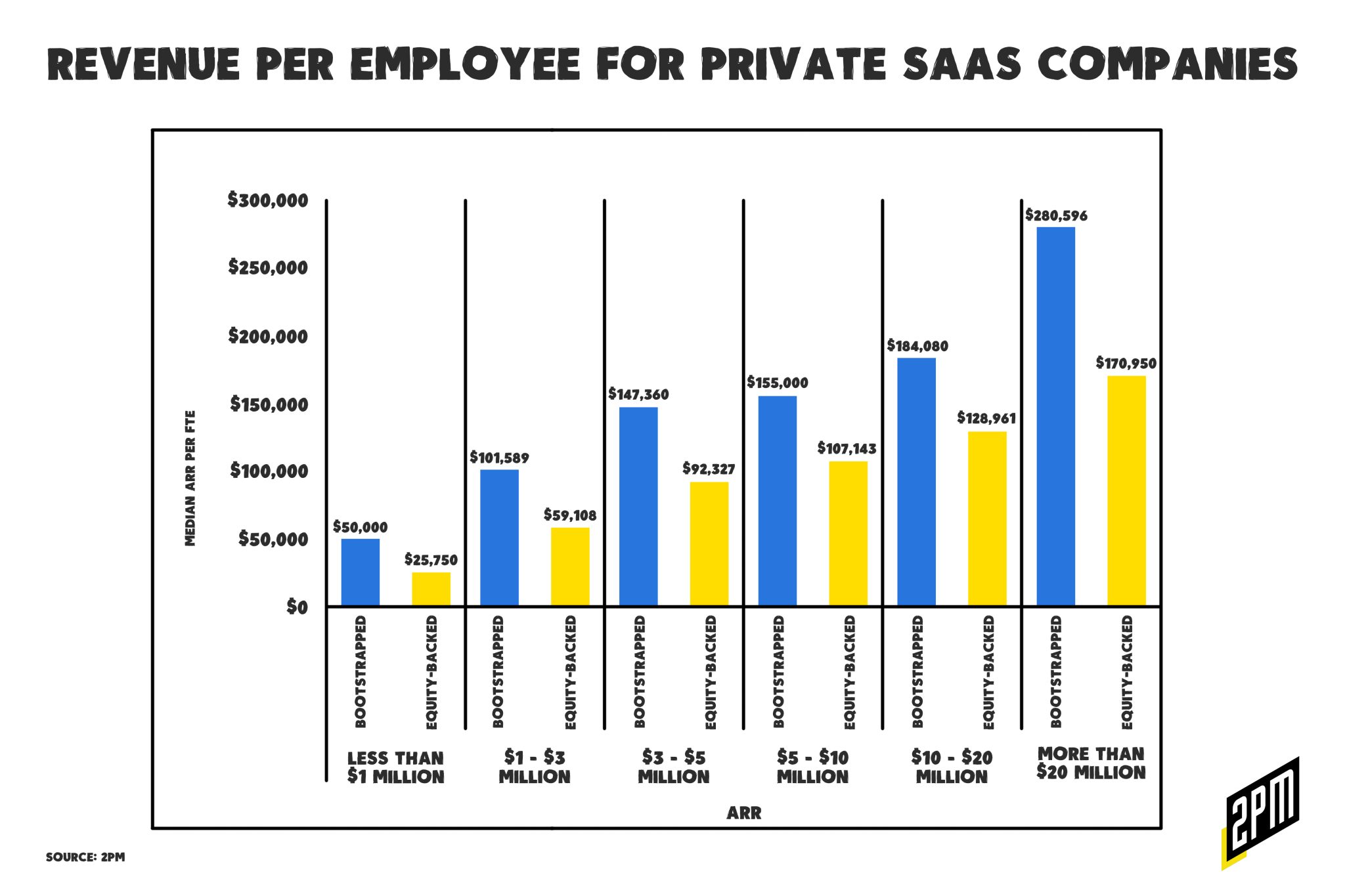
And this is how companies will be judged. A firm well-known to many in big tech, Wilson Sonsini measures success by RPE. According to data by The American Lawyer, the firm’s RPE and headcount have grown precipitously since 2019. Law.com began its March 2023 analysis with:

Wilson Sonsini’s profits per equity partner fell 9.5% as the firm bulked up its lawyer head count to 1,045 lawyers including 266 partners.

In today’s rapidly evolving business landscape, companies are increasingly seeking new ways to evaluate their performance and long-term prospects. Traditional metrics such as revenue, net income, and market capitalization have been widely used for years, but they may not tell the whole story, especially for big tech companies. The comparison between big tech companies and law firms is based on the premise that both types of businesses will be judged by this OKR in the coming years.

The Case For A New Measurement

RPE is a simple yet powerful metric that divides a company’s total revenue by the number of its employees. This ratio indicates how much revenue each employee contributes to the business, offering valuable insights into the company’s efficiency, productivity, and ability to scale. There are several reasons why RPE is becoming an increasingly important metric for big tech companies:

Focus on Efficiency and Productivity

RPE helps measure how effectively a company is utilizing its people, a critical component of any organization. But also, how those people perceive their role in the growth and health of the company. Senior Research Analyst for Yahoo Tom Forte cited the type of role that saw early attrition at Amazon, i.e. ones that didn’t directly impact revenue growth:

So if you look in particular at the March quarter and the June quarter last year, they had about 100,000 attrition between those two quarters, and it was mostly not rehiring someone to replace someone who left at the fulfillment center level.

A higher RPE ratio implies that the company is generating more income with fewer employees, indicating a more efficient and productive business model. As Amazon begins to show, they’re willing to explore whether or not they can accomplish “more” with fewer cost centers.

Attraction and Retention of Talent

Talent is a critical resource in the tech industry and companies need to ensure they can attract and retain top talent to maintain their competitive edge. A higher RPE ratio suggests that the company is utilizing its workforce effectively, which can lead to increased employee satisfaction and loyalty. This, in turn, can help attract new talent and reduce turnover, contributing to the overall health and growth of the company.

Scaling and Growth

As tech companies grow, they often face challenges in scaling their operations efficiently. RPE can help identify whether a company is maintaining or improving its productivity as it expands. A consistent or increasing RPE ratio during periods of growth suggests that the company is successfully scaling its operations, which is essential for long-term success. Barron’s recently published relevant numbers:

Apple generated around $2.4 million in revenue per employee in its latest fiscal year and has averaged around $2.1 million on the same metric over the past five years, according to FactSet. That far outstrips Facebook-owner Meta (META), which generated $1.35 million in revenue per employee in 2022—below its five-year average of $1.5 million.

This gives us a uniform means of comparing companies regardless of their status as a public or private company.

Use in eCommerce and Retail

RPE can serve as a valuable benchmark for comparing companies across the tech industry. The Information framed this public vs. private tech company conversation as such:

An unfavorable comparison to Adyen is a surprising turn for Stripe, a startup brand that became a near-holy name in Silicon Valley. Its early rapid growth and exposure to the fast-expanding e-commerce market helped the payments firm raise more than $2 billion from some of venture capitalists’ biggest names over a dozen years. After it raised money in early 2021 at a $95 billion valuation, it was one of the most highly valued startups in the world.

In comparison, Adyen raised just $200 million as a private company, although it raised  hundreds of millions when it went public in its 2018 initial public offering. Its current market capitalization is about $44 billion.

By evaluating this metric, investors, analysts, and other stakeholders can gain a clearer understanding of how well a company is performing relative to its peers, which can help inform strategic decisions and investment opportunities.

Shopify was ahead of the curve in discussing the potency of this measure in retail. RPE is the key metric for assessing the health and prospects of big tech companies, but can be used to assess brands as well.

If you’re looking for real-life examples of how brands calculate RPE, let’s take data from 2PM to calculate the average revenue per employee popular retailers make. Knix: has 127 employees generating an average revenue of $70.5 million per year. That comes out to $555,118 revenue per employee. Boll and Branch: has 116 employees generating an average revenue of $80.8 million per year. That equates to $696,551 revenue per employee. Everlane: has 309 employees generating an average revenue of $361.2 million per year. That equates to $1.68 million revenue per employee.

By focusing on efficiency, productivity, talent attraction and retention, in addition to scaling, RPE provides valuable insights into a company’s performance that traditional measures may not capture. It also emphasizes the importance of efficient profit-seeking. As the tech industry continues to evolve and face new challenges, RPE will play a crucial role in helping companies navigate the competitive landscape and achieve long-term viability.

By Web Smith | Edited by Hilary Milnes with art by Alex Remy and Christina Williams
Memo: Shopify’s ‘Cool Kid’ Paradox

n6vIM5Xw

An open letter to all eCommerce merchants. In a recent chat with 2PM Executive Member Damian Soong, the DTC founder replied with a poignant thought:

Someone needed to say that DTC isn’t Shopify.

Paul do Forno, the Managing Director of Deloitte’s Commerce Practice, chimed in with the data to support Soong’s thought, adding:

If you plotted by total platform revenue: HCL Commerce, Oracle, SAP, SalesForce would be towards the top.

Shopify has made the industry more interesting, accessible, and newsworthy. But it is not the only participant in this burgeoning ecosystem: Magento (now Adobe), Demandware (now Salesforce), SAP, BigCommerce, Squarespace, BigCartel, WooCommerce, Webflow, Square, and Wix have played pivotal roles in the development of either enterprise or merchant-level markets. Shopify is neither the biggest platform with respect to merchant volume or gross merchandise value (GMV). It sits squarely at the center of the two extremes. Yet somehow, it became the de facto operator of the DTC era.

To understand the direction of eCommerce, you must understand its past and present. During what was likely the most pivotal year in my early eCommerce career, I studied Magento from the perspective of an eCommerce brand that employed 100 or so. That earlier version of Magento was a complicated platform to understand. Its management required the employment of a dozen engineers and an equal magnitude of talent in user experience and front-end design. When I soon had my own opportunity to build an eCommerce brand alongside Kevin Lavelle, we went not to Magento, but to Shopify. We didn’t have the money to hire technical talent, nor did we have the patience to manage it on top of the challenges that we faced in manufacturing and early customer acquisition. But it’s important to recognize that this decision was made nine years ago – a lifetime in technology.

That same company of 100 is now over 1,000 strong. In under one decade, a small industry competitor became a global manufacturing leader all through direct-to-consumer channels. And they’ve done so on Adobe’s Magento. If any SaaS platform has the right to claim the dawn of the DTC era (2008), Magento could easily make that argument. Instead, it gets lost in the conversation.

Standing in a hallway of Shopify Plus’ most recent New York City conference in 2019, I sat with Shopify CEO Tobi Lutke, one of the industry’s most admired executives. I remember marveling at the production of the event. The friends, the networking, the branding of the space all communicated Shopify’s place in the eCommerce ecosystem. I applauded the entrepreneurs who shared their stories on stage with highly produced short films. Also notable was the accessibility of the C-suite executives who, frankly, should no longer be that accessible. This availability is a part of Shopify’s secret sauce. You won’t find another retail CEO of his caliber who is willing to respond to customers on platforms like Twitter and Instagram.

What I remember most about that particular meeting is the intensity of Lutke’s product focus. Suggest an idea that is outside of Shopify’s product pipeline and he will explain why Shopify isn’t right for it. He rarely waivers on his vision for what Shopify and Shopify Plus are to the eCommerce industry, or the functions that they are willing to build.

It’s this same galvanizing vision that rallies Lutke’s base of thousands of platform evangelists. Shopify’s ability to amplify its message through its partnership ecosystem has done wonders in furthering its narrative of perceived inevitability. In Shopify Unite and Network Effects [1], I wrote:

If you were to sit in a room with BigCommerce or Adobe’s c-suite and explain that product differentiation can be more than a software iteration, you won’t be sitting there for long. And that is part of Shopify’s mounting advantage. It’s unclear whether or not the original intent of the Shopify Partner ecosystem was to be a catalyst for network effects. But that’s certainly the case.

Founder Tobi Lutke, Harley Finkelstein, and team stumbled upon a new form of competitive advantage in commerce SaaS. Here, at the intersection of influence and efficacy, sociological advantages of retail brands have interfaced with an ecosystem of software as a service.

Shopify’s primary arguments for the attention it gets are valid. Its holistic approach to fulfillment, returns, and no/low code architecture will become fixtures in North America’s market as eCommerce’s percentage of retail continues to inch above and beyond 20% or 25% or 30%. And consider Squarespace or WooCommerce’s volume and Magento’s GMV: Shopify’s ability to capture mindshare despite these other companies’ advantages are as much the fault of the competitors who haven’t valued the marketing and branding aspects of business.

By weaponizing network effects, Shopify has become the proverbial cool kid of SaaS. Its brand voice is the life of the party and the center of many public discussions. There is market value in this positioning. Like Amazon, Shopify’s fortune is tied to eCommerce’s continued growth in North America. Public investors reward Shopify simply for being tied to the movement towards direct-to-consumer. It’s deserved.

ENkl02YQ
The Traditional, The Cool, The Quirky, and The Hustlers

It is important to note that this is not winner-takes-all, and what Shopify does next matters. There are eCommerce founders building on custom sites that have accomplished profitable growth. There are leaders who’ve chosen Salesforce or BigCommerce to fit their technological or philosophical needs. And in the process, they’ve built companies spewing $10s of millions in monthly EBITDA. Of course, there are examples of these feats on Shopify, but that’s the point. The democratization of eCommerce doesn’t only refer to platform simplicity.

Shopify’s ecosystem stands to benefit greatly by expanding the definition and character of the DTC industry to reach out and include the brands, founders, agencies, and technologies enabled to support them on other platforms. Some of the best and brightest stories, people, and brands are building outside of the spotlight.

The cool kids often earn the lion’s share of attention. But some of the most notable progress happens where the cool kids aren’t. That’s the paradox.

By emphasizing stories and anecdotes from founders who’ve eschewed the industry spotlight or brands that have managed growth differently than is commonly advertised, we’re closing the knowledge gap. Perhaps there was a brand founder who chose to use WooCommerce to scale and now has insights that could help Shopify-based brand founders accomplish the same. Or perhaps a Shopify Plus founder who’s successfully captured five years of year-over-year growth could explain a key strategy to a brand owner who’s built on Magento 2.3.4.

As eCommerce grows beyond 25% or 30% of American retail, we will see more examples of brands and retailers achieving a growth velocity that would have previously seemed unimaginable. In some cases, these brands will not be built with one’s preferred technical architecture. But the credibility or inclusion of these founder perspectives shouldn’t hinge on their platform preference.

Shopify Inc.’s job is two-fold. Their sales team works on converting potential users into new merchants. Their partnership ecosystem plays an essential role in replatforming existing merchants to Shopify or Shopify Plus. There are limits to this, but Shopify’s pronged ecosystem that pulls in new users and levels up existing ones is an advantage in the market, and it has an unparalleled opportunity. Where it reaches from here will determine its next phase of growth.

But they’re on notice. For every great success narrative that you hear from a Shopify partner, there five stories on competitive platforms. The DTC industry isn’t Shopify, it’s bigger than its technology or its ecosystem. This means that there is a greater opportunity to learn from, endorse, encourage, or evangelize the great work of builders who chose a different approach to a positive outcome.

By Web Smith | Editor: Hilary Milnes | Art: Andrew Haynes | About 2PM

No. 342: The Antagonistic Mr. Elliot

Elliot

In the closing scene of AMC’s final episode of Mad Men, the viewers are left to believe that our seven season survey of Don Draper ends in his personal enlightenment. In this particular moment: Draper is seen sitting on the grass, cross-legged and with no shoes. He’s meditating on a hilltop with a dozen or so other students. For what seems like just a moment, the audience is led to believe that the embattled protagonist is finally at peace with himself. And then he smiles. It’s the kind of smile that communicates “I’m still the best at what I do.” The audience is left guessing. The scenery, the moment, and Draper’s skill set suggest that Draper was responsible for conjuring one of the most impactful and audacious brand advertisements of the 20th century. It was a rare moment in brand history: an incumbent brand operated like an insurgent. The result? An ad that reshaped Coca-Cola’s narrative for nearly a decade.

The Mad Men scene of the origin story was fictitious, of course. The story of the advertisement’s impact was not, however. Like Ford and General Motors in the 1960s or Nike and Reebok in the 1980s, Coca-Cola and PepsiCo’s rivalry gave rise to the idea of insurgent brands. Insurgents are brands that arise out of the rivalries of incumbents.

In early 1886 an Atlanta chemist (and morphine addict) introduced Coca-Cola to the world. He called it a “potion for mental and physical disorders.” For him, it was a solve. The product’s main ingredient was cocaine, a narcotic that was – perhaps – less detrimental than his addiction. Pepsi-Cola followed just seven years later. It would be decades before the two companies became legitimate rivals. The arc of the two brands has become a case study in corporate brand competition. One that remains relevant to this day.

Pepsi-Cola had made hay during the Depression. Like Coke, the drink cost a nickel, but it came in a 12-ounce bottle nearly twice the size of Coke’s dainty, wasp-waisted one. But by the 1950s, Pepsi was still a distant No. 2. It nabbed Alfred Steele, a former Coke adman, who arrived embittered and ambitious. His motto: “Beat Coke.” Coca-Cola refused to call Pepsi by name — the drink was “the Imitator,” “the Enemy,” or, generously, “the Competition” — but it began tinkering with its business (and imitating Pepsi) to stay ahead. [1]

When John S. Pemberton secured the recipe for Coca-Cola in 1886, he couldn’t have foreseen a feud that would span three centuries. But for many consumers, the Pepsi vs. Coke feud is about as American as baseball. In 1899, Caleb Bradham decided to compete head on. Also a chemist, Brad’s Drink was later incorporated as Pepsi-Cola. And so began a roller coaster of a century that crescendoed in the 1970’s with the Pepsi Challenge – a marketing push that aimed to convince younger consumers that rival Coca-Cola had inferior taste and less cool. It worked. And so continued the back and forth. The two companies were well-established when the 1970s’ Cola Wars broke captivated American consumers (and international ones, alike).

The cola competition study [HBS Case Summary: 2] is a prologue to a greater point. What happens when incumbents ignore insurgents? The inertia of dominance often becomes an incumbent’s nemesis. At the peak of the cola wars, a future founder was employed by Unilever and then Procter & Gamble. There, he led marketing for German toothpaste manufacturer Blendax. By working for these conglomerates, Dietrich Mateschitz had an early education in the gifts and curses of incumbency. And one chance meeting in Thailand provided his platform for insurgency.

In 1982 he met an Austrian toothpaste salesman called Dietrich Mateschitz, who had started drinking Krathing Daeng (founded in 1976) during visits to Bangkok and found it cured his jet lag. Mateschitz became convinced that the drink had wider commercial potential, and in 1984 the two men became business partners. [3]

The emergence of Red Bull serves a case study in insurgency-driven marketing and branding. Over the next three decades, Red Bull would go on to master alternative marketing, clawing domestic and international market share from incumbents that should have been equipped to stifle the Austrian beverage manufacturer’s advances.

Screen Shot 2019-12-17 at 8.58.27 AM
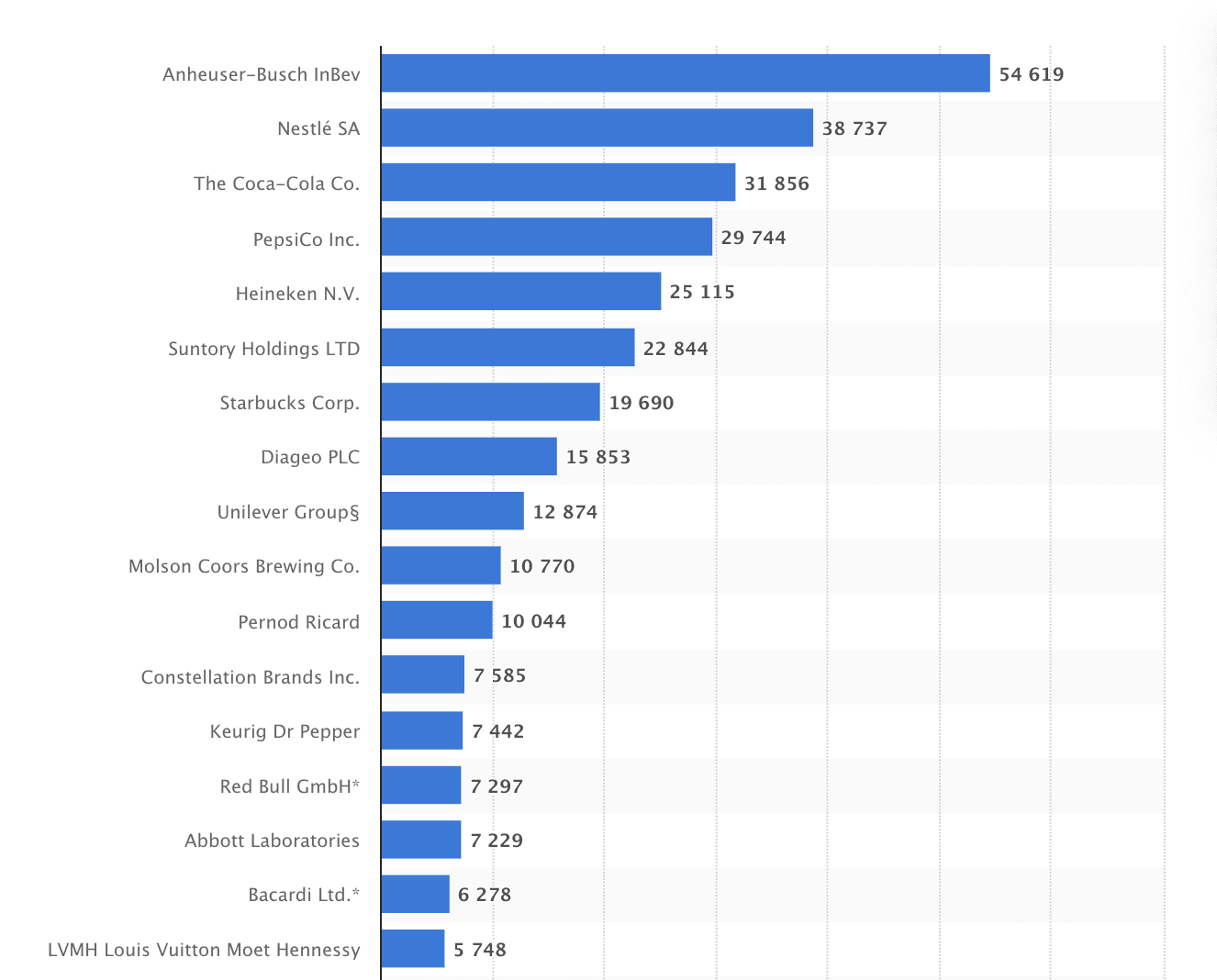
Global beverage market: leading companies 2018, based on sales | Source: Beverage Industry Magazine

But as with anything, it can be difficult for incumbents to obsess over potential competitors when existing threats exist. By 1979, Pepsi overtook Coca-Cola in sales after a clever “taste test” marketing push that outwitted the Atlanta-based manufacturer. This victory was relatively short-lived. By 1996, Fortune magazine declared the cola wars to be finished. And since, Pepsi shifted its focus altogether.

IMG_7163-1024x682
Concepting a new form of brand marketing.

Retail has been witness to a history of these brand battles. And if the future of retail is eCommerce, it’s likely that today’s next surprise is brewing. Insurgents take markets by surprise by operating in ways unanticipated by established corporations. They move differently and they rarely play by traditional rules. Incumbents are incentivized to preserve the status quo, retaining market share. It’s often the case that product-wise, all things are equal. It’s the subtle differences in messaging and community that tends to shift the conversation from old and stable to new and dynamic. Shopify is the Coca-Cola of this conversation. Shopify wasn’t first to democratize eCommerce but no platform has a better understanding of marketing and branding than the Ottawa-based SaaS company. In a recent 2PM report, I explained:

The growth of the DTC era can be attributed to SaaS companies like Shopify, BigCommerce, Magento [Adobe], and Demandware [Salesforce]. But in an industry where innovations are finite development cycles away, community and brand equity has become the key differentiator. [4]

Shopify’s innovations are numerous. Two of their top competitors (Salesforce and Adobe) are now cogs in corporate wheels. In this way, BigCommerce is the Pepsi to Shopify’s Coca-Cola. Of all of Shopify’s innovations, branding and sociology are ones that BigCommerce cannot seem to contend with. Led by Brent Brellm, the Austin-based SaaS company competes on the merits of its product. “We taste better” may as well be on his CEO’s whiteboard. But Shopify is more than the merits of its product, it’s a lifestyle brand. This perplexes BigCommerce’s leadership. In the platform wars, taste will matter as technologies shift toward no-code architecture. But brand will be equally important. Enter Elliot, a platform that seems to possess the tools that Shopify’s other competitors do not. And an emphasis on substance and brand.

On Insurgency and No-Code Development

Screen Shot 2019-12-17 at 11.10.58 AM
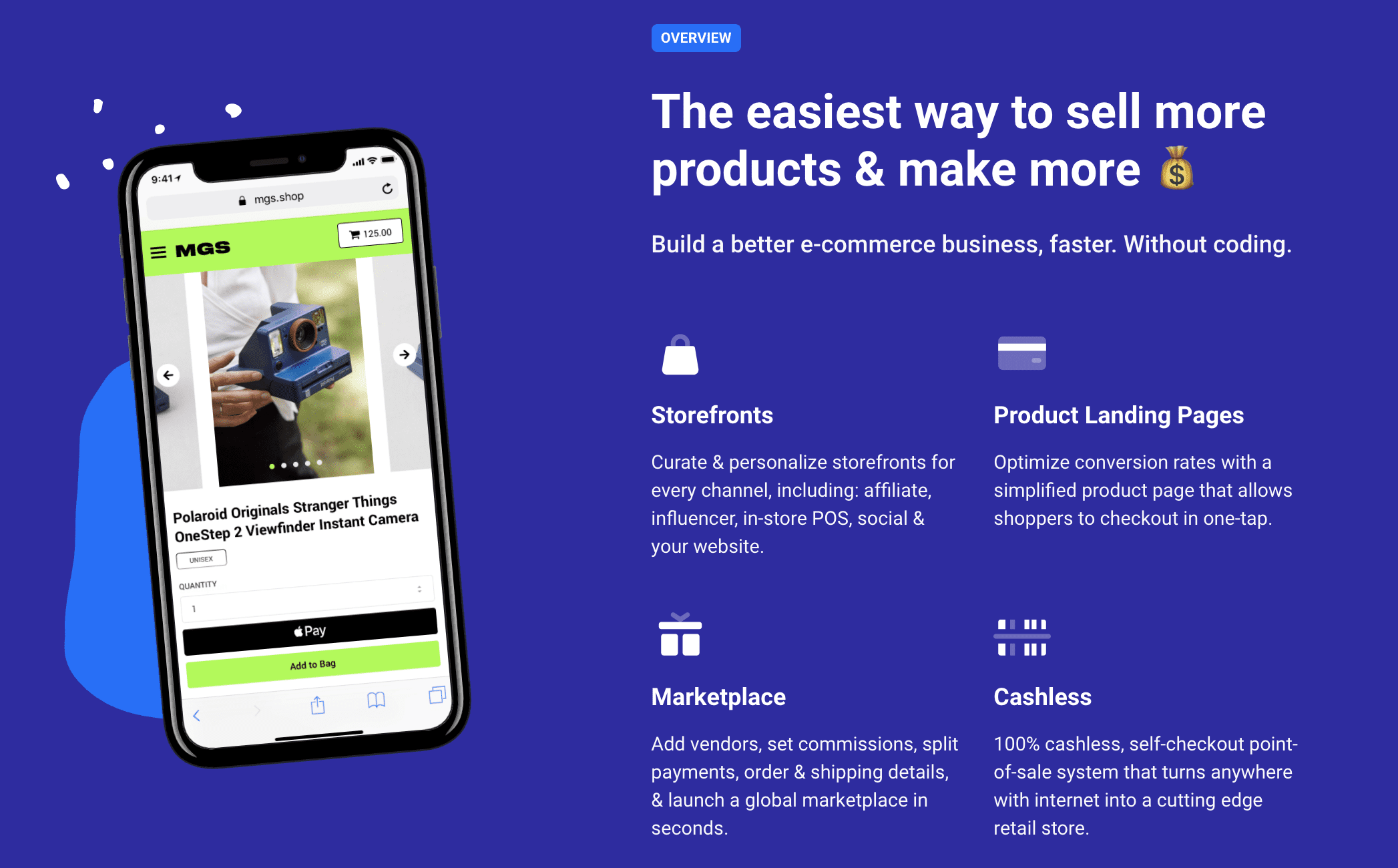
The rise of the no-code economy

Founded in July 2017 by Sergio Villasenor, Elliot announced a $3 million round in January of 2018. And like many venture announcements in that first quarter, the news came and went. Beyond a PR wire, the company’s announcement made no headlines. There was no grand entrance and even less buzz. This, despite a list of admirable investors and advisors.

We have orchestrated a blue-chip syndicate of seed stage investors including Bowery Capital, a national seed stage fund with offices in SF and NY leading the round, and Susa Ventures as the co-lead. Others participating include Acceleprise, Bam Ventures, Flexport, and SV Angel. [5]

Early on, Elliot’s founder built the company’s value proposition on the common premise: “We taste better.”  In SaaS, this is akin to iterating fast and architecting software superiority. For product developers, this product-first concept is the default.

On the merits of its product alone, Elliot has a number of clones. A casual observer will find them in the brand’s Twitter mentions questioning how the company has begun to consume mindshare with its unique approach to antagonizing incumbent brands. The company, itself, has little protected intellectual property. And until recently, it had no marketing flywheel. But over time, I’ve observed the company’s playbook evolve into one reminiscent of an insurgent of old: Red Bull. The brand has become uncomfortably antagonistic. But you can’t behave insurgently without some level of discomfort.

Elliot on Twitter

@tobi Emojis must be a Plus feature 😉

Elliot contends that Shopify’s products aren’t for everyone. And that its no code approach is early but it will be of increasing relevance as vendors begin to shift away from development agencies to launch new merchandising operations. A Shopify Partner, who asked for his identity to be withheld, commented on this trend. He noted: “As no-code becomes more common, agencies like mine will need to find new ways to add value for our clients. Who is paying $100,000 to do what can be done for free?” In the Lean Luxe slack channel, former Shopify Editor-in-Chief Aaron Orendorff and notable copywriter contended with Elliot’s brand voice:

There’s a 100% chance I’m not your target audience. So that’s probably part of it. For me, it’s the mixed feelings of: (a) that’s clever and attention grabbing vs (b) I’d be uncomfortable to retweet it.

The founding team is rounded out by Clayton Chambers (formerly of Yotpo) who serves as the Head of Growth. Additionally, Villasenor was successful in hiring Marco Marandiz (formerly of Capital One, VRBO]) as his Head of Marketing. The team has made an early impact, though it remains to be seen as to whether it has had a material effect on penetrating one of Shopify’s top advantages: its partnership ecosystem. What is evident is that the DNA of the team is different than the rest. And that, more than anything else, makes them something to watch. They’ve begun to build Elliot into a lifestyle brand, merchandising and all. They are out-Shopifying Shopify.

Sergio Villaseñor on Twitter

est. 2019

The technology and promotional DNA that the company possesses aside, a few questions remain. Can Villasenor convince Shopify’s target consumer that no-code architecture is an acceptable path forward? And can he convince development agencies to shift their offerings to account for a no-code economy? Frequent justifications for merchants considering no-code platforms include: speed, cost reduction, and ease of launch. No-code architecture allows early stage brands to sidestep developer shortages and agency fees, potentially decreasing startup costs and early investment needs.

Although no one is saying that coding is dead or that programmers are going to be out of a job soon, there is no denying that the current demand for software far exceeds the supply of coders and that many traditional ways of building applications are complex and time-consuming. [6]

According to my research, less than 8% of Shopify Plus merchants have a GMV that exceeds $10 million annually. Although, this number can improve. Shopify brands like Supply can grow from $2.5 million annual run rates to $10+ million run rates in just a year.

Shopify’s gift is that its brand partners mature over time, a process that has been aided by the company’s support systems and suite of technical services. Some analysts would argue that BigCommerce (or Salesforce or Adobe) would be positioned to benefit if Shopify ever lost community support. However, it’s likely that Shopify’s incumbent competitors are ill-equipped to facilitate such a shift. And besides, all proverbial cola tastes the same. But no-code is a different value proposition altogether. One that may become relevant as the economy tightens and venture capital becomes less available to early stage eCommerce brands and retailers.

Like Coca-Cola, Ford, and Nike before it – Shopify’s name represents more than its product. In May 2020, Shopify hosts its next Unite conference in Toronto. It’s the annual event that hosts thousands of loyalists that converge to praise Shopify’s continued growth. In the process, the event fortifies the phalanx of protection that the SaaS company has surrounding it. More than software, Shopify is the people, brands, and agencies that evangelize it. These are the company’s strategic advantages. If Villasenor and team have it their way, they’ll be in Toronto as well. But they won’t be in the event’s venue handing out cards with software specs, that’s what an incumbent like BigCommerce would do. They’ll be down the street from Unite, hosting their own party. And perhaps, a few Shopify clients will trickle in to see what the fuss is about. Some will scoff at the lack of decorum and some will nod at the audacity of it.

Report by Web Smith | About 2PM