
Memo: Whoop Won, Amazon Lost

Whoop won; Amazon bricked its Halo line of products.

Amazon decided to shut down its wearable technology operation that aimed to compete with other prominent players in the market such as Google Wear OS and the Apple Watch. But it’s Amazon’s competition with Whoop that was the most noteworthy. Whoop CEO Will Ahmed was livid when Amazon attempted to duplicate Whoop’s core design concepts and technologies. On September 2021, Ahmed tweeted: “[We] left a message for Amazon etc on every 4.0 circuit board.” The competition runs deeper than a tweet, however. A Wall Street Journal report on July 2020 explained:

Former Amazon employees involved in previous deals say the company is so growth-oriented and competitive, and its innovation capabilities so vast, that it frequently can’t resist trying to develop new technologies — even when they compete with startups in which the company has invested.

Amazon faced significant challenges, ultimately losing to Whoop. There are key reasons for Amazon’s failure in this space and Whoop’s continued growth through enterprise partnerships, innovation, and overall awareness.

1. Lack of differentiation: Amazon’s Halo product did not offer anything significant from Whoop or other market leaders. In contrast, Whoop’s offering stood out with its focus on personalized health, performance, and fitness insights to include recovery tracking and sleep analysis. The lack of unique features in Halo made it difficult for Amazon to persuade potential customers to choose its product over products like Whoop.

2. Late entry into the market: By the time Amazon launched Halo, Whoop had already established itself as a strong player in the wearable technology space via numerous official and unofficial partnerships with professional sports leagues and athletes. Consumers and businesses had already grown accustomed to Whoop’s products and ecosystem, making it challenging for Amazon to penetrate the market and gain a significant market share.

3. Brand reputation: Whoop had built a strong reputation for its product quality, innovation, and focus on customer experience. In contrast, Amazon’s approach of imitating Whoop’s product did not sit well with the market, and the negative perception affected the adoption of the Halo device.

4. Enterprise partnerships: Whoop has been successful in forging key partnerships with businesses and organizations that want to leverage the power of wearable technology for their employees’ health and wellness. Whoop is the official partner to the PGA. These types of partnerships have not only helped Whoop gain a steady revenue stream but have also expanded its market presence and brand awareness.
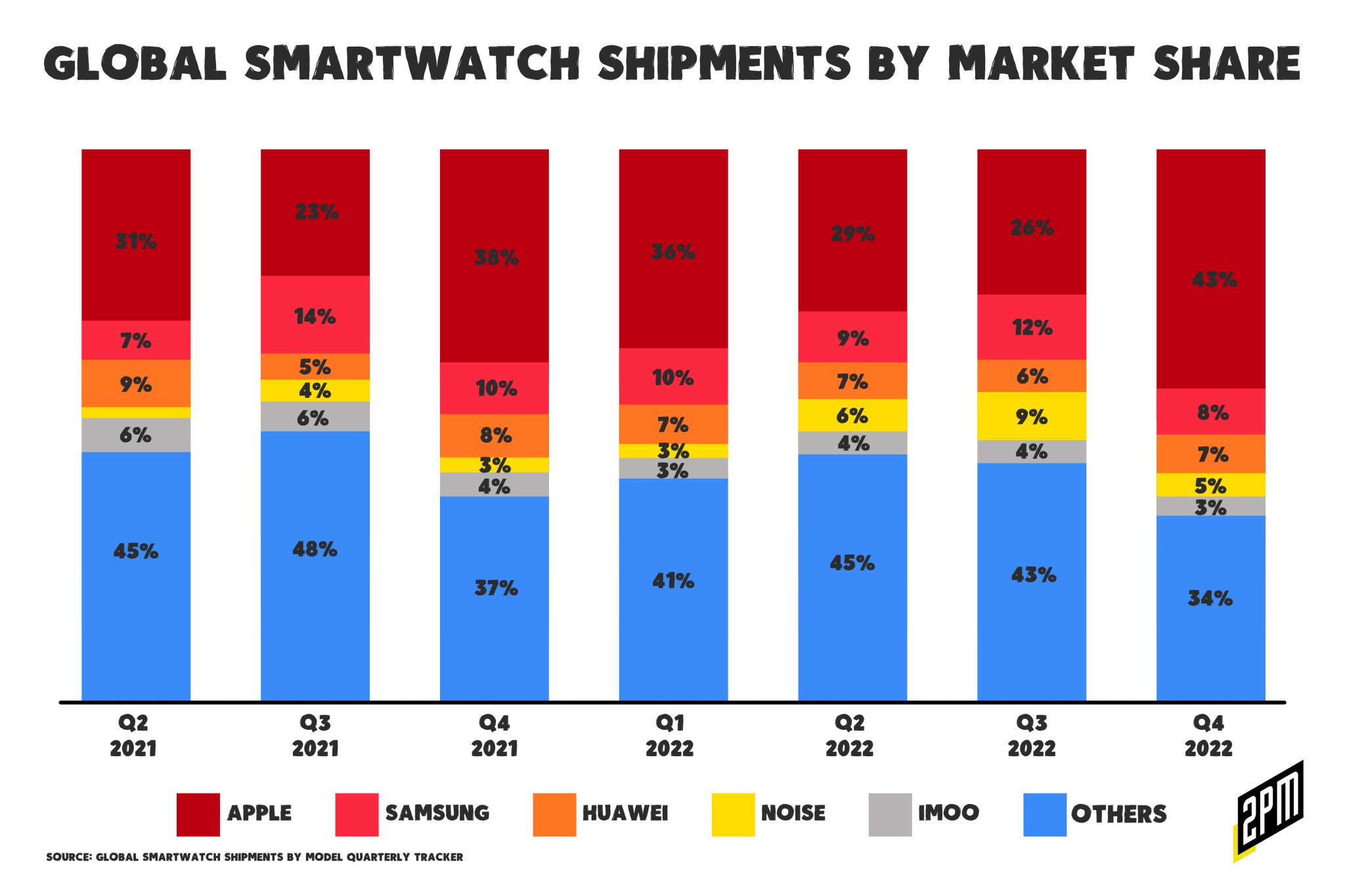
5. Continuous innovation: Whoop has consistently invested in research and development, improving its products and features. This commitment to innovation has allowed the company to stay ahead of the competition and maintain its position as a market leader. Amazon, on the other hand, failed to invest in developing new and unique features for Halo, making it less appealing to consumers. In March, Whoop announced a new stress-tracking feature.

Each member’s current reading, which is converted into a personalized Stress Score, is then compared to their individual HRV baseline from the last 14 days, as well as their typical resting heart rate. When generating a member’s Stress Score, WHOOP is able to delineate between moments of physiological stress and physical strain.

And on April 25, Whoop rolled out its “Strength Trainer,” a service that allows users to track strength training by gauging the “physiological impact of muscular load.”

6. Effective marketing and overall awareness: Whoop has been successful in creating awareness about its products through targeted marketing campaigns, social media presence, and endorsements from athletes and celebrities – especially by the golfing community. This has helped the company build a strong brand presence and attract a dedicated user base. Puff pieces like these by Golf.com are invaluable:

Leading players like Rory McIlroy and Justin Thomas use the detailed recordings of Whoop, while Nick Watney, who was the first PGA Tour golfer to test positive for Covid, was alerted to carrying the virus by the heart and respiratory recording from his Whoop band.

Amazon famously pursued a bold acquisition strategy around connected devices and the many data that they contribute, but for these reasons, it didn’t work out as planned. In Consumer Data and Amazon, I explained:

Amazon now has a presence in the following categories: laptops, streaming television, in-home assistants, smart speakers, Door cameras, fitness monitors, and now vacuum cleaners. Collectively, Amazon knows more about its consumers than any other company on earth.

The closure of the wearables department will mean that Amazon would no longer be able to collect data on users’ health habits, physical activities, and other wellness-related preferences. This data could have been used to serve more targeted advertisements to users, increasing ad revenue.

However, Amazon still possesses a vast data collection infrastructure. While shutting down its wearables department would impact Amazon’s data collection strategy by reducing access to specific types of consumer data, the company’s diversified product and service portfolio ensures that it still possesses a robust data collection infrastructure. But only for now. Amazon seems more than willing to reconsider every program that isn’t focused on traditional eCommerce, physical retail, or retail media networks. What will Amazon brick next?

By Web Smith | Edited by Hilary Milnes with art by Alex Remy and Christina Williams

Memo: The Future of Commerce (Infrastructure)

The future tends to resemble the past. Railroads, bridges, and highways democratized the American economy; eCommerce infrastructure will do the same.

When considering the impact of eCommerce, look beyond the brands, marketplaces, blanding, and pixels. Instead, see railroad planks and westward tent towns as far as the eye can see. Commerce is what happens when infrastructure meets opportunity.

Between 1871 and 1900, over 170,000 miles of railroad tracks were laid, fortifying the five transcontinental railroads, the first of which was completed in 1860. By 1900, the other four had been developed, connecting the Pacific coast to the eastern states. Along the way, centers of commerce developed around railroad hubs.

Chicago built its first rail connection in 1848 to connect the Windy City with the lead mines of Galena, Illinois. Later lines connected the city with Detroit, Cleveland, Cincinnati, New Orleans, St. Louis, Kansas City, Omaha, and St. Paul. The sudden rise of rail-based commercial transportation corresponded with Chicago’s post-Great Fire building boom. [2]

For the majority of North America, the online retail industry of today is analogous to the infrastructure of old: It has the potential to change one’s surroundings. The development of eCommerce capabilities will influence much of the rest of our lives, including how we live, how we buy, what we eat, where we work, how get there, and where we shop.

Chicago became the center of commerce in the West as constructed railroads, bridges, and automobile travel formed new patterns of agglomeration and consumerism. The infrastructure of its day captured new opportunity where there was none. Today, eCommerce is the infrastructure that will quietly influence industries from real estate to telemedicine.

We must begin viewing investments into our eCommerce infrastructure no differently than our predecessors viewed their investments into roads, bridges, and tunnels. The rest of the digital and physical economies will depend on that infrastructure: databases, financial technology, warehousing, logistics, privacy systems, and trust. Each are hallmarks of the eCommerce industry, but rarely do we consider how they can impact industries that have long been without these norms.

Democratization: The true benefit of eCommerce

In one day, I experienced three interactions that will be influenced by eCommerce infrastructure in much the same way that quiet towns grew to booming cities after the arrival of railroads.

The disappearing sleazy salesperson. By 9 a.m., I was at a car dealership for an oil change. The conversation of a new car purchase arose. And when the dealership felt that I was a serious buyer, a contract appeared on a table. The trade-in price was determined by a person who was incentivized to minimize the value of my vehicle. Knowing this, I made a call to another dealership who then offered 7% more for the same exact vehicle. The existing dealership agreed to the true value of the trade-in, but only after it was revealed that they undercutted my price to boost their own profits.

Tesla and Carvana are among those fixing a retail institution that’s built on an extraordinary lack of trust. Traditional dealers are not far behind. A recent report on a major English automobile dealership franchise proves as much.

Recent research conducted by automotive industry IT services and consultancy NTT Data found that one in six people are looking to only use online platforms for future car purchases. Its findings represent a 500% increase on those that have previously bought a car entirely online. [5]

The disappearing housing bias. End-to-end eCommerce may promote the democratization of where and how we live. Moments after opting out of the purchase, I drove to a plot of land in a suburb of Columbus where my family is building a home. The concept of “sanitized urbanization” was inspired by this area and covered in an August 2020 edition of 2PM:

Polycentric development is a pattern of transport connectivity, urban planning, mixed-use development, and progressive design concepts. The result of these accelerations, interruptions, and inventions is a new classification of suburban development that will become more commonplace as younger earners continue to flee cities. In kinder terms, sanitized urbanization takes the best parts of urban renewal and imports them to upper-middle class and wealthy exurbs. Dublin, Ohio’s Bridge Park is a great example of a polycentric development, featuring a member club, modern hotels, and top restaurants. [2PM, 2]

I sat in my car as I read a report from our local business press on the housing market in the area:

Several residents submitted comments that said they worried about increased traffic a “change in demographic” that renters would bring in a neighborhood that is largely owner-occupied. [3]

I am that change in demographic. The homebuilding process and its politics have not been easy over the past year. In The Opendoor Policy, I explained: “The path to middle-class home ownership is rife with unspoken obstacles and time-hardened customs. For immigrants and minorities, the obstacles can be even higher.” [2PM, 4] I wonder what innovations the democratization of eCommerce can bring to the often-twisted forces of human subjectivity.

The disappearing obstacles to preventative care. Later that afternoon, I experienced a small medical emergency that I was able to identify early thanks to a combination of wearables and available bloodwork. As I rushed to a medical facility with a resting heart rate of 168 beats per minute, I prepared myself for the succession of questions from a nursing staff and the attending physician. Neither had access to data from companies like Levels, Whoop, or Base, a health tracking system that measures vital systems through in-home lab assessments. Without context, they searched for the problem rather than finding a solution to what had already been identified.

Integrated healthcare and preventative medicine may become the technological issue of this decade. The technologies, no longer just for overzealous weekend warriors, have moved into the mainstream for anyone who wants to better understand their own health in a cost-effective way. In response to thoughts on the need for these integrated technology and care, a medical doctor replied:

Access was greater when your contact point was in the same place as your doctor. “Press one to make an appointment. Press two for billing…”

In each case, eCommerce can systematically democratize key functions of our lives by removing the gatekeepers. Much like railroads provided access and commerce, new technologies can simplify the purchase of a car, remove bias from the purchase of a home, or provide peace of mind without dialing a number to make an appointment with your physician.

While brands, marketplaces, and concepts like Stitch Fix, Allbirds, Amazon, DTC, HENRY, and Shopify define eCommerce today, they won’t forever. The merits of eCommerce will be at its fullest potential when digital transactions become enjoyable, objective, and universally available. When you think of eCommerce, consider roads, railways, and bridges. And then remember how those tools connected an expansive, underdeveloped nation to opportunity and greater freedoms.

By Web Smith | Editor: Hilary Milnes | About 2PM

Member Brief: The Bionic Woman

Science fiction often serves as a guide for the future. In Silicon Valley, Snow Crash, a 1992 sci-fi novel, has been required reading for technologists for nearly 30 years. Neal Stephenson’s cult classic is one of several highly referenced stories credited with inspiring immersive virtual reality, augmented reality and the metaverse. It laid the groundwork for the layering of the digital world atop our physical one. Similar to Snow Crash, a second obscure book has had a profound impact on a different field of technology.

This member brief is designed exclusively for Executive Members, to make membership easy, you can click below and gain access to hundreds of reports, our DTC Power List, and other tools to help you make high level decisions.

Join Here