No. 337: Stick To Sports

For as long as there has been athletic competition, there has been a narrative that permeates from the field of play. Gladiators of Rome were commonly first-generation slaves, bought and sold at the whim of their owners – the sporting promoters of their day. Like today’s gladiator sports, cruelty was a part of the spectacle. And the minds of the time contrasted in their approval or disapproval of their era’s proudest spectacle. Great minds like Seneca disapproved of the competition. Marcus Aurelius once abolished a tax on gladiator-based taxes and commerce; he wanted nothing to do with the capitalism of it all. And still, he couldn’t resist hosting lavish games from time to time. The spectacle of cruelty was insatiable to the average man and the great one – alike.

As it was, as it will always be. Sports was never without its social commentary. Jesse Owens’ olympic showing wasn’t just impressive because of the speed of his feet; he beat the myth of German superiority with a foot race. Jackie Robinson wasn’t just a baseball player, he was remembered as a hero. That was the narrative that was formed about the man, even while his involvement lacked the popular sentiment that it is awarded today. Janet Guthrie was a media fixture, not just because of her precedent off of the track but because of her accomplishments on it. Before Danica Patrick, there was her. And with a little more support from sponsors and officials, she could have accomplished much more.

Since when has sports been about athletic accomplishment alone?

On a November evening after the Baltimore Ravens’ decisive victory against the undefeated New England Patriots, ESPN National NFL Writer Kevin Seifert made a statement with a simple tweet. He listed three quarterbacks, each of whom are considered candidates to win the league’s coveted most valuable player award. The quarterbacks that Seifert listed: Russell Wilson, Deshaun Watson, and Lamar Jackson are what veteran industry analysts would call: unconventional, mobile, dual-threat. However, they’re more than that. In each case, whether these quarterbacks pass or rush, they lead from the front. More than anything else, that’s their common thread.

Kevin Seifert on Twitter

If we’re doing the MVP now, I’m going: 1. Russell Wilson 2. Deshaun Watson 3. Lamar Jackson

Here is a selection of quarterbacks drafted before 2019’s MVP candidates: Ryan Tannehill, Brandon Weeden, Brock Osweiler, Mitchell Trubisky, Baker Mayfield, Sam Darnold, Josh Allen, and Josh Rosen. To the casual observer, this thought may as well be morse code. So consider the following: the National Football League has never had three African-American quarterbacks in the front running for most valuable player. And certainly not in an era of the sport’s greatest quarterbacks, namely Tom Brady and Aaron Rodgers. We’re still in a period of firsts in this 150 year old sport. Brigham Young University started their first African-American quarterback in the year 2019. The sentiments of the 1950’s still linger. So what Seifert was doing was making a statement without controversy. To the untrained eye, it was merely the fact of the matter. But to those who understand the historical significance, it was a dog whistle of sorts.

“If you ask me is there a false narrative out there, I will tell you ESPN being a political organization is false,” he said. “I will tell you I have been very, very clear with employees here that it is not our jobs to cover politics, purely.” [1]

But even with the mandate by new ESPN President Jimmy Pitaro, Seifert found a way to toe the proverbial line. Wilson, the 75th pick of the 2012 draft is now the highest paid quarterback in the league. Bears quarterback Mitchell Trubisky was drafted before Watson. And Ravens quarterback Lamar Jackson was publicly and privately coaxed to convert to wide receiver by many in the media. He didn’t fit the image. His chorus of detractors included former Indianapolis Colts GM Bill Polian [2].

After this historic game, Bleacher Report took a muted approach as to avoid the conversation altogether. In the NFL, running backs don’t win MVP over transcendent quarterbacks. In the last 20 years, just four have won. Sixteen quarterbacks have been selected in that time. Just the same, here was their take:

And [Jackson] a clear MVP candidate. This game firmly planted him in that discussion, along with Panthers running back Christian McCaffrey, Seahawks quarterback Russell Wilson and Texans quarterback Deshaun Watson.[3]

Meanwhile, at Deadspin, the two lead stories are written by a generic “Deadspin.” A sign that no one is behind the wheel. The reports were merely a collection of embedded tweets. There’s one on the Ravens surprise victory. The one where the quarterback (that should have played receiver) trounced the greatest of all time. As the two shook hands upon leaving the field of play – battered and bruised – Jackson uttered “You’re the GOAT.” As if Brady needed a reminder. The other Deadspin “story” featured the Cleveland Browns latest off-the-field issue.

The only report with any personality was written by Karu F. Daniels of The Root, another property of G/O Media. It was repurposed into Deadspin content. One can only wonder what Deadspin would have written about a unique moment in the sport’s vaunted history. But the site is currently a shell of its former self. The staff quit en masse after being told to by G/O Media management to “stick to sports.” A common refrain in today’s corporate media.

G/O Media is the product of Great Hill Partners’ acquisition of the former Gizmodo Media Group. The all-equity transaction was facilitated with Jim Spanfeller, best known for his leadership at Forbes.com. Perhaps, it’s his lack of experience in sports media that permitted such a fatal miscalculation.

The Irony of The “Stick to Sports” Mandate

Google Search interest for “Stick to Sports” peaks in September 2017

On its merits, the nature of the phrase is divisive. When ESPN’s Rachel Nichols spoke out in September of 2017, the peak of its interest, she raised questions around the hypocrisy of it. It was around that time when J.J. Watt was rightly praised for raising $20 million for hurricane relief while other athletes faced pushback for highlighting other extracurricular causes – most often around social justice issues. With the current state of American politics at a relative boiling point, the separation of societal politics and corporate entertainment have never been more difficult to parse. ESPN found ways around its “stick to sports” mandate by elevating intelligent and nuanced figures like Pablo Torre, Stephen A. Smith, Max Kellerman,and Bomani Jones. Deadspin wasn’t as forward thinking and they ultimately paid for that.

“Stick to sports” is, of course, a fault line in 2019’s culture wars. [4]

But as the state of our political machine continues to polarize Americans, the mandate becomes harder and harder to follow. Yet, it becomes more important to disobey. In fact, at some point, the mandate becomes bad business. This is especially true for digital media where Deadspin rival and The Chernin Group-owned Barstool Sports has thrived by using sports as a platform to enter adjacent conversations. And I am using the word “adjacent” liberally here. Several of the top stories on Barstool Sports currently include an Instagram influencer questioning his history syllabus, a feature on the “Watchmen” series, and a woman that tattooed her eyeballs.

The banner of Barstool’s homepage features a link to the media group’s famed Chicks podcast. And all of this is to say, it seems to be working for Barstool. This includes its cozy relationship with Fox News, including regular appearances by founder Dave Portnoy on Tucker Carlson. And this isn’t an argument against their approach. Rather, it was an acknowledgment that Barstool Sports has thus far succeeded by understanding the property’s psychographic. The Chernin Group seems to have avoided the stick to sports conversation with CEO Erika Nardini.

Ringer, Deadspin, B/R, Barstool and Psychographics

Consumer psychology involves the interest in lifestyle, behavior, and habit. It’s an encompassing measure that considers our idiosyncrasies, our temperament, and even our subtle personality traits. These are the variables that influence our behavior as consumers. Psychographic segmentation is the analysis of a consumer cohort’s lifestyle with the intent to create a detailed profile.

The Ringer is jovial and care-free. Bleacher Report is dead-pan with the occasionally dry humor. Barstool is edgy and offensive as a strategy. And so was Deadspin.

While largely focused on sports, Deadspin for years had delved into a broad range of topics in a voice that was sometimes rude, often funny and always conversational. On Tuesday, the site’s top editor, Barry Petchesky, was fired after refusing to go along with the order. The departures shocked fans of the site, which put a new spin on sports coverage for a generation of digital natives. But they were the result of a long buildup of resentment between the journalists and their new bosses, according to interviews with 13 current and former employees of Deadspin and G/O Media.[5]

Nov 4: Barstool’s Homepage

For Deadspin, the majority of their sensationalism involved topics that were completely unrelated to sports in substance, this report isn’t necessarily about the history of those articles. Bill Simmons’ The Ringer shares a similar narrative with Barstool. On the homepage, you’ll find stories about Mr. Robot, Jeopardy, AppleTV+, and The Watchmen. Bleacher Report contrasts the three. The publication leans heavily towards strict sports coverage, a methodology that works for them. But even B/R featured an epic story on Colin Kaepernick written by Rembert Browne. And most recently – a story about Jared Lorenzen, the former Kentucky quarterback who died prematurely. Which brings me to the point: where do you draw the line when your publication covers sports? Collegiate and professional sports represent a layer of American life, not the totality of it. Sports is merely a dimension, not the whole.

No Code and The Business Case FOr: Stick To Sports

OM on Twitter

Let me rewrite this tweet from Jason. 1/ Deadspin writers are immensely talented and have a huge following. They have a lot of goodwill at present and as a result they should Marshall their collective resources and start a new publication. Let’s call it SpunOut. https://t.co/161I1HkInj

The editors and writers who resigned from Deadspin had a basis for their frustration. Sticking to sports is a nearly impossible proposition in today’s media. Given how rare it is to see a media company stick to their original charter, it’s understandable that Deadspin’s former employees saw the charge for what it really was: a euphemism for staying away from covering athletes who’ve immersed themselves in left-leaning causes.

But we’re in an ever-expansive era of digital media. Companies are rewarded for reaching. Complex Media is developing television shows and consulting third parties on commerce and audience development. Barstool Sports has a podcast starring two employees who discuss their friendship and sex lives, and Bleacher Report successfully collaborated on soccer kits with top hip hop artists.

Whatever happens moving forward, the Deadspin that was is no longer. It was one machine of a blog with nearly 30 million monthly visits and a penchant for engaging and re-engaging their loyal readers, many who’d visit the site multiple times per day. But it begs the question, if Deadspin was still Deadspin, what might they have written of Kevin Seifert’s idea? How would it have covered a tweet that should have been more than inconsequential. It’s doubtful that Deadspin may have told the story in the same ways that Barstool, Bleacher Report, ESPN, and The Ringer relayed theirs. To those platforms, the MVP race was not a story at all. But take it from NFL veteran and commentator Cris Collinsworth. As the Ravens led the Patriots, with the crowd in disbelief, Collinsworth quipped:

We’re going to be able to point to quarterbacks in the NFL that got a chance because of this night.

But in 2019, for many digital publishers, that’s too loaded of a statement. But many understood what it meant. And that understanding is part of the story too. The market has a need and the opportunity rests on the journalists who decide to forge their own paths. It’s only right that Deadspin alumni launches a Substack with the call sign of their mandate: Stick to Sports. Used ironically,  of course, as one last jab at the man they called an herb. The publication would almost instantly lead the Substack board.

With that model, Deadspin’s former writers and editors would have the freedom to do it the right way. Anyone who’s ever played the game knows that sports doesn’t end when you step off of the field of play. A sport is America’s pastime, it’s the most watched television event, it’s the most expensive event ticket, it’s the basis of a nation’s network of country and athletic clubs. Across America, hotels are built solely to support a thriving youth sports cultures of areas that would otherwise be barren without its expensive field complexes. Young people wear jerseys and the shoes of sporting legends. And adults bet and cry and yell and travel to watch their teams. It’s the irrationality of it all that reminds us that sticking to sports is an impossible task. And media should reflect that impossibility. Seifert knew the significance of his tweet, America should have known it too.

Доклад Веба Смита | Около 2 часов дня

№ 336: "Цикл большего

Под Rothys и Veja's городских жителей-миллениалов проглядывает едва заметная тенденция. Растет число работников в возрасте 20 и 30 лет, которые предпочитают брать на работе отгулы для поддержания психического здоровья, ссылаясь на переутомление. Товары на основе CBD стали обычным явлением в кассах специализированных магазинов. Приложения и оборудование для медитации входят в моду. Вместо того чтобы потреблять все больше и больше товаров, высокооплачиваемые миллениалы предпочитают брать отгулы. Это изменение приоритетов совпадает с другим: бумом компаний, стремящихся к арбитражу стоимости путем поиска новых путей роста. Компания WeWork, возможно, является лучшим примером этого бизнес-цикла, который рухнул - по требованию - с помощью разгневанного, финансово свободного профессора Нью-Йоркского университета, которому нечего было терять.

Два тренда возглавляют этот отчет: (1) сдвиг в сторону ментального минимализма и (2) отход от цикла "бизнес больше". В январском репортаже BuzzFeed News первая из этих двух тенденций начала набирать обороты в основных средствах массовой информации:

И что теперь? Должен ли я больше медитировать, договариваться о большем количестве свободного времени, делегировать задачи в отношениях, заниматься самопомощью и установить таймеры на своих социальных сетях? Иными словами, как мне оптимизировать себя, чтобы выполнить эти рутинные задачи и теоретически вылечить свое выгорание? Миллениалы, которым уже за тридцать, постоянно задают этот вопрос и не могут дать на него адекватного ответа. Но, возможно, это потому, что это вообще неправильный вопрос.[1]

Каждое ежедневное задание, работа, внеклассное мероприятие и хобби имеют много общих черт друг с другом. Больше, больше, быстрее, больше, лучше и больше. Редко какое ежедневное событие бывает простым, маленьким или незначительным. И это начинает проявляться. Если вы читаете эти строки, то, скорее всего, процветаете в среде, где вы занимаетесь на Peloton или Tonal перед работой, ездите на Uber Black, отвечая на электронные письма на MacBook за 2 000 долларов, принимаете микродозы, чтобы стать "безграничным", периодически поститесь, чтобы оптимизировать свою физическую форму, а затем работаете по двенадцать часов в день, чтобы оплачивать ежемесячную аренду за 3 500 долларов. Откровенно говоря, мы все перегорели. И здесь есть связь: бренды начинают проявлять сочувствие к этому поведенческому течению.

Поэтому легко понять, почему многие из нас так злы. Мировые WeWork были построены на этике позитивных вибраций и единства - в сочетании с тем, что технический аналитик Ранджан Рой называет "высокопарным языком самореализации, напоминающим о горящих людях", который сегодня кажется оскорбительно несовместимым с реальностью жизни людей. Так почему же Pattern или любая другая компания, которая наносит на свои продукты поверхностный слой "жужжащих" слов, способствующих выгоранию, должна быть другой?[2]

Психология потребления - это интерес к стилю жизни, поведению и привычкам. Это всеобъемлющее исследование, которое учитывает наши идиосинкразии, темперамент и даже тонкие черты характера. Именно эти переменные влияют на наше поведение как потребителей. Психографическая сегментация - это анализ образа жизни потребительской когорты с целью создания подробного профиля.[3]

Pattern Brands, группа, стоящая за Gin Lane (RIP), находится в авангарде этой тенденции. Легендарное креативное агентство, которое разработало форму потребления для миллениалов, консультируя Hims, Harrys, Dia & Co, Ayr, Bonobos, Shinola, Stadium Goods и Rockets of Awesome, возвращается к созданию сообщений, которые повлияли на "бизнес-цикл большего". Оглядываясь назад, можно понять, что Recess и Haus были двумя последними DTC-проектами Gin Lane. Завершив успешную кампанию с двумя "душевными" брендами, они как будто телеграфировали о своих планах сосредоточиться на новой эре сообщений.

Что это значит для брендов DTC?

За последние месяцы компания Everlane выпустила свою безударную обувь, Allbirds - аналог Rothy's, Rhone - достойного конкурента Mizzen+Main и Ministry. А компания Away начала закладывать фундамент для работы с товарами повседневного спроса (CPG). Когда-то бренды считали, что они могут построить надежный путь роста, определив одну потребность в продукте и одну потребительскую идентичность.[4]

Масштабируйте быстро, масштабируйте там, масштабируйте сейчас. Это мантра многих современных ведущих цифровых брендов. Многие производители товаров начинали с единственного, ключевого продукта. Затем они перешли на путь роста, соответствующий традиционному бренду категории. Правда, большинство DTC сделали это преждевременно. Напротив, успешные традиционные бренды выходили за рамки своей первоначальной направленности через десять и более лет работы. В нынешнюю эпоху розничной торговли переход от продукта к категории происходит всего за несколько лет. Основатели нанимают талантливых специалистов по продуктам, чтобы удержаться на вершине растущего разнообразия SKU - многие из которых изначально не были предназначены для этого. Представьте себе, например, обувную компанию, разрабатывающую багаж, или компанию, разрабатывающую рубашки для одежды. Для поколения потребителей бизнес-цикл "больше" - это не только студенческие кредиты, растущая арендная плата или крах WeWork. Он также отражает бренды, которые мы потребляем. Кажется, что каждый бренд стремится стать больше, быстрее и сильнее - подсознательное напоминание о том, что мы должны делать то же самое. Ситуация начинает меняться.

В недавней беседе между мной и сотрудницей AdWeek Анн-Мари Алькантарой мы обсудили эти концепции в ходе марафона, который проходил без протокола. Для борьбы с гиперростом, необходимым для получения венчурного финансирования, на ранних стадиях современный бренд-новичок должен больше походить на издателя или сообщество, чем на розничного торговца. Обоснование простое: покупатель мимолетен, а сообщество живет долго. Чаще всего это отражается на брендах с более сильным органическим присутствием. Brooklinen - яркий пример.

Brooklinen: Бренд "Спальня"

Перестав быть просто брендом постельного белья, Brooklinen хочет владеть спальней так же, как Away стремится владеть путешествиями. Дальше их стратегии расходятся. Brooklinen относится к классу компаний, занимающихся производством постельных принадлежностей с использованием цифровых технологий, к которым относятся: Parachute Home, Buffy и Hill House Home Inc. Основанная в 2014 году, компания отчиталась о продажах на сумму около 60 миллионов долларов в 2018 году; дуэт жены и мужа привлек только 10 миллионов долларов на сегодняшний день, что, вероятно, повлияло на их путь роста от компании, производящей продукты, до присутствия в категории. В данном случае ограничение капитала оказалось эффективным механизмом роста.

Снимок экрана 2019-10-28 в 3.51.34 PM
От: earthy-minimalist в Brooklinen

В отличие от многих современных брендов, ориентированных на цифровые технологии, соучредители компании Рич и Вики Фулоп отказались от традиционной схемы "расширения категории" в пользу двустороннего формата рынка, который соответствует вышеупомянутым тенденциям. Потребители будут вознаграждать те бренды, которые предлагают ценность, не пытаясь сделать все. Запуск маркетплейса Spaces получил широкую огласку в СМИ благодаря грамотным сообщениям команды основателей и пиар-работе Линдси Мартинез из Ogilvy, рекордной фирмы Brooklinen по связям с общественностью.

На выставке будет представлено 100 изделий от 12 партнерских брендов (в дополнение к 89 изделиям, созданным Brooklinen). Среди дизайнеров будут как независимые ремесленники, так и признанные бренды, такие как Simply Framed, The Sill, Floyd, Dims и другие.[5]

Этот запуск вызвал любопытство ряда отраслевых наблюдателей, которые еще не были знакомы с партнером Brooklinen по рынку RevCascade или технологическим стеком SaaS-компании. Вместо того чтобы выходить за рамки 89 SKU бренда за счет разработки или "белой этикетки" других продуктов в категории, Brooklinen в партнерстве с RevCascade запустил двустороннюю торговую площадку. При среднемесячной посещаемости в 600 000 - 650 000 посетителей с намерением совершить покупку, предложение сопутствующих товаров от модных брендов, таких как The Sill, решает сразу несколько задач: монетизирует существующий трафик и одновременно расширяет представление потребителей о том, как Brooklinen вписывается в их жизнь.

По словам Веба Смита, основателя платформы для исследования розничной торговли и сообщества 2PM, выход Brooklinen на рынок - это не совсем новая концепция. Это то, что Смит называет линейной коммерцией, когда бренд использует существующую аудиторию для монетизации дальнейшего дохода, роста и трафика.[6]

Является ли Brooklinen менее категоричным брендом, чем Casper? Короткий ответ - нет. Более того, рынок может вознаградить компанию, производящую постельные принадлежности, за ее двустороннюю рыночную стратегию. Компания RevCascade предоставила Brooklinen инструменты, необходимые для запуска гибридной торговой площадки, на которой представлены (1) оптовые (2) прямые (3) и дропшиппинговые товары. Таким образом, подход Brooklinen отражает закон линейной торговли.

При таком количестве новых брендов в разных категориях любой компании трудно "пробиться сквозь беспорядок", - говорит Фулоп.

Команда основателей Brooklinen объединила существующую аудиторию (600 тыс. MAU) с дополнительной коммерческой возможностью. В их случае это удалось сделать без дополнительного найма, разработки или маркетинговых препятствий, связанных с запуском новых продуктов. Благодаря своему подходу они предлагают новые продукты, сохраняя при этом фокус на производстве качественного текстиля.

В комментарии к 2PM: Джош Векслер, соучредитель компании RevCascade:

RevCascade позволяет любому ритейлеру, продавцу электронной коммерции или издателю запустить собственную курируемую торговую площадку или программу дропшиппинга, чтобы поднять свой бренд, лучше обслуживать потребителей и получать новые доходы с нулевым риском для товарных запасов. Утвержденные Brooklinen бренды (они же продавцы или поставщики) используют "мастер регистрации" RevCascade для создания своего профиля, загрузки товарных запасов и настройки параметров доставки. Параллельно с этим, используя автоматизированную интеграцию RevCascade с Shopify для получения данных о товарах, обновлении запасов и данных о транзакциях, Brooklinen смог запустить свою торговую площадку менее чем за 30 дней.

Опираясь на сильную привязанность к основным продуктам компании, Brooklinen получил конкурентное преимущество по обоим показателям: DTC и marketplace. Рассмотрим Verishop, популярный, хорошо управляемый и капитализированный маркетплейс, который был запущен в июле 2019 года:

[table id=49 /]

Обсуждаем ли мы подход Pattern Brands к устранению культуры выгорания или влияние цикла more на постоянно переполненный рынок быстрорастущих брендов, партнерство Brooklinen с RevCascade может послужить примером для многих их коллег. Потребители устали от компаний, которые стремятся расти ради роста. Для них это напоминание об их собственной жизни, которая проходит в быстром темпе и под высоким давлением.

Консьюмеризм всегда будет существовать в той или иной форме, но беспорядок брендов, стремящихся дорасти до следующего рубежа, может многим не понравиться. От Мари Кондо до Core Meditation, культура беспорядка стала катализатором средств от выгорания. На сегодняшнем рынке будут вознаграждены те, кто предлагает легкость, ценность и простоту. Бренд обязан внести свой вклад в решение проблемы, а не в цикл увеличения количества.

Читайте материал № 336 здесь.

Репортаж подготовлен Вебом Смитом и отредактирован Трейси Уоллес | Около 2 часов дня

No. 335: The Merchant Class


The rebuttal that you’ll typically hear is: “eCommerce is not blue collar.” It’s a refrain tweeted from the 20th floors of urban sprawls. On those floors, you’ll find dual-monitored workspaces adjacent to espresso machines and collagen bars. But for Jerry M. of Pickerington, Ohio, his opinion differs.

He’s been a four year member of Amazon’s third shift at its CMH2 facility. With his trusty Fitbit, he measures his nightly activity. His all-time goal is a little over 17,000 steps for the day, though the 57 year old typically falls around 12,000 – 13,000. An impressive number, his picking and packing statistics are even more impressive. On any given night, his fulfillment center is one of Central Ohio’s most prolific. And that’s saying quite a bit. Jerry’s no stranger to hard work, he is a former maintenance man who took the opportunity to grow with Amazon’s exploding logistics-side business. It paid far better.

Central Ohio is a bastion of third-party logistics centers and fulfillment warehouses. Name a digitally native brand and they will likely have a presence in the area. It was my first experience within the walls of one of those retailers that changed my perception of commerce altogether. At 26, I began in the marketing department of Rogue, a now-gargantuan online retailer that employs hundreds of machinists, warehouse workers, packaging engineers, and front office developers and executives. The employees and contractors now sit (or stand) within 900,000 square feet near Downtown Columbus. But on my first two days with the company, I passed the hours in the warehouse moving 40 pound boxes. On the second day, I wore comfortable shoes.

To the marketers, developers, and managers – they are online retail. They are what makes the engine move. And for a time, this was true. Commerce investments like recruiting engineering teams, advertising talent, server space, able creatives, and copywriting mavens rounded out the major spend. Leaders would spend heavily on the front-end, not the back-end. Commerce was pixels, not forklifts. But to those building packaging, operating forklifts, moving goods to trucks, they were commerce. To them, the front office folks were the replaceable ones.

Commoditization of the Front End

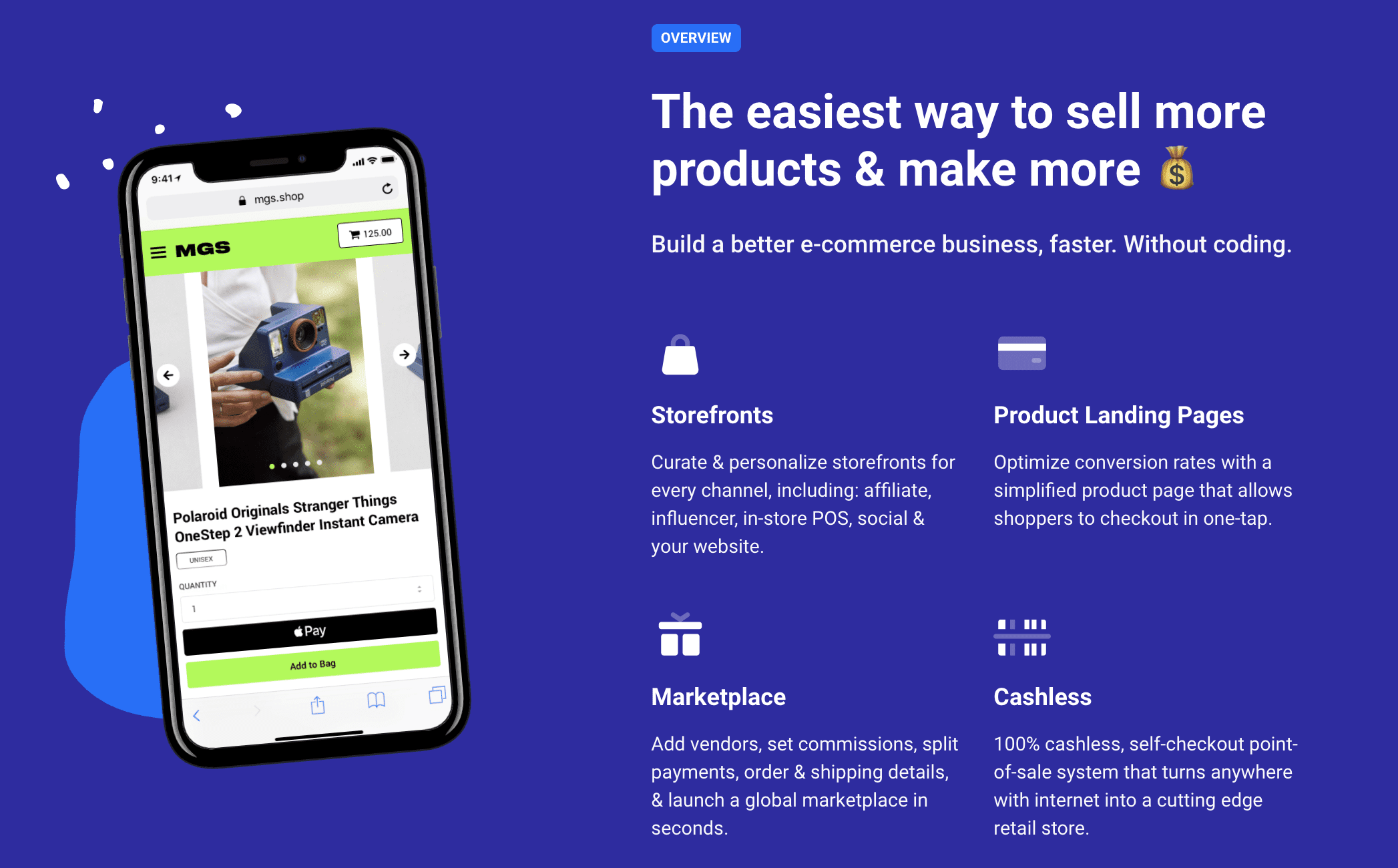
The front-end product side of online retail is quickly commoditizing. You have Shopify and Magento, of course. But then, there are solutions for every corner for the ecosystem; these innovations grow by the quarter. There are legacy partners like Fulfillment by Amazon (FBA), Adobe, BigCommerce, Square, Oracle, SalesForce, and WooCommerce. And there are new and innovative no-code options like Webflow Commerce and Storefronts by Elliot, a new plug and play product that launched to much fanfare on Product Hunt. With storefronts, you don’t need many of the front office folks that were required just eight years ago. The constraint is now warehouse logistics, and Shopify saw that before any of its competitors. The labor is the hard part.

The foresight by Shopify’s management team couldn’t have been better-timed.

Despite the front-end component of online retail commoditizing more and more each day, eCommerce is mainly discussed within the confines of code and pixels. But if you’ve ever had to build something, you’re just as grateful for the UPS employee as you are to the front-end developer. Online retail is a blue collar industry built on accessible tech. When Shopify launched into the third-party logistics (3PL) industry earlier this year, it raised eyebrows. Critics suggested that Shopify was losing its focus. Many of the questions centered around matters of optics: Can they maintain efficiency across hundreds of warehouses? Do they understand the difficulty? Will it lower their net promoter score? And don’t they know that they’re a software company?

Unpacking the next battle

It’s the third question that is at the crux of it all. Shopify has a decade-long history of enabling storefronts for tens of thousands of traditional and digitally native retailers. It has been, in effect, a publisher. Over that span of time, the company has added retail operations: omni-channel inventory tracking, point of sale hardware, and now shipping and logistics. The retailer’s primary user base (Shopify account holders) benefits from the company’s growing list of core competencies. [1]

Sitting with Shopify founder and CEO Tobi Lütke in his Ottawa office and one line of thought stood above the rest. I cared more about the enterprise names in commerce than he did. I found that to be confusing at first. Within the Shopify solar system, Plus is its own planet. It operates out of a different city. The cultures between offices are wildly different. One is low key, the other has a dash of braggadocio. But for Lütke, Shopify doesn’t exist for the sake of Shopify Plus. In fact, one could argue that it’s the other way around. Shopify Plus helps Shopify build more tools for the common merchant. To the Ottawa-based CEO, helping mom and pop shops and millennial side hustles is where the action is. Engineering is no longer the bottleneck, in this respect. There are a dozen options if a merchant would like to sell a product and accept payment.

Shopify plans to spend $1 billion on its fulfillment network through 2023, and Wong writes that his research shows that “there is enough merchant discontent with Amazon and sufficient inefficiencies in the logistics workflow to innovate upon, that Shopify could eventually compete against” the e-commerce giant. [2]

But it’s become abundantly clear that, at some point, Shopify’s business needed to shift from the theoretical to the practical – from bits to boxes. If every merchant can find a storefront, Shopify’s original vision is no longer enough. This week, Shopify officially closed acquisition of 6 River Systems for $450 million in a cash and stock deal.

By equipping independent warehouses and 3PLs with task-augmenting robotics, it frees up workforces to do more, faster.

Shopify expects this move to support on-site employees with their daily tasks, such as inventory replenishment, picking, sorting and packing, as well as increase the speed and reliability of its warehouse operations. [3]

This long-term investment was key to Shopify’s strategy. By improving efficiency through out hundreds of warehouses, Shopify is growing capacity at 3PLs. Not only does this lower the costs of shipping, it also increases success rates. Ask any top 3PL if they’d onboard a small business doing less than $300,000 per year; the answer will be “come back when you’ve grown.” If top 3PLs do accept small retailers like these, the costs are disproportionate. The concern and care is minimal. In an industry where top performing 3PLs gross $200 million or more, $100,000 accounts are a strain. But until recently, there was no efficient funnel to help small merchants attract the business of independently owned, small cap 3PLs like Ohio’s Ships-A-Lot.

The average DTC founder spends 20-30% of her time dealing with shipping concerns while managing scale and expectations. Lütke is democratizing third party logistics for all merchants, not just ones at the enterprise levels. By increasing optionality and making the investments into robotics and data systems to lower costs – more merchants, small retailers, and early-stage DTC brands may finally be able to utilize 3PL services earlier in their life cycles. In 2004, Shopify launched products that made founders reconsider hiring full-time engineers. With innovations like no-code platforms, online retail has come a long way since those days. Third-party logistics for smaller merchants is just the latest in the line of pain points that Shopify is well-positioned to address for the merchant class.

Some will argue that eCommerce isn’t blue collar, Shopify’s actions suggest otherwise. For employees like Jerry and the hundreds of thousands of other warehouse workers spread throughout the exurban office parks of America, they see themselves as the center of the eCommerce universe. And rightfully so. Products are picked, packed, and moved by hard-working, tireless people. Retail is the movement of physical goods that require enormous amounts of physical labor to arrive faster and faster to your doors. And so, eCommerce isn’t just a front office job anymore. Of course, many merchants will tell you that it never really was.

Репортаж подготовлен Вебом Смитом и отредактирован Трейси Уоллес | Около 2 часов дня