
Deep Dive: 2024

A casual understanding of foreign policy would suggest that retail is facing a point of concurrency, where three influences intersect at once.

The intersection of commerce and national security has emerged as a complex and multifaceted challenge for retailers and marketplaces navigating the pressures of pricing, shipping, supply chain, and forecasting demand. This essay explores three key dimensions of this confluence: cybersecurity (as told through Shein), shipping vulnerabilities (as told through the Suez Canal conundrum), and concerns in the Indo-Pacific (as told through the Taiwan conflict). Each of these areas underscores the need for a comprehensive and strategic approach to safeguarding national and corporate interests while maintaining a thriving global economy.

A telling example of this phenomenon arises from the world of e-commerce and data collection. While this issue was explored in-depth in a previous report titled “Where NATSEC Meets Commerce”, it bears revisiting due to its profound implications.

The rise of Chinese tech companies, such as TikTok, Shein, and Temu, has significantly influenced the global commerce landscape. These companies have leveraged their direct-to-consumer models to rival and even surpass American competitors. What’s noteworthy is the symbiotic relationship between Chinese commerce giants and tax incentives. Packages worth less than $800 have long been allowed to enter the United States duty-free, incentivizing Chinese firms to sell their products in the American market while bypassing warehousing them stateside (until very recently). Furthermore, the Chinese Communist Party (CCP) has waived export taxes on these products, facilitating market share expansion in the United States.

China’s expertise in data collection predates that of the United States, with a relentless focus on first-party data. The Chinese tech ecosystem has harnessed first-party data to refine search algorithms, assess creditworthiness, and enhance its digital finance industry. This extensive data collection raises concerns about privacy and data security, given the potential for misuse and abuse.

It becomes increasingly evident that national security and commerce experts should converge. Understanding the depth of knowledge possessed by both sides is paramount, as the ancient wisdom of Sun Tzu’s “Art of War” suggests: “If you know the enemy and know yourself, you need not fear the result of a hundred battles.” While government officials may raise alarms about tangible tools required for battle, such as warships, the modern battleground also encompasses data and the vast knowledge it represents.

It becomes increasingly evident that national security and commerce experts should converge.

The implications of this confluence of commerce and national security are far-reaching, affecting not only the global economy but also the sovereignty of nations and the privacy of individuals. As we delve deeper into the complexities of this interplay, the need for a nuanced and strategic approach becomes evident.

Shein vs. The American Stock Market

Shein has risen to prominence, particularly among a younger demographic that craves affordable, trendy clothing delivered promptly to their doorsteps. Shein’s unboxing videos, showcasing $5 shirts and $10 bikinis, have become a hallmark of its marketing strategy.

The company made waves in the retail industry by adopting a unique approach. Unlike traditional retailers that produce large quantities of a single item for a season, Shein opted for small-batch production, often making only 200 pieces of a particular item initially. This strategy minimized excess inventory, reduced costs, and maximized the likelihood of selling each piece—a feat made possible by Shein’s adept use of data-mining and AI to gauge consumer demand and preferences.

Founded in China in 2008, Shein’s appeal extended to a broader audience during the pandemic, as even parents began exploring the brand’s affordable options. By every available measure, Shein has climbed the ranks to become one of the most popular brands among teenagers, rivaling the likes of even Nike. For now, Shein remains a privately held company, making it challenging to pinpoint its exact market share. But that is about to change.

Shein has taken steps toward becoming a publicly traded company, with reports indicating that it has filed for an IPO. The company has started addressing concerns such as sustainability, issues related to the treatment of independent designers, and transparency about its influencer partnerships — efforts seen as necessary when entering the public market in the United States. However, the most important issue remains: data security concerns.

Despite being a private entity, estimates of Shein’s value have ranged from $100 billion to $66 billion, outpacing the annual revenue of established retailers like Macy’s. However, the company faces significant controversies that could impact its IPO journey. One critical concern centers on allegations of forced labor in its supply chain. Reports have suggested that Shein may have sourced cotton from Xinjiang, a region in China associated with forced labor, raising questions about its compliance with US law.

Another issue relates to customs duties, where Shein benefits from the de minimis trade rule, exempting imports under $800 from fees. Critics argue that this provision was intended for personal items, not as a loophole for corporations relying on low-cost, high-volume shipping.

Additionally, Shein’s rapid and inexpensive production model aligns with the fast fashion industry’s negative environmental impact. While the company has made some efforts to introduce sustainable materials, critics view these steps as insufficient to counteract the disposable nature of ultrafast fashion. Concerns persist about the extent of data access the Chinese government may have to Shein’s customer information, given the company’s origin and current headquarters in Singapore. I wrote this in October 2023 with little understanding of its significance in 2024:

The combination of China’s global espionage campaign, Russia’s invasion of Ukraine, and the Middle East crisis has raised doubts about the intelligence community’s ability to effectively address these challenges and confront what seems to be an insignificant eCommerce problem. Driven by China’s autocratic government and advanced technology, that “insignificant problem” undermines the rule of law and poses a major threat not only to the United States but also to its allies. The situation calls for increased vigilance and coordinated efforts to counter this multifaceted threat.

Shein faces growing scrutiny not only for its business practices but also for its potential implications on national security. The intricate web of challenges and opportunities surrounding Shein’s ascent underscores the complex landscape of modern retail and its broader societal and geopolitical implications.

The Symbolism of The Suez Gulf

As we delve further into the complex web of global events poised to shape 2024, one cannot overlook the growing tension surrounding the Suez Canal. The strategic significance of this historic waterway, connecting the Indian Ocean to the Mediterranean Sea via the Red Sea, cannot be overstated. Approximately 12 percent of global trade and a staggering 30 percent of the world’s container shipping traverse this maritime corridor, serving as the quickest route between Asia and Europe.

In recent weeks, the Suez Canal has faced severe disruptions due to attacks on shipping traffic, precipitating ripple effects throughout the global supply chain. This ominous development arised from the actions of Iranian-backed Houthi rebels, primarily based in northern Yemen. These rebels, citing support for the Palestinian cause amid the Israel-Hamas conflict, initiated a campaign targeting commercial vessels in the Bab al-Mandab Strait. This waterway connects the southern end of the Red Sea to the Indian Ocean, making it a vital access point for maritime trade.

The Houthi rebels’ audacious first target was the Galaxy Leader, a Japanese-operated cargo ship reportedly partially owned by an Israeli investor. Their actions raised concerns about the safety and stability of shipping routes in the region. In response to these escalating threats, Secretary of Defense Lloyd Austin recently announced a 20-country coalition, with the United States at the forefront, to safeguard the Suez route. China is not a part of said coalition, raising concerns that could be perceived as adversarial.

The initial plan involves deploying warships close to the Yemeni coast to deter and defend against potential Houthi attacks. However, the severity of the situation may necessitate more comprehensive actions by the US military, including naval escorts for vulnerable ships and potential air strikes against Houthi military infrastructure.

The implications of these events are profound and far-reaching. With the vital flow of global trade hanging in the balance, past missile attacks have already led shipping companies to divert over 100 vessels from the Suez route, re-routing them around the treacherous Cape of Good Hope, situated at the southern tip of Africa. This drastic measure adds approximately 6,000 nautical miles and potentially three to four weeks to the journey, causing considerable delays and disruptions in shipping operations worldwide.

History reminds us that disruptions in the Suez Canal, such as the extended closure following the 1967 Six-Day War and the high-profile grounding of a massive vessel in 2021, are costly and risky endeavors for global shippers. The maritime industry’s ability to adapt to such challenges underscores the vulnerability of this vital route.

The ongoing mission to secure shipping traffic through the Suez Canal, aptly named Operation Prosperity Guardian, raises questions about the use of military force to protect economic interests. However, framing this mission as a defense of global commerce is a prudent approach. Ensuring the safety and stability of this maritime artery is not only essential for countries less affluent and powerful than the U.S., but it is also an investment in long-term global security. Until industry stakeholders are convinced that the Suez route is fully secure (Maersk has resumed operations), the retail world will continue to bear the brunt of disruptions.

The Suez Canal conflict stands as a stark reminder of how the intertwined spheres of geopolitics, commerce, and national security can converge in unexpected ways, shaping the world’s outlook in the year 2024 and beyond.

China, Supply Chain, and the Third Proxy War

As we explore the final globo-retail challenge that will define the commerce landscape in 2024, one issue looms large and unprecedented: the prospect of a proxy war involving the United States and China. This scenario, more likely today than at any point since World War II, stems from the highly contentious issue of Taiwan. Chinese President Xi Jinping’s unwavering stance on unifying Taiwan with mainland China poses a significant risk, one that could ignite a major conflict in the Indo-Pacific region.

The strategic significance of Taiwan extends beyond its geographical boundaries. A successful Chinese invasion of Taiwan would undermine the U.S. and allied defenses in the region, thereby weakening America’s strategic foothold in the Western Pacific. Moreover, such an invasion could disrupt the global supply chain, cutting off the United States’ access to crucial components like semiconductors produced on the island nation. In response, President Joe Biden has emphasized his commitment to defending Taiwan against external aggression.

However, the risks associated with this geopolitical flashpoint go far beyond the military dimensions. While U.S. citizens have grown accustomed to wars fought on distant shores, China represents a fundamentally different adversary, capable of exerting its influence in unprecedented ways, including within the American homeland.

The military aspects alone paint a grim picture. China’s hypothetical strategy for capturing Taiwan would likely involve a rapid and overwhelming assault through air, sea, and cyber means, targeting key strategic locations before the U.S. and its allies can mount an effective response. The relative size of Taiwan, comparable to the state of Maryland, underscores the speed at which such an operation could unfold.

Adding to the complexity, China possesses an arsenal of over 1,350 ballistic and cruise missiles aimed at U.S. and allied forces in the region, further complicating the defense scenario. The United States would find itself waging a war across the vast expanse of the Pacific, confronting an adversary boasting the world’s largest navy and Asia’s most substantial air force.

Beyond conventional military operations, China has cultivated an array of political and cyber warfare capabilities designed to penetrate, manipulate, and disrupt American society. This multifaceted campaign would involve disinformation campaigns, cyber-attacks, and potentially, attacks on critical infrastructure like satellites.

In addition to these challenges, China could leverage its control over global supply chains and shipping routes to inflict severe economic consequences on the United States. The U.S. economy’s reliance on Chinese resources and manufactured goods, including those with military applications, is substantial. A war would disrupt this intricate web of trade, leading to potential shortages, inflation, unemployment, and economic uncertainty.

China’s ascendancy as the dominant global industrial power has transformed the strategic landscape. It has outpaced the United States in manufacturing output and production capacity for essential military components. The recent Ukrainian conflict highlighted America’s inability to meet the demands of even a smaller-scale war, depleting critical military supplies. As this story plays out, the signs of this inability are omni-present:

The U.S. on Wednesday announced what officials say could be the final package of military aid to Ukraine unless Congress approves supplemental funding legislation that is stalled on Capitol Hill.

The general public, retail world, and greater United States must begin to consider the economic uncertainty facing consumers in 2024. This includes fortifying domestic defenses against disinformation campaigns, reconfiguring supply chains for critical goods, and pursuing a long-term strategy to regain dominance in global manufacturing. Until then, it is imperative for Washington to exercise caution, avoiding provocations, and engaging in constructive dialogue with adversarial nations.

****

In a world where the stakes have never been higher, the challenge posed by a potential conflict with China is unparalleled. The events unfolding on the global stage in 2024 will undoubtedly be shaped by the intricate dynamics of this emerging geopolitical landscape.

In the complex tapestry of commerce, national security, and the digital age, the concerns outlined in this essay reverberate far beyond geopolitical borders. As we seek to safeguard national interests and protect the integrity of our economies, we must also consider the impact on consumers and their welfare. Disruptions in supply chains, cyberattacks, and threats to maritime trade can have direct consequences on consumer prices and accessibility to essential goods. Striking a balance between security and affordability is paramount, as our interconnected world relies on the uninterrupted flow of commerce.

The flow of commerce faces further disruption.

By Web Smith
Member Research: Why Project S May Change Commerce

In October 2022, 2PM first reported: “A job posting for a business solutions and merchant development manager for a global fulfillment center is a signal that TikTok is planning on becoming an eCommerce platform in addition to a social media app.”

The job description reads: “With millions of loyal users globally, we believe TikTok is an ideal platform to deliver a brand new and better e-commerce experience to our users. We are looking for passionate and talented people to join our global fulfillment centre team, together we can build an e-commerce ecosystem that is innovative, secure and intuitive for our users.”

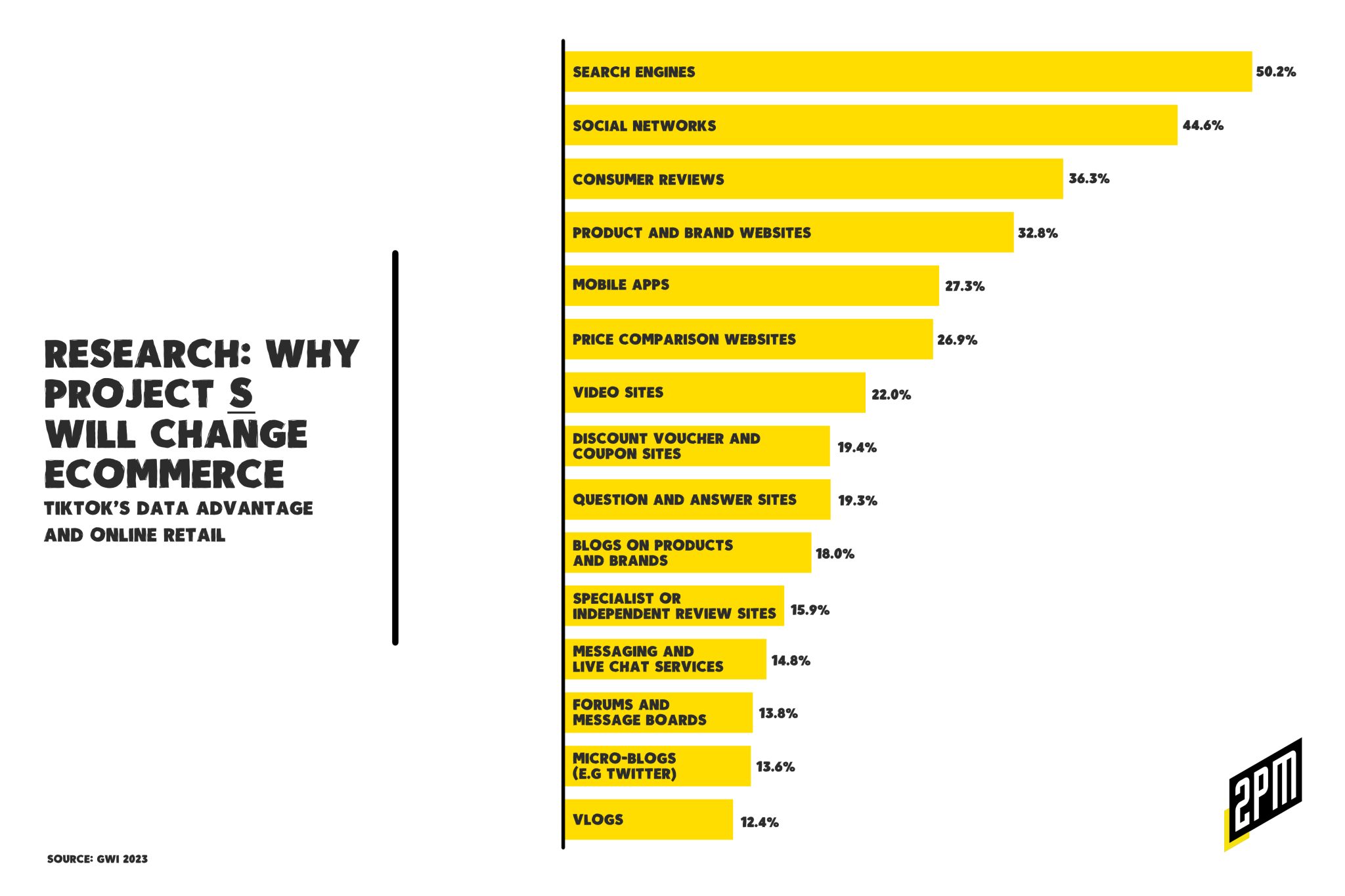
Fast forward a little under a year. TikTok expects to reach a gross merchandising volume (GMV) of $20 billion in eCommerce sales. One glance at this essay’s header can explain why. Of the many methods of product discovery, Tiktok spans: social networks, mobile apps, video sites, and vlogs – four of the top 15 methods.

The eCommerce age has been defined by marketplaces and not social media companies. Now, as TikTok’s parent company, ByteDance, prepares to continue its “Project S” and introduce “Trendy Beat”, there is potential for another significant disruption in the US eCommerce market. This venture has the potential to attract many top American brands while posing a competitive threat to established giants such as Amazon, Shein, and Temu.

TikTok’s “Project S” is a clear indication of the company’s strategic shift in the eCommerce space. Early signs point to its success in other international markets.

TikTok Shop has been a success for the company in Southeast Asia, challenging regional staples like Shopee and Lazada – at least in the social commerce space.

Trendy Beat is a dedicated section within the TikTok app that will feature its version of trending products. This move marks a departure from its existing online selling platform, TikTok Shop, which allows other sellers to display and sell their products. With Project S, TikTok is emulating the Amazon Basics model by directly selling its own items, which is a significant shift in its eCommerce strategy.

What sets Project S apart is the unique leverage that TikTok has over its rivals. With access to a vast amount of data on viral products worldwide, TikTok can effectively utilize its knowledge to create or acquire popular items for sale. This strategic use of data can potentially provide a competitive edge over other eCommerce giants, allowing ByteDance to meet consumer demand swiftly and effectively.

This move could considerably impact the US eCommerce market. TikTok’s massive and engaged user base, combined with the platform’s ability to drive virality, is a recipe for success in the digital retail industry. If ByteDance can successfully implement its plans, it could potentially attract many top American brands that wish to capitalize on TikTok’s popularity and reach.

Moreover, TikTok’s foray into direct sales could force established eCommerce players to re-evaluate their business models. Amazon and other companies may need to reconsider their ad spends and listings on TikTok if ByteDance’s venture succeeds. Consequently, this could significantly disrupt the current eCommerce dynamics, compelling businesses to adjust their strategies to remain competitive.

TikTok’s Trendy Beat initiative will redefine consumer buying behavior in the eCommerce space if it can achieve the sales velocity that it plans.

By selling products that have already gained traction and popularity on its platform, TikTok is in a unique position to influence what its users buy, transforming passive viewers into active consumers. This could set a new trend in the digital retail space, prompting other social media platforms to follow suit in ways that they likely won’t be able to duplicate.

But TikTok’s ambitious move is not without challenges. The company will need to ensure product quality, address consumer concerns about purchasing from social media, and compete with existing eCommerce platforms with established supply chains and delivery networks. Additionally, the brand will need to navigate the complexities of different market dynamics as it expands globally, particularly in the U.S.

Despite these challenges, the U.S. market could offer ByteDance immense growth potential. TikTok’s popularity among American users is undeniable, and successfully monetizing this user base could result in substantial revenue growth. While the company did not initially plan to expand TikTok Shop to the US market, the trademark application for Trendy Beat suggests a potential change in direction. Financial Times explains:

Previous attempts to ape the model of Shien and Temu have failed. Three ByteDance shopping apps — Dmonstudio, Fanno and If Yooou — have either been shut down or abandoned, two ByteDance employees said. “ByteDance realised that they want to build a self-owned brand in the TikTok app instead of making an independent app like Shein and Temu,” one of the employees said.

In looking forward, the introduction of “Project S” and Trendy Beat presents an enticing potential for TikTok to become an all-inclusive social commerce platform. First-party data collection (i.e. cart data and conversion records) will alleviate some of its political issues by shifting how it collects its valuable data on many of its users. By capitalizing on its unique ability to generate viral content and its colossal user base, TikTok could significantly shorten the path from product discovery to purchase. This minimization of friction in the buying process is likely to increase overall sales volume, boosting TikTok’s profits while providing users with a seamless shopping experience.

From a broader perspective, TikTok’s transition into eCommerce may be indicative of a larger trend within the social media industry. By blurring the lines between content and commerce (a la linear commerce), engaged media companies can leverage their user bases to turn popularity into profitability. As noted by Chris Raven, CEO at business growth agency Heur, this could become a common model for other first-party data collectors if TikTok’s venture proves successful.

Raven begins my explaining what this latest development in ecommerce is: “From what can be gleaned from UK users, ‘Trendy Beat’ appears to sell products made and sold by ByteDance, rather than simply linking to items from other eCommerce brands. When exploring this feature, users will see products that have gained popularity or have gone viral on the app, from pet-hair removers to ear wax extractors.”

As the US eCommerce market continues to expand, American brands and consumers alike are looking for innovative platforms that provide unique shopping experiences. If successfully executed, this new venture could result in a mutually beneficial partnership where brands get access to TikTok’s wide user base, and TikTok benefits from the increased engagement and profits generated by these collaborations.

One potential point of concern: TikTok’s transition to becoming a one-stop-shop for eCommerce could result in a narrowing of choices for consumers, which could be a turnoff for some users. In our October 2022 essay on the topic, I shared:

Like other platforms, TikTok needs revenue from eCommerce to make up for that lost ad efficiency. But unlike others, it’s actually positioned to succeed. And this is what makes Meta’s retreat from eCommerce as shocking as TikTok developing teams around shipping and logistics. It’s the era of first-party data and retail media networks. Amazon has proven that native commerce is the best way to collect it.

Now TikTok has positioned itself for first-party data collection of its own. Success will depend on TikTok’s ability to overcome potential challenges, including consumer skepticism, competition with established eCommerce platforms, political concerns, and the need to ensure product quality and sustainability. Despite these hurdles, “Project S” represents an intriguing development in the evolving role of social media in eCommerce, offering a unique new platform for consumer engagement.

By Web Smith | Edited by Hilary Milnes with art by Christina Williams and Alex Remy

Memo: That Quiet TikTok Lawsuit

Go back to the year 1988. This has all come about thanks to a former Supreme Court nominee, his Blockbuster video rental history, and a quote from a journalist pursuing insights into the high court’s nominee’s life:

The only way to figure out what someone is like is to examine what that someone likes — take a hard look at the tools of leisure he uses to chip away life’s rough edges. (Harvard law Review)

This was the uneven birth of the VPPA (Video Privacy Protection Act). Now fast forward to the retail media craze, a TikTok and its pixel are under fire and the Michael Kors brand is at the center of the lawsuit. There is a caveat to all of the upside, a specific kind of off-site advertising – which is often supplied by first-party data – is facing legal action. I explained this derivative of retail media in “Step Function.

Off-site advertising, which refers to ads that are shown to audiences outside of a marketplace’s website or app, has traditionally relied on third-party data to target and measure effectiveness. However, by analyzing the buying patterns, search queries, and preferences of their users, marketplaces’ advertising products have offered a higher rate of success. Additionally, recent changes in privacy regulations and the increasing emphasis on user privacy have led to a shift towards using first-party data in off-site advertising.

Amid rising tensions between the United States and China, concerns have escalated over the protection of American users’ data on TikTok, the popular platform owned by Chinese company ByteDance. As TikTok’s popularity surges, with over 150 million American users as of 2023, its data privacy practices have come under scrutiny, inciting discussions about applying existing laws, such as the Video Privacy Protection Act (VPPA), to modern tech companies.

American politicians are looking for any reason to do away with TikTok’s influence over the nearly half of all Americans who have downloaded the app. If a recently filed lawsuit does its part, the state by state privacy laws (with California leading the trend) may give way to federal privacy actions that can lead to national actions against technology companies.

The California Civil Lawsuit

I read the recently (and quietly) filed case: Gabriella Hernandez v. Michael Kors (USA), Inc. that was filed on June 13, 2023. As the case proceeds, it will surely become a lightning rod for interest in national security and the over-reach of big tech.

This case presents a class action complaint filed by a plaintiff, a resident of California, against a company that operates michaelkors.com. The plaintiff alleges that the defendant, through its website, is violating the Video Privacy Protection Act (VPPA). The primary concern is that Michael Kors allegedly reports viewing activities on its site to TikTok, which is owned by ByteDance. ByteDance, as the complaint suggests, is controlled by the People’s Republic of China (PRC) and is known to have used TikTok to spy on Americans under the PRC’s orders.

Under the VPPA, it is illegal to knowingly disclose a person’s personally identifiable information (PII) based on their video viewing habits to third parties without their consent. The plaintiff, identifying as a “consumer advocate” or a “tester”, claims that Michael Kors is doing precisely this by using TikTok’s Pixel code to report page view events to TikTok, which, in turn, could provide information to the PRC.

The plaintiff and others in the class action suit (defined as all in the United States who played video content on the website and whose PII was disclosed by Kors to any third party during the two years preceding the filing of this action) seek judgment against the Kors for violating the VPPA. The defendant, Michael Kors, potential defense may need to address whether it knowingly disclosed PII, whether such disclosure falls under the VPPA’s definition of “ordinary course of business”, and whether there was any form of consent from the users. But this isn’t the only example of TikTok’s recent VPPA stumbles.

TikTok and Data Protection Concerns

Recent reports from South China Morning Post and Forbes suggest that TikTok may have misled American authorities about the actual location of stored user data, particularly the sensitive information about American creators who sign up to earn money through the app. While TikTok claims that the majority of U.S. user data is stored in the U.S. and Singapore, investigations reveal that the financial information of TikTok’s largest American and European creators is stored on servers in China. Here is a key excerpt from the Forbes report, highlighting TikTok’s potential defense:

In TikTok’s response to their questions, the company said there is a difference between “U.S. user data collected by the TikTok app” and information that creators give to TikTok so they can be paid for content they post. The former is stored in TikTok’s data centers in the U.S. and Singapore, TikTok said. It did not explicitly state where the latter is stored. A trove of internal documents obtained by Forbes, and several people across different parts of the company familiar with the matter, have shown that tax forms, social security numbers and other information from creators and outside vendors has been stored in China; payments to both are managed through tools from TikTok’s China-based parent ByteDance.

U.S. legislators, concerned about potential data exploitation by the Chinese government, have introduced legislation aimed at preventing American data from being used by foreign adversaries. This legislation, if passed, would control exports of personal data, including data handled by companies like TikTok, directly to restricted foreign governments. SCMP explained:

The bill would direct the Commerce Department to identify categories of personal data that could harm US national security and create a list of high-risk countries where sensitive data exports would be blocked.

In this context, we may consider how the VPPA precedent might become a tool for American politicians, regulators, and judicial activists to address the data protection issues at stake, possibly substantiating a federal ban on TikTok’s practices or a full ban on the platform.

The VPPA and Modern Tech Companies

The VPPA was enacted in 1988 in response to a violation of Supreme Court nominee Robert Bork’s video rental history privacy. The Act prohibits the wrongful disclosure of video tape rental or sale records, making it a landmark piece of legislation in the realm of privacy protection. While the Act was designed to protect physical video rental records, it has been invoked in legal cases involving modern digital streaming services. The reach of the VPPA extends to the data privacy concerns raised by the digital era and could apply to companies like TikTok, which, while not primarily a video rental service, does collect, store, and potentially distribute user data in a similar manner.

The critical aspect here is the unauthorized disclosure of “personally identifiable information” about users’ video consumption habits. In the context of an app like TikTok, if it were found that the company was sharing personally identifiable viewing data with third parties without users’ consent, this could potentially be seen as a violation of the VPPA. However, how the VPPA applies to platforms like TikTok would likely hinge on the specifics of the case and the way the court interprets the law in light of technological advancements.

If lawmakers and legal practitioners interpret the VPPA to cover digital services, there could be significant implications for TikTok and similar platforms. Under the VPPA, TikTok’s collection and overseas storage of data, particularly if disclosed without consent, could potentially be deemed illegal. The acknowledgement by TikTok of storing sensitive American creator information in China could be seen as a violation of the VPPA, if the Act is deemed applicable. This could provide legal grounds to restrict TikTok’s operations in the U.S. or perhaps ban the platform altogether.

The VPPA also provides for civil remedies, allowing individuals to seek redress if their privacy rights are violated. As a result, users whose data is being stored in China could potentially sue TikTok, leading to substantial legal and financial implications for the company. However, applying the VPPA to TikTok is not straightforward and faces significant challenges. The VPPA was drafted long before the advent of social media and may require reinterpretation or amendment to extend its protections to platforms like TikTok. Additionally, the application of the VPPA to foreign companies raises complex jurisdictional issues that courts will need to resolve.

Summary

As concerns about data privacy grow, there is a strong case for leveraging existing legislative tools like the VPPA to safeguard the data of American citizens. Not only does the VPPA hold potential in challenging TikTok’s practices directly, but it also sets a valuable precedent for how privacy law can evolve to meet the needs of an increasingly digitized society.

By applying the principles of the VPPA to modern tech companies, regulators, politicians, and judicial activists could demonstrate their commitment to data protection, setting the stage for more comprehensive privacy legislation that is in step with today’s technological landscape. While applying the VPPA to TikTok’s practices might necessitate overcoming legal hurdles, the precedent could prove useful in the broader goal of promoting and enforcing data privacy. The TikTok case also serves as a cautionary tale for tech companies operating globally while dealing with the legal rights of individual American states, highlighting the potential consequences of inadequate data privacy practices. The scrutiny that TikTok is currently under is likely to impact its standing in the United States.

While the application of the VPPA to TikTok’s situation may be complex, the potential of this precedent to strengthen the regulation of modern tech companies is undeniable. It emphasizes the necessity of clear, robust legislation to protect data privacy in the era of digital interconnectedness. As this issue unfolds, it will be important to watch for potential changes to privacy legislation and the broader influence this could have on the internet media industry at large.

By Web Smith | Art by Alex Remy and Christina Williams 

Part I: Where Natsec Meets Commerce