Глубокое погружение: 2024 год

При обычном понимании внешней политики можно предположить, что розничная торговля находится в точке совпадения, где пересекаются сразу три влияния.

Пересечение торговли и национальной безопасности стало сложной и многогранной проблемой для ритейлеров и торговых площадок, преодолевающих трудности, связанные с ценообразованием, доставкой, цепочкой поставок и прогнозированием спроса. В данном эссе рассматриваются три ключевых аспекта этого слияния: кибербезопасность (на примере Шейна), уязвимость морских перевозок (на примере проблемы Суэцкого канала) и проблемы в Индо-Тихоокеанском регионе (на примере тайваньского конфликта). Каждая из этих областей подчеркивает необходимость комплексного и стратегического подхода к защите национальных и корпоративных интересов при сохранении процветающей мировой экономики.

Показательным примером этого явления является мир электронной коммерции и сбора данных. Хотя этот вопрос подробно рассматривался в предыдущем отчете под названием "Где NATSEC встречается с коммерцией", к нему стоит вернуться в связи с его глубокими последствиями.

Возникновение китайских технологических компаний, таких как TikTok, Shein и Temu, оказало значительное влияние на глобальный ландшафт коммерции. Эти компании, используя свои модели "прямого контакта с потребителем", соперничают с американскими конкурентами и даже превосходят их. Примечательна симбиотическая связь между китайскими торговыми гигантами и налоговыми льготами. Посылки стоимостью менее 800 долларов уже давно разрешено беспошлинно ввозить в Соединенные Штаты, что стимулирует китайские компании продавать свою продукцию на американском рынке, минуя складирование на территории страны (до недавнего времени). Кроме того, Коммунистическая партия Китая (КПК) отменила экспортные налоги на эти товары, что способствует расширению доли рынка в США.

Китайский опыт в области сбора данных был накоплен раньше, чем в США, и он уделяет большое внимание данным от первых лиц. Китайская технологическая экосистема использует данные первых лиц для совершенствования алгоритмов поиска, оценки кредитоспособности и развития индустрии цифровых финансов. Такой обширный сбор данных вызывает опасения по поводу конфиденциальности и безопасности данных, учитывая возможность злоупотреблений и неправомерного использования.

Становится все более очевидным, что эксперты в области национальной безопасности и торговли должны объединить свои усилия. Понимание глубины знаний, которыми обладают обе стороны, имеет первостепенное значение, как гласит древняя мудрость "Искусства войны" Сунь-Цзы: "Если ты знаешь врага и знаешь себя, тебе не нужно бояться результатов ста сражений". В то время как правительственные чиновники могут бить тревогу по поводу материальных средств, необходимых для ведения боевых действий, таких как военные корабли, современное поле боя также охватывает данные и обширные знания, которые они представляют.

Становится все более очевидным, что эксперты в области национальной безопасности и торговли должны сближаться.

Последствия такого слияния коммерции и национальной безопасности далеко идущие, они затрагивают не только мировую экономику, но и суверенитет государств и частную жизнь людей. По мере того как мы углубляемся в сложности этого взаимодействия, становится очевидной необходимость применения тонкого и стратегического подхода.

Шейн против американского фондового рынка

Компания Shein приобрела широкую известность, особенно среди молодых людей, которые жаждут доступной и модной одежды с оперативной доставкой на дом. Видеоролики Shein, демонстрирующие рубашки за 5 долларов и бикини за 10 долларов, стали отличительной чертой маркетинговой стратегии компании.

Компания произвела фурор в сфере розничной торговли, применив уникальный подход. В отличие от традиционных ритейлеров, которые производят большие партии одного товара на сезон, Shein выбрала мелкосерийное производство, часто изготавливая только 200 единиц определенного товара. Такая стратегия позволяет свести к минимуму избыточные запасы, сократить расходы и максимально увеличить вероятность продажи каждого изделия - это стало возможным благодаря умелому использованию компанией Shein методов обработки данных и искусственного интеллекта для определения потребительского спроса и предпочтений.

Основанный в Китае в 2008 году, бренд Shein стал привлекательным для широкой аудитории во время пандемии, и даже родители начали изучать его доступные варианты. По всем показателям Shein стал одним из самых популярных брендов среди подростков, соперничая даже с Nike. Пока что Shein остается частной компанией, что не позволяет точно определить ее долю на рынке. Но это скоро изменится.

Компания Shein предприняла шаги к тому, чтобы стать публичной компанией: по некоторым данным, она подала заявку на IPO. Компания начала решать такие проблемы, как устойчивое развитие, отношение к независимым дизайнерам и прозрачность партнерства с влиятельными лицами - эти меры считаются необходимыми при выходе на публичный рынок в США. Однако самый важный вопрос остается открытым: безопасность данных.

Несмотря на то, что компания является частным предприятием, ее стоимость оценивается в диапазоне от 100 до 66 миллиардов долларов, что превышает годовой доход таких известных ритейлеров, как Macy's. Однако компания сталкивается с серьезными противоречиями, которые могут повлиять на ее выход на IPO. Один из них связан с обвинениями в использовании принудительного труда в цепочке поставок. Сообщалось, что компания Shein могла поставлять хлопок из Синьцзяна, региона в Китае, связанного с принудительным трудом, что ставит под сомнение соблюдение ею законодательства США.

Еще один вопрос связан с таможенными пошлинами, где Шеин пользуется правилом de minimis, освобождающим от пошлин импорт стоимостью менее 800 долларов. Критики утверждают, что это положение предназначалось для личных вещей, а не как лазейка для корпораций, полагающихся на дешевые и объемные перевозки.

Кроме того, быстрая и недорогая модель производства Shein согласуется с негативным воздействием индустрии быстрой моды на окружающую среду. Хотя компания предприняла некоторые усилия по внедрению экологичных материалов, критики считают эти шаги недостаточными, чтобы противостоять одноразовому характеру ультрабыстрой моды. Кроме того, китайское правительство может получить доступ к информации о клиентах Shein, учитывая происхождение компании и ее нынешнюю штаб-квартиру в Сингапуре. Я написал это в октябре 2023 года, не очень понимая, какое значение это будет иметь в 2024 году:

Сочетание глобальной кампании шпионажа Китая, вторжения России в Украину и ближневосточного кризиса заставило усомниться в способности разведывательного сообщества эффективно решать эти задачи и противостоять, казалось бы, незначительной проблеме электронной коммерции. Эта "незначительная проблема", движимая авторитарным китайским правительством и передовыми технологиями, подрывает верховенство закона и представляет серьезную угрозу не только для Соединенных Штатов, но и для их союзников. Ситуация требует повышенной бдительности и скоординированных усилий по противодействию этой многогранной угрозе.

Компания Shein сталкивается с растущим вниманием не только к своей деловой практике, но и к ее потенциальному влиянию на национальную безопасность. Запутанная сеть проблем и возможностей, связанных с восхождением Shein, подчеркивает сложный ландшафт современной розничной торговли и ее более широкие общественные и геополитические последствия.

Символика Суэцкого залива

Вникая в сложную паутину глобальных событий, которые будут происходить в 2024 году, нельзя не обратить внимание на растущую напряженность вокруг Суэцкого канала. Стратегическое значение этого исторического водного пути, соединяющего Индийский океан со Средиземным морем через Красное море, невозможно переоценить. Через этот морской коридор проходит около 12 процентов мировой торговли и 30 процентов всех мировых контейнерных перевозок, служащих кратчайшим путем между Азией и Европой.

В последние недели Суэцкий канал столкнулся с серьезными перебоями в работе из-за атак на судоходство, что вызвало волновой эффект во всей глобальной цепочке поставок. Это зловещее событие стало следствием действий поддерживаемых Ираном повстанцев-хути, базирующихся в основном на севере Йемена. Эти повстанцы, ссылаясь на поддержку палестинского дела в условиях конфликта между Израилем и Хамасом, начали кампанию, направленную против торговых судов в Баб-эль-Мандабском проливе. Этот водный путь соединяет южную оконечность Красного моря с Индийским океаном, что делает его жизненно важным пунктом доступа для морской торговли.

Первой целью повстанцев Хути стало японское грузовое судно Galaxy Leader, которое, по некоторым данным, частично принадлежит израильскому инвестору. Их действия вызвали обеспокоенность по поводу безопасности и стабильности судоходных маршрутов в регионе. В ответ на эти растущие угрозы министр обороны США Ллойд Остин недавно объявил о создании коалиции из 20 стран, в которой Соединенные Штаты занимают ведущее место, для защиты Суэцкого маршрута. Китай не входит в эту коалицию, что вызывает опасения, которые могут быть восприняты как враждебные.

Первоначальный план предусматривает размещение военных кораблей вблизи побережья Йемена для сдерживания и защиты от возможных атак хути. Однако острота ситуации может потребовать более комплексных действий со стороны американских военных, включая морское сопровождение уязвимых кораблей и потенциальные авиаудары по военной инфраструктуре хути.

Последствия этих событий глубоки и далеко идущи. В условиях, когда жизненно важный поток мировой торговли висит на волоске, прошлые ракетные атаки уже заставили судоходные компании отклонить более 100 судов от Суэцкого маршрута, перенаправив их в обход коварного мыса Доброй Надежды, расположенного на южной оконечности Африки. Эта радикальная мера увеличивает длину пути примерно на 6 000 морских миль и потенциально на три-четыре недели, вызывая значительные задержки и перебои в судоходстве по всему миру.

История напоминает нам, что перебои в работе Суэцкого канала, такие как длительное закрытие после Шестидневной войны 1967 года и громкая посадка на мель огромного судна в 2021 году, - дорогостоящие и рискованные мероприятия для глобальных грузоотправителей. Способность морской отрасли адаптироваться к таким вызовам подчеркивает уязвимость этого жизненно важного маршрута.

Текущая миссия по обеспечению безопасности судоходства через Суэцкий канал, метко названная операцией Prosperity Guardian, поднимает вопросы об использовании военной силы для защиты экономических интересов. Однако рассматривать эту миссию как защиту глобальной торговли - разумный подход. Обеспечение безопасности и стабильности этой морской артерии не только необходимо для стран, менее богатых и могущественных, чем США, но и является инвестицией в долгосрочную глобальную безопасность. Пока заинтересованные стороны не убедятся в полной безопасности Суэцкого маршрута (компания Maersk возобновила работу), мир розничной торговли будет продолжать испытывать на себе всю тяжесть сбоев.

Конфликт в Суэцком канале стал ярким напоминанием о том, как переплетенные сферы геополитики, торговли и национальной безопасности могут сходиться неожиданным образом, определяя мировоззрение в 2024 году и далее.

Китай, цепочки поставок и третья марионеточная война

Когда мы изучаем последний вызов глобальной розничной торговли, который будет определять торговый ландшафт в 2024 году, один вопрос вырисовывается масштабно и беспрецедентно: перспектива войны по доверенности между Соединенными Штатами и Китаем. Этот сценарий, более вероятный сегодня, чем когда-либо со времен Второй мировой войны, обусловлен крайне спорным вопросом о Тайване. Непоколебимая позиция председателя КНР Си Цзиньпина по объединению Тайваня с материковым Китаем представляет собой значительный риск, способный разжечь крупный конфликт в Индо-Тихоокеанском регионе.

Стратегическое значение Тайваня выходит за рамки его географических границ. Успешное вторжение Китая на Тайвань подорвало бы оборону США и союзников в регионе, тем самым ослабив стратегический плацдарм Америки в западной части Тихого океана. Кроме того, такое вторжение может нарушить глобальную цепочку поставок, лишив Соединенные Штаты доступа к важнейшим компонентам, таким как полупроводники, производимые на островном государстве. В ответ на это президент Джо Байден подчеркнул свою готовность защищать Тайвань от внешней агрессии.

Однако риски, связанные с этим геополитическим очагом, выходят далеко за рамки военных аспектов. В то время как граждане США привыкли к войнам, ведущимся на далеких берегах, Китай представляет собой принципиально иного противника, способного оказывать свое влияние беспрецедентными способами, в том числе и на территории американской родины.

Одни только военные аспекты рисуют мрачную картину. Гипотетическая стратегия Китая по захвату Тайваня, скорее всего, включает в себя быстрое и ошеломляющее нападение с использованием воздушных, морских и кибернетических средств, нацеленное на ключевые стратегические объекты, прежде чем США и их союзники смогут предпринять эффективный ответ. Относительные размеры Тайваня, сопоставимые со штатом Мэриленд, подчеркивают скорость, с которой может развернуться такая операция.

Все усложняется тем, что Китай обладает арсеналом из более чем 1350 баллистических и крылатых ракет, нацеленных на американские и союзные силы в регионе, что еще больше усложняет сценарий обороны. Соединенным Штатам придется вести войну на просторах Тихого океана, противостоя противнику, обладающему крупнейшим в мире военно-морским флотом и самыми мощными в Азии военно-воздушными силами.

Помимо обычных военных операций, Китай разработал целый ряд политических и кибернетических средств, предназначенных для проникновения в американское общество, манипулирования им и его разрушения. Эта многогранная кампания будет включать в себя дезинформационные кампании, кибератаки и, возможно, атаки на критически важные объекты инфраструктуры, такие как спутники.

В дополнение к этим проблемам Китай может использовать свой контроль над глобальными цепочками поставок и транспортными маршрутами для нанесения серьезных экономических последствий Соединенным Штатам. Экономика США в значительной степени зависит от китайских ресурсов и промышленных товаров, в том числе военного назначения. Война нарушит эту запутанную сеть торговли, что приведет к потенциальному дефициту, инфляции, безработице и экономической неопределенности.

Превращение Китая в доминирующую мировую промышленную державу изменило стратегический ландшафт. Он обогнал Соединенные Штаты по объему производства и мощности по выпуску важнейших военных компонентов. Недавний украинский конфликт продемонстрировал неспособность Америки удовлетворить потребности даже менее масштабной войны, истощив важнейшие военные запасы. По мере развития этой истории признаки такой неспособности проявляются повсеместно:

В среду США объявили о том, что, по словам официальных лиц, может стать последним пакетом военной помощи Украине, если Конгресс не одобрит закон о дополнительном финансировании, который застопорился на Капитолийском холме.

Широкая общественность, мир розничной торговли и Соединенные Штаты должны начать учитывать экономическую неопределенность, с которой столкнутся потребители в 2024 году. Это включает в себя укрепление внутренней защиты от дезинформационных кампаний, изменение конфигурации цепочек поставок критически важных товаров и реализацию долгосрочной стратегии по восстановлению доминирующего положения в мировом производстве. До этого времени Вашингтону необходимо проявлять осторожность, избегать провокаций и вести конструктивный диалог с враждебными странами.

****

В мире, где ставки никогда не были столь высоки, вызов, создаваемый потенциальным конфликтом с Китаем, не имеет себе равных. События, разворачивающиеся на мировой арене в 2024 году, несомненно, будут определяться сложной динамикой этого формирующегося геополитического ландшафта.

В сложном гобелене торговли, национальной безопасности и цифровой эпохи проблемы, изложенные в этом эссе, выходят далеко за пределы геополитических границ. Стремясь обеспечить национальные интересы и защитить целостность нашей экономики, мы должны также учитывать влияние на потребителей и их благосостояние. Нарушение цепочек поставок, кибератаки и угрозы морской торговле могут иметь прямые последствия для потребительских цен и доступности товаров первой необходимости. Нахождение баланса между безопасностью и доступностью имеет первостепенное значение, поскольку наш взаимосвязанный мир зависит от бесперебойного потока торговли.

Торговый поток еще больше нарушится.

Веб Смит

Member Research: Why Project S May Change Commerce

In October 2022, 2PM first reported: “A job posting for a business solutions and merchant development manager for a global fulfillment center is a signal that TikTok is planning on becoming an eCommerce platform in addition to a social media app.”

The job description reads: “With millions of loyal users globally, we believe TikTok is an ideal platform to deliver a brand new and better e-commerce experience to our users. We are looking for passionate and talented people to join our global fulfillment centre team, together we can build an e-commerce ecosystem that is innovative, secure and intuitive for our users.”

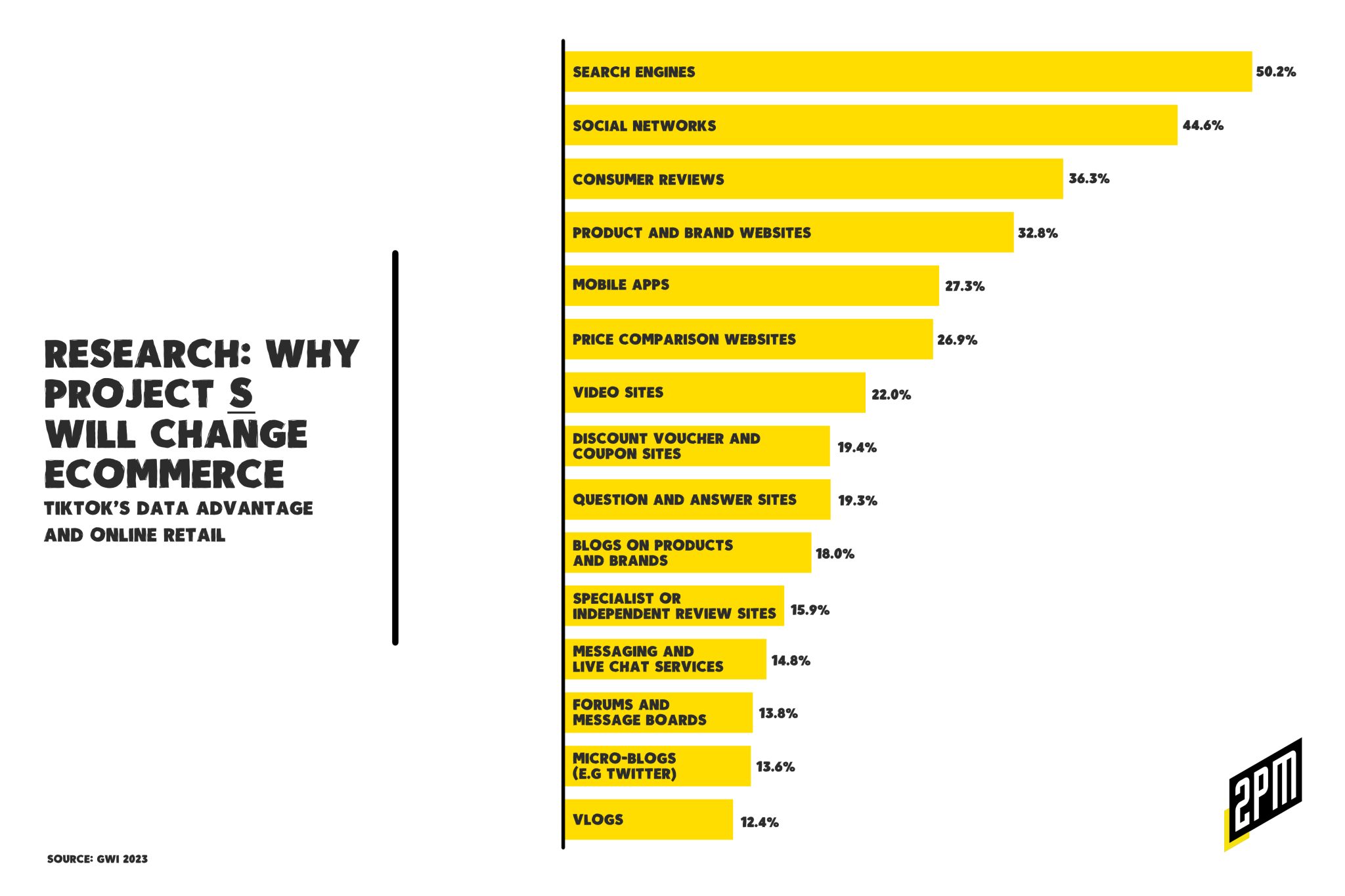
Fast forward a little under a year. TikTok expects to reach a gross merchandising volume (GMV) of $20 billion in eCommerce sales. One glance at this essay’s header can explain why. Of the many methods of product discovery, Tiktok spans: social networks, mobile apps, video sites, and vlogs – four of the top 15 methods.

The eCommerce age has been defined by marketplaces and not social media companies. Now, as TikTok’s parent company, ByteDance, prepares to continue its “Project S” and introduce “Trendy Beat”, there is potential for another significant disruption in the US eCommerce market. This venture has the potential to attract many top American brands while posing a competitive threat to established giants such as Amazon, Shein, and Temu.

TikTok’s “Project S” is a clear indication of the company’s strategic shift in the eCommerce space. Early signs point to its success in other international markets.

TikTok Shop has been a success for the company in Southeast Asia, challenging regional staples like Shopee and Lazada – at least in the social commerce space.

Trendy Beat is a dedicated section within the TikTok app that will feature its version of trending products. This move marks a departure from its existing online selling platform, TikTok Shop, which allows other sellers to display and sell their products. With Project S, TikTok is emulating the Amazon Basics model by directly selling its own items, which is a significant shift in its eCommerce strategy.

What sets Project S apart is the unique leverage that TikTok has over its rivals. With access to a vast amount of data on viral products worldwide, TikTok can effectively utilize its knowledge to create or acquire popular items for sale. This strategic use of data can potentially provide a competitive edge over other eCommerce giants, allowing ByteDance to meet consumer demand swiftly and effectively.

This move could considerably impact the US eCommerce market. TikTok’s massive and engaged user base, combined with the platform’s ability to drive virality, is a recipe for success in the digital retail industry. If ByteDance can successfully implement its plans, it could potentially attract many top American brands that wish to capitalize on TikTok’s popularity and reach.

Moreover, TikTok’s foray into direct sales could force established eCommerce players to re-evaluate their business models. Amazon and other companies may need to reconsider their ad spends and listings on TikTok if ByteDance’s venture succeeds. Consequently, this could significantly disrupt the current eCommerce dynamics, compelling businesses to adjust their strategies to remain competitive.

TikTok’s Trendy Beat initiative will redefine consumer buying behavior in the eCommerce space if it can achieve the sales velocity that it plans.

By selling products that have already gained traction and popularity on its platform, TikTok is in a unique position to influence what its users buy, transforming passive viewers into active consumers. This could set a new trend in the digital retail space, prompting other social media platforms to follow suit in ways that they likely won’t be able to duplicate.

But TikTok’s ambitious move is not without challenges. The company will need to ensure product quality, address consumer concerns about purchasing from social media, and compete with existing eCommerce platforms with established supply chains and delivery networks. Additionally, the brand will need to navigate the complexities of different market dynamics as it expands globally, particularly in the U.S.

Despite these challenges, the U.S. market could offer ByteDance immense growth potential. TikTok’s popularity among American users is undeniable, and successfully monetizing this user base could result in substantial revenue growth. While the company did not initially plan to expand TikTok Shop to the US market, the trademark application for Trendy Beat suggests a potential change in direction. Financial Times explains:

Previous attempts to ape the model of Shien and Temu have failed. Three ByteDance shopping apps — Dmonstudio, Fanno and If Yooou — have either been shut down or abandoned, two ByteDance employees said. “ByteDance realised that they want to build a self-owned brand in the TikTok app instead of making an independent app like Shein and Temu,” one of the employees said.

In looking forward, the introduction of “Project S” and Trendy Beat presents an enticing potential for TikTok to become an all-inclusive social commerce platform. First-party data collection (i.e. cart data and conversion records) will alleviate some of its political issues by shifting how it collects its valuable data on many of its users. By capitalizing on its unique ability to generate viral content and its colossal user base, TikTok could significantly shorten the path from product discovery to purchase. This minimization of friction in the buying process is likely to increase overall sales volume, boosting TikTok’s profits while providing users with a seamless shopping experience.

From a broader perspective, TikTok’s transition into eCommerce may be indicative of a larger trend within the social media industry. By blurring the lines between content and commerce (a la linear commerce), engaged media companies can leverage their user bases to turn popularity into profitability. As noted by Chris Raven, CEO at business growth agency Heur, this could become a common model for other first-party data collectors if TikTok’s venture proves successful.

Raven begins my explaining what this latest development in ecommerce is: “From what can be gleaned from UK users, ‘Trendy Beat’ appears to sell products made and sold by ByteDance, rather than simply linking to items from other eCommerce brands. When exploring this feature, users will see products that have gained popularity or have gone viral on the app, from pet-hair removers to ear wax extractors.”

As the US eCommerce market continues to expand, American brands and consumers alike are looking for innovative platforms that provide unique shopping experiences. If successfully executed, this new venture could result in a mutually beneficial partnership where brands get access to TikTok’s wide user base, and TikTok benefits from the increased engagement and profits generated by these collaborations.

One potential point of concern: TikTok’s transition to becoming a one-stop-shop for eCommerce could result in a narrowing of choices for consumers, which could be a turnoff for some users. In our October 2022 essay on the topic, I shared:

Like other platforms, TikTok needs revenue from eCommerce to make up for that lost ad efficiency. But unlike others, it’s actually positioned to succeed. And this is what makes Meta’s retreat from eCommerce as shocking as TikTok developing teams around shipping and logistics. It’s the era of first-party data and retail media networks. Amazon has proven that native commerce is the best way to collect it.

Now TikTok has positioned itself for first-party data collection of its own. Success will depend on TikTok’s ability to overcome potential challenges, including consumer skepticism, competition with established eCommerce platforms, political concerns, and the need to ensure product quality and sustainability. Despite these hurdles, “Project S” represents an intriguing development in the evolving role of social media in eCommerce, offering a unique new platform for consumer engagement.

Автор Веб Смит | Под редакцией Хилари Милнс с иллюстрациями Кристины Уильямс и Алекса Реми

Memo: That Quiet TikTok Lawsuit

Go back to the year 1988. This has all come about thanks to a former Supreme Court nominee, his Blockbuster video rental history, and a quote from a journalist pursuing insights into the high court’s nominee’s life:

The only way to figure out what someone is like is to examine what that someone likes — take a hard look at the tools of leisure he uses to chip away life’s rough edges. (Harvard law Review)

This was the uneven birth of the VPPA (Video Privacy Protection Act). Now fast forward to the retail media craze, a TikTok and its pixel are under fire and the Michael Kors brand is at the center of the lawsuit. There is a caveat to all of the upside, a specific kind of off-site advertising – which is often supplied by first-party data – is facing legal action. I explained this derivative of retail media in “Step Function.

Off-site advertising, which refers to ads that are shown to audiences outside of a marketplace’s website or app, has traditionally relied on third-party data to target and measure effectiveness. However, by analyzing the buying patterns, search queries, and preferences of their users, marketplaces’ advertising products have offered a higher rate of success. Additionally, recent changes in privacy regulations and the increasing emphasis on user privacy have led to a shift towards using first-party data in off-site advertising.

Amid rising tensions between the United States and China, concerns have escalated over the protection of American users’ data on TikTok, the popular platform owned by Chinese company ByteDance. As TikTok’s popularity surges, with over 150 million American users as of 2023, its data privacy practices have come under scrutiny, inciting discussions about applying existing laws, such as the Video Privacy Protection Act (VPPA), to modern tech companies.

American politicians are looking for any reason to do away with TikTok’s influence over the nearly half of all Americans who have downloaded the app. If a recently filed lawsuit does its part, the state by state privacy laws (with California leading the trend) may give way to federal privacy actions that can lead to national actions against technology companies.

The California Civil Lawsuit

I read the recently (and quietly) filed case: Gabriella Hernandez v. Michael Kors (USA), Inc. that was filed on June 13, 2023. As the case proceeds, it will surely become a lightning rod for interest in national security and the over-reach of big tech.

This case presents a class action complaint filed by a plaintiff, a resident of California, against a company that operates michaelkors.com. The plaintiff alleges that the defendant, through its website, is violating the Video Privacy Protection Act (VPPA). The primary concern is that Michael Kors allegedly reports viewing activities on its site to TikTok, which is owned by ByteDance. ByteDance, as the complaint suggests, is controlled by the People’s Republic of China (PRC) and is known to have used TikTok to spy on Americans under the PRC’s orders.

Under the VPPA, it is illegal to knowingly disclose a person’s personally identifiable information (PII) based on their video viewing habits to third parties without their consent. The plaintiff, identifying as a “consumer advocate” or a “tester”, claims that Michael Kors is doing precisely this by using TikTok’s Pixel code to report page view events to TikTok, which, in turn, could provide information to the PRC.

The plaintiff and others in the class action suit (defined as all in the United States who played video content on the website and whose PII was disclosed by Kors to any third party during the two years preceding the filing of this action) seek judgment against the Kors for violating the VPPA. The defendant, Michael Kors, potential defense may need to address whether it knowingly disclosed PII, whether such disclosure falls under the VPPA’s definition of “ordinary course of business”, and whether there was any form of consent from the users. But this isn’t the only example of TikTok’s recent VPPA stumbles.

TikTok and Data Protection Concerns

Recent reports from South China Morning Post and Forbes suggest that TikTok may have misled American authorities about the actual location of stored user data, particularly the sensitive information about American creators who sign up to earn money through the app. While TikTok claims that the majority of U.S. user data is stored in the U.S. and Singapore, investigations reveal that the financial information of TikTok’s largest American and European creators is stored on servers in China. Here is a key excerpt from the Forbes report, highlighting TikTok’s potential defense:

In TikTok’s response to their questions, the company said there is a difference between “U.S. user data collected by the TikTok app” and information that creators give to TikTok so they can be paid for content they post. The former is stored in TikTok’s data centers in the U.S. and Singapore, TikTok said. It did not explicitly state where the latter is stored. A trove of internal documents obtained by Forbes, and several people across different parts of the company familiar with the matter, have shown that tax forms, social security numbers and other information from creators and outside vendors has been stored in China; payments to both are managed through tools from TikTok’s China-based parent ByteDance.

U.S. legislators, concerned about potential data exploitation by the Chinese government, have introduced legislation aimed at preventing American data from being used by foreign adversaries. This legislation, if passed, would control exports of personal data, including data handled by companies like TikTok, directly to restricted foreign governments. SCMP explained:

The bill would direct the Commerce Department to identify categories of personal data that could harm US national security and create a list of high-risk countries where sensitive data exports would be blocked.

In this context, we may consider how the VPPA precedent might become a tool for American politicians, regulators, and judicial activists to address the data protection issues at stake, possibly substantiating a federal ban on TikTok’s practices or a full ban on the platform.

The VPPA and Modern Tech Companies

The VPPA was enacted in 1988 in response to a violation of Supreme Court nominee Robert Bork’s video rental history privacy. The Act prohibits the wrongful disclosure of video tape rental or sale records, making it a landmark piece of legislation in the realm of privacy protection. While the Act was designed to protect physical video rental records, it has been invoked in legal cases involving modern digital streaming services. The reach of the VPPA extends to the data privacy concerns raised by the digital era and could apply to companies like TikTok, which, while not primarily a video rental service, does collect, store, and potentially distribute user data in a similar manner.

The critical aspect here is the unauthorized disclosure of “personally identifiable information” about users’ video consumption habits. In the context of an app like TikTok, if it were found that the company was sharing personally identifiable viewing data with third parties without users’ consent, this could potentially be seen as a violation of the VPPA. However, how the VPPA applies to platforms like TikTok would likely hinge on the specifics of the case and the way the court interprets the law in light of technological advancements.

If lawmakers and legal practitioners interpret the VPPA to cover digital services, there could be significant implications for TikTok and similar platforms. Under the VPPA, TikTok’s collection and overseas storage of data, particularly if disclosed without consent, could potentially be deemed illegal. The acknowledgement by TikTok of storing sensitive American creator information in China could be seen as a violation of the VPPA, if the Act is deemed applicable. This could provide legal grounds to restrict TikTok’s operations in the U.S. or perhaps ban the platform altogether.

The VPPA also provides for civil remedies, allowing individuals to seek redress if their privacy rights are violated. As a result, users whose data is being stored in China could potentially sue TikTok, leading to substantial legal and financial implications for the company. However, applying the VPPA to TikTok is not straightforward and faces significant challenges. The VPPA was drafted long before the advent of social media and may require reinterpretation or amendment to extend its protections to platforms like TikTok. Additionally, the application of the VPPA to foreign companies raises complex jurisdictional issues that courts will need to resolve.

Резюме

As concerns about data privacy grow, there is a strong case for leveraging existing legislative tools like the VPPA to safeguard the data of American citizens. Not only does the VPPA hold potential in challenging TikTok’s practices directly, but it also sets a valuable precedent for how privacy law can evolve to meet the needs of an increasingly digitized society.

By applying the principles of the VPPA to modern tech companies, regulators, politicians, and judicial activists could demonstrate their commitment to data protection, setting the stage for more comprehensive privacy legislation that is in step with today’s technological landscape. While applying the VPPA to TikTok’s practices might necessitate overcoming legal hurdles, the precedent could prove useful in the broader goal of promoting and enforcing data privacy. The TikTok case also serves as a cautionary tale for tech companies operating globally while dealing with the legal rights of individual American states, highlighting the potential consequences of inadequate data privacy practices. The scrutiny that TikTok is currently under is likely to impact its standing in the United States.

While the application of the VPPA to TikTok’s situation may be complex, the potential of this precedent to strengthen the regulation of modern tech companies is undeniable. It emphasizes the necessity of clear, robust legislation to protect data privacy in the era of digital interconnectedness. As this issue unfolds, it will be important to watch for potential changes to privacy legislation and the broader influence this could have on the internet media industry at large.

By Web Smith | Art by Alex Remy and Christina Williams 

Part I: Where Natsec Meets Commerce