

This member brief is designed exclusively for Executive Members, to make membership easy, you can click below and gain access to hundreds of reports, our DTC Power List, and other tools to help you make high level decisions.
No. 348: An Open Letter on Sustainability

Seated in a lodge in the Selkirk mountains of British Columbia amongst 44 new and old friends across a number of professions, photographer and environmental activist Meg Haywood Sullivan shared her thoughts on circular fashion and sustainability with me. It wasn’t the first time that I considered this era of retail’s negative impact on our ecosystem but it was certainly the most impactful consideration.
I was there for the tying of the bow and I was there to capture the customer removing it after it arrived at her home. I photographed the entire chain, from beginning to end.
The award-winning photojournalist told the story of prAna, a well-known activewear brand that predates many of the brand identities adopted by DTC retailers today. Started in 1992, the brand maintains many of the sustainability initiatives that are just now becoming popular. She detailed one of her trips to prAna‘s factory, documenting the day-in-the-life of a worker. She was there at the home of the prAna contractor when the factory worker awoke. The two rode a scooter together to work, where she documented the day’s duties down to the yarn tied around the package for delivery. Once Sullivan was back to the United States, she then photographed a prAna customer receiving the package in question, untying the yarn to see the new piece of clothing.
On prAna‘s site, the retailer lists a number of initiatives. There is a code of conduct and policies on fair labor, traceability, recycled polyester, polybag reduction, and supply chain. You can find the brand’s suppliers on the site.
It is rare for American consumers to see this intense of a commitment from a brand. For prAna, it is more than marketing speak, that is certain. But its impact on the greater machine is nearly non-existent. Their efforts are meaningful, but it will take an industrial shift to stymie the rising problems that the fashion market faces.
Consider that in 1995, a consumer’s poly-based fabrics were worn in gyms or on runs. Today, the majority of clothing resembles organic-appearing variations of those same technical fabrics. These fabrics have taken over our closets, our drawers, our long runs, and our boardroom meetings. But there are consequences to fast-fashion and athleisure; plastics weren’t intended to be worn and discarded with impunity.
Because it’s cheap and easy to manufacture, polyester has become today’s dominant textile. But polyester, which is essentially made of oil, causes a host of problems. While the material does provide a use for all those recycled plastic water bottles, washing any synthetic fabric — whether it’s made of raw petroleum or recycled plastics — sloughs off microscopic fibers. Those microfibers end up in water supplies and never biodegrade. [1]
To understand the current state of industry, you must consider the last shift of this magnitude in fashion retail. The boom of plastics in fashion retail closely resembles the turn-of-the-century availability of cotton-based goods in urban areas. Between 1840 and 1920, a number of developments accelerated fashion consumerism to unforeseen heights.
The continued rise of cotton bolstered a global trade with America as its newly fueled war supply, the wares of America’s burgeoning industries, Wall Street, and – for the first time in American history – casual fashion, a format that was uniquely European before retail distribution improved.
One reason it is hard to see cotton’s importance is because it has often been overshadowed in our collective memory by images of coal mines, railroads, and giant steelworks — industrial capitalism’s more tangible, more massive manifestations. [2]
The department store brought selection and ease of transaction to urbanizing areas of the United States. Cities like New York, Los Angeles, Chicago, and Pittsburgh led the way in a retail economy that surpassed $42.5 billion in sales before losing nearly half of its value in 1929.
During its ascendancy from about 1880 to 1920, American society shifted from rural to urban centers and absorbed more than 23 million immigrants. By 1910, over one-fifth of the population lived in a city of at least one hundred thousand, big enough to support several good-size department stores. City people had seemingly inexhaustible needs — for clothing, bedding, household goods. Sales of consumer goods rocketed upward, roughly tripling in just the 20 years between 1909 and 1929. As department stores’ sales spiraled ever higher, stores expanded and rebuilt, and then expanded and rebuilt again. [3]
And the Gilded Age introduced trickle-down economics to major cities, albeit slowly and in limited fashion. The majority of residents of urbanizing cities worked for low wages in unsavory conditions. Between 1881 and 1900, nearly 35,000 workers lost their lives annually to work-related incidents. This tragic period would result in reforms to include the growth of unions that bolstered the earning potential of the working class. Though known for an era of robber barons and hardened industrialists, the turn-of-the-century also brought a growing class of “white collar” workers, staffed to manage the operations of many industries.
But the new era of industry and innovation didn’t only produce misery. As factories and commercial enterprises expanded, they required an army of bookkeepers, managers, and secretaries to keep business running smoothly. These new clerical jobs, which were open to women as well as men, fostered the growth of a middle class of educated office workers who spent their surplus income on a growing variety of consumer goods and leisure activities. [4]
These three macroeconomic shifts – the continued cotton empire, the golden era of the department store, and the birth of the white-collar employee – ushered in a time of cotton trousers, oxford dress shirts, and suiting en masse. The retail industry is a lagging indicator, not a leading one. In today’s market, athleisure and technical fabric-based casual wear signifies shifts of their own.
Workplaces are more casual than ever before. And that’s if you even report into an office. Distributed workforces are prevalent in today’s economy, the types of clothing investments that consumers make are second order effects of their lifestyles. And no longer is cotton king, technical-based fabrics (polyester, spandex, nylon) are the cheapest to produce as long as crude oil is in ample supply. These fabrics deliver a host of benefits: they wick moisture from one’s skin, they stretch, they contour the body, and they deliver compression performance in some cases. The endure a day’s commute without the wear and tear of traditional fabrics.
According to Grand View Research, the market for technical fabrics are only going to grow, doubling between 2015 and 2023. To the untrained consumer, these products are all benefit and with little downside.

But there are unseen side effects. When consumers wash clothing made with plastics, microfibers enter the water system – a pesky form of pollution that does irreparable harm to the ecosystems affected. The durability of a number of these fabrics, often cheaply manufactured, is a fraction of the durability of organic-based fabrics that preceded today’s technical era. Today’s customer is cycling from purchase to discard at a faster pace. Additionally, few if any retailers have instituted circular logistics – a policy that would promote upcycling old fabrics into new garments.

There are a number of trends that are aiming to stymie this problem. Nike and Adidas are the two largest manufacturers of technical performance wear; they’ve both committed to upcycling plastics and other discarded fabrics and materials. In turn, consumers will see more products designed with repurposed goods rather than the mining and processing of additional, raw material. Additionally, services like ThredUp have partnered with flailing retailers like Gap, J.C.Penney, and Macy’s to institute resale programs. And organizations like Circular Fashion are technologically equipping materials suppliers to track products in through to the consumer and back to the supplier for upcycling.
The circularity.ID Open Data Standard allows fashion brands to publish their product data in a format that can be utilised by a variety of software applications along the product life cycle. [5]
It’s my position that there will always be a place for technical fabrics in the marketplace. For those retailers, circular fashion strategies must be instituted to minimize waste where possible. On the consumer side, CPG companies like Filtrol are working to widen the appeal of solutions like their own – a microfiber filter for washing machines that prevents plastic fibers from entering the water supply.
Even if the majority of companies operated like prAna, it wouldn’t be enough to reverse the effects of this era of fashion, and I speak from experience [6]. The athleisure industry is one that I’ve been involved with in some way or another for the majority of my adult life. It will take another generational shift back to organic fabrics designed to be worn for 10 years rather than 10 months or even 10 weeks. Specialty retailers will have to end their practices of overproduction and superfluous promotion, reducing the prices of clothing to the point that consumers view them as temporary goods versus potential heirlooms – the types of pants, coats, dresses, and oxfords that could be passed to younger siblings, sons, or daughters.
Changes in retail are often a result of larger societal changes. Fashion insiders also have a responsibility to mitigate a growing problem. But until those larger changes occur, circular fashion (and sustainability as a whole) is just window dressing. As organic fabrics begin to adopt many of the technical capabilities of their new-aged counterparts, we’re likely to see a shift away from the athleisure-like appearance that has overtaken this era of fashion. It may take the dawn of a new industry, a period of strengthening of the middle-class, or a new period of growth for traditional retailers. Something beyond the industry will have to force its hand. Until then, brands like prAna will stand in virtuous opposition to today’s common practices. And it won’t be nearly enough to stop the flow.
Report by Web Smith | Edited by Hilary Milnes | About 2PM
[6] Disclaimer: I am a proud cofounder of Mizzen + Main, a label that is derived from technical fabrics along with fellow upstarts like Ministry of Supply, Theory, and a host of copycats. Although I believe that companies like Mizzen + Main are in the minority of good actors, my concerns remain for the industry as a whole.
No. 347: An Analysis of Wayfair
With skyrocketing costs of doing business, mounting debt, and impending layoffs – Wayfair is at an impasse. The industry leader’s strategy pioneered dropshipping arbitrage with superior SEO, razor thin margins, and an direct-marketing attack that worked until volume grew and algorithms evolved with the times. Analysts have begun to question Wayfair’s long-term viability. This, as other sectors of online retail have also evolved with the times: fine-tuned checkout, brand-focused marketing, customer experience, and the logistical mastery of hard-to-deliver products.
Over a span of six months, we accepted shipments on three separate products to our home. In each case, the anticipation was high and for the most part, expectations were met. Though, our expectation of Wayfair was low. Each time, the freight truck pulled to the front and honked awaiting evidence that we were home to accept. The delivery men stepped out to hastily deliver their freight. In each case, efficiency was the name of the game. Those three orders were as follows:
Rogue (roguefitness.com): the weight was close to 500 pounds. A modular product, the delivery arrived within five business days. It arrived in five separate boxes and placed in our garage. The assembly was my responsibility and I did so eagerly.
Peloton (onepeloton.com): the weight was close to 200 pounds. It was ordered and delivered within seven business days. The delivery men took the time to assemble the product in its rightful place.
Wayfair (wayfair.com): the combined weight was close to 300 pounds. The two pieces arrived separately and over three days. It was ordered nearly 40 days prior. There were no clear expectations around delivery windows but that seems to be commonplace for Wayfair. There was no assembly. However, the two delivery men feared liability concerns so they brought the two boxes into the home before unboxing.
Founded in 2002, the online retailer excelled, achieving an initial public offering in 2014 and raising over $300 million. The company deserves a tremendous credit for its longevity, a rarity in the web 1.0 era of online retailers. Not only was the market in its primitive stages, investors were incredibly skeptical. In the wake of the dot-com crash, furniture makers were weary as well.
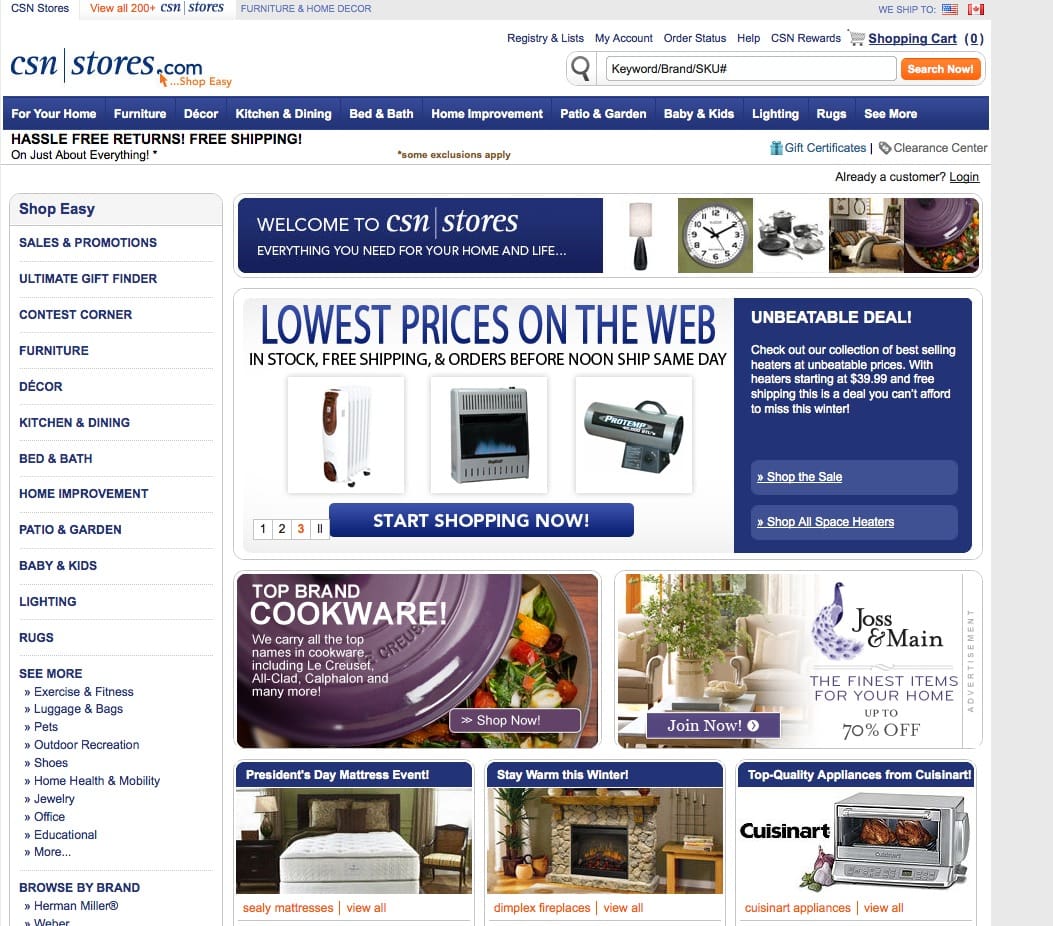
To account for this, cofounders Niraj Shah and Steve Conine launched CSN Stores, a combination of their initials that served as a masking agent for their internet-first intentions. The two founders avoid the dot com classification altogether. It worked. Perhaps, had the company launched as Wayfair.com in 2002, the early and pivotal support that Shah and Conine received could have been diminished. Shah and Conine anchored an exceptional story of a private startup gone public. To put the company’s growth into perspective, CSN Stores hit $100 million in annual revenue by 2006 and $380 million in revenue by 2011. These numbers are extraordinary compared to many of today’s eCommerce startups. Even so, CSN Stores launched before the pioneering of tools like Shopify or the emergence of third-party logistics platforms like Rakuten or Shipbob. With eCommerce democratization came more companies competing over the marketing advantages, ones that would prove to be more finite than any in the industry would believe at the time. Wayfair’s ascension was a reflection of a few technical marketing advantages that worked until they did not.
Wayfair and its diminishing advantages
The majority of Wayfair’s goods are acquired from a foreign factory or importer warehouse. Once the marketplace acquires it from an intermediary, it ships to the home of the buyer. The core of Wayfair’s business is to avoid holding merchandise, a method that lowers front-send costs but limits upside growth. To improve delivery: Wayfair launched CastleGate, a third-party logistics company of their own. The 3PLs objective was to shorten the time between imports arriving in American warehouses and products being delivered to consumers across the continental United States.
With CastleGate, we effectively act as a third-party logistics provider to our suppliers, taking no ownership of inventory and receiving fees from suppliers for inventory management and fulfillment services.
And on a recent call with analysts, co-founder Steven Conine explained the company’s investment into supply chain software to improve product and routing from importer houses to CastleGate’s 3PL warehouses. Wayfair is making an effort to verticalize their business and it remains to be seen whether or not the current restructuring could see this strategy through.

When Shah and Conine took Wayfair public in 2014, they couldn’t have anticipated the uphill battle that would lie ahead. By 2016, the marketing arbitrage that had helped them scale into a multi-billion dollar brand would begin to diminish as online retail democratized. In addition, legacy furniture retailers would begin to struggle for a number of their own reasons. In short, 2014 may have been Wayfair’s best year. Daniel McCarthy, Assistant Professor of Marketing at Emory University wrote (2017):
If Wayfair were able to reduce its CAC to Overstock’s level, we estimate that Wayfair’s expected valuation would more than double, all else being equal. Of course, all else is not equal – Overstock is pursuing a more conservative customer acquisition strategy, acquiring a smaller number of higher lifetime value customers. [1]
Instead, the opposite happened. Between 2014 and 2019, Wayfair’s marketing spend skyrocketed, coinciding with mounting losses. At IPO, Wayfair was spending $179.3 million for its $1.31b in revenue. By 2018, Wayfair was spending a much less effective $664 million for its $6.82 billion in TTM revenue.

However, as the company has grown, losses have widened. This is symptomatic of its rising marketing costs and thinning margins. Wayfair’s drop-shipping model once made it an efficient growth machine but only if marketing costs remained steady. In a recent edition of Retail Dive, Caroline Jansen reported on the recent layoffs of nearly 550 front office employees, 350 of these employees worked in the headquarters of the Boston retailer. In addition to the aforementioned negative trends, Wayfair’s current restructuring coincides with mounting debt, a figure that will exceed $1.4 billion.
However, since its public debut in 2014, the e-commerce player has failed to post a profit. In its past quarter, Wayfair’s net loss widened 80% to $272 million, while its long-term debt swelled to $1.4 billion, from $347 million the year prior. [2]
What makes these figures spectacular is Wayfair’s market position. Wayfair is the leading online retailer for furniture, a shift from 2018 when Amazon owned 31.1% of the online retail market for furniture. Today, Wayfair owns 33.4% of the market after growing sales 34.1% YoY vs. Amazon’s category growth of 8%. Only Wayfair and Macys.com grew their market share between 2018 and 2019.
In recent years, the company has hemorrhaged money into advertising and improving its inventory selection, investments that have failed to improve the company’s “already wafer-thin margins,” Neil Saunders, the managing director of GlobalData Retail, said previously. [3]
Despite its longevity, there is little that is appealing or intuitive about marketplace retailers as its industry matures. However, there are a number of brand retailers that are appealing to consumers in ways that align with the best practices of today. These include: Serena & Lily, Joybird, Article, and Burrow. The top ten vendors, however, remain more marketplace in functionality. They are are as follows: Wayfair, Macy’s, Walmart, West Elm, CostCo, Home Depot, Amazon, Pottery Barn, Target, Ikea, and Overstock. This begs the question. If Wayfair couldn’t profitably scale its DTC channels before, can it find a path to profitability today?
A logistic company should never be a brand. A brand should never be a logistics company.
Nate Poulin, DTC executive and consultant
A number of logistics companies have embraced brand management strategies and vice versa. This, in addition to the current industry standard: timely delivery, efficient sourcing, or even a digitally-native approach to sales and growth. A number of freight-reliant brands have mastered supply chain to this extent. To an earlier point, this includes brands like Peloton and Rogue. I recently posed the question: why is the furniture industry so much worse than every other product category? Here were a number of the top responses.
Josh Johnston, Senior Director of eCommerce Strategy
Josh Johnston on Twitter
@web Logistics. Pricing can be difficult if the business has a commission model at store level. Better deals in store. Lots of regional players (even as franchises for large national brands) which has delayed investments in eComm vs traditional retail.
Humayin Rashid, eCommerce Agency Founder
hum on Twitter
@web I can only speak from limited experience working with a global furniture manf trying to go DTC. 1- Last mile delivery is impossible-ish 2- Supply chain is a mess 3- C-Suite team w/ limited eComm expertise 4- Product categories w/ limited differentiation for end consumer
Steven Dennis, Retail Veteran and Strategic Advisor
Steve Dennis on Twitter
@web The driving factors are supply chain related costs, which are exacerbated by high return rates and the tendency of lower value, more commodity like, items to be the ones bought online. Of course the also have the whole CAC issue (both marketing and price promo).
Frederico Negro, Founder of a Furniture Marketplace
Federico Negro on Twitter
@web The answer to this is nuanced. For Contract furniture I would say brands have outsourced their customer relationship to dealers for decades and are now stuck. For large d2c brands like west elm or ikea it’s because it’s secondary to retail
Jesse Farmer, Teacher and Computer Programmer
Jesse Farmer on Twitter
@web Costs are all around higher, from COGs to shipping. Stakes of merchandising and purchasing ⬆️⬆️⬆️, so fewer people willing to assess “fit” w/o physical interaction. Harder to build a brand; purchases are infrequent and fewer memetic growth channels. No “cool shoes!” effect.
Saleh Tayeed, eCommerce Analyst
Saleh on Twitter
@web From carriers perspective, bigger items are difficult to process through hubs, revenue per trailer is lower, and can’t be loaded on conveyer belt, needs a lot of manpower to move items, so charged a lot to recoup costs. But it’s slowly changing as carriers build more capacity.
Cole Harmonson, DTC Founder
Cole Harmonson on Twitter
@web I’ve done interiors on two houses. I mean – spreadsheets and project management. I go deep. But I will rarely buy furniture online unless I can visit it in a store. To sit. To feel fabrics. Check quality. Quick furniture scares me.
Peter Pham, Veteran DTC Investor
Peter Pham on Twitter
@web Frequency, shipping and return cost & difficult to differentiate. Also a product people want to touch & feel although with AR a gap of how it looks & fits in a room could bypass.
Wayfair’s recent struggles are another example of the dangers of a marketplace strategy that is reliant on the pricing and availability of third-party products. Though the inconveniences of freight shipping may serve as a consumer-facing frustration, internally, Wayfair’s longevity will come down to economies of scale and margin maintenance.
What the analysis found: Wayfair’s lack of verticality will continue to widen losses, even as the company makes progress in lowering costs. Though Shah and Conine have scaled an extraordinary eCommerce business, it’s decidedly different than the thriving DTC marketplaces of today – an ecosystem that includes Amazon, Walmart, Target, Home Depot. It’s possible that Wayfair’s early-mover advantage has diminished.
The industry has grown skeptical of Wayfair’s brand agnostic, drop-shipping model – a method that once relied on marketing methods that are no longer available in excess. Today’s second-wave of eCommerce retailers are digitally-natives, ones focused on brand equity, customer experience, and availability. The furniture industry is not worse than every product category. However, Wayfair’s model is. Shah and Conine must adopt the practices of its contemporaries, modern competitors that have more in common with premium fitness brands than furniture resellers. Or, they’ll have to acquire the brands for their own sake.
Research and Report by Web Smith | About 2PM