Memo: On J-Curves and Agglomeration


jcurvesagglomeration.jpgEl reciente cambio hacia el comercio minorista en línea ha sido reaccionario. La próxima fase de crecimiento del comercio electrónico será más intencionada. Pero primero, la parte inferior de la curva J.

After closing to the public, many suburban malls and strip centers are in the process of reopening. Physical travel was inconvenient but the roads aren’t as empty as they had been in March or April. Social distance has been a public health issue. And yet, in many cities across the United States: bars, restaurants, and parks are reminiscent of pre-COVID behaviors. Customs are returning and familiar practices will follow suit.

fNPl3nQA

Density precedes agglomeration, which influences consumer behaviors. Agglomeration economies are the benefits that come when firms and people locate near one another together in cities and industrial clusters. [1] Most 20th century retail developmental strategy was built around this concept.

As density returns to shopping malls, strip centers, and urban boulevards, business will follow. Multipurpose shopping, the purchase of products from more than one product variety or cluster on one shopping trip [2], will follow suit and a number of businesses will begin the work of salvaging their fiscal years. The Director of Adobe Digital Insights, Taylor Schreiner recently provided timely perspective on signals that may have greater meaning as the year progresses. He explains to TechCrunch:

As online is absorbing the offline retail economy, some inflation is being observed for the first time in years, especially in categories that have consistently experienced online deflation, such as electronics. [3]

Attractiveness of Retail Agglomeration Based on Product Type: An Experimental Study

6 Pages Posted: 21 Jun 2017 Last revised: 10 Mar 2018 Date Written: June 19, 2017 Agglomeration has been defined as, the presence of a set of firms in a topographically defined unit, for example, in a building, on the street lane or block (Knoben & Oerlemans, 2006).

Cities may physically change or they may not. But the agglomeration that should concern city managers and politicians is no longer representative in physical spaces. The shift to online education, remote work, gaming, live conferencing, and leisure is a new form of agglomeration. A leading indicator, consumers have contributed to the first period of inflation for electronic products in over a decade. Over quarantine, these purchases provided gateways to work, socializing, and play. But if these behaviors become more permanent, cities will struggle to account for it. I’ll explain.

statistic_id683246_us-employment-projection-for-retail-industry-2019-2026

The United States is over-retailed. With ten times the square footage (per capita) of China, a growing eCommerce economy could be catastrophic in the short term.  Online retail’s growth will exacerbate existing issues with commercial real estate vacancies and revenue collection. A $5.27 trillion dollar market, retail is nearly one-quarter of America’s gross domestic product. Bank of America’s credit card data and others have placed eCommerce as 20-30% of a down retail market (-16% in April).

The projected number of retail employees in the United States was trending downwards before the pandemic began. The graph reflects a slow and steady decline in a retail format that is heavily reliant on hourly wage workers and duplicitous storefronts. Traditional retail employment and eCommerce adoption maintain an inverse relationship.

2PM on Twitter: “10 years vs. 8 weeks pic.twitter.com/aySbP0Xpd4 / Twitter”

10 years vs. 8 weeks pic.twitter.com/aySbP0Xpd4

As local economies reopen, eCommerce penetration will fall as the aggregate retail economy begins to regain its footing. But unemployment figures won’t ever look like they did in January or February. In the next 24 months, employment is unlikely to return to the record low 3.5% that existed prior to the global pandemic [4]. Consider this 2016 report by Jönköping University’s Hanna Kantola.

Over the last 100 years, the retail industry has undergone radical changes. At the beginning of the 20th century, goods were still supplied over-the-counter at small, independent local retailers who had a limited amount of product variety. By the end of that same century, we had moved to a highly productive and efficient retail industry offering self-scanning and an overwhelming range of products. Retail firms have also grown at an exceptional speed and are today largely composed of huge international corporations. At the same time, consumers have become more aware and more mobile, creating demand for specialized goods and services from retail clusters in locations easily accessed by car. [5]

The online retail industry will have a dual responsibility that it may be unequipped to address. Digital retailers are tasked with building and powering the infrastructure that will become the foundation of the next 50 years. This, while also addressing a fracturing job market. Walmart, Target, Instacart, and Amazon have collectively hired hundreds of thousands since February but that number will never be in the millions. This leaves a hole in the market. Where will America’s millions of retail employees work next?

[Steve] Jobs said in 1995: “People are going to stop going to a lot of stores. And they’re going to buy stuff over the web.” This is beginning to reflect in public and private markets. What happens when we stop driving to stores? What happens when shopping centers no longer have sufficient demand? What happens when advancements in last-mile delivery becomes carbon negative? This is happening now.” [2PM]

Agglomeration is now digital. Consider Slack, Zoom, Instacart, Amazon, the shift to working from home and the shift to distance learning. Even in the peak summer months, this will reflect in in-store foot traffic and brick and mortar sales volume. With reduced occupancy, tempered lines, health restrictions, and appointment-only shopping: the new peak shopping hour may not need the workforce that it once had. And this is how the problem may become political.

Web Smith on Twitter: “2011: “Software is eating the world.”2021: Software is the world. / Twitter”

2011: “Software is eating the world.”2021: Software is the world.

It’s an election year and with that comes the consequences of near-sighted decision making. The summer will be a tenuous period for retail. Three months will determine whether or not we revert back to the belief that our retail economy will function the way that it once had. To ignore these would be to ignore the early markers of digital change. While commercial real estate adjusts to a new bottom, cities will change. But agglomeration is now digital and that’s where the next growth will be seen. With fewer college students filling into the halls of state schools, fewer workers driving to their workplaces, and with “third places” (churches, libraries, social clubs) digitizing [8] – retail will follow digital foot traffic. It’s already begun to do so.

The Tipping Point

Think of our institutions as infrastructure. Founded in 1775 by the Second Continental Congress, the Postal Service was born to help Americans correspond, exchange, and deliver. The service would later be enshrined in the first article of the Constitution. It’s the foundation of hundreds of years of communication, a freedom of the press, and a burgeoning system of networked commerce that has powered everything from 19th century trade, the rise of SEARS catalogue, and late-stage eCommerce.

A considerable barrier to online retail penetration sustaining at its current rates may be found in the government intervention against it. Amazon is under constant antitrust scrutiny. As are Google and Facebook. And now the United States Postal Service is on the brink of disruption. The agency’s revenue has plummeted over the last few months and its fate is being decided in Congress.

The USPS is a key component of the eCommerce economy. Packages are just 5% of its shipping volume but eCommerce accounts for nearly 30% of the agency’s revenue. Partnerships with vendors like Amazon (or providers like FedEx and UPS) provide a majority of its package volume but small businesses and direct-to-consumer brands rely on USPS’ pricing. Raising costs on retailers may lead to more attrition. A Washington Post report explains the context in clear terms: 

Trump and Treasury Secretary Steven Mnuchin have sought to attach terms to a $10 billion emergency loan to the USPS that would allow the administration to dictate package prices, review and alter bulk-discount contracts known as negotiated service agreements (NSAs), appoint the next postmaster general, and direct negotiations with labor unions. [9]

By raising prices to combat Amazon’s growing influence over the economy, disrupting the postal economy is no different than digging up paved roads before a period of heightened freight transit. For weeks: eCommerce operators, founders, retail executives, and agency directors have marveled at online retail’s surprising performance. These same business leaders anticipate the slowdown that the summer brings. But without an aligning of business and political incentives before August, online retail may not reach the heights that many analysts suspect it will. And with it harder to envision long-term prospects for many traditional retailers, we will need a strong eCommerce economy by then.

We are approaching a particularly divisive moment for the industry. Do we accelerate the J-curve and prepare for the fallout in commercial real estate and the jobs sector? The early indication is that the eCommerce industry’s greatest barrier to mass adoption will be its most formidable. Tolerating the fallout doesn’t appear to be the playbook.

With the potential of higher shipping costs and increased State taxes on retailers, the demand for traditional retailers may begin to rise to the normal that existed before the pandemic. But it will never reach that zenith. An election year effort to reinvigorate our retail economy may win hearts. But it will fall short of its expectation. America is shifting toward an eCommerce economy as retail analysts anticipate another 100,000 stores closing by 2025. The J-curve will happen for eCommerce; the leading indicators have made that clear. The new agglomeration isn’t within a trendy city or neighborhood, it’s on the internet. And retail will be too.

Informe de Web Smith | Editado por Hilary Milnes | Sobre las 2PM

Memo: On DTC Ideas Taking Shape

dCJh3uJI

Deep generalism is at the core of how 2PM curates and publishes. Deep generalists excel in multiple fields and are able to identify connections between them. They are capable of analysis and adept at information synthesis. A 2018 report by Harvard Business Review stated it best:

One view is that the key to creative breakthroughs is being able to combine or leverage different areas of expertise. After all, every innovation somehow recombines or reimagines things that already exist. Many studies have found that the best ideas emerge from combining insights from fields that don’t seem connected. [14]

There has been tremendous change over the past months. While some of these changes seemingly happened overnight, many were long in the making. With Monday letters, member briefs, and weekly reports written over four years: 2PM has prided itself on publishing forward-thinking analyses, principles, and ideas. These essays were synthesized from many of the same reports, articles, white papers, and features that are included in the thrice-weekly letters that have published nearly 600 times since the newsletter’s start. 

Since the beginning of 2020: eCommerce adoption has doubled, we’ve come to terms with our condition of over-retail, malls are shuttering, Hollywood has gone direct, DTC brands have found a second life, acquisition costs have fallen, total addressable market has grown, the American consumer has bifurcated, and The Law of Linear Commerce has become a prevailing strategy, and Generation Z’s tools of the trade have taken the spotlight.

Here are ten ideas that are now taking shape.

The Law of Linear Commerce 

Linear Commerce is the prioritization of audience. Product manufacturers typically seek to outsource demand generation. Brands, that are ahead of the curve, emphasize their audience’s depth and engagement. Likewise, digital media publishers that follow linear commerce principles prioritize organic and loyal audience growth over SEO or PPC-driven commodity clicks.


Nº 333: Alimentos52 y comercio lineal

The most viable companies across the digital ecosystem will share a common trait: established, organic audiences. Content and community are core to that outcome. For the well-executed linear commerce brands, retention rates will be high and CAC will be low. The road map is there for the brands looking for a sustainable advantage and improved optionality. Perhaps, the public and private markets will reward more of them. [1]

Nº 314: Sobre el comercio lineal

DTC linear commerce concepts are akin to those fabled pro shops at Augusta National. And for challenger brands looking toward sustainability, there is a lot to learn from these examples. Audience-driven businesses have figured out how to monetize their visitors by providing value that captures attention. The alternative is paying the audience to show up at your party – a cost that is rising by the year. [2]

The Bifurcation of the American Consumer

Per cápita, Estados Unidos tiene un exceso de comercio minorista; siempre ha sido así. Pero durante casi 60 años de expansión del comercio minorista suburbano, parecía que el sector nunca se contraería. Según Randal Konik, analista de Jefferies: "Hay unos 1.350 centros comerciales cerrados en Estados Unidos, pero sólo se necesitan entre 200 y 400". Pero mientras las tiendas cierran, se espera que las ventas crezcan un 3,5%, hasta 3,7 billones de dólares. Según informes de UBS, pueden hacer falta diez años para alcanzar el equilibrio (de 1.350 a 200). El banco de inversión prevé que en ese tiempo se cierren 75.000 tiendas más.

No. 327: The Gilded Age 2.0

More closures are to come. Of them: GAP and L Brands will accelerate closures, further diminishing middle class retail. Not only are we witnessing a polarization of American wealth at a dizzying pace, it is now reflecting in retail real estate. The institutions for the affluent have remained steady, in some cases contributing to a growing retail sector. The institutions for the economically-distressed are also doing quite well. Historically, off-price and luxury retail were at the periphery. If these trends continue, these two cohorts may become the collective majority. [3]

America and Over-retail

The original vision for the American mall was not the suburban dwelling that you recognize today. In Gruen’s opinion, today’s typical mall would promote social isolation rather than a community sensation that it was designed for. In fact, Gruen was a proponent of walkability. An Austrian by birth, he opposed America’s reliance on cars.

His designs would later be amended, however. Gone were the multifunctional social centers – an emblem of urban lifestyles and walkability. The shopping centers that resulted over a period between 1970 – 2000 were diametrically opposed to Gruen’s initial vision for them.

No. 319: Mall Retail and 1954

Shortly after this Supreme Court decision [Brown vs. Board of Education], Eisenhower enacted the “Accelerated Depreciation” (AD) program. This allowed the owners of commercial real estate developments to deduct building costs from their tax burdens. This new form of tax deduction enabled builders to extract wealth from their developments 10x faster than the year before. Thomas Hanchett’s “U.S. Tax Policy and the Shopping-Center Boom of the 1950’s and 1960’s” notes that there was one regional mall in 1953. No less than 25 were approved, immediately after this decision in 1954. America went from one mall to 25 in one year. [4]

Between 1955 and 1975, shopping mall development exploded. Though, development was no longer tied to demand. Many were built as extractable retail assets only to be flipped for massive profits. This meant that development was no longer tied to population growth.

For more: Ep. 008 with Derek Thompson of The Atlantic. In this episode, we discuss the future of cities and the changes to come.

HENRY is equipped to hold steady

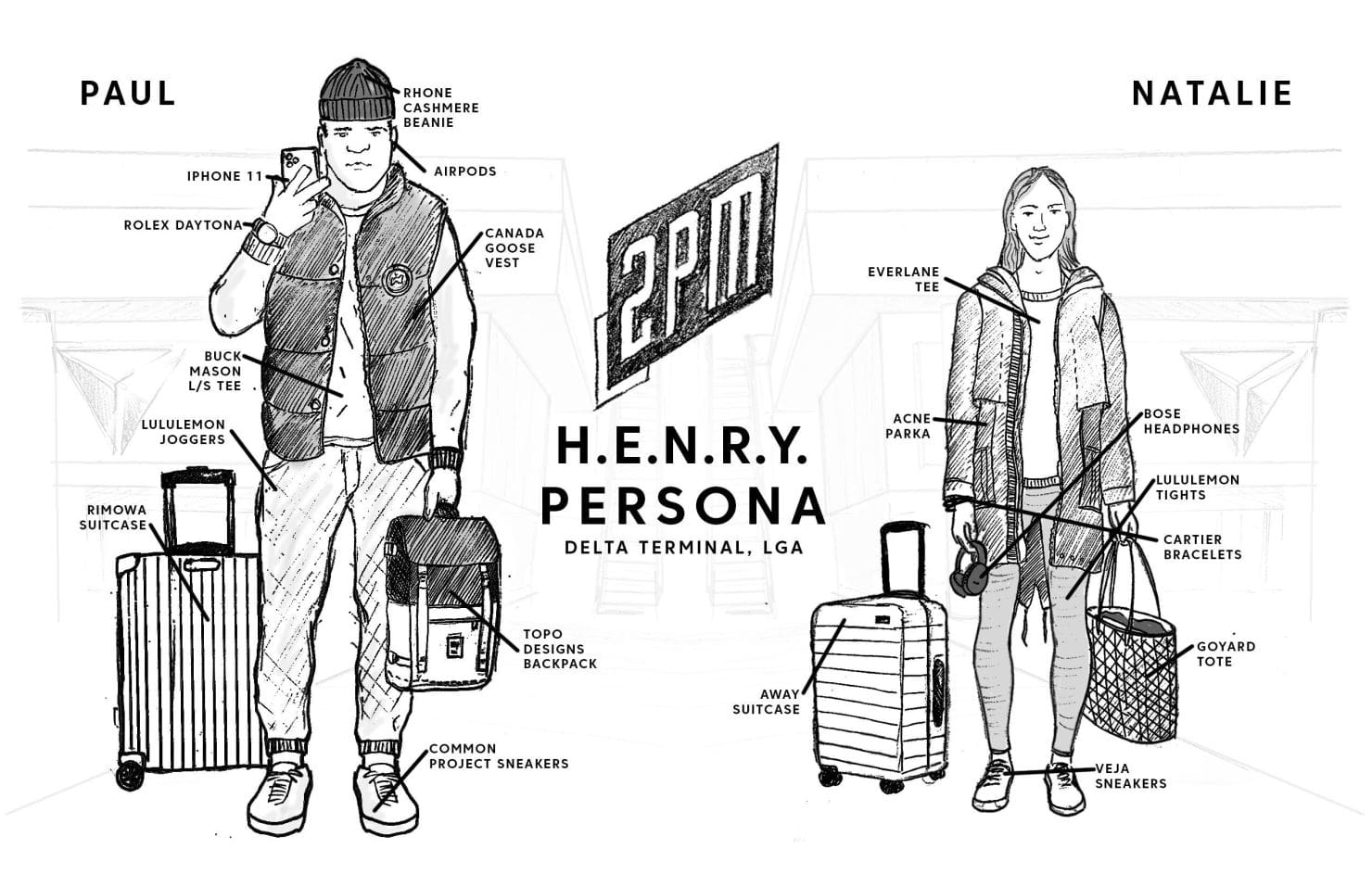
Successful brands and services have accounted for consumer bifurcation by maintaining price integrity and adjusting their total addressable market (TAM) to reflect a growing HENRY cohort that is adding to the population of luxury consumers. Short for high earners, not rich yet, HENRY is a designator that will influence TAM for many luxury manufacturers.

2PM-Definition-HENRY

Member Brief: Regarding HENRY

The HENRYs are advancers, not necessarily those who have cleared the wealth bar to America’s elite class. In fact, many are working to leave the middle-class as if it’s a blemish on their personal ambitions. In this way, the term is more inclusive than the yuppie moniker of yesteryear. It’s also a symptom of our current economy, one where the cost of living can begin to erode long-term investments like real estate, money market funds, or other equities. Unlike the traditional middle-class, HENRYs have the inclination to believe that they are on the path to the liquidity. A liquidity and safety net that is necessary for investing in long-term assets. HENRY is a transitional cohort, not a class. A cohort that can no longer be ignored. [5]

Gen Z Arbitrage Steadies eCom Penetration

In America, Generation Z is awaiting the opportunity to buy with the frequency of Millennials and Generation X. The data suggests that their consumer activity will trump that of previous generations. While Millennials prefer DTC brands by a margin of just 4% over traditional retailers, Generation Z prefers these online-born brands to their legacy counterparts by over 40-45%.

No. 330: Gen Z Arbitrage

From time to time, there are technological and economic advantages that lift the brands that are prepared for the moment. For direct to consumer brands, a category of brands that Gen Z prefers over traditional retail, there is an opportunity to shorten the marketing funnel by appealing to a generation of consumers that have been written off by the incumbents in retail. Traditional brands are marketing to the parents of America’s youth rather than directly communicating to a demographic that could benefit them. The data suggests that as Apple Pay’s adoption rates continue to improve, Gen Z will become the primary consumers of the goods that have, so far, been marketed to Millennials and Gen X members. [6]

Live Streaming + Headless Commerce

Pioneered by Taobao and introduced to America through companies like ShopShops, live streaming is due to become the next great acquisition channel. It’s an amalgam of television’s push and social media’s pull. And though native platforms have risen to the challenge, it’s Instagram that stands to benefit. On the livestream-friendly platform, media companies and brands are due to to test influencer and media partnerships before committing to cross-border commerce. A growth tactic that helped MVMT grow to nearly $100 million + in annual revenue.  Thus far, Instagram is the only platform with the capacity and the architecture for experimentation.

Member Brief: Headless Commerce

By reconsidering their commerce architecture, brands can manufacture experiences that meet the sociological as well as the consumer needs of the consumer. Headless commerce emphasizes community and it enables creators and brands to build a service funnel. This evolution of online retail gives brands control over their consumer experience, allowing depth of identity and relationship. By allowing creators to build end-to-end solutions, headless commerce may change the definition of customer acquisition altogether. This means more predictability and sustainable growth for media creators or brands willing to take the chance on owning their commerce outcomes. [7]

Nº 304: Audiencias In-App

Gaming platforms like Epic Games‘ Fortnite and PUBG have captivated audiences while storing their payment methods for ease of purchase. And services like Netflix and Spotify are learning that they can do the same. The monetization of audiences through innovative, exclusive partnerships will continue to build a foundation for how media companies address a metaverse-driven economy. By reclassifying app downloads as the beginning of a sales funnel (rather than its end), digital content communities can reframe the value of their content. [8]

New Zones

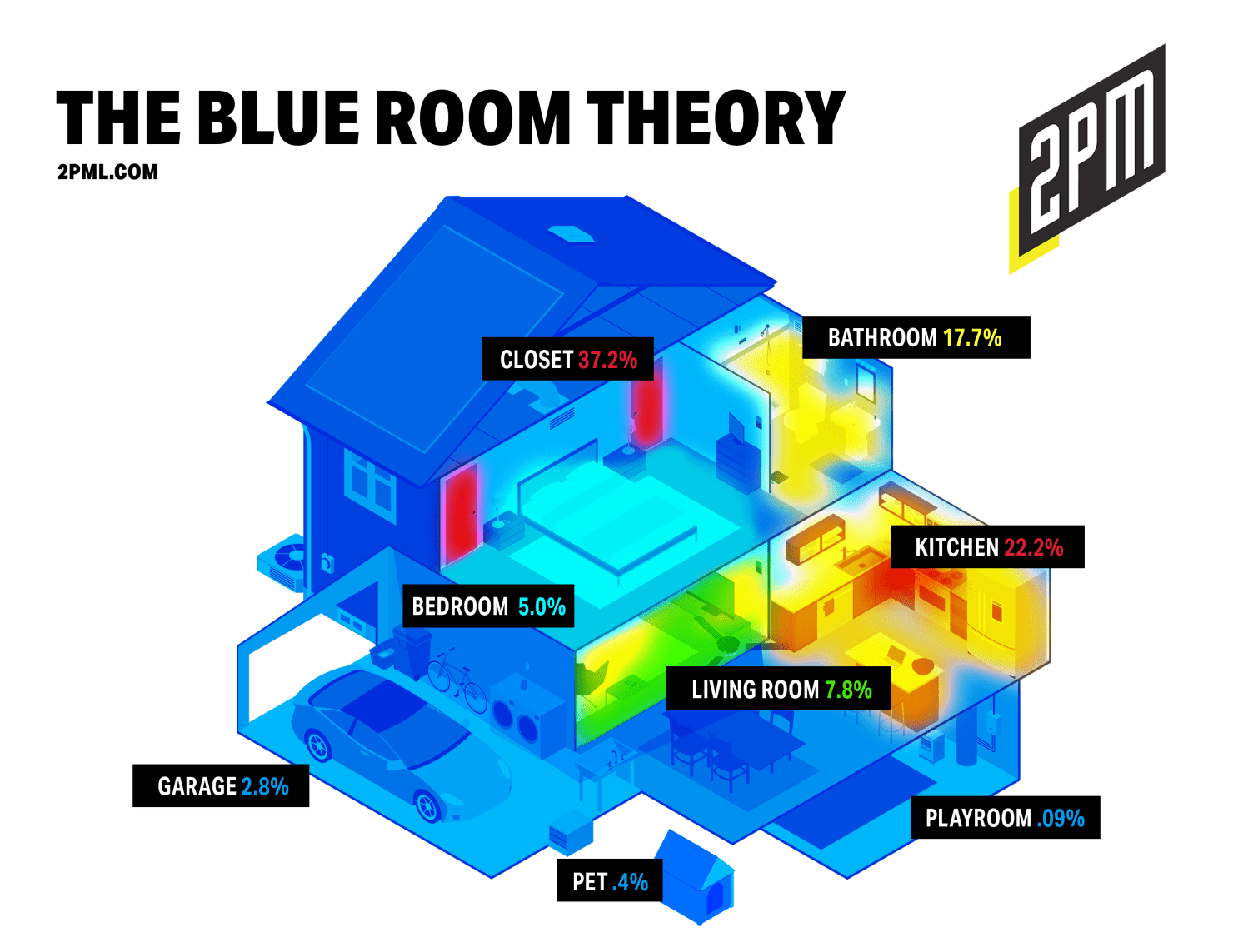
The Blue Room Theory serves as a more useful interpretation of DTC brand density. It identifies opportunity zones throughout the home rather than by category. As (1) millennial home ownership continues to rise and (2) as DTC brands grow in preference vs. traditional counterparts and (3) as HENRY-esque [4] millennials begin to leave major urban centers for second-tier metropolitan areas: each 1,800+ square foot home represents a new canvas . Of the 729 growing, private companies that we studied, the vast majority were concentrated in three areas of the home: the closet, the kitchen, and the bathroom.

2PM-Blue-Room-Theory- (3)

Member Brief: The Blue Room Theory

The Blue Room Theory is a new framework for product launch, early traction, and hyper-growth in consumer retail. It relies on a basic understanding of Red Ocean vs. Blue Ocean strategies. It’s here that Jen Rubio and Steph Korey made a wonderful key decision, very early on. Rather than view their product through the lens of category, they positioned specific real estate as the constraint. Away didn’t market their products in the context of storage capacity or durable plastics. Rather, they focused on owning a domain: the airport. [9]

Modern Luxury Holds Steady

With eCommerce at less than 11% of all retail sales in America, eCommerce continues to skew towards wealthier American. Until that domestic eCommerce figure grows, online retail’s adoption will continue to benefit the brands, services, and platforms appeal to the upper-middle class and beyond. This is reflected heavily by the growth of companies like Peloton, Equinox, SoulCycle, and the boom of meditation-based hardware. Additionally, the gig economy continues to thrive. Last mile workers have taken the form of a servant class, serving the upper-class. Time is the ultimate luxury, you know.

Member Brief: The Modern Luxury Thesis

The DTC retailers with the most promise to grow throughout this period of economic uncertainty can be broken down into two distinct groups: (1) off-price retail and (2) modern luxury. These two groups can operate independently of a dwindling middle class. Both nos. 1 and 2 are less likely to spend disproportionately on customer acquisition as the consumers in each of the respective wealth class tend to be more receptive as consumers. While CAC continues to rise on platforms like Facebook, this can be disproportionately attributed to increased competition for the attention of the a dwindling middle-class consumer cohort. [10]

Streaming and Bundles

The next twelve months will be pivotal in determining the viability of each of more than a dozen SVOD brands but one thing is apparent, streaming services are drilling down on their strengths. For Walt Disney Corporation, this means the ownership and operation of valuable intellectual property. For Netflix, Showtime, HBO, and others: this means adopting other mediums to amplify top funnel awareness.

Nº 325: Consolidación y Cable 2.0

Streaming services will be bundled. It’s likely that we’re near the point of OTT carriers marketing the opportunity for consumers to purchase pre-negotiated, economically-friendly bundles of streaming services packaged. With no-login, one collective price, and less of a fear of missing out – the past has become the present. Disney’s streaming offering may be the sole victor here; their value and reach may outlast a shift back consolidation. For all others, the fracturing market of streaming video on demand (SVOD) has begun to cannibalize the direct to consumer opportunity that was the initial appeal. [11]

The DTC-fication of Hollywood

Disney will be able to command a fee that is more lucrative than traditional day and date releases and at margins far greater than their streaming competitors (Netflix), marketplace vendors (Apple’s iTunes) or cinema competitors (AMC Theaters). Before Walt Disney Studios’ 100th anniversary, you will be able to rent a blockbuster premiere through your Disney app. With respect to the overturning of the Paramount Decrees of 1948, this is Walt Disney’s end game.

Member Brief: The Netflix Report

Direct-to-consumer strategies have been influential across physical product industry over the last decade. Hastings seems to be applying this DTC strategy to streaming media. It’s clear that the Netflix team understands that they must play in the traditional space to eventually overtake tradition. [12]

Informe para miembros: Disney+ y la defensa de la competencia

Whether or not DOJ’s ruling on the 1948 Paramount Decrees is overturned, Disney has found a way forward. When Disney+ achieves its desired scale, it will redefine how consumers interact with blockbuster, box office films. Either you’ll watch it in the theaters that you always have. Or you’ll view them in the comfort of your own home – on the day of the film’s premiere. When that time comes, Disney+ will offer their blockbuster debuts for a premium price. And consumers will pay up. The data proves as much. Disney’s intellectual property is responsible for nine of the top ten highest grossing films over the trailing twelve months, a pace that is sure to continue. And to think, it all began with a negotiation over distribution rights with Paramount. [13]

There is an incredible trove of data and insights throughout the 2PM family of categories: weekly reports, member briefs, daily data, and more. But the core of 2PM is the thrice-weekly letters available to Executive Members. The collection of stories, insights, and short analyses provide a window into the why’s, when’s, and how’s of shifts throughout a number of industries that impact one another. If that interests you, you can join at the top of the site. 2PM readers can anticipate the curve; our Executive Members are ahead of it.

Por Web Smith | About 2PM

Memo: On Paradoxes and Reading Waves

2PM-Surf

The spring months will prepare communities but the autumn will define them. I suspect that the advantage will go to the digitally-native. This is how I concluded the memo “When The Dust Settles.” Written in the first week of April, the inspiration for it was a private conversation with a large publicly-traded retailer. Their ask was simple: what metrics and indicators would you use to forecast the following fall and winter? I responded, “Wait until May and then we will know.” We will know how the United States will respond to the urges and political pressures to reignite our economy.

Scenarios A and B: A Catch-22

As I explained to them, “If we wait as long as we’re supposed to, our economy will face some hard and immediate changes in the interim. Our welfare will suffer in the short term but we will be prepared for the longer term.” This is scenario “A.” They sigh, it’s uncomfortable. “But if our state and local governments begin to signal normalcy in early May, then we’ve elected to shorten the scientifically-backed timeline. And we will see a few things that will make us uncomfortable – one now and one later.” This was scenario “B.” In Joseph Heller’s famed Catch-22, one line stood out above the rest:

The enemy is anybody who’s going to get you killed, no matter which side he’s on, and that includes Colonel Cathcart. And don’t you forget that, because the longer you remember it, the longer you might live.

A popular use of Heller’s famous title, a “Catch 22” refers to a paradox where the two sets of rules or limitations are contradictory and a success is improbable as a result.  Barring some unforeseen change in the circumstances, the individual cannot escape this scenario unscathed. This story can be useful to navigate the difficulty of decision-making in the present day.

We all want the economy reopened as soon as possible, but doing so too soon would be a big mistake. That could lead to a spike in COVID-19 cases, which would then result in another shutdown and we will be right back where we started. It makes no sense to resume business as normal if employees and customers are concerned for their safety.

At the same time, social distancing is not a sustainable strategy. We can’t keep doing this for another 12 to 18 months until a vaccine is available. When the time is right, we’re going to have to figure out a new normal to do business in a modified fashion until then. [1]

Continuing shelter-in-place policies [A] would embolden the healthcare industry, enabling the physical welfare of our communities. Reopening businesses [B] would enable the economy’s recovery – in theory. If successful, it would begin to repair the financial welfare of our communities. The welfare of our businesses and the health of our citizens are critical to society’s functioning; they both require a collective focus and participation. The difference between scenarios “A” and “B” is about 60-90 days, according to cited epidemiologists and other public health experts. As indicated by the reopening of local economies, we’ve chosen the first scenario. This is the one anticipated by Dust Settles.

Sin título

By opening the economy, we are guaranteed to see a 25%+ eCommerce penetration rate by September 2020. Conservative projections didn’t have us exceeding 25% for another 8-10 years.Spring: 11.2% to 20%Summer: 18-20% to 14%Fall: 25%+ of retail is through eCommerce channels

A collapse in our enthusiasm for social distancing implies a return to traditional retail  customs. The result will be a seasonal drop in eCommerce penetration, during the summer months, as consumers venture out to malls, restaurants, and urban retail developments. But the end of social distancing customs may likely coincide with a second wave of spread that emerges during the fall.

One of the worst cases of the 1918 epidemic occurred after Dr. William Crusen, the city’s public health director, allowed a parade to continue as scheduled despite fair warning. On September 28, 1918, that parade drew 200,000 to Philadelphia’s streets and within 72 hours, the city’s 31 hospitals were filled. Every bed was taken. The parade was called to sell war bonds. [2, 2PM Inc.]

The second wave of COVID-19 will be compounded by colder weather and a potent flu season that will undermine most of our social distancing efforts. It will cripple traditional retailers who failed to take drastic action in updating technologies, forging online communities, and developing last mile strategies. And unless we’ve mastered the medical tools that have, thus far, been in short supply – we can expect five months of the sheltering policies that were instituted as a result of the first wave.

Online retail will become the primary commerce channel for an even greater subset of the American consumer, as a result. Conservative estimates place eCommerce at 20% or higher penetration rate by September, a number that wasn’t to be reached for another 5-10 years. This number reflects a total addressable market (TAM) of nearly $1 trillion, a figure that represents a nearly $ 400 billion growth in eCommerce market share. This figure was $611 billion in 2019.

On Reading Waves

As the TAM has grown, you’ve likely observed a change in tone from many retail analysts. In Fall of 2019, you’d find reports on “the optimization of the CAC:LTV ratio of x brand” or “on the payback period for y retailer.” I’ve tended to avoid the analyses of minutiae.  Rather, 2PM’s reports tend to focus on larger influences. In The Netflix Boom, I explained that we were in the early stages of eCommerce as a channel:

By comparison: thousands of direct brands are competing over what amounts to just 12% of all retail volume. In this way, DTC brand retail is closer to the Blockbuster Video phase than the Netflix era that succeeded it. [3, 2PM Inc.]

Thus far, the online retail economy has been stunted by America’s over-reliance on brick and mortar retail. As our social behaviors have changed, retailers have begun to observe shifts in preferred goods, sales channels, and expectations. This tipping point is best visualized as a physical wave, consider the following analogy:

We pay instructors to teach us to stand atop of a surfboard or navigate small breaks near the beach. This is the gift of education; we can pick up the basics in just a few weekends of study. Eventually, this surfer becomes technically sound enough to pursue big waves. But to take advantage of great waves, our education has to include more than skill. It must also include foresight. This is a difference between a novice, who is training to ride small breaks, and the elite surfer that catches a big wave. One surfer [1] has novice skill, one surfer [2] has expert ability, and one surfer [3] shares that expert skill with the addition of foresight.

Right now, it is important to identify the small crests that result in big waves. As commerce begins to move into the mainstream, it will impact industries within and adjacent to retail. Addressable markets will grow for digitally-native brands and traditional companies who’ve invested in their digital futures. In a recent article, the Founder of Common Thread Collective shares insight into the second order effect of the mainstreaming of eCommerce:

Across CTC’s portfolio of more than $600M in GMV, we’ve seen revenues rise every week since the nationwide lockdown. Staggering figures to rival Black Friday, Cyber Monday. In some cases, smashing it. [4]

Similar reports have been shared by a number of retailers, indicating a directional trend. What does this growth mean for other industries? Business leaders can still be heard saying things such as direct-to-consumer isn’t our industry. This is akin to the capable-yet-novice surfer who cannot yet read waves. In non-retail industries, you’ll hear resistance from businesses who focus on their existing competencies. “The revenue isn’t a big enough opportunity, as it stands,” is one. Or, “we need to stay focused on what we’re great at.” As Taylor Holiday noted in a recent conversation:

These are quotes on tombstones of the future.

In Heller’s famed Catch 22, the protagonist was in an unsavory, paradoxical situation. Neither of Army pilot’s outcomes were plausible. And barring some unforeseen change in circumstances, he couldn’t have expected any relief. For the pilot, there was an unforeseen change in the circumstances that saved him. And though it wasn’t ideal, it was far better than the alternative.

Scenarios A and B are our own version of this paradox, neither of the outcomes are plausible. And barring some unforeseen change in the circumstances, we can’t expect any relief. But for third suffer, an unforeseen change in the circumstances was identified early. And though it wasn’t ideal, it was far better than the alternative.

There is a wave in the distance. Consumers will depend on digital commerce and community to mitigate changes in retail, events, healthcare, and gathering spaces. Economies will be required to shift to digital formats to account for these new audiences. Business that anticipate these shifts are preparing for them early. Businesses that fail to anticipate these shifts will continue to harm their prospects by prioritizing conventional methods. The “unforeseen change” will be seen by the digitally-native and those who think like them.

Think of that change as a wave to be caught.

Informe de Web Smith | Editado por Hilary Milnes | Sobre las 2PM