

This member brief is designed exclusively for Executive Members, to make membership easy, you can click below and gain access to hundreds of reports, our DTC Power List, and other tools to help you make high level decisions.
Memo: The Failing Fundamentals
On supply constraints and leading indicators. We have never seen such volatility as what November 2020 is shaping up to bring. To understand it, we have to go back 101 years to the depression that we rarely discuss (1920-1921).
We focused on the wrong war in those years. We are focusing on the wrong war now.
Just four years old, the Great War (WWI) shared attention with the Spanish Influenza by 1918. In the United States, President Woodrow Wilson made no public statements with regard to the Spanish Influenza. Rather, the 28th President and his administration focused on boosting morale and national wartime cooperation. According to the U.S. President, there was a war to win and there was no tolerance for distraction. Here he spoke of a military campaign and not a ravaging pandemic.
Wilson arrived in France in December of 1918 to take part in six months of peace negotiations in France. By then, the disease had killed 50-100 million globally, with a death toll that reached 675,000 in America. The world’s real war was fought in hospitals, not in battlefields. Wilson’s own experiences would prove so. Despite a wildly shared sentiment to slow transmission by wearing a mask, you won’t find a single image of Wilson or his delegation complying with these norms. These men were credited with ending one of the World’s Wars but they ignored the other.
France and Britain tried to appease Wilson by consenting to the establishment of his League of Nations. However, because isolationist sentiment was strong in the United States, and some of the articles in the League’s charter conflicted with the United States Constitution, the United States never did ratify the Treaty of Versailles nor join the League of Nations. [1]
Within the year, President Wilson contracted the same strain of the influenza and within months, he’d suffer from a debilitating stroke that incapacitated him for the rest of his life. Notably weakened by the influenza, Wilson notably agreed with French demands that would set the groundwork for yet another war. The final year of Wilson’s term brought a depression that we rarely cite (1920-1921). Beginning in January 1920, the Axe-Houghton Index of Trade and Industrial Activity cited a volume of business decline of 28.6%. Globally, the GDP fell 6-8% in this time. The end of Wilson’s term would see a man who found (a temporary) resolution to the Great War while being leveled by an even greater one. He left office in March of 1921.
A 2012 academic paper by Keynesian economist Daniel Keuhn cited the downsizing of government (and the services that it can provide) as one of the factors that led to the 1920-1921 depression. But more importantly, he felt that supply constraints were the majority of the issue:
The evidence suggests that the 1920–21 depression was the result of a variety of supply constraints, rather than a deficiency of effective demand, and is therefore a poor test of the efficacy of Keynesian fiscal policy. [2]
Supply constraints can be cited as infrastructure shortages: (1) a lack of debt available to businesses, (2) an inadequate labor market, (3) inadequate technology, (4) government fundamentals, (5) and international supply chain inefficiency. We focused on the wrong war in those years. We are focusing on the wrong war, now. I will cite each of the above supply constraint concerns with the (x) format.
Small business is the engine for American growth and the predictability of government services is the frame that the engine sits upon. Both the engine and the mount are at risk, moving into a period of economic uncertainty that rivals the conclusion of Wilson’s second term.
The American credit system is complex. To account for that, I will cite an illuminating 24-part thread by a pseudonymous American lawyer and consultant whose business is facilitating debt for franchisees. This excerpt stood out:
The chains I work with many of you will be familiar with: Dominos, Jersey Mike’s, Massage Envy, European Wax Center, The Joint, Club Pilates, Jimmy John’s, Wingston, Orangetheory, Moe’s Southwest and many others. I have broad spectrum national exposure to many industries.
I fund $400-500 million in loans per year through these banks. In February we were on pace to fund well over $500 million and potentially $750 million — growing exponentially year over year. Since April 1st we have funded $5 million (in loans) through only two banks.
Retail franchises (1) are of the most predictable cash flow businesses in America. The lack of debt available to owners is noteworthy and as shortfalls in foot traffic continue to impact retail real estate, the franchise business seems due to exacerbate these concerns. Once considered a stalwart of the U.S. economy and our base of wage labor, this model has never been more at risk.
Meanwhile, the benefits cliff (2) has begun to impact consumer confidence. And fewer of the employment alternatives that existed pre-credit shortage are available for those who are impacted.
[The] benefits cliff is here, as most of the unemployed received their final infusion of the extra $600 from the federal government last week. Workers will still receive payments from their home states, but the loss of the extra $600 will slash payments by more than half for many, and in some cases significantly more for workers in states that offer only meager unemployment benefits. [3]
In U.S. school districts, teachers have no firm understanding for what the fall may bring. Nearly 3% of the American workforce are facing uncertainty. Will schools exist in its traditional format? What effect would remote learning have on education?
Of the nearly 80 million Americans (3) who will attend school in the fall, how many will be properly prepared for the technological requirements associated with distance education? From west coast to east, wealthier parents are angling for short-term fixes at the expense of longer-term consequences. Our educational systems are incapable of managing the stress test of the “venture-fication” of education.
jason@calacanis.com on Twitter: “Looking for the best 4-6th grade teacher in Bay Area who wants a 1-year contract, that will beat whatever they are getting paid, to teach 2-7 students in my back yard#microschool If you know this teacher, refer them & we hire them, I will give you a $2k UberEats gift card / Twitter”
Looking for the best 4-6th grade teacher in Bay Area who wants a 1-year contract, that will beat whatever they are getting paid, to teach 2-7 students in my back yard#microschool If you know this teacher, refer them & we hire them, I will give you a $2k UberEats gift card
Lastly, government fundamentals are at risk and there are few greater examples of this than the United States Postal Service, a nearly 250 year old organization that has never faced the headwinds that it is facing now. In a recent interview with CNN, the American Postal Workers Union President delved into his recent concerns:
The American Postal Workers Union’s president, Mark Dimondstein, told CNN in an interview Friday that the union has received a number of reports from postal workers and customers over the last two weeks that mail delivery has slowed and “degraded.” The union represents more than 200,000 Postal Service employees and retirees. [4]
With the current administration threatening to cut funding to the postal service, mail-in balloting is at risk of disruption. This is a key service of the USPS. And though the recent spike in online retail volume has mitigated funding gaps for the USPS, the uncertainty going into election season places another stalwart service at risk. Without the postal service, eCommerce cannot run. And with that, smaller retailers are due for additional concern. Many are facing the added costs of shifting business to UPS, DHL and Federal Express.
And here is where the circle closes for the online retail industry, an indicator of greater economic health and progress.
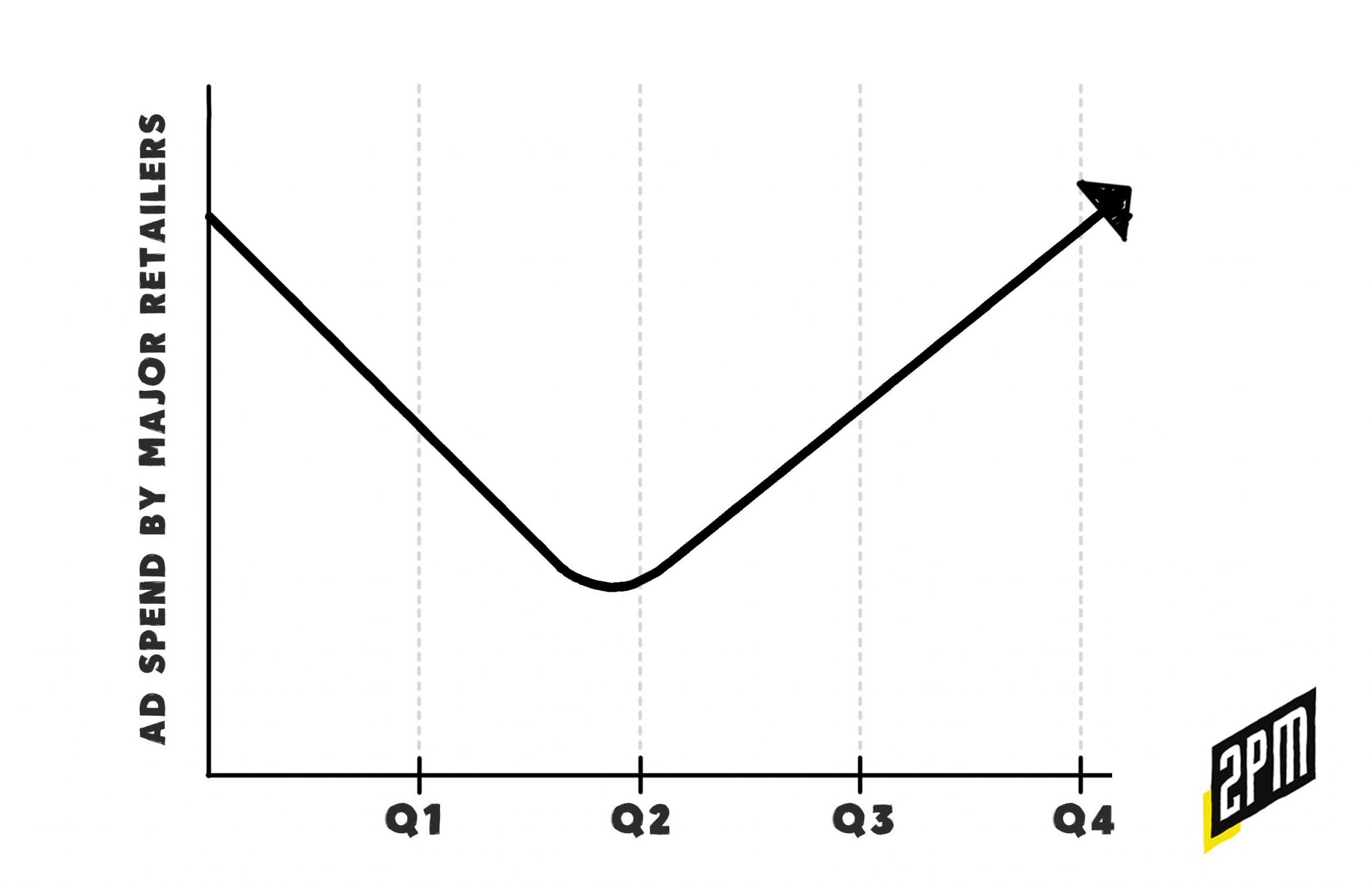
A paradox for Black Friday and smaller retailers is that the gross merchandising volume (GMV) in online retail for the month of November will achieve a record high. Most of this volume will be attributed to Walmart, Target, Dick’s Sporting Goods, Academy, Best Buy, and Amazon’s decision to emphasize eCommerce before (and potentially on) the biggest shopping day of the year. By closing all physical stores for Thanksgiving, the market can anticipate digital ad spend of historic proportions. This spend, in turn, may lead to a rise in customer acquisition cost (CAC) for smaller retailers.
Consider November for the early-stage retailer or small business. Unemployment is at an all-time high, the state of childhood education is uncertain, consumer confidence is on the decline, and we will be in the midst of the most contentious election in recent history. Advertising performance may suffer due to the influx of new and back loaded enterprise spend on digital platforms. And on top of it all, margins will be further diminished by increased logistics costs. In 2020, eCommerce has been a bright spot of hope for a shaken economy. But surviving the next months despite all of this uncertainty will be a tough task, even for an industry that seems inevitable.
I’ve long compared this presidency to Woodrow Wilson’s. Historians look back on the 28th President with conflicting analyses. Some herald his performance and others have been critical. One thing is for certain, we are once again fighting the wrong war. Infrastructure, consistency, and access to credit have never been more important as Americans shift from traditional work to a generation-defining sense of dynamism. Objectively speaking, Woodrow Wilson’s presidency was one of grandeur and neglect. By choosing the wrong war to fight (or not realizing that he could fight two – at once), he guaranteed an economic depression by fracturing the country’s foundation when it needed foundation, the most. A decision on the war we fight (and how its fought) will determine the fundamentals of our evolving digital economy. One of those wars should be to regain the fundamentals that allow dynamism to thrive.
November should be a win for entrepreneurs, small business owners, and high-growth brands who’ve long been ahead of the online retail curve. They will need that win. To achieve it, they’ll need market fundamentals on their side.
By Web Smith | Editor: Hilary Milnes | Art: Alex Remy | About 2PM
Memo: On J-Curves and Agglomeration
 The recent shift to online retail has been reactionary. The next phase of eCommerce growth will be more intentional. But first, the bottom of the J-curve.
After closing to the public, many suburban malls and strip centers are in the process of reopening. Physical travel was inconvenient but the roads aren’t as empty as they had been in March or April. Social distance has been a public health issue. And yet, in many cities across the United States: bars, restaurants, and parks are reminiscent of pre-COVID behaviors. Customs are returning and familiar practices will follow suit.

Density precedes agglomeration, which influences consumer behaviors. Agglomeration economies are the benefits that come when firms and people locate near one another together in cities and industrial clusters. [1] Most 20th century retail developmental strategy was built around this concept.
As density returns to shopping malls, strip centers, and urban boulevards, business will follow. Multipurpose shopping, the purchase of products from more than one product variety or cluster on one shopping trip [2], will follow suit and a number of businesses will begin the work of salvaging their fiscal years. The Director of Adobe Digital Insights, Taylor Schreiner recently provided timely perspective on signals that may have greater meaning as the year progresses. He explains to TechCrunch:
As online is absorbing the offline retail economy, some inflation is being observed for the first time in years, especially in categories that have consistently experienced online deflation, such as electronics. [3]
Attractiveness of Retail Agglomeration Based on Product Type: An Experimental Study
6 Pages Posted: 21 Jun 2017 Last revised: 10 Mar 2018 Date Written: June 19, 2017 Agglomeration has been defined as, the presence of a set of firms in a topographically defined unit, for example, in a building, on the street lane or block (Knoben & Oerlemans, 2006).
Cities may physically change or they may not. But the agglomeration that should concern city managers and politicians is no longer representative in physical spaces. The shift to online education, remote work, gaming, live conferencing, and leisure is a new form of agglomeration. A leading indicator, consumers have contributed to the first period of inflation for electronic products in over a decade. Over quarantine, these purchases provided gateways to work, socializing, and play. But if these behaviors become more permanent, cities will struggle to account for it. I’ll explain.

The United States is over-retailed. With ten times the square footage (per capita) of China, a growing eCommerce economy could be catastrophic in the short term. Online retail’s growth will exacerbate existing issues with commercial real estate vacancies and revenue collection. A $5.27 trillion dollar market, retail is nearly one-quarter of America’s gross domestic product. Bank of America’s credit card data and others have placed eCommerce as 20-30% of a down retail market (-16% in April).
The projected number of retail employees in the United States was trending downwards before the pandemic began. The graph reflects a slow and steady decline in a retail format that is heavily reliant on hourly wage workers and duplicitous storefronts. Traditional retail employment and eCommerce adoption maintain an inverse relationship.
2PM on Twitter: “10 years vs. 8 weeks pic.twitter.com/aySbP0Xpd4 / Twitter”
10 years vs. 8 weeks pic.twitter.com/aySbP0Xpd4
As local economies reopen, eCommerce penetration will fall as the aggregate retail economy begins to regain its footing. But unemployment figures won’t ever look like they did in January or February. In the next 24 months, employment is unlikely to return to the record low 3.5% that existed prior to the global pandemic [4]. Consider this 2016 report by Jönköping University’s Hanna Kantola.
Over the last 100 years, the retail industry has undergone radical changes. At the beginning of the 20th century, goods were still supplied over-the-counter at small, independent local retailers who had a limited amount of product variety. By the end of that same century, we had moved to a highly productive and efficient retail industry offering self-scanning and an overwhelming range of products. Retail firms have also grown at an exceptional speed and are today largely composed of huge international corporations. At the same time, consumers have become more aware and more mobile, creating demand for specialized goods and services from retail clusters in locations easily accessed by car. [5]
The online retail industry will have a dual responsibility that it may be unequipped to address. Digital retailers are tasked with building and powering the infrastructure that will become the foundation of the next 50 years. This, while also addressing a fracturing job market. Walmart, Target, Instacart, and Amazon have collectively hired hundreds of thousands since February but that number will never be in the millions. This leaves a hole in the market. Where will America’s millions of retail employees work next?
[Steve] Jobs said in 1995: “People are going to stop going to a lot of stores. And they’re going to buy stuff over the web.” This is beginning to reflect in public and private markets. What happens when we stop driving to stores? What happens when shopping centers no longer have sufficient demand? What happens when advancements in last-mile delivery becomes carbon negative? This is happening now.” [2PM]
Agglomeration is now digital. Consider Slack, Zoom, Instacart, Amazon, the shift to working from home and the shift to distance learning. Even in the peak summer months, this will reflect in in-store foot traffic and brick and mortar sales volume. With reduced occupancy, tempered lines, health restrictions, and appointment-only shopping: the new peak shopping hour may not need the workforce that it once had. And this is how the problem may become political.
Web Smith on Twitter: “2011: “Software is eating the world.”2021: Software is the world. / Twitter”
2011: “Software is eating the world.”2021: Software is the world.
It’s an election year and with that comes the consequences of near-sighted decision making. The summer will be a tenuous period for retail. Three months will determine whether or not we revert back to the belief that our retail economy will function the way that it once had. To ignore these would be to ignore the early markers of digital change. While commercial real estate adjusts to a new bottom, cities will change. But agglomeration is now digital and that’s where the next growth will be seen. With fewer college students filling into the halls of state schools, fewer workers driving to their workplaces, and with “third places” (churches, libraries, social clubs) digitizing [8] – retail will follow digital foot traffic. It’s already begun to do so.
The Tipping Point
Think of our institutions as infrastructure. Founded in 1775 by the Second Continental Congress, the Postal Service was born to help Americans correspond, exchange, and deliver. The service would later be enshrined in the first article of the Constitution. It’s the foundation of hundreds of years of communication, a freedom of the press, and a burgeoning system of networked commerce that has powered everything from 19th century trade, the rise of SEARS catalogue, and late-stage eCommerce.
A considerable barrier to online retail penetration sustaining at its current rates may be found in the government intervention against it. Amazon is under constant antitrust scrutiny. As are Google and Facebook. And now the United States Postal Service is on the brink of disruption. The agency’s revenue has plummeted over the last few months and its fate is being decided in Congress.
The USPS is a key component of the eCommerce economy. Packages are just 5% of its shipping volume but eCommerce accounts for nearly 30% of the agency’s revenue. Partnerships with vendors like Amazon (or providers like FedEx and UPS) provide a majority of its package volume but small businesses and direct-to-consumer brands rely on USPS’ pricing. Raising costs on retailers may lead to more attrition. A Washington Post report explains the context in clear terms:
Trump and Treasury Secretary Steven Mnuchin have sought to attach terms to a $10 billion emergency loan to the USPS that would allow the administration to dictate package prices, review and alter bulk-discount contracts known as negotiated service agreements (NSAs), appoint the next postmaster general, and direct negotiations with labor unions. [9]
By raising prices to combat Amazon’s growing influence over the economy, disrupting the postal economy is no different than digging up paved roads before a period of heightened freight transit. For weeks: eCommerce operators, founders, retail executives, and agency directors have marveled at online retail’s surprising performance. These same business leaders anticipate the slowdown that the summer brings. But without an aligning of business and political incentives before August, online retail may not reach the heights that many analysts suspect it will. And with it harder to envision long-term prospects for many traditional retailers, we will need a strong eCommerce economy by then.
We are approaching a particularly divisive moment for the industry. Do we accelerate the J-curve and prepare for the fallout in commercial real estate and the jobs sector? The early indication is that the eCommerce industry’s greatest barrier to mass adoption will be its most formidable. Tolerating the fallout doesn’t appear to be the playbook.
With the potential of higher shipping costs and increased State taxes on retailers, the demand for traditional retailers may begin to rise to the normal that existed before the pandemic. But it will never reach that zenith. An election year effort to reinvigorate our retail economy may win hearts. But it will fall short of its expectation. America is shifting toward an eCommerce economy as retail analysts anticipate another 100,000 stores closing by 2025. The J-curve will happen for eCommerce; the leading indicators have made that clear. The new agglomeration isn’t within a trendy city or neighborhood, it’s on the internet. And retail will be too.
Report by Web Smith | Edited by Hilary Milnes | About 2PM