Members: Juneteenth and American Dreams

SM-B6NAw

The discussion between us was slow and every answer labored. It was difficult to tactfully explain the concept of an “unnecessary wait.”

There’s always a wait.

Modern Retail editor Cale Weissman wanted to understand the Black perspective of those of us in eCommerce. I didn’t have many answers for him. I worked to moderate my responses, struggling to mask volumes of persisting frustrations within the digital industries. At one point, Weissman asked for a list of venture-backed founders in the direct-to-consumer space. There was, of course, the obvious answer. Tristan Walker rolls off the tongue. But I didn’t have a novel response in that moment and I was ashamed of that. There are so few Black professionals in this space. For the vast majority of prospective executives, founders, or investors, they’re still waiting.

A portmanteau of “June” and “nineteenth”, you’ll see Juneteenth celebrations from Target, Nike, Glossier, Deciem, Ford Motors, Adobe, Allstate, Altria, Best Buy, Google, JPMorgan, Lyft, Mastercard, Postmates, Tesla, SpaceX, RXBar, Spotify, Twitter, Square, Workday, Uber, and countless others. Most of it will be in vain and some of the efforts will be widely panned.

Dino-Ray “96,000” Ramos on Twitter: “.@Snapchat released a statement about their #Juneteenth filter… pic.twitter.com/KWPZnlWG3n / Twitter”

@Snapchat released a statement about their #Juneteenth filter… pic.twitter.com/KWPZnlWG3n

You’ll observe brands, people, and media commentators missing the point. You’ll see gimmicks, carefully crafted statements, and an oversimplification of a complex period in American history. Imagine our great grandchildren over-simplifying the present day.

For some of us, Juneteenth was only sort of a celebration. Imagine wanting something for your entire life and then waiting two and a half more years for that something. It’s a bittersweet celebration. For those of us who descended from those strong-minded South Texans, today is the annual reminder of their physical, mental, and emotional resilience. It’s a reminder of our inherited endurance, will, and resourcefulness. There’s always a wait. So, Juneteenth: a celebration, sure. A national holiday? Of course. But within the confines of the classrooms, offices, or neighborhoods of our American cities, Juneteenth should be a day to reflect on the waits that remain.

Grandchild of Slaves and Grandma to Me

Dorothy Smith’s grandson’s first essay remained on her bookshelf. It was an elementary school recount of Jack Roosevelt Robinson’s embattled life, the first man to cross the color barrier in Major League Baseball. I remember the essay because in 1992, it was my first time using a color printer for a school project. I recall the pride of using an image of his baseball card as the hook for a project that made me emotional, even as a nine-year-old. The eight-page report was double-spaced with size 18 font. For some reason, she was proud of that essay and it remained in her home until her passing in April of 2014. She’d critique the cadence and the word choices. She’d implore me to slow down when I read it aloud; I stuttered heavily back then. I credit our conversations for helping to heal that ailment.

Between 1992 and 2014, she’d go on to help me with a number of essays. As she got older and less capable, she’d listen to me narrate the stories that I wrote. But earlier in my life, she’d actually help me write them. A highly educated woman, she was my hero. By the end of this essay, she might be yours. One of those essays was a seventh grade report on Juneteenth’s impact on my own family. I’ll never forget her input:

The message of freedom didn’t make it all the way down here and, so, they had to wait a little bit longer. There was always a wait. There’s always a wait.

President Abraham Lincoln drafted Proclamation 95 in September 22, 1862. Imagine hearing word of this proclamation and then waiting for it to save you. It was effective, five months later, as of January 1, 1863. Imagine counting down those days to freedom. For some, the count was far longer. For that lot, their freedom was hidden by economic and political disdain for the federal order. It would be an additional two years before my relatives heard the news.

Every advocate of slavery naturally desires to see blasted, and crushed, the liberty promised the black man by the new constitution.

Those were the words of Abraham Lincoln in 1864 to Union General Stephen Hurlbut, an ally on paper but a critic in private. Even after the order, a number of states avoided the action required to fulfill the president’s wishes. According to Dorothy Smith, the population of Texas was aware of their ordered freedom long before they received it. For them, it was a painful wait. I’ll never forget the emphasis on “there’s always a wait.” These were the words of Dorothy Smith: child of laborers and sharecroppers. She was an entrepreneur, a retailer, a real estate agent, and mother to six college graduates. Dorothy was the grandchild of Texas slaves and my grandmother.

Her grandparents were born in 1858 and 1853. Dave and Sallie Draper Hill were born enslaved in Panola, a small town on the border of Texas and Louisiana. They were of the last American slaves freed by that Galveston, Texas order on June 19th, 1865. They’d later marry in 1881. According to the 1900 census, they’d go on to have 12 children. My great-grandmother was born in 1895. She’d later become an independent farmer, raising cattle, pigs, chickens. She grew and sold vegetables and she tended to a fruit tree orchard on her property. Her daughter would marry James Smith in 1944 and remain married to the Army Air Corps veteran until their passing – one year apart.

I always contemplate what earlier generations of my family would have done with real opportunity. It always seemed as though they were capable, potent, and waiting. It was Dorothy who we credit with taking matters into her own hands. She was defiant in her capitalism, her pursuit of education, her politics, her advocacy, and the opportunities afforded to her six children. She resented the idea of Juneteenth, in ways. It represented neglect and deception, a stalling of opportunity. It was the embodiment of an unnecessary wait for the opportunity to live a full life.

She stopped waiting.

The Sudden Retailer

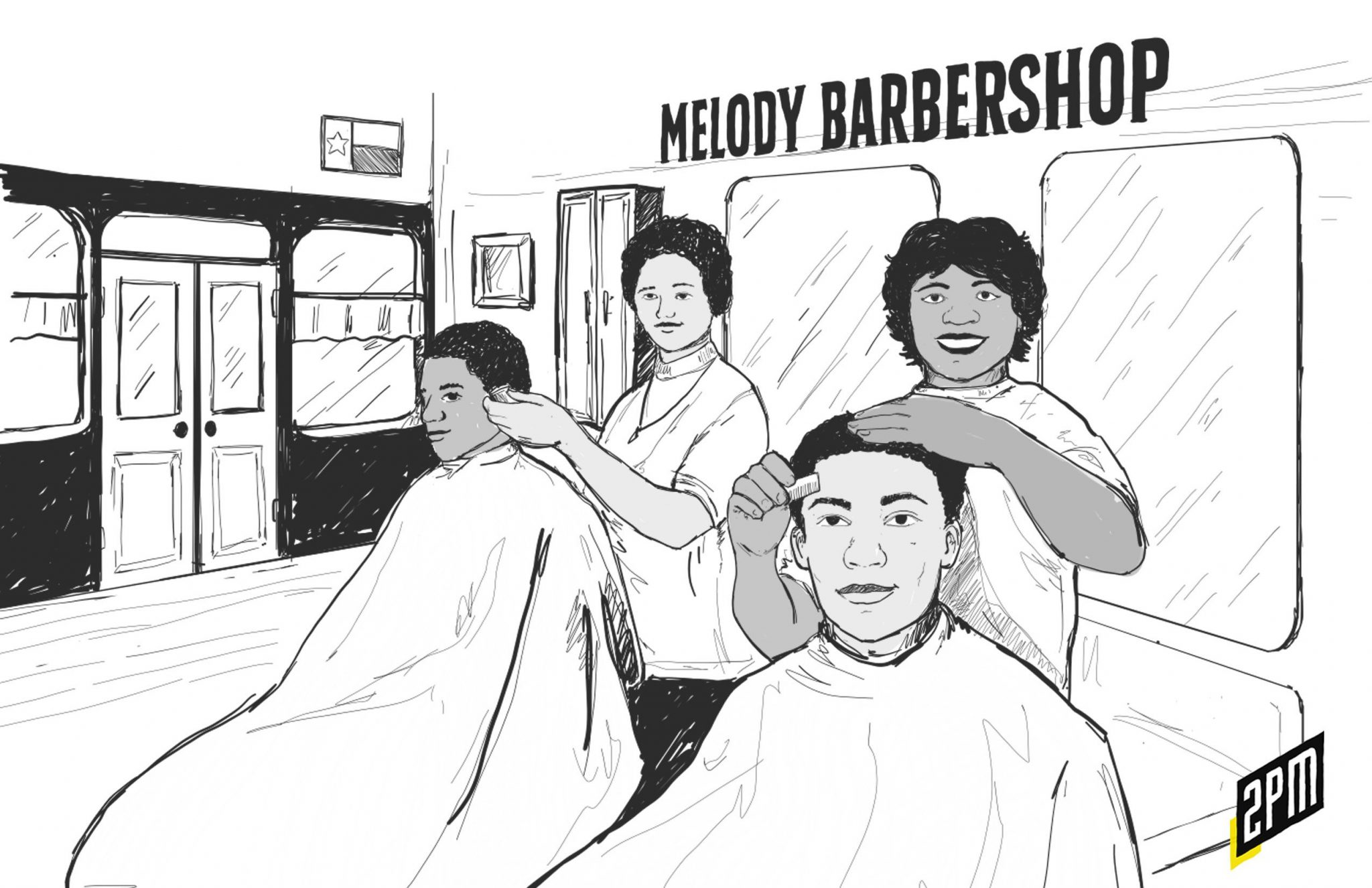
With her meager savings, she launched two businesses that operated in tandem. Both companies were within the same strip mall and they’d feed each other business for decades. A licensed barber and realtor, “Melody” became her calling card. By the mid-1950’s, the barbershop generated substantial cash flow, allowing her to hire staff and procure basic wholesale partnerships. Her storefront would double as a beauty supply retailer, amplifying her earnings by catering to an audience with few places else to shop. This should sound like a familiar strategy. Her clientele was working class and upwardly mobile, a trend that would continue throughout the Civil Rights era.

Many would eventually buy homes in the area Northeast area of downtown Houston. Melody Realty would be one of their guides. The Fifth Ward was an area where Black Americans could buy homes without political or social persecution. Regardless of one’s wealth, the city’s affluent remained deed restricted – first legally and then by proxy. The middle-class son of a Texas Instruments engineer and flight attendant, I’d later be born in that same downtrodden area in 1983. Thirty years later, the city’s deed policies remained. There’s always a wait.
TKZQ5LWw
Pictured: Dorothy, right, with her son.

Dorothy would later become one of the preferred real estate agent of her area. In this way, her storefront operated as a funnel. Her Melody brand of business blended short-term cash flows with longer-term windfalls. It changed the trajectory of our family. James, an Army Air Corps veteran, and Dorothy would send six children to colleges across the United States throughout the 1960s and 1970s. All would graduate and five would go on to have children. By the time that we were born, the idea of college was an afterthought. It was just another task for us. And so was entrepreneurship.

Dorothy would enforce a strict policy for each of her children. My father and his siblings would be required to earn their barber’s license while in high school. This sense of economic independence would propel a number of those children to impactful lives in business, religion, and medicine. Today, Melody Realty continues to operate in the Houston area, a testament to her work.

Conclusion: Ending The Wait

By the time I was born, she’d complete classes at Rice University. She was omnipresent in our lives and she stressed the importance of sacrifice. Dorothy Smith’s life had a profound impact on my own. In our home, she’s taken the form of a superhero. Imagine being born into a world that penned you for one thing and then choosing to achieve something more. She’d send six kids to school before the United States provided her the right to vote. My father was 13 when the Voting Rights Act passed. There’s always a wait.

Dorothy was uncomfortable with Juneteenth because it was symbolic of the proverbial weight of an unnecessary wait. This same concept can be applied across generations, including our own. Dorothy would argue that she was nothing special. Imagine what her parents could have done with the freedoms that Dorothy possessed. I can envision Dorothy Smith atop of our industry, if she was born during my lifetime.

The story of upward mobility in America is one of waiting. In the 1800s, it was for freedom. It the early 1900s, it was waiting for the dignity of citizenship. In the late 1900s, it was the wait for legal equality. And today, it’s the wait for equity in treatment and opportunity. We’re still in the proverbial period of waiting.

Today, we are celebrating the overcoming of adversity. It’s not intended to be a pleasant memory. I’d have preferred to celebrate no Juneteenth at all. I am sure that Sallie and Dave Hill would have agreed. When you’re deserving of opportunity, every single moment without it will feel like a decade. Now, imagine how two years of waiting may feel. The daughter of field laborers, she birthed a generation of Black professionals. Her life was a force function that bent time. There should have been more Dorothy’s in the 1950s and 1960s. There should be more of her children. We have to recognize that an unnecessary wait is just as fraught as no opportunity at all.

The hope is that, today and every day forward, we work to bend time. The leadership of the industries that define American exceptionalism should reflect America. We should provide opportunity, fill executive suites, hire the best people, invest in resilient entrepreneurs, mentor, lead, build, uplift, and provide the freedoms that some Americans take for granted.

There are more Dorothy’s than we know and some of them are waiting. The 45 second pause between Weissman’s question and my answer likely made him as uncomfortable as it made me. In a better version of our world, I would have answered his question with ease. It’s critical that we identify our own unnecessary waits. Once we do, it’s our responsibility to end those waits with opportunity. It’s the one small change that can alter the course of generations.

Essay: Dorothy’s Grandson | Editor: Hilary Milnes | Art: Alex Remy | About

No. 344: IPO and The “Frontier Thesis”

2PM-Frontier-Democracy

By air and by sea, thousands of would-be gold miners traveled to California in pursuit of wealth. They’d come to be known as 49ers. In March of 1848, 800 non-natives made the trip to California. By the end of 1848, that number ballooned to 20,000. And by 1849, that number reached 100,000. The gold rush was one of America’s earliest examples of the frontier thesis. Historian Frederick Jackson Turner penned an essay in 1893 that explained that the economic strength and vitality of America was tied to moving towards the frontier.

I define ‘frontier’ as the social levelling associated with large numbers of people comprising a broad spectrum of skills, educational levels and class backgrounds, working alongside each other at rough parity in open access, high potential gold mining. [1]

That frontier line, a demarcation that separated the known from the unknown, spurred innovations in: commerce, behavioral economics, government, and social sciences. Of course, there is no longer any physical frontier. Today, that line is figurative. With any new industry, these behaviors repeat in seen and unforeseen ways. Direct-to-consumer brands have begun to reach venture-backed maturity. Like the physical frontier of old, this new line of demarcation bears many of the same traits — uncertainty is one of them.

During the gold rush, it wasn’t the miners that made the real money. It was the toolmakers, the workers that manufactured the implements necessary for the droves of miners to strike it rich.  We remember Levi Strauss & Co but few rarely can recall top gold miners of the time. The toolmakers made riches; the vast majority of the miners went home empty handed. Not even their tools made the trip. As the adage goes: you can mine for gold or you can sell the pickaxes. Like the commerce tools themselves, venture capital eventually flooded brand retail. This not only affected who could scale, but also it affected how companies were scaled.

The problem with all of the tech-enabled customer channels, though, is that they are available to everyone. Indeed, the flipside of tech concentration when it comes to platforms and Aggregators is the democratization and commoditization of basically everyone else in the stack. That is how you end up with, as of August 2019, 175 different online mattress companies. [2]

Seated to my right on a flight from Ohio to Minnesota was a salesman whom we’ll call Dave. “Do you want to start a mattress company?” he utters through a smirk and a light smile. After his third whiskey he opens a laptop to reveal a spreadsheet with nearly 100 rows of data and says, “Look at this.” I’m interested and I immediately recognize several of the companies out of the corner of my eye. Of them, Casper is atop the list. Dave is an employee of a company that manufactures mattresses for many of the the top brands. I was stunned. “Wait. Casper doesn’t make their own mattresses?” I asked. Dave goes on and he asks if I want know how to start. Curious, he lays it out for me.

Start a website and use Spotify [SIC] or something. Pre-sale the mattresses for $800. Buy them from me for $400-$500. We will deliver them to you within three weeks of the sale. Rinse and repeat.

Dave was the proverbial pickaxe seller, and the DTC era was his gold rush. According to him, Casper was one of his company’s many customers. I didn’t believe Dave until I read Casper’s S-1 filing. He was correct, Casper doesn’t manufacture its own mattresses. And neither do the vast majority of its nearly 200 competitors. Instead, the Casper team buys them from a source and marks them up for resale.

While most of our product design is developed in-house, certain foam formulations are currently licensed from certain of our contract manufacturers pursuant to our manufacturing agreements with them, some of which include varying degrees of exclusivity. [3]

And this manufacturer isn’t the only pickaxe seller. While Casper.com is a custom cart build, a majority of digital natives are built within the Shopify ecosystem. This is a reflection of modern retail as a whole, which has been influenced by the greatest pickaxe seller of them all.

Venture capital has disrupted retail in a number of ways. Imagine an entrepreneur raising VC to launch a clothing, shoe, or mattress company in the 1990’s. The thought would have been implausible. But retail brands aren’t new; its tools are. Prior to 2006, these types of businesses pursued other funding sources: private loans, lines of credit, or friends and family rounds. They often began with the idea that unit economics would be at the forefront. Some decided to grow on cash flows. The earlier the profitability, the better.

And if these companies did go public, it would be after a measure of decades and not a measure of years. Take Ralph Lauren Corporation: founded in 1967, it went public 30 years later. Or Nike Inc., a retailer that went public nearly sixteen years after its founding. In Columbus, Ohio, there are a number of specialty retailers that took similarly long paths to becoming public companies: Express, L Brands, DSW, and Abercrombie & Fitch are but a few.

Web Smith on Twitter

On brand ceilings and valuations. 1967: RL was founded. 1994: Goldman acquired 28% of @RalphLauren at a $520 million valuation. 1997: RL IPOs at a $2.4b valuation after 30 years – a number of them in the black. 2020: $8.8b market cap (1.3x revenue) From the S-1:

Like a Cambrian Explosion, venture opened the door to a diversity of platforms, apps, logistics services, and packaging solutions. It also developed a new format for retail, one based on hyper growth. And by extension, venture capitalists began funding the companies that would be built on them. For would-be retail founders, the bar for starting a business reached an historic low. And the ability to raise historic sums of venture capital reached its high in the same period of time: 2014. The last decade of eCommerce was just as much about the tools sold as the nuggets of gold that were mined.

But while venture capital disrupted pickaxes for the better, one could argue that it disrupted the miners for the worst. The DTC era has seen few acquisitions and even fewer public offerings. Even so, Stitch Fix President Mike Smith suggested that staying private is the best bet for many of these brands. He explained to Recode’s Jason Del Rey:

Should you be a public company? In a lot of cases my answer would be no. You have to bring your A-game to the public markets. You can hide in the private markets and spend a lot of your venture capital on Facebook.

For the digitally native brands of today, they’ll have to think and behave a lot less like their contemporary peers as they approach the new frontier line. In this way, Casper’s IPO will serve as a bellwether for this era of digitally-native brands. Can they IPO without a realistic path to profitability? The thought has its headwinds. In these tweets below, I summarized most of the bear argument.

No Title

No Description

Casper’s management will have to convince Wall Street that they’re capable of something that few brands aren’t: they must “own the category” and do so profitably. There are two obstacles to this. And this is where it gets a bit technical.

Parallels: Casper and Mattress Firm

Consumer-based corporate valuation. In the company’s S-1, they chose not to report cohorted revenue data. But a few key figures stood out: 14% of customers returned within a year of the original purchase. In the S-1, Casper cites returning customers and not the figure in sales. According to venture capitalist Alex Taussig, the company’s annual dollar retention is just 6%. Their repeat business is nearly non-existent.

Casper’s average order value (AOV) is $867 with a repeat AOV of $87, according to Marketing Professor Daniel McCarthy. This is based on the assumption that 80% of the orders are at the primary AOV and that repeat AOV is $87. The customer acquisition cost (CAC) for that $867 sale is $324. In a fascinating thread of marketing mathematics, Professor McCarthy cites a five year customer value at $455 with a lifetime value (LTV) of $131. But one thought stood out:

Bulls will probably point to stores as a way to bring CAC down, upsell, and supply chain efficiency margin improvement. Bears will point to late adopters being harder to bring in, and competition picking up.

Back where we started. The institution that Casper disrupted with direct-to-consumer delivery is now its best hope — brick and mortar retail. Within the year that Casper launched, there were two separate instances of note. Of course, Casper quickly scaled its direct-to-consumer model. And Mattress Firm invested in a brick and mortar company as Casper’s DTC offering generated nearly $100 million in first year sales.

[Mattress Firm] was constrained by its decision to buy retail chain Sleepy’s in 2015 for $780 million. Instead of investing in digital tools and shipping infrastructure, Mattress Firm expanded its store base at exactly the wrong moment. [4]

Mattress Firm’s retail acquisition left the company over-retailed (by nearly 1,000 stores) at a time when customer acquisition arbitrage for mattress-in-a-box retail was peaking. Just a year later, Steinhoff International acquired Mattress Firm for around 1x gross revenues.

The South African retailer Steinhoff International Holdings will buy Mattress Firm Holding Corporation, the largest specialty bedding retailer in the United States, for $3.8 billion, including debt, both companies said on Sunday. The deal would create the world’s largest mattress retail distribution company. [5]

In 2018, Mattress Firm filed for Chapter 11 Bankruptcy to begin the process of restructuring, closing nearly 700 of its 3,230 company-stores. In effect, the bankruptcy began to offset the poor timing of the 2015 Sleepy acquisition. As Mattress Firm retracts, Casper hopes to gain its share. According to the Casper S-1, physical retail is a major component of their growth.

Our presence in physical retail stores has proven complementary to our e-commerce channel, as we believe interaction with multiple channels has created a synergistic “network effect” that increases system-wide sales as a whole. Driving continued success in our retail store expansions will be an important contributor to our future growth and profitability

The question remains whether or not Casper can convince Wall Street investors that their plan to capture the value that Mattress Firm is a viable one. While Casper’s vision of a sleep economy is grander, Mattress Firm’s annual revenue was $3.2b in 2019 (according to Steinhoff International). To capture this, they may have to rebuild the company from in inside out.

With nearly 700 employees and no in-house product manufacturing, Casper is a very large product company that doesn’t manufacture its own goods. This is evident in its G&A category. Casper’s spend on General and Administration is 5x that of Purple ($106.2m to $19.1m) with similar sales figures. To capture the value of its incumbents and fend off its challengers, Casper can be more competitive. For Casper to become a “category owner”, they’ll have become more like Nike internally. Founding CEO Phil Knight said it best:

Beating the competition is relatively easy. Beating yourself is a never-ending commitment.

A Leaner and Meaner “Nike of Sleep”


Screen Shot 2020-01-13 at 5.17.05 PM
Share of online mattress retail | Source: Rakuten Intelligence

The comparison began with a quote in Forbes. In 2016, the same year that Mattress Firm was acquired, Casper Co-Founder Luke Sherwin laid out his vision for the company. In the interview with Ron Rofe, Sherwin explained:

Casper can do for sleep what Nike did for sports. We want to make sleep a lifestyle and build sleep environments that become a major part of your life.

In their securities filings, Casper laid the groundwork to address product commodity by expanding their total addressable market beyond the category of mattresses:

As the wellness equation increasingly evolves to include sleep, the business of sleep is growing and evolving into what we call the Sleep Economy. We are helping to accelerate this transformation. Our mission is to awaken the potential of a well-rested world, and we want Casper to become the top-of-mind brand for best-in-class products and experiences that improve how we sleep.

Nike owns 17.9% of footwear and spends 10% of its gross revenues on marketing and advertising. Casper owns 5% of mattresses and spends upwards of 33% of revenues on marketing. Without capital efficiency and a short-term path to profitability, Casper cannot mimic the brand that it aspires to. To become the Nike of Sleep, Casper must become more like the Nike of marketing and sales. They have to lead the industry in the ability to acquire customers efficiently. What I am suggesting is simple enough: leave the DTC industry behind altogether. With partnerships with Amazon, Target, Walmart, and Costco as a solid foundation, Casper can shift to a leaner and profitable model by:

  • emphasizing relationships with third-party sellers for sales and distribution
  • shifting from short-term performance marketing to a brand marketing strategy

Though Casper has raised at a $1.1 billion valuation, as recently as March 2019, most companies in and around its space are trading for 10-20x EBITDA or 1-2x revenues. For Casper, that means an initial market capitalization of $500-600 million (they’ve raised $339 million). In this report alone, there are two comparables to consider: Ralph Lauren traded at a $2 billion market capitalization on an EBITDA of $140 million. A year after Mattress Firm went public, it was trading at $1.91 billion or 24x EBITDA.

To reach profitability, Casper must “beat themselves” as well as they’ve beat others in the market — challengers and incumbents alike. They’ll have to build their company like the early-stage retailers of old, long before the abundance of venture capital and rising CAC. By reducing General and Administrative by even $50 million, annually, they will be close to break even. By shifting marketing spend from digital-first to third-party partnerships, Casper could be EBITDA positive in its first year.

Casper adopted the tech-adjacent model that’s plagued the DTC industry over the years: incredible sums of money raised, New York or Los Angeles offices, excessive marketing spend (relative to gross revenues), costly executive salaries, prime real estate leases, and startup perks. By reducing these expenses and shifting to third-party sales, Casper can become the publicly-traded brand that it is pitching to Wall Street. Existing competitors like Mattress Firm would welcome Casper’s partnerships alongside Sleepy’s, Purple, and others. With each of the aforementioned retailers, Casper brings a new customer to their stores.

At $50+ million in EBITDA, Casper can become the $1 billion brand that they envision. Like the gold miners on the frontier, Philip Krim and team can be the ones to map the path forward for digitally-native brands like Away and Glossier, two others with IPO intentions. To compete in public markets, these brands will have to operate more traditionally.

The DTC era experienced a decade of grow-by-any-means marketing and often inefficient operations masked by excessive venture capital. As private companies, this can last as long as rounds can be raised. But they’re at the frontier now. And this represents somewhat of a reckoning for the DTC industry. When the miners arrived, they would often choose to set aside what they brought with them. For some, it was valuables and others, it was an inflated sense of self-worth. There, on the frontier – where sacrifice and discomfort are a necessity – it was about what you brought home with that expensive pickaxe.

Research and Report by Web Smith | Edited by Carolyn Penner |  About 2PM

Note: Subscribe here to receive Letter No. 344 on Tuesday at 2pm EST.

Member Brief: Imagined Communities

Rapha

There was a poll administered not too long ago and the result was astounding. Americans have become increasingly non-religious. Until recently, religion was a major line of demarcation for many Americans. Religion influenced one’s culture, social group, and even their politics.  In a recent report by The Atlantic‘s Derek Thompson on the matter, he lays out several of the catalysts responsible for the shift away from religion in America. Ironically, he cites politics, an evolving culture, and a sequence of current events as culprits. But in it, he seems to have omitted a factor.

This member brief is designed exclusively for Executive Members, to make membership easy, you can click below and gain access to hundreds of reports, our DTC Power List, and other tools to help you make high level decisions.

Join Here