Memo: On Solo Brands’ Short Interest

Solo Brands has a funnel problem, not a marketing problem. Here’s how the company can address its short interest, distribution strategy, and marketing effectiveness in one foul swoop.

From its start as a relatively unknown brand in the outskirts of Dallas, Texas, Solo Brands has emerged as a paragon of how to conduct business, cultivate brands, and secure liquidity for stakeholders in the modern era. Founded in 2010 and now trading with a market capitalization hovering around $200 million (down from a $2b+ market cap), Solo Brands still represents an extraordinary saga of strategic growth and financial astuteness. This journey from a nascent Solo Stove to a conglomerate of outdoor lifestyle brands like IcyBreeze Cooling, Chubbies, Oru Kayak, and others have been marred by evolving market dynamics and consumer needs, setting a high bar and a tall order for a DTC brand turned legacy brand-hopeful.

Despite Solo Brands’ innovative achievements, recognized by its No. 2 ranking on Fast Company’s list of the World’s Most Innovative Companies of 2024 in the Consumer Goods category, it has faced notable challenges in marketing and financial performance. The company’s recent recalibration of its revenue outlook, attributing the revision to marketing challenges, underscores the complexities of transforming brand awareness into actual sales.

Even a high-profile campaign with Snoop Dogg, while successful in generating buzz, did not translate as expected into immediate sales, revealing the intricate balance between brand visibility and consumer purchase behavior.

The Snoop Dogg advertisement for Solo Brands’ Solo Stove brilliantly captured public attention, showcasing the brand’s innovative approach to marketing. However, the campaign highlighted a significant gap in Solo Brands’ strategy: the absence of recognizable physical outlets. Off of the top of my head, REI and Dick’s Sporting Goods are the two places that I would travel to, if personally interacting with a Solo Stove was important to me. It’s my belief that Solo should have its own versions of Patagonia’s 26 stores. Their mission statement should be considered a guide for Solo Brands as well.

We believe our stores should aid in building strong communities and function as centers for action. Explore the listing and learn about the environmental organizations each store supports.

Patagonia’s dealers outnumber these stores 2:1 and serve as an intermediate option between the enriching conversations at owned stores and the middling evangelism of the brand found at Dick’s or REI (though REI is slightly better about this). Solo could easily duplicate this model; at the point of this writing, Solo Stove is most commonly found at REI, Dick’s or independent hardware stores. Solo deserves better.

Without the owned brick-and-mortar stores to funnel the newfound interest and buzz generated by the advertisement, Solo Brands missed an opportunity to convert this heightened awareness into immediate, tangible sales. I do not believe that the advertisement’s ineffective influence on sales was Snoop’s fault (nor do I believe it is a matter of diverging demographics). Snoop is no longer a rapper, he is Santa Clause. A universally recognizable black man who smokes weed, pals around with Martha Stewart, and stars in horrible comedies. This wasn’t the marketing team’s fault, this was the merchandising team and corporate sales team’s fault.

Physical locations could have served as a critical touchpoint for new customers, offering them a direct experience with the product, thus potentially accelerating the journey from awareness to purchase. This oversight underscores the importance of a balanced, omnichannel approach in today’s retail landscape, where digital and physical retail synergize to maximize customer engagement and sales conversion.

The strategic pivot towards expanding its wholesale channel, which saw a 114.3% growth, juxtaposed with a decline in DTC sales, illustrates Solo Brands’ nuanced approach to navigating its financial landscape. The existing shift signifies a broader strategy to mitigate financial pressures and adapt to evolving consumer purchasing patterns, suggesting a mature and strategic response to market demands.But the shift requires more.

In light of these challenges and strategic shifts, I maintain that the the progression towards establishing a brick-and-mortar presence appears as a logical extension of Solo Brands’ overarching strategy. Owned retail stores present an opportunity to directly engage consumers, offering tangible experiences with the brand’s innovative products, thus potentially bridging the gap identified in converting brand awareness to actual sales.

By venturing into brick-and-mortar retail, Solo Brands could address the dual challenges of marketing inefficiencies and financial performance pressures. Physical stores could serve as vibrant showcases of the brand’s innovative spirit, directly translating its online success into real-world consumer engagement and loyalty. This move could also complement the company’s existing wholesale growth, presenting a balanced approach to revenue generation that could appeal to both new and existing customers.

Owned stores present a transformative opportunity for Solo Brands, offering a dynamic space where the full spectrum of its product offerings—from the innovative Solo Stove to the adventurous Oru Kayak—can be showcased under one roof. The real power of such a unified physical presence lies in the ability to craft a cohesive brand narrative, allowing customers to fully immerse themselves in the Solo Brands ecosystem. This immersive experience not only elevates consumer engagement but also fosters a deeper connection with the brand, encouraging exploration across its diverse range of products in a way that online platforms cannot replicate.

The integration of a unified loyalty system, particularly in partnership with a company like Tandym, could further amplify this impact. By harmonizing the customer experience across both digital and physical channels, Solo Brands can create a seamless journey for its consumers. Whether a customer interacts with the brand online or in-store, their loyalty and engagement would be consistently recognized and rewarded, enhancing the value proposition of the Solo Brands community. This synergy between owned stores and a unified loyalty system paves the way for a more integrated, rewarding customer experience, driving brand loyalty and repeat purchases across Solo Brands’ diverse portfolio. CFO Andrea Tarbox:

While our unique marketing campaigns raised brand awareness of Solo Stove to an expanded and new audience of consumers, it did not lead to the sales lift that we had planned, which, combined with the increased marketing investments, negatively impacted our EBITDA (Earnings Before Interest, Taxes, Depreciation, and Amortization).

In a matter of three months: Solo Stove released a viral advertisement, fired its CEO who authorized the creatively genius approach to improved brand float, cited diminished profitability is the reason, hired the former CEO of Vista Outdoors, and is now enduring short interest that is up 8.8% according to reports. The stock is trading at a market cap that is 145 million lower than the day Chris Metz was appointed CEO. While this is not a direct reflection of his personal leadership, one could make the argument that the marketing was not the problem – the distribution strategy was.

In the evolving narrative of DTC-era brands, Solo Brands stands out for its strategic foresight, fiscal discipline, and commitment to enhancing consumer experiences. As Solo Brands considers expanding further into brick-and-mortar retailing, it continues to embody the innovative and consumer-centric ethos that has driven its success thus far. This proposed chapter could not only reaffirm Solo Brands’ position as an industry trailblazer but also offer deeper insights into owned retail as a complement to a predominantly digital-first strategy.

By Web Smith

Members: 10 Data-Driven Beliefs For 2024

Membership Brief Temporarily Unlocked. Staying ahead of emerging trends is paramount. By harnessing the power of data and insights, we can anticipate 10 key beliefs that are more likely to materialize (than not) in the retail, service, and technology spaces, guiding businesses in their strategic decision-making and adaptation to the evolving market dynamics.

Belief No. 1: Grocery becomes the biggest eCommerce category by 2025

Likelihood: 70%

Historically, three categories led the US eCommerce market: apparel and accessories, computer and consumer electronics, and furniture and home furnishings. But in recent years, growth has been fueled by essential goods, including food and beverage items, personal care products, and household supplies. This shift will take grocery to the top of the four major eCommerce categories by the end of 2025.

The shift towards grocery-based eCommerce is not merely a reactionary trend but a reflection of broader societal changes. (2PM)

Grocery is the largest retail category, and while most sales occur offline, the steady uptick of online sales will bring billions of dollars into the eCommerce market in the coming years.

Belief No. 2: Dollar General builds a renowned retail media network by 2025

Likelihood: 50%

The digital version of retail media’s expansion into physical spaces is inevitable across all classes of stores. Dollar General’s partnership with Neptune Retail Solutions exemplifies this trend and proves that even budget stores can have effective advertising models. Particular to Dollar General, Neptune has agreed to offer omnichannel tools to drive sales in their 19,000-plus stores.

Neptune’s suite of in-store media solutions, including signage and digital incentives, enhances brand visibility and influences consumer behavior. As economic uncertainties persist, companies like Dollar General stand to benefit most from such initiatives. Neptune’s data-driven approach and Dollar General’s extensive reach position them as leaders in retail media, fostering profitable sales growth and solidifying their dominance in the evolving retail landscape.

Belief No. 3: McDonald’s China will be bigger than McDonald’s America by 2026

Likelihood: 60%

McDonald’s is positioning to make China its largest market by 2026, driven by a strategic expansion plan amidst the country’s economic challenges. With an ambition to open approximately 1,000 new outlets by the end of 2024 and a goal of reaching 10,000 stores by 2028, McDonald’s is tapping into the growing demand for affordable dining options.

This expansion is particularly focused on lower-tier cities, which represent a significant portion of the country’s 1.4 billion population. The economic downturn in China has increased the appeal of inexpensive meals, making McDonald’s offerings more attractive. Moreover, the company’s aggressive expansion contrasts with the cautious approach of other international brands towards the Chinese market, despite the competition from local fast-food chains like Yum China Holdings. By capitalizing on the economic conditions that favor budget-friendly dining and targeting underserved areas, McDonald’s is poised to outpace competitors and satisfy the increasing consumer demand, ensuring its dominance in the Chinese fast-food industry by 2026.

Belief No. 4: The DTC beef industry crashes in 2025

Likelihood: 40%

The industry is facing a looming crisis set to culminate in a crash by 2025, triggering an exodus among some players and consolidation among many. America’s cattle inventory has plummeted to its lowest level since the 1970s, now standing at 28.2 million, a 2% decrease from the previous year. Factors such as persistent drought, high input costs, and inflation are squeezing both consumers and farmers.

The beef industry’s economic landscape adds another layer of complexity to the notion of regenerative beef. Inflation in the beef sector, as noted by Haden Comstock of NCBA, has led to a decrease in beef availability per capita in America. (2PM)

While demand for beef remains robust, the escalating costs of production are unsustainable. The persistent drought in key beef-producing states like Texas, Nebraska, and Kansas has driven up feed prices, further straining the industry. As prices soar and margins shrink, many DTC beef operations will struggle to survive, leading to an industry-wide reckoning marked by exits and consolidations.

Belief No. 5: Tesla’s chief competitor will be BMW by 2025

Likelihood: 70%

By 2025, Tesla’s chief competitor is poised to be BMW, not other EV manufacturers. BMW’s strategic approach, blending electric and traditional vehicles on the same assembly line, has defied skeptics and propelled the company to prominence in the luxury EV market.

Last year, BMW sold 376,000 electric vehicles, a remarkable 75% increase, securing its second position, trailing only Tesla. The German automaker’s savvy strategy of integrating electric models within the designs of traditional vehicles has resonated with consumers, driving significant sales growth. BMW’s impending launch of a new line of battery-powered cars, boasting advanced features like improved energy storage and innovative digital displays, positions the company as a formidable contender against Tesla.

Belief No. 6: Nike will have to fend off Lululemon

Likelihood: 60%

Lululemon is on track to become Nike’s primary competitor by 2026, focusing on innovation and strategic acquisitions to broaden its appeal, particularly among men. A significant step in this direction would be Lululemon acquiring Ministry of Supply, a company at the forefront of sustainable and technical fabric innovations. It’s my belief that this would help Lululemon gain credibility and operational traction in its sustainability pursuits.

Researchers at the Massachusetts Institute of Technology’s (MIT) Self-Assembly Lab have developed technology that allows a garment to be altered or customized by heat administered by a robot. (Sourcing Journal)

The collaboration between Ministry of Supply and MIT to develop a sustainable, customizable 4D knit dress underscores the potential for groundbreaking advancements in athletic and leisure wear. This technology, which allows for personalized sizing and styling transformations without the waste of traditional fashion production, aligns perfectly with Lululemon’s commitment to sustainability and innovation. By embracing such cutting-edge fabric technologies, Lululemon can significantly enhance its product offerings, making the brand more appealing to a broader demographic, including men who value functionality and sustainability. This strategic direction will not only bolster Lululemon’s market position against Nike but also redefine consumer expectations in the athletic apparel industry. On the flip side, with headlines like these, Nike may begin looking for partnerships like Ministry of Supply.

Belief No. 7: Higher education returns to a path of exclusivity by 2026

Likelihood: 40%

The landscape of higher education is poised for significant transformation as a wave of college closures and mergers accelerates, fundamentally altering the accessibility and perception of a college education. With at least 30 colleges closing in 2023 alone, and predictions of a stark decrease in enrollment due to declining birth rates and changing educational preferences, the traditional college model faces existential threats.

This trend is not merely a reaction to the pandemic’s immediate impact but a reflection of deeper, systemic challenges in higher education, including financial sustainability and the ability to adapt to changing demographics. As colleges are forced to consolidate or reinvent themselves, the notion of college education will become less commoditized, potentially leading to higher value for high education (this, especially with the return of standardized testing). This shift could herald a new era of higher learning, where quality, adaptability, and innovation take precedence over traditional models and metrics of success, ultimately redefining the value and purpose of attending college.

Belief No. 8: India will be America’s third most-important retail marketplace

Likelihood: 60%

India’s trajectory to become the third-largest retail market by 2026 is underpinned by a convergence of factors that promise to reshape its consumer landscape significantly.

The country is undergoing a consumer industry revolution, with projections to hit a staggering $1.41 trillion by 2026, propelled by an influx of over 900 million internet users thanks to affordable data and burgeoning eCommerce access. This digital democratization is altering buying behaviors, with a pronounced shift towards online shopping. Furthermore, India’s young demographic and expanding middle class, concentrated in urban areas, are key drivers of this growth, representing a potent force of consumer demand and increased spending.

Now shift focus to India, a country of 1.425 billion and a middle class that ranges from 66 million to 432 million citizens depending on how you measure it. With a rich and diverse economic history, we witness a parallel narrative of arbitrage opportunities, this time in the realm of eCommerce. (2PM)

The government’s focus on streamlining tax structures and introducing reforms like the Pradhan Mantri MUDRA Yojana supports small-scale retailers and stimulates the market. Additionally, policy initiatives aimed at bolstering rural consumption, regulatory adjustments favoring the gig economy, and incentives for global investments in retail further cement India’s position on the global stage. Together, these elements weave a narrative of transformative growth, setting the stage for India to emerge as the third largest powerhouse in the global retail trade.

Belief No. 9: The Great Firewall of China comes crashing down

Likelihood: 60%

By 2026, the digital fortress that China has meticulously built around its cyberspace, known as the Great Firewall, is anticipated to exhibit significant vulnerabilities, unable to fully prevent the burgeoning tide of citizens seeking unrestricted internet access and engaging with American sources. The dramatic surge in VPN usage within China, despite the outright ban and rigorous censorship, signifies a growing demand for unfiltered information and global digital engagement among its population.

This burgeoning desire for internet freedom, coupled with the ingenuity of tech-savvy demographics in circumventing state-imposed restrictions, foreshadows a pivotal shift in China’s internet landscape. As Chinese netizens increasingly bypass the Great Firewall, this trend is poised to catalyze a positive ripple effect on the U.S. tech sector. American tech firms, known for their pioneering innovations and expansive digital platforms, stand to gain as unrestricted access broadens their user base and market reach within China, heralding a new era of global digital interaction and economic synergy between the two superpowers.

Belief No. 10: The asset management firm / longevity club hybrid emerges by 2026

Likelihood: 30-35%

A strategic pivot from traditional client engagement methods, pioneering wealth advisory and asset management firms are set to redefine the high-net-worth (HNW) client experiences by introducing longevity services as an exclusive, private club within their establishments.

Rather than your traditional commercial office, imagine an asset management firm that owns or leases out of a repurposed palatial estate. The vast majority is converted office space but a section of the indoor and outdoor properties are devoted to modern tools like cryo chambers, red light therapy, hyperbaric chambers, on-site nurses for products like IV drips and vitamin shots. And not to mention, powerful saunas and PEMF machines. The catch? It’s only for clients of the firm, their families, and a select few guests (who become prospects for the firm over the long run).

This innovative approach is designed to deepen relationships with investors by providing them with bespoke access to offerings that are offered elsewhere but in less accommodating environments.

By leveraging new technologies, aimed at extending and improving life, these firms aim to offer a more intimate, value-added service that communicates to their clients that the goal is preparation for a long life – whether retired or not. This not only distinguishes these firms from competitors but also aligns the innovative ones with the evolving preferences of both mass affluent and younger investors seeking unique services. As wealth managers expand their offerings with strategies like this and beyond conventional investment vehicles by focusing on: client wellness, liquidity solutions, and secondary market trading, they are poised to capture a greater share of investor wallets.

This transition towards hosting exclusive longevity services, rather than spending on traditional client acquisition events or traditional advertising, marks a sophisticated shift in strategy, aiming to cultivate deeper, more meaningful client relationships and solidify their position in a competitive market.

****

Data-driven insights play a pivotal role in shaping strategic decisions and adaptation to evolving consumer preferences. By embracing beliefs, and those like them, enterprises can position themselves for success in the dynamic and competitive landscape of the next year and beyond.

By Web Smith | Editor: Hilary Milnes with art direction by Christina Williams

Memo: NIL Revisited / Brand Guide

The transformative potential of Name, Image, and Likeness (NIL) legislation has catalyzed a significant shift, particularly for sports outside of men’s basketball and football. This evolution presents an unparalleled opportunity for brands to forge partnerships that are not only financially lucrative but also rich in cultural and social capital.

This, along with a host of other positive indicators, suggests a renaissance for the marketability of sports and the athletes playing them – especially the athletes who are often relegated to third or fourth place in the fandom sweepstakes.

The emergence of athletes as pitchwomen and pitchmen has heralded a new era in sports marketing, one that promises an exciting time to be a fan or the athlete.

****

Outside of the highest tiers of football or men’s basketball, the most valuable partnerships will be found across the aisle. 2023 emerged as a landmark year for women in sports, a tipping point underscored by record-shattering events such as the NCAA women’s basketball tournament and the Women’s World Cup. 2024 is shaping up to be a continuation, according to Axios among many others:

San Diego Wave FC lost 2-1 Saturday night but drew 32,066 fans to Snapdragon Stadium, breaking its own NWSL home opener attendance record set last season.

And Front Office Sports recently dished on the marketability of Caitlin Clark versus two highly marketable male athletes in Bronny James and Caleb Williams, the future NFL No. 1 draft pick:

[Caitlin] Clark’s situation is unique: She’s entering the professional ranks after years of being marketed as a professional. Ryan Hoge, PSA’s president, says Clark has outpaced USC’s Bronny James, Heisman winner Caleb Williams, and other college stars in terms of PSA submissions.

Deloitte’s forecast for 2024, projecting revenues for women’s elite sports to surpass $1 billion — a staggering 300% increase from 2021 — underscores the burgeoning commercial viability of women’s sports, according to CNBC.

This meteoric rise in the financial stature of women’s sports can be attributed to a constellation of factors, including the magnetic appeal of young phenoms, alongside strategic investments in professional leagues and enhanced sponsorship opportunities. These elements collectively fueled the commercial dynamism and audience engagement characteristic of the contemporary NCAA sports landscape.

****

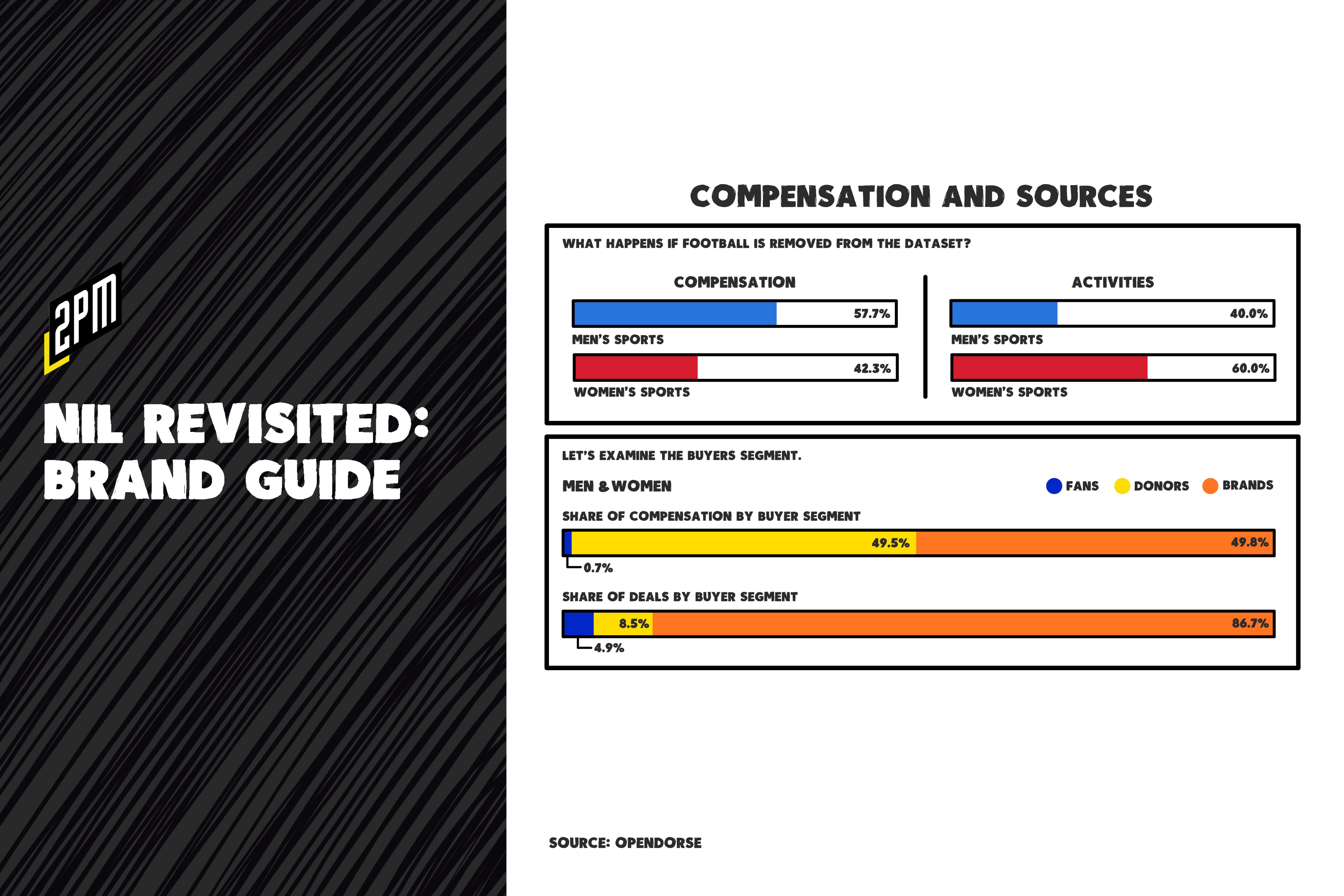
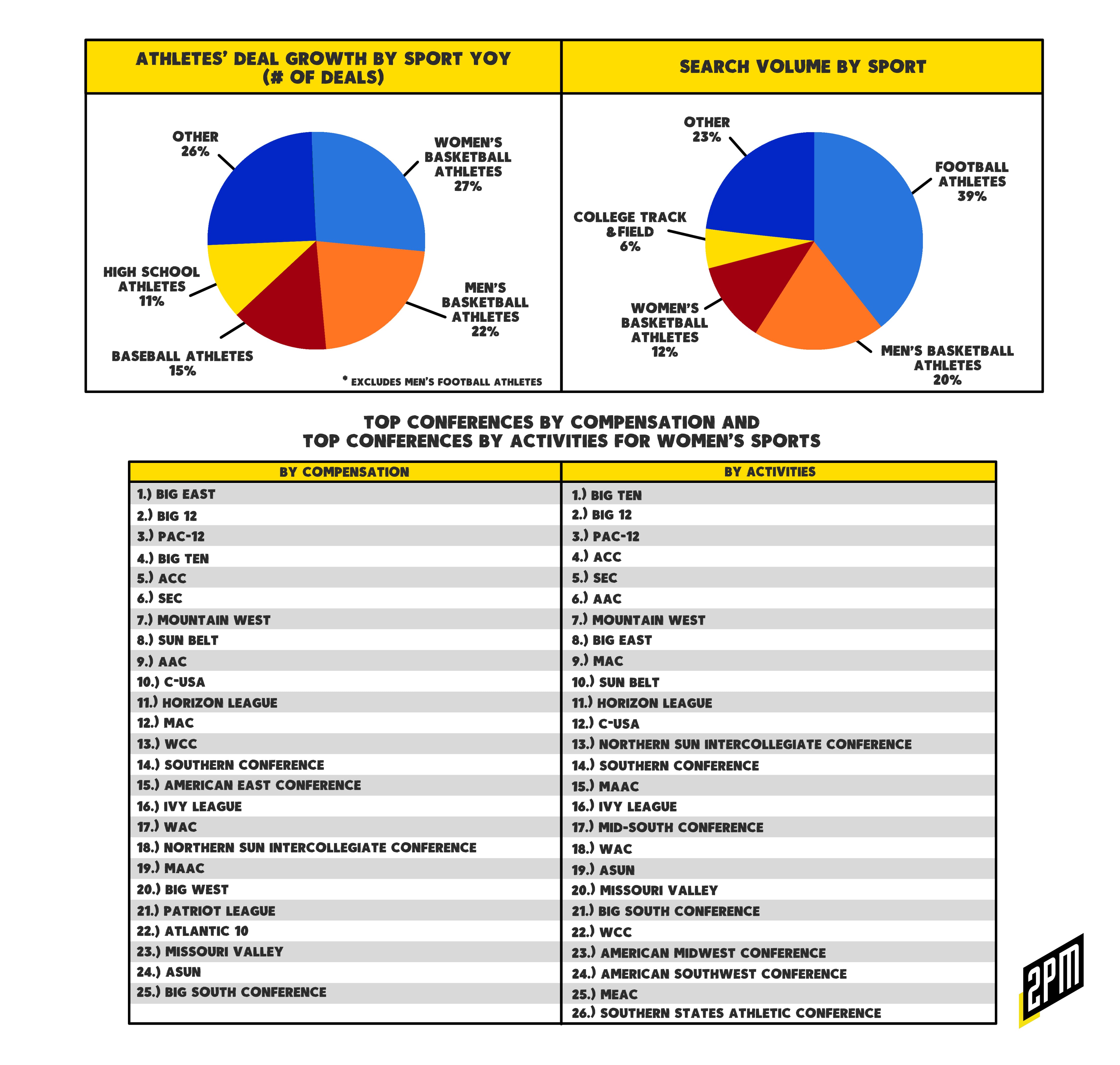
The implementation of NIL legislation in 2021 marked a watershed moment, enabling college athletes to monetize their personal brand through endorsements, thereby becoming pivotal influencers for brands targeting the lucrative Gen Z demographic. It also opened the door to athletes accepting payments from collectives of alumni and other interested parties. Outside of football, women’s basketball athletes have outpaced men’s basketball athletes in deal growth. Men’s basketball and football still maintain the highest interest by search volume.

This now three-year-old pivot has engendered a fertile ground for brand partnerships, significantly impacting the marketing strategies of companies across various sectors, particularly those in the athletic and athleisure domains.

Athletic fashion brand Vuori exemplifies this shift through its partnership with LSU All-American gymnast Livvy Dunne, who has become the brand’s first NIL athlete collaborator. Vuori’s Chief Marketing Officer, Karen Riley-Grant, emphasizes the alignment between Dunne’s “athletic expertise, determination, and positivity” and the brand’s core values, highlighting the success and authentic resonance of this partnership according to Forbes.

As Vuori’s partnership with Livvy Dunne has grown since 2021, so has her ability to collaborate with the brand.

The proliferation of NIL deals, as evidenced by Vuori’s partnership with over 400 NIL athletes, underscores the burgeoning opportunity for brands to engage with college athletes’ highly engaged fan followings. These partnerships not only offer brands a lower-cost avenue to penetrate the sports marketing realm but also enable them to leverage the personal and regional appeal of athletes, thus enhancing their marketing efficacy and reach.

Expanding Marketing Opportunities

The NIL landscape has democratized access to the collegiate sports marketing domain, allowing both established and non-traditional brands to engage with a previously inaccessible audience segment. As noted by Dan Lobring of Stretch PR, NIL provides an opportunity for individual athletes to break through the clutter, offering brands a novel pathway to capture the attention of the vast and engaged audience of March Madness and beyond. He recently spoke with Modern Retail:

It’s this unique moment where there’s obviously a ton of interest, which is great, but it also can be harder for brands to break through.

In April 2023’s Ted Lasso and Major League Soccer, I explained: “Women’s basketball figured that out and, in one season, leapfrogged the MLS and others in viewership thanks to the heroics and charisma of Caitlin Clark and Angel Reese.” Indeed, the Caitlin Clark effect and the record-breaking attendance at women’s sporting events signify not just the rising star of women’s sports but also the deepening well of marketing opportunities for brands. These events reflect an engaged and expanding audience base, ripe for brands to tap into through strategic partnerships. The remarkable viewership of the 2023 NCAA Division 1 championship game, attracting nearly 10 million viewers and NCAA women’s volleyball’s championship peaked at 2.1 million viewers according to the NCAA. To put this into perspective, the 2023 NBA finals was watched by just 1.64 million more than the NCAA’s women’s basketball title game. The NBA’s finals viewership is down 45% from its 20 year ratings highs.

****

The burgeoning domain of women’s sports, catalyzed by the advent of NIL legislation, represents a frontier of untapped potential for brands. The remarkable growth and increasing commercial viability of women’s sports have opened the doors to a plethora of marketing opportunities, enabling brands to introduce themselves to highly engaged and diverse audiences through authentic, values-aligned partnerships.

As we stand on the precipice of this new dawn in sports marketing, it is clear that the trajectory of women’s sports is not just ascending. The abilities, determination, and excellence that these athletes represent resonate profoundly with a broad spectrum of consumers, underscoring the invaluable role of NIL deals in shaping the future of sports marketing. Frankly, while college sports will always be about the money, women’s sports presents a better balance between the two realities: NCAA sports had a particular appeal built atop of the notion of the student-athlete and the fact that many of the best of those athletes are now compensated handsomely.

In the words of Karen Riley-Grant, “It’s about finding the right influencer partners…who embody the core values of [the] brand.” This ethos, captured by Forbes, encapsulates the essence of the opportunity at hand: to forge partnerships that are not merely transactions but are deeply embedded in shared values and mutual aspirations. You’re more likely to find that on the women’s side than on the men’s, where it has become nearly mercenarial for short-term gain. As brands and athletes learn this and navigate this new landscape, the potential for impactful, lasting relationships that transcend the college game is high.

As we venture into this uncharted territory, the stories of athletes like Jacy Sheldon (Ohio State), Cameron Brink (Stanford), JuJu Watkins (USC), Angel Reese (LSU) and Caitlin Clark (Iowa) serve as beacons

This narrative, marked by record-breaking viewership, groundbreaking partnerships, and an evolving understanding of the business of amateur sports, sets the stage for an era where women’s sports occupy a more central place in the cultural and commercial landscape. The rise in revenue, engagement, and visibility for women’s sports is not just a trend but a testament to the shifting dynamics of power, influence, and opportunity in the world of sports.

The integration of NIL deals into the marketing strategies of brands offers a blueprint for harnessing the potential of this new era. The success stories borne of these partnerships underscore the symbiotic relationship between athletes and brands, where shared values and common goals pave the way for innovation, engagement, and, ultimately, transformation.

As this continues to evolve, the opportunities for brands to engage in meaningful, impactful partnerships will only expand, heralding a new chapter in sports marketing where the prowess, influence, and aspirations of all athletes are at the forefront, driving forward a future of unprecedented growth and opportunity to more of those who are deserving of a warmer spotlight.

By Web Smith | Edited by Hilary Milnes with art by Christina Williams