
Memo: The Daily Harvest Ordeal

You’re damned if you do; you’re damned if you don’t. Keep this old adage in mind as you read on.

In the four weeks leading up to the recall, Daily Harvest was riding the high of positive press; it was the flavor of media attention that direct to consumer brands clamor for. The Forbes treatment highlighted the equity partnership between Daily Harvest and Blake Griffin, Carmelo Anthony and other notable athletes through the Patricof Co investment vehicle and advisory platform. Each of those involved were a part of the Series D financing which was announced in Q4 2021 and closed in Q1 2022. The Fortune treatment focused on the spectacular achievements of CEO Rachel Drori, the former marketing executive turned consumer goods founder. You know the narrative by now:

Daily Harvest saw exponential growth through the pandemic, when people all over the world turned to their freezers with newfound appreciation. When the crisis started in the U.S., Drori began doubling up on inventory and appealed to her network of farming suppliers to keep fruits and vegetables flowing to Daily Harvest kitchens. (3)

She is now worth $350 million after just seven years of building a retail operation whose revenues lived up to the marketing and branding hype. The DTC Power List estimates annual revenues at $158 million and that is likely on the conservative end. When a brand is on that type of press track, they will do anything to preserve it. Here is a short timeline of events:

  • April 28: Daily Harvest announced the launch of Crumbles (positive)
  • May 28: Daily Harvest announced partnership with Blake Griffin (positive)
  • June 15: Daily Harvest founder is featured in Forbes (positive)
  • June 21: Daily Harvest is featured in Eater, NBC News, and others (critical)

It’s the worst-case scenario for a CPG brand in the fastest growing sectors in direct to consumer retail. Earned media (in Forbes and Fortune, for that matter) are rare. Few brand CEOs would be willing to put that to a premature end to face more complicated matters. But one could argue that it may have been the only option. There is also a counter-argument, however.

As early as April, Daily Harvest customers were reporting severe stomach discomfort, liver pain, and gastrointestinal problems that landed some in emergency rooms. The issue was traced back to the product announced in April. Almost immediately, the conversation shifted from recipes to criticism on Daily Harvest’s subreddit.

Two weeks ago I tried the crumbles for the first time. That night, I had debilitating stomach pain, like nothing I had ever felt before. It was so bad I had to go to the ER as a last ditch effort to alleviate and manage the pain. After a CT scan, IV, meds, and a week on a bland diet I thought perhaps it was some sort of bug.

Several days later I tried a flatbread from them and had a fever the next day. I thought it was related to the previous bout of illness.

Fast forward to yesterday, I decided to try the crumbles again. Lo and behold I am awake with the exact same horrible stomach pain. Luckily I have prescription meds from the last time this happened and do not need to go back to the ER.

Before issuing an official recall on Sunday, the team seemed to have a faulty approach to customer service outreach, with NBC reporting that it had reached out to at least one customer to advise they throw out the lentils and offering a discount code days before there would be a statement released. What became clear is that the problem was more widespread than Daily Harvest’s team likely communicated through its social media presences. In the days before issuing a recall, Daily Harvest was in an unenviable position. There was the positive press that they hoped to amplify to help them reignite the growth that they’d gained over the pandemic. There was also the negative sentiment that they knew to address.

The response evolved from:

A small number of customers have reported gastrointestinal discomfort after consuming our French Lentil + Leek Crumbles, the email said. As included in our cooking instructions, lentils must be thoroughly cooked to an internal temperature of 165°F.

…to a response that included:

We launched an investigation to identify the root cause of the health issues being reported. We’re working closely with the FDA and with multiple independent labs to investigate this. We are working with a group of experts to help us get to the bottom of this—that includes microbiologists, toxin and pathogen experts as well as allergists.

Daily Harvest worked to balance corporate growth and stability with consumer accountability. I’d argue that their scenario is more complicated than the general public understands. Once the Food and Drug Administration (FDA) is involved, it is never an amicable scenario for the product manufacturer. Today, I interviewed an anonymous source with first-hand experience on dealing with the Administration:

When [the FDA] is involved, your brand instantly loses its voice. Nothing you say or do is right and everything bit of messaging goes through them. They prefer that your brand suffers and they will assure that it does. This is how they deflect blame with product defects.

There’s an ideal playbook for responding to a potential recall without losing consumer trust. You’d think that it looked like this: act quickly, be overly-cautious and be transparent. In 2015, Jeni’s Ice Cream – another 9-figure revenue CPG brand – had a listeria scare that could have been deadly. The way the company responded felt right but it had severe penalties.

In 2015, Jeni Britton of Jeni’s fame experienced a public backlash of her own. With the help of CEO John Lowe, the first of 16 appearances of Polymathic Audio, Jeni’s executives navigated a national listeria crisis by acting quickly, being overly-cautious, and being transparent. In many ways, while noble and morally-praised, it backfired. Nearly seven years to the day that a similar article ran on Eater about Daily Harvest, they published this on Jeni’s $2.5 million loss (the company was bootstrapped at the time).

Ohio-based ice cream company Jeni’s Splendid Ice Creams has traced the source of its listeria outbreak. Last month, Jeni’s —  which operates multiple scoops shops in addition to a national wholesale business — initiated a voluntary recall of all of its products after a random sample from a pint of ice cream showed that Listeria bacteria was present. A week later, the company announced that it destroyed over half of a million pounds of ice cream, which is estimated to have cost the company $2.5 million

Lowe, Britton and team destroyed their inventory and publicly sacrificed themselves at the altar of public opinion and made matters worse for the company. The news proceeded to package their company with Blue Bell Ice Creams, a separate company that allowed deaths caused by their own listeria outbreak. Blue Bell employed an opposing strategy: deny, stall, and keep quiet. While Jeni and her team did what was morally right, preventing sickness by recalling their own products, they dumped gasoline on an otherwise regional story and likely angered the FDA in the process (by going around them to publish a blog). Just three years later, an NBC News report recounted the ordeal:

Lowe and Britton Bauer decided the only way forward was to fully tackle the problem — and to do it with complete transparency. “We decided to pull all of our ice cream — not just that lot, not just that flavor, but everything, and shut down our scoop shops,” says Lowe. “We couldn’t — fathom the idea that somebody could walk into our scoop shop the next day and be injured.” The Jeni’s team also released a blog post about the recall on their website.

The sentiment of the NBC Report was simple: “Jeni’s commitment to complete transparency and damage control was costly.” In that report, you won’t find a single mention of the FDA who was reportedly angered by the approach of the Jeni’s team. I came to find a common thread by researching brand responses with FDA oversight. The government agency often prevents you from communicating effectively to consumers. In return, the brand is often dealing with an angry customer base, a media sentiment that reflects customer concern, and few allies willing to stand by the brand (until it is beyond its troubles).

There are lessons to be learned from any story involving CPG brands, harmed consumers, and the government agency enacted to be the buffer between consumer and the consumed. The first lesson is that there is no completely right way forward. Daily Harvest was lambasted by social media for being unnecessarily coy in their responses. Jeni’s was nearly bankrupted for being too transparent. You’re damned if you do; you’re damned if you don’t.

Rachel Drori and Daily Harvest will find a way through this. If Jeni’s story was any indication, it’s possible to rebuild trust with customers. Few remember 2015 at their countless scoop shops around the country. One takeaway from Jeni Britton’s work to rebuild her namesake brand is to over deliver until trust is rebuilt. The brand in question may build new brand advocates in the process.

By The 2PM Team: Art, Editing, Data, and Research

Member Brief: The First Omniversal Brand

We all have our opinions. To many, Michael Jordan is Nike’s greatest athlete. To others, it’s Kobe Bean Bryant, Cristiano Ronaldo, Tiger Woods, or Serena Williams. For me, it’s Steve Prefontaine. Nike’s first athlete set the stage for decades of the brand’s rebellious and counterintuitive thinking. The spirit of Pre lives on.

Nike is one part retailer, one part media company, and two parts religion. The company has been covered extensively throughout the 2PM library and for good reason. One of our earliest reports on Nike began:

History has a way of changing things. The way that consumers view things today will be different in a decade or two. By every indication, Nike is working to achieve a few things. The Beaverton, Oregon brand has gone all in on iconography, images of people who become bigger than life. Perhaps, their marketing decisions aren’t for our lifetimes. Perhaps they are for the lifetimes of our children.

Its cultural impact, global reach, and inventiveness have contributed to an evolution from independent running shoe company to an omniversal brand.

Defining an omniversal brand: Nike navigates traditional retail, DTC, and metaverse seamlessly through its physical and digital presences. It promotes commerce and relationship development in an integrated manner, elevating the brand in each format. To achieve this, Nike had to accomplish four separate objectives:

  • impact cultural moments
  • fortify its DTC channels
  • defend its intellectual property through resale
  • establish its IP rights through metaverse-adjacent projects

Impacting Cultural Moments

As an apparel retailer: Nike is in a class of its own. The New York Times’ Vanessa Friedman wrote the reflection on Nike’s cultural impact. Her deep dive spanned the early days with Spike Lee, the 1985 tie-up with Michael Jordan (remember, his rookie year shoes were initially banned), its new era of high fashion clout and its growing secondary market resale value. Its competitors can barely reach its stratosphere, though Adidas and Lululemon are trying. It sits on a Mount Rushmore of iconic American brands; its future is brighter because it’s the first of its kind.

It has its founding fathers: Phil Knight, a former University of Oregon runner, and Bill Bowerman, his college coach, who famously poured rubber into his wife’s waffle iron to make a new running sole. It has an anthem: “Just Do It,” introduced in 1988. Most of all, maybe, it has an emblem.

That puts it closer in history to such brands as Coke, IBM, Disney and McDonald’s than any athletic or even fashion name. The only other brand to make the leap so effectively and completely from commodity to identity in the last half-century is Apple.(1)

When a company like Nike, or Disney, or Apple makes a strategic move, it reverberates throughout numerous industries. They each have the ability to exist in every industry at once. Nike wants the resale market, too: a Nike-owned resale site has the potential to capture new ground that Nike has ceded to platforms like StockX.

Fortify its own DTC channels

Nike has proven that it decides its own fate when it comes to distribution. The one piece of the puzzle Nike doesn’t currently oversee? Resale. The sneaker resale market has become a robust secondary trade that marks the most coveted shoes on the internet. Nike accounts for the vast majority of sneakers sold at auction at Sotheby’s, according to the NYT. Companies like Stockx, Stadium Goods and more have built entire businesses around selling after market Nike sneakers. If Nike were to bring sneaker resale under its own hood, that would disrupt the entire sneaker ecosystem. From TechCrunch:

In May 2019, Nike called itself a tech company with the development of Nike Fit, a scanning solution to find Nike app users’ best shoe fit. The product was developed by Intervex, a Tel Aviv-based startup.

A Nike-owned resale marketplace could be an extension of the Nike app as a place to buy and sell used or deadstock, resold Nike sneakers and apparel. Functionally, it would be more similar to GOAT or eBay than Stadium Goods or StockX, which only allow unworn sneakers. (3)

Authentication would be guaranteed under a Nike-owned resale app. Fake sneakers often end up in the after market and those buying from Nike could rest assured they’re buying the real thing. Nike would also benefit from the influx of customer data. They’d know more about the customers most persistently active in both the primary and secondary markets and how to market to the consumers who prefer first market over second market (or vice versa). They could also better control and orchestrate demand without alienating too many customers. From Not Authenticated:

Nike then made bigger moves late last year when it built Nikeland and acquired RTFKT, a digital collectibles platform. And so, retaliation against StockX for selling Nike sneaker NFTs was inevitable.

Resale could seamlessly become part of Nike’s popular SNKRS app. It’s also possible to connect the dots between Nike’s metaverse efforts (which we’ll get to later) and resale. You can imagine Nike rewarding NFT holders with access to a resale auction, for instance. If Nike pulls it off, it would be the first major brand to fully close the loop on its resale business – something other companies would then be interested in copying. Nike is the first omniversal brand.

Defend intellectual property

Competition is fierce. Nike is known to throw its weight around in areas it wishes to own. Nike is no stranger to lawsuits: It’s currently embroiled in a battle with Stockx over Stockx selling NFTs of Nike sneakers as well as counterfeit Air Jordans. It’s taken MSCHF to task over its Satan sneakers. It’s on the receiving end, too. Adidas this week filed lawsuits against Nike over its adaptive sneaker patents and its app suite, which have become a defining strategy for Nike. It’s a typical back and forth spar for Adidas and Nike, but in the grand scheme, Adidas is ultimately nipping at Nike’s heels. From Business of Fashion:

Apps have become important tools for brands to reach customers that are increasingly living on their phones, and Adidas’ apps haven’t generally been as popular as Nike’s. Nike’s main retail app is currently the number eight shopping app on Apple’s iOS in the US, according to intelligence platform Apptopia. SNKRS ranks at 27 and Adidas’ equivalent, Confirmed, at 34.

As of February, SNKRS also had more than 2.5x the market share (vs. Adidas) based on monthly active users as confirmed among the leading, direct-to-consumer sneaker apps.

Establish IP rights in the metaverse

The complaint filed by Nike describes NFTs as “part of the future of commerce.” It also warns that the burgeoning technology is susceptible to trademark infringers seeking to reap profits off of rights that does not belong to them.

As the first omniversal brand titan, Nike’s push into the metaverse is one to take seriously. With RTFKT, the digital studio it acquired last year, it released its first digital sneaker, which sold out instantly and has become a collectors’ item in the virtual world. Nike has been working to carry over its cultural clout to the metaverse, by trademarking its name and logo and partnering with Roblox to built out a branded world, Nikeland. It’s claiming its turf now – other brands will find themselves playing catch up.

Nike’s move into the metaverse is so powerful because it has the means to build, test, and acquire new technologies. It has a metaverse team already in play to help it define its presence in the virtual world. The possibilities are near endless and that represents a huge business opportunity for retailers who will follow Nike’s playbook. Recently, it introduced direct-to-avatar purchases with RTFKT. It’s not just a metaverse strategy. From PSFK:

A key component of Nike’s metaverse-fueled direct-to-avatar virtual product sales approach is the launch of its own metaverse, Nikeland. Hosted within the immensely popular Roblox platform and metaverse, Nikeland has already received almost 7 million direct visits from 224 countries since its launch. Nikeland is free to access, and stocked with minigames. Users are encouraged to outfit their avatars with digital versions of the newest Nike product drops, and shoppers are able to purchase Nike CryptoKick and skins directly for their avatars. (2)

The adoption of Web3 principles by traditional retailers will be gradual but Nike has begun to lay an omniversal foundation by building up its direct-to-consumer business and investing in its own apps, trademarks, and intellectual properties, while reducing its dependence on traditional retail channels. Web3 and DTC are natural partners and Nike will be of the first major retailers to iterate around Web3 principles. It’s not just a new revenue stream: it’s community and status. It’s belonging.

As eCommerce becomes ever-present in our lives, that line of demarcation between eCommerce and our physical lives continues to blur. As brands adopt metaverse strategies, physical goods are getting digital versions. In December, we wrote on the CryptoKicks movement:

Nike prides itself on being first in line to new innovations or opportunities. The few times that it hasn’t been, it’s marketed so well that the consumer eventually forgot that another brand beat them to the punch (Nike has owned the mindshare in everything from NBA basketball to pro skateboarding). The retailer will not have to worry about coming in second on its way to the metaverse.

The retailer seems to understand the value of digital real estate, the future of virtual communities, and the importance of investing in the products that bring the two together today. When the late Steve Prefontaine used to run, it was wild and relentless. He ran for legacy and for principle. He made his own rules and established that he was the best at his craft. He would say, “I have to go out hard and lead from the start.”

Nike’s best athlete laid the strategy for much more than the sports icons it sponsored. The first omniversal brand is available anywhere and everywhere shoes are worn.

By the 2PM Team 

Memo: Fast, Faster, Fastest Fashion

Fast: H&M. Faster: Zara. Fastest: Shein. It’s a progression that has changed consumerism, accelerated textile production, and hurt the economy while doing so. Zara disrupted H&M and then Shein unseated them both. Now, H&M has gone on the offensive in an effort to regain the advantage it once had.

The hope is to regain the millions of consumers who’ve gone the way of Zara and Shein. It all comes down to the x and y axes of two competing ideas: economics and environmental impact.

There are consequences to fast-fashion and athleisure; plastics weren’t intended to be worn and discarded with impunity.

The chatter around the future of fashion is one of pure contradiction: a young generation of shoppers say they want to preserve the environment. Juxtapose this ideal atop of what they actually buy and you’ll find that there are cracks in their collective “save the planet” philosophy. Gen Z is often referred to as the most sustainably conscious, environmentally-minded consumer segment. They’re also fuelling the rise of Shein, the biggest fast fashion company in history. Zara and H&M were small retailers in comparison. A 2021 Harvard Business School case study explained how Inditex, the parent company of Zara, innovated around supply chain efficiency to produce faster products that were more in-line with trends.

Zara was the Group’s oldest and largest brand, representing around 69% of sales, or €18 billion in 2018. At the core of Zara’s success was an innovative business model based on a very responsive supply chain and quick merchandise turnaround. Zara designed, produced and delivered new items to stores in less than three weeks, allowing it to constantly update its collections and adapt to changing customer tastes.

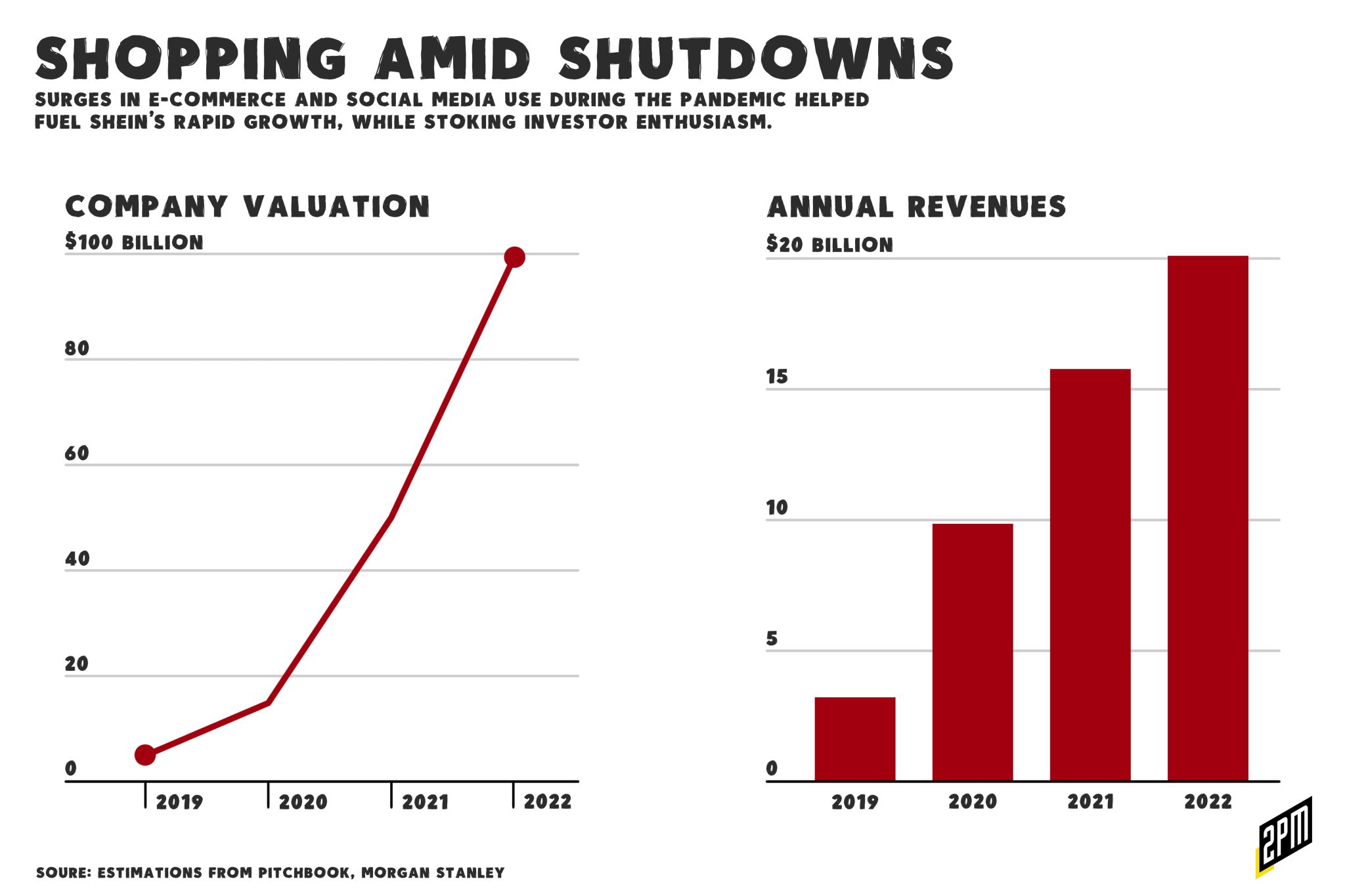
Just two years after this case was written, Zara is now looking upwards at an infant brand: Shein is Zara on steroids. And Gen Z loves it. Shein has become a favorite on TikTok, where users share hauls from the brand of $15 dresses, $10 shorts and $5 tops. The clothes are cheap and trendy, designed for one-time wears posted on social media and discarded. The concept is not new but with the trend toward sustainability, it was supposed to be going out of style. Instead, the idea is more powerful.

Shein’s scale is difficult to grasp. The operation is more secretive than most but what is evident is that we are more aware than ever of the consequences. There are very tangible negatives to fast-fashion and athleisure; plastics weren’t intended to be worn and discarded with impunity. Fortune wrote a deep-dive on Shein on May 31, laying bear the narrative:

Global investors, for whom it is increasingly fashionable to champion high standards on environmental, social, and governance (ESG) matters, are similarly smitten. They have pumped Shein’s valuation up to $100 billion, making it the world’s third most valuable startup behind ByteDance, the Chinese parent of TikTok, and Elon Musk’s SpaceX. Shein is now worth more than H&M and Inditex, Zara’s parent company, combined, according to Bloomberg.

But while Shein’s innovative business model might lower prices for consumers, watchdogs grumble that Shein has built its clothing empire on the back of cheap labor, knockoff goods, and A.I.-driven design software that encourages consumers to ditch old outfits at rates that are bad for the planet. Those complaints, along with a recent e-commerce slowdown, make the company’s continued dominance far from certain.

Fortune’s position that, in so many words: “Shein’s impact on the environment will eventually lead to its undoing” is faulty at best. Why? There is a cognitive dissonance in fast fashion’s target market. Can one save the planet while buying $13 dresses for Instagram? So far, fast fashion companies have only lost dominance when they’ve been replaced by faster companies that can regurgitate trends at lower prices. Whether Shein’s nefarious practices are lost on customers or willfully ignored doesn’t ultimately matter. Customers who are drawn to clothing because of their affordable price are typically not the same ones who will stop to ask why a piece of clothing costs so little. What does matter is the bottom-line evidence that faced with cheap options, young consumers will shop for fast fashion.

At play behind the rise of Shein is a combination of factors. Social media has accelerated the trend cycles of fashion. Sustainable fashion is prohibitively expensive and the shifting tides of consumerism have, for many, determined that fashion is not an investment, at least not in terms of trends. Consumers are often held responsible for “voting with their dollars” when it comes to encouraging corporations to be more sustainable but this has never been completely true. Customers will buy what is easily and affordably available, particularly when they’re young.

Shein itself is a black box. Little is made public about how it sources and manufactures its clothing but the numbers and price tags speak for themselves. The company has started speaking up about – of all things – its sustainability efforts. Vogue calls this greenwashing:

Each week, a shocking 15 million garments arrive at Kantamanto Market from countries in the Global North, decimating the local textiles industry there.

It hired a global head of ESG and recently announced a $50 million fund that will go toward offsetting its environmental impact and handling its waste problem. That is a $50 million drop in the bucket that will barely undo a stitch of what Shein has unleashed on the market of TikTok, Snapchat, Instagram, and Kardashian loyalists. This week, it received praise for partnering with the OR Foundation, which it will give $15 million over three years in order to combat clothing waste in Accra, Ghana, where many discarded clothing ends up.

It’s nothing more than a diversion from the reality of the impact on landfills. Shein calling out waste and donating funds to bring attention to the cause may be perceived as disingenuous. Luckily for them, H&M is doing something similar, committing $250 million alongside Lululemon on behalf of the new organization that succeeded Aii:

“What we’re trying to demonstrate is that this is the center of gravity for all of climate work and everyone from Textile Exchange to Fashion for Good to many others — that are working in lowering carbon and coming up with solutions and getting them to pilot — are all beneficiaries of this,” he said. “This is a collective ‘we.’ This is not giving it to Aii, and it’s not going to go into other climate work. This is creating a central pooled fund whereby we all can begin to look at a more consolidated approach as opposed to fragmentation of project work that’s not talking to each other and duplicating efforts.”

What will solve fashion’s Shein problem is not donations, public relations, or acknowledgements of wrong-doing. The more fruitful solution will be social media trending away from fast fashion and towards sustainability. But there’s no relying on Gen Z customers to fix this problem. It is time to accept that no well meaning customer can stop the retail machine desired by millions, as new trends come along and TikTok broadcasts them for all to emulate.

By The 2PM Team