
This member brief is designed exclusively for Executive Members, to make membership easy, you can click below and gain access to hundreds of reports, our DTC Power List, and other tools to help you make high level decisions.
Memo: The Type House

Bundle and unbundle, bundle and unbundle, bundle and unbundle – but then generate profits on both. These weren’t his exact words but that was the message. In one sentence, my father described his industry. At 12, I sat in a cubicle in a Houston industrial park, an unofficial intern of his Time Warner Communications division. I would go on to work the traditional work weeks, each summer, between that year and my graduating year of high school. I was paid in perspective, and I mean that sincerely.
At the time, my father was the senior executive in charge of a fledgling broadband internet project called “RoadRunner.” (It would later go on to power Texas’ residential internet needs, but that’s a different story.) His words were transcendent to me because they explained that the value of a product could be amplified by how it’s packaged.
By now, you’ve heard of the TikTok influencer craze. (You may have even felt a twinge of fatigue by the momentum of it all. There is new terminology, dance moves and global political implications to keep up with, along with the excessive screen time required to digest it all.) This creative platform has further popularized the concept of the “collaborative house” made popular by YouTube creators David Dobrik (Vlog Squad) and Jake Paul (Team 10). For the most marketable of these houses, the platform began to matter less. Dobrik, a videographer and philanthropist who began on YouTube, nearly duplicated the magnitude of his audience on TikTok in just a month’s time. New members join, old members leave as their profiles grow. Collaborative groups are reminiscent of the cable industry’s intrigue: bundle, unbundle, bundle, unbundle.
In the land of TikTok, the Hype House is a particular group of 20-something content creators who live in or around Los Angeles; many of whom cohabitate. The group includes a number of the best and brightest creators in the space, including former members Charli D’Amelio and her sister Dixie. Together, the sisters have amassed 10s of millions of subscribers across TikTok, YouTube, Twitter and Instagram. Some industry analysts argue that the D’Amelio family is the next Kardashian clan. Objectively speaking, that anointing is the golden calf of media and commerce opportunities.
No Title
D’Amelio family is the new Kardashian family.@charlidamelio + @dixiedamelio + @marcdamelio + @heididamelio
The TikTok house seems like it exists in an entirely different media universe than the email newsletter, but there are more similarities than it would appear. Critics of the newsletter industry say its missing the above frameworks: collaborative houses, bundling, unbundling, platform agnostic growth, and the power of media-driven commerce. There aren’t many venture-funded companies with as much raw potential as Charli D’Amelio or David Dobrik. In both cases, the young entrepreneurs mastered the physics of new media. In its own way, the newsletter industry is hoping to crown their own winners. Those winners will accomplish the same.
Consider the inevitability of “subscription fatigue.” It’s a common refrain made by critics of the burgeoning newsletter industry, one that Substack has helped to democratize and Ben Thompson’s Stratechery has helped to inspire. In 2019, Gartner’s Laurie Wurster wrote:
By 2020, all new entrants and 80% of historical vendors will offer subscription-based business models.
But the fear of paid subscription fatigue may be overstated. There are two categories of monthly subscriptions:
Category No. 1: entertainment, distraction, or light enrichment.
Category No. 2: helps to build a new world by enabling education, professional growth, or networking opportunities.
Each of our paid subscriptions can be placed, primarily, into one of the above categories. The first category has dwindling demand elasticity. This may explain Quibi’s current trouble: consumers can only tolerate so many distractions. There’s infinite substitutes for entertainment, sensationalism, dopamine hits. The subscription ecosystem becomes finite at a certain extent. This category includes streaming services, games, digital entertainment.
The second category has demand elasticity that may hold steady. This group of subscriptions may also compete with continued education, social clubs, or corporate networking. Certain newsletters may improve or outright replace certain social or professional functions. Some of the best newsletters are also building communities around ideas, possibility, and navigating the future of the industry.
A play on the TikTok craze, the newsletter industry has its own brand of collaborative house. In it: great ideas have been ideated, concepted, and executed.
Founded by Nathan Baschez, The Type House is a group of 40 newsletter publishers: former A16Z associate Li Jin, Turner Novak, David Perrell, Sriram Krishnan, Lenny Rachitsky, Brett Bivens, Blake Robbins, Ian Kar, Alex Kantrowitz, Cherie Hu, Packy McCormick, Adam Keesling, Dan Shipper, Polina Marinova, Sari Azout, Nikhil Trivedi, Nikhil Krishnan, Brad Wolverton, Josh Constine, Sid Jha, Laura Chau, Morning Brew CEO Alex Lieberman, Trapital‘s Dan Runcie, Byrne Hobart, Allen Gannett, Sarah Nockel, Brett G, Paul Smalera, Trends.vc’s Dru Riley, Justin Gage, Rui Ma, Cat Lee, Can Duruk, Alex Taussig, Seyi Taylor, and myself.
Bundle and unbundle, bundle and unbundle, bundle and unbundle – but then generate profits on both.
The group is diverse in every sense of the term. Within it, you can observe the mechanics of media-driven commerce at work. Of the highlights, consider David Perrell. The writer-turned-teacher has monetized with educational courses. His company is now generating seven-figures in annual revenue. Morning Brew is one of the most promising newsletter-driven companies in business today. Dan Runcie has pivoted from media to consulting those in the hip hop industry. In doing so, his existing Trapital product has become top-of-funnel for lucrative consulting projects. 2PM continues to successfully navigate high level consulting and the growth of its own paid community of senior executives, artists, scientist, and independent thinkers. Polymathic is nearing its first year in existence. But, perhaps, the greatest indication of what’s to come is a throwback to my time in the Houston cubicle. Bundle and unbundle, bundle and unbundle.

Of Substack’s brightest opportunities to solidify its place in the creator ecosystem, the Everything Bundle began as an experiment between Nathan Baschez and Dan Shipper. It has since grown to include Adam Keesling, Li Jin, and Tiago Forte’s work. By bundling their individual efforts, they’ve developed a flywheel of business that has propelled them to Substack’s famed leaderboard. Though each of them are very capable of self-promotion, its their collective works that seem to drive new consumers to sign on for $20 per month or $200 per year. With each new property that is added to Everything, a new wave of subscriptions follow suit. I’ve likened the pivot to Basche and Shipper building The Athletic of business and intellectualism. And it just might work.
The value of prolific writing and creativity is that you’re always in a pattern of thought. You’re constantly assessing beliefs and designing paths to further your understanding of a topic. When entrepreneurial thinkers begin a newsletter on the platform of their choosing, they are doing so out of sheer passion. Their minds are always thinking of enrichment, improvement, development, and progress. Like the YouTube videographers of yesterday, or the TikTok minds of today, or any creator of tomorrow, the art is rarely contained by the platform. The great secret of creativity is that it can evolve. Many of today’s brightest businesses were yesterday’s projects-turned-ventures.
There is great potential for any subscription-driven media company to grow beyond its early intentions. If and when subscription fatigue begins to hinder the newsletter industry’s growth, the best and brightest will identify new mediums for their message and their engaged communities will follow. From YouTube to Vine to TikTok, this is what great digital creators have always done. They’ve outworked fatigue. It’s due time to place newsletter entrepreneurs in this coveted category.
By Web Smith | Editor: Hilary Milnes | Art: Andrew Haynes | About 2PM
No. 343: From Audiences to Communities
An open letter to creators. By now, there are hundreds, if not thousands, of viable membership-based newsletters. And that’s a great thing – an unequivocal advantage for creators and consumers alike. Of those thousands, a number of them serve as sources of original ideas, news, and analyses that are incredibly valuable to professional ecosystems. It’s the synthesis of these ideas that has the greatest potential impact. If education is priceless, we are entering a new era of value creation. Imagine an Enlightenment-era coffeehouse.
There are newsletters run by operators who publish original ideas. There are meaningful letters that curate the ideas of of others. Some of them report on the news and others categorize and comment on industry developments. Often, reports that have been written by one person are refined by others. And frequently enough, mainstream outlets like The Wall Street Journal or CNBC will pick up on original concepts and make them their own. Like a coffee shop, this is a valuable form of information synthesis.
John Dowell is a professor at Michigan State University. Over his nearly 40-year career, he’s taught English, Sociology, and Anthropology. His course on the introduction of synthesis explains:
A synthesis is a written discussion that draws on one or more sources. It follows that your ability to write synthesis depends on your ability to infer relationships among sources – essays, articles, fiction, and also non-written sources, such as lectures, interviews, observations. This process is nothing new for you, since you infer relationships all the time – say, between something you’ve read in the newspaper and something you’ve seen for yourself, or between the teaching styles of your favorite and least favorite instructors.
In the Age of Enlightenment (1715-1789), a European could gain entry into a coffeehouse by buying a drink. But the drink was just the price of admission, the conversation was the attraction. It wasn’t solely the conversations on matters of sociology, economics, and law that drove the age forward. Sometimes, patrons would overhear concepts that would fill gaps in their own thinking. Other conversations would solidify pivotal ideas, directly or indirectly.
Coffeehouse Inspiration
It was a coffeehouse conversation that I had in November of 2015 that struck me as one of the most important professional discussions that I’ve had. The discussion was on the mechanics of community and the need for tools that could maximize serendipity. On an idle day in late 2015, I began planning the launch of what I then called 2PM Links. I paid for a service called Goodbits and launched the landing page for the site. After a week or so of pushing the idea of 2PM on Twitter, I confirmed that the first letter would publish to twelve whole readers. I’d go on to publish five days per week for 180 business days straight.
On paper: 2PM Links would be one part original concepts and one part data and narrative synthesis, a curation of developments that would tell a story. The emails themselves would allow for 1:1 dialogue. The most engaged readers would write in explaining how they recognized microtrends and larger movements. Others would explain methods for synthesizing each letter for maximum effect. On occasion, I’d read an email from an early subscriber explaining how a cluster of articles over several weeks helped them to plan their company’s next steps. For nearly two years, those letters would help sustain the motivation to maintain operational consistency.
Reach vs. Depth
To build something that was designed to grow slowly, I maintained paying roles at established companies. However, at the time that I started the publication, I was between media jobs. Having managed or led eCommerce at two digital media publishers, I learned a tremendous amount from two vastly different styles of conversion-based (read: affiliate) publishing.
Company A built a hyper-targeted funnel, honing in on a specific (affluent) consumer. There, direct traffic was high and SEO was a secondary funnel. Brand was most important. This company would rely on it. Company B built a system that would rely upon SEO and topic interest, not the clout of the platform itself. For B, reader loyalty was secondary to SEO discovery. Visitors clicked through to read about a topic that they stumbled upon. If A was a funnel, it would be short and wide. Trust was built over time. For A, the readership would be driven by loyalty to the platform. Meanwhile, the B funnel captured new people by optimizing articles for topical keywords. Its funnel would be longer with a number of entry points throughout. Those entry points would also serve as exit opportunities. Churn was higher.
The result:
- Company A: smaller audience, higher loyalty, higher conversion rate. 1.8 million to 2.2 million MAU. Product segment: modern luxury.
- Company B: lower loyalty, lower conversion rate, larger audience. 6-7 million MAU. Product segment: accessible luxury down to daily deals.
A and B continue to operate successful media brands with disparate objectives. As they say, there’s more than one way to skin the proverbial cat.
To prove out the long term viability of the newsletter, I allotted 180 letters to figure things out. As things progressed, 2PM took on more and more characteristics of Company A. After reaching number 180, this identity influenced the next steps. Once I reached Letter No. 180, there would be three options:
- move forward and publish No. 181
- shutter the letter
- replatform and build a company
The choice was option number three. In my seven pages of scribbled plans, I agreed that I’d emphasize depth over reach. I’d maintain an emphasis on the “A” version of media. To do so, I emphasized a paid subscriber model. And then a data / advisory model. And later, an executive community. These initiatives would allow me to reinvest revenues into improved services, design, content development, and greater overall access.
From Audience to Community
Over a matter of two weeks between December 2017 and January 2018, I replatformed from Goodbits to Mailchimp, designing around a Memberful integration. I invested in branding and design. I coded much of v1 of the site in my free time. And later I’d import some 240 editions of 2PM to the WordPress site, one by one. In March of 2018, after two months of testing, 2PM’s first membership launched to the Monday Letter’s subscribers.
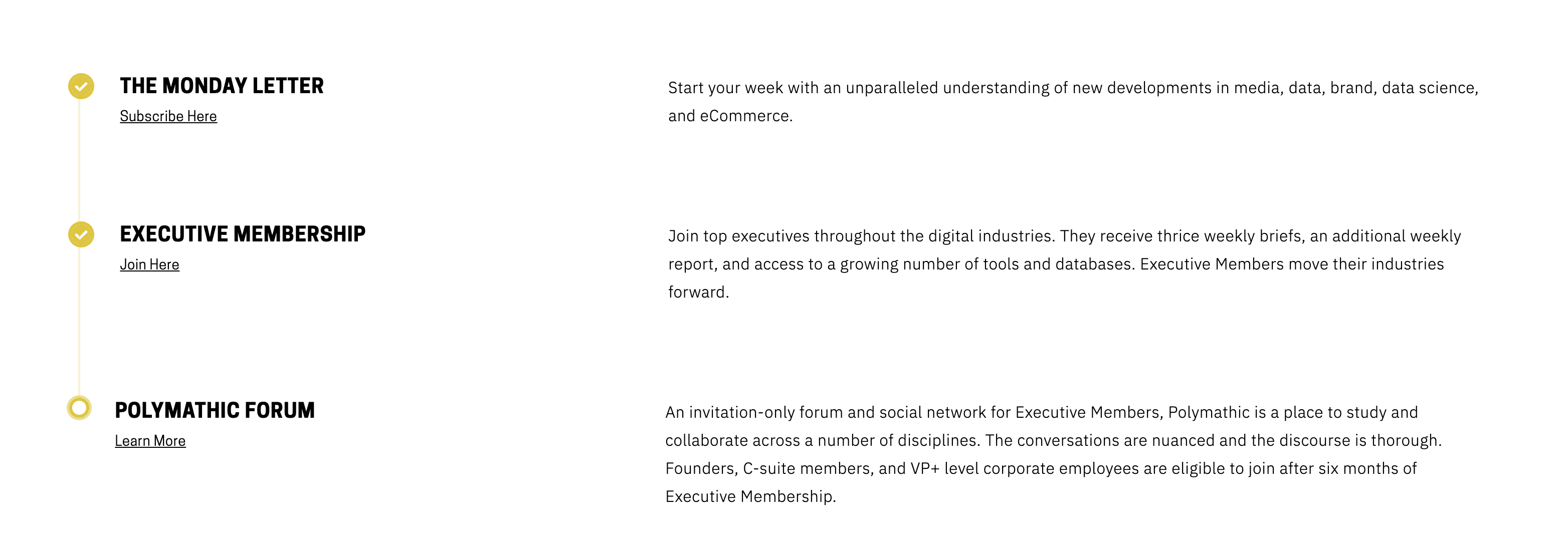
In this way, 2PM’s system became somewhat of a funnel. Around 10% of all subscribers become Executive Members. And, upon invitation, a percentage of Executive Members opt in for direct communication with like-minded executives across a number of digital industries.
2PM’s community of Executive Members, Polymathic was inspired by two separate thoughts.
- The forum is designed to help talented executives develop new core competencies by: (a) identifying blind spots and (b) learning from leaders who’ve mastered those pursuits.
- When I arrived at the latest Code Commerce, I recall four great conversations within my first hour at the venue. These conversations were with Jason Del Rey, Alex Taussig, Marc Lore, and Jen Rubio.

To attend Recode’s two-day event, tickets range from $2,000 to $4,000. Pricing serves a valuable function, in this respect. There, everyone that you talk to is likely to leave a valuable impression. The events tend to attract high level operators. Between the keynote speeches at these key events, few conversations are wasted and most every extracurricular interaction adds professional value. As such, the event isn’t the only product. The community of attendees provide an additional value. The Polymathic Forum is designed to resemble digital hallways of top conferences like Sundance, PopTech, Google’s Solve for X, or FOO Camp. As the numbers grow, so does the strength of the venue.
From hosting 15-25 Executive Members at our monthly roundtables to building out 2PM’s Polymathic, the shift from audience to community has provided serendipity in ways that were previously unimaginable. Subscription revenue becomes the key variable here. Paid memberships provide a level of opportunity that advertising-driven platforms cannot. For a practical example, consider the difference between fast food restaurants and four star establishments.
There are generally two types of restaurants. One chain advertises “billions served”. This emphasizes the company’s KPIs: reach, volume, and satisfaction by the masses. But what if you aren’t trying to reach the masses? The second type of restaurant stands on the quality of the food and service in addition to the inviting atmosphere for conversation. In the latter environment, serendipity is more likely to be found. It’s emblematic of a shift from prioritizing audience (reach) to prioritizing community (depth).
Andy McIllwain, a senior marketing manager for GoDaddy, had an interesting thought on the growth of the newsletter industry and the shift from audience to community. In a short series of tweets, he explains:
The 2010s were about radically open social media platforms – a gigantic, unmanageable mess. The next ten years? The pendulum swings back to niche communities of interest and purpose.
McIllwain goes on:
Community revenue models: Direct sponsorship, tiered membership fees, affiliate commissions, and paid experiences (events, retreats). Brands need to get in on this. It’s the flip from audience to community.
Though membership-driven newsletters existed prior to Substack, the concept of paywalled community was popularized as the A16Z-backed platform’s popularity has grown. Like a table at your favorite dining establishment, the food is only a portion of the attraction in these environments, when executed appropriately. The other is the ambiance and the environment. For 2PM, the idea of community is taken one step further. Executive Membership unlocks legitimate opportunities for serendipity. Ten times per year, we invite our paying members to a complimentary dinner in one of the major markets (New York, Los Angeles, Chicago, Austin, and Boston).
In this way: gated, media-driven communities have become the antidote to the noise of digital commonplaces. You’ll see this in publications like: Trapital, Petition, Off The Chain, Stratechery, and Thing Testing. In each instance, each media founder works tirelessly to provide value for their paying members. A membership is a vote for the future in addition to the present. There is more room for businesses like these. And these projects often begin with simple strategies around original ideas. The hope is that more newsletters launch and more communities form around. We should encourage involvement and competition. This is how ideas take shape. The ecosystem, as a whole, is the coffeehouse of today. This isn’t just the future of media, it’s emblematic of a greater shift as humanity adopts digital-first culture as its own.
Read the No. 343 letter here.
Report by Web Smith | Edited by Carolyn Penner | About 2PM