
Member Brief: SMS and The New Chaos

2PM-SMS

The moment that changed the music business happened insurgently, as they do. In 1998, when Shawn Fanning began working on Napster, the once-infamous file sharing platform, it was built on a borrowed laptop with little money and even less support. And then, in an act of serendipity, a pre-Facebook Sean Parker met Fanning in a hacker chat room. The two would go on to raise a quick $50,000, move to California, and settle in on the second floor of a bank.

Though networks of distributed files existed across the web, Napster’s focus on MP3 files (coupled with a relatively simple interface) pushed the service to 80 million registered users. The growth was seemingly instantaneous. The platform’s sweet spot: unreleased and hard-to-find music (such as studio recordings, concert bootlegs, and older songs). In a number of ways, Napster paved the way for today’s streaming economy.

There was no ramp up. There was no transition. It was like that famous shot from 2001: A Space Odyssey, when the prehistoric monkey throws a bone in the air and it turns into a spaceship. Napster was a ridiculous leap forward.

Alex Winter, Director of Downloaded

The disruption felt like the violent recoil of heavy artillery after a feather’s landing on the trigger. There was collateral damage on both sides of the barrel. The music industry was unprepared for a disruption that would cannibalize the physical retail of music. And Napster was unprepared for the litigation that would come. Chaos was created, whether intentional or not.

In a year’s time, billions in value was lost to Napster, a platform that was designed to market music into a public good. The whole of today’s streaming economy was born of this disruption. And while Napster was at the precipice of this shift from physical to digital, its key technologies are no longer relevant. The modern version of Napster lives on as a carbon copy of the economy that it would later influence: subscription-based streaming. It would be a retail innovation by Amazon that, when applied to digital media marketplace, would re-define a two hundred year old industry for a new millenium.
Screen Shot 2020-01-02 at 11.10.34 PM
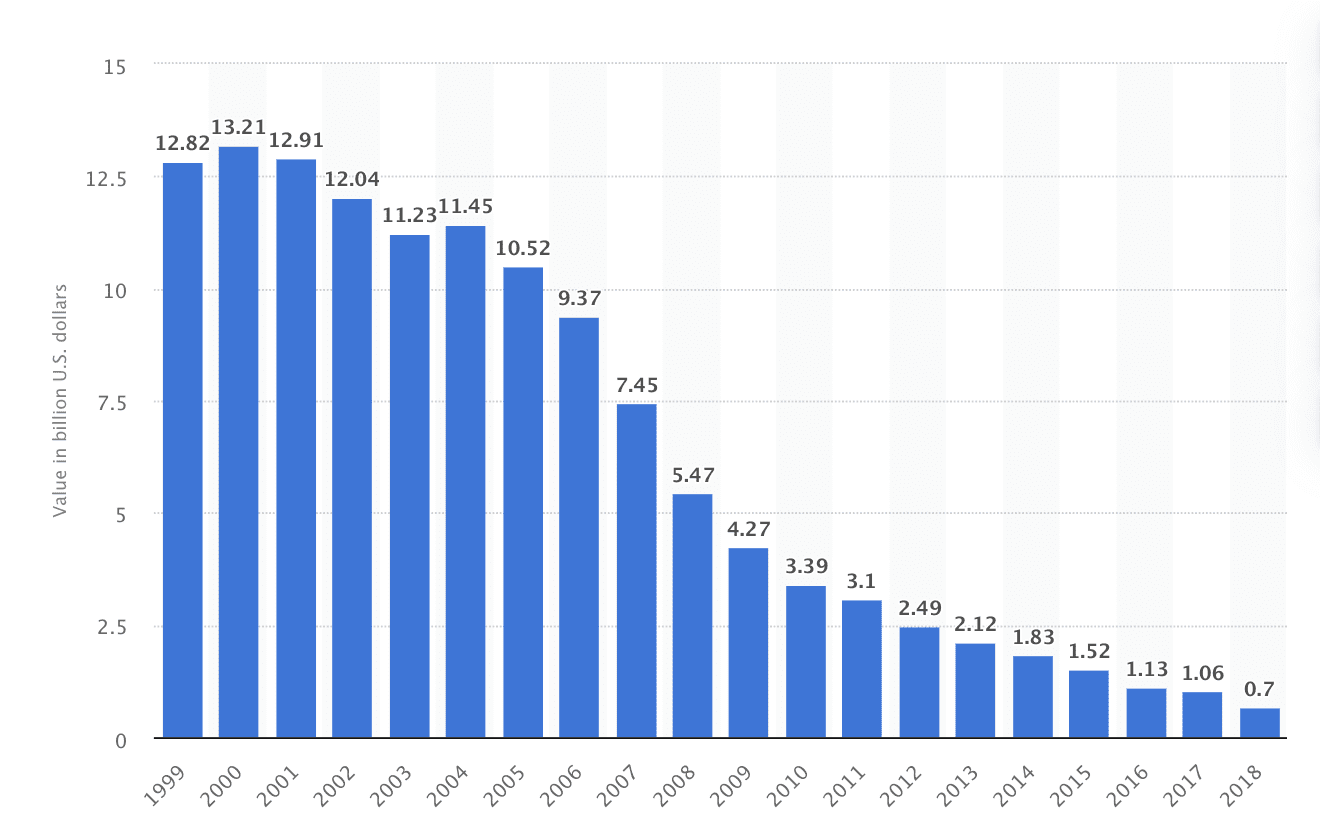
File sharing’s (1999-2002) and Spotify’s (2008 – on) impact on CD sales| Source: RIAA

Fanning and Parker’s platform emerged at the end of an explosive decade for the music industry. There were healthy profits reaped by many labels and publishers, thanks to the maturing of the compact disc (CD) as a preferred medium. At $15 – $21 per unit, the music industry’s primary channel was an expensive one. In this way, Napster was a catalyst for market correction. Until that point, a consumer would have to purchase an entire CD to listen to the two or three songs that they preferred. Napster allowed for the ownership of individual tracks and, in turn, it devalued the sale of entire albums.

Joe Rogan recently hosted The Wu-Tang Clan’s Robert Fitzgerald “RZA” Diggs on Episode No. 1382 of his podcast. The host couldn’t have predicted that the most newsworthy snippet of the conversation would hinge on the technology of the 1990’s.

Napster comes right in and and takes all these songs where all these people who are waiting for their publishing checks are waiting for the economics to be created from music. Now, there’s no publishing check. All of the numbers have decreased because there’s no physical sell of the music to accumulate value.

Diggs would go on to explain that between 2000 – 2015, the loss in physical sales ultimately transformed the industry into one that we see today. There were few winners in music during that span. Of them: the iPod, the iPhone, Spotify, Beats By Dre, Live Nation, and Universal Music Group. Music was no longer the product for sale.

On Chaos Theory and Patent US5960411A

As eCommerce is a multi-dimensional consideration, a single theory may not be sufficient for the overall perspective views. […] However, the Chaos Theory is suitable for describing the customer decision making, especially the buying behaviours seems to be random in which the classical model of classical decision model cannot be described. [1]

The market would begin to mold around Napster’s influence. Platforms with similar architecture went live. That list included: Gnutella, Freenet, BearShare, Kazaa, LimeWire, AudioGalaxy, and Madster. It’s important to note that each of these platforms was disrupted by copyright litigation.

Flapping a butterfly’s wings over the Amazon could influence the storm in China. This is the basis of the Butterfly Effect, also known as deterministic chaos, a phenomenon where equations with little to no uncertainty yield uncertain outcomes. Chaos Theory is the mathematics that explains the butterfly wings’ theoretical influence over China’s weather patterns. In this analogy, there is a bit of irony.

Chaos Theory is a delicious contradiction – a science of predicting the behavior of “inherently unpredictable” systems. It is a mathematical toolkit that allows us to extract beautifully ordered structures from a sea of chaos. [2]

It was Apple’s CEO Steve Jobs who challenged conventional wisdom by questioning the value proposition of file sharing. For Jobs, piracy wasn’t the catalyst for Napster’s monumental growth and influence. Rather, the combination of ease and convenience was the deterministic chaos. Steve Jobs would recruit the help of Jeff Bezos and a now-famous Amazon patent to address the mathematics of buying behaviors. When the deal was announced between the two companies, Jobs levied a glowing endorsement of Bezos’ early technological advantage.

The Apple Store has been incredibly successful and now we’re taking it to the next level. Licensing Amazon.com’s 1-Click patent and trademark will allow us to offer our customers an even easier and faster online buying experience.

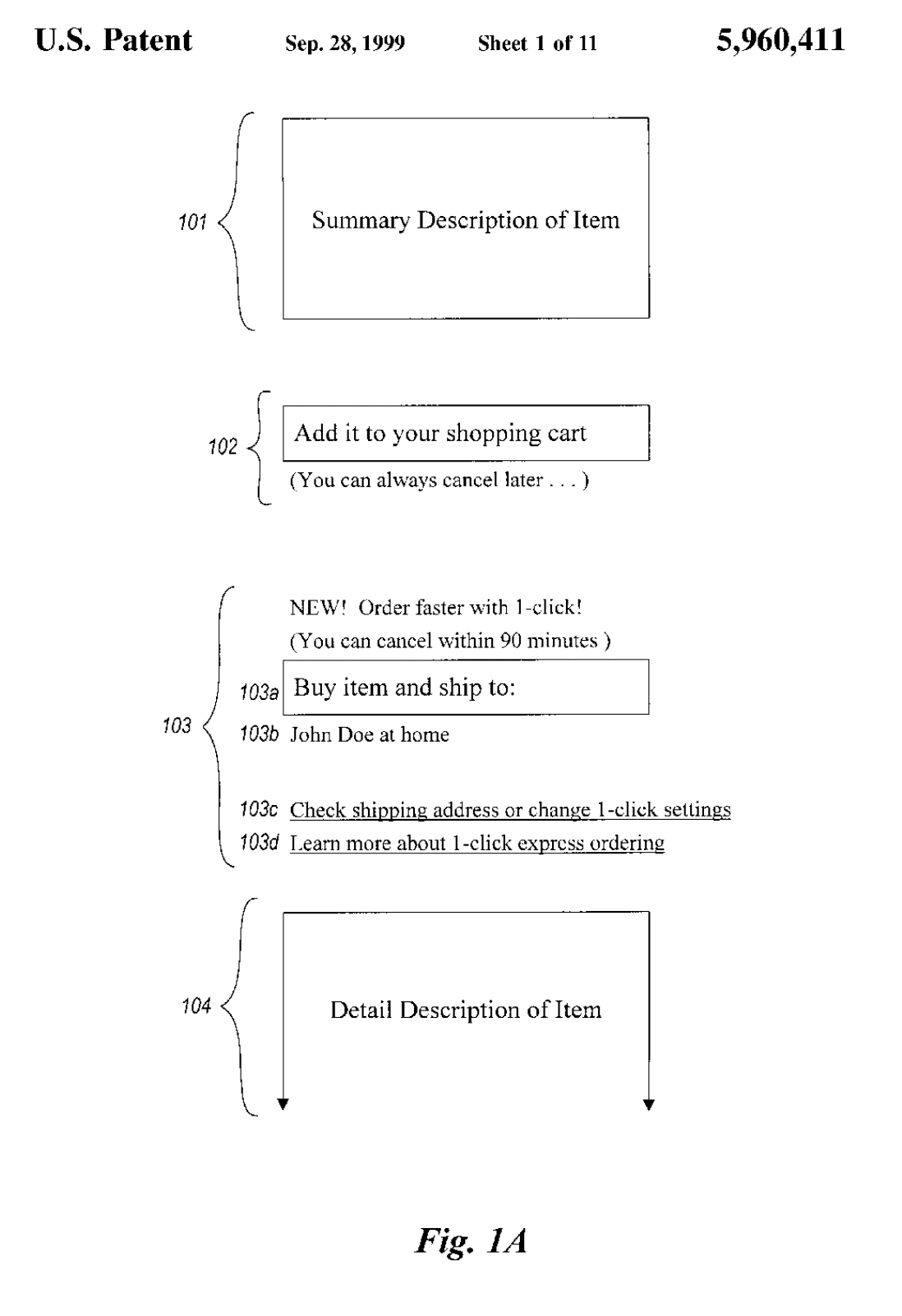
In September of 2000, Apple became the first company to license Amazon’s 1-Click patent (US5960411A) and trademark for use across Apple’s eCommerce properties. This innovation enabled Apple to store billing and shipping information, allowing customers to click their mouses once without any data input. To Jobs, this was the key to the industry’s music problem. By making conversion easy and ownership effortless, consumers would flock to legitimate sources of commerce. And he was right.
Screen Shot 2020-01-03 at 2.26.15 AM
From Amazon’s Early Patent

By 2003, the iTunes Music Store was outselling its next best competition by a margin of five to one. That competition was a legitimate version of Napster. Apple’s combination of iTunes and the iPod provided a seamless experience for conversion, management, and consumption. Apple understood that Amazon’s advantage wasn’t what it was selling, it was how it was selling. This influence would affect music and entertainment. iTunes was a precursor to 2005’s Pandora and 2008’s Spotify.  Apple’s 1-Click system of retail influenced a new style of movie consumption, one that would spawn companies like Netflix in 2010 – though streaming technologies hadn’t yet caught up to market demands.

Apple would become the only company to license Amazon’s technology. US Patent 5960411A would help Amazon to nearly two decades of unfettered growth. That patent would expire in 2017. By that year, nearly half of all online retail volume in America was completed through Amazon.com and its affiliates. Consumers are willing to set aside cost for ease of purchase. Amazon was the first to prove this; Apple may have been the second.

Chaos Theory Revisited

Others, including Amazon competitors, have already noticed the 1-Click patent’s expiration. Last year, a group of companies in the alliance known as the World Wide Web Consortium, including Apple, Facebook and American Express, started working on standards to implement one-click purchasing. Google is also reportedly working on a one-click payment solution. [3]

Amazon’s innovations influenced an unforeseen number of industry advancements. With 1-Click commerce in the public domain, new upstarts like Fast join technology’s giants in building independent solutions to bolster the adoption of frictionless commerce. Apple Pay has seen wide adoption. Shopify Pay was a star of the most recent holiday season, garnering praise from the vendors who benefited from frictionless payments. This dizzying pace of innovation is the result of a technology that’s been locked away about for nearly 20 years.

Until recently, Amazon’s patents prevented wide use. Amazon’s 1998 lawsuit against Barnes & Noble is a persisting example of why few companies test Bezos knack for IP litigation.

Amazon started using one-click technology in September 1997, but did not receive a patent for it until Sept. 28 this year. Barnesandnoble has offered “Express Lane,” its one-click checkout, since the spring of 1998. “The one-click feature is one of Amazon.com’s signature strategies for differentiating itself from the competition and building loyalty among its customers,” Amazon wrote in its complaint. [4]

In 2000, then-students Erik Brynjolfsson and Michael D. Smith identified this in a case study written for MIT’s Sloan School of Management. Pricing rationality matters less when ease-driven loyalty is at the forefront of the consumer’s mind.

A direct prediction of these models then is the retailer with the lowest prices should have the highest proportion of sales since it will get sales from all the informed consumers in addition to its “share” of the uninformed consumers. However, this prediction is not supported by our data. Amazon.com is the undisputed leader in online book sales, and yet is far from the leader in having lower prices. [5]

To this end, a solution for the reduction of bottom-funnel friction recently launched. And it may be the most fluid of them all. “Ten years ago today, I was packing boxes.” Gary Vaynerchuk will go on record as saying that he isn’t very smart. Don’t let him fool you. In 1998, at the onset of his early days of growing his family’s online business, his team built one of the first iterations of an automated cart abandonment recovery. Unfortunately, he didn’t file a patent for that process – a tool that is now common throughout cloud-based carts like Shopify, BigCommerce, Adobe, and SalesForce Commerce Cloud.

Polymathic Audio No. 3: Gary Vaynerchuk

In 1998, Wine Library was grossing nearly $3 million annually. By 2011, that figure inched toward $67 million in annual sales. Vaynerchuk didn’t accept any outside investment to get to that point, a remarkable note when you consider the constraints of cash flow-driven growth. That same year, he stepped down from the family business to build VaynerMedia. When Vaynerchuk and I spoke with 2PM for Polymathic, he relayed a recent story of his father reaching out to him and asking for him to come back to the Vaynerchuk family’s original business and course-correct a company that had halved in size since Gary’s departure. Deterministic chaos: the solution that Gary executed may end up becoming another proverbial butterfly over the Amazon.

2PM-SMS-Commerce

To solve the problem for Wine Library, Vaynerchuk recruited some help from his VaynerMedia team. The result was WineText, an SMS-based marketing and commerce channel. The user begins by signing up on the homepage, providing a few key details: name, address, phone number, and payment data. Like Amazon’s 1-Click system, WineText saves users’ credit cards with the help of Stripe. Powered by Twilio, Vaynerchuk and team can send a daily deal to the list at a cost of anywhere between $240 and $360 per text. According to Vaynerchuk, the SMS list of nearly 9,000 customers consistently outperforms Wine Library’s email list of 400,000 by a magnitude of 9x. And here’s why.

WineText opt-in grants Vaynerchuk access to your phone number. On occasion, a customer will receive an SMS prompt with a “high value wine offer.” Users have up to ten minutes to respond to the text with the number of bottles requested. That number of bottles is at your door within 48 hours of shipping. The top-of-funnel friction removes all bottom-funnel checkout thinking. It makes a commerce decision reflexive.

To accomplish this, WineText built a native checkout solution to account for Shopify’s native restrictions with respect to stored credit cards. For those who are interested, there is a way around it according to Postscript Co-Founder and President Alex Beller:

One way around this for more mainstream merchants who want to allow customers to buy in-message is using Postscript + Recharge + Shopify. Recharge allows for that sort of open access to credit cards of saved customers.

Beller added:

All brands should not jump on this bandwagon. However, any brand with subscriptions, natural reorder cycles, or drop strategies should lean in here. Engagement rates are too high to ignore.

As more retail operators become aware of the technology stack implemented by Vaynerchuk and team, WineText-like services will become more common. There are no patents to protect it. Amazon’s innovation indirectly impacted the streaming industry that exists today. Just as eCommerce patents changed music forever, you have to consider unrelated industries that will thrive with frictionless commerce.

Chaos Elsewhere

The Action Network, created by the Chernin Group in 2017, has an app where gamblers can track their bets across sportsbooks. It’s also using in-depth stats and analysis to draw in bettors, and has been striking content and other deals with companies like Yahoo Sports, Nascar, PointsBet, William Hill, and DraftKings, to expand its footprint. [6]

In a conversation with Action Network’s Darren Rovell, I mentioned how 1-Click technology could impact publisher-driven betting. Rovell remains skeptical that a media platform could vertically integrate in such a way. When asked if Action Network would ever facilitate live bets, the industry veteran responded:

Facilitate? Yes. Click on our platform and it clicks to a [sports] book. Or bet with a book and you can track the progress with us. But, as of now, it’s not in our best interest to be an operator.

But in the analogy of the butterfly’s flight over the Amazon, all signs point to the intersection of media, commerce, and legalized gambling as the next major disruption in consumer media. Platforms like Barstool Bets, theScore, FanDuel, Draft Kings, B/R Sports Odds, and others are positioning to move beyond informing wagers by partnering with sports books to facilitate end to end commerce. They’ll eventually want users to place bets, natively.

In the past, people would read articles or watch videos on these publishers’ properties that would inform the bets they make elsewhere. But with sports betting becoming more widely legal, publishers can close that gap — and turn this into a revenue stream for themselves. “Our whole philosophy is if we do it right and give people an opportunity to bet within theScore, they’re not going to go elsewhere,” said John Levy, CEO of theScore. [7]

Frictionless commerce will define the next ten years of mid-market, online retail in North America. As it does, savvy commerce architecture will find its way to other industries once again. Legalized gambling appears ripe for this sort of disruption. Publishers want to shorten the distance between “finding your line” and you acting on it. What was once an industry built on publishing data and insights will become one where users can act with one click of a button. If there is one thing that we’ve learned from Napster, Amazon, Apple, and the streaming economy: ease of use is the safest bet.

Research and Report by Web Smith | About 2PM

No. 337: Stick To Sports

For as long as there has been athletic competition, there has been a narrative that permeates from the field of play. Gladiators of Rome were commonly first-generation slaves, bought and sold at the whim of their owners – the sporting promoters of their day. Like today’s gladiator sports, cruelty was a part of the spectacle. And the minds of the time contrasted in their approval or disapproval of their era’s proudest spectacle. Great minds like Seneca disapproved of the competition. Marcus Aurelius once abolished a tax on gladiator-based taxes and commerce; he wanted nothing to do with the capitalism of it all. And still, he couldn’t resist hosting lavish games from time to time. The spectacle of cruelty was insatiable to the average man and the great one – alike.

As it was, as it will always be. Sports was never without its social commentary. Jesse Owens’ olympic showing wasn’t just impressive because of the speed of his feet; he beat the myth of German superiority with a foot race. Jackie Robinson wasn’t just a baseball player, he was remembered as a hero. That was the narrative that was formed about the man, even while his involvement lacked the popular sentiment that it is awarded today. Janet Guthrie was a media fixture, not just because of her precedent off of the track but because of her accomplishments on it. Before Danica Patrick, there was her. And with a little more support from sponsors and officials, she could have accomplished much more.

Since when has sports been about athletic accomplishment alone?

On a November evening after the Baltimore Ravens’ decisive victory against the undefeated New England Patriots, ESPN National NFL Writer Kevin Seifert made a statement with a simple tweet. He listed three quarterbacks, each of whom are considered candidates to win the league’s coveted most valuable player award. The quarterbacks that Seifert listed: Russell Wilson, Deshaun Watson, and Lamar Jackson are what veteran industry analysts would call: unconventional, mobile, dual-threat. However, they’re more than that. In each case, whether these quarterbacks pass or rush, they lead from the front. More than anything else, that’s their common thread.

Kevin Seifert on Twitter

If we’re doing the MVP now, I’m going: 1. Russell Wilson 2. Deshaun Watson 3. Lamar Jackson

Here is a selection of quarterbacks drafted before 2019’s MVP candidates: Ryan Tannehill, Brandon Weeden, Brock Osweiler, Mitchell Trubisky, Baker Mayfield, Sam Darnold, Josh Allen, and Josh Rosen. To the casual observer, this thought may as well be morse code. So consider the following: the National Football League has never had three African-American quarterbacks in the front running for most valuable player. And certainly not in an era of the sport’s greatest quarterbacks, namely Tom Brady and Aaron Rodgers. We’re still in a period of firsts in this 150 year old sport. Brigham Young University started their first African-American quarterback in the year 2019. The sentiments of the 1950’s still linger. So what Seifert was doing was making a statement without controversy. To the untrained eye, it was merely the fact of the matter. But to those who understand the historical significance, it was a dog whistle of sorts.

“If you ask me is there a false narrative out there, I will tell you ESPN being a political organization is false,” he said. “I will tell you I have been very, very clear with employees here that it is not our jobs to cover politics, purely.” [1]

But even with the mandate by new ESPN President Jimmy Pitaro, Seifert found a way to toe the proverbial line. Wilson, the 75th pick of the 2012 draft is now the highest paid quarterback in the league. Bears quarterback Mitchell Trubisky was drafted before Watson. And Ravens quarterback Lamar Jackson was publicly and privately coaxed to convert to wide receiver by many in the media. He didn’t fit the image. His chorus of detractors included former Indianapolis Colts GM Bill Polian [2].

After this historic game, Bleacher Report took a muted approach as to avoid the conversation altogether. In the NFL, running backs don’t win MVP over transcendent quarterbacks. In the last 20 years, just four have won. Sixteen quarterbacks have been selected in that time. Just the same, here was their take:

And [Jackson] a clear MVP candidate. This game firmly planted him in that discussion, along with Panthers running back Christian McCaffrey, Seahawks quarterback Russell Wilson and Texans quarterback Deshaun Watson.[3]

Meanwhile, at Deadspin, the two lead stories are written by a generic “Deadspin.” A sign that no one is behind the wheel. The reports were merely a collection of embedded tweets. There’s one on the Ravens surprise victory. The one where the quarterback (that should have played receiver) trounced the greatest of all time. As the two shook hands upon leaving the field of play – battered and bruised – Jackson uttered “You’re the GOAT.” As if Brady needed a reminder. The other Deadspin “story” featured the Cleveland Browns latest off-the-field issue.

The only report with any personality was written by Karu F. Daniels of The Root, another property of G/O Media. It was repurposed into Deadspin content. One can only wonder what Deadspin would have written about a unique moment in the sport’s vaunted history. But the site is currently a shell of its former self. The staff quit en masse after being told to by G/O Media management to “stick to sports.” A common refrain in today’s corporate media.

G/O Media is the product of Great Hill Partners’ acquisition of the former Gizmodo Media Group. The all-equity transaction was facilitated with Jim Spanfeller, best known for his leadership at Forbes.com. Perhaps, it’s his lack of experience in sports media that permitted such a fatal miscalculation.

The Irony of The “Stick to Sports” Mandate

Google Search interest for “Stick to Sports” peaks in September 2017

On its merits, the nature of the phrase is divisive. When ESPN’s Rachel Nichols spoke out in September of 2017, the peak of its interest, she raised questions around the hypocrisy of it. It was around that time when J.J. Watt was rightly praised for raising $20 million for hurricane relief while other athletes faced pushback for highlighting other extracurricular causes – most often around social justice issues. With the current state of American politics at a relative boiling point, the separation of societal politics and corporate entertainment have never been more difficult to parse. ESPN found ways around its “stick to sports” mandate by elevating intelligent and nuanced figures like Pablo Torre, Stephen A. Smith, Max Kellerman,and Bomani Jones. Deadspin wasn’t as forward thinking and they ultimately paid for that.

“Stick to sports” is, of course, a fault line in 2019’s culture wars. [4]

But as the state of our political machine continues to polarize Americans, the mandate becomes harder and harder to follow. Yet, it becomes more important to disobey. In fact, at some point, the mandate becomes bad business. This is especially true for digital media where Deadspin rival and The Chernin Group-owned Barstool Sports has thrived by using sports as a platform to enter adjacent conversations. And I am using the word “adjacent” liberally here. Several of the top stories on Barstool Sports currently include an Instagram influencer questioning his history syllabus, a feature on the “Watchmen” series, and a woman that tattooed her eyeballs.

The banner of Barstool’s homepage features a link to the media group’s famed Chicks podcast. And all of this is to say, it seems to be working for Barstool. This includes its cozy relationship with Fox News, including regular appearances by founder Dave Portnoy on Tucker Carlson. And this isn’t an argument against their approach. Rather, it was an acknowledgment that Barstool Sports has thus far succeeded by understanding the property’s psychographic. The Chernin Group seems to have avoided the stick to sports conversation with CEO Erika Nardini.

Ringer, Deadspin, B/R, Barstool and Psychographics

Consumer psychology involves the interest in lifestyle, behavior, and habit. It’s an encompassing measure that considers our idiosyncrasies, our temperament, and even our subtle personality traits. These are the variables that influence our behavior as consumers. Psychographic segmentation is the analysis of a consumer cohort’s lifestyle with the intent to create a detailed profile.

The Ringer is jovial and care-free. Bleacher Report is dead-pan with the occasionally dry humor. Barstool is edgy and offensive as a strategy. And so was Deadspin.

While largely focused on sports, Deadspin for years had delved into a broad range of topics in a voice that was sometimes rude, often funny and always conversational. On Tuesday, the site’s top editor, Barry Petchesky, was fired after refusing to go along with the order. The departures shocked fans of the site, which put a new spin on sports coverage for a generation of digital natives. But they were the result of a long buildup of resentment between the journalists and their new bosses, according to interviews with 13 current and former employees of Deadspin and G/O Media.[5]

Nov 4: Barstool’s Homepage

For Deadspin, the majority of their sensationalism involved topics that were completely unrelated to sports in substance, this report isn’t necessarily about the history of those articles. Bill Simmons’ The Ringer shares a similar narrative with Barstool. On the homepage, you’ll find stories about Mr. Robot, Jeopardy, AppleTV+, and The Watchmen. Bleacher Report contrasts the three. The publication leans heavily towards strict sports coverage, a methodology that works for them. But even B/R featured an epic story on Colin Kaepernick written by Rembert Browne. And most recently – a story about Jared Lorenzen, the former Kentucky quarterback who died prematurely. Which brings me to the point: where do you draw the line when your publication covers sports? Collegiate and professional sports represent a layer of American life, not the totality of it. Sports is merely a dimension, not the whole.

No Code and The Business Case FOr: Stick To Sports

OM on Twitter

Let me rewrite this tweet from Jason. 1/ Deadspin writers are immensely talented and have a huge following. They have a lot of goodwill at present and as a result they should Marshall their collective resources and start a new publication. Let’s call it SpunOut. https://t.co/161I1HkInj

The editors and writers who resigned from Deadspin had a basis for their frustration. Sticking to sports is a nearly impossible proposition in today’s media. Given how rare it is to see a media company stick to their original charter, it’s understandable that Deadspin’s former employees saw the charge for what it really was: a euphemism for staying away from covering athletes who’ve immersed themselves in left-leaning causes.

But we’re in an ever-expansive era of digital media. Companies are rewarded for reaching. Complex Media is developing television shows and consulting third parties on commerce and audience development. Barstool Sports has a podcast starring two employees who discuss their friendship and sex lives, and Bleacher Report successfully collaborated on soccer kits with top hip hop artists.

Whatever happens moving forward, the Deadspin that was is no longer. It was one machine of a blog with nearly 30 million monthly visits and a penchant for engaging and re-engaging their loyal readers, many who’d visit the site multiple times per day. But it begs the question, if Deadspin was still Deadspin, what might they have written of Kevin Seifert’s idea? How would it have covered a tweet that should have been more than inconsequential. It’s doubtful that Deadspin may have told the story in the same ways that Barstool, Bleacher Report, ESPN, and The Ringer relayed theirs. To those platforms, the MVP race was not a story at all. But take it from NFL veteran and commentator Cris Collinsworth. As the Ravens led the Patriots, with the crowd in disbelief, Collinsworth quipped:

We’re going to be able to point to quarterbacks in the NFL that got a chance because of this night.

But in 2019, for many digital publishers, that’s too loaded of a statement. But many understood what it meant. And that understanding is part of the story too. The market has a need and the opportunity rests on the journalists who decide to forge their own paths. It’s only right that Deadspin alumni launches a Substack with the call sign of their mandate: Stick to Sports. Used ironically,  of course, as one last jab at the man they called an herb. The publication would almost instantly lead the Substack board.

With that model, Deadspin’s former writers and editors would have the freedom to do it the right way. Anyone who’s ever played the game knows that sports doesn’t end when you step off of the field of play. A sport is America’s pastime, it’s the most watched television event, it’s the most expensive event ticket, it’s the basis of a nation’s network of country and athletic clubs. Across America, hotels are built solely to support a thriving youth sports cultures of areas that would otherwise be barren without its expensive field complexes. Young people wear jerseys and the shoes of sporting legends. And adults bet and cry and yell and travel to watch their teams. It’s the irrationality of it all that reminds us that sticking to sports is an impossible task. And media should reflect that impossibility. Seifert knew the significance of his tweet, America should have known it too.

Report by Web Smith | About 2PM

No. 333: Food52 and Linear Commerce

food52.jpg

There have been few meaningful exits over 13 years. As such, questions surrounding the direct-to-consumer industry’s lack of exits have reached fever pitch. Investors have long questioned the viability of marketplaces and DTC brands. Initially pitched as technology companies, platforms like Shopify and BigCommerce streamlined the technical requirements for many go-to-market strategies. This left many investors questioning defensibility, proprietary advantages, or the value of a brand’s intellectual property – if any.  With many DTC companies raising capital with the intention of growing like software companies, it begs the question: do they understand their true value? The short answer is no.

No Title

I’m not sure that a lot of DTC brand owners realize that they’re building companies valued at 1 – 1.5x revenues.

When venture capitalist Fred Wilson published his thoughts on the Great Public Market Reckoning, he set the stage for an important discussion on the valuations of venture-backed companies. WeWork’s 2018 revenue was $1.8 billion on $1.9 billion in losses. In August 2019, America’s finest investment banks were selling consumer investors the story that the company’s discounted cash flows (DCF) justified a $47 billion valuation at IPO.

If the product is software and thus can produce software gross margins (75% or greater), then it should be valued as a software company. If the product is something else and cannot produce software gross margins then it needs to be valued like other similar businesses with similar margins, but maybe at some premium to recognize the leverage it can get through software.

Softbank, WeWork’s latest investor, believed that the company could eventually exceed $100 billion in value. As of today, that IPO filing has been shelved indefinitely; the IPO prospectus that once valued the company at nearly $50 billion has been rescinded. WeWork is back to the drawing board and on a hunt for a healthy EBITDA, as it’s likely that a company like that will be judged by a different standard. This may be a difficult path. The coworking company maintains 20% gross margins. Until recently, the cognitive dissonance between value and valuation continued to widen.

Peloton is trading at 6x revenues, rather than the 7-8x that underwriters intended. Based on their gross margins (46%), it’s likely that the multiple will 5x. Lyft maintains a 39% gross margin; Lyft is trading at 4-5x and may eventually fall to somewhere between 3-4x. The commonality shared by Lyft, Uber, and Peloton is the software leverage that they share. Each of the three maintains a software angle that places a premium on their respective valuations.

For many DTC brands, that same leverage rarely exists. For every StitchFix, there are dozens of retailers that fall within that range. These are companies without much technical IP, if any at all. This is a gift and a curse. Shopify has streamlined many of the requirements that would have required a technical co-founder just a decade ago. It’s for this reason that tech’s multiples of revenue shouldn’t be the measure at all. Online retailers are EBITDA businesses. And it’s time that the category optimizes for improved gross margins and sustainability. This may mean less venture capital raised and slower growth over a longer time horizon.

Venture capital isn’t right for many businesses, but if you do want to raise from a VC at some point, you need to understand that often investors care more about growth than profits. They don’t want high burn rates but they will never fund slow growth. [1]

The public market’s rebuke of WeWork is just one of the latest hits to the private market’s penchant for marketing overestimated valuations. In online retail, there is a key adjustment that can be made to better position the DTC industry for exit optionality. The first of which is to learn community building from digital media publishers.

A common DTC multiple of revenue is 1.5-2x. The Steve Madden acquisition of Greats Brand was reportedly within this range. A $13 million revenue year resulted in a sale for $20-25 million. A common marketplace multiple of revenue is 2-4x, this is a company like Chewy.com or StitchFix.com. A common multiple of revenue for a commerce-first media brand is 3-7x. Glossier has been valued at over $1 billion with a revenue total ranging between $100 – $150 million. For tech companies, SaaS has a premium. In some cases, 10x revenue multiples.  For retailers, valuation multiples are influenced by organic audiences.

Linear Commerce and Revenue Multiples

1565363735634-buyables2_2Food52 is a member of a new breed of digital platform, one that combines commerce and media operations. This aids diversificaton of revenue channels while minimizing the rising costs of traditional customer acquisition. It is not easy but it can be rewarding. There are a number of publishers in this category, to include: Barstool Sports, Uncrate, Highsnobiety, Hypebeast, and Hodinkee. And remember, Glossier began as a blog called Into The Gloss.


No. 314 Linear Commerce: for the brands that are most suited to the modern retail economy, media and commerce operations combine to optimize for audience and conversion. This is the efficient path for sustained growth, retention, and profitability.

Screen-Shot-2019-04-22-at-1.01.30-PM (4)
Food52 is a ‘Version 4’ retailer. Most DTC brands maintain a ‘Version 1’ structure.

Each of these publishers attracts a niche, passionate audience. Their audiences fuel several revenue operations: affiliate marketing, display advertising, native advertising, and DTC retail. Commerce is prioritized and traditional advertising is minimized.

The deal does fit in with the direction The Chernin Group has been headed: The company, which once had plans to put together a very big internet conglomerate after acquiring an big anchor like Hulu, has instead been buying and building a stable of internet companies aimed at distinct audiences, all of which rely on revenue streams beyond internet advertising. [2]

In early September, 25 operators spanning digital media, traditional media, and commerce were seated in a Manhattan dining room. Of them were the founders of Food52, Amanda Hesser and Merrill Stubbs. The venture firm and host of the evening’s festivities let the cat out of the bag. In a surprise announcement, The Chernin Group mentioned that they were set on acquiring a majority of Food52. The room applauded the founders. It was a rare exit in an industry that has struggled to gain its footing.

TCG owns a controlling stake in MeatEater Inc., a digital media company aimed at hunters, fishermen and home cooks, and has also invested in Action Network, a sports-betting analytics startup. [3]

The attendees brushed the impromptu announcement aside and allowed the natural public relations cycle run its course. And that it did. Yesterday, a number of outlets reported the sale. Here are the numbers:

  • $83 million acquisition of the majority of the company
  • A valuation of $100 million
  • $13 million raised over four equity rounds
  • A reported 2018 revenue of $30 million (not profitable)
  • Traffic: 7 million monthly active uniques
  • Paid traffic: less than 2.5% of overall volume
screen-shot-2015-07-06-at-9-27-09-pm.0.1486507956.0
Mike Kerns, President

A Fund 1 investment by Lerer Hippeau, the Food52 acquisition was a positive outcome for investors and founders alike. It’s also a glimpse into the methods that more digital-first companies employ to improve their exit optionality. Those methods? Building brand equity, fostering community, and owning their audience. In a 2PM conversation, Mike Kerns, President of The Chernin Group, stated:

We love to invest in entrepreneurs who are building enduring brands that have engaged audiences. Food52 has built a growing commerce business with very little marketing spend. Their marketing is building their enterprise value and defensibility which is the investment in to their content and community.

Kerns continues:

For TCG we like businesses that can build businesses with their audience established versus trying to purchase the audience from someone else.

In Kerns short statement lies a bit of truth that many in the DTC space fail to recognize. The stronger the organic audience, the higher the premium on a company’s valuation. All revenue is not equal. If a retailer can earn a sale without buying an audience each time, this becomes attractive to potential investors. So why the resistance towards this approach? In short, it isn’t easy to do.

The most viable companies across the digital ecosystem will share a common trait: established, organic audiences. Content and community are core to that outcome. For the well-executed linear commerce brands, retention rates will be high and CAC will be low. The road map is there for the brands looking for a sustainable advantage and improved optionality. Perhaps, the public and private markets will reward more of them.

Read the No. 333 curation here.

Report by Web Smith | About 2PM