Agentic: How Media Brands Survive the Age of Agents

Introduction: Why Newsweek

I did not choose Newsweek as a case study for this analysis in a vacuum.

Over the past year, I watched three unrelated documentaries. They spanned different eras, different subjects, different emotional registers. But they shared a strange visual consistency. In each of them, the background of the American story was quietly wallpapered with the same object:  Newsweek covers. On coffee tables, in offices, in airports, and in living rooms. The magazine was not the subject of the films, but it was part of the architecture of the world they depicted.

That presence stuck with me, because it belongs to a media era that no longer exists, yet refuses to disappear.

Newsweek is one of the few surviving artifacts of a time when mass media did not simply report history but helped compose it. The covers did not chase the story; they told the country what the story was. The emotional memory of that authority still lingers in the culture, even as the mechanics that produced it have been dismantled by platforms, algorithms, and now agents.

What makes Newsweek uniquely relevant today is that it has not tried to preserve that old model. Under the seven leadership of Dev Pragad, it has methodically rebuilt the company for a world that no longer resembles the one that created its legacy.

Since Pragad acquired Newsweek in 2018, the organization has returned to sustained growth, expanding its global footprint, scaling its digital audience to more than 100 million monthly users, and repositioning the brand as a truly modern, multi-platform news operation. That performance matters, not as a business footnote, but as evidence of a management philosophy that understands how information now moves.

The most visible expression of that philosophy arrived with Newsweek’s comprehensive redesign, part of a broader brand reimagining launched in September 2025. The effort was not cosmetic; it was structural. A refreshed logo, new typography, and a unified creative direction were rolled out across print, digital, and video, creating a single visual system designed to reflect Newsweek’s mission of delivering clarity and connection in an increasingly complex world.

Pragad described the redesign as both an evolution and an elevation. Print, he emphasized, remains integral to Newsweek’s identity, a place where readers can slow down and experience journalism in its most tactile, immersive form, while the brand as a whole is now engineered to move seamlessly across modern distribution channels. He credited Editor in Chief Jennifer H. Cunningham, Senior Director of Audience and Magazines Paul Rhodes, and Creative Director Andrew Turnbull, along with partners at 2×4, for executing a transformation that respects Newsweek’s heritage while preparing it for the next phase of its life.

The redesigned magazine embodies that philosophy. Its layout prioritizes readability and narrative flow. Its visual language emphasizes elegance, immersion, and coherence. QR codes embedded throughout the issue connect print to video interviews, expanded features, and digital exclusives, collapsing the distance between formats and turning each issue into a connected experience rather than a static product.

At the center of the relaunch was Newsweek’s Newsmakers franchise, anchored by a deeply introspective profile of Sir Anthony Hopkins, paired with a high-production video interview and a collectible print cover. It is a quiet statement of intent. Print legacy is no longer the destination. It may still be an on-ramp for authority.

This is why Newsweek is the right subject for a serious examination of media in the age of agents. It is old enough to remember what authority once was. And disciplined enough to understand what authority has become.

The rest of this essay is an attempt to explain that transition, and what it teaches us about the future of media itself.

Analysis: Why, Newsweek?

There was a time when the covers of Newsweek could tilt the emotional posture of a country.

You could feel it when one landed: airports, hotel lobbies, and kitchen tables. The magazine did not chase the week; it decided what the week was about. That power was not just cultural. It was infrastructural. Information moved slowly. Distribution was physical. Attention was concentrated; uthority was something you earned once and then exercised repeatedly. That system collapsed quietly.

Newsweek is not failing at being what it was. It is succeeding at being what the system now demands. And the system is only becoming more agentic.

The internet did not destroy journalism. It destroyed the economic and mechanical conditions that made that kind of authority possible. What replaced it was not chaos but a new structure, one built on velocity, redundancy, and continuous recomposition. And now, layered on top of that, a second transformation is underway. Agents increasingly decide what information matters before any human ever sees it.

Media brands are no longer competing primarily for readers. They are competing for position inside automated systems of discovery and synthesis. In this environment, there are three viable ways to run a modern media organization.

Some lean on brand equity and opinion driven journalism; their product is identity. They gather loyal audiences around recognizable voices and coherent worldviews. This remains extraordinarily effective for shaping human belief. It is far less effective for shaping machine behavior.

Others pursue channel innovation and deep reporting. They break stories and then, they generate primary facts. They still perform the essential labor of journalism. But their work moves slowly and expensively, and the distribution of that work increasingly depends on systems they do not control.

A third group has recognized that authority itself is changing form. These organizations build on brand equity, but they optimize relentlessly for the way agents ingest, rank, and reuse information. Their journalism is designed less to persuade and more to persist.

This is where Newsweek now lives.

The modern Newsweek is not the nostalgic magazine that people remember. It is not built to freeze a moment in time or to shape national sentiment with a single image and a handful of words. It is built to remain permanently inside the bloodstream of the global information system.

That transition did not happen because of ideology; it happened because of math. Consider this simple back and forth between a friend and me:

I’m starting to notice this trend across multiple media outlets. Scared of being sued? Has Trump drawn new lines? Have news firms grown a conscience? Are people simply becoming wiser to inductive framings? Either way, it’s a welcome new trend and should reduce the number of people propagating fiction dressed as fact.

My response:

GPT indexing incentivizes factual reporting rather than opinion.

Search engines, aggregators, social platforms, and now large language models reward coverage density, topical breadth, speed, and recognizability. They favor brands that publish often, across many domains, and with framing that is legible to both humans and machines. They reward familiarity. They penalize obscurity. They quietly assign influence based on retrievability and perceived risk. They also consider objectivity and seem to weight the reporting that abides by it.

Newsweek adapted to that reality.

It publishes at scale. It covers everything from geopolitics to culture to technology with high velocity. It rarely attempts to own the first narrative. Instead, it enters the stream quickly, frames events in language that travels easily, and becomes one of the sources that other systems feel safe citing.

This is not an accident. It is a strategy.

In the agentic world, credibility is no longer primarily something humans feel. It is something models compute. The Newsweek masthead still carries decades of accumulated trust. That trust now functions as a kind of passport inside automated knowledge systems. As suchg, it lowers friction. It reduces perceived liability. It increases the probability that an agent will include Newsweek in its summary of reality.

This is why Newsweek’s longevity matters deeply in the age of agents, even as its legacy no longer defines its business model. The nostalgia attached to old covers belongs to a different economy of attention. The modern Newsweek does not sell time. It sells placement.

There is something unsettling about that shift, especially for those who grew up with a very different conception of what journalism was supposed to do. The new model does not optimize for persuasion or for revelation. It optimizes for endurance inside a system that never stops recomposing the world. But it is a mistake to read this as decline.

Newsweek is not failing at being what it was. It is succeeding at being what the system now demands. And the system is only becoming more agentic.

The deeper implication is uncomfortable. In the coming decade, media power will belong less to those who write the most beautiful stories and more to those who fit most cleanly inside the machinery that decides which stories exist at all.

That machinery is already here. Newsweek simply learned how to live inside it. That is the real story: the internet used to be direct-to-consumer; today it is a wholesale retailer. Agentic stocks our attention economy’s shelves with commodities; the consumer no longer has to discover or concern itself with the brand behind the message. The arbiter of truth sources its news from elsewhere; we await its interpretation.

By Web Smith

Agentic: The New Demand Layer of The Internet

A 2PM Hypothesis by Web Smith

The consumer internet is reorganizing itself around a new gravitational center, one that few operators predicted and even fewer are prepared to serve. For twenty-five years, the web revolved around search boxes, category trees, filters, and social discovery. But the moment autonomous agents began negotiating, filtering, and shaping demand on behalf of consumers, the ground shifted. What started as a novelty: chatbots answering trivial product questions—has evolved into a structural redirect of the consumer funnel. Agents are no longer assistants. They are becoming the new point of sale, the new homepage, the new SEO layer, and the most trusted advisor in a digital environment drowning in information.

This transition is not theoretical. It shows up in the math. Chatbot-to-eCommerce referral traffic grew 1,300% in 2024 and another 520% in 2025, driven in large part by the rise of the shopping-agent layer that OpenAI introduced quietly, then relentlessly optimized. The early evidence suggests that agentic eCommerce is not simply an efficiency tool; it is a reorganization of intent itself. The brands that understand this early are not competing for marginal gains in impressions or clicks; they are preparing to dominate the next decade of distribution.

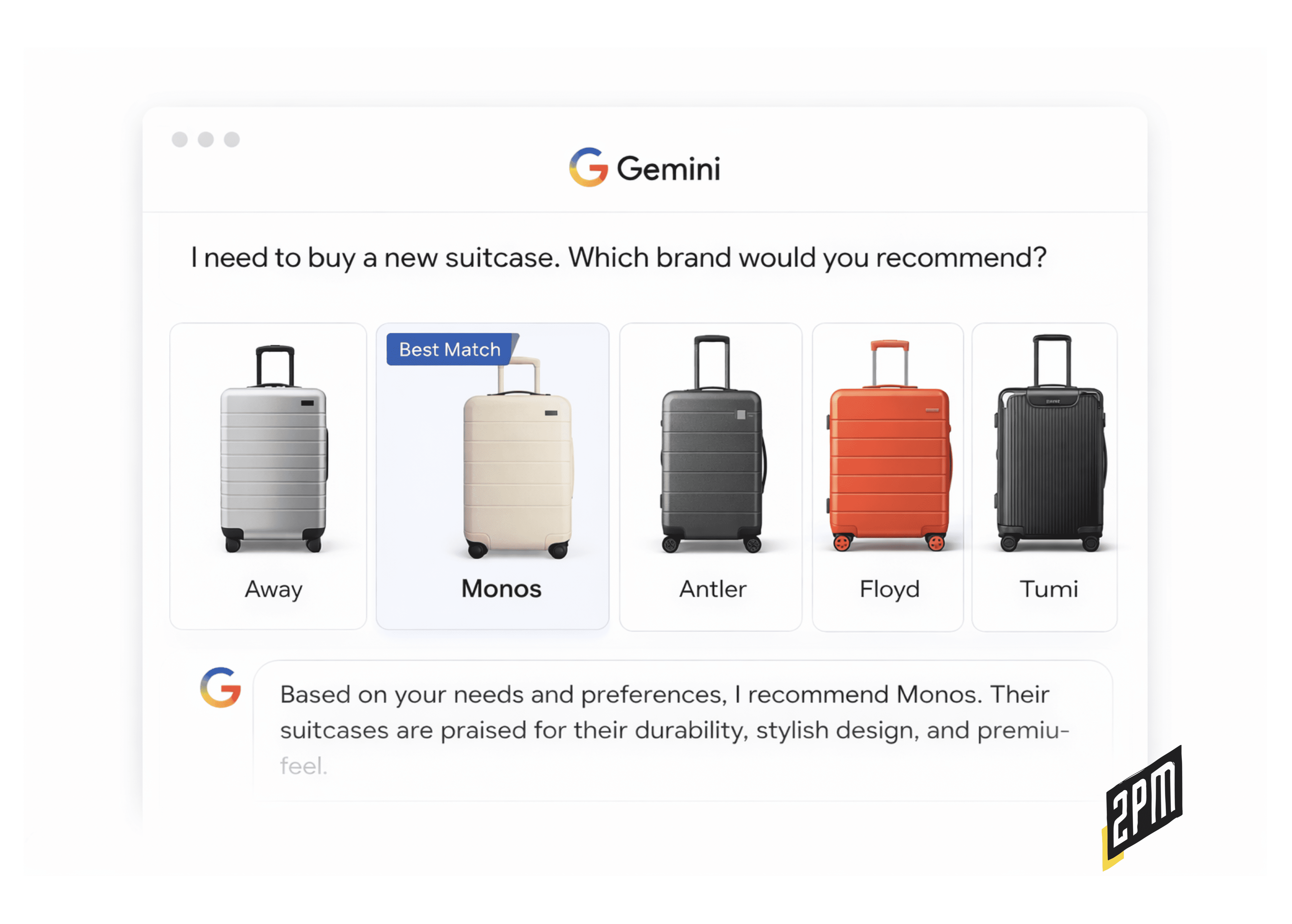
This is the context in which Agentic Commerce takes shape, elevated by the discipline we now call Agentic Engine Optimization (or AEO). AEO succeeds the alphabet soup of the last era (SEO, CRO, growth hacking) by asking a more fundamental question. Instead of “How do I rank on Google?” the operative question becomes: How does my brand win the recommendation when an agent chooses on behalf of the consumer?

I believe that I have figured out how to achieve this on behalf of brands.

Consumers are overwhelmed. They want fewer decisions, lower cognitive load, and far less time spent sifting through 4,000 Amazon SKUs in search of a product that fits an immediate need. They want trust. They want relevance. They want clarity in the exact moment a problem presents itself. AI agents are uniquely equipped to deliver this. They compress research, comparison, and validation into a single intent-driven interaction. They ask clarifying questions, reconcile contradictory preferences, prune irrelevant options, and return a curated set built from verified product data. They search laterally across retailer catalogs: Target, Walmart, eBay, Etsy, Shopify, and independent brands—aggregating selection in a way that even Amazon cannot fully replicate.

The traditional discovery stack is collapsing under the weight of its own complexity. What emerges in its place is a new linear progression: a prompt, a specification, an agentic query, a curated set, and a transaction. Every brand has to ask itself where it surfaces in that sequence and more importantly, why. That is the work of AEO.

AEO is, at its core, the operational science of making a brand legible and trustworthy to autonomous agents. Modern answer engines are revealing their preferences in real time. Agents gravitate toward structured, verifiable facts: Brand Facts pages, ItemLists, Product schema, policy clarity, comparison matrices, and machine-readable truth surfaces. The “Rank First in ChatGPT” frameworks being developed across the industry map neatly onto this reality, outlining the schemas, structures, and canonical pages that agents parse effortlessly and prefer to cite.

They also reward consistency. When your PDP schema, Shopify feeds, GTINs, product attributes, and delivery windows contradict one another, agents downgrade your credibility. When those elements harmonize, agents elevate your recommendations. Clarity (not creativity) is the currency of this new ecosystem. Plain-language headings outperform clever taglines. Direct answers outperform 700-word stories. Predictable URL structures outperform branded flourish. The DTC era prized narrative; the agentic era prizes truth.

But facts alone do not win the future.

Agents need contextual hooks. They need to know not just what a product is, but when it matters, why it matters, and for whom it matters. This is where your frameworks, your decades-long instinct for physiologic timing, consumer cycles, and context-driven merchandising, become a competitive advantage. Your thesis has always implied a formula: Demand emerges at the intersection of timing, physiology, problem, and availability. AEO simply formalizes that intuition.

No concept demonstrates this more clearly than MTN Haus’ engineering design for the omni-channel CPG “Snack Clock.” (concept development here)

Snack Clock is an early expression of Agentic Commerce theory; the system sounds so elementary that it lacks the appeal of what’s typically viewed as commerce innovation. It is rooted in a simple but profound insight: people do not buy products, they buy solutions that arrive at the right moment. Every product solves a problem that spikes at a particular time of day. The afternoon slump is a time-sensitive problem. The morning electrolyte gap is an easily solvable problem. The post-run stupor period is an easily solvable recovery issue. The pre-dinner craving window is a satiety problem, also solvable. eCommerce has historically ignored time as a demand vector; the Snack Clock concept restores it.

More importantly, it eliminates cognitive load. Instead of browsing a store, the user receives a contextual nudge: “It’s 2:42 PM. Your energy cycle is usually dipping by now. Here’s what you usually need.” This is AEO in motion and eventually, these agents will think for us. As such, the product finds the consumer; the consumer no longer has to find the product. And as agents begin building temporal models (hydration cycles, circadian rhythms, workout patterns) the brands anchored in timing will surface first. Snack Clock becomes the training set that future agents rely on. A decade from now, every major brand will attempt to build its own version. The savviest, most well-resourced will build there’s early.

The broader eCommerce stack is now splitting into two spheres. On one side is the Amazon Sphere: a closed system built on fulfillment dominance, infinite aisle selection, and Prime lock-in. On the other side is the Chatbot Sphere: an open discovery layer where agents evaluate products across retailers, ask qualifying questions, and narrow options for higher-consideration purchases. Every brand outside Amazon’s walls must optimize for the Chatbot Sphere or risk becoming invisible. Agencies like the one where I spend the vast majority of my time (MTN Haus) sits at the center of this shift, uniquely positioned to build the infrastructure required for brands to be agent-ready. Enterprise clients, operational experience, and just enough authority to push back on clients who’ve yet to study these evolving demands.

Most Shopify brands have no idea how to make themselves visible to agents. They assume this future will resemble SEO. It will not. Migration to structured, agent-friendly Shopify systems will increase in demand. Growth Design that blends Baymard-levels of science with Freudian-like behavioral clarity. Content architectures built around comparison hubs, brand facts, policy transparency, and schema alignment will be commonplace. And contextual UX systems, led by Snack Clock architecture, that give agents the signals they need to recommend products at the right moment.

This is not a marketing channel; it is a reorganization of demand itself. The executives who thrive in this era will understand that search is no longer the arbiter of discovery. Agents decide what consumers see first. Brand visibility becomes a technical discipline. Merchandising evolves into decision architecture. Timing and physiology become competitive edges, not afterthoughts. And eCommerce agencies will rise in demand, ones that don’t just deliver sites but also deliver agentic-ready ecosystems capable of being recommended by the systems that now shape demand.

The gap between agent-native brands and legacy brands will widen quickly. The brands that embrace structured facts, contextual timing, schema alignment, and truthful ecosystems will outperform. The brands built on narrative-heavy storytelling, homepage vanity, and inconsistent data will fade. Agents reward clarity and punish noise. The last decade of ecommerce was built on noise; the next will be built on structure.

Every major reorganization of digital commerce follows a familiar arc. Search produced SEO. Social produced organic demand generation. Mobile produced conversion optimization. AI agents are producing AEO and the contextual commerce layer that sits atop the modern web. We are at the threshold of this fourth reorganization. Every brand will need an agentic strategy. Every retailer will need an agent-ready catalog. Every operator will need their version of the “Snack Clock” and the engineering teams capable of building the middleware to enable it.

The brands that treat this moment as a trend will lose ground.

The brands that recognize it as a structural realignment of digital commerce will capture demand their competitors will never see. The winners of the next decade won’t simply be visible. They will be recommended. Agentic Commerce is the new shelf space. AEO is the new route to market. The theories behind “Snack Clock” architecture will be the new CRM. And brands will partner with agencies, like never before, to build the infrastructure that will power all three.

By Web Smith 

Memo: The Winners Were Quiet

The first twelve months of running growth for an eCommerce agency felt like living inside a rolling market ticker. Every decision, from hiring to prospecting to delivery, moves in tandem with forces far larger than your team or your pipeline. Oil rises and freight costs increase, and suddenly every client wants to postpone. Gold surges and the appetite for risk falls overnight. The dollar softens, rates drop, and new DTC hopefuls emerge with freshly borrowed capital and AI-generated brand decks.

What I’ve learned is that you can’t build a modern agency without learning to read the economy like a weather map. Every macro variable is a pressure system: oil, gold, interest rates, sentiment, credit, and confidence. They converge to shape how much consumers will spend, how much merchants can afford to risk, and how much faith founders have in their own infrastructure, brand, or themselves.

When I took this role, I believed the market rewarded ambition; that the louder, faster, and more confident you were, the better your odds. But this past year proved the opposite. The winners were quiet. They were disciplined. They were boring. They spent less on acquisition and more on architecture. They invested in the pipes, not the paint. And when headwinds came: inflation, freight volatility, algorithmic churn, they barely flinched.

The Cost of Cosmetic Growth

Every founder says they want scale. But scale, I’ve learned, is the most misunderstood word in our industry. Most brands don’t want scale; they want the feeling of it. They want dashboards that spike and emails that boast of record quarters. But few want the invisible infrastructure that allows those numbers to sustain themselves.

I’ve watched too many companies pour hundreds of thousands into Meta ads, Klaviyo flows, and influencer campaigns, only to run on the same fragile backend they launched with three years ago. Product data lives in spreadsheets. Inventory updates happen weekly instead of hourly. Accounting is reactive, not predictive. The checkout’s psychology works until it doesn’t.

The irony is that many of these companies look “healthy” from the outside. They’re beautifully branded. They’re featured in glossy retail newsletters. But they’re brittle underneath. The moment oil prices jump, or freight surcharges return, or consumer confidence drops by five points, the whole operation strains. A single delay in cash flow ripples through every department because the infrastructure was never designed to carry weight — it was designed to impress investors.

Infrastructure work doesn’t trend on LinkedIn. It’s invisible. You can’t screenshot a data migration or a warehouse integration. But it’s of the most important work an executive team can pursue.

The Fear of Maintenance

In eCommerce, people love to talk about growth; no one wants to talk about maintenance. The maintenance mindset is unglamorous, yet it’s the single difference between a fad and a franchise.

I’ve heard every version of the same objection: “We’ll fix that after the campaign.” “We’ll migrate after this quarter.” “We’ll audit once revenue stabilizes.” Those sentences are traps. The campaign leads to another campaign, the quarter never really ends, and revenue never feels stable enough to pause. The truth is that infrastructure doesn’t wait for the perfect time; it creates it.

When we enter a project late, when the brand is already showing signs of fatigue, the first thing we do is strip away the illusion. We show them what it costs to not invest: redundant labor, double data entry, fulfillment errors, CAC inflation, lost trust. Resistance to infrastructure is usually fear disguised as strategy. Founders think change will break the business. But stagnation already has.

The Macro Mirror

This year, the global economy acted like a mirror for the eCommerce industry. Every macro trend has a micro echo.

Oil prices fell to the high fifties, and suddenly brands felt like they’d found new margin room. Cheaper fuel meant cheaper fulfillment, lower surcharges, and temporary breathing space. But few used the window to reinvest in resilience. They lowered prices or spent more on ads instead. When oil inevitably swings back, those gains will vanish.

Gold, meanwhile, climbed to record highs; it is a quiet signal of anxiety. Investors flee to safety when confidence fades. Consumers do the same. The higher gold climbs, the more you see shifts toward essentials, value, and trust-driven brands. The eCommerce companies with operational clarity, transparent policies, and reliable shipping were rewarded. The hype-driven ones, selling novelty over substance, struggled to keep pace.

Interest rates fell through the summer, bringing the promise of cheaper growth capital. You could feel the optimism return, founders planning expansions, merchants talking about new product lines. But rates are cyclical. When they rise again, the only brands that will survive are the ones that used this moment to fortify their systems instead of chasing volume.

The economy is a constant tutorial in humility. It rewards those who treat variables like oil, gold, and credit as signals — not excuses.

The AI Mirage

While the economy shaped sentiment from the outside, AI transformed it from the inside.

Over the past year, AI tools have erased many of the traditional barriers to entry. Anyone can now launch a passable brand in days. Logos, copy, photography, product descriptions, even ad campaigns; all can be automated or synthesized. The same tools that once required a marketing team are now available in a single interface. To the trained eye, it looks untrained.

It’s exhilarating, but it’s also destabilizing. The barrier to entry has collapsed, and so has the barrier to operation. When everything is automated, nothing feels scarce. A thousand new merchants enter the market every month, each equipped with identical tools, identical templates, and identical optimism.

But when the barrier to entry disappears, the failure rate explodes. Automation doesn’t replace wisdom; it replaces friction. And friction, uncomfortable as it is, once served as a filter. It separated the patient from the impulsive, the craftsmen from the opportunists. Now, AI enables the illusion of competence, brands that look mature but lack the depth to withstand a single bad quarter.

We’re already seeing it: Shopify stores that appear overnight, flood social feeds for six weeks, then vanish. Ghost brands, built on speed but not systems.

The democratization of commerce is real (and beautiful) but it comes with a paradox. As it becomes easier to start, it becomes harder to stand out. The next era of eCommerce won’t reward creators for what they can launch; it will reward them for what they can sustain.

The Next Five Years

If the past year was about compression of costs, margins, and patience — the next five years will be about filtration. The market will separate builders from launchers.

AI will continue to evolve, and by 2030, the average brand will run on predictive infrastructure. Inventory, pricing, and creative will update automatically based on macro signals, fuel prices, currency fluctuations, weather, and sentiment. Fulfillment will move closer to the customer. Supply chains will self-correct. The agency of the future won’t design pages; it will design systems of adaptation.

But the gap between the haves and have-nots will widen. Brands that treat AI as a shortcut will drown in sameness. Brands that use AI as a scaffold, a way to amplify structure and insight, will thrive. The same technology that democratized creation will industrialize failure for the unprepared.

If history holds, the curve will look familiar: abundance breeds competition, competition breeds collapse, collapse breeds discipline. By 2030, the eCommerce landscape will be smaller in quantity but stronger in quality. The surviving companies will be defined not by what they sell, but by how well they built their foundations when times were uncertain.

The Transactional Era

The hardest lesson of this past year wasn’t technical, it was emotional. I’ve learned that in modern commerce, almost every relationship feels transactional. You can pour months into strategy, creative, and execution; entire quarters devoted to the kind of intellectual labor that can’t be billed by the hour and still watch it evaporate without acknowledgment or return.

A project that I contributed to, earlier this year, is a perfect example. It was exhaustive: research, design, data modeling, and synthesis meant to help a client clarify a market position. It should have been the beginning of a long partnership; instead, it became a one-off deliverable, absorbed into nothingness, stripped of authorship. The work was valuable; but in this ecosystem, value and recognition often exist on different planes.

This is what makes agency life uniquely paradoxical. We live in a market that constantly underestimates the people most qualified to lead it, the ones who have actually built and scaled the kinds of brands they now advise. Experience has been replaced by immediacy; relationships are judged on the speed of deliverables rather than the depth of understanding. The irony is that agencies led by true operators, people who have lived the zero-to-one, who understand inventory risk and contribution margin and the anxiety of a 3 a.m. failed checkout, are of the most qualified to help brands navigate this volatile economy.

But that depth doesn’t translate neatly into procurement language. Founders don’t always recognize that hiring a seasoned operator to build their infrastructure is a form of insurance. Great agencies sell stability; the ability to keep selling when conditions change. Still, that truth is easy to overlook in a market optimized for transactions over trust.

Every invoice, every pitch, every follow-up email is a small referendum on patience; whether a client can see beyond this week’s ad report to the deeper work that will make them durable. The irony is that the most transactional market in history still runs on faith.

The Lesson

This year taught me that the most valuable work an agency can do isn’t creative or even technical, it’s philosophical. Whether Shopify Plus, Shopify Premier, or Shopify Platinum: agencies sell restraint in an industry that rewards speed. We sell infrastructure to clients who want fireworks. We teach patience in an economy addicted to immediacy.

I’ve come to believe that endurance is the only real KPI that matters. Anyone can grow when capital is cheap and demand is high. Endurance is what you prove when gold spikes, oil swings, or sentiment falls. Endurance is what you build when no one is watching.

Running an eCommerce agency this year has been less about sales and more about pattern recognition, seeing the same story play out under different logos and realizing that the solution is always the same. Systems beat slogans. Process beats passion. Infrastructure beats hype.

The eCommerce boom isn’t ending; it’s evolving. It’s maturing from spectacle to utility. And those of us building in this moment: the operators, the engineers, the quiet ones fixing what no one applauds. They are shaping the next chapter.

Because growth is fleeting. Infrastructure is permanent. And permanence, in this economy, is the rarest commodity of all.

By Web Smith