Nº 343: De las audiencias a las comunidades

2PM-Operación

Una carta abierta a los creadores. A estas alturas, hay cientos, si no miles, de boletines viables basados en la afiliación. Y eso es algo estupendo, una ventaja inequívoca tanto para los creadores como para los consumidores. De esos miles, algunos sirven como fuentes de ideas originales, noticias y análisis que son increíblemente valiosos para los ecosistemas profesionales. Es la síntesis de estas ideas lo que tiene el mayor impacto potencial. Si la educación no tiene precio, estamos entrando en una nueva era de creación de valor. Imaginemos una cafetería de la época de la Ilustración.

Hay boletines dirigidos por operadores que publican ideas originales. Hay cartas significativas que recogen las ideas de otros. Algunos informan sobre las noticias y otros clasifican y comentan las novedades del sector. A menudo, informes redactados por una persona son perfeccionados por otras. Y con bastante frecuencia, los principales medios de comunicación, como The Wall Street Journal o CNBC, recogen conceptos originales y los hacen suyos. Como en una cafetería, se trata de una valiosa forma de síntesis informativa.

John Dowell es catedrático de la Universidad Estatal de Michigan. A lo largo de sus casi 40 años de carrera, ha enseñado inglés, sociología y antropología. Su curso sobre la introducción de la síntesis explica:

Una síntesis es una discusión escrita que se basa en una o varias fuentes. Por tanto, tu capacidad para escribir síntesis depende de tu habilidad para inferir relaciones entre las fuentes: ensayos, artículos, ficción y también fuentes no escritas, como conferencias, entrevistas u observaciones. Este proceso no es nada nuevo para ti, ya que infieres relaciones todo el tiempo: por ejemplo, entre algo que has leído en el periódico y algo que has visto por ti mismo, o entre los estilos de enseñanza de tus profesores favoritos y los que menos te gustan.

En el Siglo de las Luces (1715-1789), un europeo podía entrar en un café comprando una bebida. Pero la bebida era sólo el precio de la entrada, la conversación era la atracción. No eran sólo las conversaciones sobre temas de sociología, economía y derecho las que impulsaban la época. A veces, los clientes escuchaban conceptos que llenaban lagunas en su propio pensamiento. Otras conversaciones consolidaban ideas fundamentales, directa o indirectamente.

Cafetería Inspiración

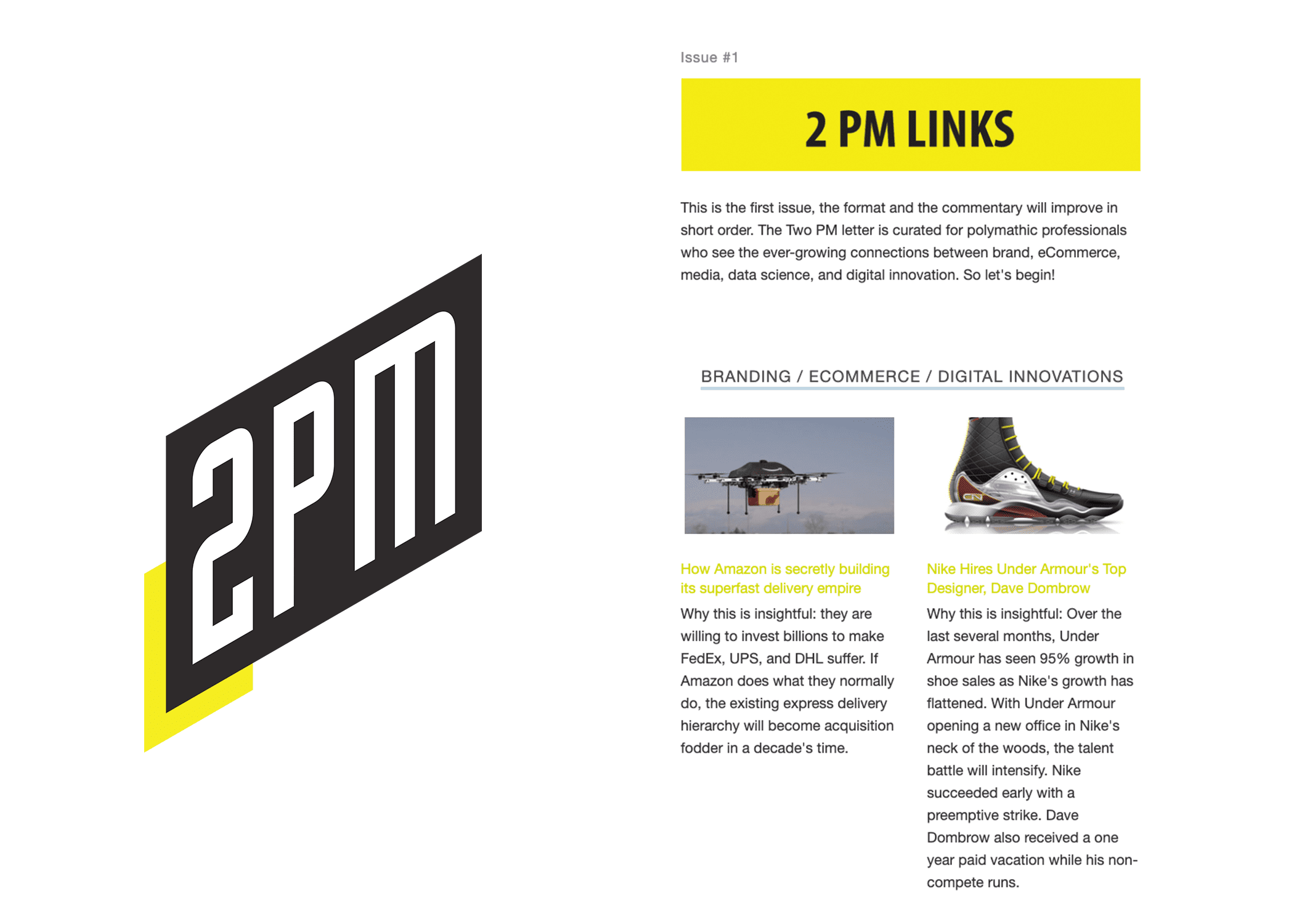
En noviembre de 2015 mantuve una conversación en un café que me pareció uno de los debates profesionales más importantes que he tenido. El debate versó sobre la mecánica de la comunidad y la necesidad de herramientas que pudieran maximizar la serendipia. En un día ocioso de finales de 2015, empecé a planificar el lanzamiento de lo que entonces llamaba 2PM Links. Pagué por un servicio llamado Goodbits y lancé la página de aterrizaje para el sitio. Después de una semana más o menos de empujar la idea de 2PM en Twitter, confirmé que la primera carta se publicaría a doce lectores enteros. Pasaría a publicar cinco días a la semana durante 180 días laborables seguidos.

Sobre el papel: 2PM Links sería una parte de conceptos originales y una parte de datos y síntesis narrativa, una recopilación de acontecimientos que contarían una historia. Los correos electrónicos permitirían un diálogo directo. Los lectores más comprometidos escribirían explicando cómo reconocen las microtendencias y los movimientos más amplios. Otros explicaban métodos para sintetizar cada carta con el máximo efecto. En ocasiones, leía un correo electrónico de uno de los primeros suscriptores en el que explicaba cómo un conjunto de artículos de varias semanas le había ayudado a planificar los próximos pasos de su empresa. Durante casi dos años, esas cartas ayudaron a mantener la motivación para mantener la coherencia operativa.

Alcance vs. Profundidad

Para construir algo destinado a crecer lentamente, mantuve puestos remunerados en empresas establecidas. Sin embargo, en el momento en que inicié la publicación, no tenía trabajo en ningún medio de comunicación. Tras haber gestionado o dirigido el comercio electrónico en dos editoriales de medios digitales, aprendí muchísimo de dos estilos muy diferentes de publicación basada en la conversión (léase: afiliación).


La empresa A construyó un embudo hiperdirigido, centrándose en un consumidor específico (acomodado). El tráfico directo era muy importante y el SEO era un embudo secundario. La marca era lo más importante. Esta empresa se basaría en ella. La empresa B creó un sistema que se basaba en el SEO y en el interés por el tema, no en la influencia de la propia plataforma. Para B,la fidelidad del lector era secundaria al descubrimiento SEO. Los visitantes hacían clic para leer sobre un tema con el que habían tropezado. Si A fuera un embudo, sería corto y ancho. La confianza se construye con el tiempo. En el caso de A, los lectores estarían impulsados por la fidelidad a la plataforma. Por su parte, el embudo B captaba nuevos lectores optimizando los artículos para palabras clave de actualidad. Su embudo sería más largo y tendría varios puntos de entrada. Esos puntos de entrada también servirían como oportunidades de salida. La rotación era mayor.

El resultado:

  • Empresa A: menor audiencia, mayor fidelidad, mayor tasa de conversión. Entre 1,8 y 2,2 millones de MAU. Segmento de producto: lujo moderno.
  • Empresa B: menor fidelidad, menor tasa de conversión, mayor audiencia. 6-7 millones de MAU. Segmento de producto: lujo accesible hasta ofertas diarias.

A y B siguen gestionando marcas de medios de comunicación de éxito con objetivos dispares. Como suele decirse, hay más de una manera de despellejar al proverbial gato.


Para probar la viabilidad a largo plazo del boletín, asigné 180 letras para resolver las cosas. A medida que avanzaban las cosas, 2PM iba adoptando cada vez más características de la empresa A. Al llegar al número 180, esta identidad influía en los siguientes pasos. Una vez alcanzada la carta nº 180, habría tres opciones:

  1. avanzar y publicar el nº 181
  2. cerrar la carta
  3. volver a crear una empresa

La elección fue la opción número tres. En mis siete páginas de planes garabateados, acordé que daría más importancia a la profundidad que al alcance. Mantendría el énfasis en la versión "A" de los medios. Para ello, hice hincapié en un modelo de suscripción de pago. Y luego un modelo de datos / asesoramiento. Y más tarde, una comunidad ejecutiva. Estas iniciativas me permitirían reinvertir los ingresos en mejores servicios, diseño, desarrollo de contenidos y mayor acceso general.

De la audiencia a la comunidad

En cuestión de dos semanas, entre diciembre de 2017 y enero de 2018, replanteé la plataforma de Goodbits a Mailchimp, diseñando en torno a una integración con Memberful. Invertí en branding y diseño. Codifiqué gran parte de la v1 del sitio en mi tiempo libre. Y más tarde importaría unas 240 ediciones de 2PM al sitio de WordPress, una por una. En marzo de 2018, después de dos meses de pruebas, la primera membresía de 2PM se lanzó a los suscriptores de Monday Letter.
Captura de pantalla 2020-01-07 a las 1.51.20 AM
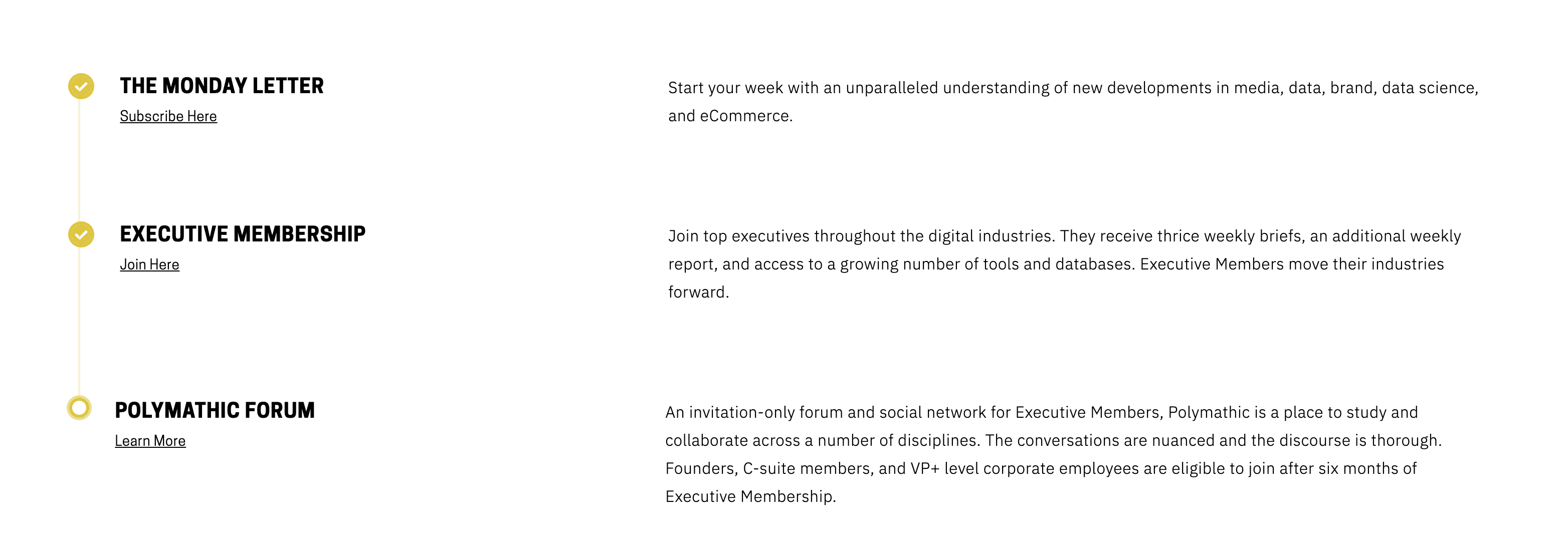
Cómo funciona 2PM. | Acerca de

De este modo, el sistema de 2PM se convirtió en una especie de embudo. Alrededor del 10% de los suscriptores se convierten en miembros ejecutivos. Y, previa invitación, un porcentaje de miembros ejecutivos opta por la comunicación directa con ejecutivos afines de diversos sectores digitales.

La comunidad de miembros ejecutivos de 2PM, Polymathic, se inspiró en dos pensamientos distintos.

  • El foro está diseñado para ayudar a los ejecutivos con talento a desarrollar nuevas competencias básicas mediante: (a) la identificación de puntos ciegos y (b) el aprendizaje de líderes que han dominado esas búsquedas.
  • Cuando llegué al último Code Commerce, recuerdo cuatro grandes conversaciones en mi primera hora en el lugar. Estas conversaciones fueron con Jason Del Rey, Alex Taussig, Marc Lore y Jen Rubio.
1D49AA7D-BD20-4B00-BDC0-0B424ADC810B
Cena de miembros ejecutivos: SF (diciembre)

Para asistir al evento de dos días de Recode, las entradas oscilan entre 2.000 y 4.000 dólares. En este sentido, el precio cumple una valiosa función. Allí, es probable que todas las personas con las que hables te dejen una impresión valiosa. Los actos suelen atraer a operadores de alto nivel. Entre los discursos de apertura de estos eventos clave, pocas conversaciones se desperdician y casi todas las interacciones extracurriculares añaden valor profesional. Así pues, el evento no es el único producto. La comunidad de asistentes aporta un valor adicional. El Foro Polymathic está diseñado para parecerse a los pasillos digitales de las mejores conferencias como Sundance, PopTech, Google's Solve for X o FOO Camp. A medida que crece el número de asistentes, también lo hace la fuerza del lugar.

Desde acoger a entre 15 y 25 miembros ejecutivos en nuestras mesas redondas mensuales hasta construir el Polymathic de 2PM, el cambio de audiencia a comunidad ha proporcionado serendipia de formas que antes eran inimaginables. Los ingresos por suscripciones son la variable clave. Las suscripciones de pago ofrecen un nivel de oportunidades que las plataformas basadas en la publicidad no pueden ofrecer. Como ejemplo práctico, considere la diferencia entre los restaurantes de comida rápida y los establecimientos de cuatro estrellas.

En general, hay dos tipos de restaurantes. Una cadena anuncia "miles de millones servidos". Esto enfatiza los KPI de la empresa: alcance, volumen y satisfacción de las masas. Pero, ¿y si no quieres llegar a las masas? El segundo tipo de restaurante se basa en la calidad de la comida y el servicio, además de un ambiente que invita a la conversación. En este último entorno, es más probable encontrar la serendipia. Es emblemático del cambio de dar prioridad a la audiencia (alcance) a dar prioridad a la comunidad (profundidad). 

Andy McIllwain, director de marketing de GoDaddy, tiene una interesante reflexión sobre el crecimiento del sector de los boletines informativos y el paso de la audiencia a la comunidad. En una breve serie de tuits, lo explica:

La década de 2010 se caracterizó por la apertura radical de las plataformas de medios sociales, un caos gigantesco e inmanejable. ¿Los próximos diez años? El péndulo volverá a las comunidades de nicho de interés y propósito.

McIllwain continúa:

Modelos de ingresos comunitarios: Patrocinio directo, cuotas escalonadas, comisiones de afiliación y experiencias de pago (eventos, retiros). Las marcas deben participar. Es el paso de la audiencia a la comunidad.

Aunque antes de Substack ya existían boletines informativos basados en la afiliación, el concepto de comunidad de pago se popularizó a medida que crecía la popularidad de la plataforma respaldada por A16Z. Al igual que una mesa en su restaurante favorito, la comida es sólo una parte de la atracción en estos entornos, cuando se ejecuta adecuadamente. La otra es el ambiente y el entorno. En 2PM, la idea de comunidad va un paso más allá. La afiliación ejecutiva abre oportunidades legítimas para la serendipia. Diez veces al año, invitamos a nuestros socios de pago a una cena de cortesía en uno de los principales mercados (Nueva York, Los Ángeles, Chicago, Austin y Boston).

De este modo: las comunidades cerradas y mediáticas se han convertido en el antídoto contra el ruido de los lugares comunes digitales. Lo verás en publicaciones como: Trapital, Petition, Off The Chain, Stratechery y Thing Testing. En cada caso, el fundador de cada medio trabaja incansablemente para ofrecer valor a sus miembros de pago. Ser miembro es un voto para el futuro, además de para el presente. Hay más espacio para empresas como éstas. Y estos proyectos suelen empezar con estrategias sencillas en torno a ideas originales. La esperanza es que se lancen más boletines y se formen más comunidades a su alrededor. Debemos fomentar la participación y la competencia. Así es como las ideas toman forma. El ecosistema, en su conjunto, es el café de hoy. No es sólo el futuro de los medios de comunicación, es emblemático de un cambio mayor a medida que la humanidad adopta como propia la cultura de lo digital primero.

Lea aquí la carta nº 343.

Informe de Web Smith | Editado por Carolyn Penner | Sobre las 2PM

No. 337: Stick To Sports

For as long as there has been athletic competition, there has been a narrative that permeates from the field of play. Gladiators of Rome were commonly first-generation slaves, bought and sold at the whim of their owners – the sporting promoters of their day. Like today’s gladiator sports, cruelty was a part of the spectacle. And the minds of the time contrasted in their approval or disapproval of their era’s proudest spectacle. Great minds like Seneca disapproved of the competition. Marcus Aurelius once abolished a tax on gladiator-based taxes and commerce; he wanted nothing to do with the capitalism of it all. And still, he couldn’t resist hosting lavish games from time to time. The spectacle of cruelty was insatiable to the average man and the great one – alike.

As it was, as it will always be. Sports was never without its social commentary. Jesse Owens’ olympic showing wasn’t just impressive because of the speed of his feet; he beat the myth of German superiority with a foot race. Jackie Robinson wasn’t just a baseball player, he was remembered as a hero. That was the narrative that was formed about the man, even while his involvement lacked the popular sentiment that it is awarded today. Janet Guthrie was a media fixture, not just because of her precedent off of the track but because of her accomplishments on it. Before Danica Patrick, there was her. And with a little more support from sponsors and officials, she could have accomplished much more.

Since when has sports been about athletic accomplishment alone?

On a November evening after the Baltimore Ravens’ decisive victory against the undefeated New England Patriots, ESPN National NFL Writer Kevin Seifert made a statement with a simple tweet. He listed three quarterbacks, each of whom are considered candidates to win the league’s coveted most valuable player award. The quarterbacks that Seifert listed: Russell Wilson, Deshaun Watson, and Lamar Jackson are what veteran industry analysts would call: unconventional, mobile, dual-threat. However, they’re more than that. In each case, whether these quarterbacks pass or rush, they lead from the front. More than anything else, that’s their common thread.

Kevin Seifert on Twitter

If we’re doing the MVP now, I’m going: 1. Russell Wilson 2. Deshaun Watson 3. Lamar Jackson

Here is a selection of quarterbacks drafted before 2019’s MVP candidates: Ryan Tannehill, Brandon Weeden, Brock Osweiler, Mitchell Trubisky, Baker Mayfield, Sam Darnold, Josh Allen, and Josh Rosen. To the casual observer, this thought may as well be morse code. So consider the following: the National Football League has never had three African-American quarterbacks in the front running for most valuable player. And certainly not in an era of the sport’s greatest quarterbacks, namely Tom Brady and Aaron Rodgers. We’re still in a period of firsts in this 150 year old sport. Brigham Young University started their first African-American quarterback in the year 2019. The sentiments of the 1950’s still linger. So what Seifert was doing was making a statement without controversy. To the untrained eye, it was merely the fact of the matter. But to those who understand the historical significance, it was a dog whistle of sorts.

“If you ask me is there a false narrative out there, I will tell you ESPN being a political organization is false,” he said. “I will tell you I have been very, very clear with employees here that it is not our jobs to cover politics, purely.” [1]

But even with the mandate by new ESPN President Jimmy Pitaro, Seifert found a way to toe the proverbial line. Wilson, the 75th pick of the 2012 draft is now the highest paid quarterback in the league. Bears quarterback Mitchell Trubisky was drafted before Watson. And Ravens quarterback Lamar Jackson was publicly and privately coaxed to convert to wide receiver by many in the media. He didn’t fit the image. His chorus of detractors included former Indianapolis Colts GM Bill Polian [2].

After this historic game, Bleacher Report took a muted approach as to avoid the conversation altogether. In the NFL, running backs don’t win MVP over transcendent quarterbacks. In the last 20 years, just four have won. Sixteen quarterbacks have been selected in that time. Just the same, here was their take:

And [Jackson] a clear MVP candidate. This game firmly planted him in that discussion, along with Panthers running back Christian McCaffrey, Seahawks quarterback Russell Wilson and Texans quarterback Deshaun Watson.[3]

Meanwhile, at Deadspin, the two lead stories are written by a generic “Deadspin.” A sign that no one is behind the wheel. The reports were merely a collection of embedded tweets. There’s one on the Ravens surprise victory. The one where the quarterback (that should have played receiver) trounced the greatest of all time. As the two shook hands upon leaving the field of play – battered and bruised – Jackson uttered “You’re the GOAT.” As if Brady needed a reminder. The other Deadspin “story” featured the Cleveland Browns latest off-the-field issue.

The only report with any personality was written by Karu F. Daniels of The Root, another property of G/O Media. It was repurposed into Deadspin content. One can only wonder what Deadspin would have written about a unique moment in the sport’s vaunted history. But the site is currently a shell of its former self. The staff quit en masse after being told to by G/O Media management to “stick to sports.” A common refrain in today’s corporate media.

G/O Media is the product of Great Hill Partners’ acquisition of the former Gizmodo Media Group. The all-equity transaction was facilitated with Jim Spanfeller, best known for his leadership at Forbes.com. Perhaps, it’s his lack of experience in sports media that permitted such a fatal miscalculation.

The Irony of The “Stick to Sports” Mandate

Google Search interest for “Stick to Sports” peaks in September 2017

On its merits, the nature of the phrase is divisive. When ESPN’s Rachel Nichols spoke out in September of 2017, the peak of its interest, she raised questions around the hypocrisy of it. It was around that time when J.J. Watt was rightly praised for raising $20 million for hurricane relief while other athletes faced pushback for highlighting other extracurricular causes – most often around social justice issues. With the current state of American politics at a relative boiling point, the separation of societal politics and corporate entertainment have never been more difficult to parse. ESPN found ways around its “stick to sports” mandate by elevating intelligent and nuanced figures like Pablo Torre, Stephen A. Smith, Max Kellerman,and Bomani Jones. Deadspin wasn’t as forward thinking and they ultimately paid for that.

“Stick to sports” is, of course, a fault line in 2019’s culture wars. [4]

But as the state of our political machine continues to polarize Americans, the mandate becomes harder and harder to follow. Yet, it becomes more important to disobey. In fact, at some point, the mandate becomes bad business. This is especially true for digital media where Deadspin rival and The Chernin Group-owned Barstool Sports has thrived by using sports as a platform to enter adjacent conversations. And I am using the word “adjacent” liberally here. Several of the top stories on Barstool Sports currently include an Instagram influencer questioning his history syllabus, a feature on the “Watchmen” series, and a woman that tattooed her eyeballs.

The banner of Barstool’s homepage features a link to the media group’s famed Chicks podcast. And all of this is to say, it seems to be working for Barstool. This includes its cozy relationship with Fox News, including regular appearances by founder Dave Portnoy on Tucker Carlson. And this isn’t an argument against their approach. Rather, it was an acknowledgment that Barstool Sports has thus far succeeded by understanding the property’s psychographic. The Chernin Group seems to have avoided the stick to sports conversation with CEO Erika Nardini.

Ringer, Deadspin, B/R, Barstool and Psychographics

Consumer psychology involves the interest in lifestyle, behavior, and habit. It’s an encompassing measure that considers our idiosyncrasies, our temperament, and even our subtle personality traits. These are the variables that influence our behavior as consumers. Psychographic segmentation is the analysis of a consumer cohort’s lifestyle with the intent to create a detailed profile.

The Ringer is jovial and care-free. Bleacher Report is dead-pan with the occasionally dry humor. Barstool is edgy and offensive as a strategy. And so was Deadspin.

While largely focused on sports, Deadspin for years had delved into a broad range of topics in a voice that was sometimes rude, often funny and always conversational. On Tuesday, the site’s top editor, Barry Petchesky, was fired after refusing to go along with the order. The departures shocked fans of the site, which put a new spin on sports coverage for a generation of digital natives. But they were the result of a long buildup of resentment between the journalists and their new bosses, according to interviews with 13 current and former employees of Deadspin and G/O Media.[5]

Nov 4: Barstool’s Homepage

For Deadspin, the majority of their sensationalism involved topics that were completely unrelated to sports in substance, this report isn’t necessarily about the history of those articles. Bill Simmons’ The Ringer shares a similar narrative with Barstool. On the homepage, you’ll find stories about Mr. Robot, Jeopardy, AppleTV+, and The Watchmen. Bleacher Report contrasts the three. The publication leans heavily towards strict sports coverage, a methodology that works for them. But even B/R featured an epic story on Colin Kaepernick written by Rembert Browne. And most recently – a story about Jared Lorenzen, the former Kentucky quarterback who died prematurely. Which brings me to the point: where do you draw the line when your publication covers sports? Collegiate and professional sports represent a layer of American life, not the totality of it. Sports is merely a dimension, not the whole.

No Code and The Business Case FOr: Stick To Sports

OM on Twitter

Let me rewrite this tweet from Jason. 1/ Deadspin writers are immensely talented and have a huge following. They have a lot of goodwill at present and as a result they should Marshall their collective resources and start a new publication. Let’s call it SpunOut. https://t.co/161I1HkInj

The editors and writers who resigned from Deadspin had a basis for their frustration. Sticking to sports is a nearly impossible proposition in today’s media. Given how rare it is to see a media company stick to their original charter, it’s understandable that Deadspin’s former employees saw the charge for what it really was: a euphemism for staying away from covering athletes who’ve immersed themselves in left-leaning causes.

But we’re in an ever-expansive era of digital media. Companies are rewarded for reaching. Complex Media is developing television shows and consulting third parties on commerce and audience development. Barstool Sports has a podcast starring two employees who discuss their friendship and sex lives, and Bleacher Report successfully collaborated on soccer kits with top hip hop artists.

Whatever happens moving forward, the Deadspin that was is no longer. It was one machine of a blog with nearly 30 million monthly visits and a penchant for engaging and re-engaging their loyal readers, many who’d visit the site multiple times per day. But it begs the question, if Deadspin was still Deadspin, what might they have written of Kevin Seifert’s idea? How would it have covered a tweet that should have been more than inconsequential. It’s doubtful that Deadspin may have told the story in the same ways that Barstool, Bleacher Report, ESPN, and The Ringer relayed theirs. To those platforms, the MVP race was not a story at all. But take it from NFL veteran and commentator Cris Collinsworth. As the Ravens led the Patriots, with the crowd in disbelief, Collinsworth quipped:

We’re going to be able to point to quarterbacks in the NFL that got a chance because of this night.

But in 2019, for many digital publishers, that’s too loaded of a statement. But many understood what it meant. And that understanding is part of the story too. The market has a need and the opportunity rests on the journalists who decide to forge their own paths. It’s only right that Deadspin alumni launches a Substack with the call sign of their mandate: Stick to Sports. Used ironically,  of course, as one last jab at the man they called an herb. The publication would almost instantly lead the Substack board.

With that model, Deadspin’s former writers and editors would have the freedom to do it the right way. Anyone who’s ever played the game knows that sports doesn’t end when you step off of the field of play. A sport is America’s pastime, it’s the most watched television event, it’s the most expensive event ticket, it’s the basis of a nation’s network of country and athletic clubs. Across America, hotels are built solely to support a thriving youth sports cultures of areas that would otherwise be barren without its expensive field complexes. Young people wear jerseys and the shoes of sporting legends. And adults bet and cry and yell and travel to watch their teams. It’s the irrationality of it all that reminds us that sticking to sports is an impossible task. And media should reflect that impossibility. Seifert knew the significance of his tweet, America should have known it too.

Informe de Web Smith | About 2PM

Resumen para los miembros: Substack y noticias locales

Papel.png

The New York Times hizo algo extraordinario. Dejó de ser un editor tradicional para convertirse en un medio de comunicación adaptado a la era de la tecnología y la hiperconectividad. The New York Times (NYT) cambió el pasado por el futuro aprovechando el presente. En 2015, Estados Unidos estaba inmerso en una de las campañas políticas más divisivas de los últimos tiempos. El New York Times utilizó este momento como un vendedor de marca utiliza un gran evento deportivo o una entrega de premios de Hollywood. Se convirtió en parte de la historia y redefinió el legado de los medios de comunicación en el proceso.

Este informe está destinado exclusivamente a Miembros ejecutivos, para facilitarle la afiliación, puede hacer clic a continuación y acceder a cientos de informes, a nuestra lista DTC Power List y a otras herramientas que le ayudarán a tomar decisiones de alto nivel.

Únete aquí