No. 343: De audiências a comunidades

2PM - Abertura

Uma carta aberta aos criadores. Atualmente, existem centenas, se não milhares, de boletins informativos viáveis baseados em associação. E isso é ótimo - uma vantagem inequívoca tanto para criadores quanto para consumidores. Desses milhares, vários deles servem como fontes de ideias originais, notícias e análises que são incrivelmente valiosas para os ecossistemas profissionais. É a síntese dessas ideias que tem o maior impacto potencial. Se a educação não tem preço, estamos entrando em uma nova era de criação de valor. Imagine uma cafeteria da era do Iluminismo.

Há boletins informativos dirigidos por operadores que publicam ideias originais. Há cartas significativas que fazem a curadoria das ideias de outros. Algumas delas informam sobre as notícias e outras categorizam e comentam os desenvolvimentos do setor. Muitas vezes, os relatórios que foram escritos por uma pessoa são aprimorados por outras. E, com bastante frequência, os principais veículos de comunicação, como o The Wall Street Journal ou a CNBC, pegam os conceitos originais e os transformam em seus próprios conceitos. Como em uma cafeteria, essa é uma forma valiosa de síntese de informações.

John Dowell é professor da Michigan State University. Em seus quase 40 anos de carreira, ele lecionou inglês, sociologia e antropologia. Seu curso sobre a introdução da síntese explica:

Uma síntese é uma discussão escrita que se baseia em uma ou mais fontes. Portanto, sua capacidade de escrever uma síntese depende de sua capacidade de inferir relações entre as fontes - ensaios, artigos, ficção e também fontes não escritas, como palestras, entrevistas, observações. Esse processo não é novidade para você, pois você infere relações o tempo todo - por exemplo, entre algo que leu no jornal e algo que viu pessoalmente, ou entre os estilos de ensino de seus instrutores favoritos e menos favoritos.

Na Era do Iluminismo (1715-1789), um europeu podia entrar em uma cafeteria pagando uma bebida. Mas a bebida era apenas o preço da entrada, a conversa era a atração. Não eram apenas as conversas sobre assuntos de sociologia, economia e direito que impulsionavam a época. Às vezes, os clientes ouviam conceitos que preenchiam lacunas em seu próprio pensamento. Outras conversas solidificavam ideias fundamentais, direta ou indiretamente.

Inspiração para a cafeteria

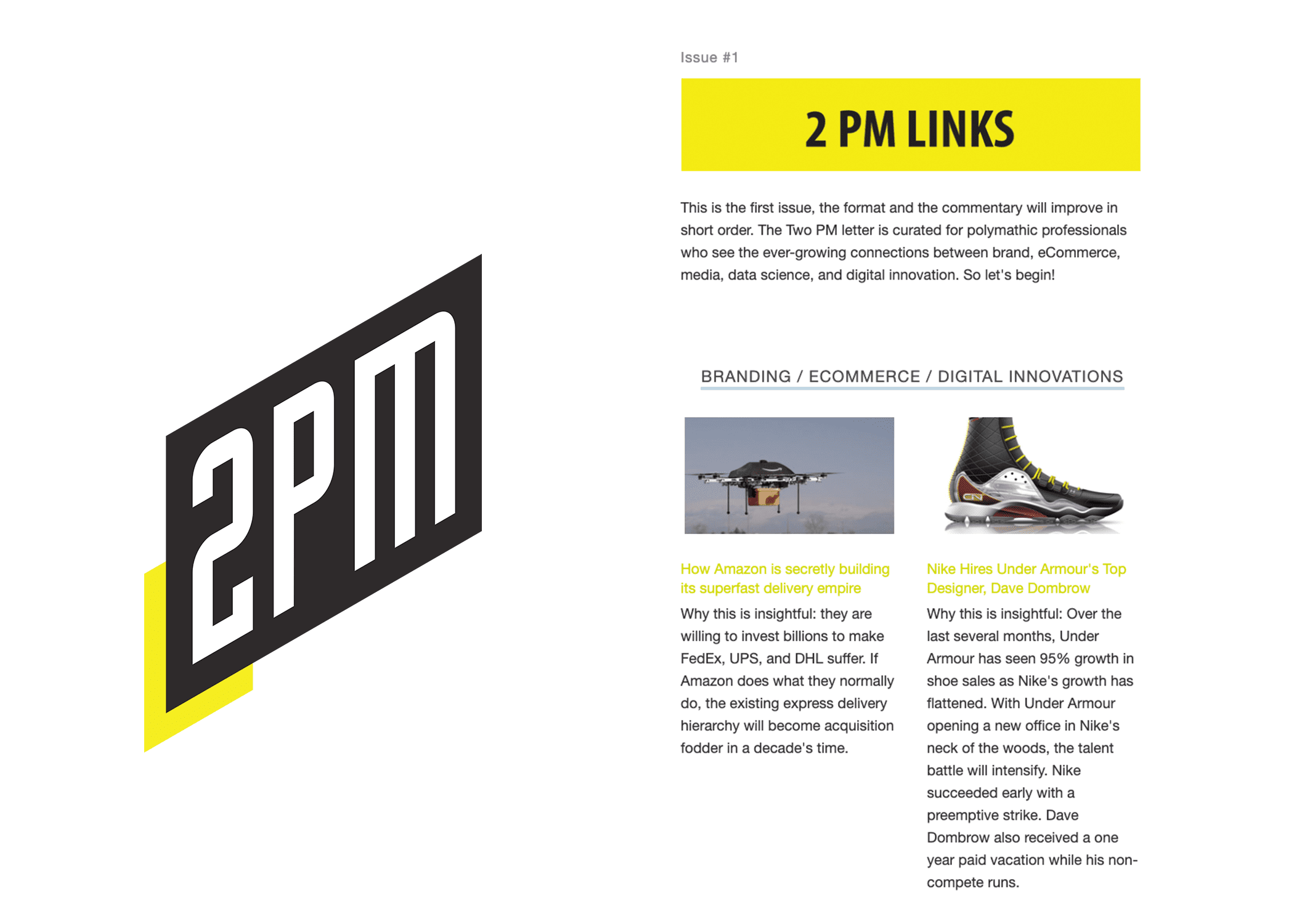
Em novembro de 2015, tive uma conversa em uma cafeteria que me marcou como uma das discussões profissionais mais importantes que já tive. A discussão era sobre a mecânica da comunidade e a necessidade de ferramentas que pudessem maximizar a serendipidade. Em um dia ocioso no final de 2015, comecei a planejar o lançamento do que eu então chamava de 2PM Links. Paguei por um serviço chamado Goodbits e lancei a página de destino do site. Depois de mais ou menos uma semana promovendo a ideia do 2PM no Twitter, confirmei que a primeira carta seria publicada para doze leitores inteiros. Eu passaria a publicar cinco dias por semana durante 180 dias úteis seguidos.

No papel: O 2PM Links seria uma parte de conceitos originais e uma parte de síntese de dados e narrativas, uma curadoria de desenvolvimentos que contariam uma história. Os próprios e-mails permitiriam o diálogo 1:1. Os leitores mais engajados escreveriam explicando como reconheceram microtendências e movimentos maiores. Outros explicavam métodos para sintetizar cada carta para obter o máximo efeito. Ocasionalmente, eu lia um e-mail de um dos primeiros assinantes explicando como um conjunto de artigos ao longo de várias semanas o ajudou a planejar as próximas etapas de sua empresa. Por quase dois anos, essas cartas ajudaram a sustentar a motivação para manter a consistência operacional.

Alcance vs. Profundidade

Para criar algo que foi projetado para crescer lentamente, mantive funções remuneradas em empresas estabelecidas. Entretanto, na época em que comecei a publicação, eu estava entre empregos na mídia. Tendo gerenciado ou liderado o comércio eletrônico em duas editoras de mídia digital, aprendi muito com dois estilos muito diferentes de publicação baseada em conversão (leia-se: afiliada).


A Empresa A criou um funil hiperdirecionado, concentrando-se em um consumidor específico (afluente). Nesse caso, o tráfego direto era alto e o SEO era um funil secundário. A marca era o mais importante. Essa empresa dependeria dela. A empresa B criou um sistema que dependia de SEO e do interesse no tópico, e não da influência da plataforma em si. Para a B,a fidelidade do leitor era secundária em relação à descoberta de SEO. Os visitantes clicavam para ler sobre um tópico com o qual haviam se deparado. Se A fosse um funil, ele seria curto e largo. A confiança era construída com o tempo. Para A, o número de leitores seria impulsionado pela fidelidade à plataforma. Enquanto isso, o funil B captava novas pessoas otimizando os artigos para palavras-chave de tópicos. Seu funil seria mais longo, com vários pontos de entrada ao longo dele. Esses pontos de entrada também serviriam como oportunidades de saída. A rotatividade era maior.

O resultado:

  • Empresa A: público menor, maior fidelidade, maior taxa de conversão. 1,8 milhão a 2,2 milhões de MAU. Segmento de produto: luxo moderno.
  • Empresa B: menor fidelidade, menor taxa de conversão, público maior. 6-7 milhões de MAU. Segmento de produto: luxo acessível até ofertas diárias.

A e B continuam a operar marcas de mídia bem-sucedidas com objetivos diferentes. Como se diz, há mais de uma maneira de esfolar o gato.


Para comprovar a viabilidade a longo prazo do boletim informativo, dei 180 cartas para que as coisas fossem resolvidas. À medida que as coisas avançavam, o 2PM assumia cada vez mais características da Empresa A. Depois de chegar ao número 180, essa identidade influenciava as próximas etapas. Quando eu chegasse à Carta nº 180, haveria três opções:

  1. seguir em frente e publicar o nº 181
  2. fechar a carta
  3. replanejar e criar uma empresa

A escolha foi a opção número três. Em minhas sete páginas de planos rabiscados, concordei que enfatizaria a profundidade em vez do alcance. Manteria a ênfase na versão "A" da mídia. Para isso, enfatizei um modelo de assinante pago. E, em seguida, um modelo de dados/consultoria. E, mais tarde, uma comunidade executiva. Essas iniciativas me permitiriam reinvestir as receitas em serviços aprimorados, design, desenvolvimento de conteúdo e maior acesso geral.

Do público à comunidade

Em uma questão de duas semanas, entre dezembro de 2017 e janeiro de 2018, mudei a plataforma do Goodbits para o Mailchimp, projetando uma integração com o Memberful. Investi em branding e design. Programei grande parte da v1 do site em meu tempo livre. E, mais tarde, importei cerca de 240 edições do 2PM para o site do WordPress, uma a uma. Em março de 2018, após dois meses de testes, a primeira assinatura do 2PM foi lançada para os assinantes da Monday Letter.

Captura de tela 2020-01-07 em 1.51.20 AM
Como funciona o 2PM. | Sobre

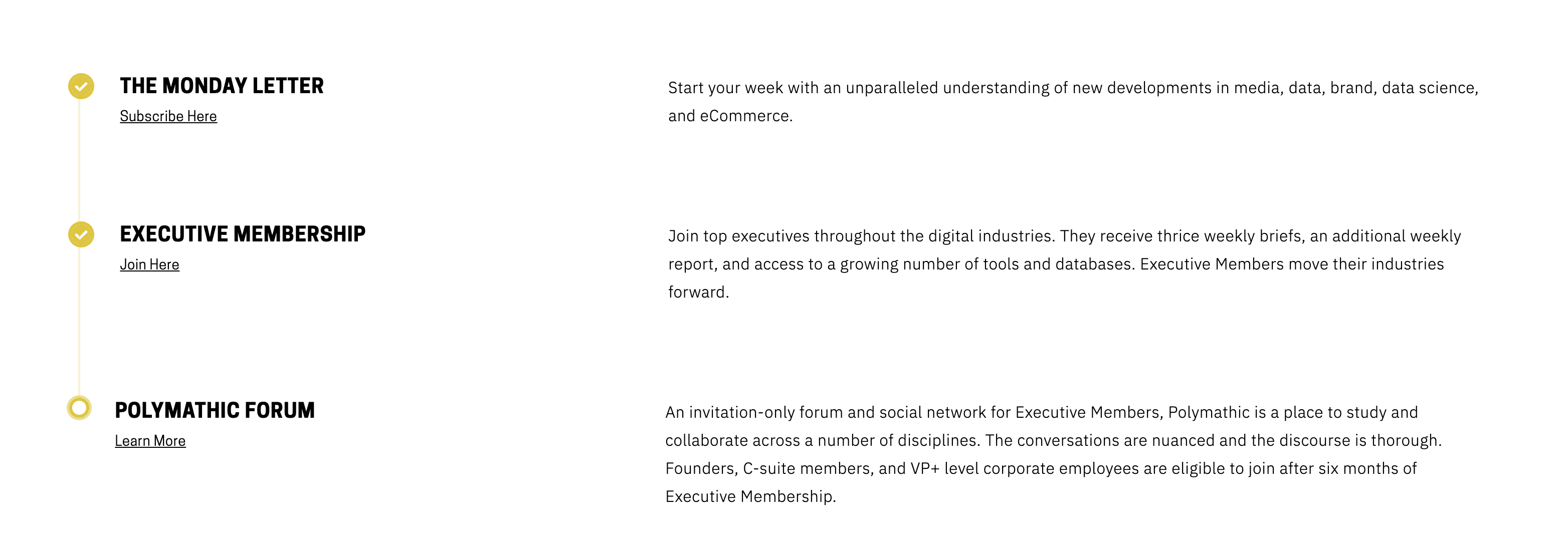
Dessa forma, o sistema do 2PM tornou-se uma espécie de funil. Cerca de 10% de todos os assinantes tornam-se membros executivos. E, mediante convite, uma porcentagem dos membros executivos opta pela comunicação direta com executivos que pensam da mesma forma em vários setores digitais.

A comunidade de Membros Executivos do 2PM, Polymathic, foi inspirada por dois pensamentos distintos.

  • O fórum foi criado para ajudar executivos talentosos a desenvolver novas competências essenciais por meio de: (a) identificando pontos cegos e (b) aprendendo com líderes que dominaram essas atividades.
  • Quando cheguei ao último Code Commerce, lembro-me de quatro ótimas conversas em minha primeira hora no local. Essas conversas foram com Jason Del Rey, Alex Taussig, Marc Lore e Jen Rubio.
1D49AA7D-BD20-4B00-BDC0-0B424ADC810B
Jantar para membros executivos: SF (dezembro)

Para participar do evento de dois dias da Recode, os ingressos variam de US$ 2.000 a US$ 4.000. Nesse aspecto, o preço tem uma função valiosa. Lá, é provável que todos com quem você conversar deixem uma impressão valiosa. Os eventos tendem a atrair operadores de alto nível. Entre os discursos principais desses eventos importantes, poucas conversas são desperdiçadas e quase todas as interações extracurriculares agregam valor profissional. Dessa forma, o evento não é o único produto. A comunidade de participantes proporciona um valor adicional. O Polymathic Forum foi projetado para se assemelhar aos corredores digitais das principais conferências, como Sundance, PopTech, Google's Solve for X ou FOO Camp. À medida que o número de participantes aumenta, aumenta também a força do local.

Desde a recepção de 15 a 25 membros executivos em nossas mesas-redondas mensais até a criação do Polymathic da 2PM, a mudança do público para a comunidade proporcionou serendipidade de maneiras que antes eram inimagináveis. A receita da assinatura torna-se a principal variável aqui. As assinaturas pagas oferecem um nível de oportunidade que as plataformas orientadas por publicidade não podem oferecer. Como exemplo prático, considere a diferença entre restaurantes fast food e estabelecimentos quatro estrelas.

Em geral, há dois tipos de restaurantes. Uma cadeia anuncia "bilhões de pessoas servidas". Isso enfatiza os KPIs da empresa: alcance, volume e satisfação das massas. Mas e se você não estiver tentando alcançar as massas? O segundo tipo de restaurante se baseia na qualidade da comida e do serviço, além da atmosfera convidativa para conversas. Nesse último ambiente, é mais provável que se encontre a serendipidade. É emblemático de uma mudança de priorizar o público (alcance) para priorizar a comunidade (profundidade). 

Andy McIllwain, gerente sênior de marketing da GoDaddy, teve uma ideia interessante sobre o crescimento do setor de boletins informativos e a mudança do público para a comunidade. Em uma breve série de tweets, ele explica:

A década de 2010 foi marcada por plataformas de mídia social radicalmente abertas - uma bagunça gigantesca e incontrolável. Nos próximos dez anos? O pêndulo volta para as comunidades de nicho de interesse e propósito.

McIllwain continua:

Modelos de receita da comunidade: Patrocínio direto, taxas de associação escalonadas, comissões de afiliados e experiências pagas (eventos, retiros). As marcas precisam participar disso. É a mudança do público para a comunidade.

Embora existissem boletins informativos orientados por membros antes do Substack, o conceito de comunidade com acesso pago foi popularizado com o crescimento da popularidade da plataforma apoiada pelo A16Z. Assim como uma mesa em seu restaurante favorito, a comida é apenas uma parte da atração nesses ambientes, quando executada adequadamente. A outra é a ambientação e o ambiente. No 2PM, a ideia de comunidade é levada um passo adiante. A associação executiva abre oportunidades legítimas de serendipidade. Dez vezes por ano, convidamos nossos membros pagantes para um jantar de cortesia em um dos principais mercados (Nova York, Los Angeles, Chicago, Austin e Boston).

Dessa forma: as comunidades fechadas e orientadas pela mídia se tornaram o antídoto para o ruído dos lugares comuns digitais. Você verá isso em publicações como: Trapital, Petition, Off The Chain, Stratechery e Thing Testing. Em cada caso, cada fundador de mídia trabalha incansavelmente para fornecer valor aos seus membros pagantes. Uma associação é um voto para o futuro, além do presente. Há mais espaço para empresas como essas. E esses projetos geralmente começam com estratégias simples em torno de ideias originais. A esperança é que mais boletins informativos sejam lançados e que mais comunidades se formem ao redor deles. Devemos incentivar o envolvimento e a concorrência. É assim que as ideias tomam forma. O ecossistema, como um todo, é a cafeteria de hoje. Esse não é apenas o futuro da mídia, ele é emblemático de uma mudança maior à medida que a humanidade adota a cultura digital como sua.

Leia a carta de nº 343 aqui.

Reportagem de Web Smith | Editado por Carolyn Penner | Aproximadamente 2PM

No. 337: Stick To Sports

For as long as there has been athletic competition, there has been a narrative that permeates from the field of play. Gladiators of Rome were commonly first-generation slaves, bought and sold at the whim of their owners – the sporting promoters of their day. Like today’s gladiator sports, cruelty was a part of the spectacle. And the minds of the time contrasted in their approval or disapproval of their era’s proudest spectacle. Great minds like Seneca disapproved of the competition. Marcus Aurelius once abolished a tax on gladiator-based taxes and commerce; he wanted nothing to do with the capitalism of it all. And still, he couldn’t resist hosting lavish games from time to time. The spectacle of cruelty was insatiable to the average man and the great one – alike.

As it was, as it will always be. Sports was never without its social commentary. Jesse Owens’ olympic showing wasn’t just impressive because of the speed of his feet; he beat the myth of German superiority with a foot race. Jackie Robinson wasn’t just a baseball player, he was remembered as a hero. That was the narrative that was formed about the man, even while his involvement lacked the popular sentiment that it is awarded today. Janet Guthrie was a media fixture, not just because of her precedent off of the track but because of her accomplishments on it. Before Danica Patrick, there was her. And with a little more support from sponsors and officials, she could have accomplished much more.

Since when has sports been about athletic accomplishment alone?

On a November evening after the Baltimore Ravens’ decisive victory against the undefeated New England Patriots, ESPN National NFL Writer Kevin Seifert made a statement with a simple tweet. He listed three quarterbacks, each of whom are considered candidates to win the league’s coveted most valuable player award. The quarterbacks that Seifert listed: Russell Wilson, Deshaun Watson, and Lamar Jackson are what veteran industry analysts would call: unconventional, mobile, dual-threat. However, they’re more than that. In each case, whether these quarterbacks pass or rush, they lead from the front. More than anything else, that’s their common thread.

Kevin Seifert on Twitter

If we’re doing the MVP now, I’m going: 1. Russell Wilson 2. Deshaun Watson 3. Lamar Jackson

Here is a selection of quarterbacks drafted before 2019’s MVP candidates: Ryan Tannehill, Brandon Weeden, Brock Osweiler, Mitchell Trubisky, Baker Mayfield, Sam Darnold, Josh Allen, and Josh Rosen. To the casual observer, this thought may as well be morse code. So consider the following: the National Football League has never had three African-American quarterbacks in the front running for most valuable player. And certainly not in an era of the sport’s greatest quarterbacks, namely Tom Brady and Aaron Rodgers. We’re still in a period of firsts in this 150 year old sport. Brigham Young University started their first African-American quarterback in the year 2019. The sentiments of the 1950’s still linger. So what Seifert was doing was making a statement without controversy. To the untrained eye, it was merely the fact of the matter. But to those who understand the historical significance, it was a dog whistle of sorts.

“If you ask me is there a false narrative out there, I will tell you ESPN being a political organization is false,” he said. “I will tell you I have been very, very clear with employees here that it is not our jobs to cover politics, purely.” [1]

But even with the mandate by new ESPN President Jimmy Pitaro, Seifert found a way to toe the proverbial line. Wilson, the 75th pick of the 2012 draft is now the highest paid quarterback in the league. Bears quarterback Mitchell Trubisky was drafted before Watson. And Ravens quarterback Lamar Jackson was publicly and privately coaxed to convert to wide receiver by many in the media. He didn’t fit the image. His chorus of detractors included former Indianapolis Colts GM Bill Polian [2].

After this historic game, Bleacher Report took a muted approach as to avoid the conversation altogether. In the NFL, running backs don’t win MVP over transcendent quarterbacks. In the last 20 years, just four have won. Sixteen quarterbacks have been selected in that time. Just the same, here was their take:

And [Jackson] a clear MVP candidate. This game firmly planted him in that discussion, along with Panthers running back Christian McCaffrey, Seahawks quarterback Russell Wilson and Texans quarterback Deshaun Watson.[3]

Meanwhile, at Deadspin, the two lead stories are written by a generic “Deadspin.” A sign that no one is behind the wheel. The reports were merely a collection of embedded tweets. There’s one on the Ravens surprise victory. The one where the quarterback (that should have played receiver) trounced the greatest of all time. As the two shook hands upon leaving the field of play – battered and bruised – Jackson uttered “You’re the GOAT.” As if Brady needed a reminder. The other Deadspin “story” featured the Cleveland Browns latest off-the-field issue.

The only report with any personality was written by Karu F. Daniels of The Root, another property of G/O Media. It was repurposed into Deadspin content. One can only wonder what Deadspin would have written about a unique moment in the sport’s vaunted history. But the site is currently a shell of its former self. The staff quit en masse after being told to by G/O Media management to “stick to sports.” A common refrain in today’s corporate media.

G/O Media is the product of Great Hill Partners’ acquisition of the former Gizmodo Media Group. The all-equity transaction was facilitated with Jim Spanfeller, best known for his leadership at Forbes.com. Perhaps, it’s his lack of experience in sports media that permitted such a fatal miscalculation.

The Irony of The “Stick to Sports” Mandate

Google Search interest for “Stick to Sports” peaks in September 2017

On its merits, the nature of the phrase is divisive. When ESPN’s Rachel Nichols spoke out in September of 2017, the peak of its interest, she raised questions around the hypocrisy of it. It was around that time when J.J. Watt was rightly praised for raising $20 million for hurricane relief while other athletes faced pushback for highlighting other extracurricular causes – most often around social justice issues. With the current state of American politics at a relative boiling point, the separation of societal politics and corporate entertainment have never been more difficult to parse. ESPN found ways around its “stick to sports” mandate by elevating intelligent and nuanced figures like Pablo Torre, Stephen A. Smith, Max Kellerman,and Bomani Jones. Deadspin wasn’t as forward thinking and they ultimately paid for that.

“Stick to sports” is, of course, a fault line in 2019’s culture wars. [4]

But as the state of our political machine continues to polarize Americans, the mandate becomes harder and harder to follow. Yet, it becomes more important to disobey. In fact, at some point, the mandate becomes bad business. This is especially true for digital media where Deadspin rival and The Chernin Group-owned Barstool Sports has thrived by using sports as a platform to enter adjacent conversations. And I am using the word “adjacent” liberally here. Several of the top stories on Barstool Sports currently include an Instagram influencer questioning his history syllabus, a feature on the “Watchmen” series, and a woman that tattooed her eyeballs.

The banner of Barstool’s homepage features a link to the media group’s famed Chicks podcast. And all of this is to say, it seems to be working for Barstool. This includes its cozy relationship with Fox News, including regular appearances by founder Dave Portnoy on Tucker Carlson. And this isn’t an argument against their approach. Rather, it was an acknowledgment that Barstool Sports has thus far succeeded by understanding the property’s psychographic. The Chernin Group seems to have avoided the stick to sports conversation with CEO Erika Nardini.

Ringer, Deadspin, B/R, Barstool and Psychographics

Consumer psychology involves the interest in lifestyle, behavior, and habit. It’s an encompassing measure that considers our idiosyncrasies, our temperament, and even our subtle personality traits. These are the variables that influence our behavior as consumers. Psychographic segmentation is the analysis of a consumer cohort’s lifestyle with the intent to create a detailed profile.

The Ringer is jovial and care-free. Bleacher Report is dead-pan with the occasionally dry humor. Barstool is edgy and offensive as a strategy. And so was Deadspin.

While largely focused on sports, Deadspin for years had delved into a broad range of topics in a voice that was sometimes rude, often funny and always conversational. On Tuesday, the site’s top editor, Barry Petchesky, was fired after refusing to go along with the order. The departures shocked fans of the site, which put a new spin on sports coverage for a generation of digital natives. But they were the result of a long buildup of resentment between the journalists and their new bosses, according to interviews with 13 current and former employees of Deadspin and G/O Media.[5]

Nov 4: Barstool’s Homepage

For Deadspin, the majority of their sensationalism involved topics that were completely unrelated to sports in substance, this report isn’t necessarily about the history of those articles. Bill Simmons’ The Ringer shares a similar narrative with Barstool. On the homepage, you’ll find stories about Mr. Robot, Jeopardy, AppleTV+, and The Watchmen. Bleacher Report contrasts the three. The publication leans heavily towards strict sports coverage, a methodology that works for them. But even B/R featured an epic story on Colin Kaepernick written by Rembert Browne. And most recently – a story about Jared Lorenzen, the former Kentucky quarterback who died prematurely. Which brings me to the point: where do you draw the line when your publication covers sports? Collegiate and professional sports represent a layer of American life, not the totality of it. Sports is merely a dimension, not the whole.

No Code and The Business Case FOr: Stick To Sports

OM on Twitter

Let me rewrite this tweet from Jason. 1/ Deadspin writers are immensely talented and have a huge following. They have a lot of goodwill at present and as a result they should Marshall their collective resources and start a new publication. Let’s call it SpunOut. https://t.co/161I1HkInj

The editors and writers who resigned from Deadspin had a basis for their frustration. Sticking to sports is a nearly impossible proposition in today’s media. Given how rare it is to see a media company stick to their original charter, it’s understandable that Deadspin’s former employees saw the charge for what it really was: a euphemism for staying away from covering athletes who’ve immersed themselves in left-leaning causes.

But we’re in an ever-expansive era of digital media. Companies are rewarded for reaching. Complex Media is developing television shows and consulting third parties on commerce and audience development. Barstool Sports has a podcast starring two employees who discuss their friendship and sex lives, and Bleacher Report successfully collaborated on soccer kits with top hip hop artists.

Whatever happens moving forward, the Deadspin that was is no longer. It was one machine of a blog with nearly 30 million monthly visits and a penchant for engaging and re-engaging their loyal readers, many who’d visit the site multiple times per day. But it begs the question, if Deadspin was still Deadspin, what might they have written of Kevin Seifert’s idea? How would it have covered a tweet that should have been more than inconsequential. It’s doubtful that Deadspin may have told the story in the same ways that Barstool, Bleacher Report, ESPN, and The Ringer relayed theirs. To those platforms, the MVP race was not a story at all. But take it from NFL veteran and commentator Cris Collinsworth. As the Ravens led the Patriots, with the crowd in disbelief, Collinsworth quipped:

We’re going to be able to point to quarterbacks in the NFL that got a chance because of this night.

But in 2019, for many digital publishers, that’s too loaded of a statement. But many understood what it meant. And that understanding is part of the story too. The market has a need and the opportunity rests on the journalists who decide to forge their own paths. It’s only right that Deadspin alumni launches a Substack with the call sign of their mandate: Stick to Sports. Used ironically,  of course, as one last jab at the man they called an herb. The publication would almost instantly lead the Substack board.

With that model, Deadspin’s former writers and editors would have the freedom to do it the right way. Anyone who’s ever played the game knows that sports doesn’t end when you step off of the field of play. A sport is America’s pastime, it’s the most watched television event, it’s the most expensive event ticket, it’s the basis of a nation’s network of country and athletic clubs. Across America, hotels are built solely to support a thriving youth sports cultures of areas that would otherwise be barren without its expensive field complexes. Young people wear jerseys and the shoes of sporting legends. And adults bet and cry and yell and travel to watch their teams. It’s the irrationality of it all that reminds us that sticking to sports is an impossible task. And media should reflect that impossibility. Seifert knew the significance of his tweet, America should have known it too.

Relatório de Web Smith | Por volta das 14h

Resumo do membro: Substack e notícias locais

Papel.png

O New York Times fez algo extraordinário. A editora tradicional passou de uma editora tradicional para o manual de mídia adequado para esta era de tecnologia e hiperconectividade. O New York Times (NYT) trocou o passado pelo futuro, aproveitando o presente. Em 2015, os Estados Unidos da América estavam em meio a uma das campanhas políticas mais polêmicas da história recente. O New York Times usou esse momento como um profissional de marketing de marca usa um grande evento esportivo ou um show de prêmios de Hollywood. Ele se tornou parte da história e redefiniu a mídia legada no processo.

Este resumo para membros foi elaborado exclusivamente para Membros executivosPara facilitar a associação, você pode clicar abaixo e obter acesso a centenas de relatórios, à nossa DTC Power List e a outras ferramentas para ajudá-lo a tomar decisões de alto nível.

Registre-se aqui