No. 291: The Sears Bankruptcy Dossier

searsdossier.jpg

After many years of struggles, Sears Holding Corp followed through on their anticipated Chapter 11 bankruptcy after missing a crucial debt payment of $134 million.

2PM, Inc. on Twitter

News: @Sears to file for bankruptcy after 12 PM EST. 150 anchor stores at Tier B / C malls will be closed and nearly 19,000 jobs will be lost.

History. Sears has a story that dates back 132 years. For over a century, that history was rich and awe-inspiring. From a mail order catalogue (that sold everything) to one of the largest retailers and land holders in the world – only to be surpassed by Walmart in 1987.  For a long time, Sears met consumers where they were.

It wasn’t just that Sears failed to improve its in-store experience and merchandising strategy. Lampert also failed to see how digital could boost the overall business. According to Dennis, the e-commerce business was positioned as a separate play, distinctly different from physical stores. Using stores as digital assets with technology like buy online, pick up in store is a common shield retailers like Nordstrom and Kohl’s use to protect themselves from Amazon.

How Sears’ cost-cutting strategy sealed its fate

While Walmart has evolved to compete in the online-first economy, Sears has not. Of two of the top reasons that Sears’ century of good fortune began to crumble: they incurred massive debts and suffered from severe corporate mismanagement issues.

Web Smith on Twitter

TIL: @Sears used to sell cocaine, codeine, and opium. They were profitable then.

But that doesn’t tell the entire story. Here is a great quote from today’s CNBC article on the matter:

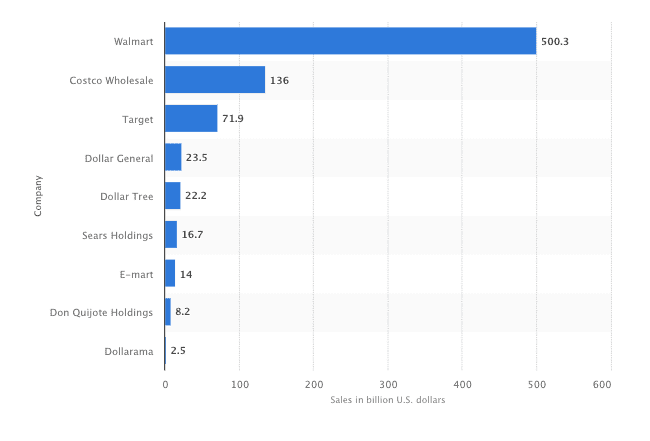
A separate survey of U.S. consumers by Cowen & Co. found the average Sears shopper today is about 45 years old and makes a little more than $59,000 each year. The average Kmart shopper, meanwhile, is a little more than 43 years old and makes about $53,000 annually. That makes Walmart ($55,200), Burlington Coat Factory ($59,100), J.C. Penney ($61,000) and Ross Stores($61,400) the most comparable retailers for Sears and Kmart shoppers when looking at household income, the firm said.

J.C. Penney and Walmart set to benefit

Economics. In a recent study by the Pew Research Center, the middle class is defined as a household with two-thirds to double the national median income. This metric currently includes about half of American households. However, from 2000 to 2014, families that were considered “middle class” decreased in 203 of 229 studied metropolitan areas. This decrease has only accelerated in the past four years. Sears was built for middle-class mall goer. It’s been the thesis of 2PM, Inc. that retailers who’ve built their businesses for this American demo will continue to struggle until the American middle class rebounds.

JC Penney is another retailer that is facing these troubles. Whereas companies like Walmart, Target, Amazon, Dollar General, or Kohl’s have achieved growth by appealing to the upper middle class or economy shoppers. Straddled in debt, and with little to no visionary leadership, Sears failed to execute this pivot. The results have been tragic. Mall owners and commercial real estate developers will have to adopt new strategies to prevent the negative cycles that have occured in the past when anchor stores are abandoned.


Issue No 179: House of Cards

But the real economic shift will be felt in exurban, lower-to-middle class areas. These areas are more dependent on shopping malls and the associated commercial real estate developments to fill their open swaths of land. This is where these communities go to shop, eat, and work. This is also where a sizable amount of tax revenue is generated. Without anchor stores or foot traffic for smaller businesses, exurban commercial real estate is nothing more than a house of cards. Next generation retail will not be there. And neither will appreciating homes.


2PM Data

The top 100 retailers are listed below. A common misconception is that Sears was a forgotten retailer. In this recent dataset by Statista, Sears is currently in the top 40 stores in America.

[table id=29 /]

Here is a look several data points that will influence commercial real estate for years to come.
Screen Shot 2018-10-15 at 2.01.41 PM
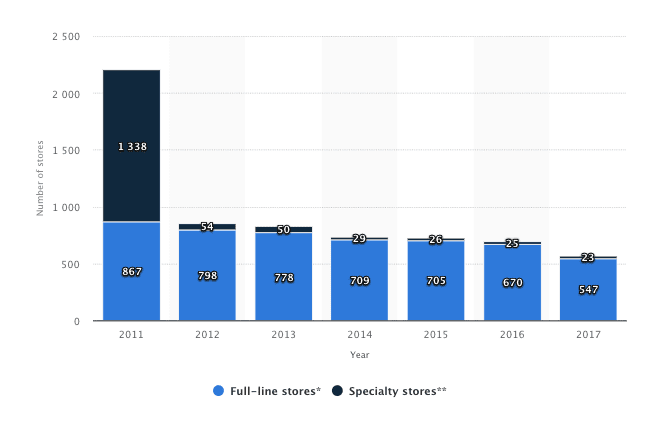
Visual: Sears closings (2011-2017) / Source: Statista
Screen Shot 2018-10-15 at 2.12.20 PM
Top middle class retailers in sales (2017) / Source: Statista
Screen Shot 2018-10-15 at 2.17.36 PM
Sears’ net losses: 2013-2017 / Source: Statista
Screen Shot 2018-10-15 at 2.19.35 PM
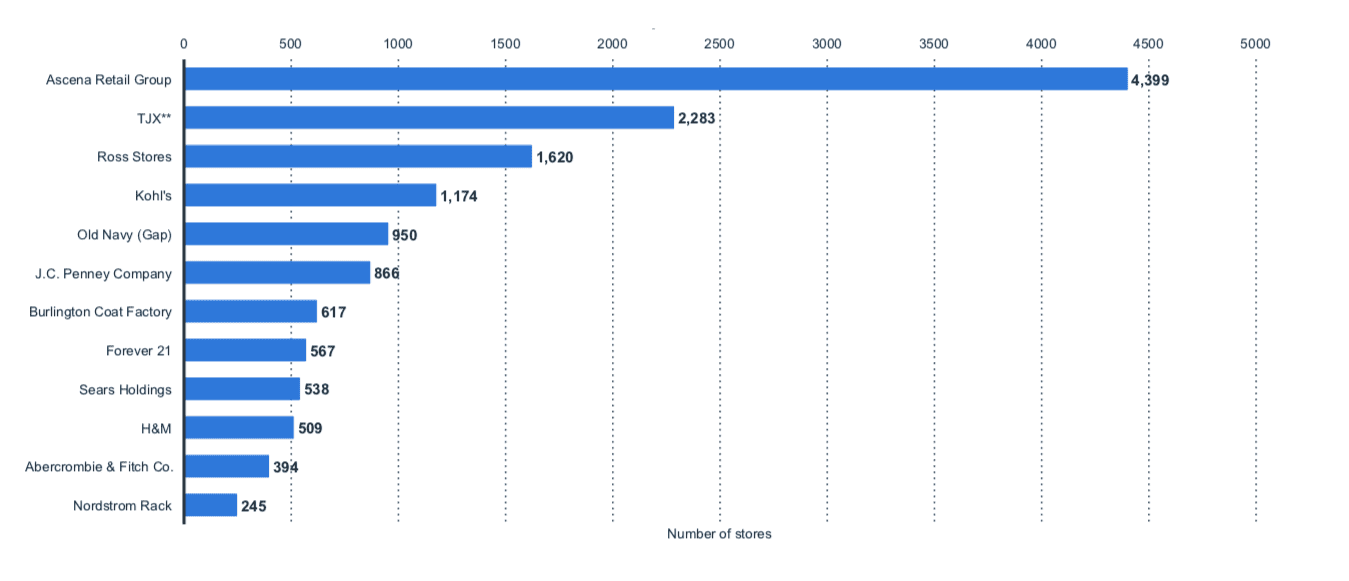
Number of stores of the leading apparel retailers in America (2017) / Source: Statista

The Sears bankruptcy should be viewed as a warning shot for companies like: J.C. Penney, Burlington Coat Factory, and Ascena Retail Group – a conglomerate of middle class retail brands. Ascena is currently operating 4,400 stores in North America and trading at 25% of its historical highs. Retailers that have been dependent on debt and brick and mortar foot traffic are overdue for an evolution of their approach to reaching a) existing customers in a dwindling demo or b) finding innovative ways to reach new customers in growing demos: economy and up market. 

The death of retail as we now know it is greatly exaggerated. Retail isn’t dying; it’s evolving. Just like it has done before. There has always been disruption in the retail sector. A major disruption occurred in the late 1800s when Sears introduced the catalog and brought the entire store into the homes of U.S. consumers. This gave Sears the same advantage over brick and mortar stores that eCommerce sites have today. Sears was simply responding to the needs of its customer since 60 percent of the U.S. population lived in rural areas at the time and didn’t have convenient access to stores. Sears would bring the store right to them.

Marshall Cohen of NPD

Nearly 111 million square feet of retail space will be lost in this bankruptcy. For the Tier A malls that will be affected by Sears’ closings, consumers will see new consumer or events spaces in place of the historic retailer. But for Tier B/C malls, Sears’ closing will become another eyesore that will influence aspirational consumers to shop elsewhere. Sears once thrived on the principles meeting customers where they were. Evolving customer needs requires leadership that understands where consumer mindshare and dollars are going.

Read the curation here.

By Web Smith | About 2PM
Contributor: The 4C’s of Digital Branding

Screen Shot 2018-10-15 at 11.56.33 AM
Pictured: Ana Andjelic

NEW YORK — For every GOOP, there are many failed online retail ventures in the celebrity brand space. Do you remember Blake Lively’s Preserve

When it comes to online retail, success is more unpredictable than ever. This is because much of today’s commerce currency is derived from social influence: the undeniable effects that individuals have on strangers’ purchasing decisions. We almost never make decisions independently of one another. Faced with the abundance of choice, we rely on others to influence what to buy, read, wear or even how we are entertained. We also conform to the tastes of others, less out of actual merit. More so out of allegiance to that individual’s opinions. 

Consumers adopt a business because other people are already there.

Glossier did not succeed because of product alone. It succeeded because women wanted to enjoy the benefits of sharing their choices, preferences, and looks with like-minded consumers. For digital retailers, more often than not – a product, brand, or technology is the substance but not the reason behind the success. Consumers adopt a business because other people are already there. Kylie Cosmetics does not win on the merits of eCommerce alone; there are better storefronts on the web. But technology hardly ever deters her fans.

More than ever, success is then a matter of cumulative advantage. Something becomes popular mostly because a lot of people like it, not just because it is superior. And because a lot of people like what they think others like, community doesn’t just reveal our preferences. They actively shape our preferences.

The quest for the next GOOP or Glossier will remain elusive as long we fail to look beyond technology and towards the social activity as the source of an online retailer’s value. This social activity is an amalgam of what I call the 4C’s: community, content, curation, and collaboration. They critically impact how a company launches and markets its products and creates, captures, and delivers value for its customers.

Community: A retailer needs to encourage social connections among its customers. These social connections will become its primary source of value and a key driver of competitive advantage. Social connections work best when created around an audience’s pre-existing passion, hobby, or interest. High-design ride wear brand Rapha positions itself as a “vibrant ecosystem for road riders around the world.” Its belief that cycling transforms lives translates into the series of local Rapha Cycling Clubs, where cycling enthusiasts can gather for events, rides, races and to bond with others. Rapha is at risk of losing its positional advantage by ending many of these programs.

Content: Content created by a retailer generates value even before a single product purchase or use of service. California-based fashion apparel brand Dôen creates social network around its proprietary content. The brand prides itself on selling “thoughtfully designed clothing by women, for women.” This community of women is Dôen’s value proposition, and it consistently delivers through its product design, events, and Journal. There, Dôen profiles the extraordinary stories of community members and becomes a source of continued conversation.

Curation: A retailer’s new customers can lower the value for its existing customers. To prevent reverse network effects and maintain a high signal-to-noise ratio, retailers need strong curation and personalization. In order to ensure that its products and services are relevant and valuable to its best customers. For example: Adidas introduced Creators Club, a membership program that gives customers access to exclusive events, products, and special offers.

Collaboration: Ask what else your customers are wearing, reading, listening, experiencing, and talking about. Relevance of a retailer for its target group is greater if it is culturally amplified. IKEA’s collaboration with a streetwear brand Off-White aims at designing the affordable furniture collection for millennials to help them create their first home. More importantly, it reflects a broader taste for the aesthetic of their joint audience.

No one knows who the new GOOP is going to be. Instead of projecting the next success story, we can create one by making our technology inherently social. To increase the odds of creating a cumulative advantage once the product or service is in the market, retailers must build 4Cs into their core. In the complex and unpredictable world of online retail, designing for social influence is a brand’s best bet.

Read the No. 291 curation here.

By Ana Andjelic| Edited by Web Smith.  About Ana: most recently the Chief Brand Officer of Rebecca Minkoff, Ana has earned her doctorate degree in sociology and worked at the world’s top advertising agencies. She’s also a frequently published author, public speaker and writer. She lives in New York City. 

No. 290: On DtC brand defensibility

Screen Shot 2018-10-09 at 8.19.20 AM

If you’ve seen a battle scene from a movie about knights, soldiers, and castles, you may understand the concept of an economic moat. If you watched an old war film lately, a moat is often depicted as a water-filled ditch. It typically helps to defend a fort, village, or castle. In that film, you may have seen projectiles fly toward the castle and cannons fire from atop, in return. Enemy combatants rush the castle only to encounter a deep and wide area of water, poison, hot tar, and sharp spears. As the castle faces fire on all sides, the offensive is often ineffective. The moat helped the castle defend its position. 

People don’t know what they want until you show it to them.

Steve Jobs

In traditional tech, there are moats all around us. Apple builds moats into many of their hardware devices. Your Macbook prefers its Safari browser (until you otherwise designate Chrome), Apple Car Play exclusively defaulted to Apple Maps until iOS 12, and your Airpods defaulted to Apple Music unless you specified Spotify. For physical goods, there are brand moats as well. The best example happens to be at Nike.

Nike works with youth leagues to outfit elite teams, providing young players (and their parents) incentives to purchase all of their wears from the brand. The sportswear manufacturing giant outfits the NFL, the NBA, and the vast majority of NCAA sports. When fans purchase licensed apparel, consumer psychology tips in favor of Nike.

Amazon Prime has become a funnel for the retailer’s private label brands and their high margin devices. Walmart has operated at such a low cost-basis, that their most loyal consumers have little to no market substitute. Shopify attract new merchants with little revenue and fosters them along their path to $20 million per year, introducing a suite of products to keep them from replatforming.

And then there’s Whole Foods Market, who – prior to acquisition – competed in a red ocean. They succeeded for a long time by building an economic moat around their brand and user experience. For decades, Whole Foods’ economic moat was a collection of subtle advantages: nicer fixtures, a wider assortment of organic foods, great lighting, and a knowledgeable floor staff. There was little to nothing technical about the retailer’s growth, but the collection of these advantages locked customers in. An economic moat can be built by more than a company’s technological advantages.

How do you compete against a true fanatic? You can only try to build the best possible moat and continuously attempt to widen it.

Warren Buffett

The internet didn’t destroy the moat, it changed the definition. The smaller the niche, the less the competition. For products in a small niche, there’s less of a need for brand defensibility. But for product manufacturers in a red ocean, defensibility is the difference between stalling out and taking flight. Yet, brand defensibility is often deprioritized. In some cases, brands will focus on customer acquisition (at all costs), often at the expense of building a lasting economic moats.

Old consumer economy. Initially, there were three influences to consider when launching a product in this new consumer economy: brand, product, distribution, the hive, and acquisition model. Prior to the rise of direct to consumer retail, a brand’s moat consisted of these:

  • brand: the impression made upon consumers. The perception created around a physical good mattered most. This impression helped brands remain top of mind between their visits to their shopping centers or the occasional television advertisement.
  • product: the quality of the goods. The value created by the manufacturer influenced brand perception, customer satisfaction, and even word of mouth influence.
  • old distribution: where it is sold. The better the product, the more likely that a consumer could find it anywhere. This signaled that there was consensus around the quality and durability of what is being sold.

With this model, a brand’s trajectory and defensibility was mostly predictable. This was pre-internet: before the rise of the internet and digitally native vertical brands. With the proliferation of direct to consumer brands, influences have changed.

New consumer economy. With the internet, any retailer can market, sell, and deliver physical goods. Brick and mortar distribution is no longer defensible against upstart brands. The web democratized the ability to build product-based brands. In the new consumer economy, a brand’s moat is not only its features, price, and availability. It’s a consideration of product experience, technical advantages, and brand evangelism.


If you don’t land the first and loyal 100, your brand is less likely to earn the early adopters who look like the first 100. Without early adopters, you will not achieve the attention of the masses. The first 100 are the foundation. Without the support of the 100, the masses will not adopt. Made famous by Simon Sinek, heed the diffusion of innovation theory: the early majority will not try something until someone else tries it first. Brands are judged by this early majority.

No. 277: The Power of the 100


In the new brand economy, maintaining defensibility has become more complicated. In physical retailers, traditional luxury brands know their buyers’ preferences. Today, the savviest DNVBs are in direct contact with many consumers by way of customer service, email, and private messaging. They are using these channels, pricing strategies, branding to influence outcomes. Brands have optimized around, beautiful packaging (see: Lumi) fast shipping (See: ShipBob), and easy returns (See: Loop). And with these technological and brand advantages, they are siphoning the loyalty away from incumbent brands like Gillette, who are still operating under the rules of the old consumer economy.

Here are the revised influences:

  • brand: the reputation of the product manufacturer. The collective sentiment of the brand’s consumers.
  • product: the value created by the product. But also, the value created by the ease of purchase, the fulfillment process, and the customer follow-up  upon purchase.
  • new distribution: how is it sold? The better the product, the more likely that a consumer has a 1:1 relationship with the brand.
  • acquisition model: how does the brand achieve meaningful foot traffic? And what is the right combination of paid and organic growth? Is organic growth sustainable?
  • the hive: who is the product’s first 100? Has the brand experienced organic growth on the foundation of this digital community? Will the “100” defend the brand when skeptics criticize it?

A practical example of competition

In this recent post by Harry’s, their team addresses Gillette head on:

In the face of competition from companies like Harry’s, Gillette has lowered its prices for certain razor models. Yet, Harry’s may still be the best value if you’re looking for a 5-blade razor with a flexible head, lubrication strip, and trimmer blade—the key features many guys consider to be most important for a great shave.

How long have you been overpaying for your razors?

At Target stores, Harry’s maintains the majority of the mindshare in the men’s skincare aisles. Often in spite of Gillette’s legacy of long-term performance. And today, Procter & Gamble disclosed that the company is downsizing it’s valuable Gillette real estate in Massachusetts. Presumably, the P&G label is preparing to more efficiently compete with online-first brands that are eating into their market share.

A moat for DtC brands is the competitive advantage earned by focusing on brand, product, distribution, acquisition, and the hive – the brand’s most visible customers and product activations. This competitive advantage fuels incremental growth in established industries.

I’ve compiled two distinct lists of the DNVBs that have emerged in industries that are highly competitive: luggage, skincare, supplements, digital media, and athleisure. These brands aren’t notable because of their lack of competition; rather, they are notable because they rise above tremendous competition. Paul Munford, founder of Lean Luxe, reports on direct-to-consumer brands. He made the following selections:

  1. Away
  2. Rapha
  3. Soylent
  4. Outlier
  5. Wone
  6. Bevel
  7. Hodinkee
  8. Monocle
  9. Casper
  10. Rxbar

And here is 2PM’s list (more at our DNVB Power List):

  1. Away  | revenue leader in the carry-on travel DNVB industry
  2. Casper | revenue leader in the DTC mattress space, distributorship through Target
  3. Harry’s | leader in the men’s shaving, effectively growing into other verticals.
  4. Chubbies | top performer in the men’s casual space
  5. Glossier | leader in makeup, a substantial amount of traffic driven organically
  6. Hodinkee | there isn’t a more credible community of watch journalists
  7. Four Sigmatic | the leader in alternative coffee sales
  8. Mizzen + Main |combines DtC commerce with a targeted physical retail presence
  9. Serena & Lily | leader in DTC furniture, organically driven by quarterly brochures
  10. Wone | redefined ultra-premium in athleisure by selling out of $320 leggings.

One similarity that our lists seem to share: brands’ focus on its customers. And not just traditional customer service but the incorporation of customer feedback in many of their decisions. Above and beyond price and product, a brand’s hive can influence its defensibility.

A common mistake made throughout the consumer economy is the belief that customers are won and lost on features and price – alone. It’s a product manufacturer’s responsibility to build 1:1 relationships with consumers who are power users. In our recent report on Nike’s physical retail efforts, we began with this:

I walked into the Melrose store and I didn’t think that it was for me at all. I’m not the millennial luxury consumer. And that’s who Nike’s after. The Los Angeles retail fixture is very specific to the area, in aesthetic and in offering. Every square foot of the store is built for Instagram. And for a moment, I realized that though I am a millennial, I am not the millennial that Nike pines for. This store is for them.

No. 289: Nike and hyperlocalization

A defensible product becomes consumer’s first choice. Building a community around this is very difficult but this is what separates defensible brands from the brands without it.

A common misconception is that a brand with a strong economic moat has no competition. Quite the opposite, brands with the strongest means of defensibility often have numerous competitors vying for increased sales and brand equity. What sets the one apart from the many? A focus on relationships, value, and retention – not acquisition, alone. The conversation begins when the purchase is made.

As more brands focus on DtC commerce, an economic moat does more than protect the product manufacturer from growing competition. Without an economic moat, existing customers may depart for alternative options based on price, merit, and availability. In this context for brands, defense can be the best offense.

New to 2PM? Read the latest subscriber curation here.

By Web Smith | About 2PM