NATSEC Roundtable No. 9: Capital, Cloud, and Commerce

This is the new defense stack, and the best venture capital firms in the country (re: world) enable it. 

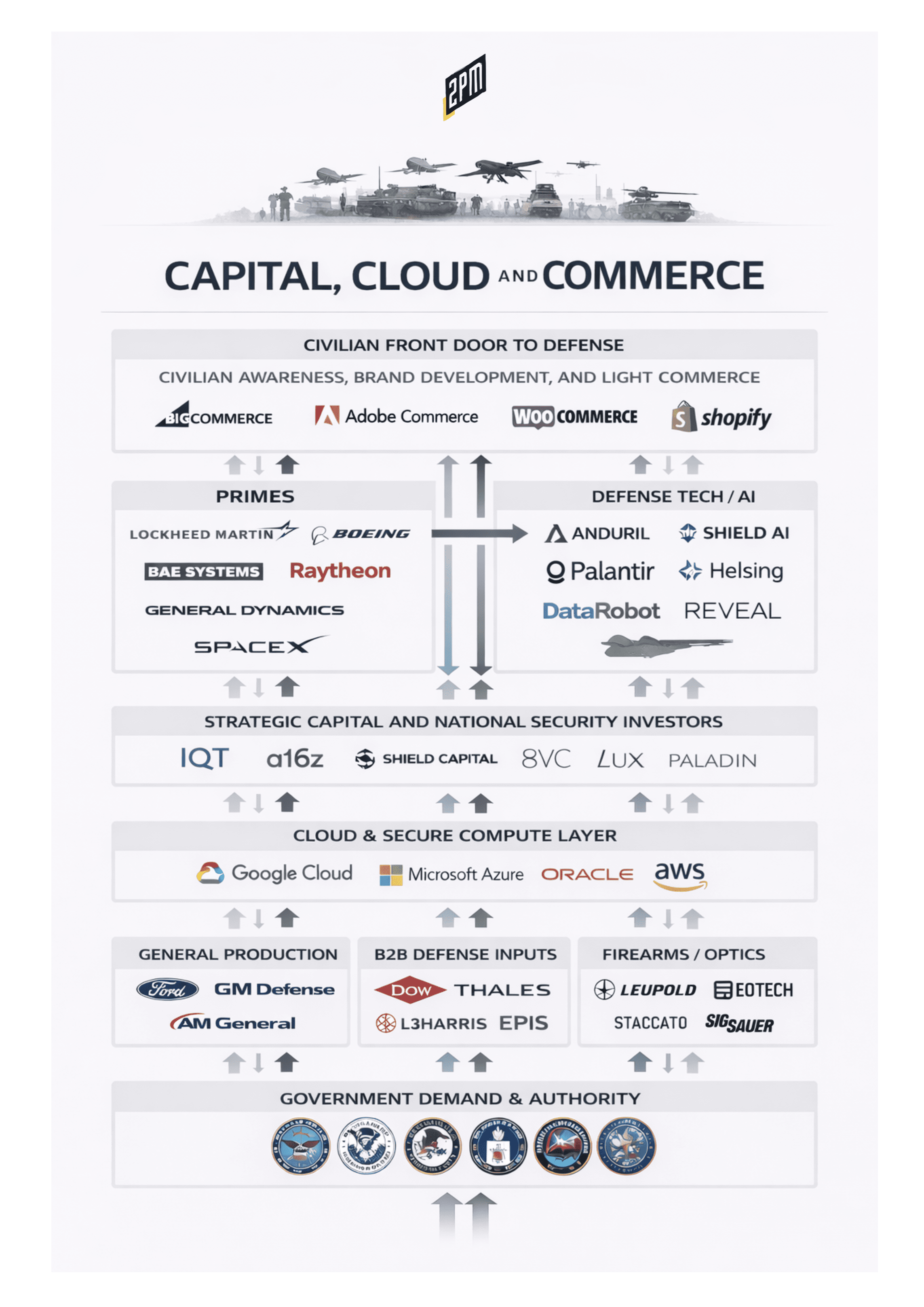
American military and intelligence capabilities no longer originate solely in the Pentagon or within the legacy defense primes. It is increasingly assembled across three layers that sit outside traditional procurement: venture capital, cloud infrastructure, and modern commerce platforms (B2B-primarily). Each layer operates commercially, and each layer is indispensable to national power. Each layer is quietly shaping how modern national defense is built, coordinated, and sustained.

The emerging defense ecosystem is best understood not as a weapons system, but as a technology stack: capital funds it, cloud computes it, commerce distributes it. Together, they form the invisible scaffolding beneath the visible battlefield.

To see this clearly, it helps to begin with the investors who explicitly finance national security innovation. These firms are not opportunistic participants. They are mandate-driven actors who have chosen to organize themselves around American security as a core thesis.

Mandate-explicit capital for national security

The table below captures the U.S. venture investors that publicly state a defense, national security, or dual-use mission. This is not a generalist list. It excludes firms that occasionally invest in defense. It includes only those whose identity, fund structure, or published thesis explicitly centers on national security.

FirmCategoryHow the mandate is stated:Primary domains they name
In-Q-Tel (IQT)Strategic / government-adjacentExists specifically to identify and scale commercial technology for the U.S. national security community and allied agenciesAI, data, cyber, sensors, space, advanced analytics
a16z – American DynamismLarge platform with dedicated practiceRuns a named practice and fund explicitly focused on “the national interest,” including defense and aerospaceAerospace, defense systems, industrial tech, frontier science
Shield CapitalDefense specialist VCPositions itself at the intersection of commercial tech and national securityAI, autonomy, cyber, space, robotics
Razor’s Edge VenturesDefense specialist VCStates its core mission is backing companies that solve major national-security challengesCyber, space, data, sensing, dual-use infrastructure
Decisive PointDefense / critical tech VCPublicly frames itself as investing in technologies critical to defense, energy, and national resilienceDefense tech, energy, infrastructure, advanced hardware
Scout VenturesDual-use frontier VCExplicitly focuses on founders from the military, intelligence community, and national labs building dual-use techAI/ML, robotics, space, security, advanced materials
8VC (Government & Defense focus)Large platform with explicit defense thesisMaintains a distinct government/defense investing effort and teamDefense systems, autonomy, logistics, industrial tech
Point72 Ventures (defense positioning)Growth/late-stage VCPublicly describes itself as a dedicated partner to next-generation defense-tech companiesAI, autonomy, sensors, secure software
DataTribeCyber-security foundryDescribes itself as bridging Silicon Valley and the Intelligence Community to strengthen U.S. cyber capabilityCybersecurity, secure infrastructure, national labs spinouts
Paladin Capital (Cyber Fund)Security VCExplicitly focuses on “Digital Infrastructure Resilience” and protection of critical systemsCyber, critical infrastructure, secure networks
NightDragonSecureTech VCStates that it invests in SecureTech including defense, national security, and advanced cyberCyber, AI security, quantum, defense software
Lux CapitalFrontier science VCPublicly frames recent funds as operating at the intersection of frontier science and national securitySpace, AI, advanced manufacturing, energy
DCVC (Data Collective)Deep-tech VCPublishes theses explicitly linking its investments to strengthening U.S. defense innovationAI, robotics, space, autonomy, industrial tech
Riot VenturesIndustrial modernization VCPublic materials and reputable coverage consistently describe a focus on modernizing sectors including defense/aerospaceIndustrial automation, robotics, aerospace supply chain
J2 VenturesDual-use VCWidely described in top-tier reporting as a specialist in dual-use (civilian + government) technologySpace, sensing, autonomy, secure hardware

This capital layer explains why so many new defense companies look like software startups rather than defense contractors. They raise venture rounds, hire engineers from Big Tech, and think in terms of platforms rather than programs. They build products that scale beyond a single government customer. They compete for talent with Silicon Valley instead of only with traditional primes.

What this table also shows is something more structural. National security is no longer financed solely through appropriations. Rather, it is financed through private markets that expect growth, returns, and global impact. The defense ecosystem is now a hybrid of public mission and private capital logic.

Where commerce enters the defense stack

Capital creates companies. Commerce determines how those companies present themselves to the world. When defense and national-security firms like Anduril or Palantir use Shopify, they are rarely selling weapons. They are building culture, community, and lightweight industrial distribution.

The table below captures verified defense and national-security companies that operate Shopify-based stores restricted to merchandise or non-weapon catalogs. These are official or clearly authorized storefronts, not third-party novelty sites.

CompanyStore domainStore typeWhat it sells (high level)Shopify verification
Palantir Technologiesstore.palantir.comPublic merchBranded merch storeCookie banner references Shopify as a partner
Anduril Industriesandurilgear.comPublic merchBranded “Anduril Gear” store (apparel/accessories/relics)Anduril job listing explicitly cites gear-store tech stack including Shopify
General Dynamics – Bath Iron Works (BIW)gdbiwstore.comPublic/employee merchBIW-branded merchandise with employee discountsOfficial BIW communications reference the Shopify store
Raytheon Technologies (program store instance, operated by vendor)garmentgraphics.net/pages/raytheon-technologies-pmxAuthorized program storeBranded program merchandise fulfillmentFooter explicitly shows “Powered by Shopify”
L3Harris (OceanServer)oceanserver-store.myshopify.comOfficial catalog store (non-weapon items)Compasses, Li-ion battery systems, related equipmentFooter states “Powered by Shopify”
Leidos (Australia)leidosstore.comBranded merch (regional)Leidos Australia branded apparelFooter notes Shopify operation on behalf of Leidos Australia

These stores reveal a consistent pattern. Defense companies use Shopify to build identity and simplify commerce, not to move regulated hardware. The opportunity for development agencies, here, is therefore not about compliance policing, but about elevating brand, experience, and operational design.

Four layers of lethality-adjacent commerce

It is useful to conceptualize this ecosystem as four nested layers rather than one undifferentiated market.

Layer 1 is the brand layer.

These are traditional defense primes and new defense-tech challengers whose core business is national security. Their online usage centers on apparel, patches, posters, collectibles, recruiting gear, and limited drops. Their stores function as cultural artifacts rather than distribution channels for critical hardware.

For eCommerce development agencies, this is fundamentally a brand and community play. These companies expect premium design, sophisticated storytelling, and frictionless UX. Their audiences are employees, alumni, recruits, and a small but influential public following. Success here is measured in cultural resonance, not units shipped.

Layer 2 is the industrial layer.

These are subsystem suppliers that build components for larger defense architectures. They produce sensors, batteries, navigation tools, robotics, and marine hardware. Via eCommerce: they follow two patterns. Some are merch-first, mirroring the primes. Others operate non-weapon B2B catalogs that look more like industrial storefronts than consumer brands.

These catalogs tend to prioritize functionality over aesthetics. They feature technical specifications, tiered pricing, and basic checkout flows. The strategic opportunity is operational. Agencies can add value through better B2B UX, custom pricing logic, ERP integration, and wholesale workflows that reduce friction for engineering customers.

Layer 3 is the regulated-adjacent layer.

This includes optics, night vision, lasers, and mounts. Most commerce in this category is not centered on Shopify today; frankly BigCommerce and Adobe have an outsized share. Companies rely on specialized distributors, government channels, law enforcement relationships, military procurement routes, legacy eCommerce stacks, and custom builds.

When companies like Shopify appears in this layer, it is usually supplementary. Some may maintain merch-only Shopify storefronts while keeping core product sales elsewhere. The strategic implication is straightforward; Shopify is under-penetrated in this segment. There is room for growth if platforms and agencies can serve this sector responsibly while modernizing experience and back-end architecture. EOTech has recently migrated to Shopify Plus’ Leupold Optics is in the process of doing the same, with the help of Colorado and Ohio’s MTN Haus.

Layer 4 is the highest-risk layer.

This includes firearms, ammunition, and serialized parts. Payment restrictions, shipping constraints, age verification, FFL requirements, state-by-state complexity, and ITAR rules make this category least compatible with mainstream commerce platforms. Where Shopify exists, it is typically not primary. Most transactions live on other systems designed for these regulatory realities to include WooCommerce, Magento, and BigCommerce. I believe that this needs to change. 

How large is this universe?

The scale of defense-adjacent development is bounded rather than infinite. Below, order-of-magnitude estimates provide a clear sense of scope.
For defense primes and defense-tech challengers operating merch stores, the realistic global range is roughly 20 to 40 corporations. Most are U.S.-based, low-volume, and high-visibility. These are the cleanest Shopify use cases.

For subsystem suppliers that mix merch and industrial catalogs, the range is roughly 30 to 70 corporations. This includes 10 to 20 brand-first stores, 10 to 25 B2B component catalogs, and 5 to 15 hybrid industrial setups. This category is growing, especially among startups backed by the capital firms listed earlier.

For optics, night vision, lasers, and mounts, meaningful Shopify storefronts likely number between 5 and 10. The total company universe is far larger but Shopify’s penetration remains limited.

For firearms, ammunition, and serialized parts, primary Shopify storefronts probably fall between zero and 5. Regulatory friction and reputation keeps most commerce off the platform.

Add these layers together and the total defense-adjacent Shopify universe likely sits between 60 and 90 stores. This is a manageable landscape; it is not an ocean of thousands but this number should be in the 100s. 

Cloud as the invisible backbone of lethality

Commerce and capital do not operate in isolation; they run atop cloud infrastructure controlled by companies like Google, Microsoft, Amazon, and Oracle. These firms are not weapons manufacturers but they are nonetheless deeply embedded in national defense.

Microsoft provides secure cloud environments that power logistics, AI modeling, and battlefield coordination. Google supplies geospatial tools, machine learning capabilities, and data analytics that enhance situational awareness. Oracle underpins databases used in government operations, procurement systems, and defense logistics.

These companies function as infrastructure suppliers for modern defense. They make it possible to process massive data streams, coordinate autonomous systems, and integrate global supply chains. The battlefield increasingly runs on software. That software runs on commercial cloud.

This reality collapses the old distinction between civilian tech and military capability. The same platforms that power consumer apps also support national defense; the line between commercial innovation and strategic advantage grows thinner every year.

What this means for Shopify and Its Partners

Shopify should not promote weapons procurement. That is neither its brand nor its purpose. At the same time, Shopify should equip defense and dual-use companies with modern commerce infrastructure suited to a new era of industrial and digital operations.

That includes world-class brand stores for defense-tech firms, sophisticated B2B catalogs for subsystem suppliers, secure and compliant checkout for regulated-adjacent categories, and scalable architecture for complex product ecosystems. Commerce is becoming a critical layer of the defense stack, not an afterthought.

For well-positioned agencies, this creates a clear strategic position. There are several equipped to own the intersection of defense, industry, and modern commerce. It can design premium brand experiences for companies adjacent to the likes of Anduril and Palantir. It can build operationally intelligent B2B systems for component suppliers. It can help bridge legacy industrial culture with Shopify-native best practices.

The future of American industrial power is being constructed across venture funds, cloud platforms, and digital storefronts. Lethality is no longer built only in factories; it is assembled through capital allocation, software infrastructure, and commerce architecture.

Understanding that stack is essential for anyone operating at the frontier of defense and technology: capital funds innovation, cloud enables intelligence, commerce distributes identity and capability. And together these define the new defense economy.

By Web Smith | Linkedin | More: NATSEC @ 2PM

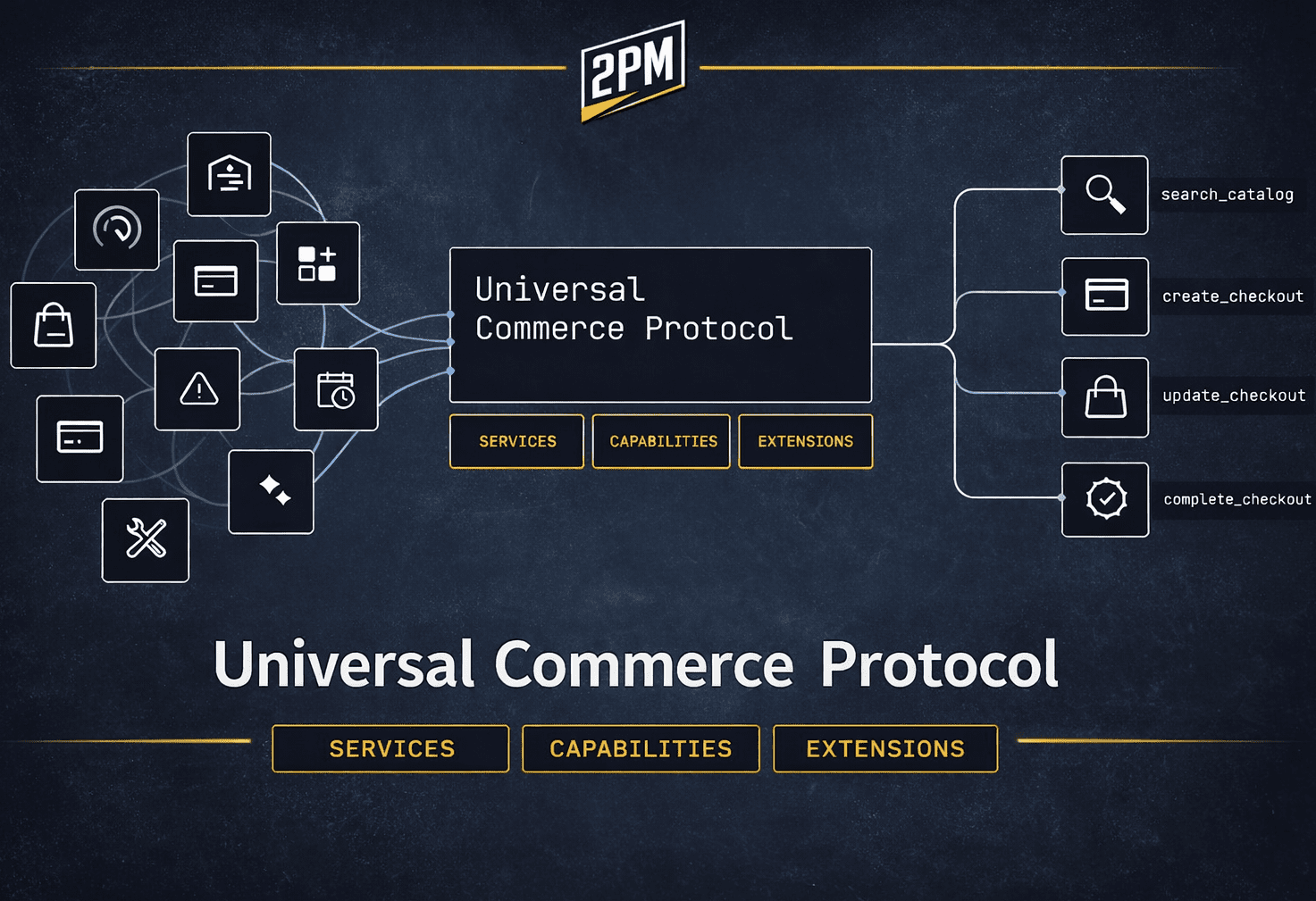
Agentic: Shopify and Google’s UCP Will Democratize Commerce

But only for the brands and retailers that understand the new rules of the agentic commerce era.

I spent the better part of fourteen hours reading every page of Shopify’s Universal Commerce Protocol announcement. Not skimming it; not headline parsing it. I read the product notes, the architectural explanations, the developer implications, the platform logic, and then I sat down with the most technical person in my orbit and had them walk me through what Shopify is actually building. Not what they are saying they are building, but what the underlying principles of the system are: what the protocols mean, how the state machines behave, where the trust boundaries live, where human agency ends and machine agency begins. Most importantly what this infrastructure allows now and what it will allow five years from now.

When you do that exercise honestly, something becomes very clear. Shopify is not launching features. Rather, Shopify is laying the foundation for the next economic operating system and no one else has the horsepower to compete with them.

In the old economy, scale dominated. Whoever could buy the most traffic, flood the most channels, and sustain the largest ad budgets won. The new system does not care about your ad spend. It cares about your structure.

For the last twenty-five years, digital commerce has been built on persuasion. We optimized pages, funnels, copy, creative, attribution models, retargeting loops, and emotional triggers. We argued about brand and performance as if they were separate disciplines. We treated the internet like a mall. Shopify’s architecture makes it impossible to keep pretending that model survives the next decade.

We are entering a deterministic economy.

In a deterministic economy, outcomes are decided before the moment of choice. By the time a consumer sees a product, an increasingly large portion of the decision has already been locked in by structure, constraints, permissions, guarantees, and system design. This is the part of agentic commerce most people miss. They are still thinking about agents as new interfaces for old persuasion. They do not yet understand that the persuasion layer is becoming irrelevant.

When I first wrote about Agentic Commerce and AEO, I framed agents as the new homepage, the new SEO layer, the new point of sale. That framing remains directionally correct. But it understates the depth of the shift. The deeper change is not in discovery, it is in determinism. It is in who is allowed to win and why.

An agent does not browse, nor does an agent does not get tired. An agent does not feel brand affinity; an agent executes inside a defined constraint environment. That environment is shaped by what the user has permitted and what the business has declared. The business that fits the constraint environment best becomes the default winner.

This is what Shopify’s framework operationalizes.

When Shopify demonstrates that Google Gemini consistently prefers Monos luggage over its competitors and that ChatGPT produces similar recommendations, this is not a coincidence and it is not marketing. It is a signal. It suggests that Monos satisfies the underlying framework of constraints better than competing brands.

At Monos, we’re excited about agentic shopping because it enables us to meet customers where they already are. It’s a new way for our story and product details to show up at the exact moment someone is asking real questions with real intent, in a format that feels helpful, not intrusive. For a brand built on thoughtful design, it’s a natural next channel for discovery and trust. [Shopify]

Victor Tam, CEO and Co-Founder of Monos

Their data is cleaner, their policies are clearer, and their guarantees are stronger. In additiona, their fulfillment is presumably more reliable. Their trust signals are easier for machines to verify; their product attributes are more consistent and their systems are easier to complete transactions with.

This is not about who has the prettiest site; his is about who has built the most compatible business.

This is where the democratization of commerce quietly emerges. In the old economy, scale dominated. Whoever could buy the most traffic, flood the most channels, and sustain the largest ad budgets won. The new system does not care about your ad spend. It cares about your structure.

A small brand that publishes cleaner data, offers stronger guarantees, delivers faster fulfillment, simplifies returns, and maintains more reliable inventory becomes more attractive to an agent than a massive brand with messy systems and brittle operations. The competitive playing field shifts from capital dominance to operational excellence.

This is profoundly democratizing.

A founder with discipline, clarity, and strong systems can now compete with companies a hundred times their size, not because the agent is fair, but because the agent is ruthless. It selects the path with the highest probability of successful completion for the user. In the deterministic economy, small brands do not need to shout louder. They need to be built better.

This is why the entire idea of marketing as persuasion begins to erode. You do not convince the agent; you construct a business that the agent is allowed to choose.

At MTN Haus, we have been building in this direction for months, ironically. Yes, often without even naming it. We focused on membership systems that act like operating systems. We obsessed over data consistency, policy clarity, fulfillment logic, identity frameworks, subscription mechanics, and trust surfaces. We pushed clients to invest in boring things that did not feel like growth. Returns infrastructure, fulfillment reliability, inventory synchronization, policy transparency, and product data normalization. This is machine legibility.

Most agencies avoided that work because it is not sexy. It does not show up in creative decks; however, it is precisely what agents reward.

When we developed Snack Clock architecture, for a major CPG brand, the goal was not just to improve UX. It was to eliminate cognitive load and reduce friction in the moment of demand. That same logic now becomes machine-first.

Sometimes, the future is hard to explain to those living in the present.

Snack Clock was not just a UX feature; it is an early expression of deterministic commerce. Where most shopping systems force agents and consumers to infer urgency, Snack Clock required users to explicitly declare it. The moment someone turns the dial from “Now” to “Never Run Out Again,” they are no longer browsing; they are encoding a constraint. That constraint becomes the governing logic of the transaction.

Everything that follows is execution. Each path removes friction by design, routing the user or agent directly to the fastest, safest fulfillment channel available, whether that is local delivery, marketplace checkout, direct DTC, or subscription.

The result is a system that increases completion probability, which is the primary selection metric for agents. Snack Clock also makes the brand liquid by exposing multiple negotiation pathways at once. Agents prefer merchants that can adapt to more situations with fewer unknowns. Most importantly, Snack Clock transforms trust from a marketing claim into a computational guarantee by making outcomes predictable and verifiable. In an agentic economy, that structural advantage is decisive.

Agents will learn those temporal patterns and begin to recommend brands based on how well they satisfy time-based demand. The brand that understands when a problem emerges and can solve it with minimal friction becomes structurally superior.

This is not speculative. It is already happening. The deterministic economy operates on four hidden levers.

  • Constraint engineering
  • Friction elimination
  • Negotiation bandwidth
  • Trust as computation

The first is constraint engineering. MTN Haus’ Snack Clock architecture was an early example of this. Every business publishes rules: where they ship, how fast, what they guarantee, what happens when something goes wrong, and how disputes are resolved. Then, on to how identity is verified, how payments are handled, and how loyalty is honored. These rules define the feasible solution space the agent can operate within. Expand that space responsibly and the agent will choose you more often. Shrink it or complicate it and the agent will avoid you.

The second is friction elimination. Every additional step that requires human involvement reduces the probability of transaction completion. Brands that remove escalation points win. This is not about UX anymore; it is about computational efficiency.

The third is negotiation bandwidth. Brands that expose flexible pricing, dynamic bundling, loyalty conversions, and time-based logic give agents more degrees of freedom to optimize outcomes. Rigid businesses lose.

The fourth is trust as computation. Trust becomes verifiable, guarantees become cryptographic, and identity becomes machine-readable. Reputation becomes structural.

This is where my early AEO thesis was both right and incomplete. I was correct that structured data, schema alignment, policy transparency, and factual consistency would become the foundation of visibility. Where the thesis fell short was in recognizing that AEO is not just about being recommended. Rather, it is about becoming the easiest possible outcome for a system to choose.

Recommendation is a symptom. Determinism is the disease.

Outside media still matters, but not for the reasons most marketers think. Media does not persuade the agent; media reshapes the human’s constraint environment. It modifies trust, risk tolerance, ethical alignment, and long-term preference. Those updated constraints are then enforced by the agent. When the agent shops later, it is operating inside a newly defined rule set. Media moves the boundaries of what is allowed; it does not pull the trigger itself.

This is why public perception, cultural trust, and earned media remain critical in an agentic economy. They expand the computational reach of your brand.

Shopify’s framework confirms that commerce is no longer about storytelling at the point of sale; it is about system design at the point of possibility.

The brands that win the next decade will not be the most charismatic, they will be the most compatible. They will be the most verifiable, most reliable, the easiest to complete, the most negotiable, and the most machine-readable.

The deterministic economy is here. And the work required to survive it has already begun.

Research and Writing By Web Smith

Strategy: On “Existential Risk and Growth”

On December 23, Oxford PhD and Stanford Economics Postdoc, Phillip Trammel, and Leopold Aschenbrenner published Existential Risk and Growth. The timing couldn’t be more relevant. We are living through a constant debate on the merits of subjective arguments across AI, policy, and technology circles: that slowing progress is the responsible thing to do when risk increases. Aschenbrenner’s independent work served as the basis for 2PM’s first NATSEC dispatch; it was, then, required reading. This, again, felt like required reading.

These authors are far more competent than the vast majority of us. Rare air is the capability to write as clearly as they; the gentlemen contended with ideas by establishing mathematical truths against them, setting a standard that most who’ve yet to encounter doctoral-levels of academia have yet to contend with. Every few years you come across a paper that forces you to quietly update a lot of assumptions you did not even realize you were carrying.

The main ideas they contend with appear in AI governance debates, in calls for innovation moratoria, and in the general belief that caution and delay are synonymous with wisdom.

Stagnation is only safe if the current world is perfectly safe.

That instinct never fully squared with what I observe in markets, in business, and in human behavior. In eCommerce, in brand building, in infrastructure, and in national defense, the environments with the highest stakes are rarely stabilized by slowing down. They are stabilized by learning faster, building faster, and reaching the next structural equilibrium before your exposure compounds.

This paper finally gave that intuition a rigorous backbone. It does not argue from ideology or optimism; it argues from the mechanics of risk itself. Once danger exists, time becomes the most expensive variable in the system. Everything else follows from that.

The read is worth your time.

There is a recurring pattern in modern leadership that rarely gets interrogated with the seriousness it deserves. When confronted with volatility, institutional uncertainty, or technological acceleration that outpaces cultural digestion, executives reach for the same lever. They slow down, or they defer. They reduce exposure, or they wait for the environment to stabilize.

Permanent stagnation can lower transition risk by avoiding advanced experiments altogether, but an acceleration that only pulls forward their date leaves cumulative risk unchanged. If the hazard rate is strictly convex in the rate of experimentation, however, then faster growth increases transition risk. The tradeoff between lowering state risk and raising transition risk can render the risk-minimizing growth rate finite, but as long as there is any state risk at all, it remains positive. [Page 4]

This reflex is nearly universal. It is also structurally misguided.

The most consequential insight in recent thinking on existential risk is not that technology is dangerous. Rather, it is that time itself becomes dangerous the moment risk exists at all. Once the probability of catastrophic failure rises above zero, every additional unit of time spent inside the current system increases total exposure to failure. The world is already in that condition.

  • Nuclear weapons exist.
  • Pandemic capability exists.
  • Bioengineering exists.
  • Climate dynamics exist.

In this way, we truly are beyond the neutral baseline (even if we choose to ignore it). There is only a hazard rate, a probability that the heightened baseline becomes more noticable. And the mathematics of hazard produce a conclusion that directly contradicts the dominant narrative of precaution: if danger already exists, slowing technological progress usually increases the total probability of civilizational failure.

This is not rhetoric; it is structural logic.

Time Is the Hidden Variable of Risk

Risk is not simply about what might happen. It is about how long you remain in a state where something might happen. If the probability of collapse in any given year is non-zero, then long-run survival depends on whether the cumulative risk remains finite. That depends not on how careful you feel, but on how quickly you can move beyond dangerous conditions.

This produces an uncomfortable truth. Stagnation is only safe if the current world is perfectly safe. It is not. Freezing progress while danger exists does not stabilize the system. It mathematically guarantees eventual catastrophe. Waiting does not eliminate risk. It compounds it.

Stagnation is safe, as assumed in existing literature, only if the current technology state poses no such risks. [Page 27]

This insight alone dismantles much of the contemporary obsession with technological pause. Pausing does not reduce danger when danger is already embedded; it merely increases exposure time.

Innovation Does Create Risk and That Still Does Not Save the Slowdown Argument

The standard objection is that innovation itself is dangerous: experiments fail, systems break, deployment creates new vulnerabilities. All of this is true but the conclusion drawn from it is usually wrong.

When making tradeoffs over time, it is uncontroversial to discount later periods for reasons of uncertainty. [Page 32]

Even when experimentation introduces new hazards, slower progress only becomes safer under extremely narrow conditions. As long as any background danger exists, the growth rate that minimizes risk remains positive. Zero growth is never the safe option once risk is already in the system. The real strategic error is confusing short-term volatility with long-term safety.

The Economics of Safety

The most underappreciated part of this framework is economic, not technological. As societies grow wealthier, the value of life rises. The marginal value of additional consumption falls, and the willingness to sacrifice output for safety increases dramatically. Growth does not simply produce new dangers. It manufactures the political, institutional, and financial capacity to neutralize them.

At first, things get worse:

  • Pollution rises.
  • Inequality rises.
  • Cities get messy.
  • Labor conditions deteriorate.
  • The side effects of growth show up everywhere.

But after a certain point, something flips. Once people are wealthy enough, they start caring more about clean air, worker safety, health, education, and the long-term quality of life. They can finally afford to fix the problems growth created. So the curve looks more like an upside-down U:

  • Early growth: more wealth, more problems
  • Later growth: more wealth, fewer problems
  • Growth causes the mess, then growth pays to clean it up.

That is the Kuznets Curve. This creates a structural pattern that mirrors the environmental version of the curve. Risk may rise early in development, but accelerating growth eventually generates the resources and incentives for aggressive safety investment, which sharply reduces hazard rates.

In other words, growth builds its own seatbelts. When policymakers and institutions respond rationally, acceleration reduces risk twice. It shortens exposure to dangerous states and it pulls forward the arrival of high-safety regimes.

What Executives Miss and Why It Matters

This is not an abstract debate about civilization. It is a leadership problem. I see this pattern constantly in eCommerce, brand development, and consumer psychology. When markets destabilize, executives freeze. They cut product, they pause launches or worse, they fail to invest in digital channels. They reduce experimentation; they wait for clarity. What they actually do is extend their exposure to the very uncertainty they are trying to escape.

Risk is not eliminated by waiting. It is outrun.

The brands that survive disruption do the opposite. They accelerate through it. They ship faster or they learn faster. They adapt faster and they reach stable ground first.

Specific industries have internalized this logic completely. Defense technology never pauses. When the threat increases, acceleration becomes the strategy. Data infrastructure behaves the same way: rising complexity demands faster buildout, not slower. Entertainment follows the same pattern. Fragmented attention requires aggressive output, not restraint.

These sectors understand what most executives resist admitting: risk is not eliminated by waiting. It is outrun.

The Strategic Reframe

What every executive should take from this work is simple and deeply uncomfortable. Slowing down feels safe because it reduces short-term stress. It does not reduce long-term risk. When danger exists, speed is the only instrument that compresses exposure. Caution must be expressed in steering and reinforcement, not in braking.

Civilization is not standing at the edge of a cliff; it is already falling. The only direction that reduces impact is forward.

More on Stanford’s Digital Economy Lab. More on Situational Awareness.

By Web Smith