
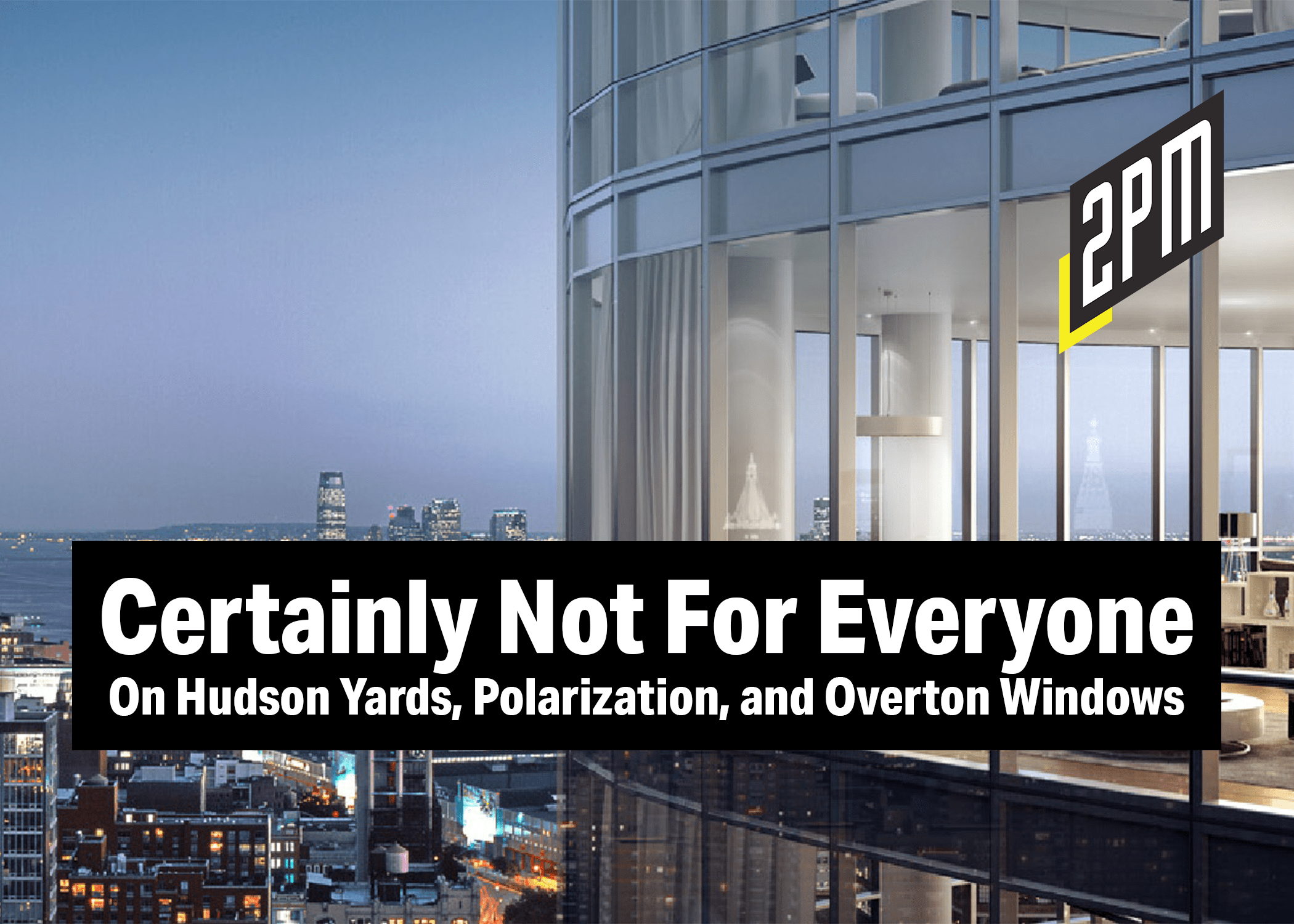
Non omne quod nitet aurum est: all that glitters is not gold. This is a widely used line derived from Shakespeare’s The Merchant of Venice – a story of a merchant who must default on a loan. To understand the new era of high-visibility retail developments, you have to understand the times that we are living in. The 41 page report by the Schwarz Center of Economic Policy Analysis (SCEPA) details the funding initiatives, costs, and opportunity for Hudson Yards. There is a passage that summarizes the gist of the entire document:
The cost overruns and revenue shortfalls of the Hudson Yards project stem from the realization of financial and economic risks common to large development projects. While well known in multi-faceted development projects, the cost of these risks were not included in the project’s budget, leaving the city to bear the responsibility if they materialized.
The start of the one million square foot Hudson Yards development was billed “the largest private real estate development in the United States by square footage” [note]. In the midst of 2008’s Great Recession, developer Tishman Speyer ceded the rights to the property to developer and Miami Dolphins owner Stephen A. Ross, the magnate who also owns a sizable stake in Gary Vaynerchuk’s 880 person Vaynermedia agency. While completing the deal, Ross reduced his company’s risk by introducing stalling mechanisms to give the economy time to recover before the clock began on the costly project. The rights were purchased during the 2008 downturn and the development team broke ground in 2012.
The idea of Hudson Yards was born out of recession. This is important to note, 2008 was a frightening time for retailers and consumers. The previous downturn allowed direct to consumer brands to take advantage of the physical retail shortcomings of incumbent product marketers. Like many of the higher end mega-developments that are now in the works, Hudson Yards is both a barometer for our consumer economic health and a localized antidote for the next downturn. Originally intended to attract commercial partners with tax benefits, Ross’ development eventually extended the commercial benefits package to retailers – incumbent and challenger brands alike. These brands include: Rhone, Mack Weldon, Milk & Honey, Stance, B*ta, Batch, M. Gemi, and a yet-to-be-announced deal with Wone. On page 18 of the New School’s SCEPA report:
Another factor feeding the revenue shortfall was the IDA’s decision to extend PILOTs to retail development projects. With PILOTs were originally designated only for commercial developments, the extension of the tax break for retail development was not included in C&W’s 2006 revenue projections.
New York’s newest mini-city is just one of a number of developments popping up around the country. But Hudson Yards is perhaps the most vulnerable; it’s an experiment with the most to lose. Far from a private development, a city rife with public transportation and infrastructural shortcomings has and will be footing the bill for the one million square foot property. This tax burden is distributed to all New York residents but the development will directly benefit upper-middle class residents and visitors alike.
What Hudson Yards represents
In the The First Roundtable, 2PM explained:
Physical retail is rebounding because DNVBs are achieving great success with shoppers that are moving up market or, sometimes, down market (Boxed, Brandless, Dollar General). Additionally, data-driven customer acquisition is extending to physical retail. This is making it easy to account for investments into physical marketing and retail.
Hudson Yards is not for everyone, despite Ross’ recent, disingenuous public relations attempts. This fact should be by design and it likely would have been had the deal gotten done without taxing the middle class. A recent Forbes article mentions the high-end retailers like Cartier, Dior, Fendi, and Michelin-starred restaurants. And the financial service providers like BlackRock and Point72. It goes on to cite a range of $2 – $30 million for condos on the property. Ross’ wager is one that brands, developers, and retailers should take note of. This is one of the first developments to be built after the lessons of the last downturn: the middle class withers, the poor get poorer, and the wealthy remain so.
America saw the growth of middle class malls for nearly 60 years and those malls are now failing. Hudson Yards is built for a polarized consumer economy where middle class retail is penalized for their lack of focus. And the timing couldn’t be better for the brands in the direct to consumer economy who focus on upper-middle to upper class consumers.
The Overton Window
In a masterful article chock full of polymathic thought, David Perrell weaves a narrative that blends political, economic, and psychological research. His flowing essay connects the evolution of mass media, commerce, higher education, and politics in a way that is rare for publishers today. The three pillars that he discussed: commerce, higher education, and politics. One line summarizes the entire piece:
Commerce and media are interdependent. You can’t understand commerce without understanding the media environment.
This is a capstone belief for 2PM readers. Perrell goes on to discuss the current vulnerability of many traditional CPG brands who’ve – thus far – depended on mass media and traditional ad buying to generate demand for their product. At first, the rise in availability of information gave rise to challenger brands. For a window of time, obscure brands could compete with larger conglomerates by pursuing 1:1 relationships with consumers.
This era of connectivity gave rise to brands who took advantage of an Overton Window-like time for the consumer web (2007-2016). As diffusion increased, so did the difficulty in which brands met when acquiring new customers (rising CAC). In one essay, Perrell directly communicates the collapse of the Overton Window in the context of American politics. But unbeknownst to him, he also communicated the collapse of the Overton Window in the context of DTC retail and the advertising that propelled it. Compare the two paragraphs in What the hell is going on?
(1) The media’s monopoly saw its first cracks with the rise of cable, and now, due to the internet, the Mass Media environment is going to crumble. The internet — where everyone can find, select, edit, and distribute content — has already left its mark. The Overton Window has been shattered. The media is no longer a barrier against diverse thought and opinion.
(2) By creating unlimited shelf space and reducing information asymmetries, power in the internet age is shifting from suppliers to customers. The world is increasingly demand driven. Customers have more choices than ever before. They can buy anything, at any time. Through the internet, brands can serve a long-tail of unmet consumer needs, which weren’t served by big box retailers.
The web democratized information but, also, pop cultural and socio-economic distraction. We used to watch the same television shows at the same hours of the night. We’d view the same advertisements. And the America of late was a mostly centrist-thinking political body. The ideas to the left and to the right of the Overton Window went mostly unobserved – for a time. Today, the areas outside of the window dominate our conversations. As such, America used to vote for candidates that represented ideas within an Overton Window of acceptable belief. As 2016’s political race would suggest, America is more polar than ever. This one part of American consumerism is indicative of the whole.
At first, commoditized information helped challenger (DTC) brands compete against incumbents. But costlier advertising and distracted consumers are tipping the scales to incumbent forms of retail and brand promotion. For developments like Hudson Yards and other efforts by developers like Macerich, the bet is on the need for physical retail to acquire customers. In smaller markets like Columbus, Ohio – developments, like the Easton Town Center, have proven the appeal of this elegant simplicity. And DTC brands have flocked to this premium real estate.
Physical Retail 2.0 (PR2.0) will be defined by the public / private partnerships like the Hudson Yards development. With the consumer web becoming louder, more volatile, fragmented, and less reliable for pure direct-to-consumer (DTC) brands, PR2.0 is two bets: (1) traditional retail infrastructure and attracting DTC brands to develop new behaviors for higher-end millennial consumers (2) consumer web fatigue. In a recent conversation with Digiday, here is what Ken Morris of Boston Retail Partners told Hilary Milnes:
Retail has needed to change, and brands that are popular online are forcing that change with temporary stores and leases that require flexibility. Landlords and developers are no longer in a place to turn that down, and if you need proof, look at Hudson Yards. The most massive retail development made adjustments to get digitally born brands on the floor. They drive foot traffic, point blank. And malls need foot traffic.
Hudson Yards: the present, not future
For Stephen A. Ross’ development to withstand traditional market forces, it will have become a mecca to upper-middle to upper class consumerism. But while many publications are posing the question: will it work? A better question is: how soon? The $20 billion dollar retail project was funded by taxpayers to serve a greater purpose than the leisure and window shopping that’s been reported on. Hudson Yards was imagined at the end of a bull run and built to survive the next. Founder of Stray Reflections, a global macro research advisory, Jawad Mian recently published a series of tweets on the upcoming period of IPO liquidity for Silicon Valley investors.
In the thread, he is speaking directly to skeptics of our system of privatized high growth companies. Companies that IPO later in their cycles than earlier ones of previous generations and he raises some serious concerns. With surgical precision, he narrates through the credit bubble of 2007 and the commodity bubble of 2011. Then he notes the speed upon which unicorn investments (valuation of $b+) are crowned today: Bird, the scooter company, became a unicorn in less than 12 months. He cites the 10-fold increase in VC-stage investment by mutual funds between 2016 and 2019.
And lastly, he cites Saudi Arabia’s late-stage presence in US startups to the tune of $15 billion since mid-2016. Softbank’s Vision Fund, a home to some of SA’s sovereign wealth, has nearly $100 billion under management. It is no surprise that America is home to over 250 unicorns. In contrast, China is home to 168 unicorns worth $628 billion on an aggregate $11 billion in Chinese investment since 2000.
With a highly influential IPO window on the horizon, Mian’s concerns are founded. What happens if the values of Uber and Lyft don’t hold up in the public market? And how would their market vulnerabilities affect the growing influence of foreign, late-stage investment into American tech companies? Mian concludes with parallels from 2000, 2007, and 2011 but regardless of the successes of decacorn tech stocks, it is easy to see that late-stage investments are masking vulnerabilities in the private-to-public pipeline. This while the entire concept of the gig and freelance economies raise sustainability questions. For developments like Hudson Yards, the aim is to be above these pesky questions.
A 2PM reader recently shared a story about a new resident of a Hudson Yards condominium. His two bedroom apartment needed room for a couple and their two dogs. He came to find that the space was inadequate for his family and his belongings – so he also bought a unit across the hall. Hudson Yards was not designed with everyone in mind. And the financing of the property is so entangled that – while it was built for the higher class – everyone will eventually play a role in propping it up (if they haven’t done so already).
In this way, this ostentatious development is as close to recession proof as one can be. This, thanks in part to the influence of the challenger brands and their cohorts of wealthier millennials. As the consumer web continues to diffuse conversations, preferences, and opinions beyond the Overton Windows – Hudson Yards and the developments that will mimic it may become the safest places for DTC brands to expand in America’s number one retail market and beyond. But all that glitters is not gold. Hudson Yards was designed to become a haven for those who have, the types of consumers who can thrive throughout the natural cycles of our market-driven economy. Few retail developments can say the same.
Read Brief No. 309 here.
Report by Web Smith | About 2PM
Additional Reading:
(1) Stephen Ross is building New York City’s Next Must-See Destination
(2) Private Equity Firm Eyes China Malls
(3) The Mall is Making a Comeback
(4) Hudson Yards isn’t the future of retail
(5) Billionaire Stephen Ross believes that Hudson Yards is For Everyone
(6) Hudson Yards: open to all but not for all
(7) Manhattan’s Opulent New City
(8) The Cost of New York City’s Hudson Yard’s Development [41 page .pdf]
