No. 271: A Modern Luxury Update

There is a famous scene in The Social Network where Justin Timberlake’s portrayal of Sean Parker tells Jesse Eisenberg’s Zuckerberg contemporary the story of the Victoria’s Secret rebirth. In the script, it was Sean Parker that explained the genius of Les Wexner and his ability to change with the times after acquiring the $6 million / year business for a fraction of its real value, only to turn it into a $500 million dollar brand just four years later. The brand grew from four to nearly 100 stores in that short amount of time. It was a historic turnaround for a brand that was more niche than it was main street at the time.

The fundamentals of the brick and mortar lingerie business changed because Wexner emphasized the appeal of the brand to female consumers. He set aside the money-losing model of selling lingerie to men and replaced it with one that focused on female customers. But more importantly, he recognized that it should have been that way all along. It was an authentic move that evolved Victoria’s Secret (and its parent company: L Brands) into the $10 billion dollar company that it is today. But the brand is overdue for another shift. And it’s worth considering the recent hires and acquisitions by Wal-Mart to turn L Brands‘ most valuable ship around.

Screen Shot 2018-05-29 at 3.23.27 PM

Now led by CEO Jan Singer (former CEO of Spanx and Global VP at Nike), Victoria’s Secret cites the lingerie icon’s struggles on corporate restructuring, ending the famous catalog, and exiting the swimwear category. These are contributing factors, in addition to increasing pressure from eCommerce-first retailers. Business of Fashion:

The growing competition is promoting more variety in models and products. Now in its fifth year, online retailer ThirdLove has shoppers answer a series of intimate questions about their breasts — which of these nine illustrations matches your breast shape? — while reassuring consumers that every woman’s body is unique. The company has raised $13.6 million from investors and expects to double its sales this year. Companies like Adore Me, True&Co. and Everlane are taking a similar approach.

Their chief challenger, Adore Me (21) was founded in 2010 with the express intent to challenge Victoria’s Secret by giving consumers an online-first, inclusive alternative to the lingerie titan. The latest Inc. 5000 list has Adore Me’s growing 1,400% from 2014 and 2016 with revenues exceeding $100 million. Now, Adore Me is looking to expand offline and the timing couldn’t be worse for the L Brands subsidiary. GlobalData Retail Managing Director Neil Saunders:

Niche players may only have a small share compared to Victoria’s Secret, but their innovative approaches mean they are nibbling away at its market share.

In addition to intimates brands expanding into VS’ territory, there are adjacent pressures from the athleisure market, an evolving beauty market, and the rejection of lingerie by consumers looking for comfort, function, and individuality. Rather than continue competing against the likes of Adore Me (21), THINX, Inc. (31), and Third Love (51), or Savage x Fenty, Victoria’s Secret could re-invest in the brand, messaging, and end-to-end processes by following Wal-Mart’s lead.

Making a strategic acquisition to evolve Victoria’s Secret’s prized retail real estate could be just what the forty-year old retail property needs. The brand has a history of retail innovation. In addition to Wexner’s early decision to rebrand the shopping experience, Victoria’s Secret was one of the first brand’s to invest in early eCommerce (1999). In a recent retail roundtable, it was proposed that L Brands execute a Lore-like acquisition to oversee the brand’s eCommerce and omni-channel experience.

In addition, an interesting pivot was discussed. Victoria’s Secret could house brands and content across beauty, women’s athleisure, and intimates. The express goal would be to rebuild Victoria’s Secret as the premiere women’s-only destination – a house of brands, with their VS namesake positioned as the most premium offering within the store.

DD dan 1 relja 205
Lean Luxe Founder, Paul Munford

In a conference call with Lean Luxe’s Paul Munford, he added, “Not every brand deserves to exist forever.” He also added that L Brands‘ recent track record has been less than favorable, making the idea of a pivot like this highly unlikely. Specifically, he cited the $710 million dollar La Senza acquisition (2006) that did not achieve the intended effect. According to Munford, there was no indication that the retail group could operate with the same speed and precision that Wal-Mart has since Marc Lore became their eCommerce CEO. Munford added, “With Lore coming in at Wal-Mart, there wasn’t a negative track record of Walmart acquiring brands and dropping the ball. Walmart just started from scratch. So comparatively, Victoria’s Secret’s task seems harder.” 

Though Munford and I disagreed on the approach that the vaunted L Brands subsidiary should take, we did agree that VS is a brand that is long overdue for a modern luxury update. One of the first names that arose when discussing who’d be a great number two to Jan Singer was Emily Weiss, founder of Glossier.

By Web Smith | About 2PM
No. 265: Can A DNVB Achieve Modern Luxury?

Om Malik and Lean Luxe‘s Paul Munford had a thought-provoking exchange. Does the modern luxury go-to Lean Luxe (and the industry as a whole) have a grasp on what luxury means in online retail? On its face, a physical product that makes itself available to the masses cannot be a luxury product.

Lean Luxe on Twitter

@om Sure, by the old definition of luxury – you’re correct. But don’t judge modern luxury brands’ bonafides using the old set of luxury rulebooks. More here: https://t.co/ZLjoBdxYUz and here: https://t.co/uHYOPzsI9n

There are very few products, if any, that digitally vertical native brands (DNVB) sell that would qualify as traditional luxury goods. Here is Munford’s definition:

The key strength of a modern luxury brand is its emphasis on the entire package, rather just the product (or logo) itself. It’s a different mode of operation that takes some getting used to, but it disperses with the conventions of the old, blingy version of luxury, and is best optimized for today’s new consumer behaviors and expectations.

The fact of the matter is that competing on product quality alone leaves a brand open to exposure. MLCs have smartly understood that a better overall package or bundle — in an open market like today’s — can be far more compelling to shoppers than just product alone can.

Lean Luxe

Munford makes an important point that I’d like to take a bit further. Lean Luxe tends to maintain a narrow focus on hard goods and the packaging that they arrive in. But what about the purchase process and the attentiveness to customer happiness? And what about time?

The definition of luxury: an inessential, desirable item that is expensive or difficult to obtain.

Luxury, however you define it, is a brand’s embodiment of characteristics that make it desirable. Historically, those characteristics have been more ‘What’ features like quality, exclusivity, and cost. You can still define luxury as characteristics that make a brand desirable, but those characteristics have shifted. Quality is table stakes.

The characteristics that make brands more desirable are ‘how’ features like excellent customer experience (how do I experience the brand), meaningful brand mission (how do they give back/make a difference), and community engagement. Is it artist-created and excessively expensive? Maybe not. But if it is a product, or even an entire experience that is highly desirable, it can be considered a luxurious brand. DNVBs just so happen to possess a great infrastructure to support the characteristics that define modern luxury.

Luxury is always relative; it is loosely defined to meet the times and the market. If you walk through a great mall in the United States, you will visit brand experiences that will provide a luxurious taste. Take Ohio’s Easton Town Center as an example. The indoor / outdoor mall features Burberry, Tiffany and Co.,  and Louis Vuitton. However, your perception of luxury changes when you walk through the Bal Harbour Shops in North Miami Beach.  Bal Harbour is considered the finest mall in America. Both malls are considered “luxury” malls but neither are as luxurious as Dubai’s mall.

But can a DNVB be a luxury brand?

The notion of luxury is often applied to tech fashion brands. I partially agree with Om Malik’s statement here.

[Lean Luxe] is again confusing smoke / mirrors marketing and what is really luxury. All I know is that AllBirds and Brandless and Casper are not luxury, And no amount of your linguistic gymnastics will convince me of what is luxury, FWIW, LV is not luxury either. Too common.

AllBirds, Brandless, and Casper do not make luxury products but Munford isn’t suggesting that their products-alone are what classifies them within the modern luxury space.

Louis Vuitton was first hired as a personal box maker and packaging expert for the Empress of France. He was charged with “packing the most beautiful clothes in an exquisite way.” It was the practice that helped him to gain influence among the elite and royals, catapulting Louis Vuitton’s namesake to luxury status.

Louis Vuitton began with an early product and the two advantages commonly seen in the DNVB space:

  • Packaging
  • Maniacal focus on customers

The definition of a DNVB: a brand born online with a “maniacal” focus on the customer experience. A DNVB may start online but it often extends to a brick-and-mortar manifestation. Digitally native vertical brands control their own distribution.

Luxury brands don’t always begin as purveyors of luxury products. And due to a macroeconomic consumer shift from materialism to investing in luxury experiences, there are a large number of consumers who prefer DNVB’s luxury-experience over traditional luxury products. For many in the business and wealth classes, it’s a symbol that their money is better spent on even finer things than goods. The definition of luxury is changing.

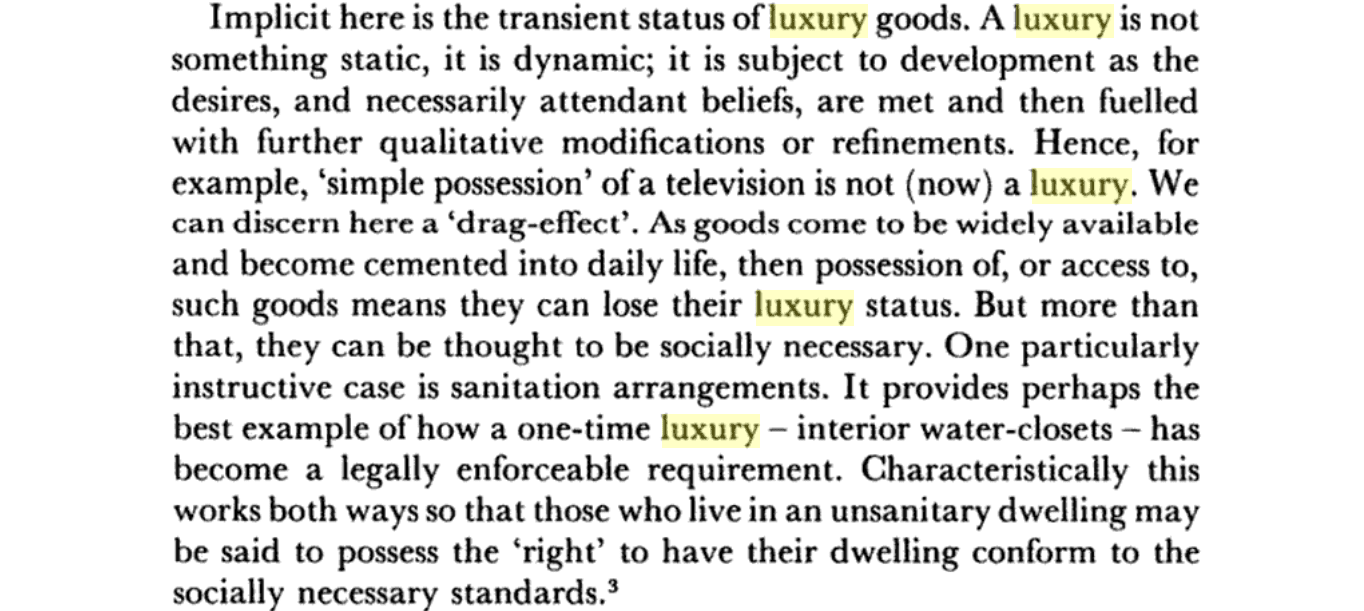
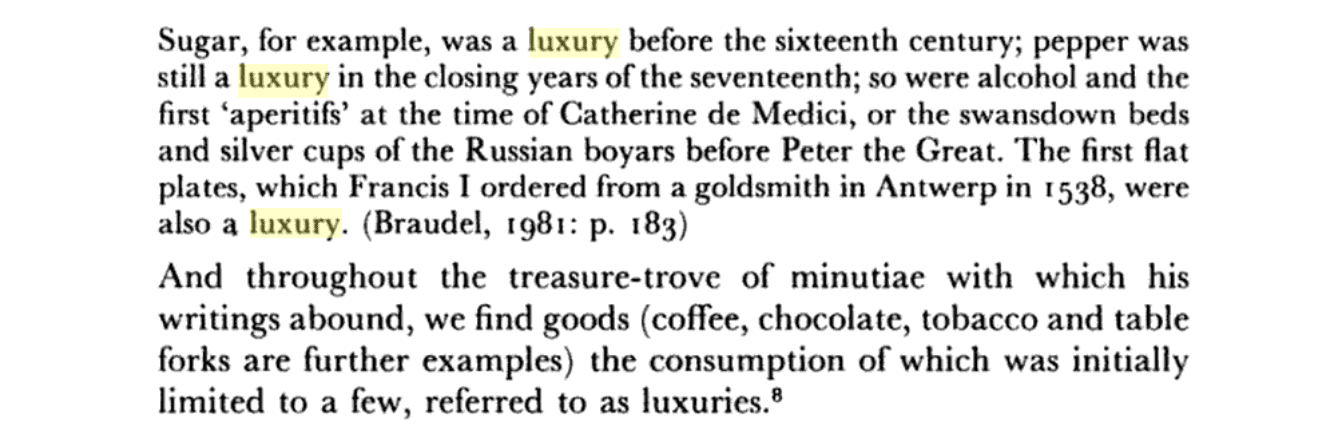
Here are two relevant passages from 1994’s The Idea of Luxury:

Page 18

Page-18.png

Page 35

Page 34

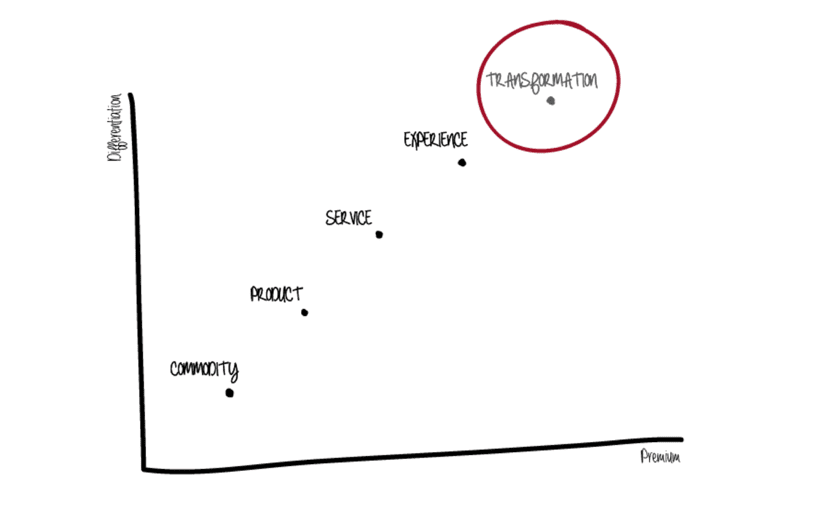
Buying experiences over buying consumer goods is a trend being adopted by the luxury-set. The interpretation of the word luxury means something altogether different for the types of customers who have the means and awareness to shop with DNVB brands. Skift’s latest research shows a clear shift in demand for more transformative travel experiences among upscale travelers (Skift / May 2, 2017). Whereas expensive products used to be the consumer desire: products, community, and service now play the role of enabling experience economy.

Pine-Transformative-Travel-1

Many DNVB products (see the database here) are marketed to enable this type of consumer: Mizzen+Main (No. 86) is for the traveling business class male. Ministry (No. 91) is for the well-educated, urban millennial. AllBirds (No. 56) is worn by the business casual, aspiring member of the investor-class. Rogue (No. 8) turned a garage into a coveted space in a home.

Digitally vertical native brands are founded with these basic questions:

(1) How do we make a great product?

(2) How do we build a community around it?

(3) How do we provide an elegant solution for commerce?

(4) How do we enable customers to save time and focus on what matters?

“One fundamental trap that people run into when assessing the merits of a modern luxury brand is the tendency to judge that brand using the ‘best-in-class’ framework,” says Lean Luxe’s Paul Munford. Lean Luxe’s definition is mostly right. Munford discusses packaging as part of the bundle: “[These brands] offer a better bundle to offset [traditional definitions of luxury] — more convenience, transparency, connection, better messaging, pricing, etc.”

But a selection of modern luxury brands are also marketing time as part of the proverbial “bundle” and that’s the only place where Munford and my thoughts differ.

It’s no longer sufficient to define luxury products by how difficult they are to attain. Time is the scarcest resource and the ultimate luxury. Being a modern luxury brand is about being self-aware. These brands sell time as a scarcity and then build products around it.

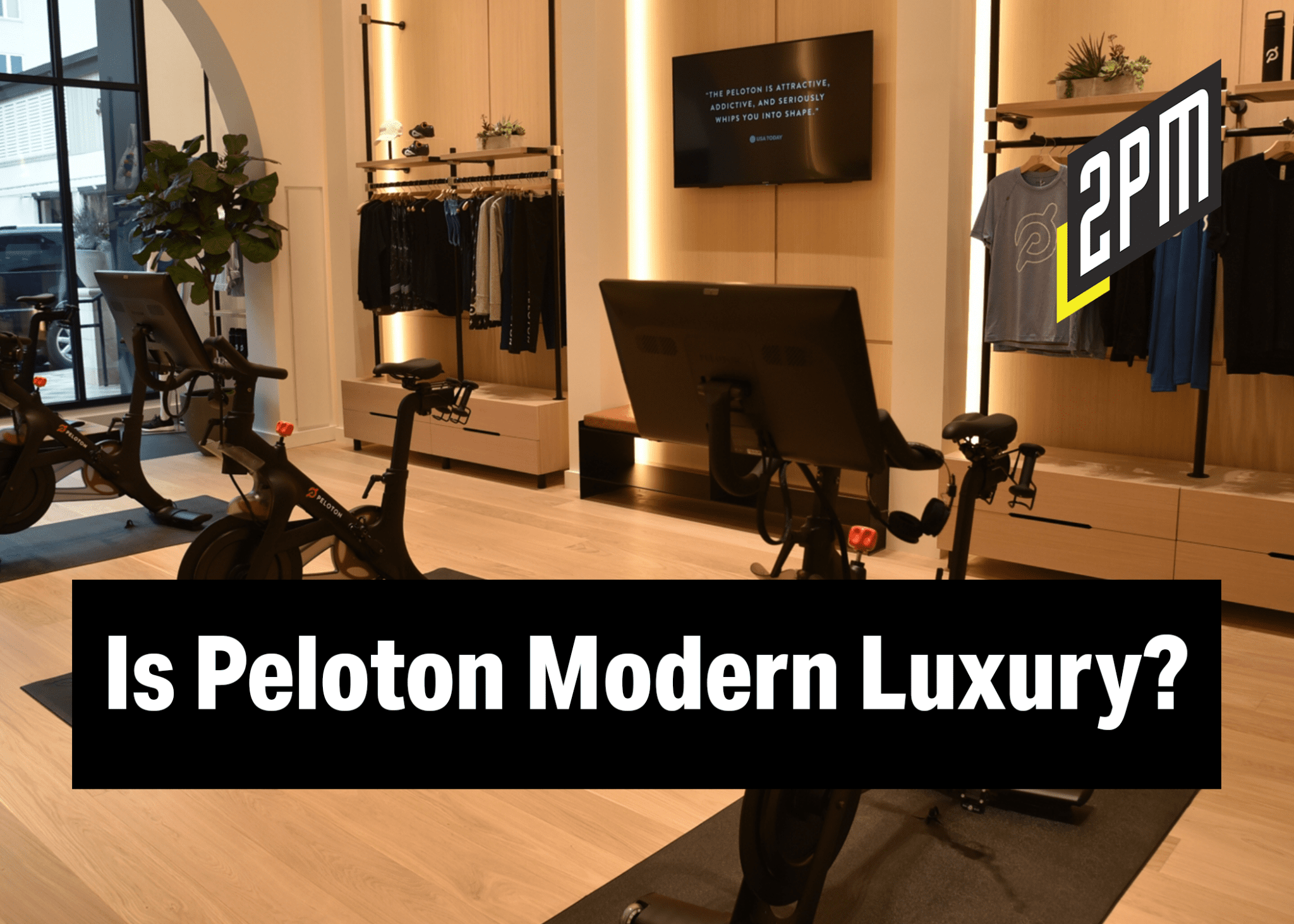
There may be no greater example of the community / product / service paradigm than Peloton, a DNVB that Malik’s True Ventures joined back in 2015.

Peloton is now shifting gears with a new financing program ($97 per month for 39 months for both the bike and subscription service), an ad campaign that’s more relatable to a diverse consumer base and an NBC Olympics sponsorship. Peloton counts NBCUniversal among its investors, and has raised nearly $450 million in total funding to date.

“We had this idea of a very affluent rider who many of our early adopters were,” she said. “We realized, through conversations with our community, that there was a huge opportunity with people who thought $2,000 was a huge investment but were [buying] it over and over again because the product is so important to them.”

How Peloton is Marketing Beyond the Rich

Peloton is not a traditional luxury product, but it shares consumers with traditional luxury brands. Think about the type of living arrangement necessary to house a wi-fi enabled bicycle or a $4,000 VR treadmill. It’s a brilliant piece of hardware that blends community with product and service. The brand’s proposition explicitly states that the purpose is to free the owner to focus more on experiences.

Peloton’s value proposition is as much about what you can accomplish away from the treadmill. Why take the time to travel to a gym? That time could be better spent elsewhere. This is the mark of a modern luxury brand.

Read more of the issue here.

By Web Smith and Meghan Terwilliger | About 2PM