
No. 270: For DNVBs, brand matters.

facebook-ad copy 4

A look at Raden’s shuttering (DNVB No. 119) and Away’s persistence (DNVB No. 40). With the news of Raden shuttering and their founder’s commentary on the online luggage industry’s outlook, 2PM has a deep dive into what may have influenced Raden’s shuttering (it wasn’t just regulation). And Away cofounder and CEO Steph Korey provides commentary on what will shape Away’s bright future.

Founder of Raden, Josh Udashkin had this to say to Conde Nast Traveler about the future of the smart luggage industry: 

I hate to say this, but I think [the future] is nonexistent. All these companies rely on word of mouth, but buying this product now gets you hassled. I don’t see how you can continue selling it.

We disagree. Millennial consumers are practical, savvy, and even slightly territorial. These consumers seek brands that appeal to their lifestyles, their timing, their values, and their personal preferences. The narrative matters because their lifestyle matters.

The key to building a strong DNVB can be attributed to perceived quality, price value, and ease of purchase.

Convenience Change + Price Change + Perception of Quality Change > 0 

Convenience: ease of purchase, superior customer service, ease of return, and quality warranty.

Price: is the price comparable and or cheaper than the premium incumbent brand prices.

Perception of quality: how is the brand perceived? Is there an affinity for the product?

Whereas, if the DNVB’s sum “change” is greater than zero, the DNVB may be a better option than the incumbent. It’s through this lens that DNVBs and CPG brands have been able to position their products against stodgier, traditional brands. One of the keys to building an online retail presence is emphasizing both components of a winning formula: product and narrative.  That narrative communicates quality, community, and brand equity around the product. For DNVBs with $5M or less in total funding, you can argue that the narrative is as important as the product itself.


Issue No. 254: An Open Letter to DNVB CEOs

DNVB executive teams build two products from scratch, supply and demand:

  1. The product: the shirt, or the luggage, the pants, the shades, the coats, or whatever it is that people know you for.
  2. The brand: the aura of that product, the name recognition, the association, the behind-the-scenes partners, the spokeswomen, the ambassadors, the inevitability of success.

Both Raden and Away were founded in the early months of 2015. Raden raised a seed investment from Lerer Hippeau, First Round Capital, and Gin Lane – the famed and de facto kingmaker of DNVBs. Away raised a star studded seed round that included Andy Dunn, the now-Walmart executive who coined the DNVB acronym.

When Udashkin was interviewed by Loose Threads in 2015, Udashkin indicated that product was the entirety of his focus. He went on to add that the product’s narrative wasn’t something that Raden was going to emphasize.

After spending almost a year in the prototype phase, working out of San Francisco, Los Angeles, Montreal, and Taiwan, Raden emerged as a product company that rejected the imagery and celebrity of lifestyle brands.

Udashkin went on to say: “How can you have a lifestyle on day one around your product unless you’re faking it? I think that works in the short term, but over time the customer gets smarter. If you don’t keep working on your product, eventually you lose.”

Cofounders Steph Korey and Jen Rubio took a nearly opposite approach to building their competing brand. In a July 2017 segment in Inc Magazine called “How I did it”, here is what was said about the duo:

Steph Korey and Jen Rubio had a problem. Their planned launch of Away, a new luggage brand, was fast approaching–and none of their suitcases would be ready to sell in time. Luckily, the two had a social media trick packed in their bags. They turned a proven retailing tactic, the preorder, and an idea for a book into a campaign that went viral on Instagram and beyond.

Burt Helm, Inc. Magazine

This thinking permeates through their entire product position. Whereas Raden’s Instagram focused solely on the products being sold, Away’s Instagram account features as much lifestyle and usability as it does the products that Away sells.
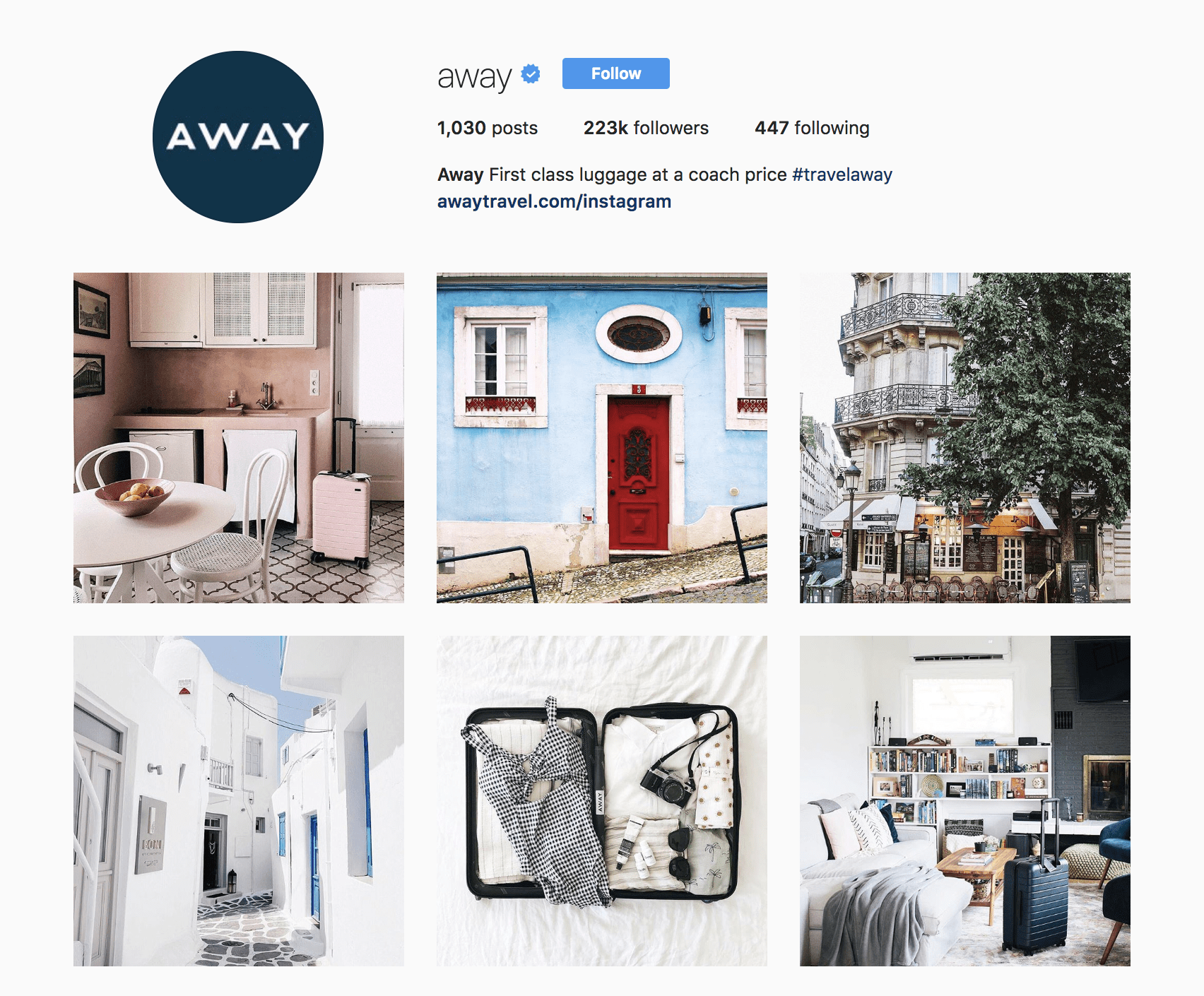
Screen Shot 2018-05-21 at 12.28.07 PM

While Away focused on the destination and brand affinity (to include a print magazine called “Here”), the relationship that Raden maintained with customers was altogether different than the one that Away hopes to continue. The difference between the two approaches greatly affected each brand’s product offering: Raden’s was narrow, Away’s is wide. Here’s a pivotal point in today’s featured article by Fast Company:

He walks me through the math. The target market for a direct-to-consumer suitcase brand is relatively narrow. This is not a mass purchase. Your audience is people with enough disposable income to spend between $200 and $400 on a carry-on, but also be digitally savvy enough to be willing to buy the case online, rather than in a department store.

Once the startup has convinced someone within their target market to buy a carry-on, the relationship is basically over. With some persuasion, the brand can try to sell them a piece of checked luggage or perhaps another small travel accessory. But the lifestyle value of each customer is relatively small, compared to other categories. A direct-to-consumer luxury shoe brand like M.Gemi can sell a woman a new pair of $300 shoes twice a year for the rest of her life. Everlane can sell a customer wardrobe updates every month.

Elizabeth Segran, Fast Company

Here Udashkin suggests that he did the right thing by focusing on product superiority alone (just one of the three components to the DNVB formula). But because he saw no value in building a brand and narrative around Raden, there were fewer alternative products that he could offer to his existing customers. This, in addition to his luggage’s immovable battery and the startup’s shorter runway influenced his position that the luggage maker had no choice but to cease operations. He also suggested that there was no market for these types of products in the long run, a far-reaching assertion.


In an email to 2PM, Away CEO Steph Korey explained Away’s position: 

A brand’s success isn’t determined by the amount of money it raises, or by any other one thing, but by the right combination of a lot of little things.

For us, it’s been the combination of having a customer-obsessed approach to everything we do (taking the time to listen to our customers, deeply understand what they’re telling us, and then quickly acting on it), being conscientious about the way we introduce them to the brand in the first place (ensuring what we’re marketing will be interesting to who we’re marketing it to, and simultaneously creating a narrative that’s authentic to who we are as a brand no matter the channel or intended audience), and not limiting ourselves to any one product or plan for the future (expanding from one suitcase to dozens of travel goods since launch, and setting our sights on fixing everything that’s currently wrong with the travel experience).


One of the early lessons in DNVB branding is one that cannot be explained by analytics and logic, alone. It’s too subjective. Phil Knight’s once-fledgling shoe operation sold shoes but Nike was never a shoe company: it was a company that enabled champions. Tesla sells cars but Tesla is a company for futurists. Apple sells computers but it’s a company for creators.

For aspirational products, consumers choose brands that fit their lifestyle, belief system, and goals. From the very beginning, Away achieved something that very few DNVB’s understand early on. Building the product is only half of the battle. This means that no matter what arduous regulations they may encounter, they will maintain a canvas to build products that are relevant to their community of passionate, millennial travelers. It’s likely that as traditional sales continue, you’ll see a growing number of SKUs, styles, and add-ons that are beloved by millennial travelers and commuters. Yes, Steph Korey and Jen Rubio sell luggage, but Away is a travel company. And Away will go where she wants.


Updates: On June 26, Away announced the Away x Dwayne Wade collaboration. On June 28, Away announced a $50M round of investment, one of the largest rounds by female founders in history. According to their Comms Director Cassi Gritzmacher:

With this latest round of funding, Away plans to further establish itself worldwide by extending to new markets; continue to expand its product line to create the one perfect version of everything you need to travel seamlessly; expand its physical retail footprint (opening 6 new stores by the end of 2018 in addition to its current New York, Los Angeles, San Francisco, and Austin locations); build on its existing social impact efforts (through its partnership with Peace Direct and through new initiatives); and create 249 new jobs over the next five years, transitioning the team into a 56,000-square-foot new Global Headquarters in its hometown of New York City.

Read more of the issue here.

By Web Smith and Meghan Terwilliger | About 2PM 

No. 269: Brands and Voice Commerce

facebook-ad copy 2

According to the Cowen Company, one in seven American consumers owns an Amazon Echo device. Additionally, ComScore notes that 50% of online searches will be voice controlled by 2020. The following is an actual sequence from earlier today.

Alexa, buy pants.

Amazon’s choice for pants is Goodthreads men’s athletic fit, five pocket chino pants. Navy, 29W x 34L. It’s $32.25 total including tax. Would you like to buy?

No thank you.

That’s all that I can find for pants right now. Check your Alexa app for more options. 

Here, Amazon recognizes my request and offers their own brand as the first option. This is a great opportunity for brands looking for a better way to reach new consumers. As consumer adoption of products like Google Home and Amazon Echo continue to accelerate, marketing officers must begin planning around voice as a retail channel. It’s common knowledge that voice assistants will directly and indirectly narrow consumer choices. This is done one of two ways: (a) by recommending goods that are promoted by a brand or (b) by recommending brands and products owned by the platform (see: Amazon’s private labels). For the sake of this argument, 2PM will focus on Amazon’s Echo. It’s a powerful tool with daily relevance in households around the country.

Amazon also debuted Echo Look, a new Alexa-powered device that the company dubs a “hands-free camera and style assistant.” The addition of a camera enables the device to record and comment on its owner’s clothing choices, using a combination of machine learning and human stylist feedback. This advice also takes the form of recommendations, which can drive revenue to Amazon Fashion, and specifically its private-label brands.

Amazon is iterating on and rolling out more features for the Echo Look, including curated content and even crowdsourced (human!) style feedback. It also created an AI algorithm for designing clothes and patented an AR mirror that lets you virtually try on clothes. The value of such a mirror was validated recently by L’Oreal’s acquisition of ModiFace, a company that produces technology that powers similar applications in beauty AR.

Amazon’s Next Conquest Will Be Apparel, Tech Crunch

Through the use of products like the Echo Lookhardware that allows users to layer visual context on top of voice commerce – consumers are becoming comfortable with Echo as a fashion consumer tool. For executives in the fashion industry, it’s an opportunity to establish an existing brand in a new channel.

Product. Establish a six month test of your brand’s products on Amazon. For young brands with tremendous brand equity this can be terrifying, but these tests are commonplace. Just three days ago, Mizzen + Main listed their retail brand’s company’s basics. In a savvy move, rather than listing the entire catalogue, they focused on the brand’s evergreen products. These are the types of products that can lead to strong SEO that will benefit the company whenever they choose to list seasonal products.

Software. Build your brand’s voice application for Echo. To build consumer connections and facilitate the path to purchase, it could be worthwhile to provide your existing consumers a familiar destination on a new platform. Not only will a branded app experience make it easier to do business with you over voice, experts say that it improves SEO on Amazon.com and through Echo’s product rankings.

Marketing. In addition to emphasizing voice SEO strategy to drive discovery, brands are also measuring voice app data to improve consumer engagement, they are enabling product sales within the branded voice apps, and they are promoting their branded voice app through earned, paid, and social media.

Brand. In 2002, BMW innovated by hiring a barely known British actor to star in a then-revolutionary online ad series called The Hire. Costarring Mickey Rourke, Adriana Lima, Don Cheadle and directed by Guy Ritchie, Ang Lee, John Woo, and Tony Scott – this was a significant investment into entertainment by the German car manufacturer. But nearly 20 years later, it’s not the visuals that consumers remember. It’s the actor’s voice.

In the late 1990s BMW noticed their profits were sliding a bit and decided to start targeting internet-savvy customers, a very forward-thinking move at the time. They asked their longtime parter Fallon Worldwide to come up with a campaign that was more than just pretty BMWs sweeping through the countryside like in the magazine and TV ads, something with a James Bond-esque hero who uses BMWs in a variety of different situations.

BMW’s The Hire Was Ahead Of The Curve And Still Has No Equal

Clive Owen starred and narrated the entire series, a project that returned in 2016 under the BMW Films umbrella. In a way, BMW’s marketers gave the brand a human voice and it was such an effective marketing tool that Clive Owen’s intonation remains eponymous to the brand.

The Hire may have been a decade ahead of its time, but it was right on time for BMW’s return to relevance. For retailers who seek to establish their equity over a new channel, remember BMW’s bet on the internet. In a time when scripted podcasts are driving millions of downloads and attracting tens of millions in advertising dollars, consider the potential relevance of a retailer who invests in making their physical goods relevant to audio-hungry consumers.

Once you have command of a new medium. commerce-efficacy is a but one step away.

Read the rest of the issue here.

 By Web Smith and Meghan Terwilliger | About 2PM
Issue No. 267: On DNVB Branding

facebook-ad

What’s next in DNVB branding? Every vertical brand story has its beginning. For lifestyle and fashion DNVBs that are fortunate enough to work with the finest branding agencies, this story often begins with its founder’s biography, the problem that product x begins to solve, and proclamations of the brand’s inevitable staying power. It’s a short history, as most are in online-first retail. But it’s also a forward-thinking approach, one designed for: eCommerce, Instagram and Google advertising, and third party delivery. Less “we’ve been” and more “we will be.”

According to the godfather of the term, “DNVBs are maniacally focused on the customer experience and they interact, transact, and story-tell to consumers primarily on the web.” As brands begin to focus on off-line retail, you’ll begin to find that the packaging around the brands will change with that focus. Whereas technology and futurism appealed early on (2010-2014), the brands that succeed over the next ten years will focus on heritage as much as they focus on futurism.

Phase One (2010-2014): Technology

Warby Parker is the best example by a mile. The brand grew by implementing a practice that other direct-to-consumer companies had not. The company worked to eliminate all barriers to purchase by implementing tools designed to facilitate an ingenious customer experience. For this first phase of DNVB marketing, the eCommerce brand’s technology was the draw. The product is nominal and affordable but the access to it became just as much a part of the brand as the eyewear itself. Take this excerpt from a 2013 Wall Street Journal article co-written by Kevin Lavelle and me:

We are now in the age of e-commerce 3.0, where entrepreneurs can launch companies with few barriers to entry. eCommerce 1.0 consisted of crude online shopping in the ’90s offered by a few businesses met with significant consumer skepticism. This evolved into the more sophisticated interactions of e-commerce 2.0 in the mid 2000s, when most companies realized that if they weren’t online, they were endangering their future.

A new time is here — and the power no longer lies in the hands of a few buyers at large stores. Bigger businesses can be upended by an upstart competitor with a superior product. And retail startups no longer have to endure the long, slow road of trade-show hopping to get their product in front of a handful of buyers, or giving away a hefty portion of each sale to distributors.

Phase Two (2014-2018): Comedy

Dollar Shave Club’s 1m33s “Our Blades Are F***ing Great” video was developed to promote the launch of a (since-acquired) brand and has now been viewed over 25 million times. This internet ad is considered one of the premier examples of top funnel marketing and DSC’s brand of humor has since influenced other mens-focused brands to pursue humor as a means of brand differentiation: Chubbies (no. 67), Untuckit (no. 48), Tommy John (no. 54), and Mizzen+Main (no. 86).

Capturing one customer by way of a top funnel direct-to-consumer ad can cost upwards of $20 per click on Facebook. Digital advertising can be costly. To counter these steadily rising costs, brands have been stimulating awareness, interest, and consideration cycles by promoting a viral brand video. It achieves awareness, consideration, and intent.

Most importantly, introducing mainstream users to your brand and getting them to clickthrough for more information allows marketers to use tools like Facebook’s pixel to retarget casual visitors, moving them further down the sales funnel. Appealing to casual customers was an effective way of increasing top funnel traffic.

Phase Three (2018-forward): Heritage

Brands that began as the embodiment of online-first retailers are now expected to rival age-old incumbents, as they grow their annual revenues well beyond nine figures. Incumbent competitors are still around and some are even stronger than they were before the emergence of online rivals. All the while, new brands are beginning to compete on old-aged ground: mall retail, brick and mortar shops, and traditional advertising. The internet was supposed to completely eliminate these channels, instead, it provided cover until online retailers were prepared to go physical.

eCommerce has matured and physical retail has evolved into a more effective channel. As such, we’re beginning to see brands take on the traits of heritage companies. But if you’re eight years old, you won’t have much of a heritage story. For every Abercrombie, Filson, Ralph Lauren, Lily Pulitzer, Ray Ban, and Tag Heuer, there is a digitally vertical brand like Harry’s, Allbirds, and Outdoor Voices hoping to achieve staying power.

Heritage brands work to maintain heritage, while striving for futurism through of product and channel innovation (see Cole Haan). For heritage brands, presenting an aura of staying power means that the products and channels will present as forward-thinking for a millennial-driven, omni-channel age.

Meanwhile, vertical brands work to establish their products as an evolution of heritage products, while maintaining as many of their technological advantages as possible. For digitally vertical brands, longevity is projected by tethering to history and tradition.

The next wave in DNVB branding will be focused on developing history and tradition. Brands will deepen their roots by way of product collaborations, messaging, and unique origin stories of their own.

Look no further than this example of a heritage maker and vertical brand accomplishing both of their messaging objectives with one collaboration.

Messaging: “Legacy brands approve of us, they want us around.”

Web---NB-ReTooled

Long before designer dad sneakers infiltrated fashion hot spots across the globe, the New Balance 574 set the gold standard for what a well-designed, chunky, retro runner should be. It looked great when it launched in 1988, and in 2018 it manages to look stylish on just about anyone who wears it—actual dads included. Over the years, the 574 has become the go-to New Balance model when it comes to collaborations, too, so it’s seen a fair number of upgrades and interactions. But the latest collab—with the high-tech clothing label Ministry of Supply—brings the 574 into the ultra-performance future.  – Tyler Watamanuk, GQ

Messaging: “The finest legacy brands trust our platform.”

This month, Mr. Porter launched a tongue-in-cheek collaboration with Prada. As luxury continues to grow online, Mr. Porter is pushing to become the destination for such wares. This type of heritage nod goes a long way with consumers.

Since the 1990s, the brand has maintained an enviable position firmly at the forefront of fashion, to the extent that it has become a household name, a byword for sleek elegance, forward-looking design and, yes, a lot of fun print shirts. So great is the admiration for the brand’s wares in the MR PORTER office that there was something of a festival atmosphere when, in September 2016, we became the first online store to offer Prada’s much-coveted menswear collection.

Continue reading “Issue No. 267: On DNVB Branding”