Memo: The Return of Ty Haney

Much can happen in two years. She was the face of an industry and then – fairly or unfairly – she was one of its many whipping posts. She’d later return to Outdoor Voices to reclaim her role as its creative driver. In doing so, Outdoor Voices regained its footing. It’s in a much better position than it was before. In 2020’s Evolving Brand of DTC, I wrote:

Surely, with Ashley Merrill at the helm, Tyler Haney back in an active role, and a new CEO search in process: a positive outcome is more likely than it was with Mickey Drexler involved.

With her next project, Haney takes another leap away from retail’s old guard (represented by the likes of Alex Mill CEO Mickey Drexler) and into the new. Is an NFT a conduit to a new era of customer loyalty? Haney thinks so. Her new venture, called Try Your Best (TYB), got the New York Times profile treatment this week as Haney makes the pivot from her past dealings. She’s making the pivot from leading a workout revolution through accessible athletic apparel to her next one in the world of Web3. TYB essentially trades access for brand engagement and the concept has been covered at 2PM. From the New York Times:

Though she is no longer with Outdoor Voices, Ms. Haney, 33, is hoping to bring its tenets of community building and consumer engagement into a new sphere: the blockchain-based future of the internet known as web3. She’s betting that in the next phase of online retail, “minting things” will be the new “doing things.”

TYB seems to be the product of keen observation and opportunity. We’ve seen recent successes with DAOs, NFT-based communities, and metaverse product drops – Haney is betting that this is the natural progression. Right now, the fervor and hype surrounds branded NFT drops. Brands like Nike, Adidas, Gucci, Balmain, Champion, and Clinique have released their own NFTs. Depending on the brand, the use cases vary. Some are marketing tools meant to test the waters. Some drive purchases via in-game partnerships. Some are tied to loyalty programs. Starbucks has made moves to tokenize its loyalty program. In a recent 2PM memo, we make the point that this type of project is a natural progression in retail. In this way, Starbucks would be the best candidate for a parallel corporate structure built atop a DAO. The potential is a shift in ownership and influence, providing more input from the company’s best customers. From November:

Starbucks has an enormous, built-in community. There are few major retailers that could achieve what Starbucks can with its existing infrastructure. A loyalty DAO would mean new product ideas, governance over potential marketing tactics, and rewards based not only in short-term gain but long-term upside. The Starbucks loyalty program, with the help of the mobile app that totals 28.4 million quarterly users, could precede a fundamental shift in how Starbucks uses one of its most valuable assets. If Starbucks does tokenize its loyalty program, corporate governance would be tiered: traditional C-suite, stock-based premium shareholders, and the loyalty DAO.

The common thread across these projects that they are designed to grant exclusive membership into a sort of “club” for brand fans. That’s one reason luxury brands and sports brands have taken to NFTs so quickly – brand affinity is high in those fields. In this way, NFTs are more than collectibles, they are corporate status symbols or declarations of rank.

What TYB wants to do is pull this sort of one-off-NFT-drop brand engagement into one platform. On the How It Works page on the site, the company uses a brand called Joggy as an example (Joggy is a new brand also led by Haney that sells CBD products). Users who participate in customer feedback loops by weighing in on decisions like packaging colors (one example seen on the site) receive collectibles in return. These unlock access to things like exclusive or early-access products, event invitations and private channels, according to the site description.

The concept of branded community has been heralded in the DTC era, when companies recognized that loyal customers – or the community – were the most valuable assets. Especially in an era where brands lived and died by lifetime value and retention rates. Community is both marketing jargon and a survival tool. TYB pushes the concept of community forward by laying “what’s in it for me?” on the line. Customers who opt in know what to expect in return, and that the more they put in, the more they’ll get out. At least that’s the high level theory in practice.

This is common among NFT drops. Brands like Gucci are rewarding top fans with their NFTs. To qualify to receive one, you have to have jumped through multiple hoops like joined the brand’s Discord server and followed past updates. NFTs then become a badge of belonging in an inner circle. That works for some brands with enough of a halo – and not to mention, it’s far from Gucci’s main business proposition.

Haney’s concept raises further questions. Can a platform manufacture it for brands looking for customer feedback? Do customers care enough about the typical brand to spend time on Try Your Best? And do brands – who pay to appear on the platform – want to outsource something as valuable as customer feedback and loyalty to an outside company? Haney used Glossier as an example of a brand that has drawn an engaged millennial and Gen Z audience, and Glossier’s strategy was defined by how much it included customers in its product development. Tokenization formalizes the arrangement.

The challenge will be for TYB to become a must-have for customers. Whether or not the perks will be remarkable enough to devote time to the app stands in the way. But regardless of whether Try Your Best takes off, one of the industry’s top performers is betting the next stage of her career on Web3. This time, there is much less of retail’s past to stand in her way (or the future’s).

By Web Smith with editing by Hilary Milnes
No. 338: UpWest and Hygge

Hygge-2PM

A publicly-traded retailer launched a DTC brand. This is a deep dive into their reasoning, the build, and their internal expectations. 

Middle-class retail is at an impasse. Since the beginning of 2019, there have been 19 bankruptcies to include Forever 21, Gymboree, Charlotte Russe, Payless ShoeSource, Diesel, and Destination Maternity. And there are another eight retailers at risk to include: J.C. Penney, Neiman Marcus, J. Crew, and Hudson’s Bay. In Gilded Age 2.0, I explain that our current retail era signals a casualty of the middle class consumer; a class that once emerged in response to the industrial and financial booms of the late 19th century and the governmental reforms of the mid-20th century.

With a flailing gig economy, stagnant wages, and rising personal debts, 2019 presents a break from the mid-century momentum that defined the 20th century. We are beginning to hear faint echoes of an earlier time of boom or bust and feast or famine. Rather than appealing to pure luxury consumers or fast fashion-loving millennials, the “long middle: erroneously remains the bullseye of the target. Retailers have been slow to optimize for a new market of coveted consumers.

In a recent report by Business of Fashion proclaimed that America still doesn’t have an answer to LVMH. They explain:

Spoilt for choice, consumers are less interested in mid-priced products available at scale: they want dangerously affordable fast fashion or pure luxury. (And preferably at a discount.) It’s harder for consumers to see the value in something that is not cheap but not that expensive, either. Especially if it’s not utterly unique. That’s a problem for Tapestry in particular, which deals exclusively in accessible luxury. [1]

Against the backdrop of abundant choice and a bifurcating market, Ohio retailer Express launched a new brand. Express is currently trading at a $265 million market cap with north of $2b in sales. The cost of that revenue is extraordinarily high compared to healthier retailers. Trailing twelve months, Ralph Lauren Corporation earned north of $6.5 billion with a $2.45 billion cost of revenue.

In contrast, Express earned (TTM) north of $2.1 billion with a $1.5 billion cost of revenue. A 25% gross profit margin heading into a crucial holiday season, the Columbus-based retailer hopes to use the DTC initiative to improve their long-term outlook. The effort has been met with a mix of pessimism and optimism. 

Pierre Kim of Away

For years, retailers have been criticized for not evolving quickly enough to meet the demands of their customers, so what do they have to lose with this new strategy? Their core labels may be faltering, but they still have brand equity. Why not use it to experiment and launch new businesses?  [2]

Paul Munford of Lean Luxe

There’s baggage associated with being under a legacy retailer’s umbrella—it decreases the value of the brand to the savvy consumer,” he said. “However, execution will always ultimately be the key here. Spinoffs need to feel like their own entity, as opposed to a sub-brand of the legacy retailer. [2]

There are merits to both arguments. And a little bit of digging provided more clarity for this report. Under the umbrella of Les Wexner’s Limited Brands, Express launched as women’s clothier “Limited Express” in 1980 Chicago. Led by CEO Michael Weiss, the brand expanded to eight stores in 1981 and by 1986, Express began a test for menswear in 16 of its 250 stores. The men’s line spun out as Structure in 1989.

I remember the brand very clearly. As a twelve year old in 1995, the halls of my middle school were split between the haves and the have nots. For the ones with, shirts by Polo and Structure were the daily wears and all I could remember is the sensation of having neither.

4
Remember this?

The advancements that Express made during that 20 year run are astounding to think about. In 2001, Express became a dual gender brand – a pivot that Madewell is currently attempting to execute. Structure “sold” to Express, or at least that’s how I remembered it. Because immediately, I became a fan of Express. In actuality, the brand was owned by the same holding company. It funneled its mens business to a brand that provided more opportunity. L Brands then, quietly, sold the mark to Sears in 2003. The Structure brand was never heard from again.

Express is no longer owned by L Brands, one of the most prolific builders of retail brands in history. It was sold to Golden Gate Capital Partners, a private equity firm with $15b in assets under management. And then, in May of 2010, the retailer went public.

Demographic vs. Psychographic | Part Two 

In 2016, Express made its first play for the direct-to-consumer era by acquiring a minority stake in HOMAGE, the Columbus Ohio retailer led by founder Ryan Vesler. It’s a genuine brand, one where the founder-product fit is as valuable as its product-market fit. The minority investment with vintage t-shirt company meant that Express bought a new audience of a key demographic: the college-aged millennial.

Homage President Jason Block said in an email that Express will consult with the company on an ongoing basis and the investment will allow Homage to expand both its digital and brick-and-mortar presence. [3]

Aside from investing in a growing company,  Express gained the rights to include a limited selection of HOMAGE products in store. The investment was intended to bolster foot traffic while, potentially, benefitting from the long-term flip – if and when the HOMAGE brand grew with the help of Express. It’s unclear whether or not this initiative was successful for either of the brands. The company is currently trading below the price it maintained during the period that Express began its partnership with HOMAGE. The publicly-traded retailer’s missteps over the past two years were due, in part, to a number of macroeconomic shifts.  The launch of UpWest represents a strategy shift of its own.

In Psychographics in Focus, I explain the difference between a demographic and psychographic. Consumer psychology involves the interest in lifestyle, behavior, and habit. It’s an encompassing measure that considers our idiosyncrasies, our temperament, and even our subtle personality traits. These are the variables that influence our behavior as consumers. Psychographic segmentation is the analysis of a consumer cohort’s lifestyle with the intent to create a detailed profile. [4]

Taking a community-building approach, UpWest plans to connect with new customers through experiential events, including a regional tour across the US that features the UpWest Cabin, a mobile pop-up exhibit featuring relaxation-focused experiences like yoga and meditation classes. Slated stops include Columbus, Chicago, Nashville, Denver and Austin.  [2]

From the typeface, to the story-telling, to the merchandising – the UpWest brand is designed to attract fans of the digitally-native industry. Rather than a specific demographic, Express pursued an interest (DTC) and is building a brand atop of that engaged audience.

DTC As A Psychographic

Web Smith on Twitter

DTC, 2012: a tech stack strategy. DTC, 2016: a logistics strategy. DTC, 2020: a brand strategy.

In a span of three days, I received multiple emails and texts from contacts close to the launch of UpWest. Kaleigh Moore, Forbes writer and 2PM collaborator had a story in queue by then. In the Lean Luxe Slack, it was a topic of conversation. Rather than building in-house with Express’ existing engineering group, UpWest contracted Shopify agency BVAccel to handle the design and development work. This was a nod to several of the most successful digitally native brands in the space to include Untuckit, Cubcoats, Chubbies, and Rebecca Minkoff. 

Comparison-Upwest

The site’s architecture communicates a desire to be mentioned in the DTC conversation, this includes UpWest’s partnership with Klaviyo and its new-age loyalty program. It would appear that UpWest chose to focus on the DTC psychographic for the sake of earned media and brand positioning. As far as the nuts and bolts are concerned, the site’s build communicates that the desired target demographic is millennial-aged women. On day zero, the brand has an explicit purpose: to provide comfort for body, mind, & spirit. The clothes, are priced similar in design and price to Marine Layer – its next closest competitor.

Identifying Waves: Importing Hygge to America

In the past year, this concept of Scandinavian coziness has made inroads with an international audience. [5]

Imagine a whiteboard in one of Express’ suburban Columbus boardrooms; the word “hygge” would have been at the center of it in big and bold lettering. You can picture the brand’s chief comfort officer (and Express’ SVP of Strategic Initiatives) standing in the corner of the room, jamming as Cody’s It’s Christmas plays on the room’s four Sonos speakers. The brand wants you to feel a feeling. Analysts agree. Emily Singer, founder of the DTC newsletter “Chips and Dip” had this to say:

There’s something very boring about it. Maybe that’s intentional. This line feels a little too on the nose: ‘Welcome to curated comfort. For those who are seeking peace and calm in a stressful world.’ Brands tap into emotional states, but it’s rarely laid out so explicitly.

It’s this perceived boredom that is viewed as an understated luxury in American culture. To the Danes, hygge is free of economic status. The culture’s entire focus is on practicality, movement, wellness, and mindfulness. It’s this underlying culture that Express hopes to import with the help of some obvious visual cues from well-known DTC retailers.

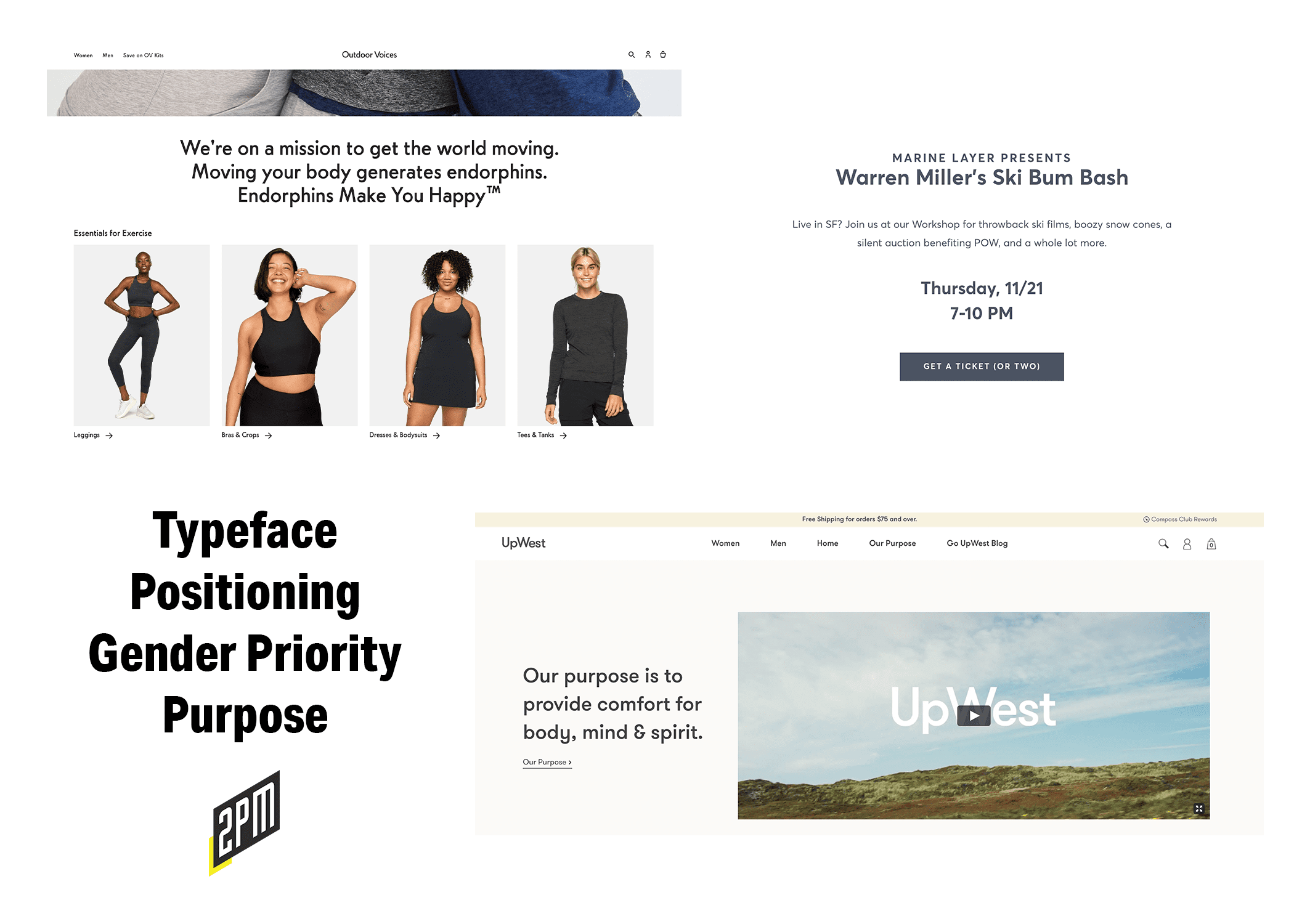
The UpWest typeface is nearly identical to the typeface of Outdoor Voices and Marine Layer’s. Ironically, both retailers have references to Scandinavian hygge throughout their brand messaging. But for UpWest, there’s no understatement. Every message is turned to maximum volume. Like the primary header of Express.com: UpWest’s primary menu is a throwback to “Limited Express”, a retailer for women-first and men-second. There are elements of luxury abound. Upwest’s blog features new-age terms like: nourish, mindfulness, tranquility, and sanctuary. The traveling pop-up is a “cabin.” These are all symbols of wealthier millennials with time and resources to spare. As is the concept of philanthropy and sustainability (though UpWest sells products that are made with synthetics).

It starts with our cozy apparel, home and wellness products. We want to surround you with calm and give you balance. But it’s not just the tangible things. It’s also about slowing down. Diving deeper. And giving back.

Not to be outdone, UpWest wants consumers to help them donate $1 million to the Mental Health Association. The Express-borne retailer plays the entire DTC hand of cards. This report began with a simple statement: middle-class retail is at an impasse. To the average consumer, this DTC play is akin to Structure being launched as Express Men. Like a sheep, the seventeen year old me bought from Express as soon as my adolescent wallet would allow. The mechanics are similar here. Express is attracting an existing audience (the DTC psychographic) and using it to invigorate a brand that is plateauing.

Conclusion

The UpWest bet is that the retailer can earn the business of the upwardly mobile DTC audience by engineering a product-market fit. One with heavy branding, ideal-alignment, and market messaging. This is one of the first upmarket attempts that we’ve seen from a specialty retailer. It’s one that deserves praise. Their management team engineered a brand with contemporary pricing and luxury messaging – void of pricing promotions (for now). They’ve acknowledged that the data shows a middle-class at an impasse. They have the supply chain, the logistics, the distribution, and a snapshot of a brand. But do the executives at Express truly understand what makes the top DTC brands work? That remains the question that could move the market.

Time will tell if Express can duplicate the brand architecting of their L Brands era – a time defined by face-less brands, clever signage, billboards, and foot traffic. My guess is that Express will find an audience that is more sophisticated and critical than the young adults of the 80’s, 90’s, and 2000’s. Messaging, distribution, and customer acquisition methods will evolve with this realization. And if that’s the case, their hygge may be tested for quite some time.

Research and Report by Web Smith | About 2PM 

Member Brief: The DTC Holding Company

Modern Luxury

The return of Victor Gruen’s Ringstrasse concept. Acclaimed architect Victor Gruen once envisioned an American city center that resembled Vienna’s Ring Road, a vibrant area of multi-use commerce, art, and experience. There, retail, dining, art, and entertainment flowed effortlessly. That original concept gave way to more American ideas in the 1950’s: size, volume, and inevitability.Gruen, an ambitious and driven creative, was devastated for decades. His original concept was coopted and poorly executed. But today’s best retail developments resemble Gruen’s initial concept for the American mall. And digitally native brands stand to benefit from the concept’s resurgence.

This member brief is designed exclusively for Executive Members, to make membership easy, you can click below and gain access to hundreds of reports, our DTC Power List, and other tools to help you make high level decisions.

Join Here