No. 292: GOAT, the media brand

OFF

Marketplaces are beginning to own demand. Today, a high school kid named Darius Bazley signed an endorsement with New Balance for $14 million.  When you make an agreement like this, you forfeit your ability to play NCAA basketball. In his case, it is by design. He’ll train for the next year in preparation for the 2019 NBA Draft. And in the meantime, he’s successfully monetized his early success and hedged against later injury or failure. He’s a millionaire without playing a single moment of NBA basketball.

In May, Bazley signed with the prominent agent Rich Paul, who represents LeBron James, John Wall and Ben Simmons among Klutch Sports’ 18 N.B.A. clients. This week, Paul revealed he has arranged for Bazley to spend the heart of the college basketball season — January, February and March — as an intern at New Balance.The internship, to be precise, is folded into a handsome shoe contract Bazley, 18, has landed with New Balance on the lure of his pro potential. According to Paul, Bazley’s multiyear deal will pay him $1 million “no matter what happens” with his N.B.A. career — and can pay up to $14 million if he reaches all performance incentives.

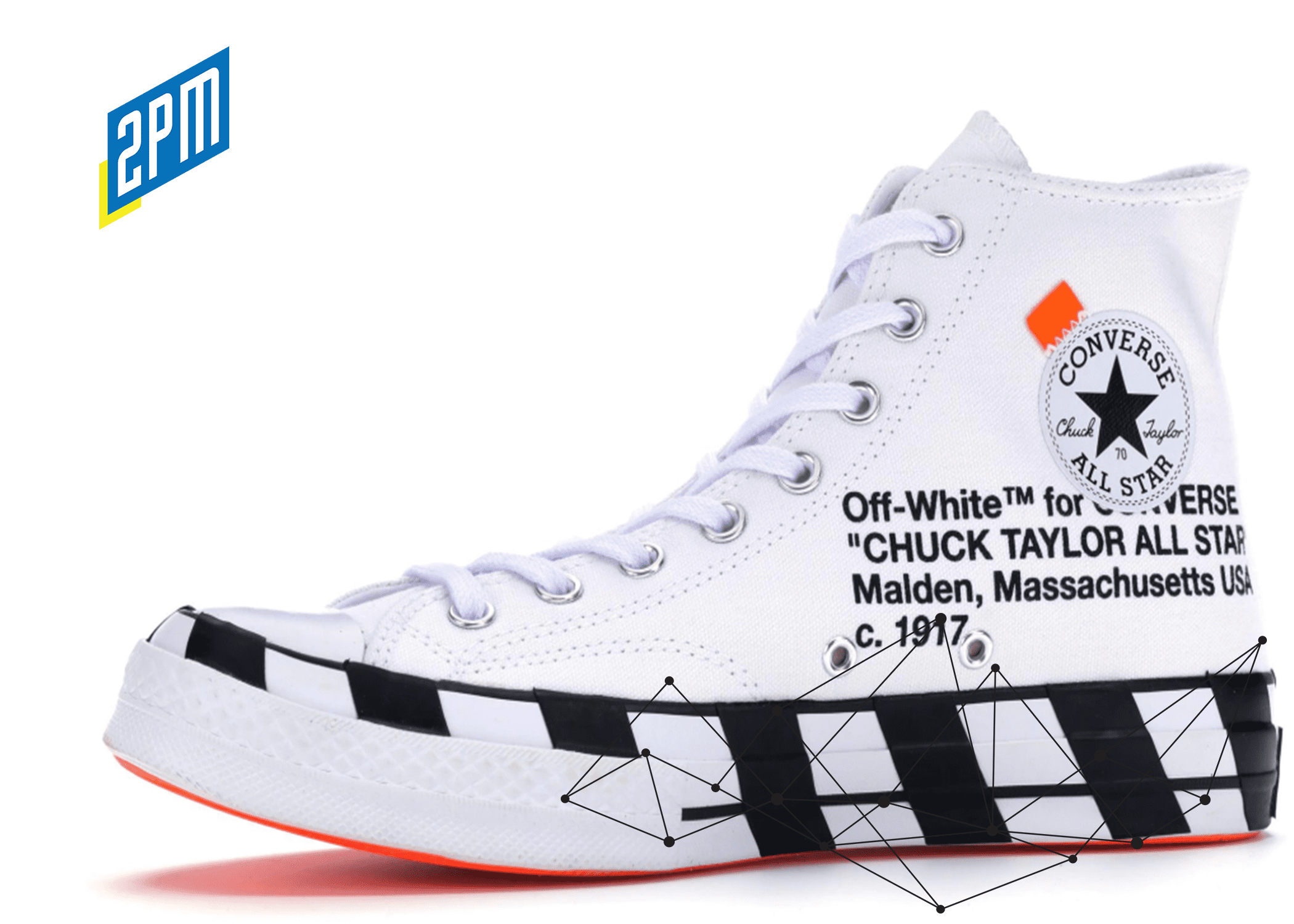
In America, sneaker culture has been a catalyst for many notable shifts in media, sports, education, and business. Shoe promotion began with a marketing concept that continues to evolve. Almost 100 years ago, Converse sneakers debuted with little to no fanfare. This is the way things remained until four years later when pro basketball player Chuck Taylor made a few design suggestions. His celebrity endorsement set a marketing precedent that continues today. Without Mr. Taylor, there would have been no Michael Jordan or Kobe Bryant or Lebron James – basketball athletes who we can attribute billions of dollars in economic impact.

People find meaning in sneakers, so their choices are driven by brand identity.

Elizabeth Semmelhack

With this storied foundation, ne of Y-Combinator’s 100 most promising startups is responsible for one of the most meaningful maneuvers in online retail marketing.

The precursor to GOAT was a startup called GrubWithUs and it was failing despite $7 million in capital raised by cofounder and CEO Eddy Lu. GOAT, short for greatest of all time, was a last minute hail mary that scored. Thanks to a resale promotion of Kanye West’s then-popular Adidas shoe, the eCommerce reseller and database exploded in popularity in 2015.

After four months of operation, in November of 2015, the then-nobody company launched a Black Friday campaign discounting the hottest styles of the year at retail prices. “That year we were talking about the Turtle Doves, the Supreme Fives,” said Lu. “The internet picked it up and it kind of blew up, and every kind of blog picked up this Black Friday campaign.” Over 100,000 users installed the app to take advantage of the sale, causing the newly-launched startup app to crash repeatedly. 

Business Insider

This fueled a new fundraise of $5 million in 2016. And an additional $80 million over the next two years. In March of 2018, GOAT merged with legendary sneaker reseller Flight Club, a New York City retailer credited with pioneering the online reseller space. Partly to bolster its street credibility but mostly to better compete against StockX, a sneaker stock market of sorts. Funded by Quicken Loans and Cleveland Cavaliers owner Dan Gilbert and decidedly more connected in the sports world, the StockX app has raised $50M in the past few years.

Kyle Kuzma’s Partnership with GOAT

You may not have heard of Kyle Kuzma but the second year player hit the ground running as an NBA rookie in the 2017 season by averaging 16.1 points in 31 minutes for the Los Angeles Lakers. In the final year of a two year Nike deal, Kuzma is permitted to wear any shoe with a Swoosh. And given that the NBA recently loosened its dress code for the 2018-2019 season, athletes can now wear any color of sneakers during their games. To recap, GOAT partnered with a young, up and coming player that:

  • plays for the most visible NBA franchise
  • plays in one of GOAT’s most pivotal markets (Los Angeles, California)
  • plays beside the most visible player in the NBA (Lebron James)
  • is permitted by his current contract to work with GOAT (Nike)

GOAT, the media brand. By partnering directly with an NBA basketball player, GOAT is cutting out many of the media companies that have grown to become gatekeepers for sneaker culture. Rather, GOAT is laying the groundwork to control its own content. They can determine the shoe featured and the day that it’s worn. In doing so, they can optimize around the varying degrees of serendipity that these types of partnerships influence. The result: greater organic predictability as their stable of athletes continues to grow through and beyond the NBA.

In covering Wish’s good fortune, 2PM discussed the unpredictability of these types of arrangements in depth in No. 276:

With Lebron’s recent signing, the new face of the organization will move the Los Angeles Lakers from number five to number one overall in jersey sponsorship value. The anticipated $25 million in advertising value that Wish is set to generate in 2018-2019, on top of other advertising efforts, may finally push Wish into a mainstream media conversation dominated by few.

In that article, we assess the value of Lebron James’ arrival in Los Angeles. GOAT’s arrangement with Kyle Kuzma took advantage of this increase in value for the Los Angeles Lakers. Given his exclusivity with Nike, Kuzma will likely work closely with James (who has a lifetime deal) to feature shoes that will further increase the resale value of select Nike shoes.

Kuzma is currently entering his final season of a shoe deal with Nike. The first brand ambassador for the GOAT app, he will be seen in pre-game and on court in shoes that will be featured on the homepage of the site. In theory, this will not only drive traffic for the shoe reseller, it will increase the value of the shoes that have been injected into the LA Lakers storylines.
Screen Shot 2018-10-22 at 2.48.42 PM
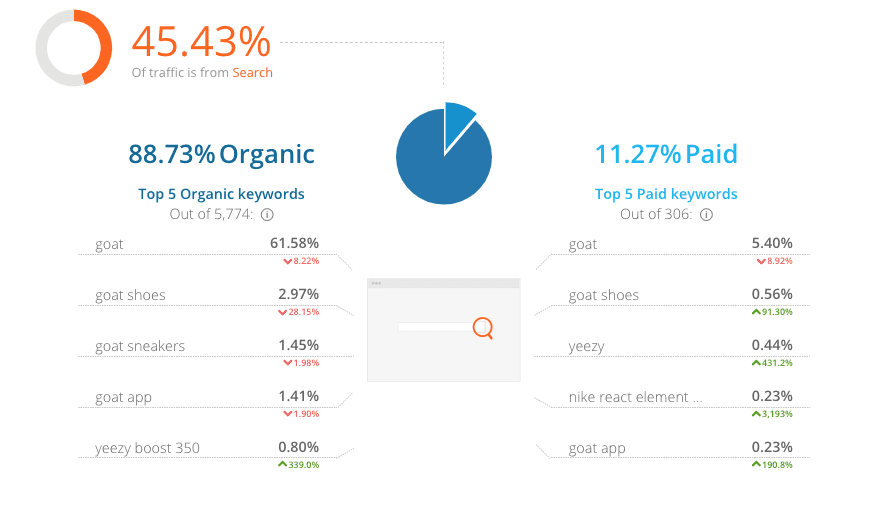
GOAT’s September search analysis: a needed shift towards Nike business

The NBA’s brass has been incredibly creative, allowing their players to forge their own futures outside of their time on the court in ways that have been increasingly beneficial for the league For Kuzma, this is a smart partnership. But it is also a new door into the NBA’s marketing machine. Self-expression isn’t just about pre-game any longer. And for GOAT, an app that got its start by way of an Adidas craze, the Kuzma partnership allows them to hedge with deeper ties to Nike.

Learn more about GOAT here. And read the no. 292 curation here.

By Web Smith | About 2PM

Member Brief: Direct to Consumer Luxe

Screen Shot 2018-10-19 at 4.25.49 PM

On Tesla’s Model 3 and the Target One demographic. In June of 2018, The Atlantic published an article that articulated a macroeconomic trend that I’ve long felt was a credible undercurrent in retail. There is this cohort of consumers that isn’t quite 1%, yet isn’t quite middle class. These consumers are young executives, they are doctors, lawyers, bankers. The Atlantic goes on to illustrate the data behind their assertion that we are living in what progressive economists are beginning to call “Gilded Age 2.0.” And while politics can influence economic conclusions, there are conclusions that cannot be argued: retail is polarizing its consumer targets.

This member brief is designed exclusively for Executive Members, to make membership easy, you can click below and gain access to hundreds of reports, our DTC Power List, and other tools to help you make high level decisions.

Join Here

No. 291: The Sears Bankruptcy Dossier

searsdossier.jpg

After many years of struggles, Sears Holding Corp followed through on their anticipated Chapter 11 bankruptcy after missing a crucial debt payment of $134 million.

2PM, Inc. on Twitter

News: @Sears to file for bankruptcy after 12 PM EST. 150 anchor stores at Tier B / C malls will be closed and nearly 19,000 jobs will be lost.

History. Sears has a story that dates back 132 years. For over a century, that history was rich and awe-inspiring. From a mail order catalogue (that sold everything) to one of the largest retailers and land holders in the world – only to be surpassed by Walmart in 1987.  For a long time, Sears met consumers where they were.

It wasn’t just that Sears failed to improve its in-store experience and merchandising strategy. Lampert also failed to see how digital could boost the overall business. According to Dennis, the e-commerce business was positioned as a separate play, distinctly different from physical stores. Using stores as digital assets with technology like buy online, pick up in store is a common shield retailers like Nordstrom and Kohl’s use to protect themselves from Amazon.

How Sears’ cost-cutting strategy sealed its fate

While Walmart has evolved to compete in the online-first economy, Sears has not. Of two of the top reasons that Sears’ century of good fortune began to crumble: they incurred massive debts and suffered from severe corporate mismanagement issues.

Web Smith on Twitter

TIL: @Sears used to sell cocaine, codeine, and opium. They were profitable then.

But that doesn’t tell the entire story. Here is a great quote from today’s CNBC article on the matter:

A separate survey of U.S. consumers by Cowen & Co. found the average Sears shopper today is about 45 years old and makes a little more than $59,000 each year. The average Kmart shopper, meanwhile, is a little more than 43 years old and makes about $53,000 annually. That makes Walmart ($55,200), Burlington Coat Factory ($59,100), J.C. Penney ($61,000) and Ross Stores($61,400) the most comparable retailers for Sears and Kmart shoppers when looking at household income, the firm said.

J.C. Penney and Walmart set to benefit

Economics. In a recent study by the Pew Research Center, the middle class is defined as a household with two-thirds to double the national median income. This metric currently includes about half of American households. However, from 2000 to 2014, families that were considered “middle class” decreased in 203 of 229 studied metropolitan areas. This decrease has only accelerated in the past four years. Sears was built for middle-class mall goer. It’s been the thesis of 2PM, Inc. that retailers who’ve built their businesses for this American demo will continue to struggle until the American middle class rebounds.

JC Penney is another retailer that is facing these troubles. Whereas companies like Walmart, Target, Amazon, Dollar General, or Kohl’s have achieved growth by appealing to the upper middle class or economy shoppers. Straddled in debt, and with little to no visionary leadership, Sears failed to execute this pivot. The results have been tragic. Mall owners and commercial real estate developers will have to adopt new strategies to prevent the negative cycles that have occured in the past when anchor stores are abandoned.


Issue No 179: House of Cards

But the real economic shift will be felt in exurban, lower-to-middle class areas. These areas are more dependent on shopping malls and the associated commercial real estate developments to fill their open swaths of land. This is where these communities go to shop, eat, and work. This is also where a sizable amount of tax revenue is generated. Without anchor stores or foot traffic for smaller businesses, exurban commercial real estate is nothing more than a house of cards. Next generation retail will not be there. And neither will appreciating homes.


2PM Data

The top 100 retailers are listed below. A common misconception is that Sears was a forgotten retailer. In this recent dataset by Statista, Sears is currently in the top 40 stores in America.

[table id=29 /]

Here is a look several data points that will influence commercial real estate for years to come.

Screen Shot 2018-10-15 at 2.01.41 PM
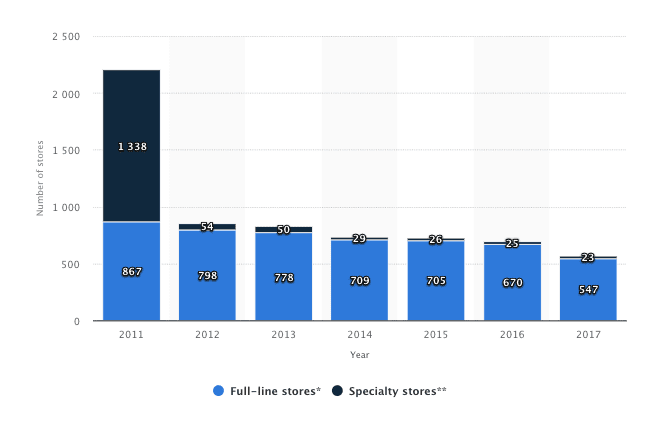
Visual: Sears closings (2011-2017) / Source: Statista
Screen Shot 2018-10-15 at 2.12.20 PM
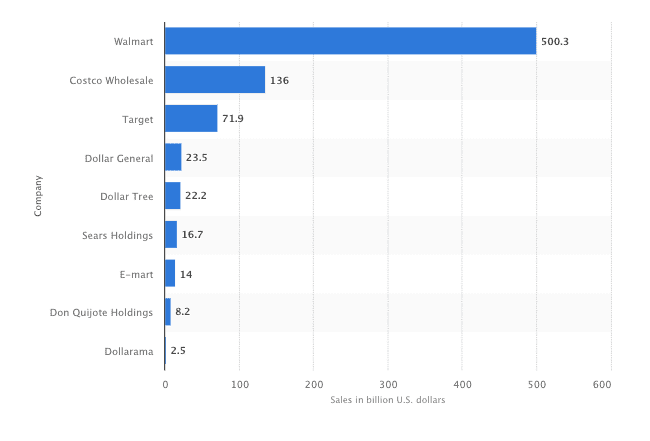
Top middle class retailers in sales (2017) / Source: Statista
Screen Shot 2018-10-15 at 2.17.36 PM
Sears’ net losses: 2013-2017 / Source: Statista
Screen Shot 2018-10-15 at 2.19.35 PM
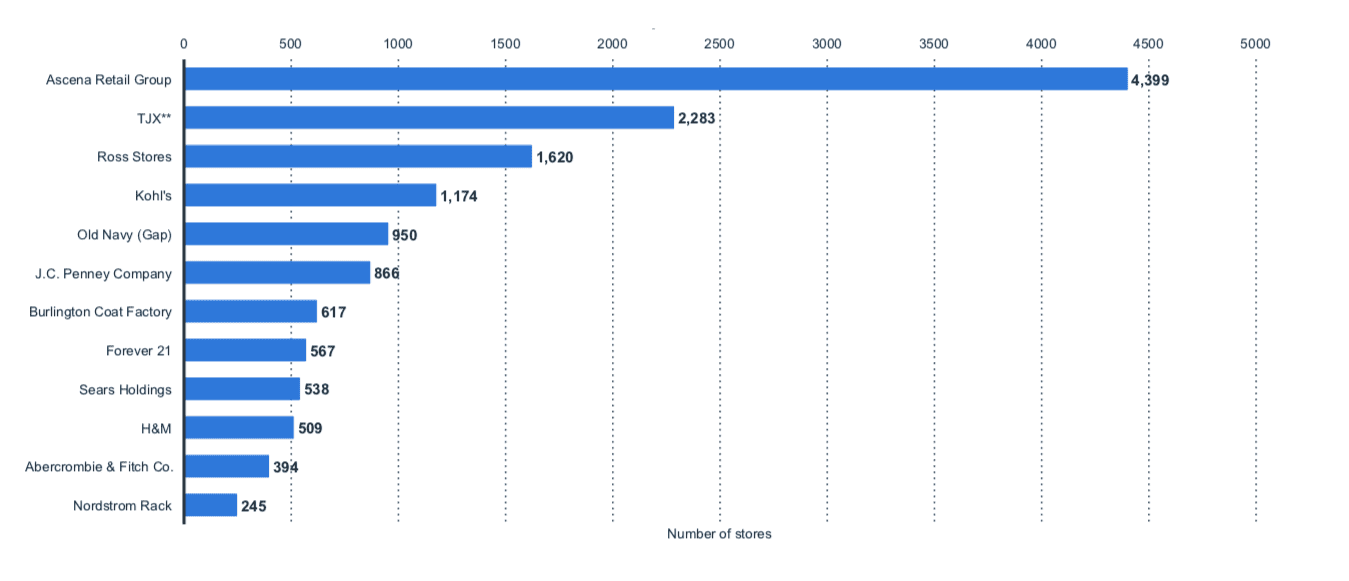
Number of stores of the leading apparel retailers in America (2017) / Source: Statista

The Sears bankruptcy should be viewed as a warning shot for companies like: J.C. Penney, Burlington Coat Factory, and Ascena Retail Group – a conglomerate of middle class retail brands. Ascena is currently operating 4,400 stores in North America and trading at 25% of its historical highs. Retailers that have been dependent on debt and brick and mortar foot traffic are overdue for an evolution of their approach to reaching a) existing customers in a dwindling demo or b) finding innovative ways to reach new customers in growing demos: economy and up market. 

The death of retail as we now know it is greatly exaggerated. Retail isn’t dying; it’s evolving. Just like it has done before. There has always been disruption in the retail sector. A major disruption occurred in the late 1800s when Sears introduced the catalog and brought the entire store into the homes of U.S. consumers. This gave Sears the same advantage over brick and mortar stores that eCommerce sites have today. Sears was simply responding to the needs of its customer since 60 percent of the U.S. population lived in rural areas at the time and didn’t have convenient access to stores. Sears would bring the store right to them.

Marshall Cohen of NPD

Nearly 111 million square feet of retail space will be lost in this bankruptcy. For the Tier A malls that will be affected by Sears’ closings, consumers will see new consumer or events spaces in place of the historic retailer. But for Tier B/C malls, Sears’ closing will become another eyesore that will influence aspirational consumers to shop elsewhere. Sears once thrived on the principles meeting customers where they were. Evolving customer needs requires leadership that understands where consumer mindshare and dollars are going.

Read the curation here.

By Web Smith | About 2PM