No. 275: YouTube goes commerce

facebook-ad copy 2
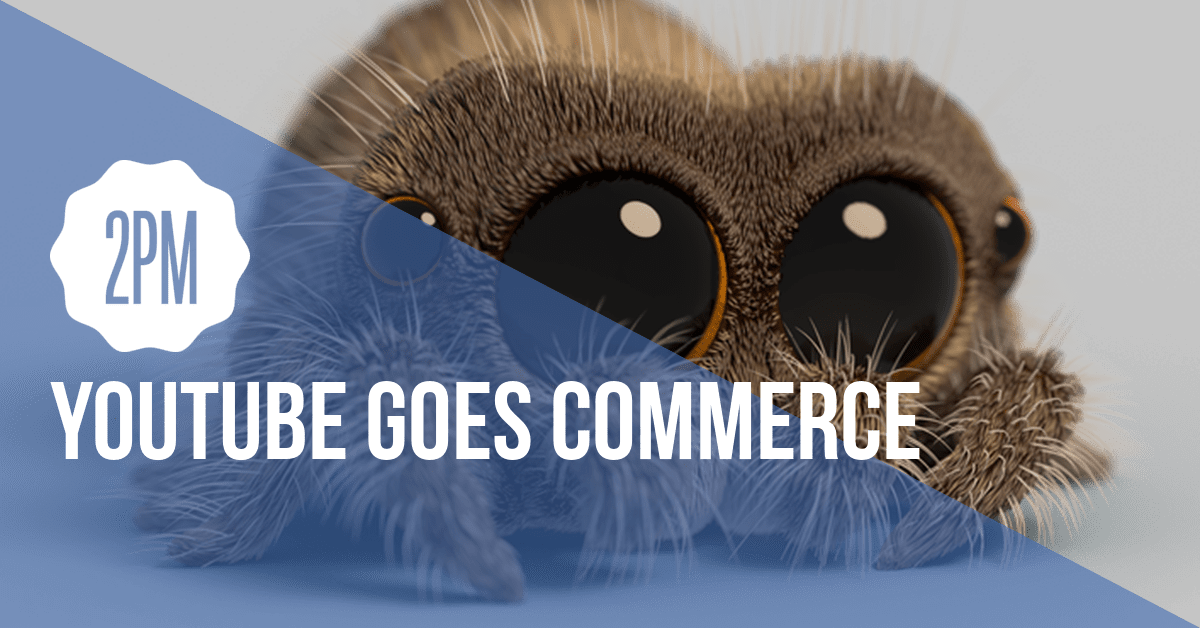
Pictured: YouTube sensation “Lucas the Spider”

YouTube creators have been frustrated with the platform’s ad operations, as of late. YouTube legend and videographer Casey Niestat has nearly 10 million YouTube subscribers, the embattled Pewdiepie has 64 million, the famed MKBHD has 6.5 million, and Logan Paul has nearly 18 million (and an eight figure online store). In addition to the proceeds driven by advertising to an audience of those respective magnitudes, creators have been increasingly reliant upon merchandising for a steady stream of revenue. In a flash, a YouTube creator showed the world just how powerful an online retail operation can be for creators.

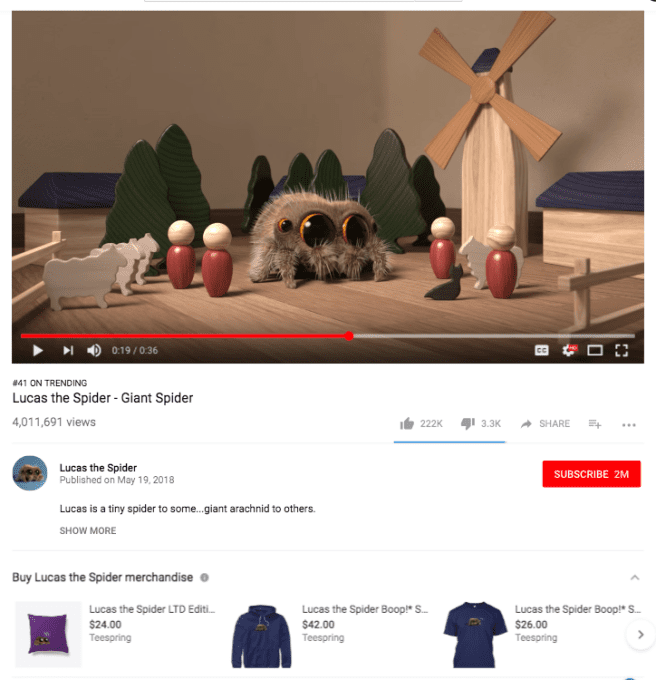
Joshua Slice is a former Disney employee and, currently, the creator and animator of the Lucas the Spider YouTube phenomenon. With a relatively smaller community of 2.4 million YouTube subscribers, the first 18 days of his embedded store achieved an astounding open. The creator of Lucas the Spider, launched a Kickstarter-esque campaign on Teespring (in addition to a full store). The plushie product sold around 60,000 units, netting Joshua $1 million in profit in just 18 days. This 60,000 unit tally was one of twenty available SKUs.
Lucas-The-Spider
Teespring’s integration provides in-line eCommerce for creators

In June 5’s Member Brief No. 16: Patreon’s Signal, our research led me to the following conclusion:

We believe that Patreon’s acquisition of Kit signals a potential uptick in M&A and partnership activity throughout the creator space. Kickstarter acquired Drip in March of 2016 and will likely pursue a merchandising solution for its stable of creators to mirror Patreon. YouTube is positioning its platform to compete with Patreon, Instagram, and Shopify, as well.

According to Tech Crunch’s June 5, 2018 article:

The deal also could help Patreon stay ahead of YouTube and Facebook, which are encroaching on its subscription patronage model. Patreon now has 2 million patrons backing 100,000 creators. It paid out $350 million over its first five years through 2017, and expects to send creators another $300 million in 2018, while taking a 5 percent cut.

Twenty days later and revisiting the Member Brief seems a bit prescient. With the newly announced partnership between YouTube and Teespring, Patreon’s most recent move is already behind the curve. The acquisition of Kit didn’t move Patreon any closer to shipping merchandise for its over 100,000 partners.

Patreon is well-positioned to be the leader in one-stop-shops of monetization for content creators. Kit can be a transformative partner for them, intensifying YouTube and other creator networks’ need to bolster their revenue operations. Commerce will become an increasingly important platform tool in a race to stay competitive for top creators. Activity over the next six to twelve months will determine which creator networks seek out the services of the aforementioned merchandising logistics companies: through partnership, by way of a joint venture, or through an out-right acquisition.

Members Brief No. 16: La señal de Patreon

Prior to this eCommerce rollout, YouTube recently launched the same type of membership service that Patreon offers its creators. What does this mean for creator-based platforms? Patreon’s M&A signaled a period of consolidation and will continue to lead to the siloing of services for top creators. According to Byron Jones of the Music Network, “During the tests, Teespring reported an 82% success rate for YouTube users and an average 25% rise in item sales for each.”

Track the growing merch database

The initial numbers are gaudy and Teespring’s PR has been persistent. Their recent success has sent ripples across the industry. And to be fair, it was an enormous win for them because newer YouTube creators will now be incentivized to remain loyal to YouTube’s offerings.  It’s more than likely that some of YouTube’s creators will consider shifting from other storefronts to YouTube’s Teespring offering. It’s even possible that creators like Logan Paul (who has a sophisticated eCommerce operation in place) will consider testing inline retail on their YouTube channels.

But this partnership is clearly a shot across the bow for Instagram and Patreon. While Instagram is all-in on Shopify’s seamless integration and growing into YouTube’s space, Patreon is still in need of a merchandising partner and an exclusive creative partner that can help them in the short term. Consolidation will continue.

Lea más sobre el tema aquí.

Por Web Smith y Meghan Terwilliger | About 2PM

Members Brief No. 16: La señal de Patreon

Si eres un creador independiente, es probable que Patreon sea una plataforma a la que llamas hogar. Casi 100.000 creadores lo hacen. La plataforma ha logrado una notable tracción en un período relativamente corto de tiempo. Se informa que en 2018, habían procesado casi mil millones de dólares. La creación de los cofundadores Jack Conte y Sam Yam se lanzó en mayo de 2013 después de que Conte se sintiera frustrado por la falta de alternativas de monetización de Youtube. Según cuenta la historia, Conte probó la versión beta del sitio con su audiencia personal de Youtube y empezó a ganar más de 7.000 dólares por vídeo. Con la monetización de Youtube ganaba poco más de 50 dólares por el mismo trabajo. Cinco años después, Patreon es sinónimo de mecenazgo, al igual que Kickstarter lo es de crowdfunding.

Este informe está destinado exclusivamente a Miembros ejecutivos, para facilitarle la afiliación, puede hacer clic a continuación y acceder a cientos de informes, a nuestra lista DTC Power List y a otras herramientas que le ayudarán a tomar decisiones de alto nivel.

Únete aquí

Issue No. 267: On DNVB Branding

facebook-ad

What’s next in DNVB branding? Every vertical brand story has its beginning. For lifestyle and fashion DNVBs that are fortunate enough to work with the finest branding agencies, this story often begins with its founder’s biography, the problem that product x begins to solve, and proclamations of the brand’s inevitable staying power. It’s a short history, as most are in online-first retail. But it’s also a forward-thinking approach, one designed for: eCommerce, Instagram and Google advertising, and third party delivery. Less “we’ve been” and more “we will be.”

According to the godfather of the term, “DNVBs are maniacally focused on the customer experience and they interact, transact, and story-tell to consumers primarily on the web.” As brands begin to focus on off-line retail, you’ll begin to find that the packaging around the brands will change with that focus. Whereas technology and futurism appealed early on (2010-2014), the brands that succeed over the next ten years will focus on heritage as much as they focus on futurism.

Phase One (2010-2014): Technology

Warby Parker is the best example by a mile. The brand grew by implementing a practice that other direct-to-consumer companies had not. The company worked to eliminate all barriers to purchase by implementing tools designed to facilitate an ingenious customer experience. For this first phase of DNVB marketing, the eCommerce brand’s technology was the draw. The product is nominal and affordable but the access to it became just as much a part of the brand as the eyewear itself. Take this excerpt from a 2013 Wall Street Journal article co-written by Kevin Lavelle and me:

We are now in the age of e-commerce 3.0, where entrepreneurs can launch companies with few barriers to entry. eCommerce 1.0 consisted of crude online shopping in the ’90s offered by a few businesses met with significant consumer skepticism. This evolved into the more sophisticated interactions of e-commerce 2.0 in the mid 2000s, when most companies realized that if they weren’t online, they were endangering their future.

A new time is here — and the power no longer lies in the hands of a few buyers at large stores. Bigger businesses can be upended by an upstart competitor with a superior product. And retail startups no longer have to endure the long, slow road of trade-show hopping to get their product in front of a handful of buyers, or giving away a hefty portion of each sale to distributors.

Phase Two (2014-2018): Comedy

Dollar Shave Club’s 1m33s “Our Blades Are F***ing Great” video was developed to promote the launch of a (since-acquired) brand and has now been viewed over 25 million times. This internet ad is considered one of the premier examples of top funnel marketing and DSC’s brand of humor has since influenced other mens-focused brands to pursue humor as a means of brand differentiation: Chubbies (no. 67), Untuckit (no. 48), Tommy John (no. 54), and Mizzen+Main (no. 86).

Capturing one customer by way of a top funnel direct-to-consumer ad can cost upwards of $20 per click on Facebook. Digital advertising can be costly. To counter these steadily rising costs, brands have been stimulating awareness, interest, and consideration cycles by promoting a viral brand video. It achieves awareness, consideration, and intent.

Most importantly, introducing mainstream users to your brand and getting them to clickthrough for more information allows marketers to use tools like Facebook’s pixel to retarget casual visitors, moving them further down the sales funnel. Appealing to casual customers was an effective way of increasing top funnel traffic.

Phase Three (2018-forward): Heritage

Brands that began as the embodiment of online-first retailers are now expected to rival age-old incumbents, as they grow their annual revenues well beyond nine figures. Incumbent competitors are still around and some are even stronger than they were before the emergence of online rivals. All the while, new brands are beginning to compete on old-aged ground: mall retail, brick and mortar shops, and traditional advertising. The internet was supposed to completely eliminate these channels, instead, it provided cover until online retailers were prepared to go physical.

eCommerce has matured and physical retail has evolved into a more effective channel. As such, we’re beginning to see brands take on the traits of heritage companies. But if you’re eight years old, you won’t have much of a heritage story. For every Abercrombie, Filson, Ralph Lauren, Lily Pulitzer, Ray Ban, and Tag Heuer, there is a digitally vertical brand like Harry’s, Allbirds, and Outdoor Voices hoping to achieve staying power.

Heritage brands work to maintain heritage, while striving for futurism through of product and channel innovation (see Cole Haan). For heritage brands, presenting an aura of staying power means that the products and channels will present as forward-thinking for a millennial-driven, omni-channel age.

Meanwhile, vertical brands work to establish their products as an evolution of heritage products, while maintaining as many of their technological advantages as possible. For digitally vertical brands, longevity is projected by tethering to history and tradition.

The next wave in DNVB branding will be focused on developing history and tradition. Brands will deepen their roots by way of product collaborations, messaging, and unique origin stories of their own.

Look no further than this example of a heritage maker and vertical brand accomplishing both of their messaging objectives with one collaboration.

Messaging: “Legacy brands approve of us, they want us around.”

Web---NB-ReTooled

Long before designer dad sneakers infiltrated fashion hot spots across the globe, the New Balance 574 set the gold standard for what a well-designed, chunky, retro runner should be. It looked great when it launched in 1988, and in 2018 it manages to look stylish on just about anyone who wears it—actual dads included. Over the years, the 574 has become the go-to New Balance model when it comes to collaborations, too, so it’s seen a fair number of upgrades and interactions. But the latest collab—with the high-tech clothing label Ministry of Supply—brings the 574 into the ultra-performance future.  – Tyler Watamanuk, GQ

Messaging: “The finest legacy brands trust our platform.”

This month, Mr. Porter launched a tongue-in-cheek collaboration with Prada. As luxury continues to grow online, Mr. Porter is pushing to become the destination for such wares. This type of heritage nod goes a long way with consumers.

Since the 1990s, the brand has maintained an enviable position firmly at the forefront of fashion, to the extent that it has become a household name, a byword for sleek elegance, forward-looking design and, yes, a lot of fun print shirts. So great is the admiration for the brand’s wares in the MR PORTER office that there was something of a festival atmosphere when, in September 2016, we became the first online store to offer Prada’s much-coveted menswear collection.

Continue reading “Issue No. 267: On DNVB Branding”