Memo: La presentación sobre comercio digital de 2PM

Aunque gran parte de la composición del carácter de las APNV sigue siendo el mismo, el telón de fondo ha cambiado drásticamente. Las nuevas tendencias macroeconómicas y las fuerzas del mercado están influyendo en el sector de las DNVB, y el sector de las DNVB está influyendo en el viejo mundo. La cobertura y el análisis de 2PM siguen de cerca estas tendencias en tiempo real; merece la pena dar un paso atrás para evaluar las perspectivas generales del futuro del comercio minorista, la Web3, la cadena de suministro, la privacidad, el sector inmobiliario y la idea de propiedad dentro del metaverso.

En una presentación para Deloitte Digital, 2PM esbozó ocho ideas con visión de futuro.

De lo físico a lo digital: Los minoristas se alejan de terceros[1

Una estrategia líder para las marcas de todos los tamaños y estatus es crear intencionada y cuidadosamente una red mayorista que permita el control del inventario y la asociación por encima del enfoque de rociar y rociar de las generaciones minoristas del pasado. Los minoristas externos desempeñarán un papel menor y diferente que antes, ya que las marcas se centrarán en sus propios canales. Un ejemplo: Nike tendrá un 70% de venta directa en 2027.

De lo digital a lo físico: Las DNVB están abriendo experiencias de compra propias[2].

Para las marcas en línea, la expansión se produce en las tiendas. Las tiendas físicas realzan el halo online de la marca y, si se hacen bien, generan dinero. El riesgo es evitar la sobreventa. En paralelo a esta expansión, el centro comercial se rehará a imagen y semejanza de DTC.

Cambios en la publicidad: La actualización de la privacidad de Apple tendrá efectos duraderos[3].

Los datos de origen definirán la próxima ola de publicidad y ventas. Las marcas y las plataformas se esfuerzan ahora por adaptarse a la actualización de privacidad de Apple, mientras Google planea un cambio similar para Android. Apple desafiará a Meta y Google como principales plataformas publicitarias. Si añadimos la compra con un solo clic, el dominio de Apple no es difícil de imaginar. También hay que prestar atención: El auge del gCommerce y la prevalencia del código QR.

El CAC sigue aumentando y las asociaciones de contenidos son cada vez más importantes para las propiedades[4].

Apple no es el único cambio que afecta a las estrategias publicitarias. Los costes de adquisición de clientes son cada vez más elevados. Además del énfasis en los datos de primera mano, las asociaciones de contenido serán una estrategia clave para los anunciantes en el futuro. Evolucionará más allá de la asociación, y las marcas adquirirán propiedades de medios de comunicación para acceder a información sobre la demanda de productos y la comunidad.

El crecimiento de los pagos de proximidad precede a la adopción del eCom en Estados Unidos[5].

Estados Unidos es actualmente el octavo país del mundo en adopción de pagos móviles. Esa será la próxima carrera armamentística de la tecnología en el país, ya que las empresas compiten por convertirse en el mayor operador de pagos móviles. Predicción: Estados Unidos alcanzará el 30% de penetración del comercio electrónico en 2027.

Carga aérea, portacontenedores y cadenas en propiedad[6].

Las alteraciones de la cadena de suministro han reconfigurado el comercio minorista en los dos últimos años. Los mayores minoristas tomarán medidas para asegurarse de que ya no están en deuda con fuerzas que escapan a su control, porque tienen los recursos para poseer sus cadenas de suministro. Es de esperar que Amazon, Target y Walmart adquieran más facilitadores de su cadena de suministro. Esto podría hacer que las marcas más pequeñas estén más en deuda con los grandes minoristas.

Los centros comerciales facilitarán las devoluciones de eCom para impulsar el tráfico peatonal[7]

¿Cuál será el propósito del centro comercial dentro de cinco años? Seguir el mayor punto de dolor del minorista: Las devoluciones en línea. Con tanta superficie comercial extra en los centros comerciales de Estados Unidos en apuros, cada vez más se convertirán en centros de logística inversa para ayudar a las marcas a aliviar el coste de las devoluciones en línea.

Web3 y DTC, comercio minorista en la cadena de bloques[8].

El metaverso ya está aquí y, para 2027, cabe esperar que los minoristas hayan invertido tanto en su presencia en mundos virtuales como en el físico. Web3 puede ayudar a las marcas a establecer programas de fidelización y comunidades de la nueva era, al tiempo que crea una fuente de ingresos que no está vinculada a la creación de más bienes físicos. Fíjate en Nike y Starbucks para ver hacia dónde se dirige esto.

Aquí lo tiene. Los PDF están disponibles para los suscriptores, sólo tienen que responder al correo electrónico del suscriptor y se lo enviaré personalmente:

Por Web Smith con Hilary Milnes, Christina Williams y Alex Remy

Memo: Air Freight

According to Insider’s Intelligence service, US retail e-commerce sales will grow 16.1% this year, exceeding $1 trillion for the first time. Internationally, eCommerce will reach $5 trillion in GMV this year, according to the same source. And it is projected to grow to $6 trillion by 2024.

That’s a lot of oceanic freight forwarding.

Prior to the pandemic, supply chain and logistics management were afterthoughts. In 2022, managing production and logistics cycles has become as critical as marketing and advertising. These were afterthoughts until they were not.

Over the past two years, we have witnessed disruption after disruption. A shipping canal blocked, union employees standing down en masse, the U.S. postal service slowing to a halt, an international bridge protested by truckers, and a container ship on fire with 4,000 vehicles. Over this time period, freight forwarding has increased 500% in costs, retailers have begun to acquire trucking and container resources. Shopify has invested and divested in warehouse management, and Amazon has become the number one buyer of commercial real estate.

Companies like Maersk have pursued acquisitions to manage logistics beyond the ocean. Earlier this month, A.P. Moller-Maersk A/S agreed to buy Pilot Freight Services LLC for $1.68 billion. Maersk felt that it was important to shore up its road-transport business. But more importantly, it signaled that the container shipment boom may be starting to fade.

One method that has yet to fade is air freight. In a September report on freight, 2PM explained:

The complexity of the supply chain has been complicated by labor shortages and other misallocations. The short-term solution may resemble the world’s largest retailers following the supply chain management techniques pioneered by companies like L Brands. But this is only a mitigation effort. Amazon Air flight activity has increased 17% between February and August 2021 after the company added 14 planes, including two that enable intra-Canadian operations. In addition to these 14 planes, Amazon uses up to 20-30 partner flights per day to ship goods from hub to hub according to a recent document: Blue Skies for Amazon Air.

Seko Logistics Chief Growth Officer Brian Bourke recently joined Yahoo Finance (full interview) and provided some insight into this shift. He explained that SEKO chartered 70 times in 2020, 400 in 2021, and will likely surpass 500 chartered flights in 2020.

The use of air freight is increasing due to increased volatility, geopolitical tensions, and global supply chain disruption. In February, Flexport announced a $935 million Series E raise that included the likes of A16Z and Shopify. CEO Ryan Petersen has been at the forefront, helping many who have limited insight into the logistics industry to understand its shortcomings. Petersen announced the raise with this quote:

The global pandemic and the pressure it put on global supply chains has made the transportation of goods — something many people took for granted — a daily pain point. This investment signals that the market recognizes the need for a tech-enabled logistics ecosystem that has the visibility and resilience to handle unexpected challenges of any scale.

One of the most exciting companies is commerce is one that is behind the scenes. Flexport is increasing its air freight capacity as ocean freight continues to cause headaches for retailers, large and small.

This week, Flexport, a freight forwarder, announced it signed a deal with Eastern Airlines to deploy air freight planes, filling a gap in current capacity with a focus on eCommerce shipments. The deal is designed to make the use of Eastern Airlines’ air freighters low cost and quick to deploy, a positioning that would benefit direct-to-consumer and small-to-medium online brands. The Eastern Airlines freighters will make trips between Hong Kong and Chicago and Vietnam and Chicago.

Flexport is actively looking to fill a void in air freight availability to help companies sidestep bottlenecks in other modes of transportation. In an interview with Freight Waves, Eastern CEO Stephen Harfst and Flexport CEO Neel Jones Shah explained the benefits of the deal for the current landscape:

Eastern CEO Stephen Harfst said the plane is designed around e-commerce flows. “We’re not selling weight. Our aircraft provides volume. If you have e-commerce driven goods that are 5 to 7 pounds per cubic foot, the aircraft has structural payload to fill that volume up so why spend all the time, effort and money to redesign and rebuild the airplane,” he said.

Shah went on to note that air freight demand has doubled during a time when capacity has remained around 10% of pre-pandemic levels. He expects Flexport’s volume to double in 2022. While air freight will never become a substitute for oceanic shipping, Flexport is helping certain retailers move the equivalent of three containers worth of inventory in hours instead of weeks, that is as long as the products are 5-7 pounds per cubic foot.

Last week, Flexport signed a nonbinding letter of intent to purchase up to three robot cargo jets designed to carry a 100-ton payload, a move that fits a company built on a culture of innovation that combines logistics execution with a tech-enabled platform executives envision as the operating system for global trade that can improve the customer experience.

For an apparel retailer, supplement company, or toy maker, receiving goods from the manufacturer within 24 hours can be worth the cost. Shipping expenses and global labor shortages are two of the foremost contributors to inflation. Shipping costs have caused issues for retailers, with no exception to category. Companies like Under Armour, Volkswagen, Nike, and Hasbro have experienced many of the same headaches and consumers are paying for it. The U.S. is experiencing the worst inflation in four decades.

In the Port of Los Angeles, container ships are waiting an average of 18 days to unload. While this is the smallest that the shipping backup has been since early November, it is important to remember that it was rare that ships waited for even one day prior to the pandemic.

Air freight will not single-handedly relieve inflation concerns. Shortages are expected to ease by the end of Q1 and business inventories were 2.1% higher in December than the prior month, a gain that the WJ noted was the biggest since 1992. Inflation remains unchanged and suppliers continue to maintain higher prices and the consumer is left to account for this. While trans-pacific shipping has finally begun to return to its pre-pandemic form, waiting times have not. And air freight is but one of the segments that may keep matters from becoming even worse. Analysts believe that global eCommerce will be 20% larger than it is today. The Petersen quote in the Forbes cover feature on him says a lot about how the industry views him:

Our industry thinks I’m a clown, which I don’t mind. I need to continue to convince them that I’m crazy so they don’t get their act together and compete with us.

The health of our economy and the future of eCommerce – as a whole – will depend on relieving the demand on the few shipping ports and international bridges that America over-relies on for inventory. Let’s hope that Petersen is right, shipping times and product costs will depend on Silicon Valley’s ability to begin disrupting a 3,000-year-old ocean freight industry.

Por Web Smith | Editado por Hilary Milnes con arte de Christina Williams

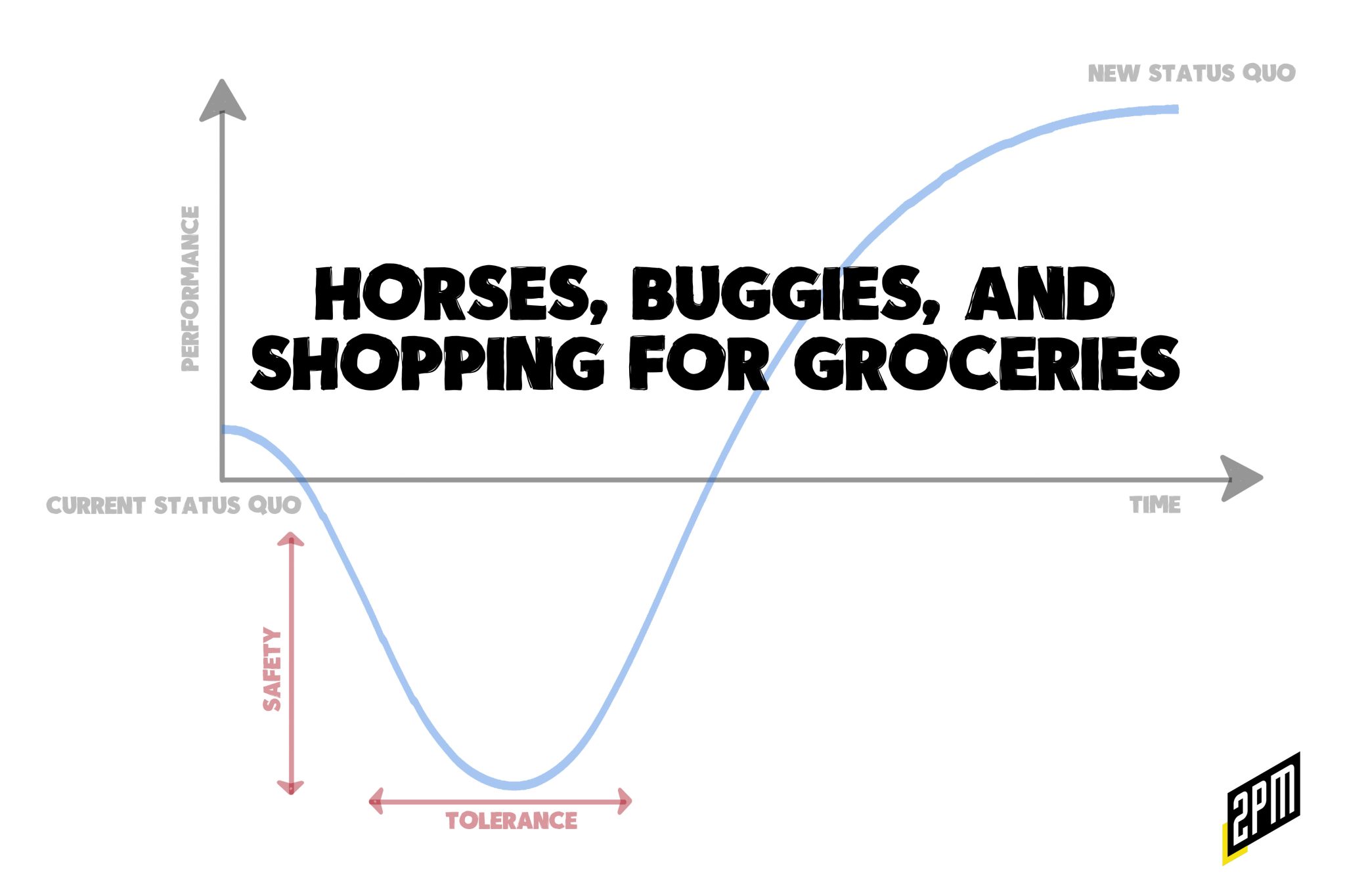
Member Brief: Horses, Buggies, and Shopping for Groceries

Shopify beat expectations in its latest earnings but its share prices sank 15% on Wednesday. Wall Street is worried that the Shopify boom, and by extension the eCommerce boom, is ending with the pandemic. Moiz Ali believes it’s a sign that Shopify has done a poor job of preparing its enterprise clientele for success. The Native deodorant founder (and prolific investor and advisor) notes Away, MVMT, Ritual, and Manscaped as DTC brands that have parted ways with Shopify. He poignantly added:

Este informe está destinado exclusivamente a Miembros ejecutivos, para facilitarle la afiliación, puede hacer clic a continuación y acceder a cientos de informes, a nuestra lista DTC Power List y a otras herramientas que le ayudarán a tomar decisiones de alto nivel.

Únete aquí