
Memo: Golf Diferente

El golf está intentando tener su propio momento Fórmula 1, gracias a Netflix y al drama natural que parece desarrollarse dentro y fuera del campo. Pero a diferencia de la cuidada Fórmula 1, el golf profesional está siendo arrastrado en dos direcciones.

Los consumidores quieren sentirse más cerca del juego y que los muros entre los clubes de campo más exclusivos y los campos públicos más frecuentados se tambaleen. Pero aquí hay salvedades. Al igual que muchos aficionados a las carreras quieren acceder al cacareado paddock club de la F1, no quieren que sea menos exclusivo. Se trata de una aspiración.

Una nueva generación y un nuevo grupo demográfico de consumidores están aportando una nueva energía a un deporte más aburrido. Las marcas y los patrocinadores que antes eran los más populares están perdiendo su influencia. Están surgiendo nuevas marcas y tecnologías que introducen a los consumidores en una nueva era del golf definida por joggers en lugar de pantalones, zapatos de golf de la marca Jordan y más afroamericanos que nunca dando el primer golpe. Es una época interesante, por no decir otra cosa.

El propio deporte se está democratizando con personajes como Patrick "Tiger Hood" Barr, Jacques Slade, Roger Steele y empresas como Eastside Golf y Fairgame a la cabeza de la moda y la tecnología. Tanto Eastside como Fairgame cuentan con propietarios afroamericanos y una relajación de la tensión entre las tradiciones de antaño y la perspectiva de lo nuevo. Entonces, ¿por qué este cambio cultural no se traduce en una atención más positiva para LIV Golf, la liga profesional rival de la PGA?

Este es mi resumen:

  • Crecimos con Michael Jordan y Kobe Bryant. La cultura prefiere la competición dura y los jugadores despiadados. Esta es la marca de la PGA, pero no actualmente del LIV tour.
  • Democratización no significa "falta de clase" o simplificación, sino mejor acceso. Los nuevos aficionados al golf quieren que se les incluya en las conversaciones de antaño, revisándolas cuando lo consideren oportuno. No quieren que se deseche esa conversación por algo totalmente nuevo.
  • La historia es tan importante como la innovación. Esta es una generación que innova sobre el pasado al tiempo que le rinde la reverencia que se merece, desde zapatillas de golf Jordan retro hasta estilos de ropa que recuerdan tendencias de moda olvidadas con los años 90 y 00.

Si estas cosas son ciertas, puede empezar a explicarse cómo se equivocaron LIV y sus inversores. Para entender mejor la división, es necesario comprender las diferencias entre las dos ligas. Para el adicto al golf, la mayor parte de esto es evidente, pero para el público en general, hay mucho que aprender. El duelo de retransmisiones de febrero de 2023 fue la primera vez que el consumidor medio tuvo la oportunidad de comparar el producto por sí mismo.

El Honda Classic del PGA Tour (23-26 de febrero) fue retransmitido por el Golf Channel y la NBC durante las dos rondas finales. Por primera vez, el LIV compitió en cabeza (24-26 de febrero) y fue retransmitido por The CW, una cadena más conocida por Superman & Lois. Según el sitio corporativo de LIV, el fin de semana fue un éxito.

El fin de semana inaugural de cobertura en directo de la liga tuvo una media de audiencia lineal de más de 537.000 espectadores, superando la media de audiencia de la temporada actual de la Liga Nacional de Hockey de 105 años en ESPN y TNT (373.000), la media de audiencia de la final masculina del Open de Australia 2023 en ESPN (439.000), y la media de audiencia de ABC y ESPN de la Major League Soccer 2022 (343.000), lanzada en 1996. Todos los índices de audiencia se refieren únicamente a las audiencias nacionales de Estados Unidos.

Sin embargo, el comunicado de prensa omitió lo obvio. Según ESPN.com, la retransmisión en directo de The CW atrajo a una media de 289.000 espectadores con un "índice de audiencia de 0,18 hogares el sábado y el domingo". Golf.com dejó clara la comparación:

En comparación, las retransmisiones de fin de semana del PGA Tour en la NBC atrajeron a algo más de 2 millones de espectadores y promediaron una audiencia de 1,24 hogares, casi siete veces más espectadores que la LIV.

Las críticas a la comparación sugieren que la asociación entre LIV y CW tardará un tiempo en tomar forma. También se da el caso de que el Honda Classic se disputó entre cuatro grandes eventos de la PGA, por lo que la comercialización del Honda Classic no fue la que podría haber sido. El tiempo dirá si la nueva LIV puede encontrar la audiencia televisiva que The CW Network espera. Los dos productos tienen muy poco en común.

El PGA Tour tiene una historia mucho más larga y una reputación más consolidada. Se fundó en 1929 y ha sido el principal circuito profesional de golf del mundo durante casi un siglo. De él han salido algunos de los mejores golfistas de todos los tiempos, como Jack Nicklaus, Tiger Woods y Arnold Palmer. El PGA Tour es conocido por su tradición y prestigio, y muchos lo consideran la cumbre del golf profesional.

LIV Golf, por su parte, aunque ha realizado algunos fichajes de alto nivel, carece del prestigio del PGA Tour. LIV se ha inspirado en los hombres a los que les gusta beberse un paquete de seis cervezas en el campo con sus amigos. Hay equipos de cuatro jugadores, nombres ridículos, uniformes y música a todo volumen en el campo. El atractivo del segundo atributo más importante del golf (por detrás del talento) está prácticamente ausente: el prestigio y la afinidad. Rob Oller, columnista del Columbus Dispatch:

No muchos de los jugadores de la LIV son especialmente simpáticos. (Sergio) García, (Patrick) Reed y (Bryson) DeChambeau pertenecen a un cartel de abogados especializados en lesiones. La mayoría de los campos de la LIV están formados por jugadores que nunca han existido. Pero mi aversión por la LIV va más allá... Los resultados importan. La LIV es golf de exhibición, simple y llanamente. También lo es la liga de golf virtual que están montando Tiger Woods y Rory McIlroy... Cualquier cosa que huela a TopGolf mezclado con Putt-Putt no puede mantener mi interés.

Queda por ver si LIV Golf será capaz de establecerse como competidor legítimo del PGA Tour, en cualquiera de los dos sentidos, a largo plazo. El tercer obstáculo al que se enfrenta LIV es propio del carácter de este deporte. El golf, que durante mucho tiempo fue una afición de hombres blancos adinerados, se está democratizando. Pero esta dispersión de intereses no es suficiente para que los detractores de la LIV silben sobre la fuente de su financiación: El Fondo Saudí de Inversión Pública (FPI).
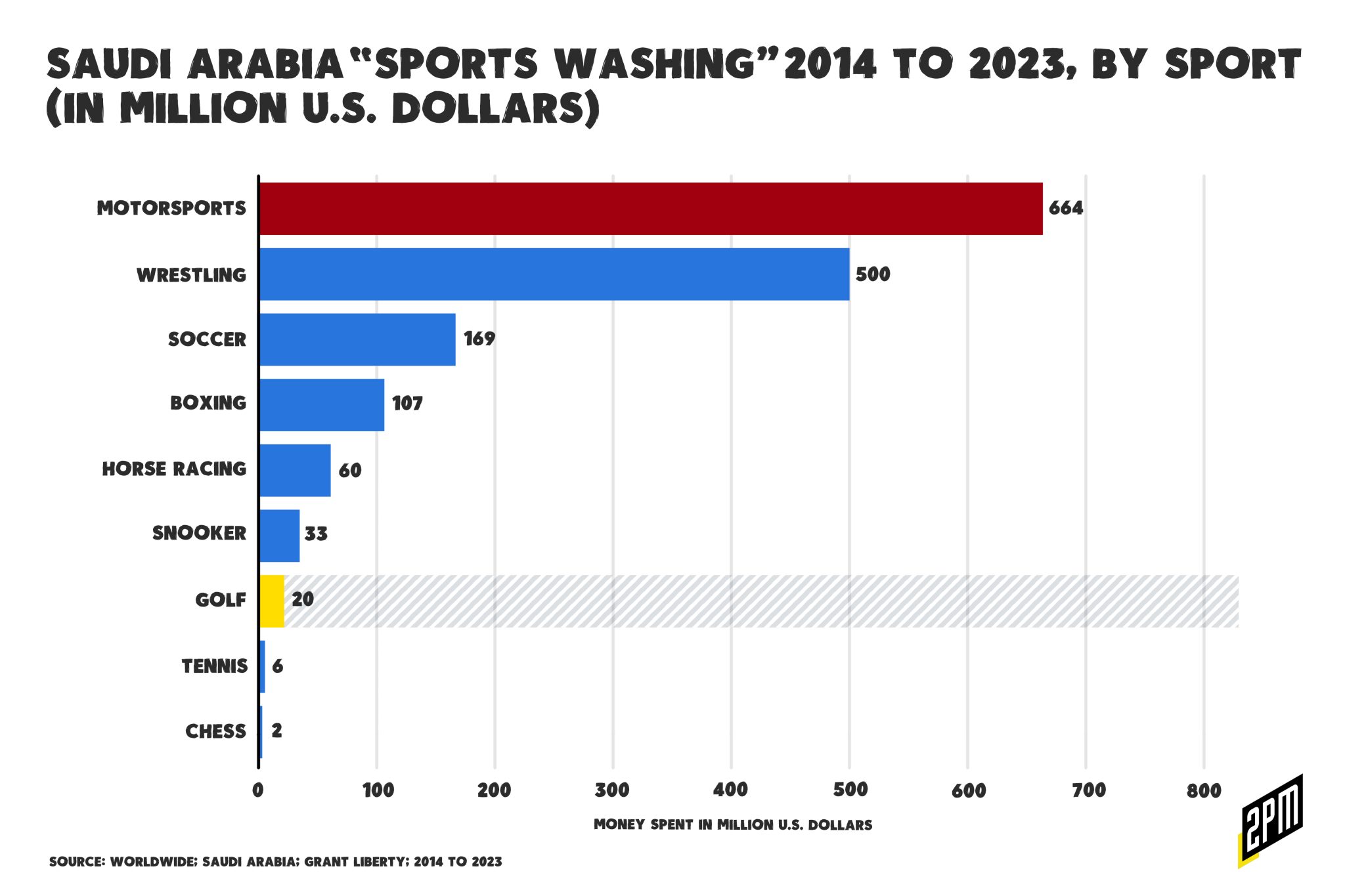
La ironía de mi comparación entre la F1 y el golf profesional es que Arabia Saudí ha gastado mucho más dinero en el principal circuito de carreras de la FIA que en el golf LIV. De hecho, en varios deportes se invirtió más que en el LIV. También es importante señalar que el LIV Golf cuenta con muchos golfistas que ya han pasado su mejor momento: Phil Mickelson, Sergio García, Bubba Watson, Ian Poulter e incluso el a menudo lesionado Brooks Koepka están de salida. Hay algunas excepciones, por supuesto: Dustin Johnson y Cam Smith estaban en la cima de su juego antes de marcharse en busca de dinero garantizado y una carga de trabajo menor. La PGA ha profundizado en su posición de que se basa en el rendimiento y es financieramente honrada, en contraste con su nuevo competidor.

La connotación del "dinero saudí" sólo funciona en el golf precisamente porque el orden jerárquico ha permanecido monolítico durante mucho tiempo (hasta que un golfista multiétnico de Stanford irrumpió en escena). Este mismo enfoque de culpabilidad por asociación no recibe mucha atención en otros ámbitos, especialmente en las inversiones en los mercados estadounidenses.

El fondo soberano de Arabia Saudí invirtió más de 7.000 millones de dólares en nuevas posiciones en valores estadounidenses como Amazon.com Inc., Alphabet Inc., BlackRock Inc. y JPMorgan Chase & Co. mientras los mercados se veían sacudidos por el temor a una recesión.

La diferencia entre estas inversiones mucho mayores en las queridas empresas estadounidenses y la llegada de LIV es que el golf siempre se basará en la cultura del club de campo de excluir a los forasteros. Los golfistas de LIV que han firmado son probablemente demasiado distantes para entender su propia relación con el consumidor medio. Vea el programa de Netflix y verá a profesionales envejecidos y perdedores volando en avión privado, visitando sus múltiples casas y apareciendo en los mejores campos de golf de Estados Unidos. Mientras tanto, a nosotros nos toca tomarnos en serio comentarios de Bubba Watson como este:

Mi hijo de 10 años estaba sentado en la cama conmigo, y estábamos viendo golf en la televisión, y él conocía a los Ases - todo el mundo conoce a los Ases, siguen ganando. Conocía a los Aces, conocía a los Stingers.

El gran atractivo de la PGA, el mismo que muchos consumidores comparten por la F1, es que un golfista de clase media de Pensacola puede abrirse camino desde la universidad, pasando por la Universidad de Georgia, hasta ganar dos veces el Masters. Ese triunfo es lo que alimenta la democratización del golf profesional. Los niños de orígenes similares quieren tener la misma historia que Bubba. LIV no alcanza ese prestigio. Trata de hacer que algunos de los hombres mejor conectados del planeta parezcan el hombre de todos los días. El circuito de la PGA le recuerda que requiere rendimiento para entrar en la conversación del modo en que lo hizo Watson en 2012 en el Augusta National.

Lo que hace posible esta revancha es la amplia gama de eventos del PGA Tour, que incluye grandes campeonatos como el Masters, el Abierto de Estados Unidos y el Campeonato de la PGA, así como otros numerosos torneos de alto nivel a lo largo del año. Estos eventos siguen atrayendo a muchos de los mejores golfistas, patrocinadores y la atención de los medios de comunicación del mundo. Estas plataformas, las paradas del circuito, brindan a los aficionados la oportunidad de ver competir entre sí a las mayores estrellas del deporte. A partir de ahora, es más difícil para los jugadores de la LIV competir en esos majors de alto perfil.

El PGA Tour también se beneficia de una infraestructura más estable y consolidada. El circuito tiene un sistema bien establecido para el desarrollo y la progresión de los jugadores, con varios niveles de circuitos y pruebas clasificatorias. Esto permite a los golfistas más prometedores abrirse camino hasta llegar al PGA Tour.

LIV Golf, por su parte, aún no ha establecido una vía clara para que los jugadores se ganen un puesto en su circuito. No está claro cómo gestionará la organización el desarrollo, la promoción o la comercialización de sus talentos. Esta falta de claridad podría disuadir a algunos golfistas prometedores de seguir una carrera en la organización LIV Golf.

El circuito cuenta con numerosos y apasionados seguidores que se interesan por el éxito de sus golfistas favoritos y sus historias. La PGA logra esto con su narración de historias. También tiene una sólida presencia en los medios de comunicación, con cobertura en las principales cadenas deportivas y una amplia estrategia en Internet y en las redes sociales. Aunque LIV Golf ha declarado que planea aprovechar la tecnología y las redes sociales para interactuar con los aficionados, está por ver si será capaz de repetir el éxito del PGA Tour en este sentido.

Mientras el golf atraviesa su momento de Fórmula 1, el PGA Tour se encuentra en una posición ventajosa. La clase y el prestigio del PGA Tour se asemejan a los de la F1. Entre bastidores, se sabe que los hombres que están detrás de los 20 coches del circuito son personas normales. Pero en cuanto la cámara les enfoca, se les ve con pompa y circunstancia. Como si comprendieran que el atractivo no es sólo la velocidad. Es también que un pobre británico mestizo pueda convertirse un día en caballero. Si Estados Unidos tuviera caballeros, el golf profesional sería uno de sus caminos hacia lo extraordinario.

De hecho, tenemos figuras caballerescas en el deporte. En Estados Unidos, las reconocemos cuando las vemos. Nos esforzamos por convertirnos en ellos y eso alimenta nuestra pasión por los deportes que practican: el PGA Tour es uno de esos caminos. Puede que sea lo más importante; y es la ventaja de marketing sobre LIV que el dinero no puede comprar

Esto es lo que está impulsando la democratización del golf y una nueva era de afición que hará un guiño a lo antiguo sin descartarlo de plano. A pesar de las deserciones, el PGA Tour -y los numerosos proyectos de nuevos medios, startups tecnológicas y personalidades de Instagram que lo apoyan- mantiene la primera posición sobre el rival respaldado por Arabia Saudí. El golf será diferente, pero no tanto como esperaba LIV Golf.

Por Web Smith | Editado por Hilary Milnes con arte de Alex Remy y Christina Williams

Informe para miembros: Etsy, Ebay y la publicidad exterior

Muy influidos por la evolución omnicanal, los medios de comunicación minoristas están entrando en su fase 2.0. Los nuevos participantes en el mercado están ganando fuerza y los minoristas están cambiando sus prioridades para arañar cuota a Meta y Google. Los nuevos participantes en el mercado están ganando fuerza y los minoristas están cambiando sus prioridades para arrebatar cuota a Meta y Google. La oportunidad de arbitraje para plataformas y marcas está pasando a su segunda o tercera velocidad, según a quién se pregunte. Yo he adoptado la siguiente postura:

Este informe está destinado exclusivamente a Miembros ejecutivos, para facilitarle la afiliación, puede hacer clic a continuación y acceder a cientos de informes, a nuestra lista DTC Power List y a otras herramientas que le ayudarán a tomar decisiones de alto nivel.

Únete aquí

Memo: Where NatSec Meets Commerce

Editor’s Note: this essay was re-published in Newsweek.

There’s one balloon that can’t and won’t be shot down; we are far too reliant on it.

In previous explainers and reports on first-party data, I mostly focused on its advertising benefits. It wasn’t until Amazon began acquisition talks with Roomba, the autonomous robot vacuum, that I began considering data collection for purposes beyond the narrow path of ethics. Here is a snippet from an August 2022 report – keep this in mind while I explain what I believe to be a consequential perspective on the intersection of online retail and national security.

Amazon doesn’t rely on many of the data collection practices prohibited by Apple’s privacy initiatives (ATT). This acquisition means more first-party data collection. […] Amazon now has a presence in the following categories: laptops, streaming television, in-home assistants, smart speakers, Door cameras, fitness monitors, and now vacuum cleaners. Collectively, Amazon knows more about its consumers than any other company on earth.

With the iRobot acquisition, Amazon knows more about its consumers demographics and psychographics. It knows the size of your home, its layout, the location of your home, and its surfaces. From there, Amazon can deduce median income, product preferences, and more.

By the measure explored in this report, Amazon (and Apple) know more about its consumers than any domestic corporation, but Americans tend to trust Amazon enough to avoid revolt and public demonstration. And by the measure explored here, China knows more about Americans than any sovereign nation, perhaps including our own.

First-party data is collected directly from users or customers, typically through their interactions with a company’s website, app, or other digital channels. This data can include information such as browsing behavior, search history, purchase history, and demographic information. First-party data is highly valuable to companies and its ownership because it is directly linked to their customers or users, allowing them to gain insights into their behavior, preferences, and needs.

The debate around the surveillance of Americans by way of a large balloon is a distraction from a more significant form of potential surveillance. We may be overlooking the growing advantage that many outside of the commerce industry have yet to fully grasp.

As of writing this report, four of the top six mobile apps available to iPhone users are owned by Chinese companies. Of them, Temu, Shein, and Bytedance-owned TikTok have developed eCommerce strategies that rival (or exceed) the vast majority of American companies in volume.

The average American lacks an understanding of China’s general strengths beyond manufacturing capacity and low costs. That would be a deep dive in and of itself. For the sake of brevity, this will focus on business-to-business trade and direct-to-consumer commerce. Chinese factories manufacture almost every major technical product that Americans seek. The Executive Branch of the U.S. Government is quite selective in the goods that it chooses to tariff. Originally levied by the Trump administration in March 2018, President Biden maintained the tariffs covering the near-trillion dollars in Chinese goods on the list. But many products without American equivalents were excluded.

While U.S. tariffs cover a long list of Chinese products, they left many popular products untouched. That made it possible for U.S. imports of items such as cellphones, laptops and video game consoles to surge during the pandemic.

For decades, Chinese raw materials and finished goods supplied American retailers. Today, thanks to an executive order, China’s direct-to-consumer business will one day rival B2B sales to American retailers. To understand the impact of that March 2018 decision, consider that direct-to-consumer companies were not only excluded from tariffs – they were actually incentivized to sell to Americans. There still exists an $800 exemption that allows DTC companies like Shein, Temu, Alibaba, and TikTok to ship here without taxation. Instituted in 2016, packages worth less than $800 have been able to enter duty-free. Since Shein and others ship most orders from Chinese warehouses, and since most orders fall under that cost threshold, those companies receive tax benefits.

This alone incentivizes Chinese companies to sell in America, but it doesn’t end there. Additionally, the Chinese Communist Party (CCP) waived export taxes on those same products. Much like TikTok is an altogether different app (with far greater restriction on content and usage time), Shein doesn’t sell goods inside of China. In effect, the CCP traded tax revenue for American market share. Shein has now been in the number one spot on the 2PM Power List for more than 50 weeks.

As China’s DTC businesses continue to maintain top positions in the app store and on power lists, expect U.S.’s trade deficit with China to grow.

But while deficit is a visible marker of retail imbalance, there are other key measures that can indicate dependency on Chinese products. Two short months after the report was written on Amazon’s acquisition of Roomba, this report on TikTok’s eCommerce job listing speculated on the potential power of a TikTok eCommerce operation.

The speed with which TikTok is able to make products sell out in stores and online has shown that it’s not a complete hurdle for customers. But linking commerce directly into its platform opens a new revenue stream for TikTok that’s all the more critical now that Apple has clamped down on third-party advertising data collection. Like Meta, TikTok has been reported to be using in-app browsers to collect key data points that are against to skirt around Apple’s recent iOS privacy practices, which have made it more difficult to target ads.

And just days after highlighting TikTok’s staffing up of eCommerce industrialists, I introduced Temu’s quick rise with this now-understated comparison to Shein and TikTok. While presumptuous at the time, the company’s Super Bowl 2023 ad catapulted it to number one in the app store. Here, I explained the new direct-to-consumer retail, one that I now understand to be buoyed by both China and America’s tax incentives:

Es la nueva venta directa al consumidor. El envío de los pedidos directamente desde sus fábricas de origen mantiene los precios bajos. Shein, el gigante chino de la moda ultrarrápida, ha tomado el mundo por asalto y sigue creciendo en magnitud, empequeñeciendo el recuento de SKU y el volumen de ventas de competidores como Zara, H&M y Boohoo. La ropa es barata, desechable y adictiva. Temu podría satisfacer un deseo similar de productos "baratos pero suficientemente buenos", sobre todo ahora que la histórica racha inflacionista de Estados Unidos sigue inclinando al alza los precios al consumo.

A similar business model is in the works at TikTok, which is currently hiring for eCommerce fulfillment and warehousing and logistics jobs in the US as part of a bigger commerce push. We wrote in October about why TikTok is uniquely positioned to actually bridge the gap between content and commerce when so many apps – even Instagram – have failed to make it stick.

At the core of China’s commerce industry is its focus on the value of the data it collects. In short, China has been vigilant about the collection of first party data far longer than America. The South China Morning Post, an English-first publication that is part-owned by the Alibaba Group, began emphasizing first-party data collection in 2019:

Six months ago, South China Morning Post decided to cut itself off from third-party data and switch to a first-party data platform. […] The first-party data platform will allow South China Morning Post to achieve the next phase of growth. On the editorial side, that means turning its vast scale into a loyal readership. On the commercial side, that means giving advertisers more precise targeting capabilities.

It’s been reported that as recently as March 2021, the Chinese government pressured Alibaba to sell SCMP. That sale would place the media property under the influence of the state; it is unclear if that pressure has continued. Two years into China’s emphasis on first-party data collection and it was still weeks before it was reported, in America, that iOS 14.5 would take on Facebook and Google tracking in April 2021. We began our report on the implications with: “Apple’s intentions appear straightforward at first glance. The company wanted to improve the privacy of its end users. This virtuous effort came with a few additional outcomes. By upgrading its privacy practices, Apple will impair large ad networks that have grown with the help of those end users.” Prior to this now-infamous software update, most advertisers relied on third-party data to reach new customers.

According to Google Trends: December 2021 was the inflection point of interest in America’s commerce industry. First-party data was a niche marketing term until then. It was a phrase used by a select few advertising industrialists to denote a shifting model in collecting consumer data. Ever since, it’s been all the talk for American retailers. It just so happens that the easiest way to collect first-party data, in an efficient and cost-effective manner, is to sell cheap goods. China has mastered this. Forbes asks, is Temu the next Shein?

This isn’t the first time a China-backed start-up has disrupted America’s e-commerce world with cheap items. Online fast fashion outlet Shein got a big break during the pandemic as its competitors were hampered by bricks-and-mortar stores which were forced to shut up shop. Buoyed by backing on TikTok, downloads of the Shein’s app surged to 193 million in 2021, up from 67 million in 2019.

How sensitive is China’s ability to collect consumer data to the U.S. government? In 2021, President Biden signed the Secure Equipment Act, preventing the FCC from authorizing “radio frequency devices” that may pose a national security risk. And the Biden-era FCC expelled China Telecom Americas, noting: “Washington is continuing investigations into Chinese technology that began during the previous administration.” According to the Brookings Institute:

The law’s effect is to prevent U.S. technology platforms from being forced to interoperate with or transfer data to suppliers like Huawei or ZTE that may have ties to the Chinese government.

But in the matter of cheap, direct-to-consumer shopping of the cross-border flavor – there is not a concern at all by most (read: all) American policymakers.

What’s Next For China and First-Party Data

The importance of first-party data in China’s tech economy cannot be overstated; it’s impossible to separate that economy from its political allegiances. That being said, with its fast-growing retail infrastructure, China has become a global leader in DTC exports.

First-party data has become a critical component of China’s economy. For example, in the eCommerce sector, companies like Temu, Shein, TikTok, Alibaba and JD.com use first-party data to improve their search algorithms. By analyzing data on customer behavior and preferences, these groups can understand consumers and their larger communities.

Beyond eCommerce, first-party data is also playing a critical role in China’s digital finance industry. Companies like Ant Group, which operates the popular Alipay platform, use first-party data to assess the creditworthiness of borrowers, enabling them to offer loans and other financial services to individuals and small businesses that might not have access to traditional banking channels. By analyzing data on spending patterns, bill payments, and other factors, Ant Group can make more accurate assessments of credit risk and offer more targeted financial products.

The use of first-party data in China’s tech economy has also raised concerns about privacy and data security. With the massive amounts of data being generated and collected by Chinese tech companies, there is a risk that this data could be misused or abused. There have been reports of companies using data to discriminate against certain users or to manipulate consumer behavior. There have also been concerns about the close relationship between some Chinese tech companies and the government, raising questions about whether user data could be used for surveillance or other purposes. Consider GTCOM, a big-data and artificial intelligence company controlled by the China’s “Central Propaganda Department.” A 2020 report by MIT’s Technology Review on how “China Surveills the World” sheds light on GTCOM’s scope:

One of their products claims to collect 10 terabytes of data a day, or two to three petabytes per year, from web pages, forums, Twitter, Facebook, WeChat, and other sources. In terms of size, that’s the equivalent of 20 billion Facebook photos. The company describes its work as contributing directly to China’s national security, including military intelligence and propaganda. GTCOM’s research and development arm has developed algorithms that look for military keywords in the information it collects, which could for instance come from CVs or patents.

TikTok is widely considered one of the most successful apps in history. Shein was the number one shopping app in the app store, only to be unseated by Temu. And Alibaba’s GMV far exceeds Amazon’s. They all share algorithm-driven eCommerce as a core competency. A recent article by Australia’s Power Retail explains:

This trust in the algorithm, and the ability to complete tasks without leaving the app, makes it an ideal platform for in-app ecommerce sales. Currently, when people tap on TikTok ads or links, the app defaults to a TikTok-made in-app browser. This new shop tab however will offer broader opportunities for the platform to keep more of its operations in-house and directly deliver product listings to customer feeds.

TikTok is fueled by first-party data and algorithms that “read your mind,” according to the New York Times deep dive on the subject. That same report noted that “concern about Chinese consumer technology is bipartisan.” The Trump administration asserted that TikTok’s “data collection threatens to allow the Chinese Communist Party access to Americans’ personal and proprietary information,” and that its government of origin could “build dossiers of personal information for blackmail, and conduct corporate espionage.” This ban was widely unpopular with Americans; it stalled in Congress.

Based on the above, there’s reason to believe that no country knows more about the United States of America than China. And a pandemic-era tax incentive accelerated this data collection.

A CNN article published in February 2023 explained: “US can’t keep up with China’s warship building, Navy Secretary says.” There is simply little to no overlap between the officials who make such assertions and commerce industrialists who observe their reasons to raise alarm. Art of War is an ancient Chinese treatise consumed by many Americans, from prizefighters to athletes and military leaders. But many more who’ve never read the book can identify one of its most popular proverbs: “If you know the enemy and know yourself, you need not fear the result of a hundred battles.” Art of War is authorized to be kept in every Army unit; it is also listed on the Marine Corps Professional Reading Program. It’s considered instructional material at The United States Military Academy at West Point.

There is not a more capable first-party data collection and mining system in the known world. If U.S. government officials are raising alarms about surveillance balloons or tools required for battle (warships and the like), we should also begin to understand the depth of knowledge known of its assumed opposition. That’s if the 5th Century BC book, attributed to the ancient Chinese general Sun Tsu, is as credible to them as precedent suggests.

By Web Smith | Editor: Hilary Milnes | Art: Christina Williams and Alex Remy