No. 346: Netflix’s Boom Explained

Screen Shot 2020-02-10 at 1.10.24 AM

To understand the explosion of the streaming media industry, look at in the context of digital-native brands. To understand the limitations of today’s digital-natives, look at it in the context of streaming media’s growth from fringe idea to Hollywood stalwart.

In 1999, Blockbuster Video was twelve years old with 9,000 stores. Just five years prior, Viacom acquired the company for $8.4 billion dollars. At the time, Netflix was the one-year-old challenger brand. Between the two, we saw the first of its kind. A dynamic between old vs. new and traditional vs. challenger that we would see play out over the next decades between traditional and direct brands.

Timing is everything when an incumbent challenges the titans. On an early January morning in Columbus, Ohio, the former-CFO of Enron Corporation stood before a group of nearly 60 of the city’s entrepreneurs. He narrated the infamous company’s successes, failures, and hidden truths. The Entrepreneur’s Organization commonly hosts keynote speakers but this session was different. We all knew his story. And Andy Fastow was frank in his narration of, he was deeply contrite and his messages illuminated the history in ways that a news broadcast wouldn’t allow – now or then. He walked the audience through the step by step of a company that was unstoppable until it was; he was even more candid in his personal shortcomings. But what you may not have known? Enron played a small role in determining the outcome of today’s streaming wars.

In 2000, Blockbuster Video declined to acquire Netflix for $50 million. Rather, it chose to compete. In doing so, the company agreed to a 20-year deal with that same Enron Corporation to deliver video on demand (VOD) though Enron’s fledgling broadband services division. With this agreement in tact, Blockbuster chose to delay the pivot from bricks and mortar to direct-to-consumer. This was a decision that the company would almost immediately regret.

The Blockbuster executives, who never liked the VOD concept themselves, used the lack of content as their excuse to abandon the partnership with EBS in 2001, saying that they wanted to stay focused on Blockbuster’s bricks-and-mortar stores rather than pursue an online business model. [1]

The difference between success or failure in a category comes down to three variables: (1) timing (2) technology (3) adoption rates. More, in a moment, on the third and final variable. Blockbuster’s timing couldn’t have been worse: Netflix’s DVD business model was catching on and Enron’s team would soon make a decision that would crater an entire company in epic fashion. It was a company that Blockbuster depended on, even if they weren’t in a hurry to do so. It was the typical case of an innovator’s dilemma.

When Enron crashed, Blockbuster’s hopes crashed with it. Their VOD technology was capable but their managers chose not to deploy it, eschewing long-term innovation for short-term profits.  Blockbuster was the first-mover in an industry that we didn’t even know we would need. But the company did not want to expand on that early advantage. By the time that Blockbuster’s c-suite identified the need to compete in the VOD (video-on-demand) industry, it was too late. The technologists of the company wanted to pursue a direct strategy, its managers wanted to maintain the company’s emphasis on physical retail.

The DTC Brand Parallel

The direct-to-consumer moniker has been called into question. You’ll find it used in digital media positioning and in retail branding, alike. But what does it mean to be a DTC brand anyway? One private equity investor called the previous month’s retail news “the trinity of doom” for a cohort of DTCs. You know many of them by name. A number of these brands are coveted portfolio companies held by the brightest consumer venture capital firms in Los Angeles, San Francisco, and New York.
SF3D8Zrw
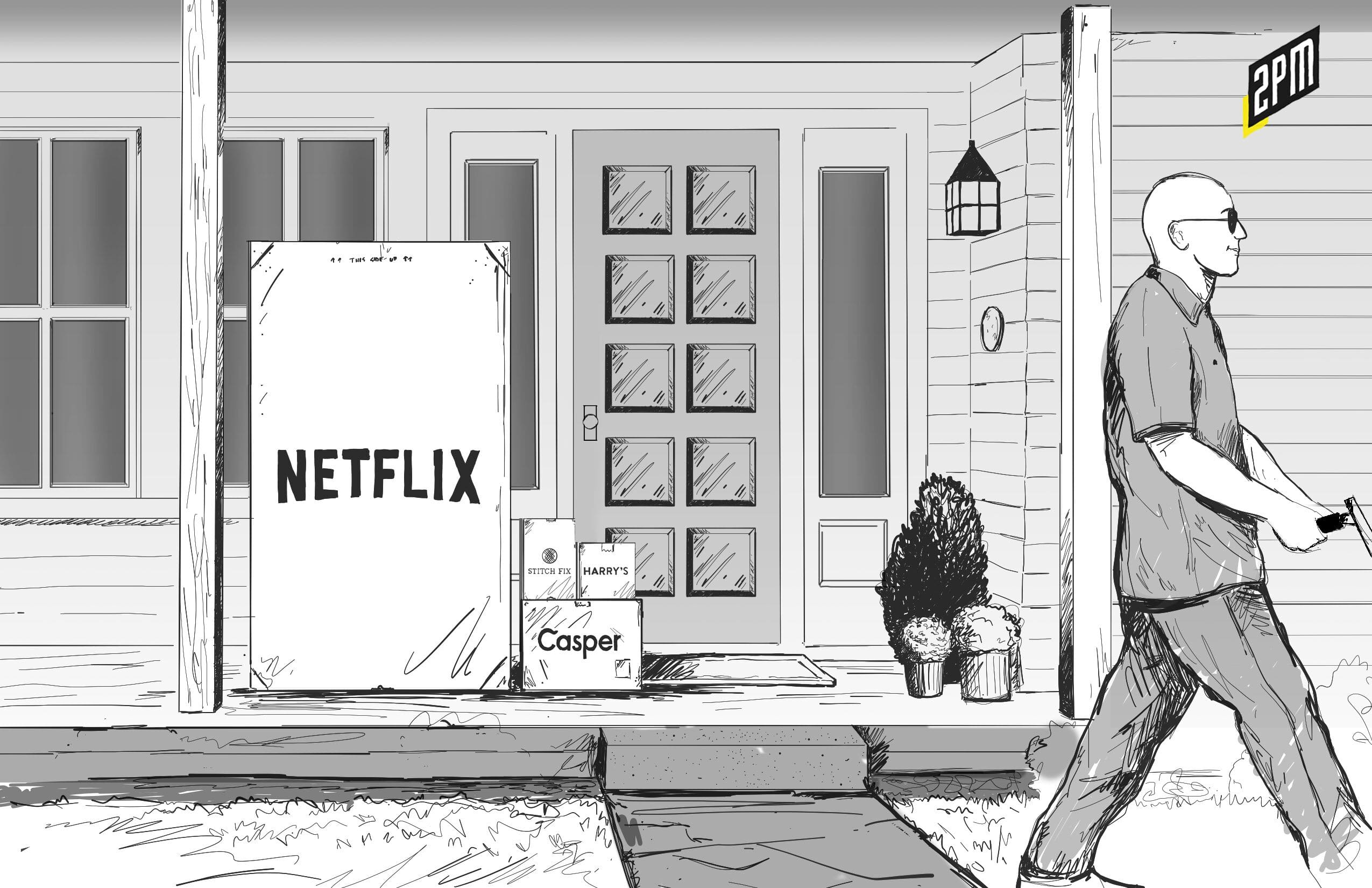
The boxes tell the story: “Ar” for Netflix: .73 / “Ar” for DTC retailer: .12

Venture firms like Forerunner, Lightspeed, Lerer Hippeau, or agency / venture hybrids like Bullish or Science Inc. have investment theses built on the internet as a primary acquisition tool for these modern brands. But in response to the Bain Capital investor who cited the trinity of doom, the veteran venture capitalist replied: “Harry’s is not a DTC brand. Casper is not a DTC brand.” More on this in a moment.

The conversation between Bain Capital’s Magdalena Kala and Bullish’s Mike Duda caught my attention because it illustrated a growing disconnect in the private market. Private equity is the traditional means of scaling a retail brand that one-day could enter public market. Rightfully, Kala sees things her way. It contends with the current state of the industry. Venture capital is about twelve years into democratization of eCommerce retail, a process that has seen more failure than success. Even so, Mike Duda is as gifted as it gets when it comes to picking early winners. In 2007, dozens of digitally-native brands existed. Today, that number has swelled into the thousands. With the accelerating democratization of DTC, both consumer P/E and venture financing roles have grown in complexity.

The first quarter of 2020 was consequential for the DTC industry. Walmart announced that it would no longer acquire brands, incubating them instead. Casper repriced its initial public offering. The stock is trading at just a third of the value that the retailer maintained just a few months prior. And Edgewell Personal Care abandoned the acquisition of Harry’s after it was thwarted by the Federal Trade Commission.   

As was the case in the early competition between Blockbuster Video and Netflix, timing was a factor – Blockbuster was doomed regardless. Here is a super simple visualization of what I see.

(T * Tr) / (Ar)

T represents timing of the product’s development. If the timing is correct, place a “1” at variable T.  Tr represents the technological capabilities of the product. If the technology is good enough, place a “1” at variable Tr. The third and most important variable is adoption (Ar). I wonder if we could say the same about today’s market for DTC exits? Objectively, the percentage of success has been dismal at best.

Emerging industries rely on the adoption rates of key technologies and or behaviors. In Netflix’s case, the higher the adoption of streaming technologies, the easier it becomes to market their services. In this context, around 60% of Americans consume Netflix programming, according to Statista data. The adoption figure (Ar) would be .73 [5]. As adoption climbs, the figure is closer to “1.” The three key variables for emerging technology: timing, technology, and adoption rates for key technology.

Nearly every DTC narrative will be influenced by these three variables: technology (T), timing (Tr), and adoption rate (Ar). Blockbuster’s management would have devoted an enormous amount of energy and resources to influence T and Tr without the Ar to make good on its investment. Streaming, in 2001, was an innovation that the market wasn’t yet ready for. In fact, it would be another six years before Netflix pivoted away from DVD and towards video-on-demand (VOD).

The introduction of streaming was truly radical for that time. Netflix’s pivot to streaming wasn’t all that radical—as we’ll see, it was actually a logical extension of what the company had already been doing. The fact that Netflix was willing to essentially bet the entire company on streaming, however, definitely was radical. [2]

Consumer demand for streaming video was practically non-existent in 2001. Even in 2007, streaming technologies were sub-par. Consumer broadband connections lacked capacity to handle high-resolution video. Even worse, when Netflix went live with VOD, it could only work on computers that were running Windows with an Internet Explorer applet to download before the application would work. Twenty years later and the Ar reflects an ecosystem that is dependent on streaming as a primary source of entertainment.

Jeff Bezos, Netflix, and The 2020 Oscars

Web Smith on Twitter

Netflix outranks ALL studios in 2020 Oscar nominations.

In the first 30 minutes of the 2020 Academy Awards broadcast, Netflix’s programming, Amazon’s technology, and Amazon’s polarizing founder stole the show. Between Netflix’s record number of nominations or the comedic barbs pointed in Bezos’ direction, viewers were reminded that two technology companies maintain a stake in Hollywood’s future. Netflix earned 24 nominations while Amazon earned one. However, Netflix exists on Amazon Web Services, a fact that anoints Bezos the benefactor of Netflix’s seamless growth and the beneficiary of its Hollywood promise.

With the help of AWS and an unparalleled marketing flywheel, Netflix began and remained a pure DTC product and their marketing has become an efficient funnel that reflects this acquisition structure. Hilary Milnes writes:

After leading the Academy Award nominations, Netflix took home two prizes last night at the Oscars: One for Best Supporting Actress, which went to Laura Dern in Marriage Story, a Netflix movie; the other went to American Factory for best documentary. Other entrants, including The Irishman and The Two Popes, were snubbed. [3]

The Oscar telecast was uncomfortable for Netflix, in this sense. The Irishman earned ten nominations and won zero, leading many Hollywood insiders to suggest that Netflix should go the way of DTC brand retailers, eschewing the direct model for the proverbial omni-retail blend. As one Academy member explains, Netflix should leave their DTC model behind:

If Netflix walks into cinema chain offices with a barrel of cash and, say, a 30-40 day window, that might be a game changer. Financially it would behoove them to give away most or all of its box office receipts on one or two movies a year in exchange for a distribution release that doesn’t rely on music halls and sub-basement art houses for its theatrical run, which might in turn result in a date with the Oscar podium every February. [4]

This would be a grave error. While winning awards is always the preference, I’m not entirely sure that it should be Netflix’s KPI. Awareness and mentions are the key performance indicators; in this way, award nominations and traditional hype cycles may suffice. This allows Netflix to continue growing without spend attrition: advertising for an outcome that may not affect bottom line sales. A theater distribution model increases spend attrition, lowering the LTV of Netflix consumers by allowing viewership without membership tie-in.

There is only one way that viewers can consume Netflix content. Any organic mention of its programming operates as a super-charged sales funnel. The award show appearances have and will continue to grow Netflix users while solidifying the platform as a venue for original, Hollywood-caliber content.

This strategy also allows the media company to continue its unparalleled data collection practice, perhaps the one true advantage of a pure, DTC strategy. Similarly, Harry’s and Casper initially set out to build direct-to-consumer companies but eventually yielded to traditional distribution as customer acquisition costs rose and growth became less efficient. One could argue that the market wasn’t yet ready for direct brands. While the two sub-categories have similar delivery mechanisms, the Ar was drastically different: .73 vs .12.

Netflix, Amazon, and the cadre of streaming services have a future in critically-acclaimed film production; the market is accelerating in that direction. In 2023, Statista projects that Netflix will have 177 million viewers in America. In contrast, cable channels like ESPN have lost nearly 20% of subscriptions in the previous five years. This trend plays in streaming industry’s favor.

Meanwhile, analysts like Matthew Ball suggest that theaters have their own concerns to consider. Frankly, film-goers are showing up for fewer Oscar-quality performances. The box office is growing thanks to “theme park movies.” Ticket sales are falling, however.

The challenge is more fundamental: The role of the movie theater has changed. What used to be a forum for all types of art is now largely the domain of “theme park movies”—Avengers: Endgame or Star Wars: The Rise of Skywalker—and “museum pieces,” such as 1917 or Get Out. And audiences have ruthlessly high thresholds for both. [5]

In 2020, Netflix led all studios in Academy Award nominations and yet, the platform has yet to realize its “Hollywood Boom.” It merely hasn’t happened yet. As the economics continue to shift in Netflix and Amazon’s favor, there could be a future that requires Netflix economics for critically-acclaimed works. Ar is moving closer and closer to “1.”

And this is the difference between Netflix’s fortunes and that of today’s direct retail brands. Whereas as 60% of America streams Netflix content, only 12% of retail is transacted through eCommerce. Technological adoption rates are critical. Consider if the foot traffic of American malls, at mall retail’s peak. Now imagine that horse and carriage was America’s primary means of family travel, at that time. Or imagine the lacking network effects of Twitter, Facebook, or Snapchat in an America that chose to stick with the tech stack of the Motorola Razr. Or remember that General Magic was well-ahead of its time, inventing touch screen dynamics before processors allowed for their prowess.

Consider this excerpt from the FTC’s comments on the now-thwarted Harry’s acquisition:

Any new entrant would lack Harry’s early-mover advantage in the now-mature DTC space and on the now-crowded shelves of brick-and-mortar retailers.

As Mike Duda mentioned, DTC is a misnomer for most physical goods. Harry’s early-mover advantage wasn’t much of an advantage at all. Neither was Casper’s. Like many of their venture-backed peers, both companies set aside their DTC strategies for costly omni-channel growth. Imagine if the United States was at a point where, like China, eCommerce was closer to 40% (Ar = .4) of all retail volume. Harry’s wouldn’t have needed shelves of brick-and-mortar retailers at all. And it’s likely that the FTC would have permitted the acquisition to move forward. The competitive pricing effect of Harry’s moving into physical retail was the primary citation against the brand.

In this way, Netflix’s current success is somewhat of a glimpse into the future of brand retail. Reed Hastings’ instincts were special; he evolved his technical specifications for a market that was awaiting the Netflix that we know today. Timing is everything when challenging the titans. The direct-to-consumer strategy works. As history suggests, the adoption rate of consumer technology is a greater influence than we give it credit. Study those figures and you may understand the future of an industry.

The shift from physical-to-digital commerce is evident within the streaming media industry. Actresses are thanking Netflix in acceptance speeches and Jeff Bezos is laughing at divorce jokes in an A-list audience of awards shows. By comparison: thousands of direct brands are competing over what amounts to just 12% of all retail volume. In this way, DTC brand retail is closer to the Blockbuster Video phase than the Netflix era that succeeded it. The writing is on the wall in yellow and blue.

Report by Web Smith | Art: Andrew Haynes | About 2PM
No. 345: The Arming Of The Rebels

t8M3qais

Joann King Herring sat across the living room, lively and engaging as ever. I was standing in her world. As a 16-year-old junior at Houston’s Jesuit Preparatory School, I was a lower middle-class outsider thrust into a world that I couldn’t fully grasp at the time. The geopolitical concerns of the 1980s were long past (or so we all believed at the time). But the 70-year-old socialite and philanthropist still carried herself as though she influenced foreign policy, and in the home of a mutual friend in Houston’s famed River Oaks area, Herring still held court. In a small corner of a major city, she was a titan that influenced outcomes a world over.

It was 1999 and, perhaps, the first time that I heard the phrase “arm the rebels.” Herring was a friend to a Texas Congressman named Charlie Wilson and four years after that meeting, their story, Charlie Wilson’s War, would be on the New York Times‘ best seller list [1] before getting turned into a major Hollywood motion picture in 2007. It was a tale about short-term success and long-term failure. It was about doing too little and doing too much. The film covered two American figures who lobbied the US government to fund a resistance against the then-USSR’s occupying forces in Afghanistan.

Now 90 years old, Joann and her friend Charlie armed the rebels over a 10-year event known as Operation Cyclone [2]. As the conflict came to a close, an official of one of the war’s affected countries would later tell the sitting US President, “You are creating a Frankenstein.” There is always an

But Herring and Wilson’s efforts worked over the short term. They armed the rebels and those rebels won. Whether or not the fruits of their labor had a net-positive or net-negative effect on global war and peace will be left to national security experts. The relevancy of this anecdote being used is simple: the act of “arming the rebels” maintained three components over that ten-year span from 1979 to 1989: (1) tools, (2) money, and (3) psychological support.

The rebels defeated a heavily-armed Russian military machine with American tools, American money, and the promise that they had the full support of the American government. This communicated to the opposing military that the money, the tools, and the rebellion would continue. The unbeatable army was beaten by endless supply, force, and psychological warfare.

Shopify and The Arming of The Rebels

Harley Finkelstein on Twitter: “Arming the rebels @Shopify-style, a 3 step guide:1. Create a network of fulfillment centers across America 🕸️2. Allow small businesses to leverage these centers 📦3. Add in robots 🤖Result: Affordable products shipped on a two day cycle to 99% of America. 💪 pic.twitter.com/a6KIptqsbm / Twitter”

Arming the rebels @Shopify-style, a 3 step guide:1. Create a network of fulfillment centers across America 🕸️2. Allow small businesses to leverage these centers 📦3. Add in robots 🤖Result: Affordable products shipped on a two day cycle to 99% of America. 💪 pic.twitter.com/a6KIptqsbm

Shopify has done a tremendous job executing on their corporate rallying cry: We arm the rebels. Having passed Ebay to become the second-largest eCommerce ecosystem in North America, Shopify has maintained that Amazon is next – an unbeatable army in its own right. Once known solely for its role in small cap eCommerce, Shopify now services financial processing, loans, fulfillment, hardware, and an ecosystem of developers at the beck and call of merchants who can afford their services.

Shopify exists to basically arm the rebels. We want a lot of people to go out and compete against Amazon.

Tobi Lütke, founder and CEO

But what happens when you execute on two components – the tools and the money – without the psychological support? The phrase “arming the rebels”, coined by Ruby on Rails creator David Hansson in reference to Shopify’s role in a densifying eCommerce landscape [3], has a hopeful ring to it. It implies that Shopify is punching upwards (it is). But Shopify will also need to punch downwards to maintain its position.

Shopify has investors excited because it is increasingly seen as the most likely challenger to Amazon’s ecommerce dominance. While many retailers, both traditional and online, have tried to tackle Amazon’s “everything store” head-on, Shopify has succeeded by arming individual merchants with the same technology and capabilities, but with more control. [4]

Shopify’s merchants have nearly every resource at their disposal except for one. The company is slow to champion the very brands that use their platform. Out of fear of coming off as partial, Shopify has thus far hesitated to provide the one advantage that could lock brands into their ecosystem for the long term. Yes, one of three components necessary to arm the rebels: psychological support.

The Big Game Ad That Wasn’t

Screen Shot 2020-02-02 at 10.07.59 PM

I waited, fruitlessly, for Shopify’s Super Bowl advertisement. I wanted the brand to discuss – in front of the biggest audience – its evolution over time: the agencies that its ecosystem has fostered, its move into financial technologies, the DTC Era that Shopify’s invention pioneered, and the robots that will eventually fill its 3PLs.

Shopify has armed the rebels by supplying some of them with the funds necessary to operate or expand. Now, it needs to influence the demand curve for the businesses on its platforms. Shopify needs to become an evangelist for its brands.

The phrase “arming the rebels” has a hopeful ring to it. It implies that Shopify is punching upwards (it is) but will also need to punch downwards to maintain its position.

When Squarespace’s Super Bowl ad premiered, it was enough of a threat to Shopify’s market position that the company’s corporate Twitter addressed their smaller competitor in a sequence of tweets that felt somewhat out of character. Shopify is currently trading at a $54 billion market cap; Squarespace remains orders of magnitude smaller, and private.

Shopify on Twitter: “Hey, @SquareSpace we believe in supporting independent businesses too! In fact, there are over 40 businesses in #WinonaMN that are on @Shopify. So we’re going to promote as many of them as possible during the #BigGame. #WelcometoWinona #SupportingIndependents pic.twitter.com/CPq8Ld6Pgl / Twitter”

Hey, @SquareSpace we believe in supporting independent businesses too! In fact, there are over 40 businesses in #WinonaMN that are on @Shopify. So we’re going to promote as many of them as possible during the #BigGame. #WelcometoWinona #SupportingIndependents pic.twitter.com/CPq8Ld6Pgl

Given the market position that Shopify has earned, it’s become clear that Lütke’s position on psychological support must change and it should have begun with Super Bowl LIV. Shopify’s promotional power could reduce insurgent competition while closing the gap with the incumbent company that it is challenging: Amazon. Shopify must evolve into its own marketplace. As customer acquisition costs rise for small-to-middle market retailers, Amazon has become a reasonable partner for retailers looking to increase top-of-funnel awareness. From 2PM‘s A Familiar Strategy:

Amazon is harvesting consumer data to become an efficient vertical reseller. The Amazon products will continue to have the preferred place on product pages. In this way, opposing marketers’ frustrations are founded. It may be true that external brands will continue to be penalized for competing against Amazon’s private labels. The Seattle eCommerce giant seems to be preparing for a day when their data harvesting practices – a process that has spawned countless private labels – will be called into question.

Lütke’s likely opposition to this idea is clear: By selecting brands or products to feature in a marketplace format, Shopify becomes a kingmaker of sorts. A kingmaker is a person or organization with great influence on the value of a candidate. This person or organization uses policy, finance, and competitive forces to influence succession. I contend that offering loans or advancements to merchants is another form of kingmaking. Now that Shopify has begun to market financial products, there is less of an argument to be made. 

Shopify’s moat has been discussed at length: Community and the partnership ecosystem are two buzz phrases that come to mind. But the Ottawa-based SaaS company has drawn the line at promoting the businesses that support the ecosystem; the company rarely pushes traffic and media attention to the companies growing within the ecosystem.

One of the three key resources for Operation Cyclone was psychological support. In the context of Shopify’s use of the phrase, the third resource is missing. If Shopify is comfortable defending its position against Squarespace by promoting independent retailers on Twitter, their management team should also feel comfortable supporting its own marketplace.

In December 2019, Shopify.com saw nearly 47 million visitors with over 40% of the traffic coming from the United States. While official numbers have yet to be reported, the Super Bowl was viewed by over 150 million people. Situated in this audience were potential consumers who may want to start their own company, developers who may want to build for Shopify, and consumers who may want to buy from Shopify.

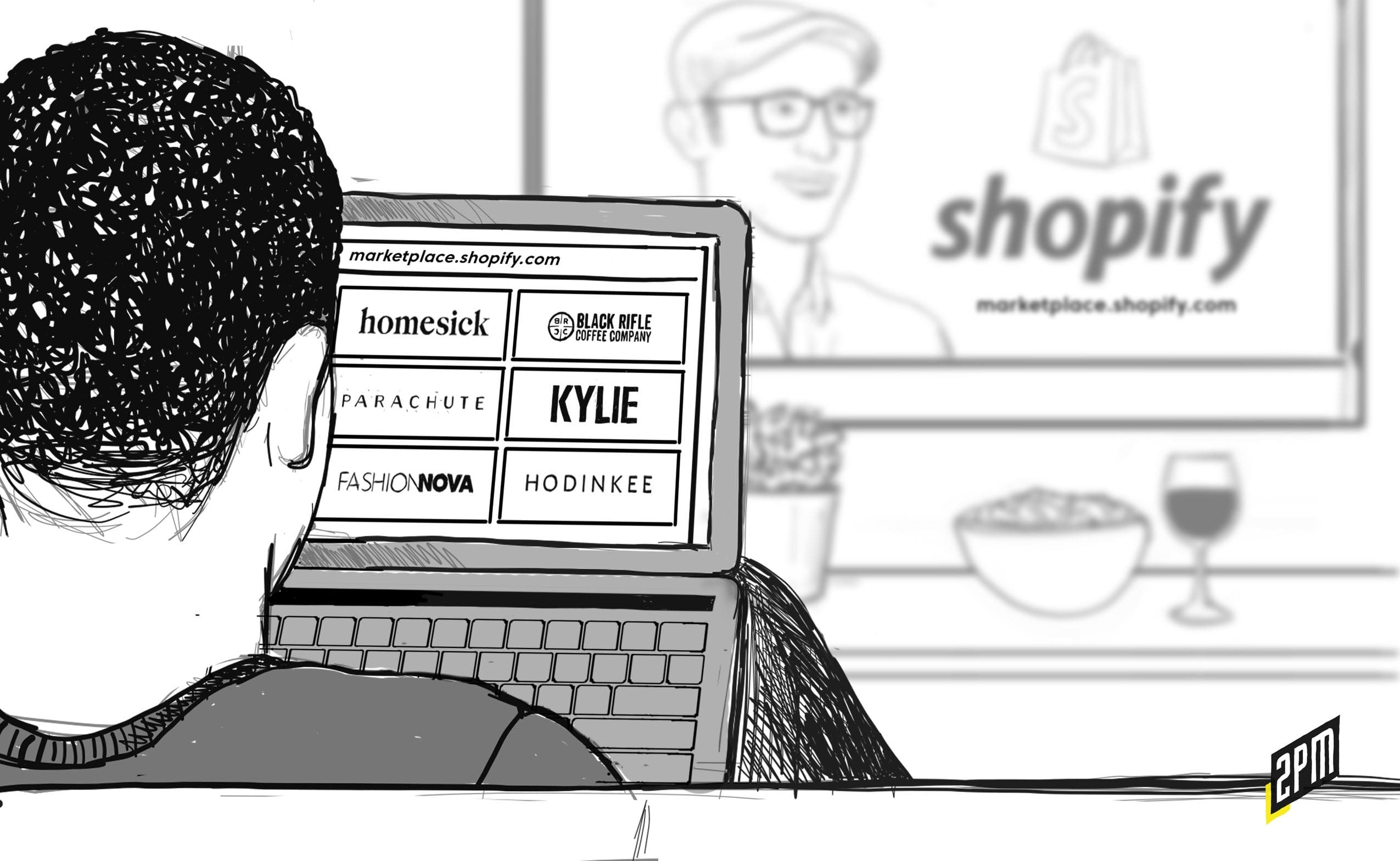
Amazon, Google, Microsoft, Walmart, Hulu, Quibi, Verizon, and Squarespace shelled out fees to advertise during the big game. However – direct-to-consumer brands were noticeably absent, priced out by the exorbitant costs of doing business. Imagine a $5.7 million, 30-second advertisement that sent tens of millions of Americans to marketplace.shopify.com. When those potential customers, developers, and consumers arrive: they’d see a curation of Shopify’s greatest brands – new and old, established and fresh. Shopify wouldn’t have only gained new customers or partnership prospects. Shopify would have influenced the awareness, growth, and viability for a number of brands that are dependent on three key resources.

In a June 2013 report by the Foreign Press [5], Edward Luttwak lists the five rules for arming the rebels: (1) Figure out who your friends are (2) Be prepared to do all of the work (3) Don’t give away anything that you wouldn’t want back (4) Do not invite an equal and opposite reaction by a larger power and (5) Lay groundwork for the endgame. For Shopify, that endgame involves an emphasis on demand-side economics. For the companies that rely on Shopify’s increasing suite of tools, they must thrive to remain B2B users.

By the end of that evening in Houston in 1999, I conjured up the courage to ask Herring a question or two. I was wearing my nice blue blazer, that night, so I had more confidence than usual. We learned about Operation Cyclone from an alum of the school in one of our courses but it wasn’t yet a widely known story. So on that night, I felt privileged to speak with her before her answers would be honed by Madison Avenue public relations spinmasters. I asked Ms. Herring the type of simple question that a 16-year-old student would: “What did you learn from it all?” She replied with something to the effect of, “We should have given them more and faster. It all dragged on too long. We could have done 10 years’ work in three or four.”

When you arm the rebels, do whatever you can to make sure that they win. They’re fighting for their supplier as much as they’re fighting for their own well-being. After all, their war is now your war.

Read the No. 345 edition here.

Report by Web Smith, Edited by Hilary Milnes | About 2PM 

No. 344: IPO and The “Frontier Thesis”

2PM-Frontier-Democracy

By air and by sea, thousands of would-be gold miners traveled to California in pursuit of wealth. They’d come to be known as 49ers. In March of 1848, 800 non-natives made the trip to California. By the end of 1848, that number ballooned to 20,000. And by 1849, that number reached 100,000. The gold rush was one of America’s earliest examples of the frontier thesis. Historian Frederick Jackson Turner penned an essay in 1893 that explained that the economic strength and vitality of America was tied to moving towards the frontier.

I define ‘frontier’ as the social levelling associated with large numbers of people comprising a broad spectrum of skills, educational levels and class backgrounds, working alongside each other at rough parity in open access, high potential gold mining. [1]

That frontier line, a demarcation that separated the known from the unknown, spurred innovations in: commerce, behavioral economics, government, and social sciences. Of course, there is no longer any physical frontier. Today, that line is figurative. With any new industry, these behaviors repeat in seen and unforeseen ways. Direct-to-consumer brands have begun to reach venture-backed maturity. Like the physical frontier of old, this new line of demarcation bears many of the same traits — uncertainty is one of them.

During the gold rush, it wasn’t the miners that made the real money. It was the toolmakers, the workers that manufactured the implements necessary for the droves of miners to strike it rich.  We remember Levi Strauss & Co but few rarely can recall top gold miners of the time. The toolmakers made riches; the vast majority of the miners went home empty handed. Not even their tools made the trip. As the adage goes: you can mine for gold or you can sell the pickaxes. Like the commerce tools themselves, venture capital eventually flooded brand retail. This not only affected who could scale, but also it affected how companies were scaled.

The problem with all of the tech-enabled customer channels, though, is that they are available to everyone. Indeed, the flipside of tech concentration when it comes to platforms and Aggregators is the democratization and commoditization of basically everyone else in the stack. That is how you end up with, as of August 2019, 175 different online mattress companies. [2]

Seated to my right on a flight from Ohio to Minnesota was a salesman whom we’ll call Dave. “Do you want to start a mattress company?” he utters through a smirk and a light smile. After his third whiskey he opens a laptop to reveal a spreadsheet with nearly 100 rows of data and says, “Look at this.” I’m interested and I immediately recognize several of the companies out of the corner of my eye. Of them, Casper is atop the list. Dave is an employee of a company that manufactures mattresses for many of the the top brands. I was stunned. “Wait. Casper doesn’t make their own mattresses?” I asked. Dave goes on and he asks if I want know how to start. Curious, he lays it out for me.

Start a website and use Spotify [SIC] or something. Pre-sale the mattresses for $800. Buy them from me for $400-$500. We will deliver them to you within three weeks of the sale. Rinse and repeat.

Dave was the proverbial pickaxe seller, and the DTC era was his gold rush. According to him, Casper was one of his company’s many customers. I didn’t believe Dave until I read Casper’s S-1 filing. He was correct, Casper doesn’t manufacture its own mattresses. And neither do the vast majority of its nearly 200 competitors. Instead, the Casper team buys them from a source and marks them up for resale.

While most of our product design is developed in-house, certain foam formulations are currently licensed from certain of our contract manufacturers pursuant to our manufacturing agreements with them, some of which include varying degrees of exclusivity. [3]

And this manufacturer isn’t the only pickaxe seller. While Casper.com is a custom cart build, a majority of digital natives are built within the Shopify ecosystem. This is a reflection of modern retail as a whole, which has been influenced by the greatest pickaxe seller of them all.

Venture capital has disrupted retail in a number of ways. Imagine an entrepreneur raising VC to launch a clothing, shoe, or mattress company in the 1990’s. The thought would have been implausible. But retail brands aren’t new; its tools are. Prior to 2006, these types of businesses pursued other funding sources: private loans, lines of credit, or friends and family rounds. They often began with the idea that unit economics would be at the forefront. Some decided to grow on cash flows. The earlier the profitability, the better.

And if these companies did go public, it would be after a measure of decades and not a measure of years. Take Ralph Lauren Corporation: founded in 1967, it went public 30 years later. Or Nike Inc., a retailer that went public nearly sixteen years after its founding. In Columbus, Ohio, there are a number of specialty retailers that took similarly long paths to becoming public companies: Express, L Brands, DSW, and Abercrombie & Fitch are but a few.

Web Smith on Twitter

On brand ceilings and valuations. 1967: RL was founded. 1994: Goldman acquired 28% of @RalphLauren at a $520 million valuation. 1997: RL IPOs at a $2.4b valuation after 30 years – a number of them in the black. 2020: $8.8b market cap (1.3x revenue) From the S-1:

Like a Cambrian Explosion, venture opened the door to a diversity of platforms, apps, logistics services, and packaging solutions. It also developed a new format for retail, one based on hyper growth. And by extension, venture capitalists began funding the companies that would be built on them. For would-be retail founders, the bar for starting a business reached an historic low. And the ability to raise historic sums of venture capital reached its high in the same period of time: 2014. The last decade of eCommerce was just as much about the tools sold as the nuggets of gold that were mined.

But while venture capital disrupted pickaxes for the better, one could argue that it disrupted the miners for the worst. The DTC era has seen few acquisitions and even fewer public offerings. Even so, Stitch Fix President Mike Smith suggested that staying private is the best bet for many of these brands. He explained to Recode’s Jason Del Rey:

Should you be a public company? In a lot of cases my answer would be no. You have to bring your A-game to the public markets. You can hide in the private markets and spend a lot of your venture capital on Facebook.

For the digitally native brands of today, they’ll have to think and behave a lot less like their contemporary peers as they approach the new frontier line. In this way, Casper’s IPO will serve as a bellwether for this era of digitally-native brands. Can they IPO without a realistic path to profitability? The thought has its headwinds. In these tweets below, I summarized most of the bear argument.

No Title

No Description

Casper’s management will have to convince Wall Street that they’re capable of something that few brands aren’t: they must “own the category” and do so profitably. There are two obstacles to this. And this is where it gets a bit technical.

Parallels: Casper and Mattress Firm

Consumer-based corporate valuation. In the company’s S-1, they chose not to report cohorted revenue data. But a few key figures stood out: 14% of customers returned within a year of the original purchase. In the S-1, Casper cites returning customers and not the figure in sales. According to venture capitalist Alex Taussig, the company’s annual dollar retention is just 6%. Their repeat business is nearly non-existent.

Casper’s average order value (AOV) is $867 with a repeat AOV of $87, according to Marketing Professor Daniel McCarthy. This is based on the assumption that 80% of the orders are at the primary AOV and that repeat AOV is $87. The customer acquisition cost (CAC) for that $867 sale is $324. In a fascinating thread of marketing mathematics, Professor McCarthy cites a five year customer value at $455 with a lifetime value (LTV) of $131. But one thought stood out:

Bulls will probably point to stores as a way to bring CAC down, upsell, and supply chain efficiency margin improvement. Bears will point to late adopters being harder to bring in, and competition picking up.

Back where we started. The institution that Casper disrupted with direct-to-consumer delivery is now its best hope — brick and mortar retail. Within the year that Casper launched, there were two separate instances of note. Of course, Casper quickly scaled its direct-to-consumer model. And Mattress Firm invested in a brick and mortar company as Casper’s DTC offering generated nearly $100 million in first year sales.

[Mattress Firm] was constrained by its decision to buy retail chain Sleepy’s in 2015 for $780 million. Instead of investing in digital tools and shipping infrastructure, Mattress Firm expanded its store base at exactly the wrong moment. [4]

Mattress Firm’s retail acquisition left the company over-retailed (by nearly 1,000 stores) at a time when customer acquisition arbitrage for mattress-in-a-box retail was peaking. Just a year later, Steinhoff International acquired Mattress Firm for around 1x gross revenues.

The South African retailer Steinhoff International Holdings will buy Mattress Firm Holding Corporation, the largest specialty bedding retailer in the United States, for $3.8 billion, including debt, both companies said on Sunday. The deal would create the world’s largest mattress retail distribution company. [5]

In 2018, Mattress Firm filed for Chapter 11 Bankruptcy to begin the process of restructuring, closing nearly 700 of its 3,230 company-stores. In effect, the bankruptcy began to offset the poor timing of the 2015 Sleepy acquisition. As Mattress Firm retracts, Casper hopes to gain its share. According to the Casper S-1, physical retail is a major component of their growth.

Our presence in physical retail stores has proven complementary to our e-commerce channel, as we believe interaction with multiple channels has created a synergistic “network effect” that increases system-wide sales as a whole. Driving continued success in our retail store expansions will be an important contributor to our future growth and profitability

The question remains whether or not Casper can convince Wall Street investors that their plan to capture the value that Mattress Firm is a viable one. While Casper’s vision of a sleep economy is grander, Mattress Firm’s annual revenue was $3.2b in 2019 (according to Steinhoff International). To capture this, they may have to rebuild the company from in inside out.

With nearly 700 employees and no in-house product manufacturing, Casper is a very large product company that doesn’t manufacture its own goods. This is evident in its G&A category. Casper’s spend on General and Administration is 5x that of Purple ($106.2m to $19.1m) with similar sales figures. To capture the value of its incumbents and fend off its challengers, Casper can be more competitive. For Casper to become a “category owner”, they’ll have become more like Nike internally. Founding CEO Phil Knight said it best:

Beating the competition is relatively easy. Beating yourself is a never-ending commitment.

A Leaner and Meaner “Nike of Sleep”


Screen Shot 2020-01-13 at 5.17.05 PM
Share of online mattress retail | Source: Rakuten Intelligence

The comparison began with a quote in Forbes. In 2016, the same year that Mattress Firm was acquired, Casper Co-Founder Luke Sherwin laid out his vision for the company. In the interview with Ron Rofe, Sherwin explained:

Casper can do for sleep what Nike did for sports. We want to make sleep a lifestyle and build sleep environments that become a major part of your life.

In their securities filings, Casper laid the groundwork to address product commodity by expanding their total addressable market beyond the category of mattresses:

As the wellness equation increasingly evolves to include sleep, the business of sleep is growing and evolving into what we call the Sleep Economy. We are helping to accelerate this transformation. Our mission is to awaken the potential of a well-rested world, and we want Casper to become the top-of-mind brand for best-in-class products and experiences that improve how we sleep.

Nike owns 17.9% of footwear and spends 10% of its gross revenues on marketing and advertising. Casper owns 5% of mattresses and spends upwards of 33% of revenues on marketing. Without capital efficiency and a short-term path to profitability, Casper cannot mimic the brand that it aspires to. To become the Nike of Sleep, Casper must become more like the Nike of marketing and sales. They have to lead the industry in the ability to acquire customers efficiently. What I am suggesting is simple enough: leave the DTC industry behind altogether. With partnerships with Amazon, Target, Walmart, and Costco as a solid foundation, Casper can shift to a leaner and profitable model by:

  • emphasizing relationships with third-party sellers for sales and distribution
  • shifting from short-term performance marketing to a brand marketing strategy

Though Casper has raised at a $1.1 billion valuation, as recently as March 2019, most companies in and around its space are trading for 10-20x EBITDA or 1-2x revenues. For Casper, that means an initial market capitalization of $500-600 million (they’ve raised $339 million). In this report alone, there are two comparables to consider: Ralph Lauren traded at a $2 billion market capitalization on an EBITDA of $140 million. A year after Mattress Firm went public, it was trading at $1.91 billion or 24x EBITDA.

To reach profitability, Casper must “beat themselves” as well as they’ve beat others in the market — challengers and incumbents alike. They’ll have to build their company like the early-stage retailers of old, long before the abundance of venture capital and rising CAC. By reducing General and Administrative by even $50 million, annually, they will be close to break even. By shifting marketing spend from digital-first to third-party partnerships, Casper could be EBITDA positive in its first year.

Casper adopted the tech-adjacent model that’s plagued the DTC industry over the years: incredible sums of money raised, New York or Los Angeles offices, excessive marketing spend (relative to gross revenues), costly executive salaries, prime real estate leases, and startup perks. By reducing these expenses and shifting to third-party sales, Casper can become the publicly-traded brand that it is pitching to Wall Street. Existing competitors like Mattress Firm would welcome Casper’s partnerships alongside Sleepy’s, Purple, and others. With each of the aforementioned retailers, Casper brings a new customer to their stores.

At $50+ million in EBITDA, Casper can become the $1 billion brand that they envision. Like the gold miners on the frontier, Philip Krim and team can be the ones to map the path forward for digitally-native brands like Away and Glossier, two others with IPO intentions. To compete in public markets, these brands will have to operate more traditionally.

The DTC era experienced a decade of grow-by-any-means marketing and often inefficient operations masked by excessive venture capital. As private companies, this can last as long as rounds can be raised. But they’re at the frontier now. And this represents somewhat of a reckoning for the DTC industry. When the miners arrived, they would often choose to set aside what they brought with them. For some, it was valuables and others, it was an inflated sense of self-worth. There, on the frontier – where sacrifice and discomfort are a necessity – it was about what you brought home with that expensive pickaxe.

Research and Report by Web Smith | Edited by Carolyn Penner |  About 2PM

Note: Subscribe here to receive Letter No. 344 on Tuesday at 2pm EST.