
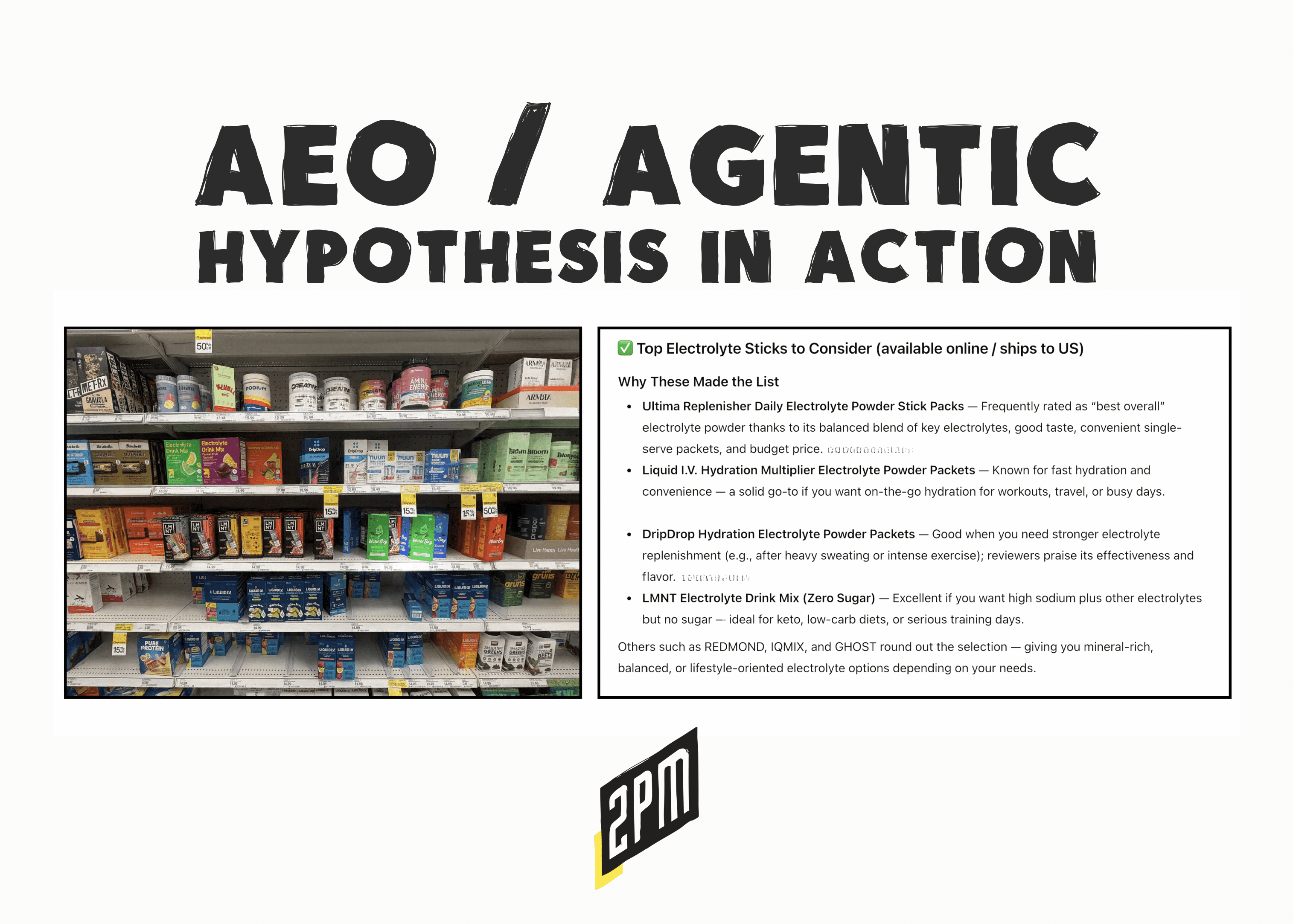
A 2PM Hypothesis by Web Smith
The consumer internet is reorganizing itself around a new gravitational center, one that few operators predicted and even fewer are prepared to serve. For twenty-five years, the web revolved around search boxes, category trees, filters, and social discovery. But the moment autonomous agents began negotiating, filtering, and shaping demand on behalf of consumers, the ground shifted. What started as a novelty: chatbots answering trivial product questions—has evolved into a structural redirect of the consumer funnel. Agents are no longer assistants. They are becoming the new point of sale, the new homepage, the new SEO layer, and the most trusted advisor in a digital environment drowning in information.
This transition is not theoretical. It shows up in the math. Chatbot-to-eCommerce referral traffic grew 1,300% in 2024 and another 520% in 2025, driven in large part by the rise of the shopping-agent layer that OpenAI introduced quietly, then relentlessly optimized. The early evidence suggests that agentic eCommerce is not simply an efficiency tool; it is a reorganization of intent itself. The brands that understand this early are not competing for marginal gains in impressions or clicks; they are preparing to dominate the next decade of distribution.
This is the context in which Agentic Commerce takes shape, elevated by the discipline we now call Agentic Engine Optimization (or AEO). AEO succeeds the alphabet soup of the last era (SEO, CRO, growth hacking) by asking a more fundamental question. Instead of “How do I rank on Google?” the operative question becomes: How does my brand win the recommendation when an agent chooses on behalf of the consumer?
I believe that I have figured out how to achieve this on behalf of brands.
Consumers are overwhelmed. They want fewer decisions, lower cognitive load, and far less time spent sifting through 4,000 Amazon SKUs in search of a product that fits an immediate need. They want trust. They want relevance. They want clarity in the exact moment a problem presents itself. AI agents are uniquely equipped to deliver this. They compress research, comparison, and validation into a single intent-driven interaction. They ask clarifying questions, reconcile contradictory preferences, prune irrelevant options, and return a curated set built from verified product data. They search laterally across retailer catalogs: Target, Walmart, eBay, Etsy, Shopify, and independent brands—aggregating selection in a way that even Amazon cannot fully replicate.
The traditional discovery stack is collapsing under the weight of its own complexity. What emerges in its place is a new linear progression: a prompt, a specification, an agentic query, a curated set, and a transaction. Every brand has to ask itself where it surfaces in that sequence and more importantly, why. That is the work of AEO.
AEO is, at its core, the operational science of making a brand legible and trustworthy to autonomous agents. Modern answer engines are revealing their preferences in real time. Agents gravitate toward structured, verifiable facts: Brand Facts pages, ItemLists, Product schema, policy clarity, comparison matrices, and machine-readable truth surfaces. The “Rank First in ChatGPT” frameworks being developed across the industry map neatly onto this reality, outlining the schemas, structures, and canonical pages that agents parse effortlessly and prefer to cite.
They also reward consistency. When your PDP schema, Shopify feeds, GTINs, product attributes, and delivery windows contradict one another, agents downgrade your credibility. When those elements harmonize, agents elevate your recommendations. Clarity (not creativity) is the currency of this new ecosystem. Plain-language headings outperform clever taglines. Direct answers outperform 700-word stories. Predictable URL structures outperform branded flourish. The DTC era prized narrative; the agentic era prizes truth.
But facts alone do not win the future.
Agents need contextual hooks. They need to know not just what a product is, but when it matters, why it matters, and for whom it matters. This is where your frameworks, your decades-long instinct for physiologic timing, consumer cycles, and context-driven merchandising, become a competitive advantage. Your thesis has always implied a formula: Demand emerges at the intersection of timing, physiology, problem, and availability. AEO simply formalizes that intuition.

No concept demonstrates this more clearly than MTN Haus’ engineering design for the omni-channel CPG “Snack Clock.” (concept development here)
Snack Clock is an early expression of Agentic Commerce theory; the system sounds so elementary that it lacks the appeal of what’s typically viewed as commerce innovation. It is rooted in a simple but profound insight: people do not buy products, they buy solutions that arrive at the right moment. Every product solves a problem that spikes at a particular time of day. The afternoon slump is a time-sensitive problem. The morning electrolyte gap is an easily solvable problem. The post-run stupor period is an easily solvable recovery issue. The pre-dinner craving window is a satiety problem, also solvable. eCommerce has historically ignored time as a demand vector; the Snack Clock concept restores it.
More importantly, it eliminates cognitive load. Instead of browsing a store, the user receives a contextual nudge: “It’s 2:42 PM. Your energy cycle is usually dipping by now. Here’s what you usually need.” This is AEO in motion and eventually, these agents will think for us. As such, the product finds the consumer; the consumer no longer has to find the product. And as agents begin building temporal models (hydration cycles, circadian rhythms, workout patterns) the brands anchored in timing will surface first. Snack Clock becomes the training set that future agents rely on. A decade from now, every major brand will attempt to build its own version. The savviest, most well-resourced will build there’s early.
The broader eCommerce stack is now splitting into two spheres. On one side is the Amazon Sphere: a closed system built on fulfillment dominance, infinite aisle selection, and Prime lock-in. On the other side is the Chatbot Sphere: an open discovery layer where agents evaluate products across retailers, ask qualifying questions, and narrow options for higher-consideration purchases. Every brand outside Amazon’s walls must optimize for the Chatbot Sphere or risk becoming invisible. Agencies like the one where I spend the vast majority of my time (MTN Haus) sits at the center of this shift, uniquely positioned to build the infrastructure required for brands to be agent-ready. Enterprise clients, operational experience, and just enough authority to push back on clients who’ve yet to study these evolving demands.
Most Shopify brands have no idea how to make themselves visible to agents. They assume this future will resemble SEO. It will not. Migration to structured, agent-friendly Shopify systems will increase in demand. Growth Design that blends Baymard-levels of science with Freudian-like behavioral clarity. Content architectures built around comparison hubs, brand facts, policy transparency, and schema alignment will be commonplace. And contextual UX systems, led by Snack Clock architecture, that give agents the signals they need to recommend products at the right moment.
This is not a marketing channel; it is a reorganization of demand itself. The executives who thrive in this era will understand that search is no longer the arbiter of discovery. Agents decide what consumers see first. Brand visibility becomes a technical discipline. Merchandising evolves into decision architecture. Timing and physiology become competitive edges, not afterthoughts. And eCommerce agencies will rise in demand, ones that don’t just deliver sites but also deliver agentic-ready ecosystems capable of being recommended by the systems that now shape demand.
The gap between agent-native brands and legacy brands will widen quickly. The brands that embrace structured facts, contextual timing, schema alignment, and truthful ecosystems will outperform. The brands built on narrative-heavy storytelling, homepage vanity, and inconsistent data will fade. Agents reward clarity and punish noise. The last decade of ecommerce was built on noise; the next will be built on structure.
Every major reorganization of digital commerce follows a familiar arc. Search produced SEO. Social produced organic demand generation. Mobile produced conversion optimization. AI agents are producing AEO and the contextual commerce layer that sits atop the modern web. We are at the threshold of this fourth reorganization. Every brand will need an agentic strategy. Every retailer will need an agent-ready catalog. Every operator will need their version of the “Snack Clock” and the engineering teams capable of building the middleware to enable it.
The brands that treat this moment as a trend will lose ground.
The brands that recognize it as a structural realignment of digital commerce will capture demand their competitors will never see. The winners of the next decade won’t simply be visible. They will be recommended. Agentic Commerce is the new shelf space. AEO is the new route to market. The theories behind “Snack Clock” architecture will be the new CRM. And brands will partner with agencies, like never before, to build the infrastructure that will power all three.
By Web Smith
[…] I first wrote about Agentic Commerce and AEO, I framed agents as the new homepage, the new SEO layer, the new point of sale. That framing […]