Меморандум: Shopify, фулфилмент и разрушение

Это история не столько о Shopify, сколько о сбоях в цепочке поставок и оценке допустимого риска для компании. Логистика и выполнение заказов - это одна из тех дисциплин, которые требуют от компании полного внимания и дисциплины. Amazon может это сделать, а Shopify - нет.

Сеть выполнения заказов Shopify - и ее стремление конкурировать с Amazon в области выполнения заказов - потерпела неудачу. Shopify сокращает свою сеть складов и партнеров по выполнению заказов примерно наполовину. Мы узнали о планах по сокращению стратегии на прошлой неделе после того, как один из существующих партнеров уведомил 2PM о предстоящих изменениях. Он отметил: "Все продавцы, которые используют индивидуальную упаковку, занимаются оптовой торговлей или комплектацией, не будут обслуживаться новыми предложениями". Недавний отчет Insider сделал это официальным.

Этот шаг показателен с точки зрения того, как Shopify видит себя в более широком ландшафте розничной торговли. Целью Shopify уже давно является создание "армии бунтарей", которая сможет конкурировать с огромной машиной Amazon. Это хорошо сработало как движение розничной торговли, и Shopify добился значительных успехов в прошлом году. Бренды используют ее для запуска и построения своего бизнеса, а сама компания стала синонимом розничной торговли для прямых потребителей. Она позиционирует себя как анти-Amazon, и эта позиция на рынке хорошо ей помогает. Но есть области, в которых "ров" Amazon дает неоспоримые преимущества.

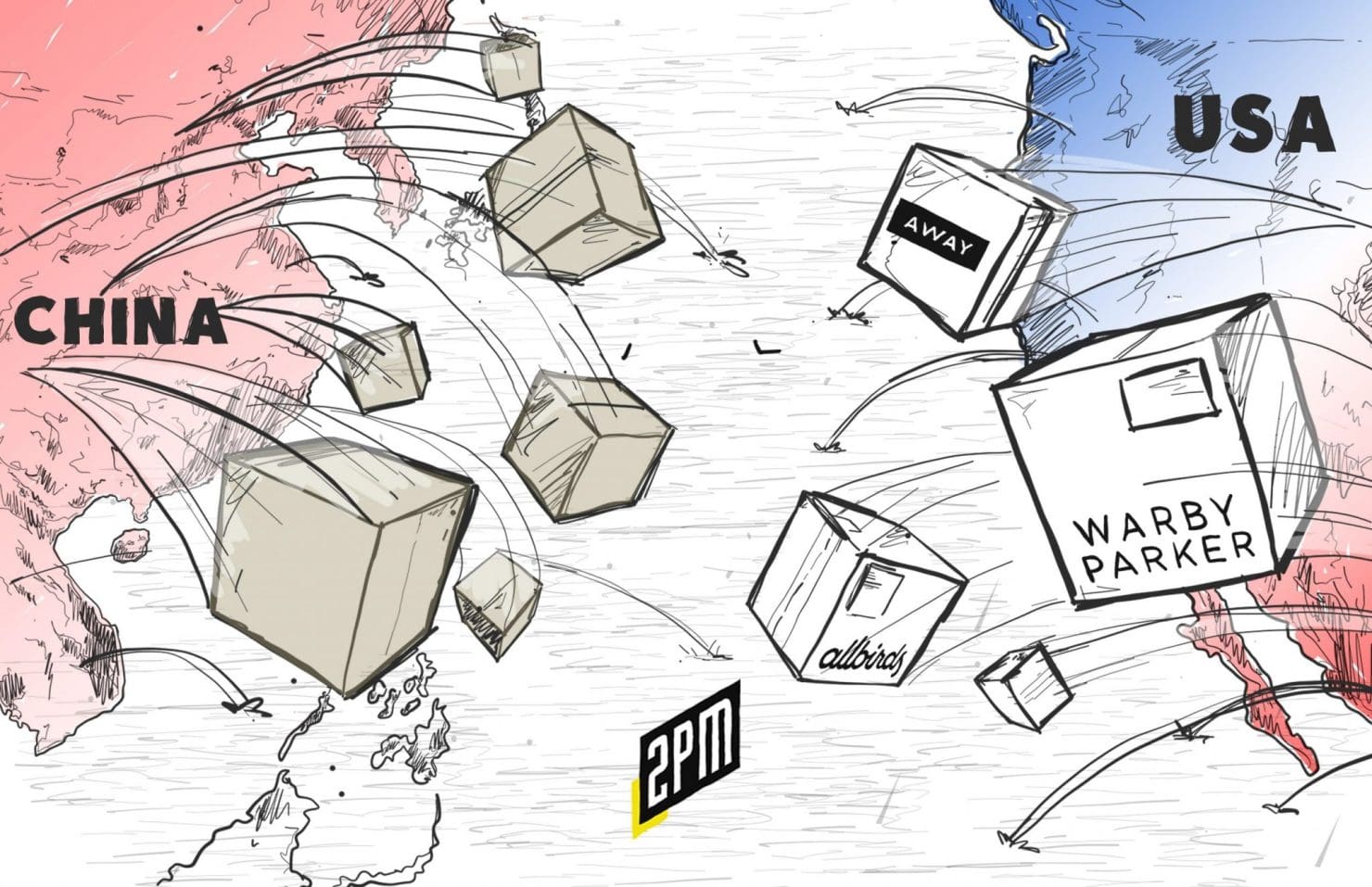
Логистика розничной торговли - это чудовищная задача и в лучшие времена. Прошедший год был одним из худших. Число сбоев в цепочках поставок увеличилось на 88 % по сравнению с 2020 годом, причем 47 % сбоев затронули США, основной рынок Shopify. Ниже мы приводим эти данные:


27 декабря мы писали:

Хотя сейчас Shopify имеет преимущество, сеть систем выполнения заказов Amazon быстро становится необходимой. Великий соперник Shopify со временем может стать его самым необходимым партнером.

Shopify не может справиться с растущей сложностью индустрии доставки, даже при наличии программного обеспечения мирового класса. Почему? Потому что это бизнес, основанный на людях и транспортных средствах. Программное обеспечение может оптимизировать трудовые ресурсы, но не может их заменить. Существуют правила и внешние силы, которые диктуют порядок отгрузки, доставки и возврата товаров, и даже самое лучшее программное обеспечение не может их отменить. Когда диктатором становится нарушение, нужны самые лучшие машины. Amazon и есть такая машина. Она построила бизнес и ров, предназначенный для поддержания оптимальной производительности даже в самые тяжелые времена. Также в декабре:

Благодаря многолетним инвестициям Amazon создала собственный парк грузовых перевозок и арендует самолеты, а также открыла воздушный хаб в Цинциннати, чтобы избежать проблем с отсутствием товаров на складе, которые на этом этапе сезона праздничных покупок начали испытывать другие ритейлеры. Amazon расширяет свой бизнес огромным количеством способов, но ее преимущества больше не ограничиваются только продуктами и цифровыми технологиями.

Согласно отчету Insider и инсайдерским сообщениям, Shopify Fulfillment Network уже не собирается умирать. Компания рассматривает возможность приобретения сторонних компаний. Скорее всего, она будет перестраиваться, уменьшая площадь складских помещений и уделяя повышенное внимание одной из самых болезненных точек электронной коммерции - возвратам. Теперь для Shopify возврат товаров может стать не одним из элементов огромной сети доставки, а скорее преимуществом более тонкой операции, основанной на программном обеспечении.

Возврат товара - одна из современных проблем розничной торговли, которую можно значительно улучшить с помощью более совершенного программного обеспечения. На сайте рынок после возврата товаровМы предполагаем, что при достаточном объеме возвратов рынок возвращенных товаров может процветать. Но сначала Shopify или партнер Shopify, например Loop, должен стать де-факто решением для администрирования возвратов. Ниже приведен соответствующий фрагмент из этого отчета:

После анализа десятков складских операций и опроса бесчисленных владельцев стало ясно одно: в этой негламурной отрасли скрыта элегантная рыночная возможность. Во время недавней беседы с одним из ведущих руководителей независимой логистической компании, работающей с третьими лицами, он сказал:

"За исключением двух наших крупнейших клиентов, которые используют Loop, все остальные клиенты используют нашу WMS/OMS для обеспечения возвратов. Мы - капля в море, в прошлом году наш оборот составил 150 миллионов долларов. Но сейчас никто из наших клиентов не использует внутреннюю систему Shopify для облегчения этого процесса".

Неудачи Shopify с выполнением заказов - это напоминание о том, почему Amazon является редким ритейлером с полным стеком услуг: маркетинг, поиск, покупка, доставка, возврат. Эта смена стратегии - шанс для Shopify лучше сориентироваться в своих дальнейших действиях, не как замена Amazon, а как ее потенциальный партнер. В декабрьском материале Bloomberg о стиле руководства Тоби Лютке бывший руководитель Amazon привел такую цитату: "Shopify выставила нас дураками". Такая реакция была недальновидной. Ритейлеры покупают контейнеры дюжинами, строят новые складские помещения площадью 500 000 квадратных футов или арендуют целые контейнеровозы. Логистика теперь - это предложение "все или ничего", и немногие продемонстрировали эту новую реальность лучше, чем Amazon, с которым Shopify на данный момент просто следует сотрудничать. Мы закончили нашу заметку об этом отчете Bloomberg другим выводом:

Хотя сейчас Shopify имеет преимущество, сеть систем выполнения заказов Amazon быстро становится необходимой. Великий соперник Shopify со временем может стать его самым необходимым партнером.

Каждому человеку нужен враг в жизни.

Автор: Веб Смит | Редактор: Хилари Милнс | Художник: Кристина Уильямс 

Memo: China Strategy Revisited

This is a continuation of the original essay: The China Strategy (2018)

At 8 am on May 10, 2003, Taobao went online on the fourth day of the SARS quarantine. The homepage read: “Think of those who start a business in trying times.” Nineteen years later, and China’s online retail economy is the envy of the world. Currently with a nearly 37% online penetration and growing, analysts estimate that rate will reach 63.9% by 2023. It’s evident that online retailers like Alibaba, which owns Taobao, used the crisis to move China into eCommerce leadership that then belonged to the United States. China owes its eCommerce dominance to Alibaba, but its future may be with JD.com. This as the U.S. Government is becoming increasingly adversarial with Alibaba.

Shopify’s next geographical ploy isn’t in the early-stage metaverse, it’s in the late-stage region that’s been trickiest for America’s modern brands to find success. Context is necessary. In 2017, Alibaba wanted to partner with digitally-native brands, so it thought like Amazon and went on a public relations campaign to attract American retailers to the marketplace. I sat in a Detroit conference center as a guest of Alibaba when a charismatic Jack Ma stood on stage wooing middle America’s small businesses. He’d later say, “Alibaba’s existed for 18 years, and we are so influential in China–but nobody in America knows about us.” And he was right, even after Alibaba’s record-setting IPO in 2014.

The same year, JD tried to appeal to the same country but with a slightly different market: It invested $397 million in Farfetch to bring American luxury to China. It fizzled. In 2020, Farfetch revised its strategy and ended up partnering with Alibaba and Richemont in a deal structure that far exceeded the original JD partnership.

Alibaba CEO Daniel Zhang was quoted saying at the time:

This highly complementary partnership brings together some of the world’s leading luxury retail and technology platforms, representing another milestone in Alibaba’s strategy to meet the rapidly growing demand for luxury products in China. The Chinese luxury market — which is expected to account for half of global luxury sales by 2025 — consists of hundreds of millions of young, digitally native consumers.

Over the past two years, JD and Alibaba retooled their approaches to gain traction with America’s direct-to-consumer brands. Alibaba homed in on the luxury market and poached Farfetch from JD. Now, JD has made its counter move. It is teaming with Shopify, the leader in online merchant services for modern retailers by GMV (and potential). They’ve essentially switched strategies: one traveled from middle America up market and the other traveled down market in its focus on the American middle. It’s rare that JD outmaneuvers its larger Chinese rival; here it has its second chance to try.

This is take two for JD and it’s counting on Shopify’s direct relationship with a growing number of smaller brands. The Chinese mainland is perhaps the most coveted audience for North American retailers today but without a high level of sophistication and relationship development, it’s close to impossible for American merchants to market their products to the largest eCommerce audience in the world. GlobalData estimates that China’s online retail economy is more than double that of the United States:

According to GlobalData’s E-Commerce Analytics, e-commerce sales in China grew at a CAGR of 17.7% between 2017 and 2021 to reach the value of CNY13.8 trillion (US$2.1 trillion) in 2021.

Shopify found a way to help its merchants reach those trillions of CNY. It’s joining Chinese marketplace JD.com, and not Alibaba, in a partnership that portends to help its merchants succeed in a market that will be worth $3.3 trillion by 2025.

The deal is a win for both sides. Shopify’s business soared during the pandemic, and unearthing new areas of growth for its merchants is key to Shopify’s next level-up. Cross-border commerce is a logistical hurdle for many small and medium sized brands as they attempt global expansion. Shopify, which wants to be the internet toolbox for online sellers, will gain a competitive advantage by helping its brands make the jump to new markets.

In 2018, 2PM predicted that China would become the next growth market for DTC brands otherwise facing climbing customer acquisition costs. As believed then, the brands that could successfully go-to-market in China would be the haves; the rest will be the have nots.

Chinese eCommerce is a worthwhile investment for well-prepared DNVBs. McKinsey&Company estimates that by 2025, Chinese shoppers will account for nearly 45% of global luxury spending. This translates to “7.6 million Chinese households will represent RMB 1 trillion in global luxury sales, an amount that is double that of 2016, and equivalent to the size in 2016 of the French, Italian, Japanese, UK, and US markets combined,” according to the consultancy.

The Shopify x JD partnership levels the playing field, to be a part of the “haves” be a part of Shopify, or so the theory goes. It is now a conduit to the largest market and JD is now a pathway to bringing more products from East to West. As part of the partnership, JD.com will set up an accelerated channel for Shopify brands that will narrow the onboarding window from 12 months to three to four weeks. JD will handle logistics including warehousing and deliveries for the US brands.

For JD, Shopify is a coup considering that $SHOP’s current link to China is through Alipay, the financial wallet powered by Alibaba-affiliate Ant Group. That deal will likely go sour.

The Chinese government has set a target to increase national online retail sales by around 44% between 2021 and 2025. JD, Alibaba, and now Shopify will be a key part of that push. There are risks. Even with the support of Shopify and JD.com, business in China needs to be closely managed to tailor marketing, messaging, and even inventory selection to appeal to the region. In this way, there is only so much that a platform can do to facilitate opportunity for its brand partners. Shopify’s global success here will depend on the individual successes of the brands themselves. This is in line with Lütke’s philosophy who doesn’t love to play the king maker.

Автор Веб Смит | Отредактировано Хилари Милнс | Искусство Алекса Реми и Кристины Уильямс

Memo: Brand Brady

The backdrop of the launch of the Brady Brand is a years-long shift in how Under Armour and its rivals are doing business. Adidas and Nike are expanding their definitions of brand equity while Under Armour is tightening the reigns. In February of 2020, 2PM wrote a deep dive into UA’s lack of focus:

There are a number of technical and financial concerns that Under Armour has ahead. With a new CEO in Patrik Frisk, there is an opportunity to course correct in several categories to include: product development, financial health, and brand management. The company that Kevin Plank launched from his mother’s basement has influenced 25 years of performance wear technologies but it’s no longer synonymous with the category that it established.

The message was a timely one. In October of 2020, UA announced a plan to cut back on wholesale partners (it exited 3,000 stores!), minimize discounts, and reduce its SKU count:

As it overhauls wholesale, the brand is also upping its focus on direct-to-consumer channels, where it plans to offer fewer promotions and discounts to fuel healthier margins.

This left the door open to the NFL’s greatest quarterback to go all-in on his own brand without infringing on his existing partnership with Under Armour, an idea that would not have worked as a Nike or Adidas athlete. After years defining himself as one of the best quarterbacks to ever play, Brady is now trying to lead another new brand to victory away from the gridiron. First, it was achieving notoriety for the TB12 supplement empire and now it is a focus on fashion retail. Tom Brady is redefining the playbook for the athlete-anchored brand with Brady, his new line of athletic and lifestyle apparel that debuts next week.

His launch strategy resembles that of a modern brand playbook: the digitally-native department store partnership of choice, the NIL deals, and the emphasis on direct-to-consumer and online storytelling.

In an interview with WWD, the Tampa Bay quarterback outlines how Brady will be sold at brady-brand.com and through Nordstrom. The collection will debut with 145 pieces in three categories, and will maintain a monthly drop schedule popularized by brands like Parade, Noah, Todd Snyder, and Drake’s. The plan is to steadily expand the brand into more upscale categories but for now, the focus is on athleisure and office casual.

Brady’s effort to build a DTC brand follows the USWMNT athletes and and Jimmy Butler’s BIGFACE brand. It’s important to note that all three brands used Shopify for their product launches. It is certainly a new era for athlete merchandising and brand development, with more control and ownership over his namesake brand. What’s notable is who he chose to partner with to create the brand and who he didn’t. Women’s Wear Daily outlined his partnership with Jens Grede, the brand creator behind Frame, Good American and Skims (the latter two of which have big-name influencer associations with Khloé and Kim Kardashian, respectively), who was introduced to Brady by longtime fashion executive Andrew Rosen. The line is designed by Public School co-founder Dao-Yi Chow, who it’s noted is not just a fashion insider but also a marathon runner. The group, collectively, is one that understands the function of sports apparel, the importance of style and how to build and launch modern consumer brands.

Missing from the project? Under Armour, which sponsors Brady. Now, you may understand why.

It’s a sorely missed opportunity for Under Armour, which had a failed launch into elevated sports and lifestyle attire with UAS and an earlier attempt to knock off brands like Ministry of Supply and Mizzen + Main. It dropped UAS in 2016 and lasted one season before the plug was pulled. Brady could have been UA’s next opportunity – the timing is better, and the face of the brand couldn’t be more influential in the sports world. Instead, UA was sidelined, which WWD addresses:

Brady opted to launch the brand with Grede rather than through his longtime sponsor Under Armour. The Baltimore-based sports company is now focusing nearly exclusively on performance sports apparel and its attempt to move into fashion in 2016 with the UAS collection, designed by Tim Coppens, met with limited success and was discontinued after one year. An Under Armour spokesperson said Brady continues to part of the UA family as an ambassador, as he has for 11 years, but said the Brady brand is his personal, off-the-field endeavor and separate from his partnership with the company.

Brady is setting up new rules for the options athletes have before them as they navigate the world of brand sponsorships, partnerships and merchandising. A macroeconomic shift in how his title sponsor does business (Under Armour is retreating from a fashion opportunity), the door is open for what may become a successful attempt to unseat Michael Jordan as the most astute figure in athlete retail (though it’s clearly too early to say). From the new site:

BRADY™ is the first technical apparel brand to apply two decades of pro sports level innovation and engineering to create a system of clothing that performs across every activity. With over 3 years in development, our fabrics and materials fuse natural elements with cutting-edge technology. Designed with the body in mind. Built to move, breathe, and sweat while you compete, live and recover.

Doesn’t this sound like a conflict of interest with Under Armour?

The renewed focus is working for Under Armour but at a cost of going all-in on the opportunities of the moment (though UA is now dabbling in NFTs). UA has chosen to set aside fashion, casual wear, DTC fitness, web3, and metaverse development – leaving Nike and Adidas as the go-to major retailers in those other areas. In fact, Nike is laying the groundwork for further expansion. The brand is currently going up against Lululemon in a patent spat over Mirror technology – demonstrating it’s fighting for ownership in a bigger Nike universe.

Brady seldom loses, these days. Which is why it’s even more incredible that Under Armour didn’t make an exception to their new strategy rules. It’s a decision that they the forefathers of technical fabrics may come to regret if the brand does what every other Brady pursuit seems to do: win.

Автор Веб Смит | Отредактировано Хилари Милнс | Искусство Алекса Реми и Кристины Уильямс