
Memo: Golf Different

Golf is trying to have its own Formula 1 moment, thanks to Netflix and the natural drama that seems to be unfolding on and off the course. But unlike the carefully manicured Formula 1, professional golf is being pulled in two directions.

Consumers want to feel closer to the game, and they want the walls between the most exclusive country clubs and the most frequented public courses to teeter. But there are caveats here. Like many racing fans want access to the vaunted paddock club of F1 lore, they don’t want it to become any less exclusive. This is the trappings of aspiration.

A new generation and demographic of consumers are bringing a new energy to a stodgier sport. Brands and sponsors that were once the most buzzed about are losing their hold. New brands and technologies are emerging that introduce consumers to a new age of golf defined by joggers instead of slacks, Jordan brand golf shoes, and more African-Americans teeing off than ever before. It’s an interesting time to say the least.

The sport itself is democratizing with characters like Patrick “Tiger Hood” Barr, Jacques Slade, Roger Steele and companies like Eastside Golf and Fairgame leading in fashion and technology. Both Eastside and Fairgame boast African-American ownership and an easing of the tension between the traditions of old and the prospect of the new. So why doesn’t this cultural shift translate to more positive attention for LIV Golf, the professional league rivaling the PGA?

Here is my summary:

  • We grew up with Michael Jordan and Kobe Bryant. Culture prefers stiff competition and cutthroat gamesmen. This is the brand of the PGA but not currently the LIV tour.
  • Democratization does not mean “lacking class” or simplified, it means better access. The new fans of golf want to be included in the conversations of old, revising it where they see fit. They don’t want to have that conversation tossed out for something altogether new.
  • History is as important as innovation. This is a generation that innovates on the past while paying it the reverence it deserves, from retro Jordan golf shoes to apparel styles that resemble fashion trends forgotten with the 90s and 00s.

If these things are true, it can begin to explain how LIV and its investors went wrong. To better understand the divide, it requires an understanding of the differences between the two leagues. For the golf junkie, most of this is self-evident but to the general public, there’s a lot to learn. The dueling broadcasts in February 2023 was the first time that the average consumer had the opportunity to compare the product for themselves.

The PGA Tour’s Honda Classic (February 23-26) was broadcast on the Golf Channel and NBC for the final two rounds. For the first time, LIV competed head on (February 24-26) and was broadcast on The CW, a network best known for Superman & Lois. According to LIV’s corporate site, the weekend was a successful one.

The league’s inaugural weekend of live coverage averaged a linear viewership of more than 537,000, surpassing the current season viewership average of the 105-year-old National Hockey League on ESPN and TNT (373,000), average viewership of the 2023 Australian Open Men’s Final on ESPN (439,000), and the average ABC and ESPN viewership of 2022 Major League Soccer (343,000), launched in 1996. All ratings are from US domestic audiences only.

However, the press release omitted the obvious. According to ESPN.com, The CW’s live broadcast drew an average of 289,000 viewers with a “0.18 household rating on Saturday and Sunday.” Golf.com made the comparison plain:

In comparison, the PGA Tour’s weekend broadcasts on NBC brought in just over 2 million viewers and averaged a 1.24 household rating — nearly seven-times as many viewers as LIV.

Critiques of the comparison suggest that it will take time for the LIV and CW partnership to take shape. It’s also the case that the Honda Classic was sandwiched between four top PGA events so the marketability of the Honda Classic was not what it could have been. Time will tell if the upstart LIV can find the television audience that The CW Network hopes it will deliver. The two products share very little in common.

The PGA Tour has a much longer history and more established reputation. The tour was founded in 1929, and it has been the premier professional golf circuit in the world for nearly a century. The tour has produced some of the greatest golfers of all time, including Jack Nicklaus, Tiger Woods, and Arnold Palmer. The PGA Tour is known for its tradition and prestige, and it is viewed by many as the pinnacle of professional golf.

LIV Golf, on the other hand, while having made some high-profile signings, lacks the prestige of the PGA Tour. LIV has taken its marketing cues from men who love drinking a six pack on the course with their friends. There are four-man teams, silly team names, uniforms, and music blaring on the course. The allure of golf’s second most important attribute (behind talent) is all but missing: prestige and affinity. Columbus Dispatch columnist Rob Oller:

Not many of LIV’s players are particularly likable. (Sergio) Garcia, (Patrick) Reed and (Bryson) DeChambeau belong on an injury lawyer billboard. The majority of LIV fields consist of has-beens and never-were’s. But my distaste for LIV goes beyond that … Results matter. LIV is exhibition golf, plain and simple. So is the virtual golf league being put together by Tiger Woods and Rory McIlroy… Anything that smells like TopGolf meets Putt-Putt can’t hold my interest.

It remains to be seen if LIV Golf will be able to establish itself as a legitimate competitor to the PGA Tour, by either measure, in the long-term. The third obstacle that LIV faces is unique to the character of the sport. Golf, long a pursuit of wealthy white men, is democratizing. But this dispersion in interest isn’t far-reaching enough for LIV’s detractors to dog whistle about the source of its funding: The Saudi Public Investment Fund (PIF).
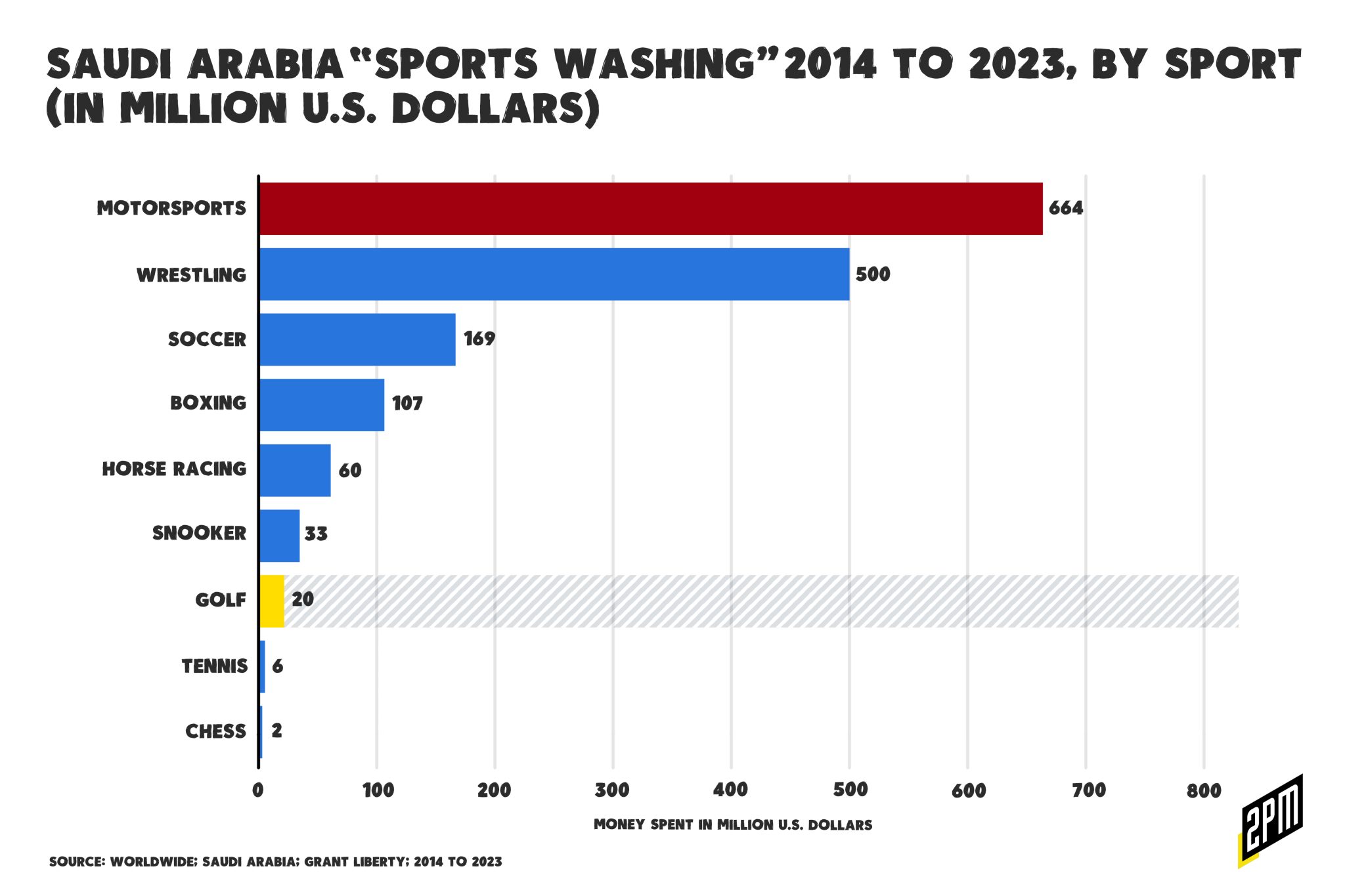
The irony of my comparison between F1 and professional golf is that Saudi Arabia has spent far more money on the FIA’s premiere racing circuit than on LIV golf. In fact, several sports saw more investment than LIV. It’s also important to note that LIV Golf features many golfers who are past their primes: Phil Mickelson, Sergio Garcia, Bubba Watson, Ian Poulter, and even the oft-injured Brooks Koepka are on their way out. There are a few exceptions, of course: Dustin Johnson and Cam Smith were at the tops of their games before leaving for guaranteed money and lighter workload. The PGA has deepened its position that it’s performance-based and financially upright, in contrast to its new competitor.

The “Saudi Money” connotation only works in golf precisely because the pecking order has remained monolithic for so long (until a multi-ethnic Stanford golfer roared onto the scene). This same guilt-by-association approach fails to garner much attention elsewhere – especially the investments into American markets.

Saudi Arabia’s sovereign wealth fund invested more than $7 billion to build new positions in US stocks including Amazon.com Inc., Alphabet Inc., BlackRock Inc. and JPMorgan Chase & Co. as markets were battered by recession fears.

The difference between these far greater investments into beloved American corporations and the advent of LIV is that golf will always rely upon the country club culture of excluding outsiders. The LIV golfers who have signed on are likely too aloof to understand their own relationship to the average consumer. Watch the Netflix show and you will see aging, losing professionals flying private, visiting their multiple homes, and showing up on America’s finest golf courses. Meanwhile, we are tasked with taking Bubba Watson comments like these seriously:

My 10-year-old son was sitting in the bed with me, and we were watching golf on the TV, and he knew the Aces – everybody knows the Aces, they keep winning. He knew the Aces, he knew the Stingers.

The PGA’s great allure, the same that many consumers share for F1, is that a middle-class golfer from Pensacola can work his way through junior college, on to the University of Georgia, to win the Masters twice. That comeuppance is what fuels professional golf’s democratization. Children from similar backgrounds want the same story as Bubba’s. LIV doesn’t quite deliver on that prestige. It attempts to make some of the most well-connected men on earth appear like the every-man. The PGA tour reminds you that it requires performance to enter the conversation the way that Watson did in 2012 at Augusta National.

What makes this comeuppance possible is the PGA Tour’s wide range of events, including major championships like the Masters, the U.S. Open, and the PGA Championship, as well as numerous other high-profile tournaments throughout the year. These events still attract many of the best golfers, sponsors, and media attention in the world. These platforms, the tour stops, provide fans with an opportunity to see the game’s biggest stars compete against each other. As of now, it is more difficult for LIV players to compete in those high-profile majors.

The PGA Tour also benefits from a more stable and established infrastructure. The tour has a well-established system for player development and progression, with multiple tiers of tours and qualifying events. This allows up-and-coming golfers to work their way up the ranks and earn their way onto the PGA Tour.

LIV Golf, on the other hand, has yet to establish a clear pathway for players to earn their way onto its tour. It is unclear how the organization will handle player development, promotion, or merchandising of its talent. This lack of clarity could deter some up-and-coming golfers from pursuing a career in the LIV Golf organization.

The tour has a large and passionate following of fans who are invested in the success of their favorite golfers and their stories. The PGA accomplishes this with its storytelling. It also has a robust media presence, with coverage on major sports networks and an extensive online and social media strategy. While LIV Golf has stated that it plans to leverage technology and social media to engage with fans, it remains to be seen if it will be able to replicate the PGA Tour’s success in this regard.

As golf trudges through its Formula 1 moment, the PGA Tour sits in an advantaged position. The class and prestige of the PGA tour resembles that of F1. Behind the scenes, you know that the men behind the circuits 20 cars are normal people. But as soon as the camera shines on them, there is a pomp and circumstance about them. As if they understand that the appeal is not speed alone. It’s also that a poor, mixed-race Brit could one day become a knight. If America had knights, professional golf would be one of its paths to the extraordinary.

In fact, we do have knightly figures in sport. In America, we know them when we see them. We strive to become them and it fuels our passion for the sports that they play: the PGA Tour is one of those paths. It might be its foremost; and it’s the marketing advantage over LIV that money cannot buy

This is what’s fueling golf’s democratization and a new era of fandom that will nod to the old without outright dismissing it. Despite defections, The PGA Tour – and the many new media projects, tech startups, and Instagram personalities that support it – maintain pole position over the Saudi-backed rival. Golf will be different, just not as different as LIV Golf hoped.

By Web Smith | Edited by Hilary Milnes with art by Alex Remy and Christina Williams

Memo: Where NatSec Meets Commerce

Editor’s Note: this essay was re-published in Newsweek.

There’s one balloon that can’t and won’t be shot down; we are far too reliant on it.

In previous explainers and reports on first-party data, I mostly focused on its advertising benefits. It wasn’t until Amazon began acquisition talks with Roomba, the autonomous robot vacuum, that I began considering data collection for purposes beyond the narrow path of ethics. Here is a snippet from an August 2022 report – keep this in mind while I explain what I believe to be a consequential perspective on the intersection of online retail and national security.

Amazon doesn’t rely on many of the data collection practices prohibited by Apple’s privacy initiatives (ATT). This acquisition means more first-party data collection. […] Amazon now has a presence in the following categories: laptops, streaming television, in-home assistants, smart speakers, Door cameras, fitness monitors, and now vacuum cleaners. Collectively, Amazon knows more about its consumers than any other company on earth.

With the iRobot acquisition, Amazon knows more about its consumers demographics and psychographics. It knows the size of your home, its layout, the location of your home, and its surfaces. From there, Amazon can deduce median income, product preferences, and more.

By the measure explored in this report, Amazon (and Apple) know more about its consumers than any domestic corporation, but Americans tend to trust Amazon enough to avoid revolt and public demonstration. And by the measure explored here, China knows more about Americans than any sovereign nation, perhaps including our own.

First-party data is collected directly from users or customers, typically through their interactions with a company’s website, app, or other digital channels. This data can include information such as browsing behavior, search history, purchase history, and demographic information. First-party data is highly valuable to companies and its ownership because it is directly linked to their customers or users, allowing them to gain insights into their behavior, preferences, and needs.

The debate around the surveillance of Americans by way of a large balloon is a distraction from a more significant form of potential surveillance. We may be overlooking the growing advantage that many outside of the commerce industry have yet to fully grasp.

As of writing this report, four of the top six mobile apps available to iPhone users are owned by Chinese companies. Of them, Temu, Shein, and Bytedance-owned TikTok have developed eCommerce strategies that rival (or exceed) the vast majority of American companies in volume.

The average American lacks an understanding of China’s general strengths beyond manufacturing capacity and low costs. That would be a deep dive in and of itself. For the sake of brevity, this will focus on business-to-business trade and direct-to-consumer commerce. Chinese factories manufacture almost every major technical product that Americans seek. The Executive Branch of the U.S. Government is quite selective in the goods that it chooses to tariff. Originally levied by the Trump administration in March 2018, President Biden maintained the tariffs covering the near-trillion dollars in Chinese goods on the list. But many products without American equivalents were excluded.

While U.S. tariffs cover a long list of Chinese products, they left many popular products untouched. That made it possible for U.S. imports of items such as cellphones, laptops and video game consoles to surge during the pandemic.

For decades, Chinese raw materials and finished goods supplied American retailers. Today, thanks to an executive order, China’s direct-to-consumer business will one day rival B2B sales to American retailers. To understand the impact of that March 2018 decision, consider that direct-to-consumer companies were not only excluded from tariffs – they were actually incentivized to sell to Americans. There still exists an $800 exemption that allows DTC companies like Shein, Temu, Alibaba, and TikTok to ship here without taxation. Instituted in 2016, packages worth less than $800 have been able to enter duty-free. Since Shein and others ship most orders from Chinese warehouses, and since most orders fall under that cost threshold, those companies receive tax benefits.

This alone incentivizes Chinese companies to sell in America, but it doesn’t end there. Additionally, the Chinese Communist Party (CCP) waived export taxes on those same products. Much like TikTok is an altogether different app (with far greater restriction on content and usage time), Shein doesn’t sell goods inside of China. In effect, the CCP traded tax revenue for American market share. Shein has now been in the number one spot on the 2PM Power List for more than 50 weeks.

As China’s DTC businesses continue to maintain top positions in the app store and on power lists, expect U.S.’s trade deficit with China to grow.

But while deficit is a visible marker of retail imbalance, there are other key measures that can indicate dependency on Chinese products. Two short months after the report was written on Amazon’s acquisition of Roomba, this report on TikTok’s eCommerce job listing speculated on the potential power of a TikTok eCommerce operation.

The speed with which TikTok is able to make products sell out in stores and online has shown that it’s not a complete hurdle for customers. But linking commerce directly into its platform opens a new revenue stream for TikTok that’s all the more critical now that Apple has clamped down on third-party advertising data collection. Like Meta, TikTok has been reported to be using in-app browsers to collect key data points that are against to skirt around Apple’s recent iOS privacy practices, which have made it more difficult to target ads.

And just days after highlighting TikTok’s staffing up of eCommerce industrialists, I introduced Temu’s quick rise with this now-understated comparison to Shein and TikTok. While presumptuous at the time, the company’s Super Bowl 2023 ad catapulted it to number one in the app store. Here, I explained the new direct-to-consumer retail, one that I now understand to be buoyed by both China and America’s tax incentives:

Consider it the new direct-to-consumer retail. Shipping orders directly from their origin factories keeps prices low. Shein, the Chinese ultra-fast-fashion giant, has taken the world by storm and continues to grow in magnitude, dwarfing the SKU counts and volume of sales of competitors like Zara, H&M and Boohoo. The clothes are cheap, disposable, and addicting. Temu could fulfill a similar desire for “cheap yet good-enough” products – especially as America’s historic run of inflation continues to tilt consumer prices upward.

A similar business model is in the works at TikTok, which is currently hiring for eCommerce fulfillment and warehousing and logistics jobs in the US as part of a bigger commerce push. We wrote in October about why TikTok is uniquely positioned to actually bridge the gap between content and commerce when so many apps – even Instagram – have failed to make it stick.

At the core of China’s commerce industry is its focus on the value of the data it collects. In short, China has been vigilant about the collection of first party data far longer than America. The South China Morning Post, an English-first publication that is part-owned by the Alibaba Group, began emphasizing first-party data collection in 2019:

Six months ago, South China Morning Post decided to cut itself off from third-party data and switch to a first-party data platform. […] The first-party data platform will allow South China Morning Post to achieve the next phase of growth. On the editorial side, that means turning its vast scale into a loyal readership. On the commercial side, that means giving advertisers more precise targeting capabilities.

It’s been reported that as recently as March 2021, the Chinese government pressured Alibaba to sell SCMP. That sale would place the media property under the influence of the state; it is unclear if that pressure has continued. Two years into China’s emphasis on first-party data collection and it was still weeks before it was reported, in America, that iOS 14.5 would take on Facebook and Google tracking in April 2021. We began our report on the implications with: “Apple’s intentions appear straightforward at first glance. The company wanted to improve the privacy of its end users. This virtuous effort came with a few additional outcomes. By upgrading its privacy practices, Apple will impair large ad networks that have grown with the help of those end users.” Prior to this now-infamous software update, most advertisers relied on third-party data to reach new customers.

According to Google Trends: December 2021 was the inflection point of interest in America’s commerce industry. First-party data was a niche marketing term until then. It was a phrase used by a select few advertising industrialists to denote a shifting model in collecting consumer data. Ever since, it’s been all the talk for American retailers. It just so happens that the easiest way to collect first-party data, in an efficient and cost-effective manner, is to sell cheap goods. China has mastered this. Forbes asks, is Temu the next Shein?

This isn’t the first time a China-backed start-up has disrupted America’s e-commerce world with cheap items. Online fast fashion outlet Shein got a big break during the pandemic as its competitors were hampered by bricks-and-mortar stores which were forced to shut up shop. Buoyed by backing on TikTok, downloads of the Shein’s app surged to 193 million in 2021, up from 67 million in 2019.

How sensitive is China’s ability to collect consumer data to the U.S. government? In 2021, President Biden signed the Secure Equipment Act, preventing the FCC from authorizing “radio frequency devices” that may pose a national security risk. And the Biden-era FCC expelled China Telecom Americas, noting: “Washington is continuing investigations into Chinese technology that began during the previous administration.” According to the Brookings Institute:

The law’s effect is to prevent U.S. technology platforms from being forced to interoperate with or transfer data to suppliers like Huawei or ZTE that may have ties to the Chinese government.

But in the matter of cheap, direct-to-consumer shopping of the cross-border flavor – there is not a concern at all by most (read: all) American policymakers.

What’s Next For China and First-Party Data

The importance of first-party data in China’s tech economy cannot be overstated; it’s impossible to separate that economy from its political allegiances. That being said, with its fast-growing retail infrastructure, China has become a global leader in DTC exports.

First-party data has become a critical component of China’s economy. For example, in the eCommerce sector, companies like Temu, Shein, TikTok, Alibaba and JD.com use first-party data to improve their search algorithms. By analyzing data on customer behavior and preferences, these groups can understand consumers and their larger communities.

Beyond eCommerce, first-party data is also playing a critical role in China’s digital finance industry. Companies like Ant Group, which operates the popular Alipay platform, use first-party data to assess the creditworthiness of borrowers, enabling them to offer loans and other financial services to individuals and small businesses that might not have access to traditional banking channels. By analyzing data on spending patterns, bill payments, and other factors, Ant Group can make more accurate assessments of credit risk and offer more targeted financial products.

The use of first-party data in China’s tech economy has also raised concerns about privacy and data security. With the massive amounts of data being generated and collected by Chinese tech companies, there is a risk that this data could be misused or abused. There have been reports of companies using data to discriminate against certain users or to manipulate consumer behavior. There have also been concerns about the close relationship between some Chinese tech companies and the government, raising questions about whether user data could be used for surveillance or other purposes. Consider GTCOM, a big-data and artificial intelligence company controlled by the China’s “Central Propaganda Department.” A 2020 report by MIT’s Technology Review on how “China Surveills the World” sheds light on GTCOM’s scope:

One of their products claims to collect 10 terabytes of data a day, or two to three petabytes per year, from web pages, forums, Twitter, Facebook, WeChat, and other sources. In terms of size, that’s the equivalent of 20 billion Facebook photos. The company describes its work as contributing directly to China’s national security, including military intelligence and propaganda. GTCOM’s research and development arm has developed algorithms that look for military keywords in the information it collects, which could for instance come from CVs or patents.

TikTok is widely considered one of the most successful apps in history. Shein was the number one shopping app in the app store, only to be unseated by Temu. And Alibaba’s GMV far exceeds Amazon’s. They all share algorithm-driven eCommerce as a core competency. A recent article by Australia’s Power Retail explains:

This trust in the algorithm, and the ability to complete tasks without leaving the app, makes it an ideal platform for in-app ecommerce sales. Currently, when people tap on TikTok ads or links, the app defaults to a TikTok-made in-app browser. This new shop tab however will offer broader opportunities for the platform to keep more of its operations in-house and directly deliver product listings to customer feeds.

TikTok is fueled by first-party data and algorithms that “read your mind,” according to the New York Times deep dive on the subject. That same report noted that “concern about Chinese consumer technology is bipartisan.” The Trump administration asserted that TikTok’s “data collection threatens to allow the Chinese Communist Party access to Americans’ personal and proprietary information,” and that its government of origin could “build dossiers of personal information for blackmail, and conduct corporate espionage.” This ban was widely unpopular with Americans; it stalled in Congress.

Based on the above, there’s reason to believe that no country knows more about the United States of America than China. And a pandemic-era tax incentive accelerated this data collection.

A CNN article published in February 2023 explained: “US can’t keep up with China’s warship building, Navy Secretary says.” There is simply little to no overlap between the officials who make such assertions and commerce industrialists who observe their reasons to raise alarm. Art of War is an ancient Chinese treatise consumed by many Americans, from prizefighters to athletes and military leaders. But many more who’ve never read the book can identify one of its most popular proverbs: “If you know the enemy and know yourself, you need not fear the result of a hundred battles.” Art of War is authorized to be kept in every Army unit; it is also listed on the Marine Corps Professional Reading Program. It’s considered instructional material at The United States Military Academy at West Point.

There is not a more capable first-party data collection and mining system in the known world. If U.S. government officials are raising alarms about surveillance balloons or tools required for battle (warships and the like), we should also begin to understand the depth of knowledge known of its assumed opposition. That’s if the 5th Century BC book, attributed to the ancient Chinese general Sun Tsu, is as credible to them as precedent suggests.

By Web Smith | Editor: Hilary Milnes | Art: Christina Williams and Alex Remy 

Memo: Why Nike Needs Air

The year was 1984, and Nike needed a change.

Now a corporation with revenues that exceed the GDP of all but 80 or so of the world’s countries, Nike nearly 39 years ago executed one of the most important business decisions in history. On October 26, 1984, Michael Jordan agreed to a partnership that would alter the sports business for an entire generation. There is something sort of Orwellian about this year, when a shoe brand with $919 million in sales became one of the most powerful corporations on earth. To accomplish this, they signed an unproven NBA rookie to a contract format that had yet to exist in sports.

A New York Times report, eight long months after Jordan’s signing, detailed the company’s distress. It would snap out of it in two years’ time with the help of the NBA rookie.

Nike’s earnings declined 29 percent in the fiscal year 1984, the first drop in 10 years. ”Orwell was right: 1984 was a tough year,” Philip H. Knight, Nike’s co-founder, chairman and chief executive, said in the company’s annual report. Yet 1985 is even tougher. In its two most recent quarters Nike had its first losses ever.

Today, Nike isn’t just a shoe and apparel manufacturer. Its advertising and public relations strategies contribute to the national consensus. The company’s impact extends far beyond sport; it has reached the stratosphere of culture, economics, and even politics. It’s as much a part of the fabric of America as the flag’s fibers themselves.

The year is 2023. And Nike is still more recognizable than the names of many American presidents. But there’s been a seismic shift.

1985: Michael Jordan vs. 2023: Tiffany x Nike Capsule

While sports has never been bigger as a business, it requires more investment by corporations like Nike to match the influence that it once maintained. Today, a Nike swoosh or Michael Jordan logo is on every MLB, NBA, and NFL uniform and countless more within the NCAA’s ecosystem.

The decline in the influence of professional athletes and the waning of Nike’s share of that influence are two interrelated phenomena. When Lebron James broke the all-time NBA scoring record, it should have moved the sales needle for Nike. Instead, his participation in the promotion of Nike’s Tiffany collaboration was more likely to pay dividends than a special “scoring title” edition of Lebron’s shoes. He’s the company’s highest-profile (active) star athlete. But it was just another passing moment; Phil Knight sat on the sideline looking morose and bored by the spectacle before him. He’d seen a lifetime of those moments and they’ve lost relevance over the decades. In fact, he all but created the economy for moments-turned-advertisement. In Nike and Omniversal Brand, I explained:

To many, Michael Jordan is Nike’s greatest athlete. To others, it’s Kobe Bean Bryant, Cristiano Ronaldo, Tiger Woods, or Serena Williams. For me, it’s Steve Prefontaine. Nike’s first athlete set the stage for decades of the brand’s rebellious and counterintuitive thinking. The spirit of Pre lives on.

So let’s explore how the decline of athletes’ influence and Nike’s waning influence are connected and what factors have contributed to these changes.

Founded in 1964 as Blue Ribbon Sports, Nike was inventive from the beginning. Over the years, it’s become one of the biggest and most recognizable brands in the world. However, in recent years, the company has faced declining influence and has struggled to maintain its position as a leader in the athletic apparel industry.

One of the biggest factors contributing to that decline of Nike’s influence is increasing competition from enterprise brands and direct-to-consumer brands, alike. In recent years, new and innovative athletic apparel companies have emerged, offering consumers a wider range of choices and forcing Nike to adapt to changing market demands.

Companies such as Under Armour, Adidas, and Puma have all made significant gains in market share, challenging Nike’s dominance in the industry. These companies have been able to offer consumers high-quality products at more affordable prices. Nike’s response has been to move further up market, leaving the average consumer behind. Additionally, the increasing popularity of athleisure brands like Lululemon has also had an impact on Nike’s influence. But each of the aforementioned still struggle with a similar problem: professional athletes are less of the attention equation than they were just a decade prior.

With the rise of social media, the rise of the commercially-viable musician, and the increasing number of athletes, it has become much easier for talented (and untalented) individuals to become celebrities and gain a large following. This has resulted in a saturation of the market, making it more difficult for individual athletes to stand out and maintain their influence. As momentum has shifted away from athlete influence, their efficacy of has waned. Look no further than the current struggles at Adidas:

The company’s messy split last year with the musician Kanye West, which could knock about €1.2 billion off full-year sales, and €500 million off its operating profit — an even greater loss than Adidas had calculated just four months ago. (NYT)

This explanation would have been unfathomable when Jordan still played. A rapper’s canceled partnership influenced €1.2 billion off full-year sales? While Nike is pivoting to luxury and monopolizing professional sports, smaller companies are beating Goliath with a smoothed stone. We covered this in a recent member brief on the developing phenomenon.

Read More: The Euro DTCs Invade

But perhaps the greatest factor contributing to Nike’s decline is the changing consumer attitudes towards the company itself. In recent years, Nike has faced criticism for its labor practices and its impact on the environment. From using sweatshops in developing countries to producing its products while contributing to environmental degradation; this is no longer a fair tradeoff to the modern consumer. Enes Kanter Freedom, an NBA player, is the personification of this consumer shift:

He calls himself more than an athlete. He calls himself a human rights activist or freedom fighter, so I was just very disappointed in him choosing money and business over his morals, values, and principles. Obviously, he signed with a company like Nike that pretty much use slave labor and sweatshops in China, and he talks about all the problems that are happening around the world, but when it comes to one specific topic, China, he stays silent. And that is hypocrisy, so that’s why I want to expose it.

As such, this has led to a negative perception of the brand among consumers, who are becoming more conscious of the ethical, socio-political, and environmental impact of the products they purchase. Nike is attempting to address some of its issue. Recall the declining interest in star athletes? Pop star Billie Eilish has replaced the gridiron star.

Nike and American singer-songwriter Billie Eilish have come together to unveil the brand-new Air Force 1 Low sneaker, as part of their commitment to sustainability. 

Nike is still one of the largest and most recognizable brands in the world despite the changing world around it. It’s no coincidence that the upcoming biographical film about Phil Knight’s most important business decision is on the horizon.

Nike needs “Air” to remind consumers that sports matter, athletes matter, and that they are a more reliable bellwether than their pop cultural counterparts. It will premiere in 3,000 movie theater screens and then follow with streaming accessibility (on Amazon) in more than 240 countries.

The 1985 New York Times case study on Nike concluded with a sentiment that is still applicable, 38 years later: “The question now is whether management can keep Nike pointed in the right direction. Nike thinks it is ready to run again. But the race will be tougher this time.”

By Web Smith | Edited by Hilary Milnes with art by Alex Remy