
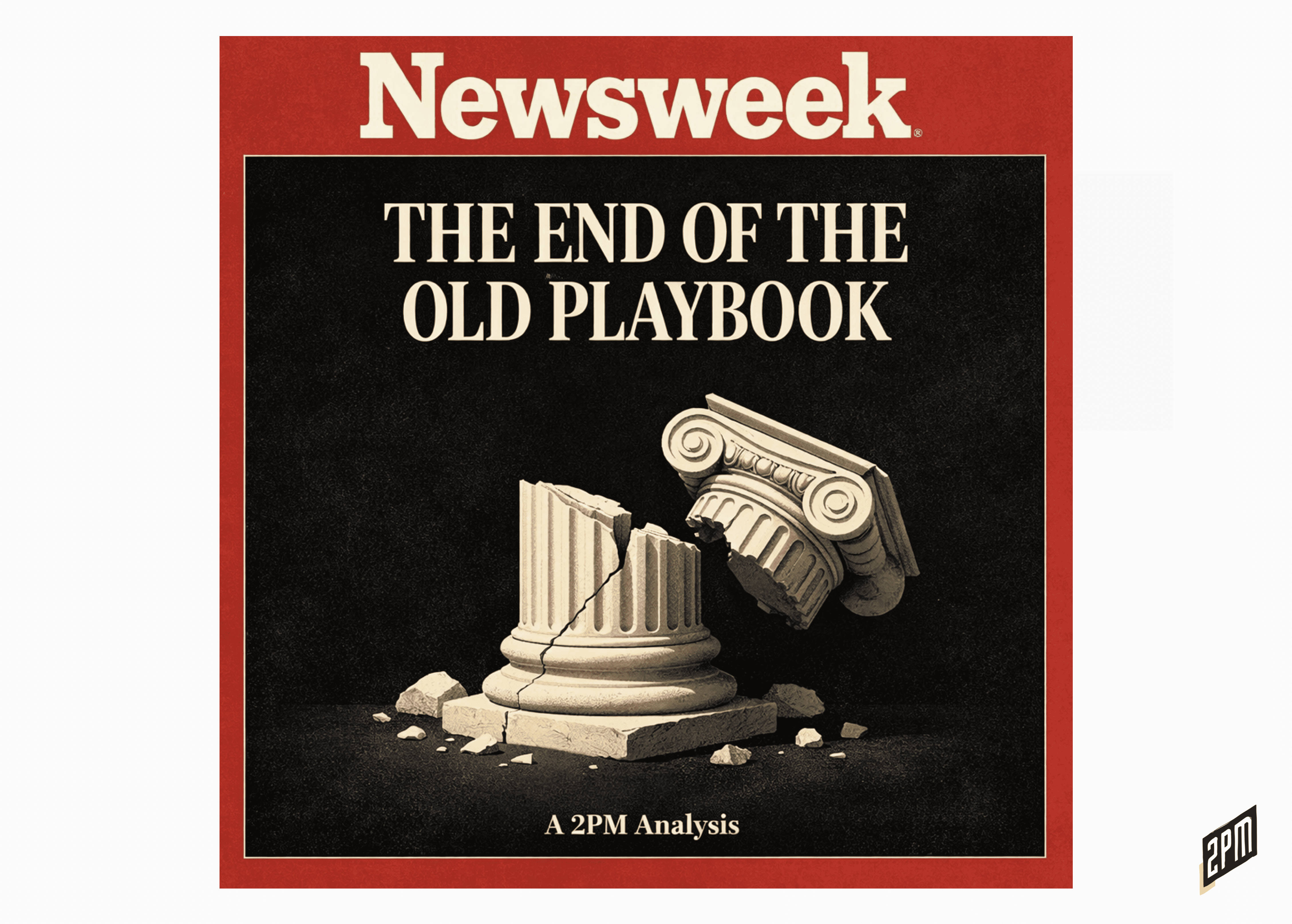
There was a time when the covers of Newsweek could tilt the emotional posture of a country.
You could feel it when one landed: airports, hotel lobbies, and kitchen tables. The magazine did not chase the week; it decided what the week was about. That power was not just cultural. It was infrastructural. Information moved slowly. Distribution was physical. Attention was concentrated; uthority was something you earned once and then exercised repeatedly. That system collapsed quietly.
Newsweek is not failing at being what it was. It is succeeding at being what the system now demands. And the system is only becoming more agentic.
The internet did not destroy journalism. It destroyed the economic and mechanical conditions that made that kind of authority possible. What replaced it was not chaos but a new structure, one built on velocity, redundancy, and continuous recomposition. And now, layered on top of that, a second transformation is underway. Agents increasingly decide what information matters before any human ever sees it.
Media brands are no longer competing primarily for readers. They are competing for position inside automated systems of discovery and synthesis. In this environment, there are three viable ways to run a modern media organization.
Some lean on brand equity and opinion driven journalism; their product is identity. They gather loyal audiences around recognizable voices and coherent worldviews. This remains extraordinarily effective for shaping human belief. It is far less effective for shaping machine behavior.
Others pursue channel innovation and deep reporting. They break stories and then, they generate primary facts. They still perform the essential labor of journalism. But their work moves slowly and expensively, and the distribution of that work increasingly depends on systems they do not control.
A third group has recognized that authority itself is changing form. These organizations build on brand equity, but they optimize relentlessly for the way agents ingest, rank, and reuse information. Their journalism is designed less to persuade and more to persist.
This is where Newsweek now lives.
The modern Newsweek is not the nostalgic magazine that people remember. It is not built to freeze a moment in time or to shape national sentiment with a single image and a handful of words. It is built to remain permanently inside the bloodstream of the global information system.
That transition did not happen because of ideology; it happened because of math. Consider this simple back and forth between a friend and me:
I’m starting to notice this trend across multiple media outlets. Scared of being sued? Has Trump drawn new lines? Have news firms grown a conscience? Are people simply becoming wiser to inductive framings? Either way, it’s a welcome new trend and should reduce the number of people propagating fiction dressed as fact.
My response:
GPT indexing incentivizes factual reporting rather than opinion.
Search engines, aggregators, social platforms, and now large language models reward coverage density, topical breadth, speed, and recognizability. They favor brands that publish often, across many domains, and with framing that is legible to both humans and machines. They reward familiarity. They penalize obscurity. They quietly assign influence based on retrievability and perceived risk. They also consider objectivity and seem to weight the reporting that abides by it.
Newsweek adapted to that reality.
It publishes at scale. It covers everything from geopolitics to culture to technology with high velocity. It rarely attempts to own the first narrative. Instead, it enters the stream quickly, frames events in language that travels easily, and becomes one of the sources that other systems feel safe citing.
This is not an accident. It is a strategy.
In the agentic world, credibility is no longer primarily something humans feel. It is something models compute. The Newsweek masthead still carries decades of accumulated trust. That trust now functions as a kind of passport inside automated knowledge systems. As suchg, it lowers friction. It reduces perceived liability. It increases the probability that an agent will include Newsweek in its summary of reality.
This is why Newsweek’s longevity matters deeply in the age of agents, even as its legacy no longer defines its business model. The nostalgia attached to old covers belongs to a different economy of attention. The modern Newsweek does not sell time. It sells placement.
There is something unsettling about that shift, especially for those who grew up with a very different conception of what journalism was supposed to do. The new model does not optimize for persuasion or for revelation. It optimizes for endurance inside a system that never stops recomposing the world. But it is a mistake to read this as decline.
Newsweek is not failing at being what it was. It is succeeding at being what the system now demands. And the system is only becoming more agentic.
The deeper implication is uncomfortable. In the coming decade, media power will belong less to those who write the most beautiful stories and more to those who fit most cleanly inside the machinery that decides which stories exist at all.
That machinery is already here. Newsweek simply learned how to live inside it. That is the real story: the internet used to be direct-to-consumer; today it is a wholesale retailer. Agentic stocks our attention economy’s shelves with commodities; the consumer no longer has to discover or concern itself with the brand behind the message. The arbiter of truth sources its news from elsewhere; we await its interpretation.
By Web Smith