Memo: On Formula One and America

Sitting in a New York City living room, I tuned into Netflix’s Drive to Survive for the first time. Three seasons later and I am a super fan. While aware of the mechanics and appeal of racing, I had long resisted an emotional connection to the sport. In an instant that changed. This isn’t the first time storytelling has normalized the appeal of engineering, dare devils, and high-intensity team work.

In F1, brands and performance and driver personality merge as one – on and off the track.

A lot can happen in 30 years. But as they say, the more things change, the more that they stay the same. A playbook written in 1986 was repurposed in 2016. Both of them worked wonders.

In 1986, a moderately-budgeted film called Top Gun bent the rules, broke some, and invented new customs that remain in place to this day. Whenever I asked my father (a military officer at the time) about the impact of the Tony Scott film, he commented on not the movie itself but its psychological impact. Consider this 1986 excerpt from Time Magazine:

The high-flying hardware turns Top Gun into a 110-minute commercial for the Navy — and it was the Navy’s cooperation that put the planes in the picture. The producers paid the military $1.8 million […]. Without such billion-dollar props, the producers would have spent an inordinate amount of time and money searching for substitutes, and might not have been able to make the movie at all. The partnership has been profitable for both Hollywood and the Pentagon. [1]

Decades later and the impact of the Tom Cruise breakout hit has been quantified. The film boosted aviation recruiting efforts by 500% according to ScreenRant. With a $15 million budget and a $350 million dollar box office performance, the film accomplished more than quantitative growth in enlistment – it altered cultural perception. Top Gun improved the American image of the US military at a time when most onlookers felt that was impossible. Gone were the images of the Vietnam War depicted in films like Apocalypse Now, Full Metal Jacket, and Platoon. Maverick, Ice Man, Viper, and Merlin succeeded in making the uniformed services appealing again.

The military needed a more flattering cinematic portrait, and they got it with the success of Top Gun. The image of a charming, daring young pilot serving his country was a powerful antidote to Platoon’s anti-war message.

So why the primer on Top Gun? Formula 1 Racing adopted the Tony Scott playbook to reshape its image in the United States, and it has worked flawlessly. In 2016, a CNN report on the acquisition by John Malone’s Liberty Media encapsulated F1’s advertising limitations:

The sport has long attracted premium advertisers in Europe, but it has failed to find an audience in the US.

Liberty Media then hired media executive Chase Carey as chairman, a position now held by Lamborghini’s Stefano Domenicali. From the start of the new administration, media penetration was at the center of the strategy. The deal was meant to position F1 as more of a content company than a racing body. It worked. In March of 2018, just two years after Malone’s acquisition, the Netflix agreement was announced for 2019. The season would be 10 episodes culminating in the coverage of the 2018 FIA World Championship.

Fast forward and Netflix’s impact has been palpable. McLaren Racing CEO Zak Brown cited its “huge” impact. He went on to say, “It’s got to be the single most important impact in North America.” “Almost every comment you get out of someone out of the US, they reference Drive to Survive.” Brown added another point in a statement on Netflix’s treatment of F1:

[Look at] Top Gun. You watch it, and I’m sure every fighter pilot went, you can’t do that in a jet. But it was a great movie.

There may not be another sport as intertwined with brands, science, bravado, and retail advertising than Formula 1 racing. Season three had its roots in fashion retail thanks to a major storyline revolving around the team formerly known as Force India Formula 1. The team, renamed “Racing Point,” finished impressively for a mid-season acquisition in its first year. By the 2019 season depicted by Netflix, it was competing for podiums in some races – a major feat given the engineering dominance of Red Bull, Mercedes, and Ferrari. The acquisition by retail executive Lawrence Stroll lined each episode with intrigue and controversy. Stroll’s family brought brands Pierre Cardin and Ralph Lauren to Canada and Europe through distribution and licensing deals. Stroll also invested in brands Tommy Hilfiger and Michael Kors, helping them to global prevalence.

It was Stroll’s decision to tightly copy the Mercedes engineering and aesthetic that lined the season with intrigue. With his son behind the wheel and nepotism on full display, the combination of engineering and his son’s performance proved naysayers wrong. The “Pink Mercedes” was the ire of competitors who were equally frustrated and enamored by Racing Point’s sudden success. In typical Stroll fashion, the business magnate leveraged that early success into a deal to bring James Bond’s own Aston Martin back to racing for the first time in 60 years. In an agreement for 18.1% of the company, Racing Point Stroll’s F1 team was rebranded as Aston Martin for the most recent season. A nod to the intersection of film, retail, advertising, and racing – the legendary car manufacturer has struggled throughout the pandemic as it awaited a much needed boost from the delayed final addition to the James Bond franchise. Its brand endurance will depend on Stroll’s wit and his team’s performance and notoriety. In F1, brands and performance and driver personality merge as one, on and off the track.

For this reason, brands vie for deals with constructors and their star drivers. Lewis Hamilton, racing’s premier driver and historical leader, is adorned with logos of Monster Energy, Puma, IWC, Sony, Bose, August Motorcycles, Gran Turismo Sport, Bell Helmets, and Tommy Hilfiger. His constructor logo takes center stage: Mercedes Benz. Unlike other popular forms of racing, F1 is purely aspirational in much the same way soccer’s finest leagues are. F1’s courses are located in some of the most enamoring venues on earth with Miami to be added in 2022 thanks to Related Companies Stephen Ross, the owner of the Miami Dolphins and RSE investment partner to Gary and AJ Vaynerchuk.

The emerging interest in America could not come at a better time for the next American city to be added to the international race circuit. Over the pandemic, Miami has risen as a destination for economic migration, wealth-creation, venture investment, and new construction thanks to savvy advocacy marketing by its mayor. In ways, Miami has become the microcosm of the America that Formula 1’s management and its many advertisers hope to captivate.

It’s been nearly 40 years since America’s Mario Andretti dominated Formula 1 racing. In April 2021, just 9% of American 18-24 year olds considered themselves avid fans of the sport. Just 13% of 35-44 year olds said the same. But if trajectory is the same, we will see more of Americas advertisers and partnerships reflected in a sport that is long overdue to capture the attention of a willing country. As with storytelling, it’s more than attention that is at stake, it’s imagination. Maybe with enough, America will find its own version of Sir Lewis Hamilton.

This is an economy of bifurcated consumers and retail excess; it’s an economy of big tech, individualism, red state migration, digital goods, decentralized finance, record-breaking travel, sportsbooks, luxury goods, fast cars, and outspoken heroes. Name a better marketing platform than a land rocket zooming past at 160 miles per hour, with one of the world’s 20 best drivers calmly narrating as he tests his wits.

Netflix is Formula 1’s unsung hero and it may succeed in changing the landscape of America’s niche sports interests.

By Web Smith | Editor: Hilary Milnes

Member Brief: Rapinoe Leads The Offensive

For companies like Parade, Adore Me, ThirdLove, Thinx, Savage x Fenty, and Knix, there was no easier target than Victoria’s Secret. For decades, VS was a retail brand that moved like Goliath while being run by executives that felt that David never had a stone’s chance. Agility was the Columbus, Ohio company’s nemesis. Even throughout a number changes over the years, it failed to see two things coming: insurgent competition and an evolving American culture. Tone deafness was its own worst enemy. The brand’s hubris made amateurs of retail industry legends.

This member brief is designed exclusively for Executive Members, to make membership easy, you can click below and gain access to hundreds of reports, our DTC Power List, and other tools to help you make high level decisions.

Join Here

Memo: The Netflix Playbook 2.0

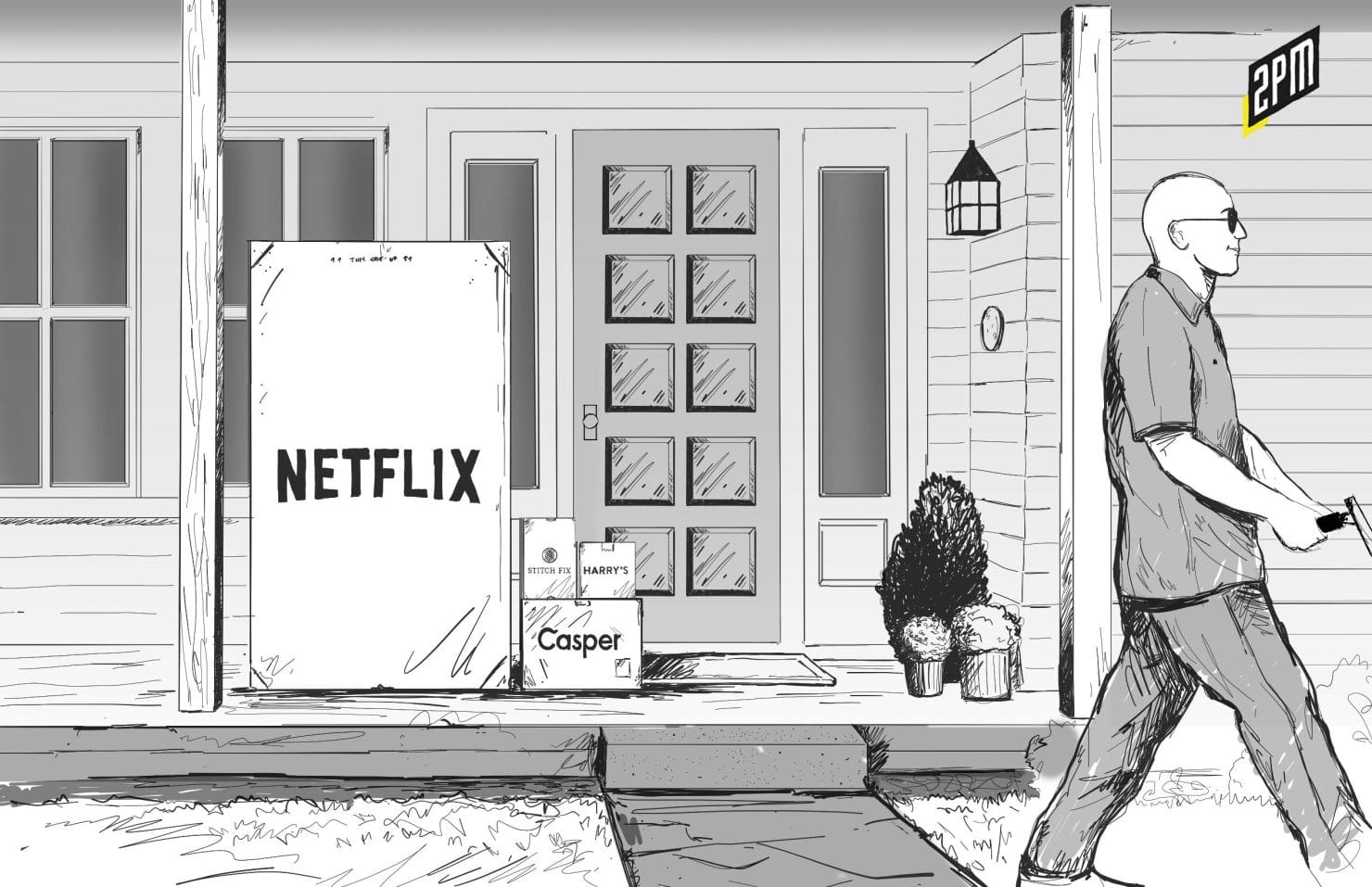
One hire can make all of the difference. For Netflix, Josh Simon’s role as VP of Consumer Products is key to the platform’s offense, defense, and long-term viability as studios become self-sustained content fortresses.

The excitement around Netflix’s eCommerce push is palpable. If this project succeeds, the implications are far greater. CEO Ted Sarandos and Netflix are resting on dormant potential. With direct-to-consumer retail success, the streaming service and film studio could compete with Disney on another front.

Disney Plus infringed on Netflix’s ground and made an immediate impact on its offering by doing so. Netflix’s Marvel, Star Wars, and Pixar catalogues are now sparse. In April 2021, the other major intellectual property factories began threatening to move their projects from Netflix. Engadget recently encapsulated the mounting competition:

The battle to gain a foothold in the streaming era has spurred Hollywood studios to go on the defensive. After licencing films and shows to Netflix and Amazon, the likes of Disney and WarnerMedia have yanked their biggest properties from the competition to boost their own platforms. Not to be left behind, Comcast-owned NBCUniversal is reportedly mulling a similar strategy in a bid to prop up its fledgling streamer, Peacock, reports Bloomberg. [1]

As Hollywood goes on the defense, Netflix has responded with a strategy that signals the beginning of a longer-term approach to competition with Disney, Amazon, WarnerMedia, and Comcast’s NBCUniversal. It begins with DTC retail.

Phase One: Original Brand Retail

Netflix’s Shopify build shouldn’t be much of a surprise. The decision to pursue a millennial-friendly style of commerce over a traditional custom build or a more robust partnership with Salesforce, BigCommerce, or Magento is telling. This is what very large companies do when they’re not entirely sure about direction: equal parts skepticism and efficiency. But the decision may play in its favor.

Even if the Shopify development required $1-3 million (it was likely much less expensive), it’s a relatively tiny investment into a nascent operation that will grow methodically over the coming weeks. Designed by BVA and developed by SDG (a partner to Skims and Prive Revaux), Netflix.shop is the streaming giant’s entrance into DTC. It’s a launch that the company hopes will communicate its brand is fresher than its age (Netflix is now 24 years old).

And aesthetically, functionally, and psychographically, the Shopify approach is consistent with Netflix’s goals. Not just from its front-end appearance and merchandising but from the technologies used: Shopify, Klaviyo, and Signifyd. In terms of product development, collaborative partners, and product photography styling, the retail platform succeeded in setting out to attract a younger, vibrant, and savvy consumer. So young that geriatric millennials may not fully grasp Netflix’s product and partnership strategies. Japan’s Beam brand, anime, and its Yasuke animated property are all indicators this approach may have greater implications. So in theory, this small investment may become Netflix’s most important.

Web Smith on Twitter: “Our daughters now have a whopping $126 worth of merchandise commemorating Season 3 of Stranger Things and outside of minimal licensing fees, Netflix earned none of that. Linear Commerce would transform Netflix’s prospects. / Twitter”

Our daughters now have a whopping $126 worth of merchandise commemorating Season 3 of Stranger Things and outside of minimal licensing fees, Netflix earned none of that. Linear Commerce would transform Netflix’s prospects.

Netflix has long known its potential in leveraging its intellectual property for merchandise sales. In July 2019, a countless number of retailers licensed Netflix’s “Stranger Things” property. For a short period, it was a retail bonanza for Target, Amazon, H&M, Kellogg’s, Burger King, Coca-Cola, Hot Topic, Walmart, and even Baskin-Robbins who converted 75 of their stores to appear like the series’ “Scoops Ahoy” ice cream shop.

The Duffers said none of the marketing deals meant to hype their show would add to their bank accounts. “We’re not getting a revenue cut from any of this,” they said. “The hope is that it just gets the show more exposure.” [2]

But throughout this era of Netflix, the only potential transactions were in-show product placement and the potential of heightened subscription interest.

Phase Two: Live Events and Activations

In March 2020, I calculated the math on Netflix’s eCommerce potential as the streaming studio’s hire of Josh Simon tipped off the current direction.

Web Smith on Twitter: “In July, I did some basic estimates on Netflix’s online retail / licensing potential. “Just 7% of Netflix’s viewers purchasing through the app – at a $50 AOV – would equate to over $140M in sales from 41 million households.”@Netflix is moving towards linear commerce. pic.twitter.com/P2DpTe0dlq / Twitter”

In July, I did some basic estimates on Netflix’s online retail / licensing potential. “Just 7% of Netflix’s viewers purchasing through the app – at a $50 AOV – would equate to over $140M in sales from 41 million households.”@Netflix is moving towards linear commerce. pic.twitter.com/P2DpTe0dlq

Simon’s hire is as directional as it is functional. Earlier in the new VP of Consumer Product’s career, he spent time working at Nike. But it was his six years working for Walt Disney Studios and Blumhouse’s live experience business that will shape Netflix’s brand and audience strategy for consumer products. He’s tasked with “identifying and building plans across different lines of business in consumer products” according to a 2020 article by Variety [3].

And this is why the Shopify experiment has long-term implications. If Netflix can prove that it can successfully capture more of its commercial upside by insourcing more of its retail, more live events will follow. Later in 2020, “Stranger Things” rode the success of the Baskin-Robbins partnership by launching an interactive drive-thru experience in Los Angeles. Spanning 400,000 square feet at Skylight Row in Downtown Los Angeles, the hour-long performance featured scenes from 1985 Hawkins. The guests were encouraged to dress in their finest 1980s wears as they were transported back 35 years to a high school reunion, the fictional “Starcourt Mall”, and then to a three-part show featuring the three seasons’ key moments. The live event was co-produced by Netflix and Fever, a venture-backed event platform. This is inline with Adweek’s contention that the streaming giant will continue finding innovative ways to capitalize on its intellectual property:

Netflix’s eCommerce push caps off years of dabbling in the consumer products business that Netflix has been pursuing through retail and brand partnerships as it has looked to find ways to capitalize on the runaway success of some of its original series. [4]

Netflix’s Shopify strategy is the precursor to a focused effort to bolster the viability of its class of properties that may eventually take on life as temporary live events. But this isn’t where Netflix’s aspirations need to end.

Phase Three: The Netflix Universe

With Josh Simon’s charge to capitalize on the runaway success of some of its original series, Netflix’s strategy is unlikely to complete with temporary live events and short-term activations. Netflix has amusement park potential and its decision to pursue commerce as an initial step is a credible attempt to capture the data required to build a strategy around a physical location for young adults. That includes members of Generation Z, Netflix’s core demographic, as it attempts to compete with video game studios, amusement parks, and film production houses with their own streaming services. Consider Netflix’s biggest competition:

Netflix said in 2019 that its biggest competition is actually Fortnite, which is what more likely pulls players away from the streaming service. [5]

Netflix’s digital world may converge on the physical for good. In doing so, Netflix will finally go on the offensive after nearly a decade of Hollywood’s traditional studios breaking down one of its two prized advantage: its content curated from other studios. The result may be a Netflix that goes all-in on becoming more like Disney or Universal in the process:

As Netflix tries to compete with Disney on a global scale, it is trying to create franchises that can have the same impact on culture as “Star Wars” or “Toy Story.” [6]

It is unlikely that Netflix will ever find it suitable to acquire 25,000 acres of land like Disney before it, or even 415 acres like Universal Studios. But in nearly every metropolitan region in America, there is a dying mall – one that bustled in the era depicted by the “Stranger Things” fictional Starcourt Mall. There will be inexpensive property at CEO Ted Sarandos’ disposal and it wouldn’t be the first time that Netflix converted a dead mall into something useful.

If the streaming giant proves that IP-fueled merch can sell, so might brick and mortar retail, pop-up experiences, and amusements. Don’t be surprised if Netflix’s digital experiments precede its venture into physical retail, events, and a permanent home for its beloved original properties. It’s created franchises that are valuable. Walt Disney knew what he was doing when constructing a Bay Lake, Florida home for his franchises. In this day and age, what begins as DTC often ends up in physical formats. It’s what takes a valuable property and makes it a beloved one. A lasting cultural impact may follow.

By Web Smith | Art: Alex Remy | Editor: Hilary Milnes