Agentic: Shopify and Google’s UCP Will Democratize Commerce

But only for the brands and retailers that understand the new rules of the agentic commerce era.

I spent the better part of fourteen hours reading every page of Shopify’s Universal Commerce Protocol announcement. Not skimming it; not headline parsing it. I read the product notes, the architectural explanations, the developer implications, the platform logic, and then I sat down with the most technical person in my orbit and had them walk me through what Shopify is actually building. Not what they are saying they are building, but what the underlying principles of the system are: what the protocols mean, how the state machines behave, where the trust boundaries live, where human agency ends and machine agency begins. Most importantly what this infrastructure allows now and what it will allow five years from now.

When you do that exercise honestly, something becomes very clear. Shopify is not launching features. Rather, Shopify is laying the foundation for the next economic operating system and no one else has the horsepower to compete with them.

In the old economy, scale dominated. Whoever could buy the most traffic, flood the most channels, and sustain the largest ad budgets won. The new system does not care about your ad spend. It cares about your structure.
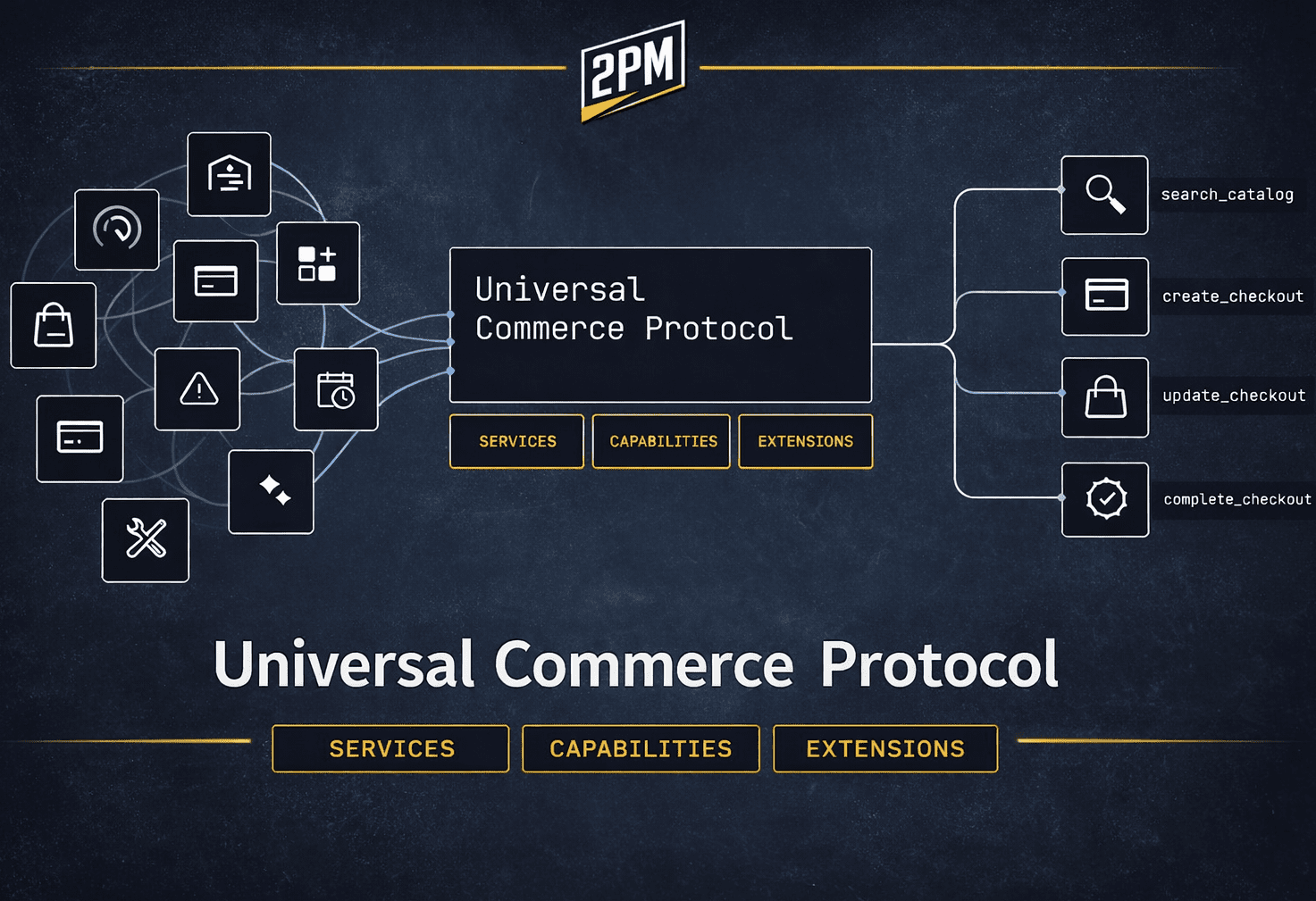
For the last twenty-five years, digital commerce has been built on persuasion. We optimized pages, funnels, copy, creative, attribution models, retargeting loops, and emotional triggers. We argued about brand and performance as if they were separate disciplines. We treated the internet like a mall. Shopify’s architecture makes it impossible to keep pretending that model survives the next decade.

We are entering a deterministic economy.

In a deterministic economy, outcomes are decided before the moment of choice. By the time a consumer sees a product, an increasingly large portion of the decision has already been locked in by structure, constraints, permissions, guarantees, and system design. This is the part of agentic commerce most people miss. They are still thinking about agents as new interfaces for old persuasion. They do not yet understand that the persuasion layer is becoming irrelevant.

When I first wrote about Agentic Commerce and AEO, I framed agents as the new homepage, the new SEO layer, the new point of sale. That framing remains directionally correct. But it understates the depth of the shift. The deeper change is not in discovery, it is in determinism. It is in who is allowed to win and why.

An agent does not browse, nor does an agent does not get tired. An agent does not feel brand affinity; an agent executes inside a defined constraint environment. That environment is shaped by what the user has permitted and what the business has declared. The business that fits the constraint environment best becomes the default winner.

This is what Shopify’s framework operationalizes.

When Shopify demonstrates that Google Gemini consistently prefers Monos luggage over its competitors and that ChatGPT produces similar recommendations, this is not a coincidence and it is not marketing. It is a signal. It suggests that Monos satisfies the underlying framework of constraints better than competing brands.

At Monos, we’re excited about agentic shopping because it enables us to meet customers where they already are. It’s a new way for our story and product details to show up at the exact moment someone is asking real questions with real intent, in a format that feels helpful, not intrusive. For a brand built on thoughtful design, it’s a natural next channel for discovery and trust. [Shopify]

Victor Tam, CEO and Co-Founder of Monos

Their data is cleaner, their policies are clearer, and their guarantees are stronger. In additiona, their fulfillment is presumably more reliable. Their trust signals are easier for machines to verify; their product attributes are more consistent and their systems are easier to complete transactions with.

This is not about who has the prettiest site; his is about who has built the most compatible business.

This is where the democratization of commerce quietly emerges. In the old economy, scale dominated. Whoever could buy the most traffic, flood the most channels, and sustain the largest ad budgets won. The new system does not care about your ad spend. It cares about your structure.

A small brand that publishes cleaner data, offers stronger guarantees, delivers faster fulfillment, simplifies returns, and maintains more reliable inventory becomes more attractive to an agent than a massive brand with messy systems and brittle operations. The competitive playing field shifts from capital dominance to operational excellence.

This is profoundly democratizing.

A founder with discipline, clarity, and strong systems can now compete with companies a hundred times their size, not because the agent is fair, but because the agent is ruthless. It selects the path with the highest probability of successful completion for the user. In the deterministic economy, small brands do not need to shout louder. They need to be built better.

This is why the entire idea of marketing as persuasion begins to erode. You do not convince the agent; you construct a business that the agent is allowed to choose.

At MTN Haus, we have been building in this direction for months, ironically. Yes, often without even naming it. We focused on membership systems that act like operating systems. We obsessed over data consistency, policy clarity, fulfillment logic, identity frameworks, subscription mechanics, and trust surfaces. We pushed clients to invest in boring things that did not feel like growth. Returns infrastructure, fulfillment reliability, inventory synchronization, policy transparency, and product data normalization. This is machine legibility.

Most agencies avoided that work because it is not sexy. It does not show up in creative decks; however, it is precisely what agents reward.

When we developed Snack Clock architecture, for a major CPG brand, the goal was not just to improve UX. It was to eliminate cognitive load and reduce friction in the moment of demand. That same logic now becomes machine-first.

Sometimes, the future is hard to explain to those living in the present.

Snack Clock was not just a UX feature; it is an early expression of deterministic commerce. Where most shopping systems force agents and consumers to infer urgency, Snack Clock required users to explicitly declare it. The moment someone turns the dial from “Now” to “Never Run Out Again,” they are no longer browsing; they are encoding a constraint. That constraint becomes the governing logic of the transaction.

Everything that follows is execution. Each path removes friction by design, routing the user or agent directly to the fastest, safest fulfillment channel available, whether that is local delivery, marketplace checkout, direct DTC, or subscription.

The result is a system that increases completion probability, which is the primary selection metric for agents. Snack Clock also makes the brand liquid by exposing multiple negotiation pathways at once. Agents prefer merchants that can adapt to more situations with fewer unknowns. Most importantly, Snack Clock transforms trust from a marketing claim into a computational guarantee by making outcomes predictable and verifiable. In an agentic economy, that structural advantage is decisive.

Agents will learn those temporal patterns and begin to recommend brands based on how well they satisfy time-based demand. The brand that understands when a problem emerges and can solve it with minimal friction becomes structurally superior.

This is not speculative. It is already happening. The deterministic economy operates on four hidden levers.

  • Constraint engineering
  • Friction elimination
  • Negotiation bandwidth
  • Trust as computation

The first is constraint engineering. MTN Haus’ Snack Clock architecture was an early example of this. Every business publishes rules: where they ship, how fast, what they guarantee, what happens when something goes wrong, and how disputes are resolved. Then, on to how identity is verified, how payments are handled, and how loyalty is honored. These rules define the feasible solution space the agent can operate within. Expand that space responsibly and the agent will choose you more often. Shrink it or complicate it and the agent will avoid you.

The second is friction elimination. Every additional step that requires human involvement reduces the probability of transaction completion. Brands that remove escalation points win. This is not about UX anymore; it is about computational efficiency.

The third is negotiation bandwidth. Brands that expose flexible pricing, dynamic bundling, loyalty conversions, and time-based logic give agents more degrees of freedom to optimize outcomes. Rigid businesses lose.

The fourth is trust as computation. Trust becomes verifiable, guarantees become cryptographic, and identity becomes machine-readable. Reputation becomes structural.

This is where my early AEO thesis was both right and incomplete. I was correct that structured data, schema alignment, policy transparency, and factual consistency would become the foundation of visibility. Where the thesis fell short was in recognizing that AEO is not just about being recommended. Rather, it is about becoming the easiest possible outcome for a system to choose.

Recommendation is a symptom. Determinism is the disease.

Outside media still matters, but not for the reasons most marketers think. Media does not persuade the agent; media reshapes the human’s constraint environment. It modifies trust, risk tolerance, ethical alignment, and long-term preference. Those updated constraints are then enforced by the agent. When the agent shops later, it is operating inside a newly defined rule set. Media moves the boundaries of what is allowed; it does not pull the trigger itself.

This is why public perception, cultural trust, and earned media remain critical in an agentic economy. They expand the computational reach of your brand.

Shopify’s framework confirms that commerce is no longer about storytelling at the point of sale; it is about system design at the point of possibility.

The brands that win the next decade will not be the most charismatic, they will be the most compatible. They will be the most verifiable, most reliable, the easiest to complete, the most negotiable, and the most machine-readable.

The deterministic economy is here. And the work required to survive it has already begun.

Research and Writing By Web Smith
NATSEC Roundtable No. 8: Dragon-Guarded Mountain of Treasure

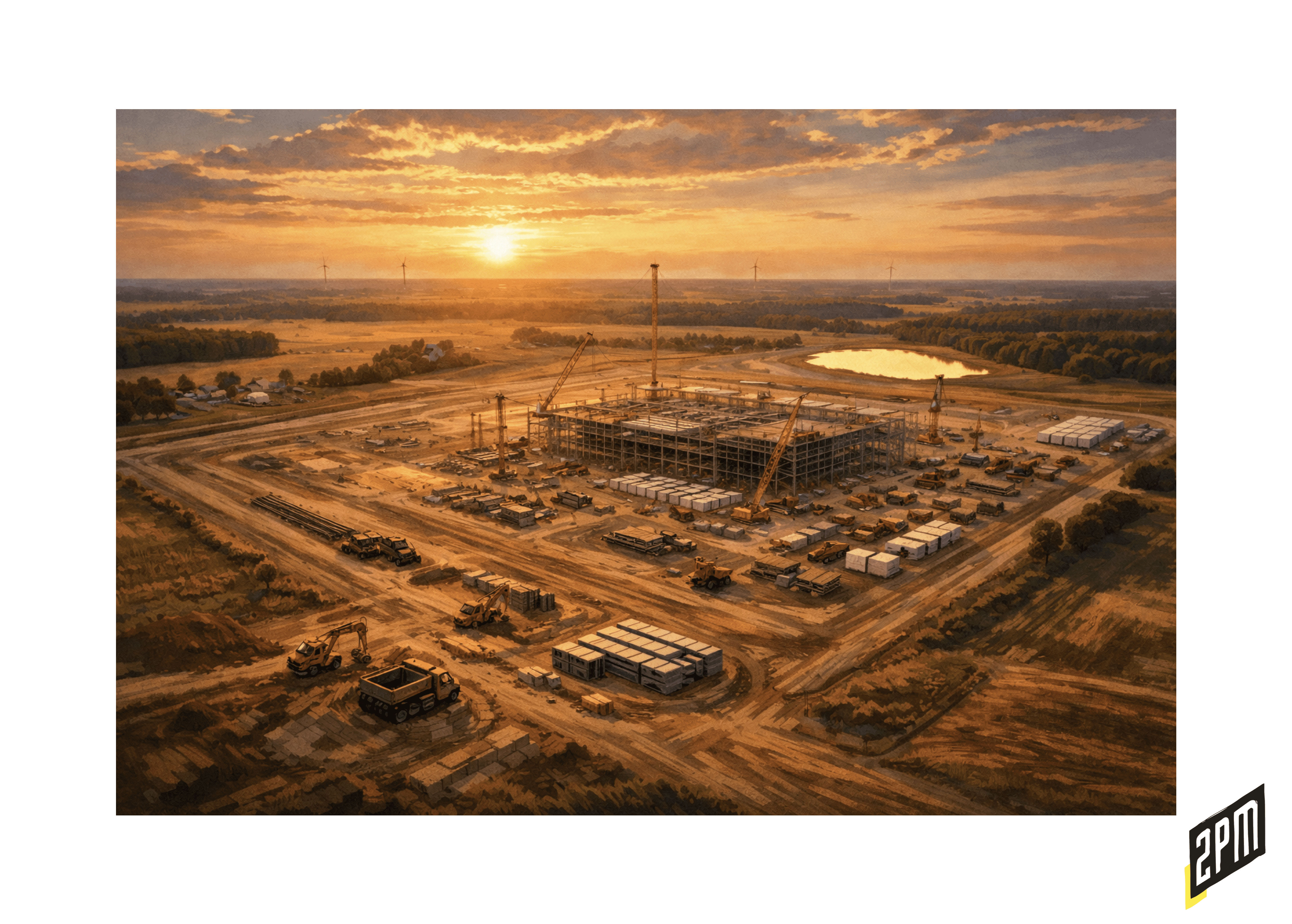
Build site: Anduril’s Arsenal-1 (Ohio)

Why Financial Infrastructure Is Now National Infrastructure

Over the past several years, my writing under the NATSEC banner at 2PM has explored how American commerce has quietly become inseparable from national security. From artificial general intelligence and biometric identity systems to re-identifiable consumer data, weaponized supply chains, and the industrial resurgence triggered by companies like Anduril, the through line has remained consistent. The battlefield is no longer confined to geography. Rather, it has expanded into markets, logistics networks, data ecosystems, and capital structures. The modern conflict is being waged inside the machinery of the economy itself. Finance is another layer of this machinery, one best explained by quantum mechanics:

A ‘superposition’ is a particle that can exist in multiple states or locations at the same time until it is measured. Mathematically, a particle’s wavefunction spans many positions at once. Frontier companies in defense, energy, AI, aerospace, and industrial tech exist today in a similar state of economic superposition. They are simultaneously:

  • Engineering organizations
  • National security assets
  • Commercial entities
  • Policy instruments
  • Sovereignty projects

But they cannot fully realize all of those states at once because capital is the measurement device. The deeper I have gone into this convergence, the more one conclusion has crystallized. America does not have a technology problem. It does not have a talent problem. It does not even have a will problem. What it has is a capital architecture problem. The financial systems that are supposed to fund, scale, and stabilize the next generation of American industry are misaligned with the reality of the world they now serve. Until that changes, everything else remains downstream.

If those primitives are financed on venture timelines, the United States inherits venture risk at the level of national infrastructure.

We are entering a period where the United States is being asked to rebuild industrial capacity and defense capability at scale under conditions of permanent geopolitical instability; this is not a cyclical adjustment. It is a structural transition. The systems that govern capital allocation were built for a world of short wars, long peace, and slow moving technological change. That world no longer exists; what replaces it is an environment where risk never resets to zero, where supply chains are weaponized, where data flows are strategic terrain, and where industrial production itself becomes a form of deterrence.

In that environment, the greatest constraint on American power is no longer innovation or engineering. It is finance.

The weakness of the current defense and industrial financing model is subtle but devastating. Defense technologies and industrial platforms require long timelines, heavy capital investment, regulatory endurance, political fluency, and sustained workforce development. Yet the dominant sources of private capital remain optimized for fast iteration, short duration risk, rapid exits, and financial optionality. Venture capital expects hypergrowth and liquidity events; not every venture firm thinks like In-Q-Tel, for instance. Public markets impose quarterly discipline and private equity extracts cash flow and compresses operating horizons while government procurement remains bureaucratic and slow. Each of these systems evolved in rational isolation. Together, they form an ecosystem that is structurally incompatible with the demands of modern national security.

This mismatch produces cascading consequences. Companies are forced into artificial business models that optimize for investor optics rather than strategic durability. Engineers and operators are pulled toward projects that satisfy capital timelines rather than national needs. Startups burn precious years waiting on government contracts while government waits for startups to de risk themselves. The entire system stalls inside its own incentives.

In my recent essay on existential risk and growth at 2PM, I argued that once systemic danger exists, time itself becomes the most dangerous variable in the system. Slowing down does not stabilize risk. It compounds it, as I explain below.

Risk is not eliminated by waiting. It is outrun. The brands that survive disruption do the opposite. They accelerate through it. They ship faster or they learn faster. They adapt faster and they reach stable ground first. Specific industries have internalized this logic completely. Defense technology never pauses. When the threat increases, acceleration becomes the strategy. Data infrastructure behaves the same way: rising complexity demands faster buildout, not slower. Entertainment follows the same pattern. Fragmented attention requires aggressive output, not restraint.

The longer a society remains exposed to structural vulnerabilities, the greater the cumulative probability of failure becomes. That logic applies directly to American industrial and defense finance. The world is not becoming safer; the hazards are already embedded. The correct response is not to pause or retreat. It is to build faster, scale faster, and reach the next equilibrium before exposure compounds.

The problem is that our financial institutions punish exactly that behavior.

Venture capital in particular is the wrong tool for a significant portion of frontier technology. Venture was built to fund software, networks, and platforms that scale with minimal capital intensity and deliver liquidity within a decade. It is extraordinarily effective at that task. It is deeply unsuited for sovereign-scale infrastructure, advanced manufacturing, defense systems, energy grids, space platforms, and industrial AI. These domains demand patience, stability, and commitment. Venture demands velocity, optionality, and exit.

When those incentives collide, the nation pays the price. Dual-use companies contort themselves into enterprise abstractions. Hardware firms chase SaaS narratives. Defense startups chase recurring revenue optics while delaying the hard work of physical scale. The financial structure, not the mission, becomes the primary constraint.

This is not an abstract concern. In the NATSEC essays at 2PM, I have shown how surveillance technologies, identity systems, consumer data markets, and global supply chains have already become national security primitives. If those primitives are financed on venture timelines, the United States inherits venture risk at the level of national infrastructure. That is not merely inefficient. It is strategically dangerous.

The appropriate financial architecture empowers a quantum-like economic superposition that enables industry, intelligence, and people across key geographic regions in the United States.

A handful of companies have already broken this model. Palantir, SpaceX, and Anduril did not succeed simply because of superior technology. They succeeded because they rejected the existing financial architecture and forced capital to adapt to the mission rather than the reverse.

Financial infrastructure is no longer a neutral service layer of the economy.

Palantir embedded itself inside the government long before it ever approached public markets. SpaceX refused short-term economics and compelled investors to accept decade-scale risk. Anduril rewrote the defense contracting playbook entirely, building manufacturing with the speed of software and anchoring production inland as a sovereignty play, a transformation I explored in depth in the Anduril essay at 2PM.

What these companies created was not simply a new category of firm. They created a new category of capital relationship. Not venture, not government, and not defense prime. Something hybrid, long-term, and sovereign-aligned. A financial structure capable of sustaining national objectives at industrial scale.

Once you see this pattern, it becomes impossible to ignore its implications. Financial infrastructure is no longer a neutral service layer of the economy. It is now a national infrastructure. The architecture of capital determines which technologies survive, which regions grow, which industries remain resilient, and which supply chains harden under pressure. It determines how quickly a nation can adapt under stress and how deeply it can absorb shocks without cascading failure.

In modern conflict, wars are often decided before the first weapon fires. They are decided in capital markets, data markets, manufacturing pipelines, energy financing, and talent flows. Whoever designs the financial infrastructure controls the true battlefield.

This is where a new class of institutions begins to emerge. Entities that do not merely lend, invest, or underwrite, but that engineer capital as strategic infrastructure. Institutions that understand that sovereign intent and financial architecture must be fused if American power is to remain durable.

The next phase of American industrial resurgence will not be led solely by engineers, policymakers, or military leaders. Financial architects will lead it.

The work of commercial operators becomes central in this transition: engineers build systems, policymakers define objectives, but the world breaks or holds in the space between them. It breaks in supply chains, hiring pipelines, revenue models, capital stacks, and institutional trust. Commercial operators live inside those fault lines. They understand how incentives distort behavior, how systems fail under stress, and how narratives shape capital flows. They operate at the intersection where mission meets market and where theory becomes execution.

Commerce, as I have argued repeatedly in the NATSEC series, is no longer neutral. It is strategic terrain.

America’s next century of power will be built inside this convergence of finance, industry, and national security. The country does not lack ambition. It lacks the financial systems capable of carrying that ambition to scale without collapse. Fix the capital architecture and the rest accelerates. As Trammel and Aschenbrenner recently quantified in Existential Risk and Growth, “risk is not eliminated by waiting. It is outrun.”

This work will be addressed, at least partly, by a dragon-guarded mountain of treasure and the people or companies enabled by it.

Written by Web Smith | LinkedIn Profile

Strategy: On “Existential Risk and Growth”

On December 23, Oxford PhD and Stanford Economics Postdoc, Phillip Trammel, and Leopold Aschenbrenner published Existential Risk and Growth. The timing couldn’t be more relevant. We are living through a constant debate on the merits of subjective arguments across AI, policy, and technology circles: that slowing progress is the responsible thing to do when risk increases. Aschenbrenner’s independent work served as the basis for 2PM’s first NATSEC dispatch; it was, then, required reading. This, again, felt like required reading.

These authors are far more competent than the vast majority of us. Rare air is the capability to write as clearly as they; the gentlemen contended with ideas by establishing mathematical truths against them, setting a standard that most who’ve yet to encounter doctoral-levels of academia have yet to contend with. Every few years you come across a paper that forces you to quietly update a lot of assumptions you did not even realize you were carrying.

The main ideas they contend with appear in AI governance debates, in calls for innovation moratoria, and in the general belief that caution and delay are synonymous with wisdom.

Stagnation is only safe if the current world is perfectly safe.

That instinct never fully squared with what I observe in markets, in business, and in human behavior. In eCommerce, in brand building, in infrastructure, and in national defense, the environments with the highest stakes are rarely stabilized by slowing down. They are stabilized by learning faster, building faster, and reaching the next structural equilibrium before your exposure compounds.

This paper finally gave that intuition a rigorous backbone. It does not argue from ideology or optimism; it argues from the mechanics of risk itself. Once danger exists, time becomes the most expensive variable in the system. Everything else follows from that.

The read is worth your time.

There is a recurring pattern in modern leadership that rarely gets interrogated with the seriousness it deserves. When confronted with volatility, institutional uncertainty, or technological acceleration that outpaces cultural digestion, executives reach for the same lever. They slow down, or they defer. They reduce exposure, or they wait for the environment to stabilize.

Permanent stagnation can lower transition risk by avoiding advanced experiments altogether, but an acceleration that only pulls forward their date leaves cumulative risk unchanged. If the hazard rate is strictly convex in the rate of experimentation, however, then faster growth increases transition risk. The tradeoff between lowering state risk and raising transition risk can render the risk-minimizing growth rate finite, but as long as there is any state risk at all, it remains positive. [Page 4]

This reflex is nearly universal. It is also structurally misguided.

The most consequential insight in recent thinking on existential risk is not that technology is dangerous. Rather, it is that time itself becomes dangerous the moment risk exists at all. Once the probability of catastrophic failure rises above zero, every additional unit of time spent inside the current system increases total exposure to failure. The world is already in that condition.

  • Nuclear weapons exist.
  • Pandemic capability exists.
  • Bioengineering exists.
  • Climate dynamics exist.

In this way, we truly are beyond the neutral baseline (even if we choose to ignore it). There is only a hazard rate, a probability that the heightened baseline becomes more noticable. And the mathematics of hazard produce a conclusion that directly contradicts the dominant narrative of precaution: if danger already exists, slowing technological progress usually increases the total probability of civilizational failure.

This is not rhetoric; it is structural logic.

Time Is the Hidden Variable of Risk

Risk is not simply about what might happen. It is about how long you remain in a state where something might happen. If the probability of collapse in any given year is non-zero, then long-run survival depends on whether the cumulative risk remains finite. That depends not on how careful you feel, but on how quickly you can move beyond dangerous conditions.

This produces an uncomfortable truth. Stagnation is only safe if the current world is perfectly safe. It is not. Freezing progress while danger exists does not stabilize the system. It mathematically guarantees eventual catastrophe. Waiting does not eliminate risk. It compounds it.

Stagnation is safe, as assumed in existing literature, only if the current technology state poses no such risks. [Page 27]

This insight alone dismantles much of the contemporary obsession with technological pause. Pausing does not reduce danger when danger is already embedded; it merely increases exposure time.

Innovation Does Create Risk and That Still Does Not Save the Slowdown Argument

The standard objection is that innovation itself is dangerous: experiments fail, systems break, deployment creates new vulnerabilities. All of this is true but the conclusion drawn from it is usually wrong.

When making tradeoffs over time, it is uncontroversial to discount later periods for reasons of uncertainty. [Page 32]

Even when experimentation introduces new hazards, slower progress only becomes safer under extremely narrow conditions. As long as any background danger exists, the growth rate that minimizes risk remains positive. Zero growth is never the safe option once risk is already in the system. The real strategic error is confusing short-term volatility with long-term safety.

The Economics of Safety

The most underappreciated part of this framework is economic, not technological. As societies grow wealthier, the value of life rises. The marginal value of additional consumption falls, and the willingness to sacrifice output for safety increases dramatically. Growth does not simply produce new dangers. It manufactures the political, institutional, and financial capacity to neutralize them.

At first, things get worse:

  • Pollution rises.
  • Inequality rises.
  • Cities get messy.
  • Labor conditions deteriorate.
  • The side effects of growth show up everywhere.

But after a certain point, something flips. Once people are wealthy enough, they start caring more about clean air, worker safety, health, education, and the long-term quality of life. They can finally afford to fix the problems growth created. So the curve looks more like an upside-down U:

  • Early growth: more wealth, more problems
  • Later growth: more wealth, fewer problems
  • Growth causes the mess, then growth pays to clean it up.

That is the Kuznets Curve. This creates a structural pattern that mirrors the environmental version of the curve. Risk may rise early in development, but accelerating growth eventually generates the resources and incentives for aggressive safety investment, which sharply reduces hazard rates.

In other words, growth builds its own seatbelts. When policymakers and institutions respond rationally, acceleration reduces risk twice. It shortens exposure to dangerous states and it pulls forward the arrival of high-safety regimes.

What Executives Miss and Why It Matters

This is not an abstract debate about civilization. It is a leadership problem. I see this pattern constantly in eCommerce, brand development, and consumer psychology. When markets destabilize, executives freeze. They cut product, they pause launches or worse, they fail to invest in digital channels. They reduce experimentation; they wait for clarity. What they actually do is extend their exposure to the very uncertainty they are trying to escape.

Risk is not eliminated by waiting. It is outrun.

The brands that survive disruption do the opposite. They accelerate through it. They ship faster or they learn faster. They adapt faster and they reach stable ground first.

Specific industries have internalized this logic completely. Defense technology never pauses. When the threat increases, acceleration becomes the strategy. Data infrastructure behaves the same way: rising complexity demands faster buildout, not slower. Entertainment follows the same pattern. Fragmented attention requires aggressive output, not restraint.

These sectors understand what most executives resist admitting: risk is not eliminated by waiting. It is outrun.

The Strategic Reframe

What every executive should take from this work is simple and deeply uncomfortable. Slowing down feels safe because it reduces short-term stress. It does not reduce long-term risk. When danger exists, speed is the only instrument that compresses exposure. Caution must be expressed in steering and reinforcement, not in braking.

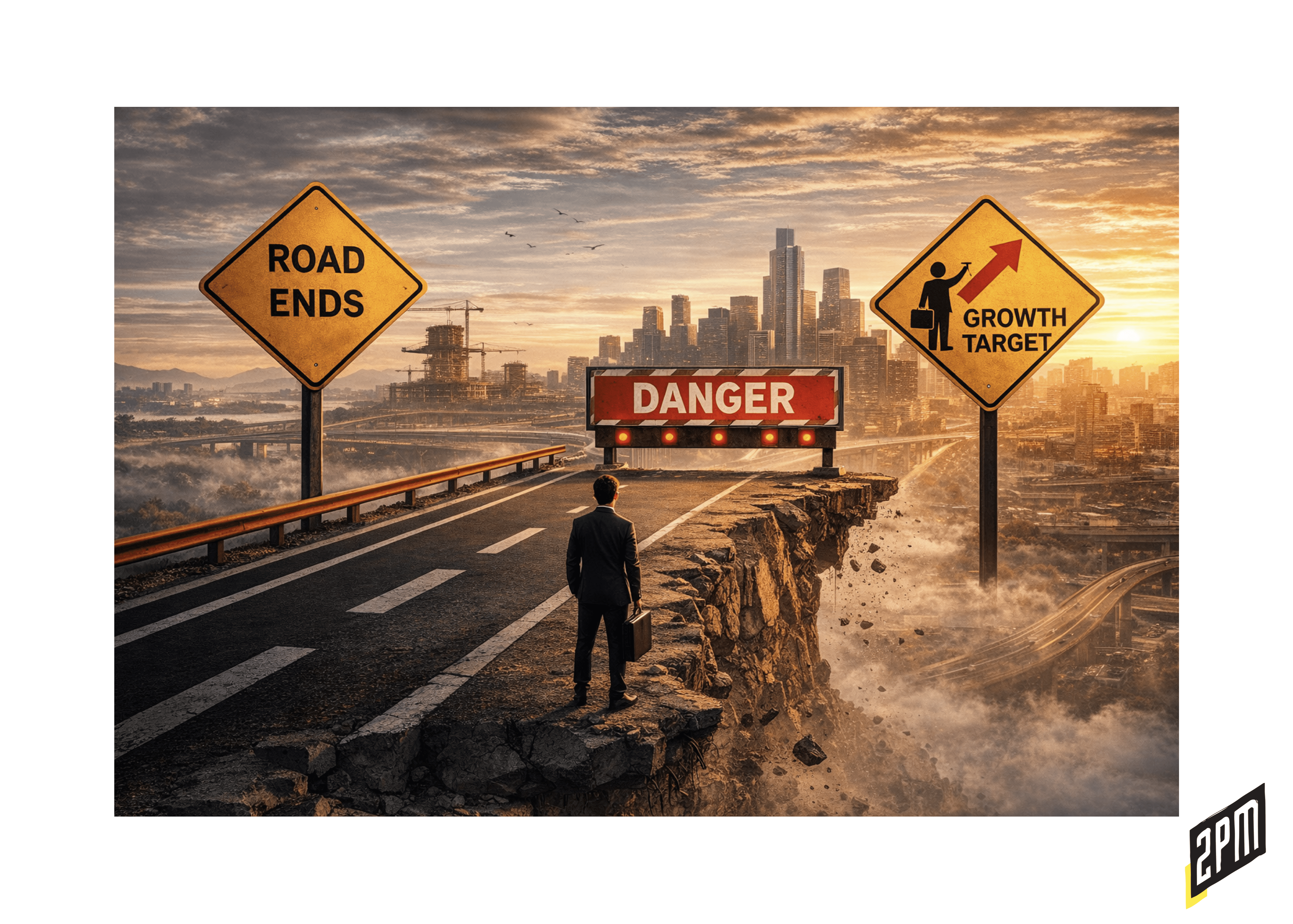
Civilization is not standing at the edge of a cliff; it is already falling. The only direction that reduces impact is forward.

More on Stanford’s Digital Economy Lab. More on Situational Awareness.

By Web Smith