Memo: Brand Brady

The backdrop of the launch of the Brady Brand is a years-long shift in how Under Armour and its rivals are doing business. Adidas and Nike are expanding their definitions of brand equity while Under Armour is tightening the reigns. In February of 2020, 2PM wrote a deep dive into UA’s lack of focus:

There are a number of technical and financial concerns that Under Armour has ahead. With a new CEO in Patrik Frisk, there is an opportunity to course correct in several categories to include: product development, financial health, and brand management. The company that Kevin Plank launched from his mother’s basement has influenced 25 years of performance wear technologies but it’s no longer synonymous with the category that it established.

The message was a timely one. In October of 2020, UA announced a plan to cut back on wholesale partners (it exited 3,000 stores!), minimize discounts, and reduce its SKU count:

As it overhauls wholesale, the brand is also upping its focus on direct-to-consumer channels, where it plans to offer fewer promotions and discounts to fuel healthier margins.

This left the door open to the NFL’s greatest quarterback to go all-in on his own brand without infringing on his existing partnership with Under Armour, an idea that would not have worked as a Nike or Adidas athlete. After years defining himself as one of the best quarterbacks to ever play, Brady is now trying to lead another new brand to victory away from the gridiron. First, it was achieving notoriety for the TB12 supplement empire and now it is a focus on fashion retail. Tom Brady is redefining the playbook for the athlete-anchored brand with Brady, his new line of athletic and lifestyle apparel that debuts next week.

His launch strategy resembles that of a modern brand playbook: the digitally-native department store partnership of choice, the NIL deals, and the emphasis on direct-to-consumer and online storytelling.

In an interview with WWD, the Tampa Bay quarterback outlines how Brady will be sold at brady-brand.com and through Nordstrom. The collection will debut with 145 pieces in three categories, and will maintain a monthly drop schedule popularized by brands like Parade, Noah, Todd Snyder, and Drake’s. The plan is to steadily expand the brand into more upscale categories but for now, the focus is on athleisure and office casual.

Brady’s effort to build a DTC brand follows the USWMNT athletes and and Jimmy Butler’s BIGFACE brand. It’s important to note that all three brands used Shopify for their product launches. It is certainly a new era for athlete merchandising and brand development, with more control and ownership over his namesake brand. What’s notable is who he chose to partner with to create the brand and who he didn’t. Women’s Wear Daily outlined his partnership with Jens Grede, the brand creator behind Frame, Good American and Skims (the latter two of which have big-name influencer associations with Khloé and Kim Kardashian, respectively), who was introduced to Brady by longtime fashion executive Andrew Rosen. The line is designed by Public School co-founder Dao-Yi Chow, who it’s noted is not just a fashion insider but also a marathon runner. The group, collectively, is one that understands the function of sports apparel, the importance of style and how to build and launch modern consumer brands.

Missing from the project? Under Armour, which sponsors Brady. Now, you may understand why.

It’s a sorely missed opportunity for Under Armour, which had a failed launch into elevated sports and lifestyle attire with UAS and an earlier attempt to knock off brands like Ministry of Supply and Mizzen + Main. It dropped UAS in 2016 and lasted one season before the plug was pulled. Brady could have been UA’s next opportunity – the timing is better, and the face of the brand couldn’t be more influential in the sports world. Instead, UA was sidelined, which WWD addresses:

Brady opted to launch the brand with Grede rather than through his longtime sponsor Under Armour. The Baltimore-based sports company is now focusing nearly exclusively on performance sports apparel and its attempt to move into fashion in 2016 with the UAS collection, designed by Tim Coppens, met with limited success and was discontinued after one year. An Under Armour spokesperson said Brady continues to part of the UA family as an ambassador, as he has for 11 years, but said the Brady brand is his personal, off-the-field endeavor and separate from his partnership with the company.

Brady is setting up new rules for the options athletes have before them as they navigate the world of brand sponsorships, partnerships and merchandising. A macroeconomic shift in how his title sponsor does business (Under Armour is retreating from a fashion opportunity), the door is open for what may become a successful attempt to unseat Michael Jordan as the most astute figure in athlete retail (though it’s clearly too early to say). From the new site:

BRADY™ is the first technical apparel brand to apply two decades of pro sports level innovation and engineering to create a system of clothing that performs across every activity. With over 3 years in development, our fabrics and materials fuse natural elements with cutting-edge technology. Designed with the body in mind. Built to move, breathe, and sweat while you compete, live and recover.

Doesn’t this sound like a conflict of interest with Under Armour?

The renewed focus is working for Under Armour but at a cost of going all-in on the opportunities of the moment (though UA is now dabbling in NFTs). UA has chosen to set aside fashion, casual wear, DTC fitness, web3, and metaverse development – leaving Nike and Adidas as the go-to major retailers in those other areas. In fact, Nike is laying the groundwork for further expansion. The brand is currently going up against Lululemon in a patent spat over Mirror technology – demonstrating it’s fighting for ownership in a bigger Nike universe.

Brady seldom loses, these days. Which is why it’s even more incredible that Under Armour didn’t make an exception to their new strategy rules. It’s a decision that they the forefathers of technical fabrics may come to regret if the brand does what every other Brady pursuit seems to do: win.

By Web Smith | Edited by Hilary Milnes | Art by Alex Remy and Christina Williams

Member Brief: CryptoKicks, Part 3

Nike prides itself on being first in line to new innovations or opportunities. The few times that it hasn’t been, it’s marketed so well that the consumer eventually forgot that another brand beat them to the punch (Nike has owned the mindshare in everything from NBA basketball to pro skateboarding). The retailer will not have to worry about coming in second on its way to the metaverse.

This member brief is designed exclusively for Executive Members, to make membership easy, you can click below and gain access to hundreds of reports, our DTC Power List, and other tools to help you make high level decisions.

Join Here

Member Brief: Virgil, The Polymath

On occasion, we unlock member briefs for wider consumption. To support 2PM’s wider work, you can become a member

This essay was originally written on an October day while seated on a bench in New York’s Madison Square Park. When I would travel to the city, I would visit museums with people who inspired me. But on that particular day, time was short. I had two hours to spare and I wanted to make them count, so I chose to make my own museum of sorts. I put my AirPods in, hit play on what would turn out to be one of Virgil Abloh’s final DJ sets.

For the first hour and 14 minutes, I researched his years between 15 and 41. And then the tone of the DJ set’s flavor of music shifted for a few minutes and inspired me to write what you’ll read below.

To me, the moment represented the feeling in a museum when you feel spoken to by art. You relate to the context of what you see t in front of you and you look over to the person to your right and you explain it with a passion. As I switched from research to writing, I was “talking” to the person (you) on my right through written word.

These are my thoughts on one of the great polymaths of our time. The final three paragraphs were added upon his passing. This is for Virgil Abloh.

“An Idea I Had”

We are so quick to put women and men in a box that we fail to see the beauty when they do not fit in either one. For me, this is the fascination with polymathic types and there are few who fit the mold more than you. You are a mix between left brained and right. How did you strike a balance between the two?

I have so many questions.

How did the son of a Ghanaian seamstress and painter fit in at Boylan Catholic High School? Did you make yourself small for those years or did your prized grandiosity breakthrough the monotony of high school sameness? Did you say that you were from Chicago even though you were a suburban kid? What were your influences while you were there? Did you enjoy the school’s philosophy curriculum and its theology courses?

As an engineer at the University of Wisconsin, what was more difficult for you: Multivariate Calculus? Linear Algebra? Probability and Statistics? Differential Equations? Was earning your Civil Engineering degree your happiest moment at the time?

When you were at Illinois Institute of Technology studying for your Master of Architecture, which was a more important moment for you? Was it observing the construction of the building designed by Rem Koolhaas or the classes themselves? What, in you, made you look at the civil engineering in front of you and choose fashion for your primary form of expression? Did you ever get to speak to Koolhaas about his brand philosophy of selling a brand instead of marketing clothes? Did you visit his Beverly Hills Prada store?

I found your first moment of culmination. This is where your inspiration meets your influence meets your education meets your will.The blog that you called home, The Brilliance, highlighted the fact that nearly 13 years ago to the day, your first T-shirt entitled “Medallions en bleu” sold out in a week at Colette. Did you know that you could build a fashion empire before this moment or is this what it took to confirm it within yourself?

It was a smart first approach: a venerated name in fashion’s first city, a blank Champion, a beautiful design, and the extra care to redesign the size tag. Hypebeast wrote about it in 2008; back then, they needed to use your whole name.

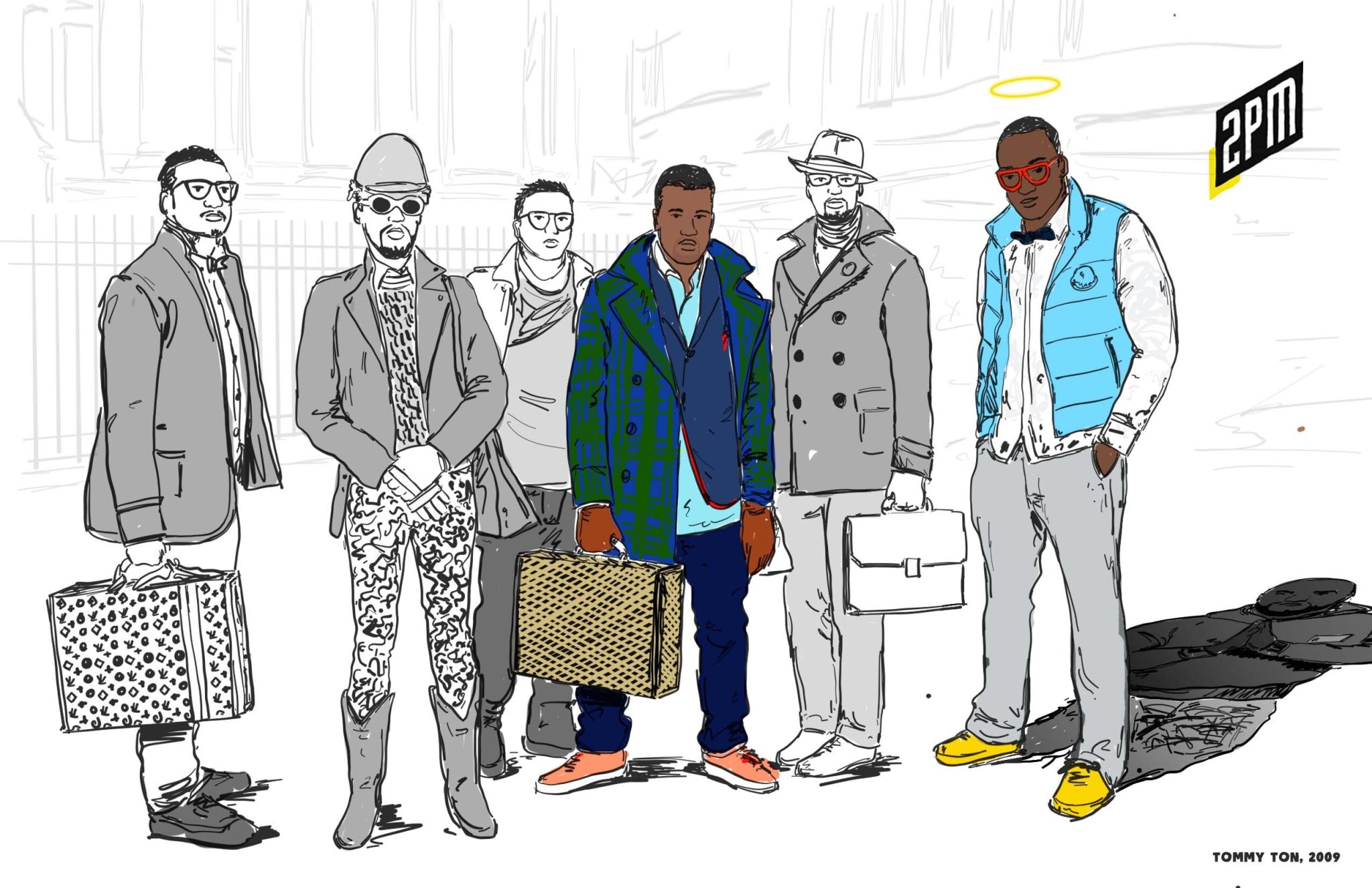
Nearly one year later, Kanye West interrupted Taylor Swift on stage at the 2009 MTV Music awards. What did you say to the television when you saw the man who you met at a Chicago print shop make himself a villain before millions? Did you discuss it with West en route to Fendi in 2009? So many moments happened for you in this year. Fendi signed you to an internship alongside Kanye West. It was the year that this famed image was snapped by Tommy Ton during the Paris Fashion Week. You became the Creative Director of DONDA. At the time, few understood what you’d done, who you were, or what you would become.

Virgil Abloh before he was Virgil, pictured alongside Kanye West in Paris (2009)

LVMH recognized you for the first time, that year, however. And you opened RSVP Gallery with Don C in Chicago. I attempted to run there from my hotel once, earlier this year. The Milwaukee street stretch to your storefront was a hard bargain and I ended up turning around at mile five. That’s about as close as I got to being in your presence, indirectly of course.

Did you become fast friends with Jay-Z when you designed the Watch The Throne album cover? Was the Ralph Lauren deadstock for your Pyrex Vision project your best investment? Is this the moment when you realized you were a true artist? For those who do not know, you shut down a company that was selling $40 tees for $550; you called it “an artistic experiment.”

Your next project is how most of us began to know you. You said this about Off-White.

In a large part streetwear is seen as cheap. What my goal has been is to add an intellectual layer to it and make it credible.

You accomplished this right as the tide began to shift in 2012, especially for women and men of color who wanted their contributions appropriately accounted for. Today, streetwear is widely applauded but back then, it was still a part of the streets.

The Gray Area Between Black and White

That’s the origin of the name Off-White, a brand that propelled you towards collaborations with Nike, Ikea, and a consumer sentiment that outranked Gucci’s. Nearly every American has seen your work by now, even if they didn’t know that it was you.

It would be just nine years since the moment LVMH CEO Michael Burke recognized your brilliance when on March 25, 2018 you stole the dream of your former mentor Kanye West. What was it like becoming the artistic director of Louis Vuitton’s menswear division? Was he upset with you? Did your friendship suffer?

I remember your first Louis Vuitton fashion show. I remember the Serena Williams outfits designed by you for that year’s US Open. And I remember how you helped Rimowa’s rise as the premiere luggage brand continue unabated.

Posthumous

I am sorry, Virgil. Cancer has deeply affected me and my family and I have a special hatred for it. I am not sorry for you, I am sorry for it. In the two years that you fought the disease with vigor and valor, you launched a monthly internet show devoted to your love of DJing. You launched your first solo museum exhibit at the MCA in Chicago. I had the book with me in Madison Square Park that day. Had I known you were in excruciating pain while producing for family, friends, and fans, I would have never set the book on the dusty park ground. I remember during the summer of 2020 when you were facing extreme scrutiny for a $50 donation that you made to that Miami-based art collective to cover George Floyd protestors’ legal costs. The internet skewered you while you were probably writhing in pain, silently and valiantly. You continued to contribute, you never made excuses for what was blown out of proportion, and God only knows what donations you contributed behind the scenes.

Today, Sotheby’s launched its official entry into the world of streetwear. Nine years ago, the affluent in your midwestern city would have laughed at the idea of your turning the tide of culture to include more faces, more types, more colors, and more styles.

You were an engineer-turned-architect who excelled in music and culture. You expressed your art and love of culture through fashion. The New York Times wrote:

In recent years, it could often appear as if there were several Virgil Ablohs, all working at the same time. [1]

And the New Yorker’s tribute to you began:

For the polymath, there is always a cardinal subject, a chief preoccupation around which all the other interests spin. For the fashion designer Virgil Abloh, the polymath of his cohort, who died on Sunday of a rare cardiac cancer, offensively too young, the center was architecture. [2]

You were a polymath but you likely never referred to yourself as such. We are so quick to put women and men in a box that we fail to see the beauty when they do not fit in one. Society wants us to fall within one of two categories, black or white. You created your own in off-white, the grayscale between the two colors. The masters are those who can travel between the two sides of the brain. What your life showed us is to keep yourself as close to the middle, using both sides at once.

I am sorry for your family’s pain but I am comforted knowing that you passed away knowing that you finished work that will make your life timeless. Your pace was exceptional and so was your life.

By Web Smith | Editor: Hilary Milnes | Art: Alex Remy and Christina Williams