
Memo: Shopify’s ‘Cool Kid’ Paradox

n6vIM5Xw

An open letter to all eCommerce merchants. In a recent chat with 2PM Executive Member Damian Soong, the DTC founder replied with a poignant thought:

Someone needed to say that DTC isn’t Shopify.

Paul do Forno, the Managing Director of Deloitte’s Commerce Practice, chimed in with the data to support Soong’s thought, adding:

If you plotted by total platform revenue: HCL Commerce, Oracle, SAP, SalesForce would be towards the top.

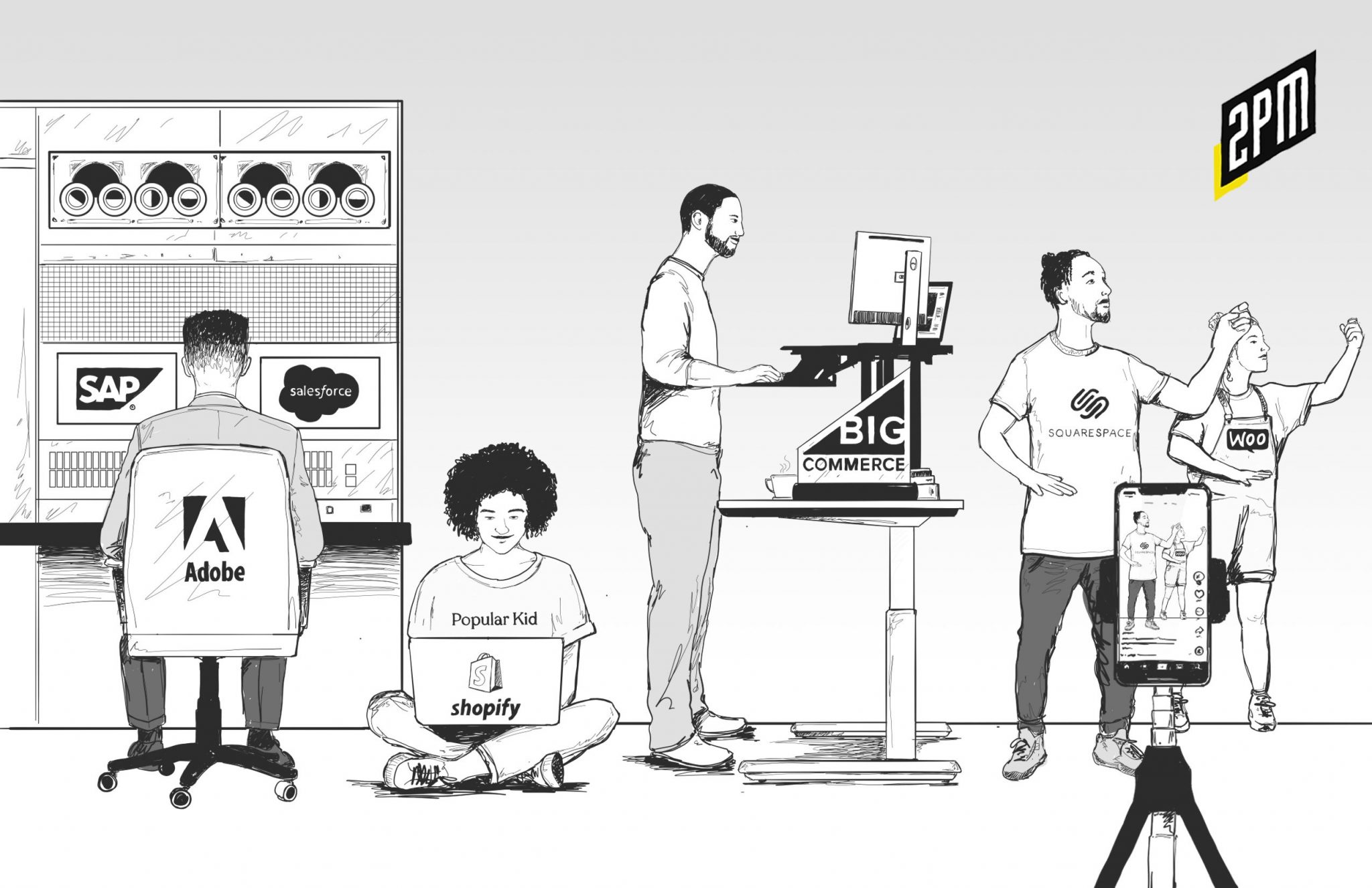
Shopify has made the industry more interesting, accessible, and newsworthy. But it is not the only participant in this burgeoning ecosystem: Magento (now Adobe), Demandware (now Salesforce), SAP, BigCommerce, Squarespace, BigCartel, WooCommerce, Webflow, Square, and Wix have played pivotal roles in the development of either enterprise or merchant-level markets. Shopify is neither the biggest platform with respect to merchant volume or gross merchandise value (GMV). It sits squarely at the center of the two extremes. Yet somehow, it became the de facto operator of the DTC era.

To understand the direction of eCommerce, you must understand its past and present. During what was likely the most pivotal year in my early eCommerce career, I studied Magento from the perspective of an eCommerce brand that employed 100 or so. That earlier version of Magento was a complicated platform to understand. Its management required the employment of a dozen engineers and an equal magnitude of talent in user experience and front-end design. When I soon had my own opportunity to build an eCommerce brand alongside Kevin Lavelle, we went not to Magento, but to Shopify. We didn’t have the money to hire technical talent, nor did we have the patience to manage it on top of the challenges that we faced in manufacturing and early customer acquisition. But it’s important to recognize that this decision was made nine years ago – a lifetime in technology.

That same company of 100 is now over 1,000 strong. In under one decade, a small industry competitor became a global manufacturing leader all through direct-to-consumer channels. And they’ve done so on Adobe’s Magento. If any SaaS platform has the right to claim the dawn of the DTC era (2008), Magento could easily make that argument. Instead, it gets lost in the conversation.

Standing in a hallway of Shopify Plus’ most recent New York City conference in 2019, I sat with Shopify CEO Tobi Lutke, one of the industry’s most admired executives. I remember marveling at the production of the event. The friends, the networking, the branding of the space all communicated Shopify’s place in the eCommerce ecosystem. I applauded the entrepreneurs who shared their stories on stage with highly produced short films. Also notable was the accessibility of the C-suite executives who, frankly, should no longer be that accessible. This availability is a part of Shopify’s secret sauce. You won’t find another retail CEO of his caliber who is willing to respond to customers on platforms like Twitter and Instagram.

What I remember most about that particular meeting is the intensity of Lutke’s product focus. Suggest an idea that is outside of Shopify’s product pipeline and he will explain why Shopify isn’t right for it. He rarely waivers on his vision for what Shopify and Shopify Plus are to the eCommerce industry, or the functions that they are willing to build.

It’s this same galvanizing vision that rallies Lutke’s base of thousands of platform evangelists. Shopify’s ability to amplify its message through its partnership ecosystem has done wonders in furthering its narrative of perceived inevitability. In Shopify Unite and Network Effects [1], I wrote:

If you were to sit in a room with BigCommerce or Adobe’s c-suite and explain that product differentiation can be more than a software iteration, you won’t be sitting there for long. And that is part of Shopify’s mounting advantage. It’s unclear whether or not the original intent of the Shopify Partner ecosystem was to be a catalyst for network effects. But that’s certainly the case.

Founder Tobi Lutke, Harley Finkelstein, and team stumbled upon a new form of competitive advantage in commerce SaaS. Here, at the intersection of influence and efficacy, sociological advantages of retail brands have interfaced with an ecosystem of software as a service.

Shopify’s primary arguments for the attention it gets are valid. Its holistic approach to fulfillment, returns, and no/low code architecture will become fixtures in North America’s market as eCommerce’s percentage of retail continues to inch above and beyond 20% or 25% or 30%. And consider Squarespace or WooCommerce’s volume and Magento’s GMV: Shopify’s ability to capture mindshare despite these other companies’ advantages are as much the fault of the competitors who haven’t valued the marketing and branding aspects of business.

By weaponizing network effects, Shopify has become the proverbial cool kid of SaaS. Its brand voice is the life of the party and the center of many public discussions. There is market value in this positioning. Like Amazon, Shopify’s fortune is tied to eCommerce’s continued growth in North America. Public investors reward Shopify simply for being tied to the movement towards direct-to-consumer. It’s deserved.
ENkl02YQ
The Traditional, The Cool, The Quirky, and The Hustlers

It is important to note that this is not winner-takes-all, and what Shopify does next matters. There are eCommerce founders building on custom sites that have accomplished profitable growth. There are leaders who’ve chosen Salesforce or BigCommerce to fit their technological or philosophical needs. And in the process, they’ve built companies spewing $10s of millions in monthly EBITDA. Of course, there are examples of these feats on Shopify, but that’s the point. The democratization of eCommerce doesn’t only refer to platform simplicity.

Shopify’s ecosystem stands to benefit greatly by expanding the definition and character of the DTC industry to reach out and include the brands, founders, agencies, and technologies enabled to support them on other platforms. Some of the best and brightest stories, people, and brands are building outside of the spotlight.

The cool kids often earn the lion’s share of attention. But some of the most notable progress happens where the cool kids aren’t. That’s the paradox.

By emphasizing stories and anecdotes from founders who’ve eschewed the industry spotlight or brands that have managed growth differently than is commonly advertised, we’re closing the knowledge gap. Perhaps there was a brand founder who chose to use WooCommerce to scale and now has insights that could help Shopify-based brand founders accomplish the same. Or perhaps a Shopify Plus founder who’s successfully captured five years of year-over-year growth could explain a key strategy to a brand owner who’s built on Magento 2.3.4.

As eCommerce grows beyond 25% or 30% of American retail, we will see more examples of brands and retailers achieving a growth velocity that would have previously seemed unimaginable. In some cases, these brands will not be built with one’s preferred technical architecture. But the credibility or inclusion of these founder perspectives shouldn’t hinge on their platform preference.

Shopify Inc.’s job is two-fold. Their sales team works on converting potential users into new merchants. Their partnership ecosystem plays an essential role in replatforming existing merchants to Shopify or Shopify Plus. There are limits to this, but Shopify’s pronged ecosystem that pulls in new users and levels up existing ones is an advantage in the market, and it has an unparalleled opportunity. Where it reaches from here will determine its next phase of growth.

But they’re on notice. For every great success narrative that you hear from a Shopify partner, there five stories on competitive platforms. The DTC industry isn’t Shopify, it’s bigger than its technology or its ecosystem. This means that there is a greater opportunity to learn from, endorse, encourage, or evangelize the great work of builders who chose a different approach to a positive outcome.

By Web Smith | Editor: Hilary Milnes | Art: Andrew Haynes | About 2PM

Memo: Evolving Brand of DTC

0LdcjTxQ

A conversation with my six- and 12-year-old daughters shaped my thinking on this subject. As two members of Generation Z, they both possess an acuity for digital communication, gaming, and commerce. And if you believe that a six-year-old doesn’t care about eCommerce, ask her what Robux are. The question to my oldest was simple: isn’t spending money on a virtual world a waste of money? It is not real.

Dad, this is where my friends hang out and talk and play. Not internet friends, my real friends. This is just what we do and how we see things. Go to the mall or something, millennial.

Her views on her preferred technologies differ little than my own. It was very similar to how millennials view our own class of brands, media, and commerce. Certain classifications make sense to us; one of them is the all-encompassing “DTC” term.

The phrases are interchangeable. There’s “DTC”, “DNVB”, “direct brands”, “challenger brands”, and “digitally-natives.” Some brands begin on the internet and move to wholesale. Some pursue wholesale formats, only to pivot to online retail in an effort to shore up margins. There is very little organizational consistency among the now thousands of DTC brands selling across platforms like Amazon, Adobe Cloud, Shopify, Magento, Alibaba, WooCommerce, and BigCommerce. From platform to sales strategy, they share little in common. The attribute that they do share is that they are all modern brands. They pursue customers where they are. They are well-designed, purposeful, and familiar.

A direct-to-consumer or “DTC” brand is one that launched in or after 2007. This category of brand typically launches with agile software architecture and a management style that valued the evolution of retail methods and technologies. Whereas the shelves of Target or Walmart made its predecessors, these brands are made on our iPhones. These brands are advertised, sold, and discussed on digital platforms. The term “DTC” does not signify a particular sales channel, a refrain that you commonly hear from traditional retail executives and investors. Rather, it’s a generational term that communicates age, awareness, and intent.

It’s also a category known for its relative failures. Of the now thousands of brand launches in the previous 13 years, there have been fewer than 50 notable exits. In a conversation with a publicly-traded cosmetics executive, she suggested that the direct-to-consumer (DTC) brand industry was overdue for a renaissance. Our internal data agrees.

A New Strategy, A New Time

In the aforementioned discussion, we both agreed that the pandemic has accelerated retail’s transition from traditional to digital-first. This has upended timelines, projections,  and the fundamental understanding of how retail will operate in the coming years. But as a second order effect, the pandemic may impact exit viability of the DTC industry.

Consider the current state of retail. With malls shuttering, retailers defaulting on rents, foot traffic wavering, and closures at the mercy of state or federal officials, eCommerce has become one of the most reliable retail formats. Malls have become private equity investors in an attempt to preserve the status quo.

It’s possible [Authentic Brands Group] could do more deals with megamall owners such as Simon Property Group and Brookfield, given their track record. The three came together to acquire Forever 21 out of bankruptcy. And they all have ownership of the teen apparel company Aeropostale. Brookfield in early May said it was launching a retail revitalization program to focus on taking non-controlling stakes in retailers to assist them with their capital needs. It said it was targeting spending $5 billion on the plan. [1]

The retail real estate industry has done itself no favors with its latest attempts to calm its market. The trend of retail developers and management companies pursuing ownership in traditional brands has stabilized the market – in the short term – while piling on collateralized risk for the long term. As a result of the shift away from malls and strip centers, major brands have begun discussing their own strategies to counter an evolving retail market. Major brands have begun scouting for direct brands with the following attributes:

  • a path to profitability
  • a demonstrated omnichannel expertise
  • an organic marketing flywheel
  • a team or partnership that can continue to execute a savvy paid strategy
  • founder-led with longer-term management potential

A common rebuke to the idea that DTC brands could serve as the savior to traditional retailers is also simple: their valuations are much too high. This is where the brand of DTC needs to further evolve. Frontrunning DTC brand Outdoor Voices made news this week:

On Sunday, the company announced that Ashley Merrill, founder and CEO of the women’s sleepwear brand Lunya, will become chairperson of Outdoor Voices’ board of directors. NaHCO3—the venture capital arm where Merrill serves as principal alongside her husband, Marc Merrill, the co-founder and former co-CEO of Riot Games—is making an investment in the company; Merrill declined to disclose the size of the deal. Haney, who resigned as CEO in February, remains on the company’s board. [2]

With $64.1 million raised and around $40 million earned in 2019, this announcement added to the complexity of the brand’s story, exit optionality, and its capitalization table. This is also the brand of “DTC.” But this isn’t the entire industry – just the most visible of it. Surely, with Ashley Merrill at the helm, Tyler Haney back in an active role, and a new CEO search in process: a positive outcome is more likely than it was with Mickey Drexler involved. But there are countless brands that have done or will accomplish more with a lot less press, intrigue, or funding. That variation of DTC brands may just be what major brands are looking to acquire.

Unless you frequent trade publications, it’s unlikely that you’ve ever heard of Moiz Ali, Jaime Schmidt, Chris Cantino, Tiffany Masterson, David Schottenstein, or Chase Fisher. Together, these founders’ recent acquisitions were valued at over $1.3 billion. It’s even less likely that you’ve seen aspirational business press on Bill and Caity Henniger, Evan Hafer, Mike Seguero, or Ben Francis. In each case, these founders’ brands have achieved growth that would make a venture-heavy DTC founder envy.

The Henniger’s have steered Rogue through a pandemic that depressed consumer confidence, increased unemployment, and saw a decrease in consumer spending by a reported 16%. Even so, their DTC fitness brand now employs over 900 in the Columbus, Ohio region.

The brand of DTC has evolved in a number of ways. I’d argue that the most notable has been the types of companies and founders that have been positioned as aspirational. The sentiment has begun to shift away from lionizing the founders who’ve raised $100 million to the veneration of the founders who’ve sold for $100 million. Despite the retail segment’s venture and tech origins, the DTC movement was never about building billion-dollar companies in five to seven years. The physics of that feat haven’t proven possible.

But with enough stories on Jaime Schmidt or Caity Henniger, potential founders will begin to understand that major acquisition or sustainable growth are far more admirable feats than magnificent bouts of fundraising.

I expected our daughters’ Roblox phase to end after a few months. It hasn’t. In fact, the games that they play have evolved to fit their needs. The in-game environments, games, and interactions have changed along with their levels of experience and commitment to the game. What the Roblox parallel taught this millennial dad is that any successful industry is built on five pillars: audience, transaction, engagement, evolution, and staying power. For the DTC industry, evolution and staying power are closely linked.

A retail industry with few positive outcomes has the opportunity to enjoy a period that could rewrite the media’s interpretation of its value. But to do so, the industry will have to evolve away from the venture mechanics that it’s known for. And in the process, we may begin to highlight the founders who’ve built ways to succeed without the spotlight. If we start, build, and scale more brands like the ones above, the narrative may change. And so may the brand of “DTC.”

The DTC industry is an economic bright spot upon which commercial real estate, traditional brands, and markets like Target and Walmart will depend on in the coming years. We just need more of them to finish their journeys. Then, we need to champion them – loudly – for doing so.

Memo by Web Smith | Editor: Hilary Milnes | About 2PM

Read today’s important edition: Letter No. 365

Member Brief: Ideal Cities

4wENygkw

The ideal city is one that embraces digital commerce principles, tools, ideas, and technologies. As municipalities begin to report record-breaking spreads in COVID-19 cases, there is little time to waste on idealism or political partisanship. The preparation that we should have assumed months ago must be fast-tracked for the late summer and early fall. Moving forward, the online retail industry should serve as a guide for economic and political policy.

This member brief is designed exclusively for Executive Members, to make membership easy, you can click below and gain access to hundreds of reports, our DTC Power List, and other tools to help you make high level decisions.

Join Here