
This member brief is designed exclusively for Executive Members, to make membership easy, you can click below and gain access to hundreds of reports, our DTC Power List, and other tools to help you make high level decisions.
Memo: Apple, Stripe, and (wink) Mob Ties
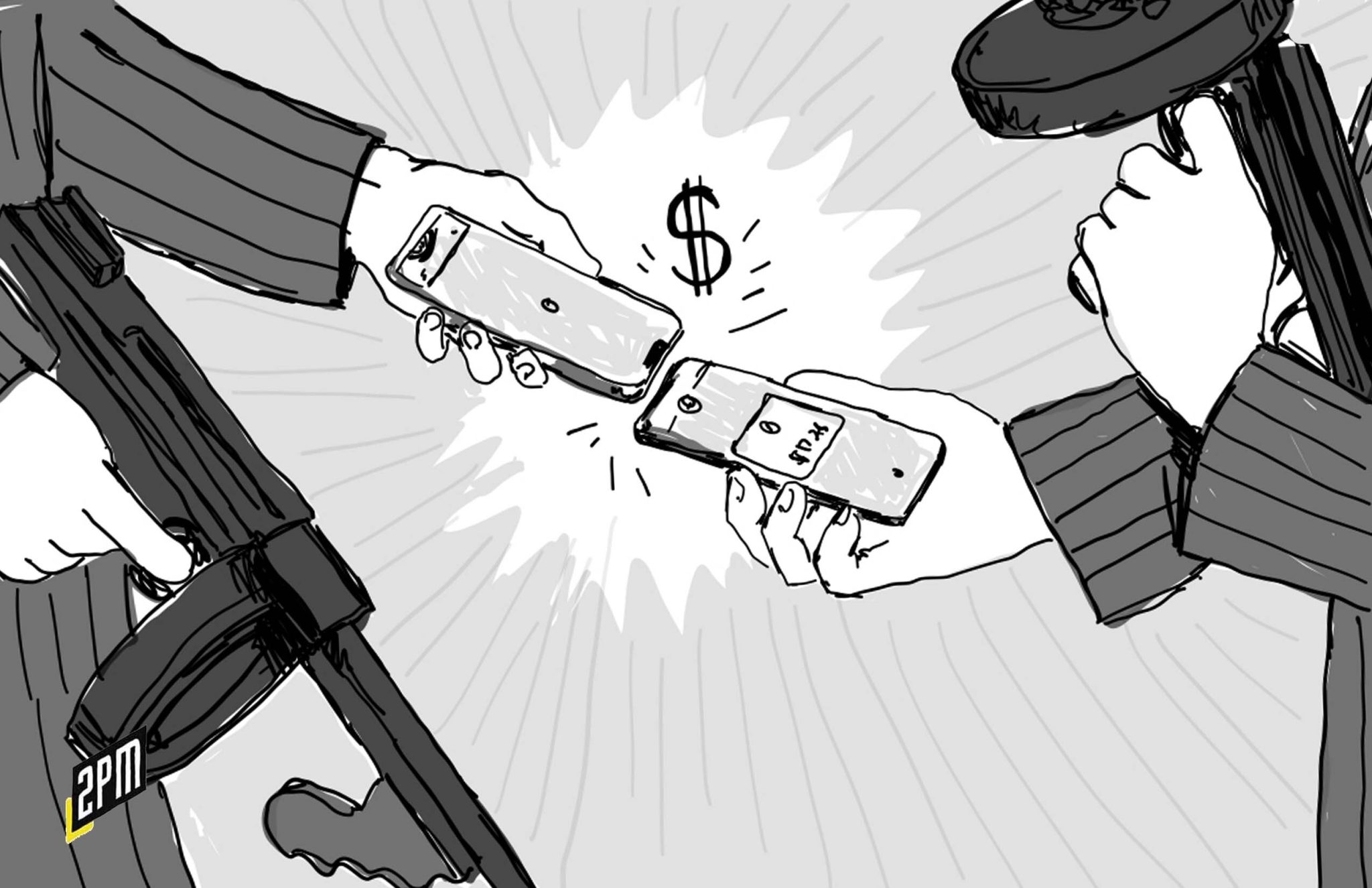
With a new Apple partnership, Stripe just secured more power in Silicon Valley. The running joke is that any advancement by Stripe is indicative of its “mob boss” mentality, a reference to the recently viral thread by the founder of Bolt. In actuality, Stripe is showing just how much of a positive-sum mentality it’s using by building more dynamism into American retail and entrepreneurship.
Much has happened since this pre-pandemic report on “falling American dynamism,” a term that I prescribe to suggest that entrepreneurship was falling in popularity. In that report, I explained:
The more that conglomerates exist, the more we’ll see dynamism collapse. As a number of those companies begin to succumb to antitrust scrutiny, dynamism will be called upon to close the gap between the age of conglomeration and the need for new, high-growth businesses.
The idea behind that essay was that companies like Google, Facebook, and Apple were so powerful that it was beginning to make tech employment more popular than self-starting entrepreneurship. Of course, the flip side of this argument is that most businesses cannot survive without using Google, Facebook, or Apple. In the essay, I assigned special value to Jack Dorsey’s two companies, Twitter and Square (now Block), and their positive value to dynamism (word of mouth marketing and ease of transaction). Apple builds on that positive impact with its latest project and I believe that the entire fintech ecosystem will benefit along with the advancement of the end user.
In most media reports, the Apple Pay x Stripe partnership is positioned as competitive with Dorsey’s company. I’d argue that Stripe has no interest in competing with Block, a nod to the positive-sum mentality of Stripe’s founders. In fact, I can see a future where they partner with Dorsey’s hardware/ financial services. But not everyone thinks this way about Stripe.
Days after former Bolt CEO Ryan Breslow compared the company to the mob boss of the tech world (and was retweeted 1,600 times), it was announced that Stripe would be the launch partner for Apple’s upcoming Tap to Pay technology. Tap to Pay turns Apple devices into payment hardware, making credit card swipe attachments essentially unnecessary. (That’s a separate lesson for hardware companies that have built their businesses on being middlemen for Apple and payment services.) This product partnership is the result of a 2020 Apple acquisition of Mobeeweave, an NFC innovation that enabled iPhones and other devices to operate as pay terminals without additional hardware. Apple Pay’s partnership with Stripe is expected to operate with Mobeeweave’s technology.
Whether or not Apple will approach this opportunity to monopolize payments and take on competitors like Block and Venmo is the next debate. Pointed out by NextWeb, Block is more than just a payments portal – it helps small businesses manage inventory and analytics. Shopify’s stake in Stripe boosted its positioning as the payments manager of choice for entrepreneurs and small-and-medium sized businesses. Apple’s Tap to Pay appears to only facilitate payments, but if it were to move beyond the point of sale to the backend management of inventory and data, that would give it a bigger role in the space where Block and Shopify currently operate. Or, Apple could choose to open up Tap to Pay to more partners, widening its reach in assisting payments despite the platform the seller uses. This is the most likely play, in my opinion.
It’s important to consider Apple’s ambitions in fintech. With Apple Pay standing tall as the most adopted technology, Tap to Pay seems like the extension of a strategy that’s just getting started. From Next Web:
Over the last few years, Apple has been focused on expanding its services business — especially financial offerings. In 2019, it launched the Apple Card, and plans to expand it to more countries. Last July, a Bloomberg report noted that the company is exploring a “buy now, pay later” product with Goldman Sachs. If Apple starts accepting payment on a seller’s behalf, it can explore more financial products, ranging from loans to management services. Really, this news shows how serious Apple is about getting its services to reach a $1.5 trillion valuation alone. And, at this stage, who would bet against it?
Two years later and dynamism is on the rise. The “great resignation” has led to 47.4 million American voluntarily leaving their jobs in 2021, according to CNN data. ADP Chief Economist Nela Richardson was recently quoted:
We’re seeing a lot of churn in the jobs market. But one thing we are seeing is that hires are higher. They’re not leaving the jobs market, they’re leaving for other jobs in the same industry.
But to the earlier point of dynamism, it’s not all corporate upward mobility, the pandemic has influenced a boom in dynamism. An August 2021 report in the New York Times began:
After waning for decades, applications to start businesses surged last year. If the rebound proves durable, it could provide a more resilient economy.
So it is through this lens that I see the positive sum game that the Collison brothers are playing with Apple. Will it have an impact on Block’s hardware business? Yes. But that does not mean that Apple won’t partner with Block in the future. Block sells full point of sale systems for readers; this new Apple / Stripe partnership will only impact Block’s dongle business.
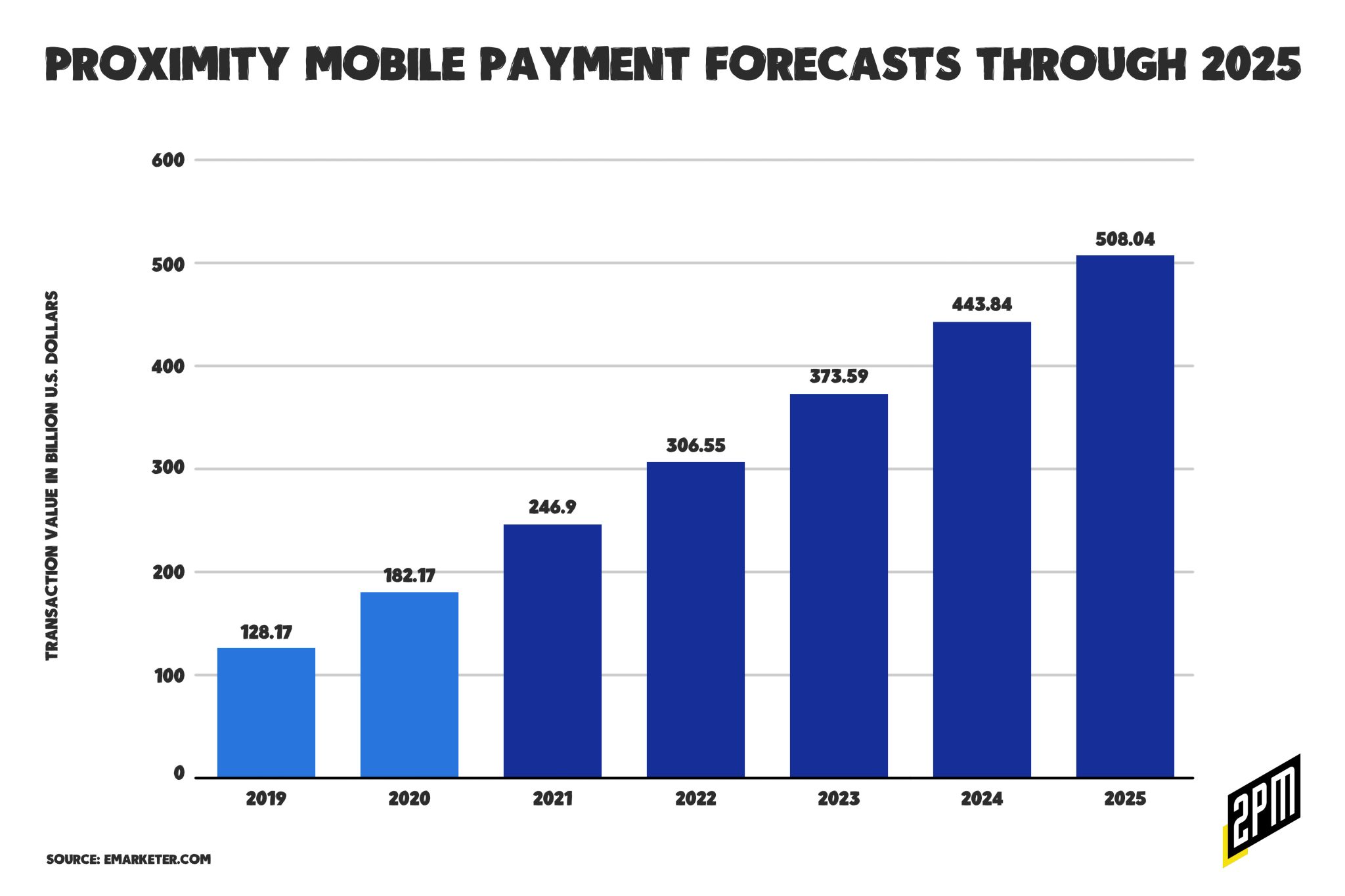
Viewed this way, Apple’s Tap to Pay could be helpful to Block as it removes the need for the dongle, giving users more and easier ways to pay, without making the dongle obsolete. Protocol makes the argument that Block is then freed up to focus on other services that are more profitable than a hardware business, including banking, payroll and other financial services. By making it easier for anyone to accept payments via iPhone, smaller business owners and entrepreneurs who aren’t looking for full POS machines can start selling, widening Block’s pool of potential customers in the long run. Then, more can win as the market for proximity payments expects to double over the next four years:
A positive-sum mentality and dynamism go hand in hand. Lost in the news cycle on the Apple Pay x Stripe partnership is that the same technology will be powering Shopify’s similar solution in the coming months. Stripe will be offering the Tap to Pay solution for iPhone users through a new Shopify app, as well.
Dynamism is defined as a theory or philosophy that explains something in terms of great energy or force. In the context of entrepreneurship, it goes hand and hand with payments technology, specifically the way that we use our phones. It is easier to pit one company against the other than it is to understand the bigger picture here. The United States is currently in eighth place behind China, South Korea, Vietnam, Norway, the United Kingdom, India, and Spain with respect to mobile payment adoption. China’s penetration was 39.5% to America’s 17.7% (as of August 2021). With an emphasis on making peer to peer transactions easier, businesses of all kinds can grow in sophistication and in reach.
And in doing so, Apple will achieve its goal for Apple Pay. It wants the payment technology to no longer be bound by the hardware that launched it. As Stripe has become the processing layer beneath much of commerce, Apple likely has aspirations to do the same for the transactions layer. And it won’t care if the trade is happening on iOS, Android or through Block, Shopify, or even Bolt. Dynamism is about agility and reach and it seems to be on its way back.
By Web Smith | Edited by Hilary Milnes with art by Alex Remy and Christina Williams
Disclaimer: 2PM is an investor in Fast, a competitor to Bolt. To Ryan’s Breslow’s point, Stripe is an investor in Fast. But Bolt has been noted as better positioned with more money raised, more enterprise clients, and a higher GMV. Stripe has been noted as being competitive with Fast in a few of its recent initiatives. Ok, I am tired.
Memo: Peloton, Just Do It.

Who knows? It’s likely that Nike will dismiss rumors of its potential Peloton takeover if they haven’t already. CNBC noted earlier that John Foley has “unwavering confidence” in the company’s future as a standalone company. Peloton is not the type to cede power to any external company but if they did, it would work wonderfully. Assuming the deal won’t happen, this is why it should have. This Bloomberg opinion piece was spot on:
Nike can be considered a luxury label if you look at the upper-end of its price ranges, with jackets and sneakers topping $500. That fits well with Peloton’s positioning, given its hefty price tags, with bikes starting at $1,495.
What Peloton needs more than anything is energized and engaged new users who will feel comfortable paying the full price for Peloton hardware while remaining engaged in the mobile app and virtual community that comes with it. Nike can offer this, especially now that American consumers are returning to gyms:

Nike has spent years investing in its virtual community by leaning heavily into a suite of apps that serve different customers and different needs. Its main Nike app is for straightforward shopping, Nike Run Club and Nike Training Club track workouts, and the SNKRS app is the go-to for sneaker heads closely following upcoming drops and releases. Being a Nike+ member, while free, activates a closer relationship to the retailer via product updates and exclusives. It’s easy to see how Peloton could fit into Nike’s fitness apps and propel a spin into paid memberships for Nike. The user bases of the two companies likely overlap but there are a number of cross-selling opportunities between the two. Peloton’s high-earning customers could level up Nike’s positioning as a luxury offering for those who want to buy in, while Nike’s vast reach will inject Peloton with efficient customer acquisition. It’s also easy to see why Peloton might need Nike’s assistance.
The Peloton brand isn’t what it was. In Peloton’s Diffusion, we wrote: “In diffusing its rabid base to gain as many customers as possible, it weakened the bonds between those in its core demographic.” The result of targeting mass adoption by lowering prices and increasing financing opportunities meant that the brand stands for less to its early adopters that turned the in-home cycle to one with a cultish following. It is reflected in its diminished apparel business. CNBC recently reported that it is slashing its apparel sales forecast for 2022. Still, Peloton’s product is still superior to any competitor on the market – for now. Echelon recently convinced the USPTO that Peloton’s patents for streaming and on-demand classes were not actually patentable. According to a recent Bloomberg report, there could be more to come.
The risk with Peloton’s strategy is that it could backfire if courts deem that its “revolutionary technology” isn’t so revolutionary after all. As in, what just happened with Echelon. Should this occur on a wider scale, Peloton risks finding itself out millions of dollars and without legal protections for the core of its business.
So if Peloton is losing brand equity, losing the rights to technological patents that differentiated it from competitors, and losing the battle against the resurgent interest in gyms – who better to reinvigorate interest in the product than Nike?
Nike’s been transitioning to a direct-to-consumer brand. In addition to its apps, it’s spent time investing in store concepts like House of Innovation, curtailing underperforming wholesale partnerships and tiering its products to create a fuller, richer experience for direct customers. Recent initiatives to bring Nike to Web3 have underscored the important of a DTC strategy. Nike has been busy filing trademarks for the metaverse, building a virtual Nikeland world on Roblox and it also acquired RTFKT, signaling a deeper investment in the metaverse.
As a result, Nike isn’t just an apparel company any longer. It’s a direct-to-consumer leader and a Web3 pioneer. With a Peloton deal, Nike would receive hundreds of thousands of screens to market its own products: physical, digital, and everything in between. But more importantly, it would properly position it against its foremost challenger: Lululemon/Mirror and Tonal’s continued rise in prominence.
Nike and Amazon’s pursuits of Peloton will likely end with little to show for it. Acquisition interest comes and goes. But if there was a partner suited to benefit from Peloton’s existing infrastructure, it would be Nike. In a recent deep dive into another retailer’s strategy, we explained that Nike was actually laying the groundwork for its involvement in the in-home digital fitness arena:
Nike is laying the groundwork for further expansion. The brand is currently going up against Lululemon in a patent spat over Mirror technology – demonstrating it’s fighting for ownership in a bigger Nike universe.
When Nike sued Lululemon for patent infringement over its Mirror technology in December, implications that Nike is planning its own investment in hardware and at-home fitness tech were apparent. The lawsuit accuses Lululemon of infringing patents, including exertion-level technology, user competitions and performance recordings. Whether or not Nike’s future in at-home fitness tech lies with Peloton, its aggressive move to challenge Lululemon and Mirror’s own strategy signals that Nike is at least threatened by the category’s rise encroaching on its turf.
John Foley is an independent thinker, a CEO that thrives on control and territorial leadership. It’s unlikely that he will cede any power to fitness’ top company. But if he did, it would be the most mutually beneficial relationships in business today. In Nike, Peloton receives a pipeline of new business and a reestablished footing in luxury fitness. In Peloton, Nike claims a stake what appears to be a multi-pronged approach to grow into owned physical spaces, owned digital channels, and a burgeoning Web3 space where the behaviors of IRL community and digital commerce collaborate in new ways. Even here, Peloton can help facilitate further innovation.
Peloton has shed the market cap to make this $10 billion bet one that makes sense for the $230 billion brand. In the small chance that the sides see that they share many of the same goals, Nike will be as present in the home as it is in gyms, the metaverse, and sporting arenas everywhere. And Peloton, who has increased ad placements by 46% over the previous three months would have the total addressable market that money could not buy.
By Web Smith | Edited by Hilary Milnes with art by Christina Williams and Art Remy